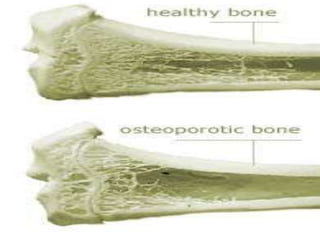

osteoporosis
Asma
:Definition
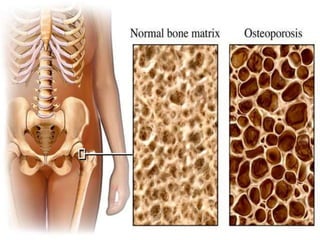
The word osteoporosis literally means‫العظم‬
‫المثقب‬"porous bones
".it is clincle disorder charichters by
abnormely low bone mass,quanititive
defect in bone stracture.
-Over time, bone mass, and therefore bone
strength, is decreased. As a result, bones
become fragile and break easily.
Fully minerlize
The three main mechanisms by
which osteoporosis develops
are:
Decrease bone formation
Increased bone resorbton
mixed
Imbalance between them lead to decrease
Bone mass and loss of bone strengh
:Types of Osteoporosis
* Primary osteoporosis :
There are two different types
of primary osteoporosis
Type 1 - Post-menopausal
osteoporosis
Type 1 usually occurs between the
ages of 50 to 70, largely because of
estrogen loss at menopause
•Exaggerated form of physiological bone
depltion that normely accompined aging
and loss of gonadel activity
•Two overlapping phases ,,
1-high turn over osteoporsis duto increase
osteoclast function
•2-low turn over duto decrase osteoblastic
activity
Type 2 – age realted osteoporsis
aftr 70 years mostely pt come with fracture
*Secondary osteoporosis:
-
:
Secondary osteoporosis can have many
causes, including;
-Diseases that affect the endocrine
systemsuch as hyperthyroidism or
hyperparathyroidism
-Liver disease and Alcoholism
•-A vitamin D deficiency.
•-Premature menopause
•-Sometimes the drug used to treat other
health problems causes osteoporosis.
For example: corticosteroids (e.g.
Prednisone, inhaled steroids for
asthma)
•
Risk Factors:
•-Female gender: Because women have
lighter, thinner bones than men
•-Advancing age: especially the onset of
menopause.
•-Family history
•:- Build :Women with thin or small frames
have a higher risk for bone fractures
•-Alcohol consumption;
•:Studies show that consuming two or more
alcoholic drinks daily decreases a woman’s
rate of calcium absorption, which may lead to
bone loss. Alcohol also interferes with vitamin
D synthesis-a process that helps bones absorb
calcium.
•-Certain diseases: Women who have anorexia
(an eating disorder) diabetes, chronic
diarrhea, or kidney or liver diseases are at an
increased risk for osteoporosis
•-Smoking :smoking interferes with the body’s
processing of calcium. smokers experience
vertebral fractures more frequently than
nonsmokers.
Sign and symptom:
•Osteoporosis itself has no specific
symptoms; its main consequence is the
increased risk of bone fractures.
Osteoporotic fractures are those that
occur in situations where healthy people
would not normally break a bone; they are
therefore regarded as fragility fractures.
*Typical fragility fractures occur in the
vertebral column, rib, hip and wrist.
Diagnosis :
•*an initial physical exam
•*various x rays that detect skeletal
problems
*laboratory tests that reveal important
information about the metabolic process
of bone breakdown and formation
•*a bone density test to detect low bone
density
*X-Ray Tests:
•x ray can detect bone loss only after 30 percent of
the skeleton has been depleted
•*Bone Mineral Density Tests:
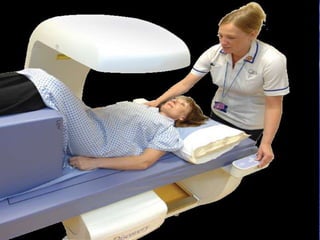
The most widely recognized BMD test is called
a dual-energy x-ray absorptiometry, or DXA test.
The BMD test is painless, a bit like having an x
ray, but with much less exposure to radiation. It
measures bone density at the hip and spine.
•During a BMD test, an extremely low energy
source is passed over part or all of the body. A
computer program evaluates the information and
allows the doctor to see how much bone mass you
have.
•BMD tests provide doctors with a measurement
called a T-score, a number value that results from
comparing your bone density to optimal bone
density. When a T-score appears as a negative
number (such as –1, –2 or –2.5), it indicates low
bone mass. The greater the negative the number,
the greater is the risk of fracture.
•RESULTS:
•T-score -1.0 or greater is "normal"
•T-score between -1.0 and -2.5 is "low bone
mass" (or osteopenia
•T-score -2.5 or below is osteoporosis
Bone Scans:
•A bone scan involves injecting the patient
with a dye that allows a scanner to identify
differences in the conditions of various areas
of bone tissue. A bone scan can show the
doctor changes in bone tissue that may
indicate cancer, bone lesions, inflammation,
or new fractures.
Lab Tests:
•*The most common blood tests evaluate:
•blood vitamin D levels
•thyroid function
•parathyroid hormone levels
•estradiol levels to measure estrogen (in women)
•follicle stimulating hormone (FSH) test to
establish menopause status
•testosterone levels (in men)
•osteocalcin levels to measure bone formation
•*The most common urine tests are:
•-24-hour urine collection to measure calcium
metabolism
Treatment:
Drugs
hormone replacement therapy (HRT), also called
estrogen replacement therapy However, the WHI
also revealed several risks with taking combined
HRT (estrogen and progesterone). In fact, the trial
was stopped early because the incidence of
invasive breast cancer in women on HRT passed a
threshold that was considered too risky for the
benefits they were receiving. The study also found
that the women on combined hormone therapy
were at increased risk for coronary heart disease
and stroke
bisphosphonate
Supression osteoclastic bone resorbtion.
Alendronate. Used one dose per week for
month ,have git side effect if pt cant
tolerate pamidronate hase given iv every 3
month
Denosumab
•New approch of antiresorptive
therpy
•It is human monoclonal antibody which
inhibits the receptor activitor need to
activate osteoclast differentiation
•Adminstreted subcutaneous injection
every 6 month and must supplimented
with ca and vit d
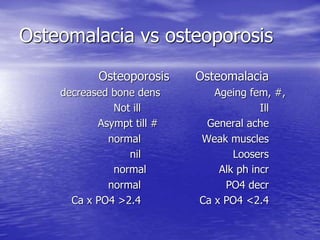
Osteomalacia vs osteoporosis
OsteomalaciaOsteoporosis
Ageing fem, #,decreased bone dens
IllNot ill
General acheAsympt till #
Weak musclesnormal
Loosersnil
Alk ph incrnormal
PO4 decrnormal
Ca x PO4 <2.4Ca x PO4 >2.4
Alternative treatment:
•Alternative treatments for osteoporosis focus on
maintaining or building strong bones. A healthy
diet low in fats and animal products and
containing whole grains, fresh fruits and
vegetables, and calcium-rich foods (such as
dairy products, dark-green leafy vegetables,
salmon), along with nutritional supplements
(such as calcium, magnesium, and vitamin D),
and weight-bearing exercises are important
components of both conventional prevention
Prognosis:
•Although osteoporosis patients have an
increased mortality rate due to the
complications of fracture, it is rarely lethal
•-Hip fractures; can lead to decreased
mobility and an additional risk of numerous
complications(such as deep venous
thrombosis and/or pulmonary embolism
pneumonia)
•-Vertebral fractures:can lead to severe
chronic pain of neurogenic origin, which can
be hard to control, as well as deformity.
Though rare, multiplevertebral
fractures can lead to such severe hunch back
(kyphosis) that the resulting pressure on
internal organs can impair one's ability to
breathe.
Prevention:
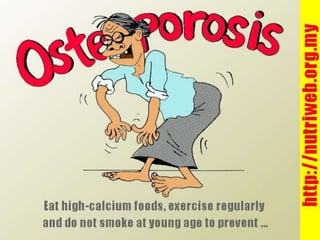
•Building strong bones, especially before the
age of 35, and maintaining a healthy lifestyle
are the best ways to prevent osteoporosis.
Getting calcium from foods Getting vitamin
d Avoiding smoking and alcohol
Osteoporosis ‫‬

Osteoporosis ‫‬

  • 1.
  • 2.
    :Definition The word osteoporosisliterally means‫العظم‬ ‫المثقب‬"porous bones ".it is clincle disorder charichters by abnormely low bone mass,quanititive defect in bone stracture. -Over time, bone mass, and therefore bone strength, is decreased. As a result, bones become fragile and break easily. Fully minerlize
  • 4.
    The three mainmechanisms by which osteoporosis develops are: Decrease bone formation Increased bone resorbton mixed Imbalance between them lead to decrease Bone mass and loss of bone strengh
  • 7.
    :Types of Osteoporosis *Primary osteoporosis : There are two different types of primary osteoporosis Type 1 - Post-menopausal osteoporosis Type 1 usually occurs between the ages of 50 to 70, largely because of estrogen loss at menopause
  • 8.
    •Exaggerated form ofphysiological bone depltion that normely accompined aging and loss of gonadel activity •Two overlapping phases ,, 1-high turn over osteoporsis duto increase osteoclast function •2-low turn over duto decrase osteoblastic activity
  • 9.
    Type 2 –age realted osteoporsis aftr 70 years mostely pt come with fracture
  • 10.
    *Secondary osteoporosis: - : Secondary osteoporosiscan have many causes, including; -Diseases that affect the endocrine systemsuch as hyperthyroidism or hyperparathyroidism -Liver disease and Alcoholism
  • 11.
    •-A vitamin Ddeficiency. •-Premature menopause •-Sometimes the drug used to treat other health problems causes osteoporosis. For example: corticosteroids (e.g. Prednisone, inhaled steroids for asthma) •
  • 12.
    Risk Factors: •-Female gender:Because women have lighter, thinner bones than men •-Advancing age: especially the onset of menopause. •-Family history •:- Build :Women with thin or small frames have a higher risk for bone fractures
  • 13.
    •-Alcohol consumption; •:Studies showthat consuming two or more alcoholic drinks daily decreases a woman’s rate of calcium absorption, which may lead to bone loss. Alcohol also interferes with vitamin D synthesis-a process that helps bones absorb calcium.
  • 14.
    •-Certain diseases: Womenwho have anorexia (an eating disorder) diabetes, chronic diarrhea, or kidney or liver diseases are at an increased risk for osteoporosis •-Smoking :smoking interferes with the body’s processing of calcium. smokers experience vertebral fractures more frequently than nonsmokers.
  • 15.
    Sign and symptom: •Osteoporosisitself has no specific symptoms; its main consequence is the increased risk of bone fractures. Osteoporotic fractures are those that occur in situations where healthy people would not normally break a bone; they are therefore regarded as fragility fractures. *Typical fragility fractures occur in the vertebral column, rib, hip and wrist.
  • 16.
    Diagnosis : •*an initialphysical exam •*various x rays that detect skeletal problems *laboratory tests that reveal important information about the metabolic process of bone breakdown and formation •*a bone density test to detect low bone density
  • 17.
    *X-Ray Tests: •x raycan detect bone loss only after 30 percent of the skeleton has been depleted •*Bone Mineral Density Tests: The most widely recognized BMD test is called a dual-energy x-ray absorptiometry, or DXA test. The BMD test is painless, a bit like having an x ray, but with much less exposure to radiation. It measures bone density at the hip and spine.
  • 18.
    •During a BMDtest, an extremely low energy source is passed over part or all of the body. A computer program evaluates the information and allows the doctor to see how much bone mass you have. •BMD tests provide doctors with a measurement called a T-score, a number value that results from comparing your bone density to optimal bone density. When a T-score appears as a negative number (such as –1, –2 or –2.5), it indicates low bone mass. The greater the negative the number, the greater is the risk of fracture.
  • 19.
    •RESULTS: •T-score -1.0 orgreater is "normal" •T-score between -1.0 and -2.5 is "low bone mass" (or osteopenia •T-score -2.5 or below is osteoporosis
  • 21.
    Bone Scans: •A bonescan involves injecting the patient with a dye that allows a scanner to identify differences in the conditions of various areas of bone tissue. A bone scan can show the doctor changes in bone tissue that may indicate cancer, bone lesions, inflammation, or new fractures.
  • 22.
    Lab Tests: •*The mostcommon blood tests evaluate: •blood vitamin D levels •thyroid function •parathyroid hormone levels •estradiol levels to measure estrogen (in women) •follicle stimulating hormone (FSH) test to establish menopause status •testosterone levels (in men) •osteocalcin levels to measure bone formation
  • 23.
    •*The most commonurine tests are: •-24-hour urine collection to measure calcium metabolism
  • 24.
    Treatment: Drugs hormone replacement therapy(HRT), also called estrogen replacement therapy However, the WHI also revealed several risks with taking combined HRT (estrogen and progesterone). In fact, the trial was stopped early because the incidence of invasive breast cancer in women on HRT passed a threshold that was considered too risky for the benefits they were receiving. The study also found that the women on combined hormone therapy were at increased risk for coronary heart disease and stroke
  • 25.
    bisphosphonate Supression osteoclastic boneresorbtion. Alendronate. Used one dose per week for month ,have git side effect if pt cant tolerate pamidronate hase given iv every 3 month
  • 26.
    Denosumab •New approch ofantiresorptive therpy •It is human monoclonal antibody which inhibits the receptor activitor need to activate osteoclast differentiation •Adminstreted subcutaneous injection every 6 month and must supplimented with ca and vit d
  • 27.
    Osteomalacia vs osteoporosis OsteomalaciaOsteoporosis Ageingfem, #,decreased bone dens IllNot ill General acheAsympt till # Weak musclesnormal Loosersnil Alk ph incrnormal PO4 decrnormal Ca x PO4 <2.4Ca x PO4 >2.4
  • 28.
    Alternative treatment: •Alternative treatmentsfor osteoporosis focus on maintaining or building strong bones. A healthy diet low in fats and animal products and containing whole grains, fresh fruits and vegetables, and calcium-rich foods (such as dairy products, dark-green leafy vegetables, salmon), along with nutritional supplements (such as calcium, magnesium, and vitamin D), and weight-bearing exercises are important components of both conventional prevention
  • 29.
    Prognosis: •Although osteoporosis patientshave an increased mortality rate due to the complications of fracture, it is rarely lethal •-Hip fractures; can lead to decreased mobility and an additional risk of numerous complications(such as deep venous thrombosis and/or pulmonary embolism pneumonia)
  • 30.
    •-Vertebral fractures:can leadto severe chronic pain of neurogenic origin, which can be hard to control, as well as deformity. Though rare, multiplevertebral fractures can lead to such severe hunch back (kyphosis) that the resulting pressure on internal organs can impair one's ability to breathe.
  • 31.
    Prevention: •Building strong bones,especially before the age of 35, and maintaining a healthy lifestyle are the best ways to prevent osteoporosis. Getting calcium from foods Getting vitamin d Avoiding smoking and alcohol