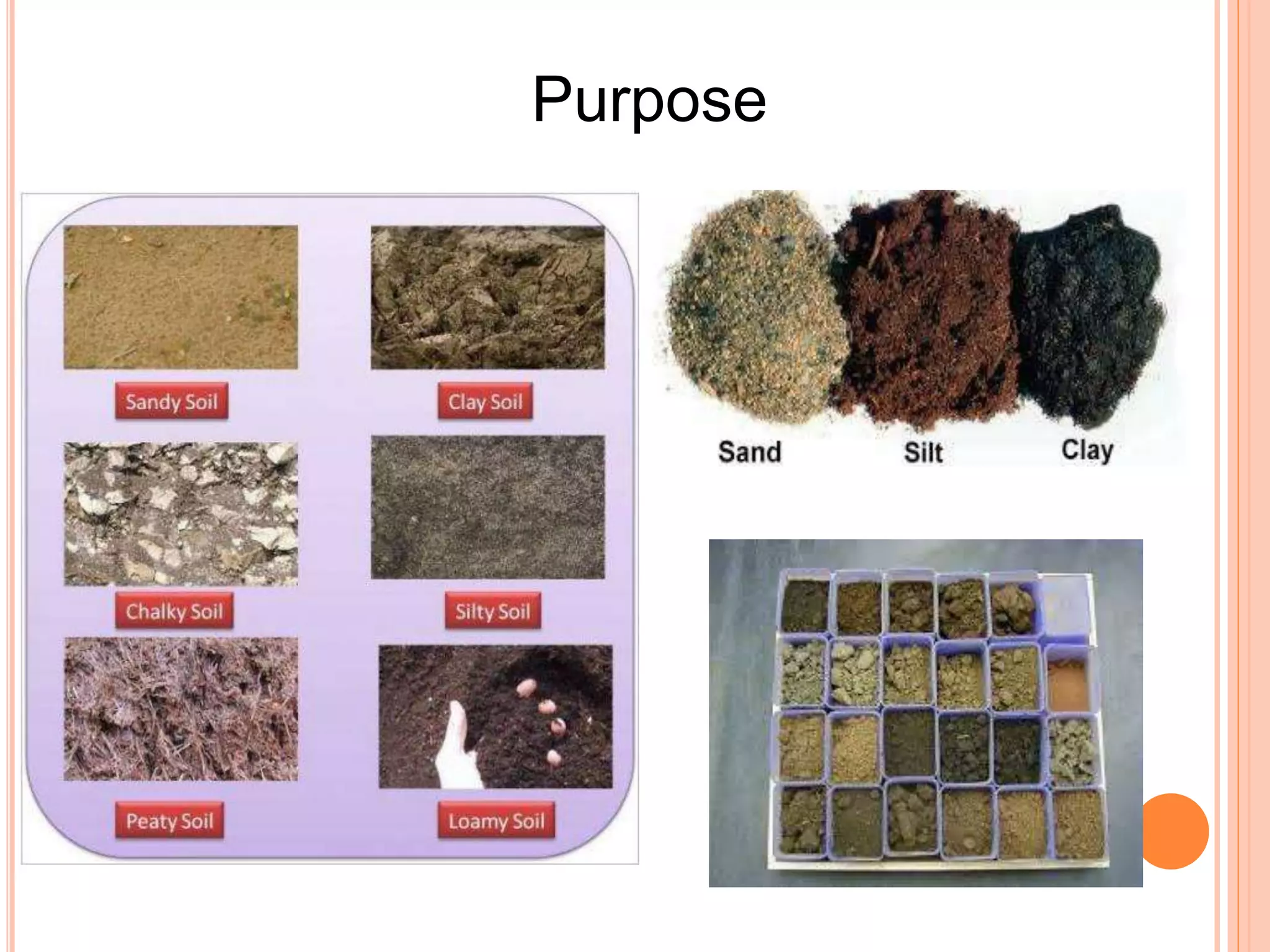
This document discusses different methods for classifying soils, including particle size classification, textural classification, Highway Research Board (HRB) classification, Unified Soil Classification System (USCS), and Indian Standard Classification System (ISCS). The key points are:
1) Soils can be classified based on their particle size, texture, engineering properties for pavement or other uses, plasticity characteristics, and percentage of sand, silt and clay.
2) Classification systems group soils with similar properties together to describe and understand their engineering behavior.
3) The ISCS system is based on the USCS but further subdivides fine-grained soils into low, intermediate and high plasticity groups based on
Purpose
Arrange various typesof soils into groups
according to their engineering or various
other characteristics.
Soil possessing similar characteristics can
be placed in the same group.
3
4.
CLASSIFICATION OF SOIL
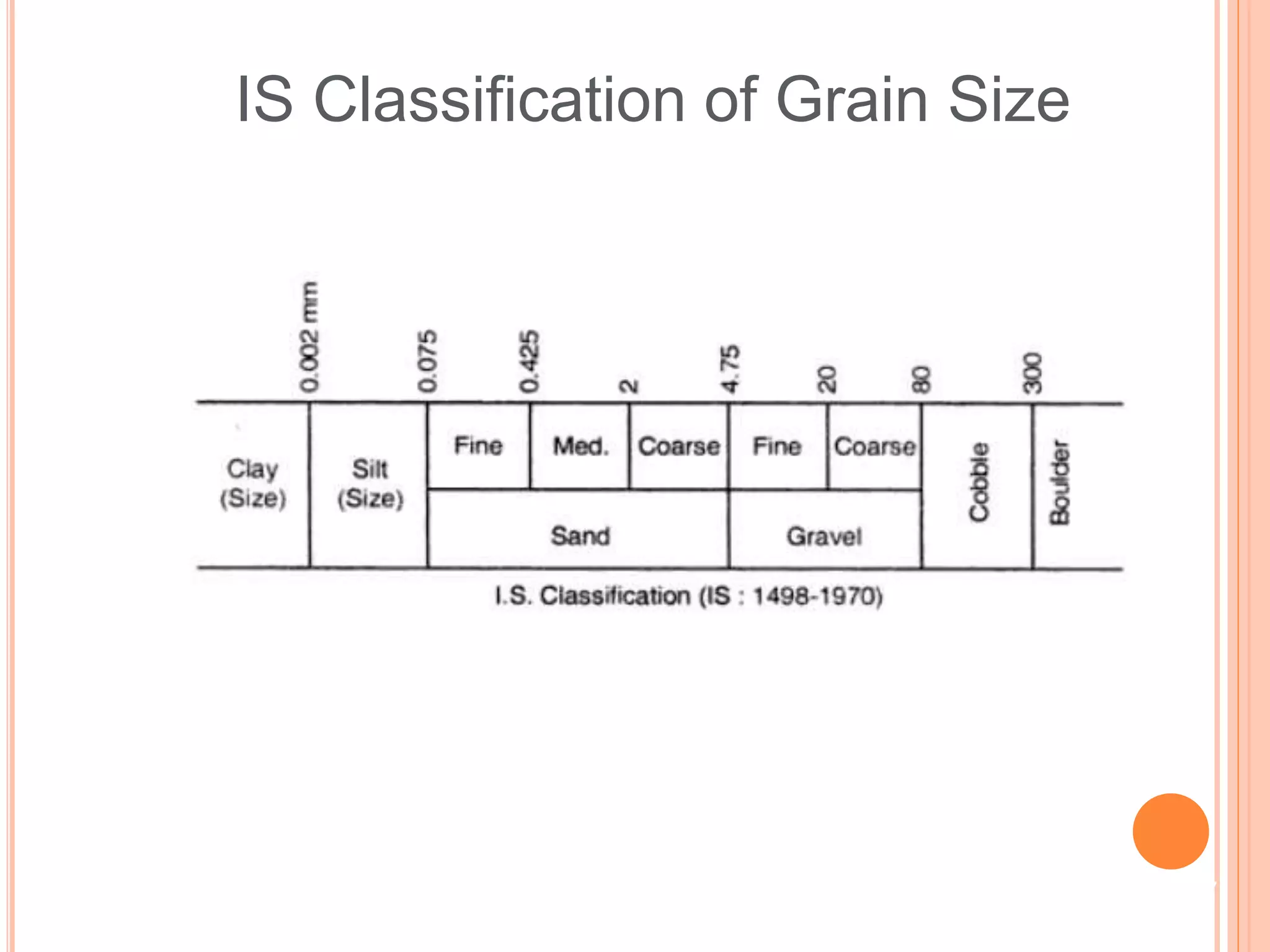
1. Particle Size Classification
2. Textural Classification
3. Highway Research Board (HRB) Classification
4. Unified Soil Classification System (USCS)
5. Indian Standard Classification System (ISCS)
Soils arranged accordingto grain sizes.
Terms such as gravel, sand, silt and clay are used
to indicate grain sizes.
These terms are used only as designation of
particle sizes.
They do not signify naturally occurring soil types.
Naturally occurring soil are mixture of particles of
different sizes.
Introduction
6
Soil classification ofcomposite soils exclusively
based on Particle Size Distribution.
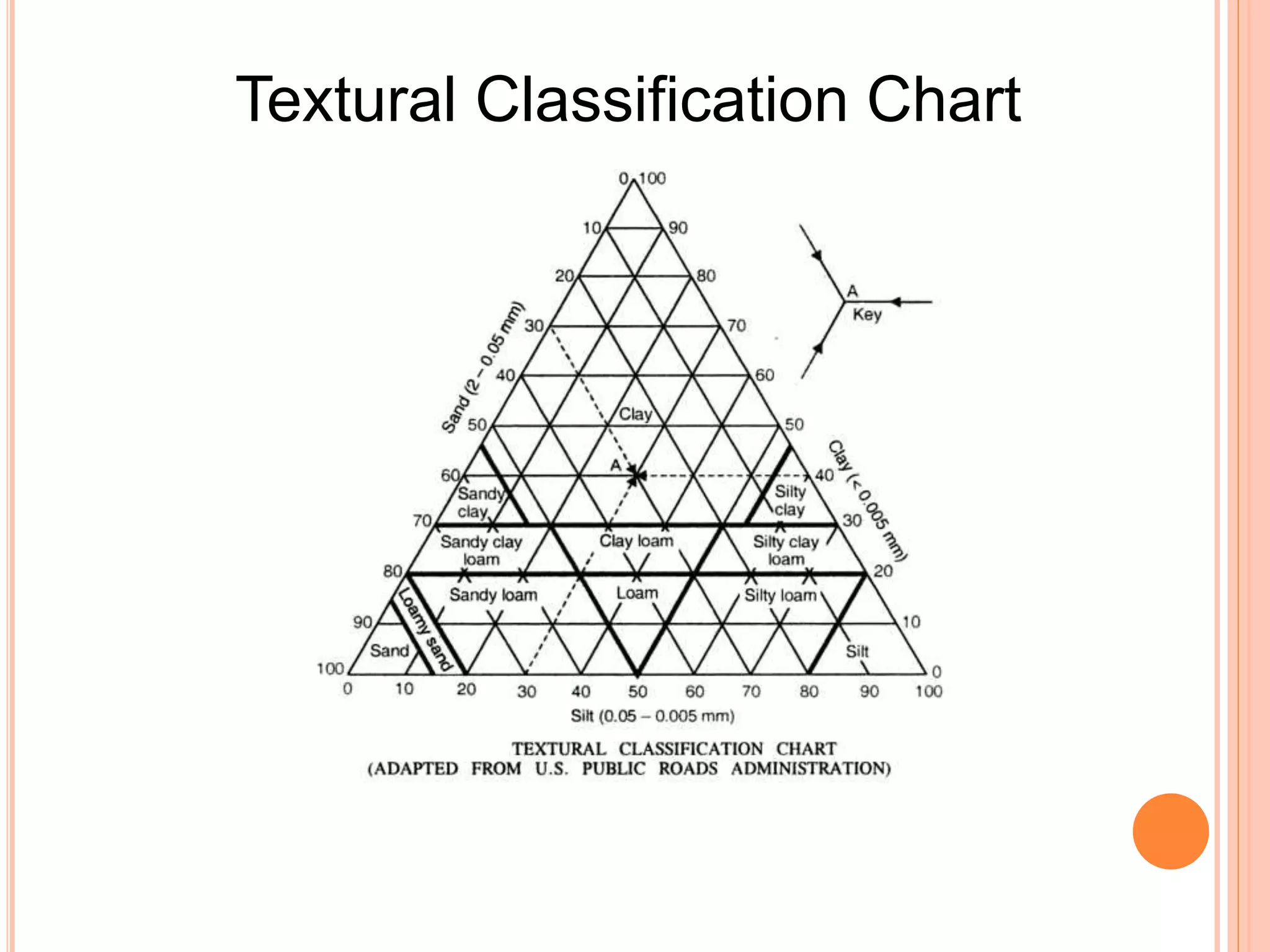
Most popular is the Triangular Classification of
U.S. Public Roads Administration.
Classification based on % of sand, silt and clay
size.
More suitable for describing coarse grained soil.
Clay soil properties are less dependent on particle
size distribution.
Introduction
9
Based on bothparticle-size composition as well
as plasticity characteristics.
Mostly used for pavement construction.
7 primary groups (A-1, A-2,…., A-7).
A-1 subdivided into 2 subgroups.
A-2 subdivided into 4 subgroups.
Introduction
13.
Used to describeperformance of soil when used for
pavement construction.
Not used to place a soil in a particular group.
It means rating the value of soil as a subgrade material
within its own group.
Higher the value of GI, poorer is the quality of material.
Group Index (GI)
14.
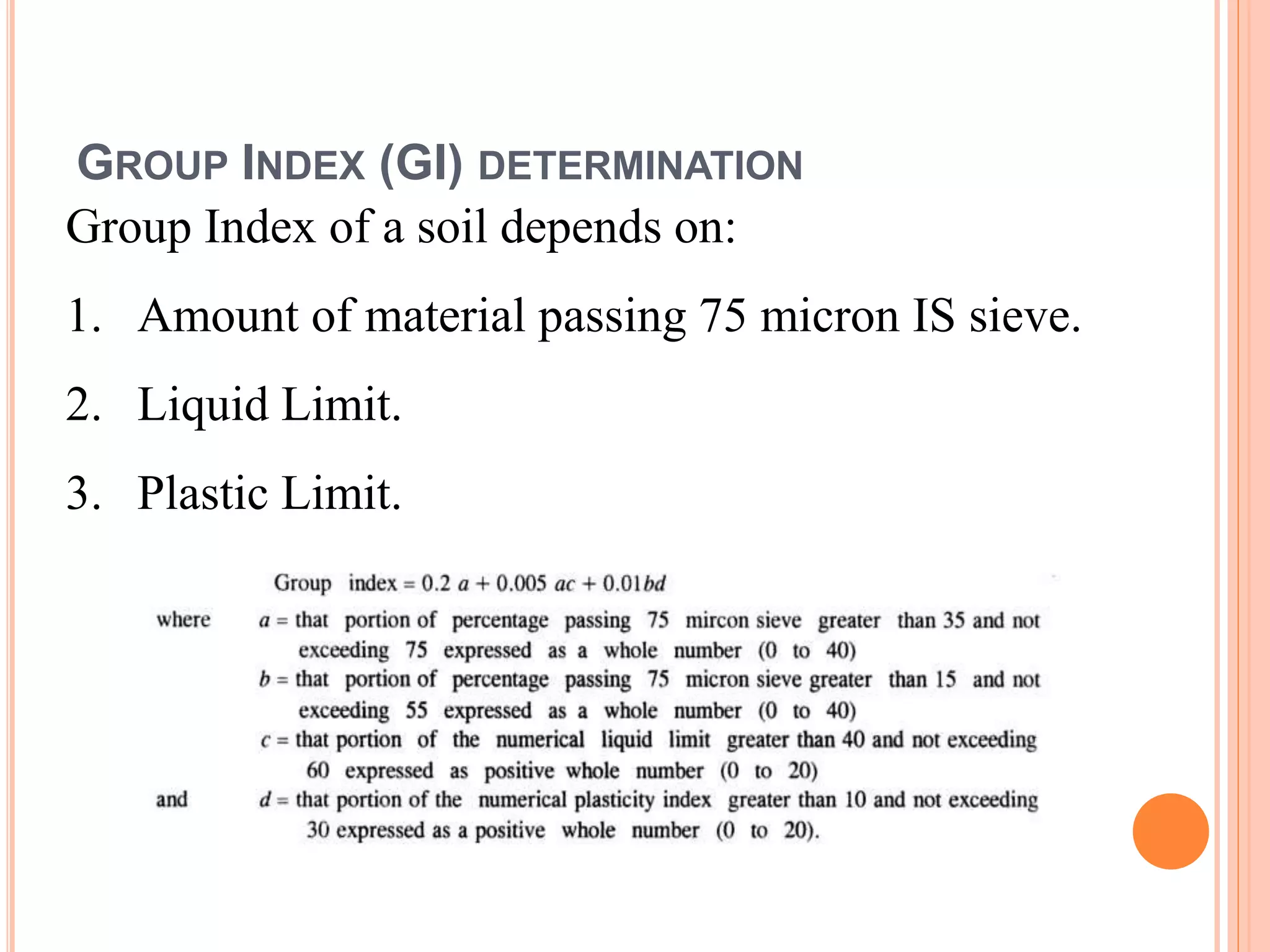
Group Index ofa soil depends on:
1. Amount of material passing 75 micron IS sieve.
2. Liquid Limit.
3. Plastic Limit.
GROUP INDEX (GI) DETERMINATION
15.
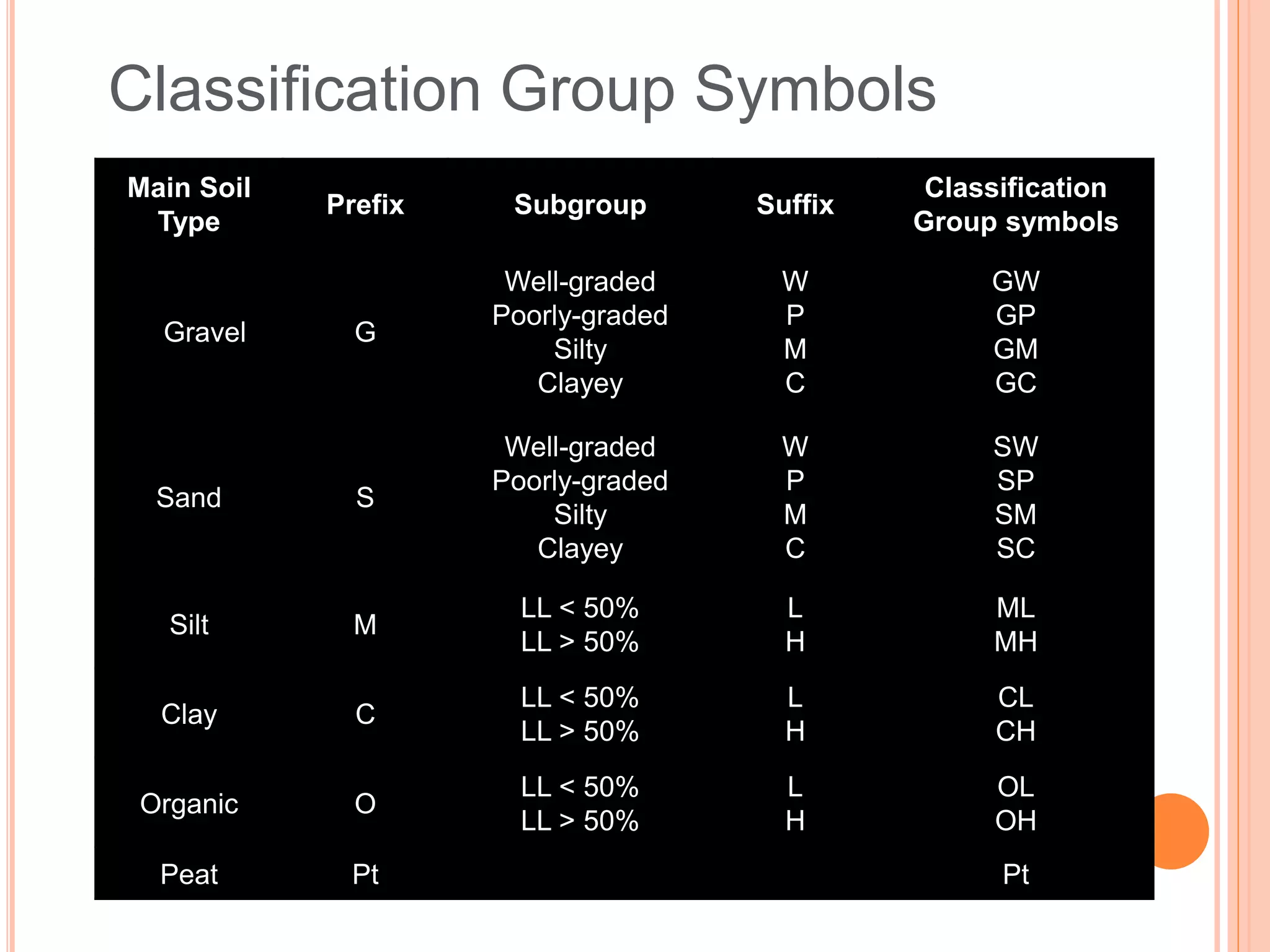
Classification Group Symbols
MainSoil
Type
Prefix Subgroup Suffix
Classification
Group symbols
Gravel G
Well-graded
Poorly-graded
Silty
Clayey
W
P
M
C
GW
GP
GM
GC
Sand S
Well-graded
Poorly-graded
Silty
Clayey
W
P
M
C
SW
SP
SM
SC
Silt M
LL < 50%
LL > 50%
L
H
ML
MH
Clay C
LL < 50%
LL > 50%
L
H
CL
CH
Organic O
LL < 50%
LL > 50%
L
H
OL
OH
Peat Pt Pt
16.
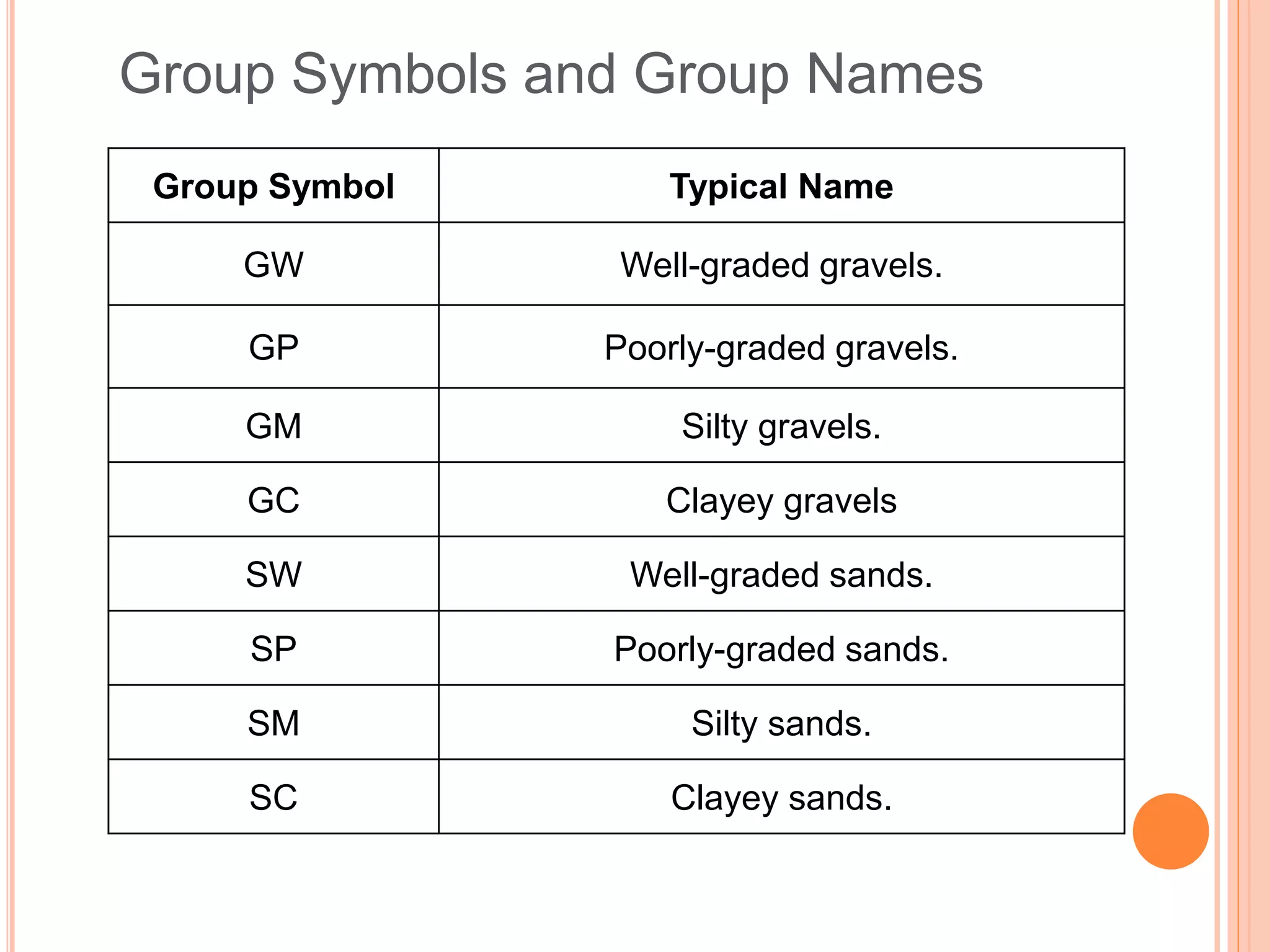
Group Symbols andGroup Names
Group Symbol Typical Name
GW Well-graded gravels.
GP Poorly-graded gravels.
GM Silty gravels.
GC Clayey gravels
SW Well-graded sands.
SP Poorly-graded sands.
SM Silty sands.
SC Clayey sands.
17.
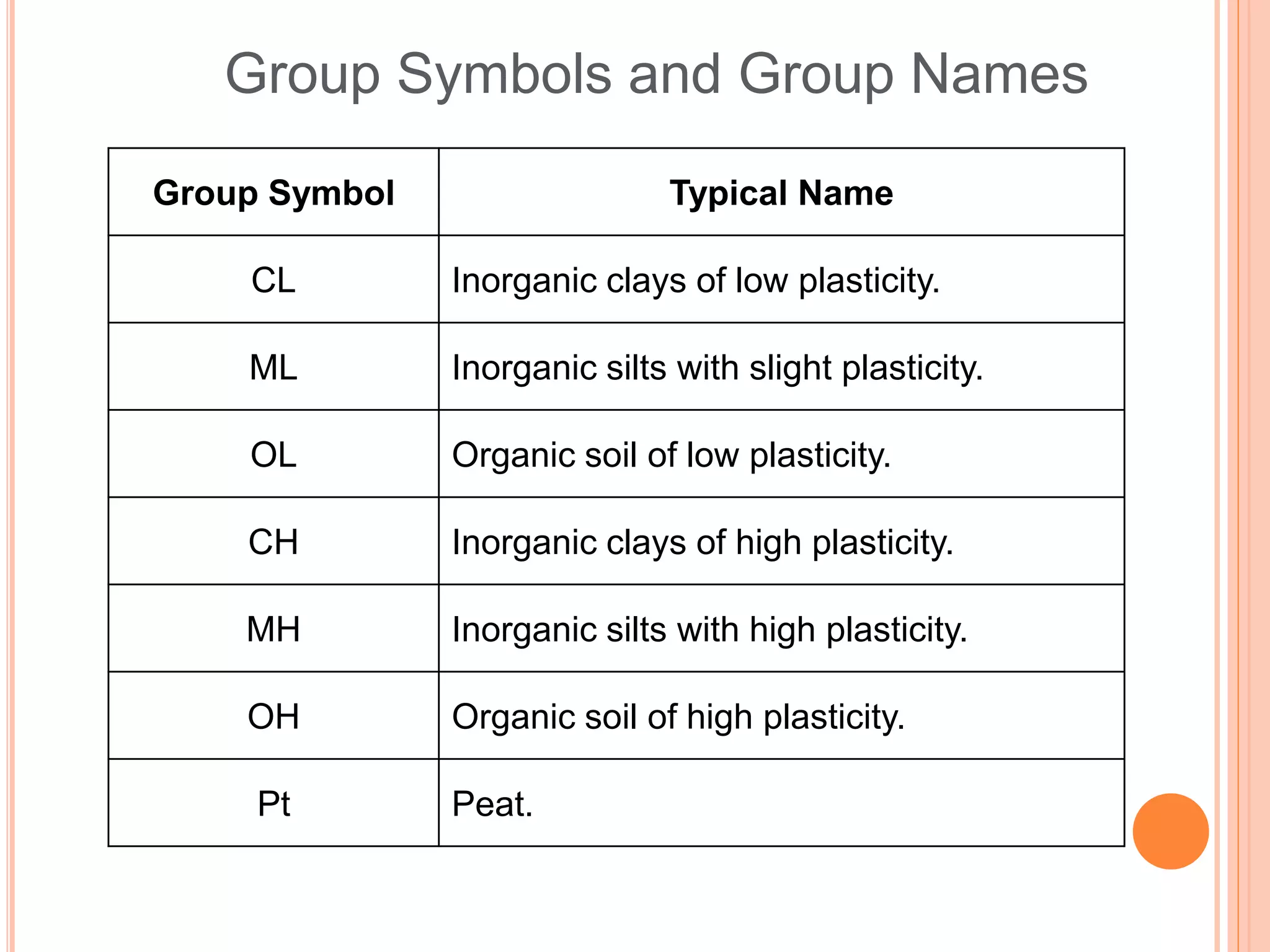
Group Symbol TypicalName
CL Inorganic clays of low plasticity.
ML Inorganic silts with slight plasticity.
OL Organic soil of low plasticity.
CH Inorganic clays of high plasticity.
MH Inorganic silts with high plasticity.
OH Organic soil of high plasticity.
Pt Peat.
Group Symbols and Group Names
Introduction
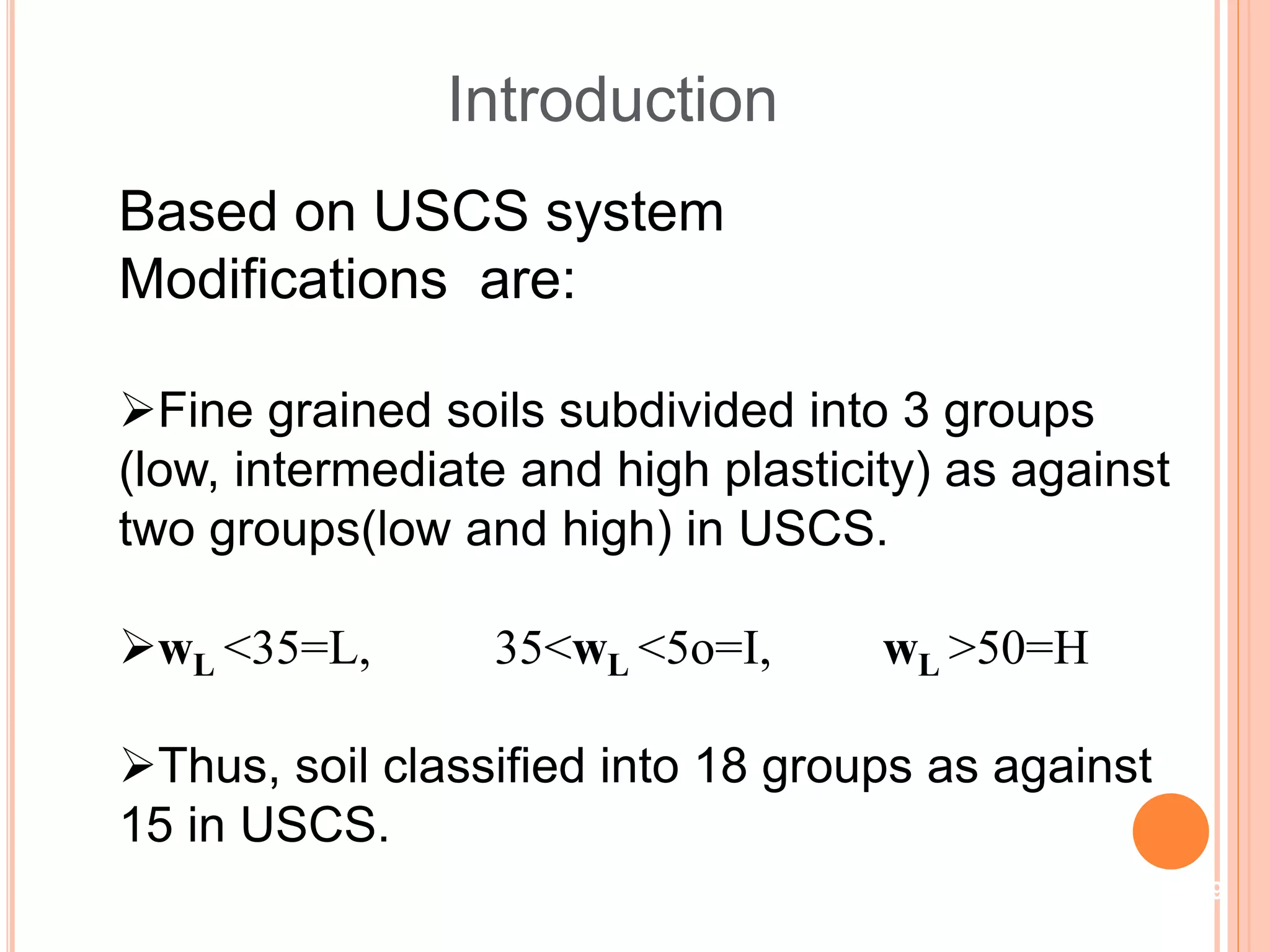
Based on USCSsystem
Modifications are:
Fine grained soils subdivided into 3 groups
(low, intermediate and high plasticity) as against
two groups(low and high) in USCS.
wL <35=L, 35<wL <5o=I, wL >50=H
Thus, soil classified into 18 groups as against
15 in USCS.
19
20.
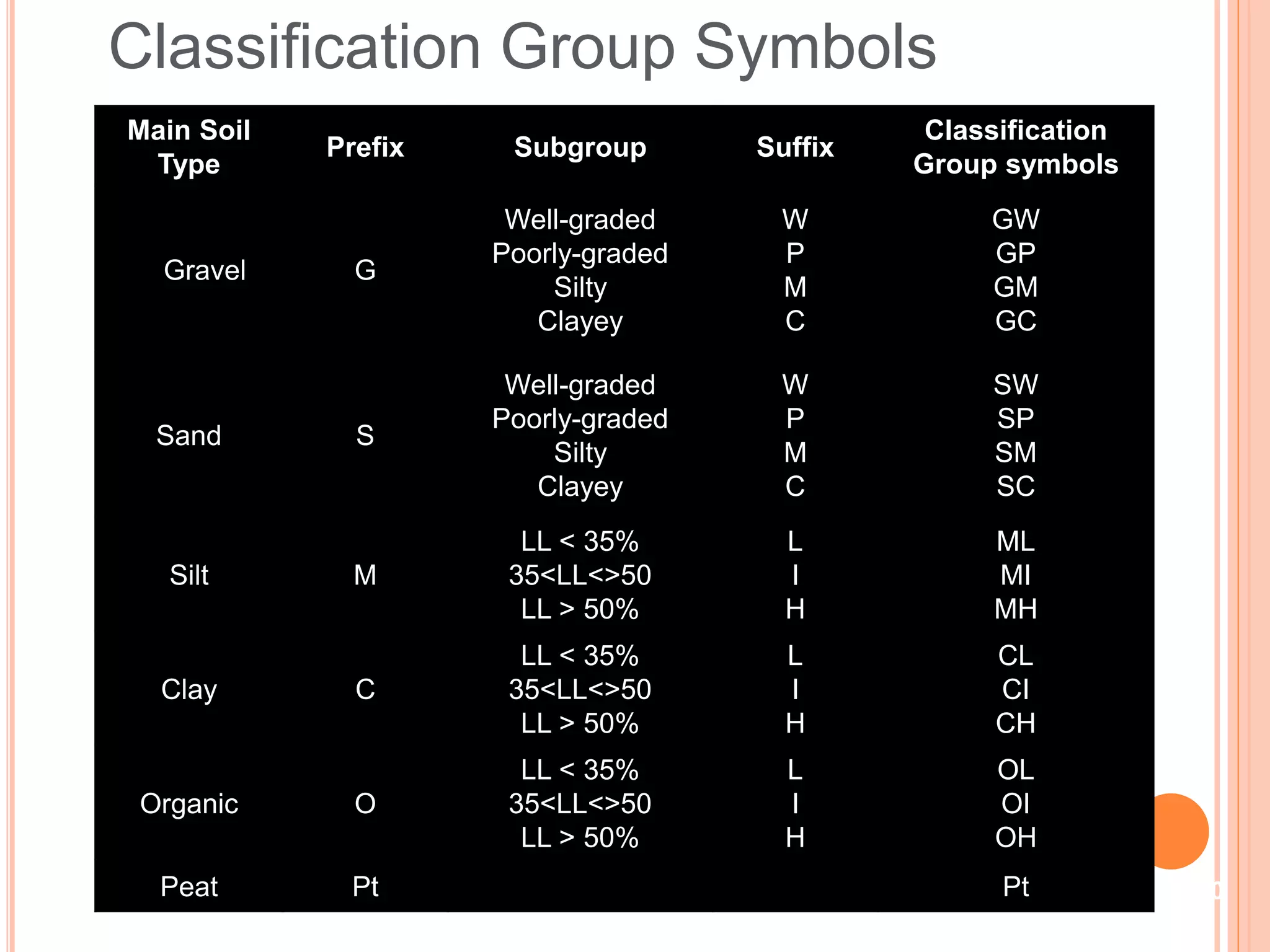
Classification Group Symbols
MainSoil
Type
Prefix Subgroup Suffix
Classification
Group symbols
Gravel G
Well-graded
Poorly-graded
Silty
Clayey
W
P
M
C
GW
GP
GM
GC
Sand S
Well-graded
Poorly-graded
Silty
Clayey
W
P
M
C
SW
SP
SM
SC
Silt M
LL < 35%
35<LL<>50
LL > 50%
L
I
H
ML
MI
MH
Clay C
LL < 35%
35<LL<>50
LL > 50%
L
I
H
CL
CI
CH
Organic O
LL < 35%
35<LL<>50
LL > 50%
L
I
H
OL
OI
OH
Peat Pt Pt 20
21.
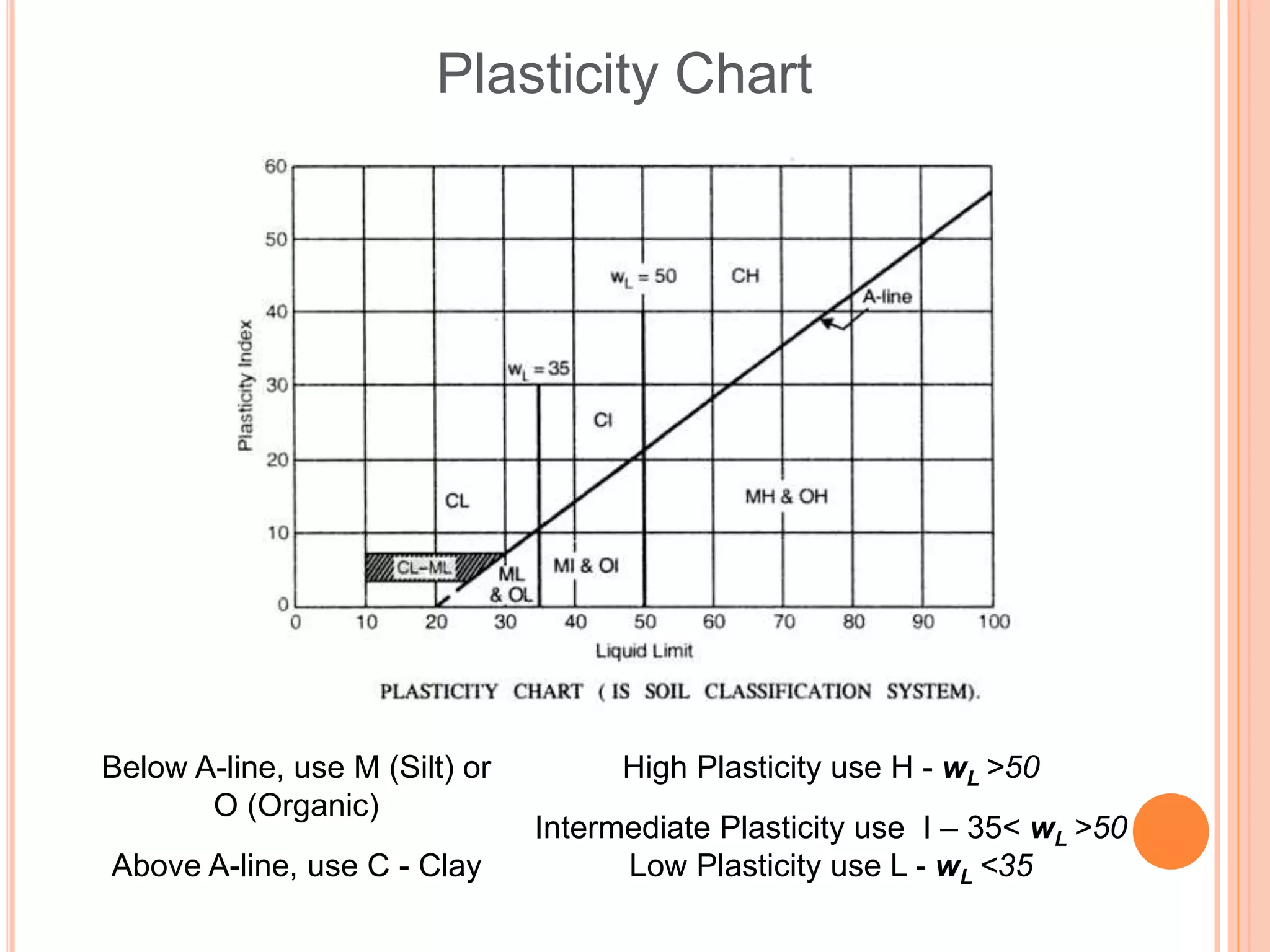
Plasticity Chart
High Plasticityuse H - wL >50
Intermediate Plasticity use I – 35< wL >50
Low Plasticity use L - wL <35
Below A-line, use M (Silt) or
O (Organic)
Above A-line, use C - Clay