Classifications of Soils
Dr. Dipjyoti Baglari
JIST, Jorhat
General Introduction
• Soil may be classified as:
– Cohesionless or coarse grained
– Cohesive or Fine grained
• But these are too general term and requires
further classification
• Thus objective of soil classification system is to
sort or group soils in different category, each
group showing similar properties
• The most commonly used properties are grain
size distribution and plasticity
Various soil classification system
• Unified soil classification system (USCS)
• American Assocation of state highway and
Transport Officials (AASHTO)
• Indian Standard Soil classification System
(ISSCS)
USCS System (Overview)
• The coarse grained soils are classified on the basis of their
grain size distribution and the fine grained soils on the basis of
their plasticity characteristics
• Here all the soils are classified in four major groups
– Coarse grained
– Fine grained
– Organic soils and peat
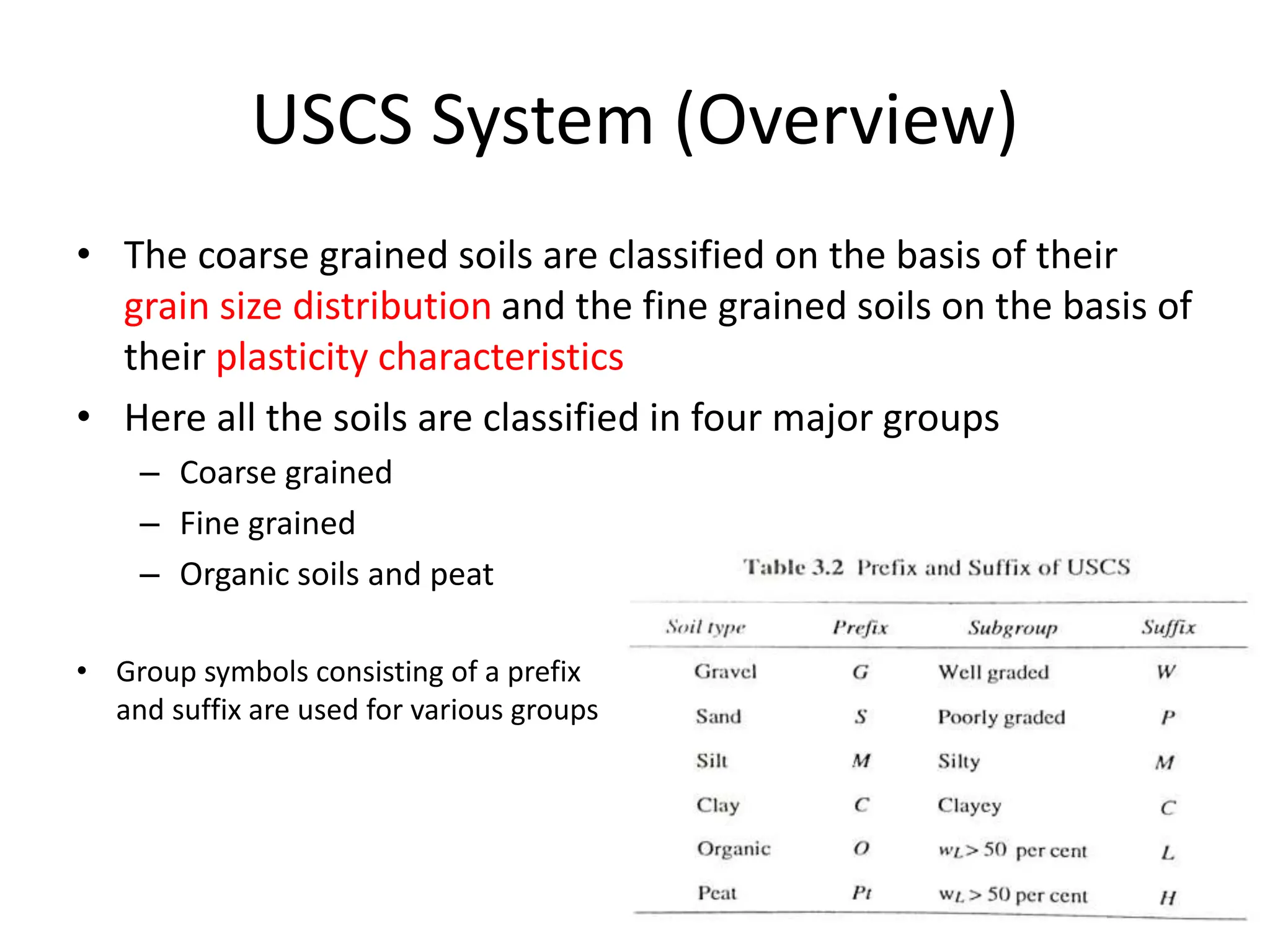
• Group symbols consisting of a prefix
and suffix are used for various groups
USCS System (Overview)
• Coarse grained soils are those having 50% or
more retained on 0.075mm sieve
• Coarse grained soil
• Gravel (G)
• Sand (S)
The coarse soil is termed as Gravel (G) if 50% or more is
retained on 4.75mm sieve otherwise termed S
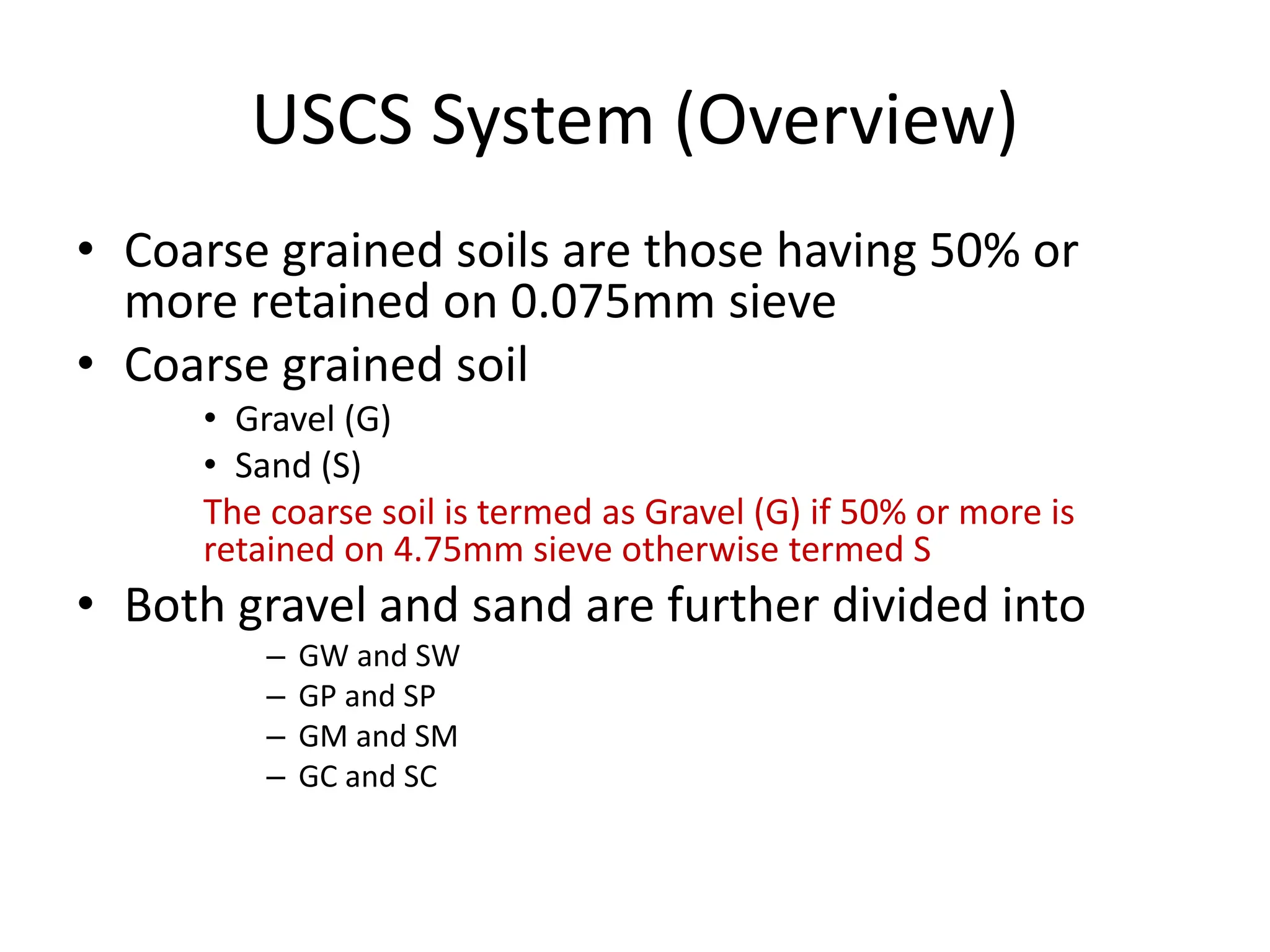
• Both gravel and sand are further divided into
– GW and SW
– GP and SP
– GM and SM
– GC and SC
USCS System (Overview)
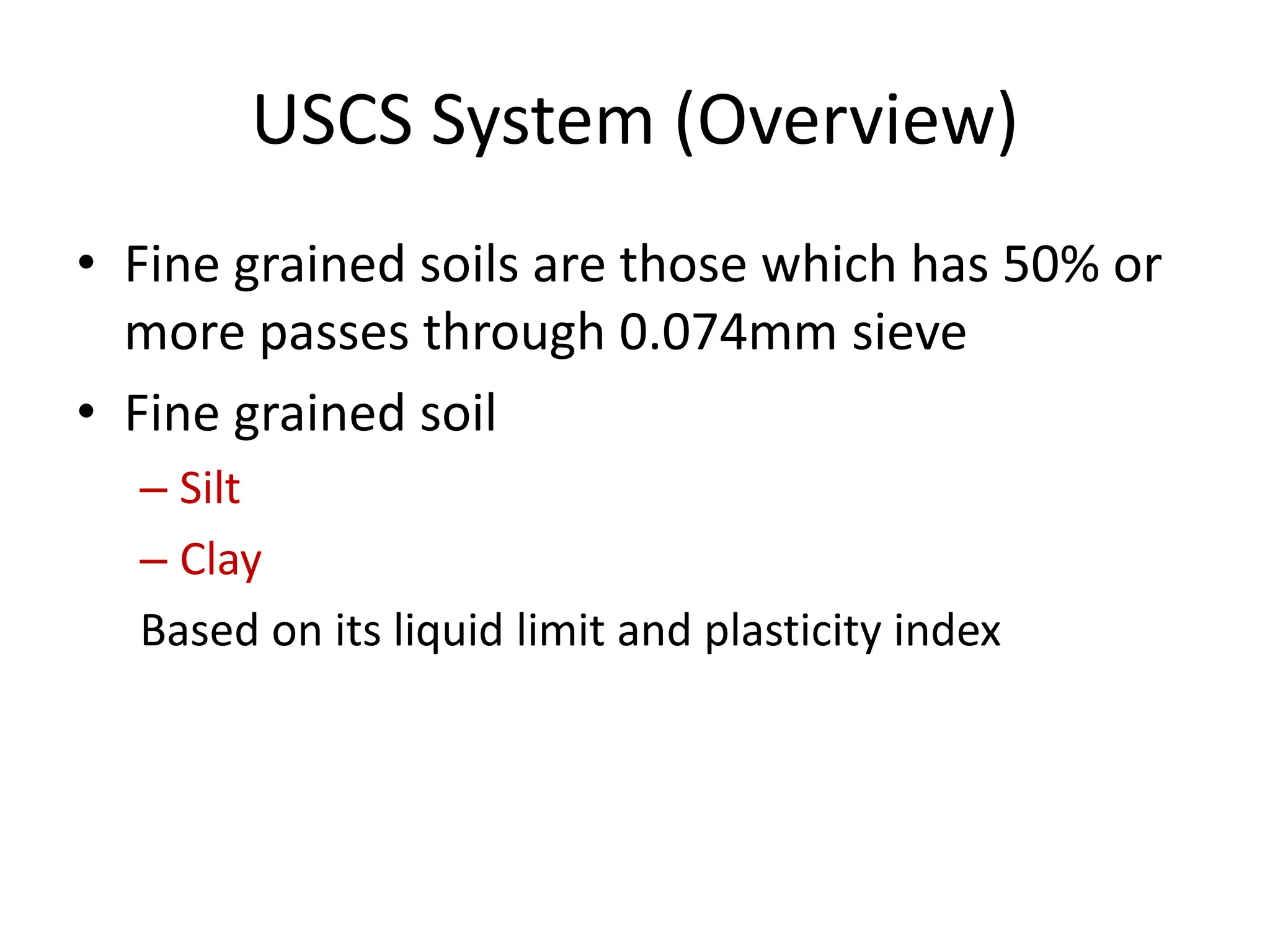
• Fine grained soils are those which has 50% or
more passes through 0.074mm sieve
• Fine grained soil
– Silt
– Clay
Based on its liquid limit and plasticity index
Plasticity Chart
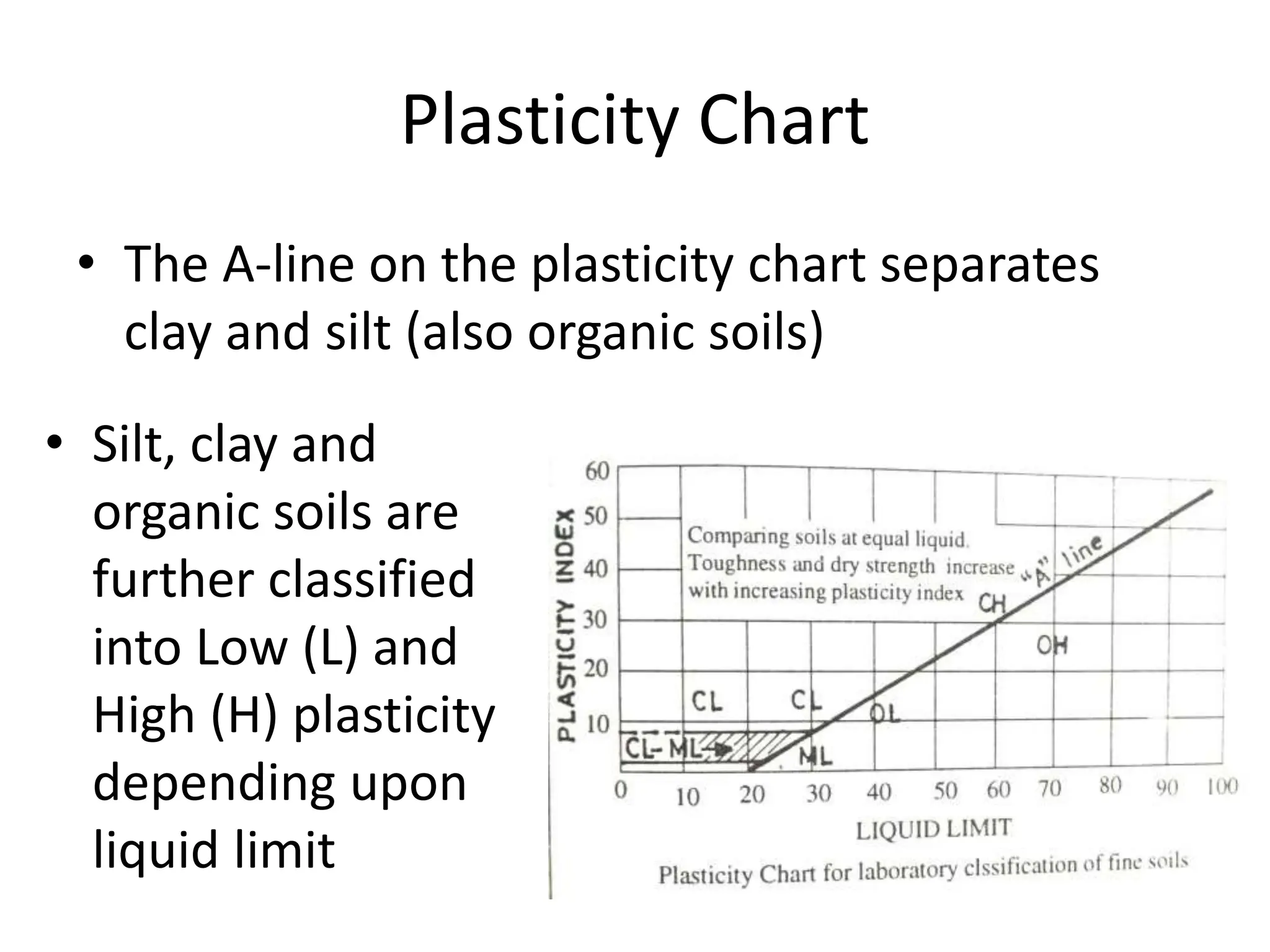
• The A-line on the plasticity chart separates
clay and silt (also organic soils)
• Silt, clay and
organic soils are
further classified
into Low (L) and
High (H) plasticity
depending upon
liquid limit
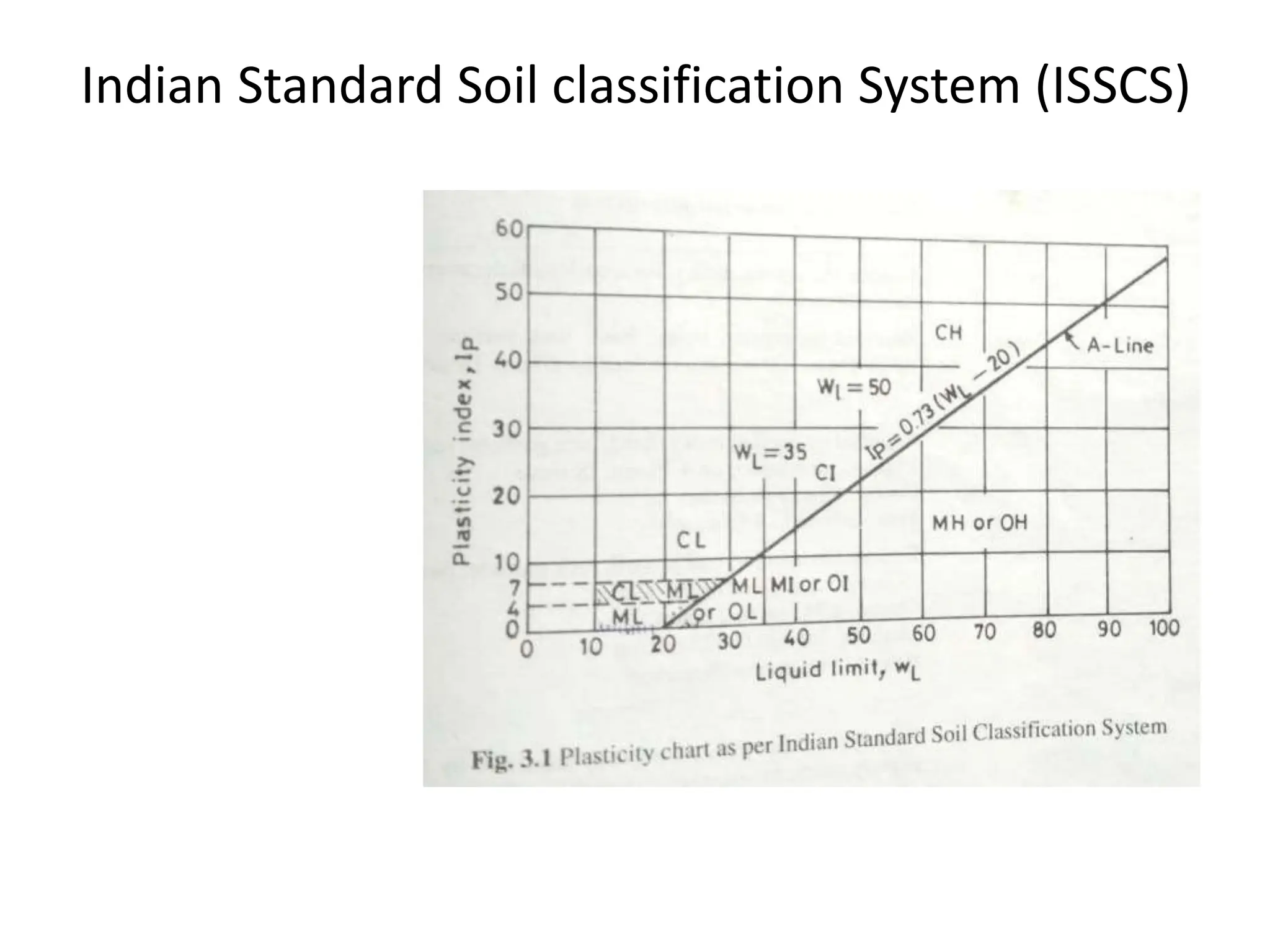
Indian Standard Soil classification System (ISSCS)

Classification of soil from Geotechnical Engineering.pptx

  • 1.
    Classifications of Soils Dr.Dipjyoti Baglari JIST, Jorhat
  • 2.
    General Introduction • Soilmay be classified as: – Cohesionless or coarse grained – Cohesive or Fine grained • But these are too general term and requires further classification • Thus objective of soil classification system is to sort or group soils in different category, each group showing similar properties • The most commonly used properties are grain size distribution and plasticity
  • 3.
    Various soil classificationsystem • Unified soil classification system (USCS) • American Assocation of state highway and Transport Officials (AASHTO) • Indian Standard Soil classification System (ISSCS)
  • 4.
    USCS System (Overview) •The coarse grained soils are classified on the basis of their grain size distribution and the fine grained soils on the basis of their plasticity characteristics • Here all the soils are classified in four major groups – Coarse grained – Fine grained – Organic soils and peat • Group symbols consisting of a prefix and suffix are used for various groups
  • 5.
    USCS System (Overview) •Coarse grained soils are those having 50% or more retained on 0.075mm sieve • Coarse grained soil • Gravel (G) • Sand (S) The coarse soil is termed as Gravel (G) if 50% or more is retained on 4.75mm sieve otherwise termed S • Both gravel and sand are further divided into – GW and SW – GP and SP – GM and SM – GC and SC
  • 6.
    USCS System (Overview) •Fine grained soils are those which has 50% or more passes through 0.074mm sieve • Fine grained soil – Silt – Clay Based on its liquid limit and plasticity index
  • 7.
    Plasticity Chart • TheA-line on the plasticity chart separates clay and silt (also organic soils) • Silt, clay and organic soils are further classified into Low (L) and High (H) plasticity depending upon liquid limit
  • 8.
    Indian Standard Soilclassification System (ISSCS)