PAVEMENT MATERIALSPAVEMENT MATERIALS
ENGINEERINGENGINEERING
(CE-862)(CE-862)
Lec-05
Fall Semester 2016
 
Dr. Arshad Hussain
arshad_nit@yahoo.com , Office Room#111, Tel: 05190854163,
Cell: 03419756251
National Institute of Transportation (NIT)
School of Civil & Environmental Engineering (SCEE)
National University of Science and Technology (NUST)
NUST Campus, Sector H-12, Islamabad
ROADBED SOILS – DROADBED SOILS – D
Soil ClassificationSoil Classification
3
OutlineOutline
1.Purpose
2.Classification Systems
3.The Unified Soil Classification System
(USCS)
4.American Association of State Highway
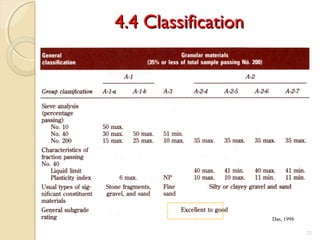
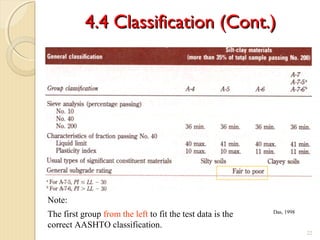
and Transportation Officials System
(AASHTO)
5.Home Assignment-1
4
1. Purpose1. Purpose
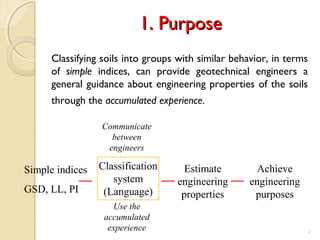
Classifying soils into groups with similar behavior, in terms
of simple indices, can provide geotechnical engineers a
general guidance about engineering properties of the soils
through the accumulated experience.
5
Simple indices
GSD, LL, PI
Classification
system
(Language)
Estimate
engineering
properties
Achieve
engineering
purposes
Use the
accumulated
experience
Communicate
between
engineers
2. Classification Systems2. Classification Systems
Two commonly used systems:
Unified Soil Classification System (USCS).
American Association of State Highway
and Transportation Officials (AASHTO)
System
6
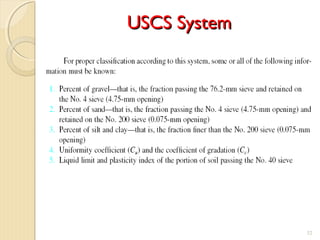
3. Unified Soil Classification System3. Unified Soil Classification System
(USCS)(USCS)
7
Origin of USCS:
This system was first developed by Professor A. Casagrande for the
purpose of airfield construction during World War II. Afterwards, it
was modified by Professor A. Casagrande, the U.S. Bureau of
Reclamation, and the U.S. Army Corps of Engineers to enable the
system to be applicable to dams, foundations, and other construction
(Holtz and Kovacs, 1981).
Four major divisions:
(1) Coarse-grained
(2) Fine-grained
(3) Organic soils
(4) Peat
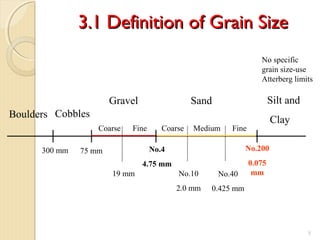
3.1 Definition of Grain Size3.1 Definition of Grain Size
8
Boulders Cobbles
Gravel Sand Silt and
Clay
Coarse Fine Coarse FineMedium
300 mm 75 mm
19 mm
No.4
4.75 mm
No.10
2.0 mm
No.40
0.425 mm
No.200
0.075
mm
No specific
grain size-use
Atterberg limits
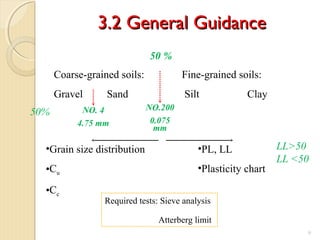
3.2 General Guidance3.2 General Guidance
9
Coarse-grained soils:
Gravel Sand
Fine-grained soils:
Silt Clay
NO.200
0.075
mm
•Grain size distribution
•Cu
•Cc
•PL, LL
•Plasticity chart
50 %
NO. 4
4.75 mm
Required tests: Sieve analysis
Atterberg limit
LL>50
LL <50
50%
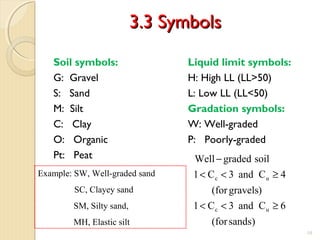
3.3 Symbols3.3 Symbols
Soil symbols:
G: Gravel
S: Sand
M: Silt
C: Clay
O: Organic
Pt: Peat
Liquid limit symbols:
H: High LL (LL>50)
L: Low LL (LL<50)
Gradation symbols:
W: Well-graded
P: Poorly-graded
10
Example: SW, Well-graded sand
SC, Clayey sand
SM, Silty sand,
MH, Elastic silt )sandsfor(
6Cand3C1
)gravelsfor(
4Cand3C1
soilgradedWell
uc
uc
≥<<
≥<<
−
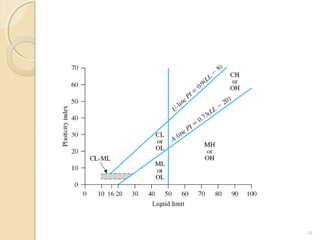
3.4 Plasticity Chart3.4 Plasticity Chart
11
(Holtz and Kovacs, 1981)
LL
PI
HL
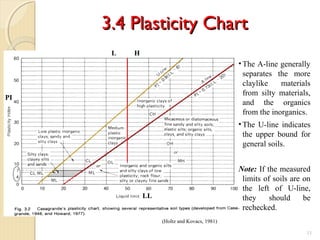
•The A-line generally
separates the more
claylike materials
from silty materials,
and the organics
from the inorganics.
•The U-line indicates
the upper bound for
general soils.
Note: If the measured
limits of soils are on
the left of U-line,
they should be
rechecked.
3.5 Procedures for Classification3.5 Procedures for Classification
12
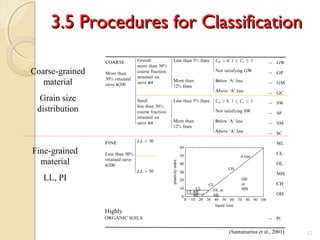
Coarse-grained
material
Grain size
distribution
Fine-grained
material
LL, PI
(Santamarina et al., 2001)
Highly
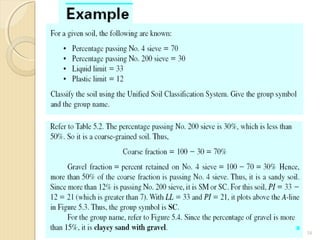
3.6 Example3.6 Example
13
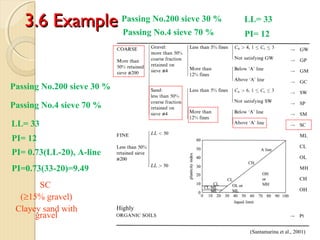
Passing No.200 sieve 30 %
Passing No.4 sieve 70 %
LL= 33
PI= 12
PI= 0.73(LL-20), A-line
PI=0.73(33-20)=9.49
SC
(≥15% gravel)
Clayey sand with
gravel
(Santamarina et al., 2001)
Passing No.200 sieve 30 %
Passing No.4 sieve 70 %
LL= 33
PI= 12
Highly
3.7 Organic Soils3.7 Organic Soils
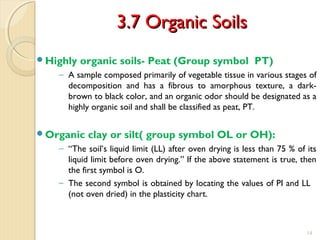
Highly organic soils- Peat (Group symbol PT)
− A sample composed primarily of vegetable tissue in various stages of
decomposition and has a fibrous to amorphous texture, a dark-
brown to black color, and an organic odor should be designated as a
highly organic soil and shall be classified as peat, PT.
Organic clay or silt( group symbol OL or OH):
− “The soil’s liquid limit (LL) after oven drying is less than 75 % of its
liquid limit before oven drying.” If the above statement is true, then
the first symbol is O.
− The second symbol is obtained by locating the values of PI and LL
(not oven dried) in the plasticity chart.
14
3.8 Borderline Cases (Dual3.8 Borderline Cases (Dual
Symbols)Symbols)
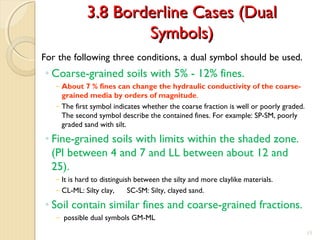
For the following three conditions, a dual symbol should be used.
◦ Coarse-grained soils with 5% - 12% fines.
− About 7 % fines can change the hydraulic conductivity of the coarse-
grained media by orders of magnitude.
− The first symbol indicates whether the coarse fraction is well or poorly graded.
The second symbol describe the contained fines. For example: SP-SM, poorly
graded sand with silt.
◦ Fine-grained soils with limits within the shaded zone.
(PI between 4 and 7 and LL between about 12 and
25).
− It is hard to distinguish between the silty and more claylike materials.
− CL-ML: Silty clay, SC-SM: Silty, clayed sand.
◦ Soil contain similar fines and coarse-grained fractions.
− possible dual symbols GM-ML
15
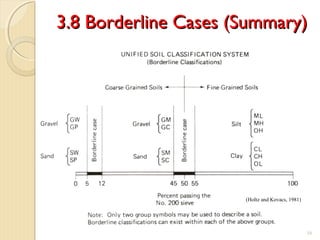
3.8 Borderline Cases (Summary)3.8 Borderline Cases (Summary)
16
(Holtz and Kovacs, 1981)
4.American Association of State4.American Association of State
Highway and TransportationHighway and Transportation
Officials system (AASHTO)Officials system (AASHTO)
17
Origin of AASHTO: (For road construction)
This system was originally developed by Hogentogler and Terzaghi in
1929 as the Public Roads Classification System. Afterwards, there are
several revisions. The present AASHTO (1978) system is primarily
based on the version in 1945. (Holtz and Kovacs, 1981)
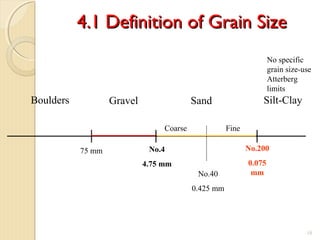
4.1 Definition of Grain Size4.1 Definition of Grain Size
18
Boulders Gravel Sand Silt-Clay
Coarse Fine
75 mm No.4
4.75 mm
No.40
0.425 mm
No.200
0.075
mm
No specific
grain size-use
Atterberg
limits
4.2 General Guidance4.2 General Guidance
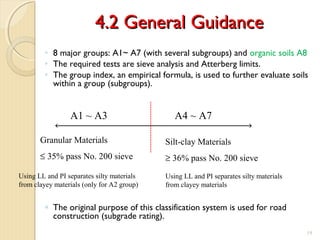
◦ 8 major groups: A1~ A7 (with several subgroups) and organic soils A8
◦ The required tests are sieve analysis and Atterberg limits.
◦ The group index, an empirical formula, is used to further evaluate soils
within a group (subgroups).
◦ The original purpose of this classification system is used for road
construction (subgrade rating).
19
A4 ~ A7A1 ~ A3
Granular Materials
≤ 35% pass No. 200 sieve
Silt-clay Materials
≥ 36% pass No. 200 sieve
Using LL and PI separates silty materials
from clayey materials
Using LL and PI separates silty materials
from clayey materials (only for A2 group)
4.3 Group Index4.3 Group Index
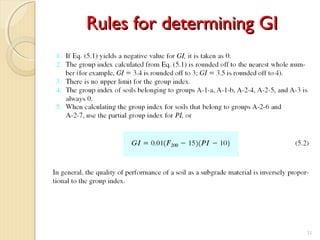
20
[ ]
)10PI)(15F(01.0
)40LL(005.02.0)35F(GI
200
200
−−+
−+−=
)10PI)(15F(01.0GI 200 −−=
For Group A-2-6 and A-2-7
The first term is determined by the LL
The second term is determined by the PI
In general, the rating for a pavement subgrade is
inversely proportional to the group index, GI.
use the second term only
F200: percentage passing through the No.200 sieve
4.4 Classification4.4 Classification
21
Das, 1998
4.4 Classification (Cont.)4.4 Classification (Cont.)
22
Das, 1998
Note:
The first group from the left to fit the test data is the
correct AASHTO classification.
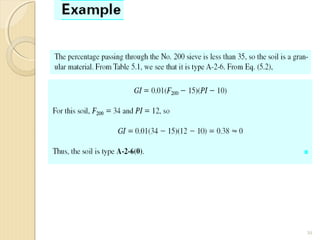
4.4 Example4.4 Example
23
Passing No.200 86%
LL=70, PI=32
LL-30=40 > PI=32
[ ]
3347.33
)10PI)(15F(01.0
)40LL(005.02.0)35F(GI
200
200
≅=
−−+
−+−=
Round off A-7-5(33)
Passing No.200 86%
LL=70, PI=32
LL-30=40 > PI=32
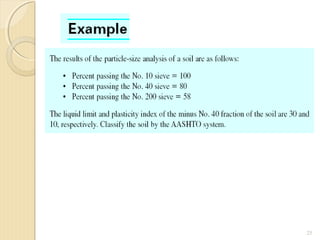
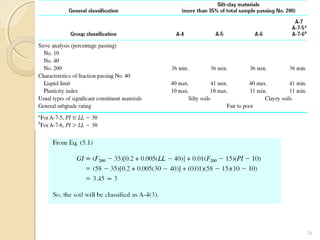
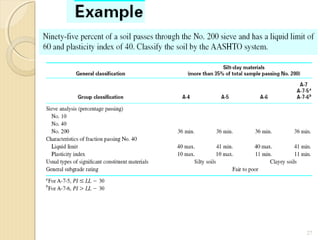
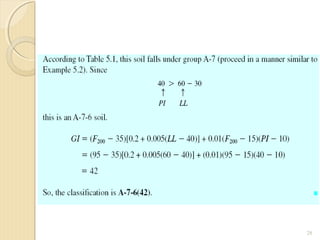
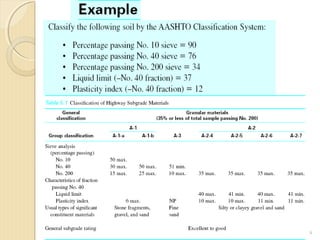
CLASS EXERCISE – SOIL CLASSIFICATION
24
25
26
27
28
29
30
Rules for determining GIRules for determining GI
31
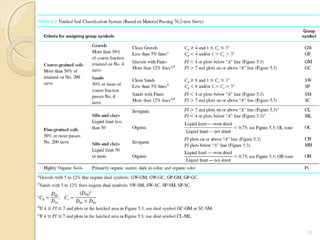
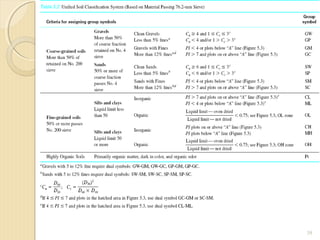
USCS SystemUSCS System
32
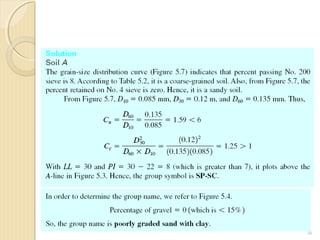
33
34
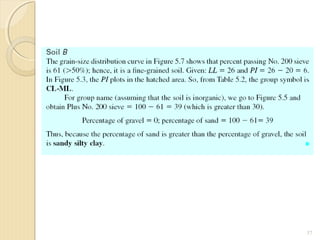
35
36
37
38
39
ThanksThanks

Pavement Engineering Materials_5

  • 2.
    PAVEMENT MATERIALSPAVEMENT MATERIALS ENGINEERINGENGINEERING (CE-862)(CE-862) Lec-05 FallSemester 2016   Dr. Arshad Hussain arshad_nit@yahoo.com , Office Room#111, Tel: 05190854163, Cell: 03419756251 National Institute of Transportation (NIT) School of Civil & Environmental Engineering (SCEE) National University of Science and Technology (NUST) NUST Campus, Sector H-12, Islamabad
  • 3.
    ROADBED SOILS –DROADBED SOILS – D Soil ClassificationSoil Classification 3
  • 4.
    OutlineOutline 1.Purpose 2.Classification Systems 3.The UnifiedSoil Classification System (USCS) 4.American Association of State Highway and Transportation Officials System (AASHTO) 5.Home Assignment-1 4
  • 5.
    1. Purpose1. Purpose Classifyingsoils into groups with similar behavior, in terms of simple indices, can provide geotechnical engineers a general guidance about engineering properties of the soils through the accumulated experience. 5 Simple indices GSD, LL, PI Classification system (Language) Estimate engineering properties Achieve engineering purposes Use the accumulated experience Communicate between engineers
  • 6.
    2. Classification Systems2.Classification Systems Two commonly used systems: Unified Soil Classification System (USCS). American Association of State Highway and Transportation Officials (AASHTO) System 6
  • 7.
    3. Unified SoilClassification System3. Unified Soil Classification System (USCS)(USCS) 7 Origin of USCS: This system was first developed by Professor A. Casagrande for the purpose of airfield construction during World War II. Afterwards, it was modified by Professor A. Casagrande, the U.S. Bureau of Reclamation, and the U.S. Army Corps of Engineers to enable the system to be applicable to dams, foundations, and other construction (Holtz and Kovacs, 1981). Four major divisions: (1) Coarse-grained (2) Fine-grained (3) Organic soils (4) Peat
  • 8.
    3.1 Definition ofGrain Size3.1 Definition of Grain Size 8 Boulders Cobbles Gravel Sand Silt and Clay Coarse Fine Coarse FineMedium 300 mm 75 mm 19 mm No.4 4.75 mm No.10 2.0 mm No.40 0.425 mm No.200 0.075 mm No specific grain size-use Atterberg limits
  • 9.
    3.2 General Guidance3.2General Guidance 9 Coarse-grained soils: Gravel Sand Fine-grained soils: Silt Clay NO.200 0.075 mm •Grain size distribution •Cu •Cc •PL, LL •Plasticity chart 50 % NO. 4 4.75 mm Required tests: Sieve analysis Atterberg limit LL>50 LL <50 50%
  • 10.
    3.3 Symbols3.3 Symbols Soilsymbols: G: Gravel S: Sand M: Silt C: Clay O: Organic Pt: Peat Liquid limit symbols: H: High LL (LL>50) L: Low LL (LL<50) Gradation symbols: W: Well-graded P: Poorly-graded 10 Example: SW, Well-graded sand SC, Clayey sand SM, Silty sand, MH, Elastic silt )sandsfor( 6Cand3C1 )gravelsfor( 4Cand3C1 soilgradedWell uc uc ≥<< ≥<< −
  • 11.
    3.4 Plasticity Chart3.4Plasticity Chart 11 (Holtz and Kovacs, 1981) LL PI HL •The A-line generally separates the more claylike materials from silty materials, and the organics from the inorganics. •The U-line indicates the upper bound for general soils. Note: If the measured limits of soils are on the left of U-line, they should be rechecked.
  • 12.
    3.5 Procedures forClassification3.5 Procedures for Classification 12 Coarse-grained material Grain size distribution Fine-grained material LL, PI (Santamarina et al., 2001) Highly
  • 13.
    3.6 Example3.6 Example 13 PassingNo.200 sieve 30 % Passing No.4 sieve 70 % LL= 33 PI= 12 PI= 0.73(LL-20), A-line PI=0.73(33-20)=9.49 SC (≥15% gravel) Clayey sand with gravel (Santamarina et al., 2001) Passing No.200 sieve 30 % Passing No.4 sieve 70 % LL= 33 PI= 12 Highly
  • 14.
    3.7 Organic Soils3.7Organic Soils Highly organic soils- Peat (Group symbol PT) − A sample composed primarily of vegetable tissue in various stages of decomposition and has a fibrous to amorphous texture, a dark- brown to black color, and an organic odor should be designated as a highly organic soil and shall be classified as peat, PT. Organic clay or silt( group symbol OL or OH): − “The soil’s liquid limit (LL) after oven drying is less than 75 % of its liquid limit before oven drying.” If the above statement is true, then the first symbol is O. − The second symbol is obtained by locating the values of PI and LL (not oven dried) in the plasticity chart. 14
  • 15.
    3.8 Borderline Cases(Dual3.8 Borderline Cases (Dual Symbols)Symbols) For the following three conditions, a dual symbol should be used. ◦ Coarse-grained soils with 5% - 12% fines. − About 7 % fines can change the hydraulic conductivity of the coarse- grained media by orders of magnitude. − The first symbol indicates whether the coarse fraction is well or poorly graded. The second symbol describe the contained fines. For example: SP-SM, poorly graded sand with silt. ◦ Fine-grained soils with limits within the shaded zone. (PI between 4 and 7 and LL between about 12 and 25). − It is hard to distinguish between the silty and more claylike materials. − CL-ML: Silty clay, SC-SM: Silty, clayed sand. ◦ Soil contain similar fines and coarse-grained fractions. − possible dual symbols GM-ML 15
  • 16.
    3.8 Borderline Cases(Summary)3.8 Borderline Cases (Summary) 16 (Holtz and Kovacs, 1981)
  • 17.
    4.American Association ofState4.American Association of State Highway and TransportationHighway and Transportation Officials system (AASHTO)Officials system (AASHTO) 17 Origin of AASHTO: (For road construction) This system was originally developed by Hogentogler and Terzaghi in 1929 as the Public Roads Classification System. Afterwards, there are several revisions. The present AASHTO (1978) system is primarily based on the version in 1945. (Holtz and Kovacs, 1981)
  • 18.
    4.1 Definition ofGrain Size4.1 Definition of Grain Size 18 Boulders Gravel Sand Silt-Clay Coarse Fine 75 mm No.4 4.75 mm No.40 0.425 mm No.200 0.075 mm No specific grain size-use Atterberg limits
  • 19.
    4.2 General Guidance4.2General Guidance ◦ 8 major groups: A1~ A7 (with several subgroups) and organic soils A8 ◦ The required tests are sieve analysis and Atterberg limits. ◦ The group index, an empirical formula, is used to further evaluate soils within a group (subgroups). ◦ The original purpose of this classification system is used for road construction (subgrade rating). 19 A4 ~ A7A1 ~ A3 Granular Materials ≤ 35% pass No. 200 sieve Silt-clay Materials ≥ 36% pass No. 200 sieve Using LL and PI separates silty materials from clayey materials Using LL and PI separates silty materials from clayey materials (only for A2 group)
  • 20.
    4.3 Group Index4.3Group Index 20 [ ] )10PI)(15F(01.0 )40LL(005.02.0)35F(GI 200 200 −−+ −+−= )10PI)(15F(01.0GI 200 −−= For Group A-2-6 and A-2-7 The first term is determined by the LL The second term is determined by the PI In general, the rating for a pavement subgrade is inversely proportional to the group index, GI. use the second term only F200: percentage passing through the No.200 sieve
  • 21.
  • 22.
    4.4 Classification (Cont.)4.4Classification (Cont.) 22 Das, 1998 Note: The first group from the left to fit the test data is the correct AASHTO classification.
  • 23.
    4.4 Example4.4 Example 23 PassingNo.200 86% LL=70, PI=32 LL-30=40 > PI=32 [ ] 3347.33 )10PI)(15F(01.0 )40LL(005.02.0)35F(GI 200 200 ≅= −−+ −+−= Round off A-7-5(33) Passing No.200 86% LL=70, PI=32 LL-30=40 > PI=32
  • 24.
    CLASS EXERCISE –SOIL CLASSIFICATION 24
  • 25.
  • 26.
  • 27.
  • 28.
  • 29.
  • 30.
  • 31.
    Rules for determiningGIRules for determining GI 31
  • 32.
  • 33.
  • 34.
  • 35.
  • 36.
  • 37.
  • 38.
  • 39.
  • 40.

Editor's Notes

  • #6 Most soil classifications employ very simple index-type tests to obtain the characteristics of the soil needed to place it in a given group. Clearly a soil classification loses its value if the index tests become more complicated than the test to measure directly the fundamental property needed. The most commonly used characteristics are particle size and plasticity. Empirical correlations between index properties and fundamental soil behavior have many large deviations. The particle size distribution and the Atterberg limits are useful index tests inherently involves disturbance of the soil, they may not give a good indication of the behavior of the in situ, undisturbed soil.
  • #7 Grain size distribution characteristics are most relevant for the classification of coarse-grained soils. On the other hand, Atterberg limits are central to the classification (Santamarina et al., 2001). Specific surface, porosity, and degree of saturation are three salient properties in particulate materials (Santamarina et al., 2001)
  • #11 See Table 3.1 Silty sand. Elastic silt Adjective, noun
  • #12 The A-line generally separates the more claylike materials from those that are silty and also the organics from the inorganics. The U-line indicates the upper range for natural soils
  • #13 Peat: a soil composed of vegetable tissue in various stages of decomposition usually with an organic odor, a dark-brown to black color, a spongy consistency, and a texture ranging from fibrous to amorphous. Organic clay: a clay with sufficient organic content to influence the soil properties. For classification, an organic clay is a soil that would be classified as a clay except that its liquid limit value after oven drying is less than 75% of its liquid limit value before oven drying.
  • #16 The fines content in coarse soils is carefully considered because the presence of more than  7 percent fines is sufficient to change the hydraulic conductivity to the medium by orders of magnitude; in turn, the hydraulic conductivity defines whether drained or undrained load deformation takes place (Carlos’ book). ASTM does not mention this part 50% case.
  • #18 In the late 1920’s the U.S. Bureau of Public Roads (now the Federal Highway Administration) conducted extensive research on the use of soils especially in local or secondary road construction, the so-called “farm-to-market” roads. From that research the Public Roads Classification System was developed by Hogentogler and Terzaghi (1929). The original system was based on the stability characteristics of soils when used as a road surface or with a thin asphalt pavement. There are several revisions since 1929, and the latest in 1945 is essentially the present AASHTO (1978) system.
  • #20 Highly organic soils including peats and mucks may be placed in group A-8. As with the USCS, classification Find what the subgrade rating is in the pavement book.
  • #22 A-1 materials are well graded, whereas A-3 soils are clean, poorly graded sands. A-2 materials are also granular (less than 35% passing the No.200 sieve), but they contain a significant amount of silts and clays. A-4 to A-7 are fine-grained soils, the silt-clay materials. They are differentiated on the basis of their Atterberg Limits.
  • #23 Tell them the figure in the handout.
  • #24 The group index is round off to the nearest whole number.