




Grain Size Analysis
Presented By:
Faizan Tanoli
GrainSizeAnalysis
Introduction:
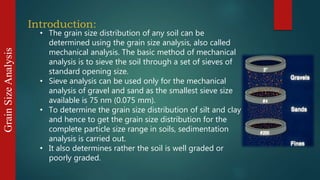
• The grain size distribution of any soil can be
determined using the grain size analysis, also called
mechanical analysis. The basic method of mechanical
analysis is to sieve the soil through a set of sieves of
standard opening size.
• Sieve analysis can be used only for the mechanical
analysis of gravel and sand as the smallest sieve size
available is 75 nm (0.075 mm).
• To determine the grain size distribution of silt and clay
and hence to get the grain size distribution for the
complete particle size range in soils, sedimentation
analysis is carried out.
• It also determines rather the soil is well graded or
poorly graded.
GrainSizeAnalysis
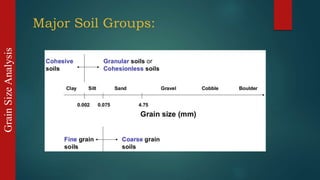
Major Soil Groups:
GrainSizeAnalysis
Apparatus:
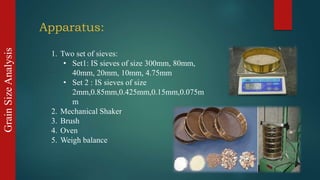
1. Two set of sieves:
• Set1: IS sieves of size 300mm, 80mm,
40mm, 20mm, 10mm, 4.75mm
• Set 2 : IS sieves of size
2mm,0.85mm,0.425mm,0.15mm,0.075m
m
2. Mechanical Shaker
3. Brush
4. Oven
5. Weigh balance
GrainSizeAnalysis
Procedure:
1. Clean the sieves of sieve shaker using cleaning brush if any particles are struck
in the openings.
2. Record the weight of each sieve and receiving pan.
3. Dry the specimen in oven for 3-4 minutes to get the dried specimen (ignore, if
the specimen is already dried).
4. Weigh the specimen and record its weight.
5. Arrange the sieves in order as the smaller openings sieve to the last and larger
openings sieve to the top. (Simply, arrange them to the ascending order of
sieve numbers – No.4 sieve on top and no.200 sieve at bottom)-
GrainSizeAnalysis
6. Keep the weight recorded specimen on the top sieve and then keep
the complete sieve stack on the sieve shaker (Don’t forget to keep
the lid and receiving pan).
7. Allow the shaker to work 10-5 minutes – use the clock here..!
8. Remove the sieve stack from the shaker and record the weight of
each sieve and receiving pan separately.
Procedure:
GrainSizeAnalysis
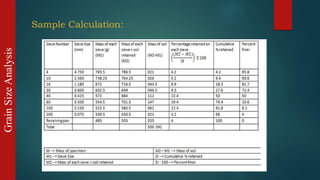
Sample Calculation:
GrainSizeAnalysis

Grain size analysis

  • 1.
  • 2.
    GrainSizeAnalysis Introduction: • The grainsize distribution of any soil can be determined using the grain size analysis, also called mechanical analysis. The basic method of mechanical analysis is to sieve the soil through a set of sieves of standard opening size. • Sieve analysis can be used only for the mechanical analysis of gravel and sand as the smallest sieve size available is 75 nm (0.075 mm). • To determine the grain size distribution of silt and clay and hence to get the grain size distribution for the complete particle size range in soils, sedimentation analysis is carried out. • It also determines rather the soil is well graded or poorly graded.
  • 3.
  • 4.
    GrainSizeAnalysis Apparatus: 1. Two setof sieves: • Set1: IS sieves of size 300mm, 80mm, 40mm, 20mm, 10mm, 4.75mm • Set 2 : IS sieves of size 2mm,0.85mm,0.425mm,0.15mm,0.075m m 2. Mechanical Shaker 3. Brush 4. Oven 5. Weigh balance
  • 5.
    GrainSizeAnalysis Procedure: 1. Clean thesieves of sieve shaker using cleaning brush if any particles are struck in the openings. 2. Record the weight of each sieve and receiving pan. 3. Dry the specimen in oven for 3-4 minutes to get the dried specimen (ignore, if the specimen is already dried). 4. Weigh the specimen and record its weight. 5. Arrange the sieves in order as the smaller openings sieve to the last and larger openings sieve to the top. (Simply, arrange them to the ascending order of sieve numbers – No.4 sieve on top and no.200 sieve at bottom)-
  • 6.
    GrainSizeAnalysis 6. Keep theweight recorded specimen on the top sieve and then keep the complete sieve stack on the sieve shaker (Don’t forget to keep the lid and receiving pan). 7. Allow the shaker to work 10-5 minutes – use the clock here..! 8. Remove the sieve stack from the shaker and record the weight of each sieve and receiving pan separately. Procedure:
  • 7.
  • 8.