Civil Engineering - Texas Tech University
CE 3121: Geotechnical Engineering Laboratory
Introduction
Moisture Content, Unit Weight, Specific Gravity
and Phase Relationships
Abdulrahman Alhabshi
Sources:
Soil Mechanics – Laboratory Manual, B.M. DAS (Chapters 2 - 3)
1
Civil Engineering - Texas Tech University
 Handouts: Syllabus, Report Format
 Class website:
http://www.classes.ce.ttu.edu/ce3121/
 Significance of the Class
 Lab No.1: Moisture Content, Specific gravity
and Unit Weight of soil
 Background: Phase Relationship
Class Outlines
2
Civil Engineering - Texas Tech University
Syllabus
 Text books:
 Soil Mechanics: Laboratory
Manual by Braja M. Das
 Lecture Notes
 ASTM Standards 2005
 Class organization
 1 hour class
 2 hours lab
 Class Schedule (No classes Oct 18 & 19)
 Attendance
3
Civil Engineering - Texas Tech University
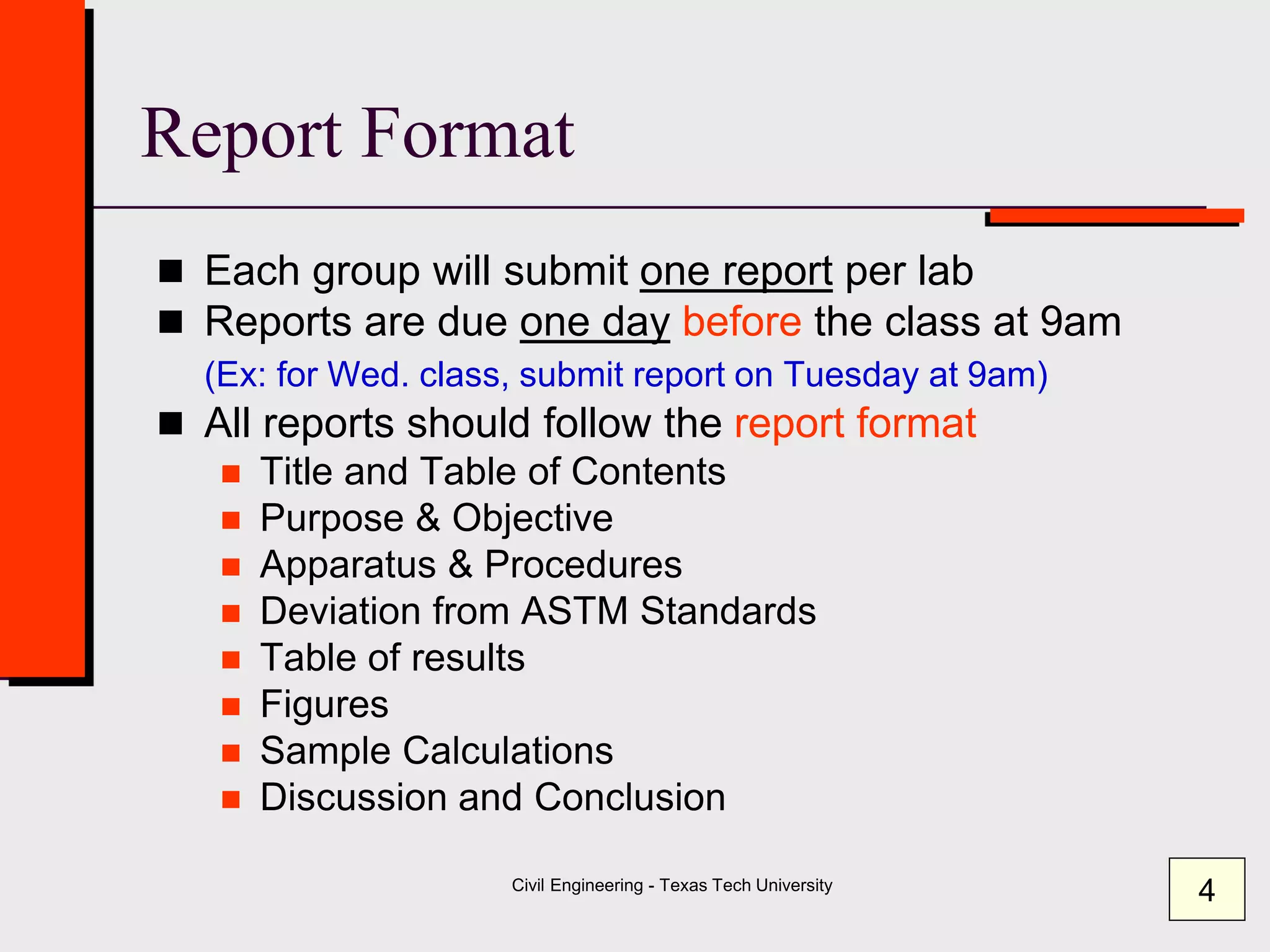
Report Format
 Each group will submit one report per lab
 Reports are due one day before the class at 9am
(Ex: for Wed. class, submit report on Tuesday at 9am)
 All reports should follow the report format
 Title and Table of Contents
 Purpose & Objective
 Apparatus & Procedures
 Deviation from ASTM Standards
 Table of results
 Figures
 Sample Calculations
 Discussion and Conclusion
4
Civil Engineering - Texas Tech University
Report Format - Conclusion
 Report your results (use a table)
 Do the results fall within the expected range
or not?
(Check tables and match your results)
 If not, Explain why (what went wrong?)
5
Civil Engineering - Texas Tech University
Significance of this Class
 Why do you need to learn about soils?
Almost all structures are either constructed
of soil, supported on soil, or both.
 Who must be concerned with soils?
Civil engineers (structural, environmental and
geotechnical) must have basic understanding
of the soil properties in order to use them
effectively in construction.
6
Civil Engineering - Texas Tech University
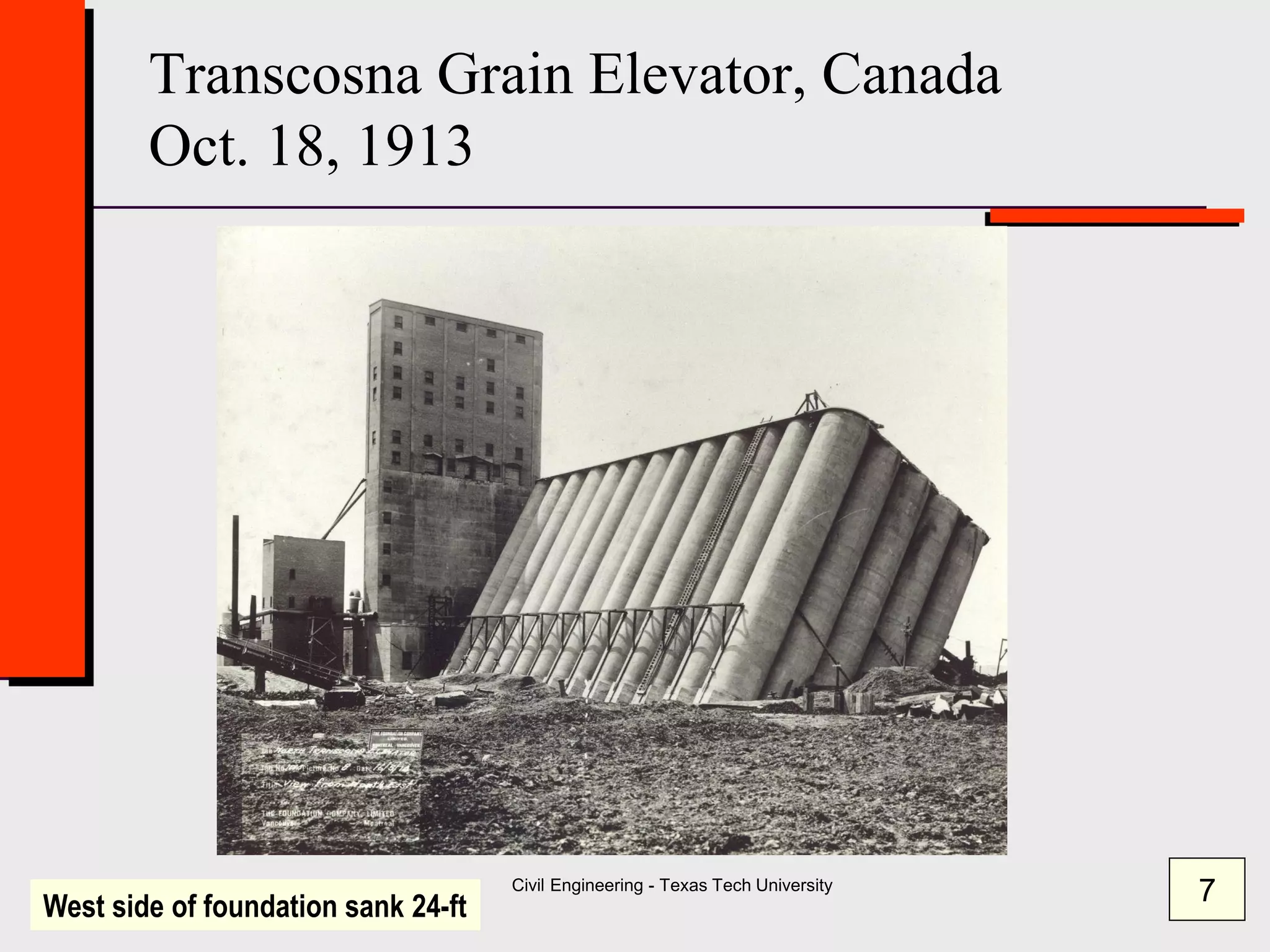
Transcosna Grain Elevator, Canada
Oct. 18, 1913
West side of foundation sank 24-ft 7
Civil Engineering - Texas Tech University
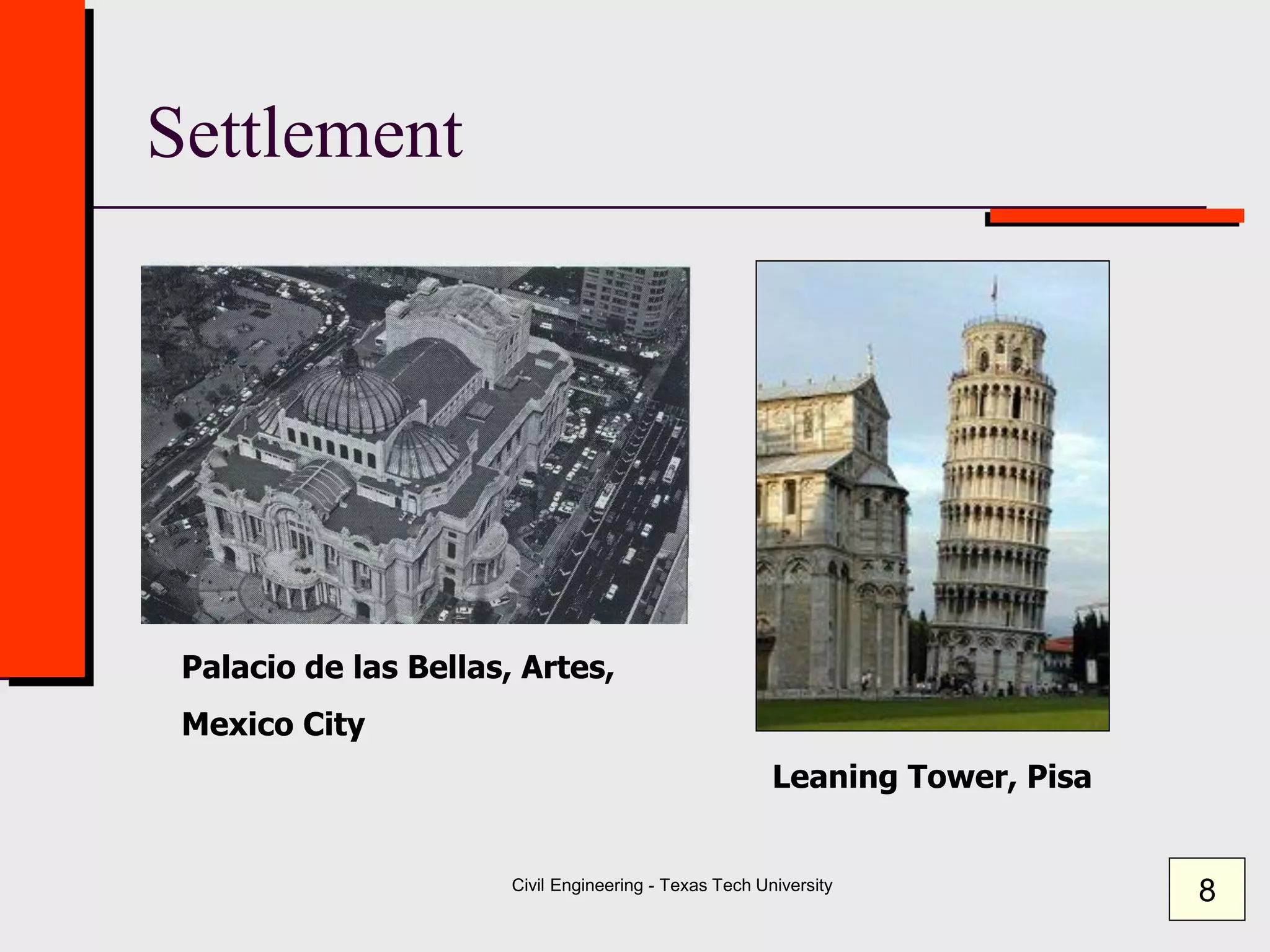
Settlement
Palacio de las Bellas, Artes,
Mexico City
Leaning Tower, Pisa
8
Civil Engineering - Texas Tech University
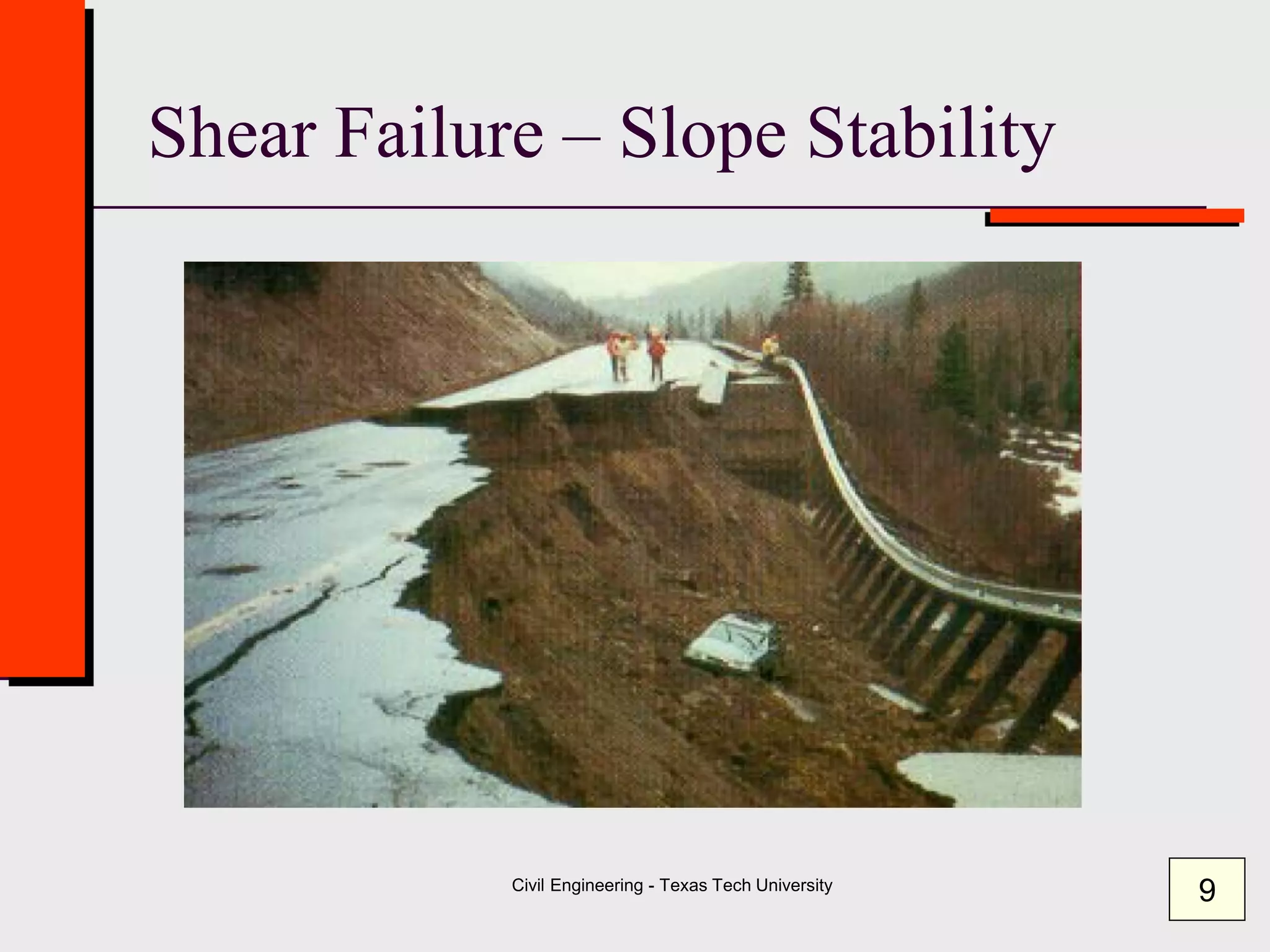
Shear Failure – Slope Stability
9
Civil Engineering - Texas Tech University
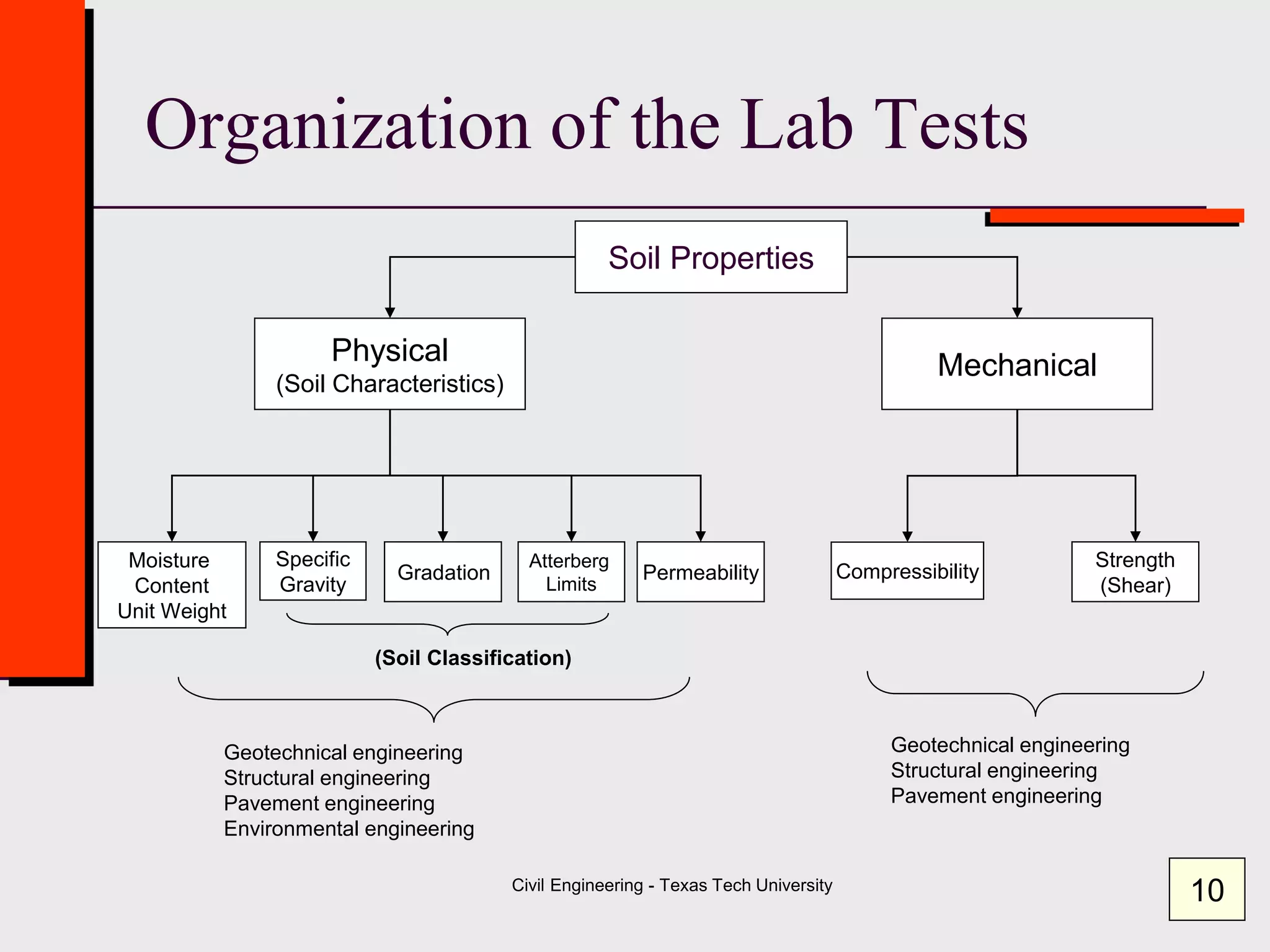
Organization of the Lab Tests
Physical
(Soil Characteristics)
Mechanical
Moisture
Content
Unit Weight
CompressibilityPermeability
Specific
Gravity
Gradation
Atterberg
Limits
Strength
(Shear)
Geotechnical engineering
Structural engineering
Pavement engineering
Environmental engineering
Geotechnical engineering
Structural engineering
Pavement engineering
Soil Properties
(Soil Classification)
10
Civil Engineering - Texas Tech University
Today’s Lab
 Determination of unit weight (density)
 Determination of moisture content
 Determination of specific gravity
 Establishing the phase (weight-volume)
relationship diagram
 Calculation of:
 Dry unit weight
 Void ratio
 Porosity
 Degree of saturation
11
Civil Engineering - Texas Tech University
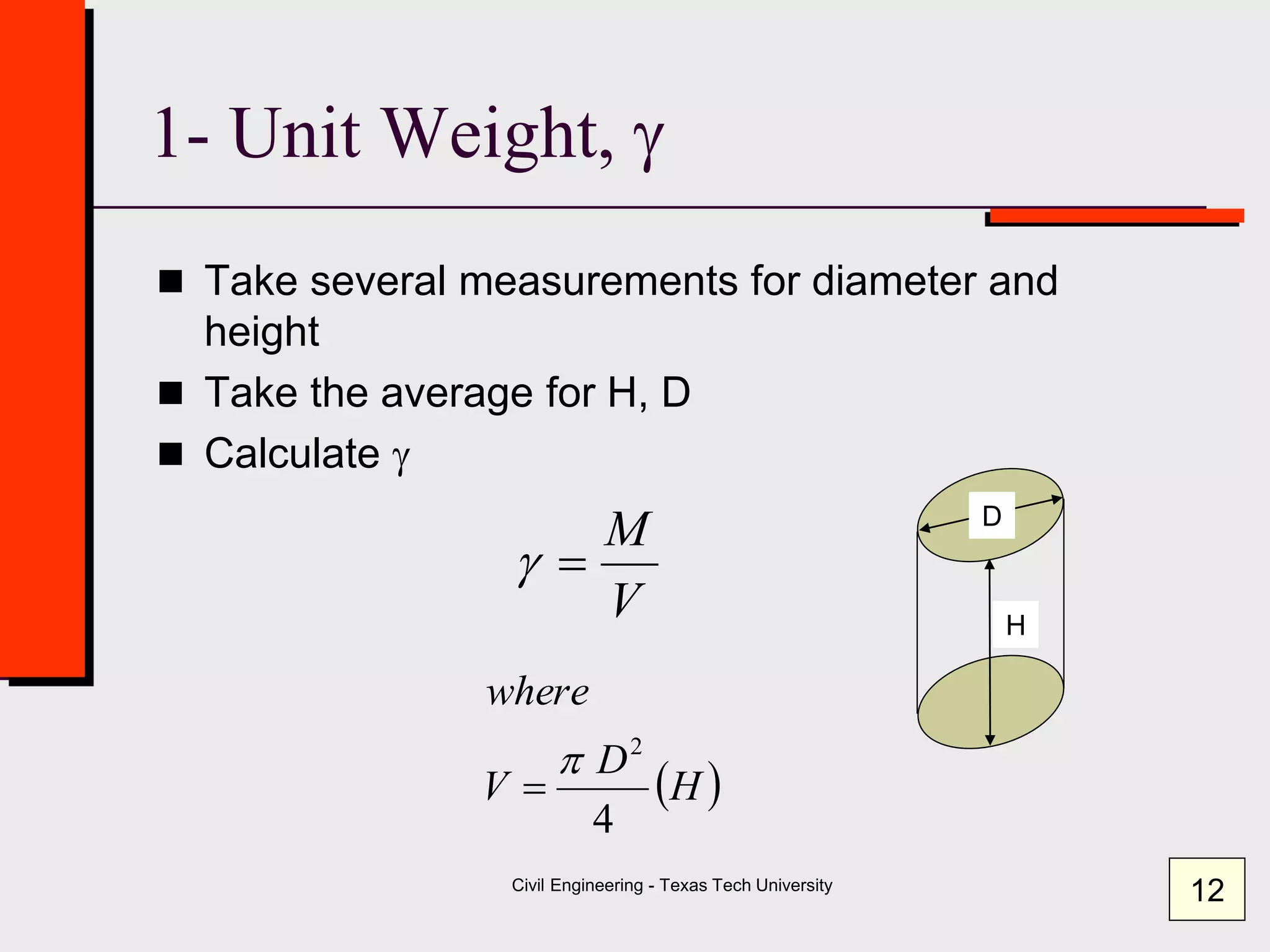
1- Unit Weight, g
 Take several measurements for diameter and
height
 Take the average for H, D
 Calculate g
V
M
g
 H
D
V
where
4
2


H
D
12
Civil Engineering - Texas Tech University
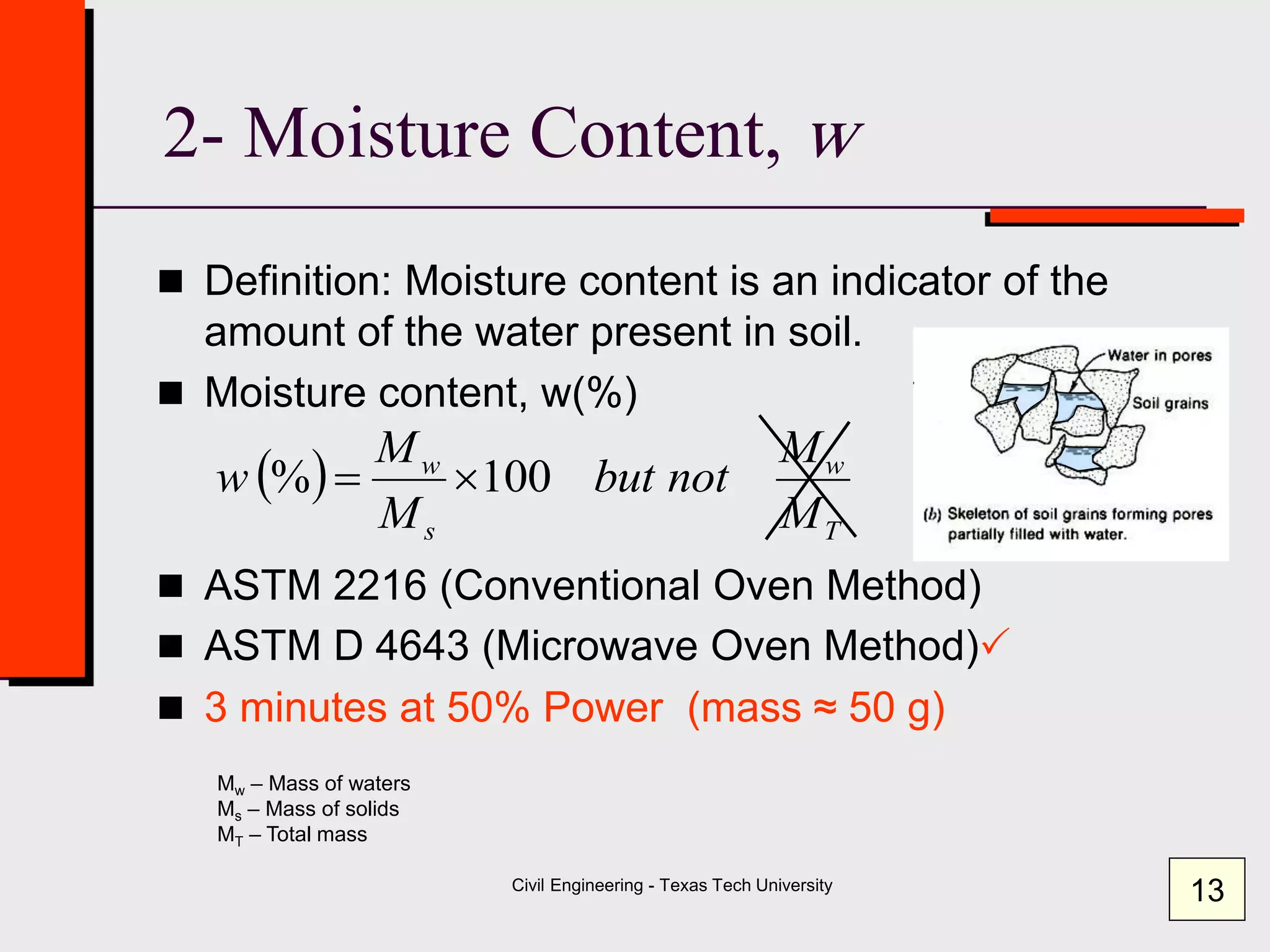
2- Moisture Content, w
 Definition: Moisture content is an indicator of the
amount of the water present in soil.
 Moisture content, w(%)
 ASTM 2216 (Conventional Oven Method)
 ASTM D 4643 (Microwave Oven Method)
 3 minutes at 50% Power (mass ≈ 50 g)
 
T
w
s
w
M
M
notbut
M
M
w 100% 
Mw – Mass of waters
Ms – Mass of solids
MT – Total mass
13
Civil Engineering - Texas Tech University
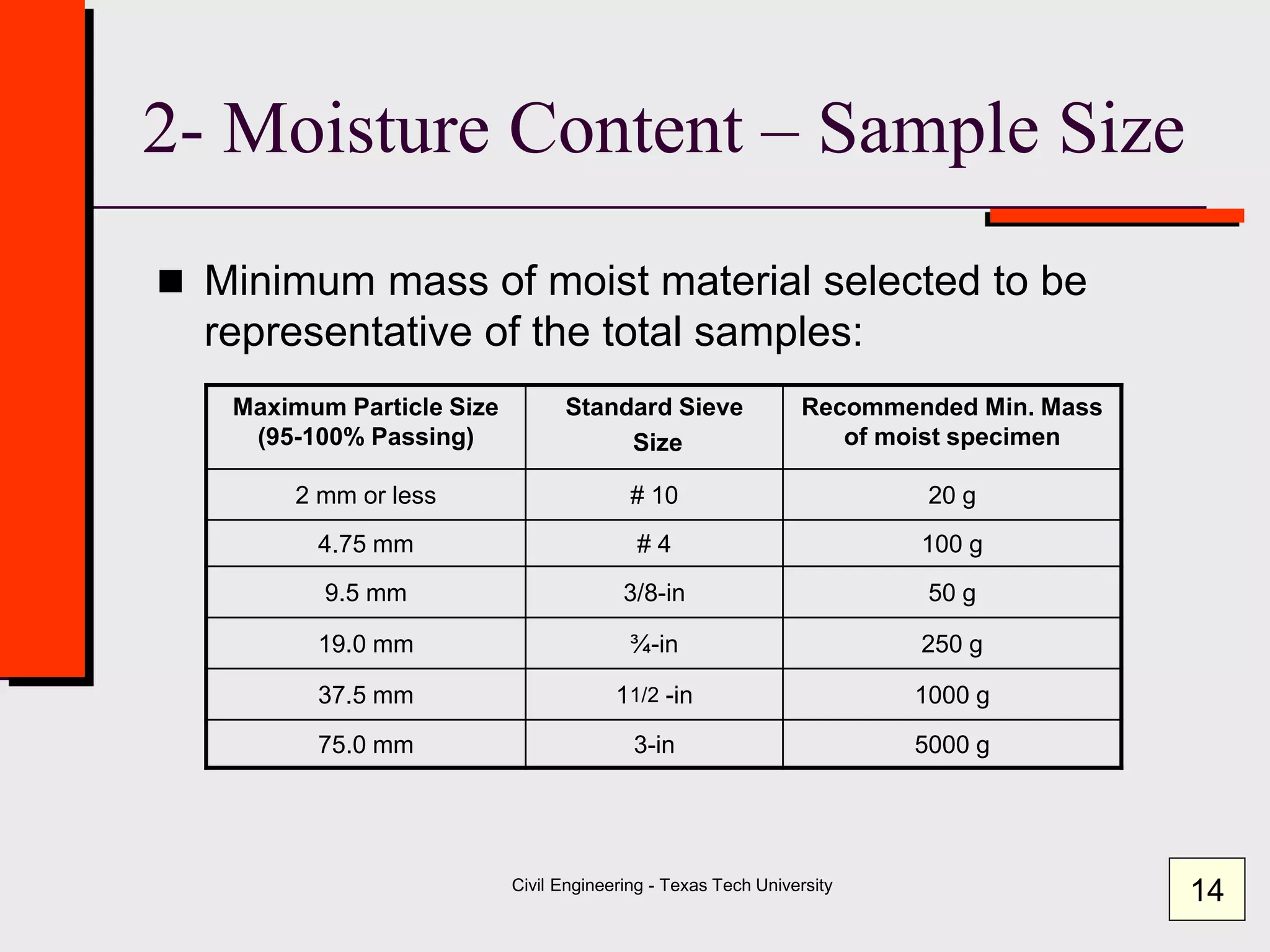
2- Moisture Content – Sample Size
 Minimum mass of moist material selected to be
representative of the total samples:
Maximum Particle Size
(95-100% Passing)
Standard Sieve
Size
Recommended Min. Mass
of moist specimen
2 mm or less # 10 20 g
4.75 mm # 4 100 g
9.5 mm 3/8-in 50 g
19.0 mm ¾-in 250 g
37.5 mm 11/2 -in 1000 g
75.0 mm 3-in 5000 g
14
Civil Engineering - Texas Tech University
2- Moisture Content - Procedure
Video Demos
Civil Engineering - Texas Tech University
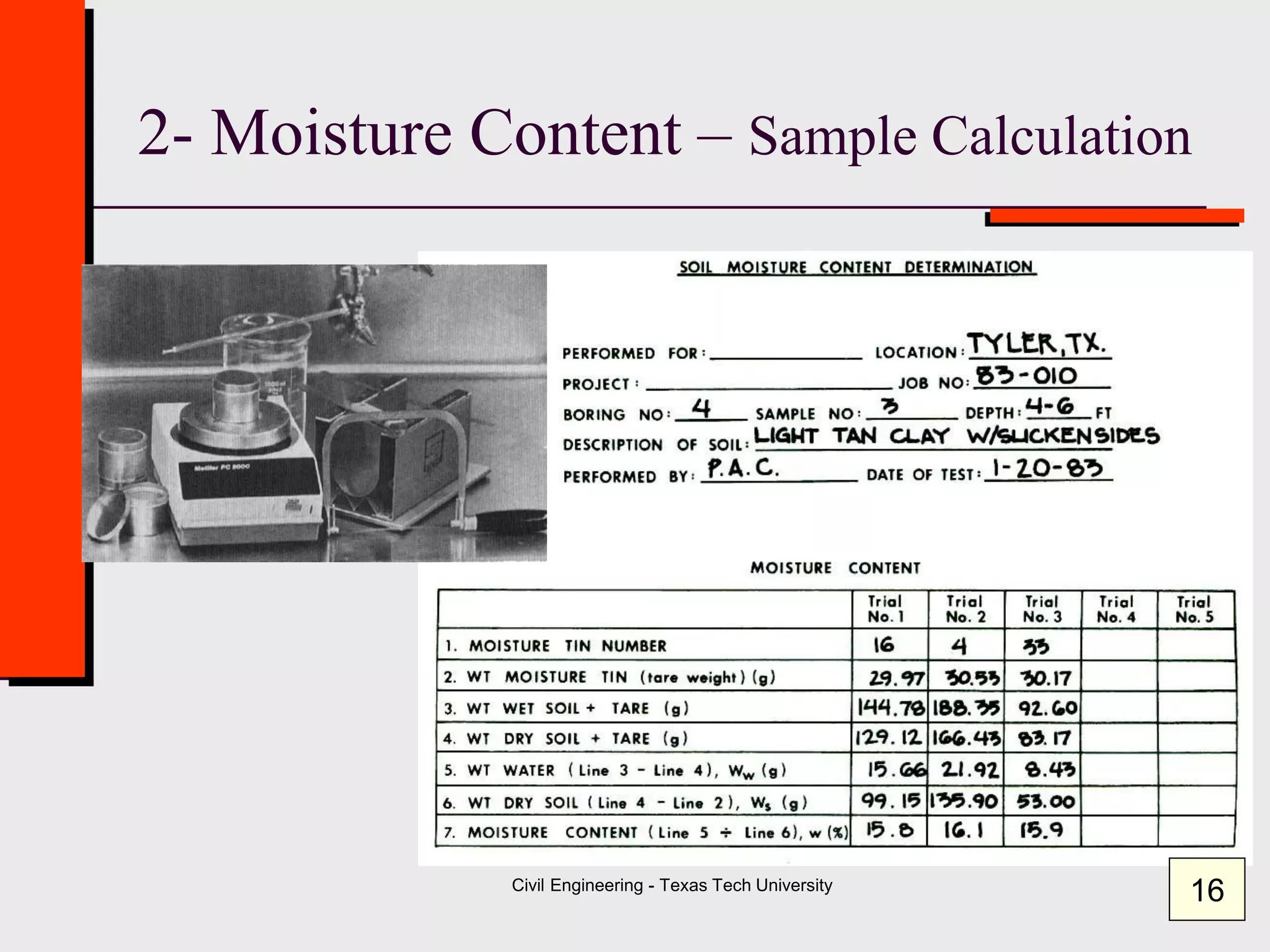
2- Moisture Content – Sample Calculation
16
Civil Engineering - Texas Tech University
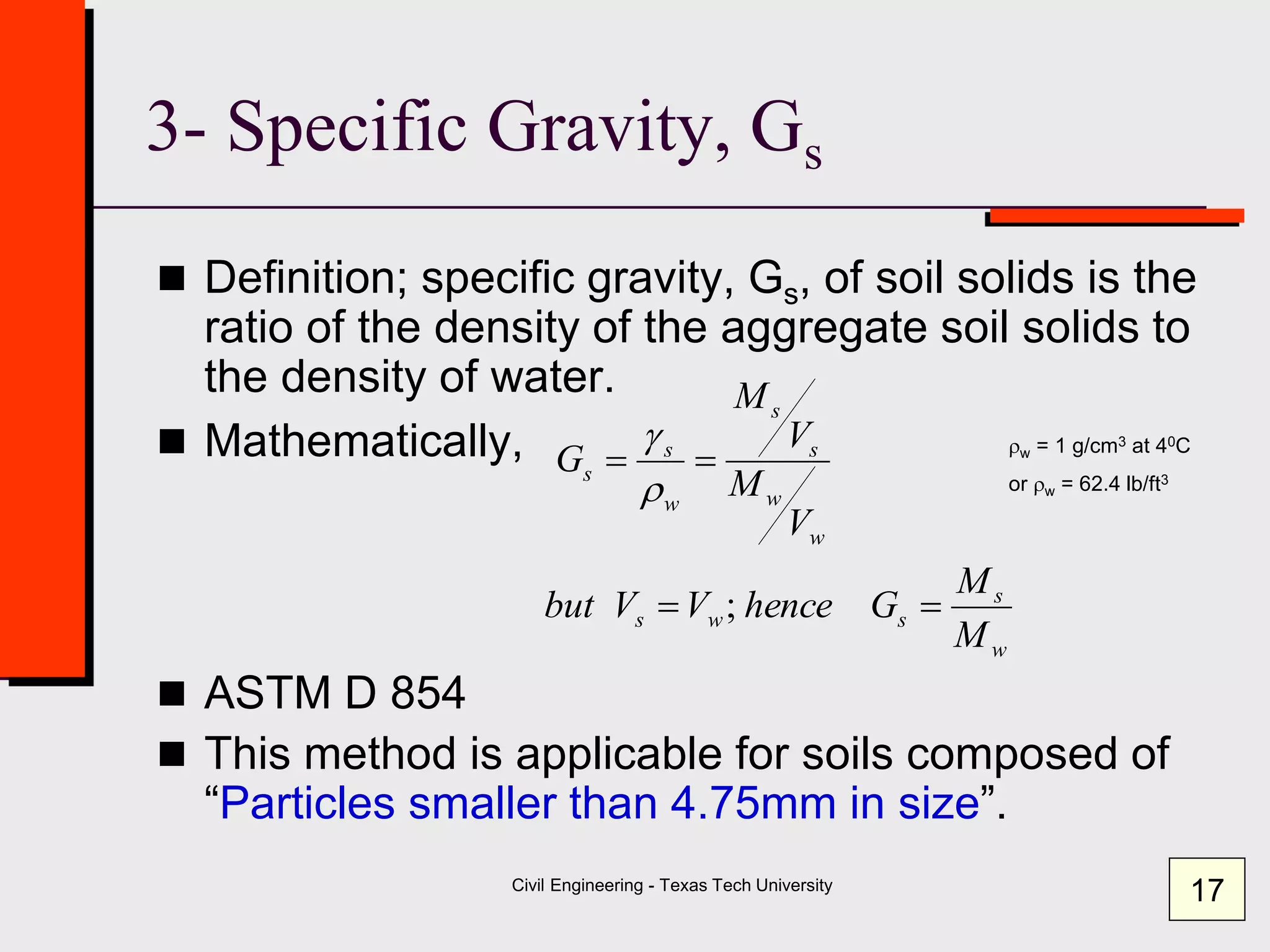
3- Specific Gravity, Gs
 Definition; specific gravity, Gs, of soil solids is the
ratio of the density of the aggregate soil solids to
the density of water.
 Mathematically,
 ASTM D 854
 This method is applicable for soils composed of
“Particles smaller than 4.75mm in size”.
w
s
sws
w
w
s
s
w
s
s
M
M
GhenceVVbut
V
M
V
M
G


;

g w = 1 g/cm3 at 40C
or w = 62.4 lb/ft3
17
Civil Engineering - Texas Tech University
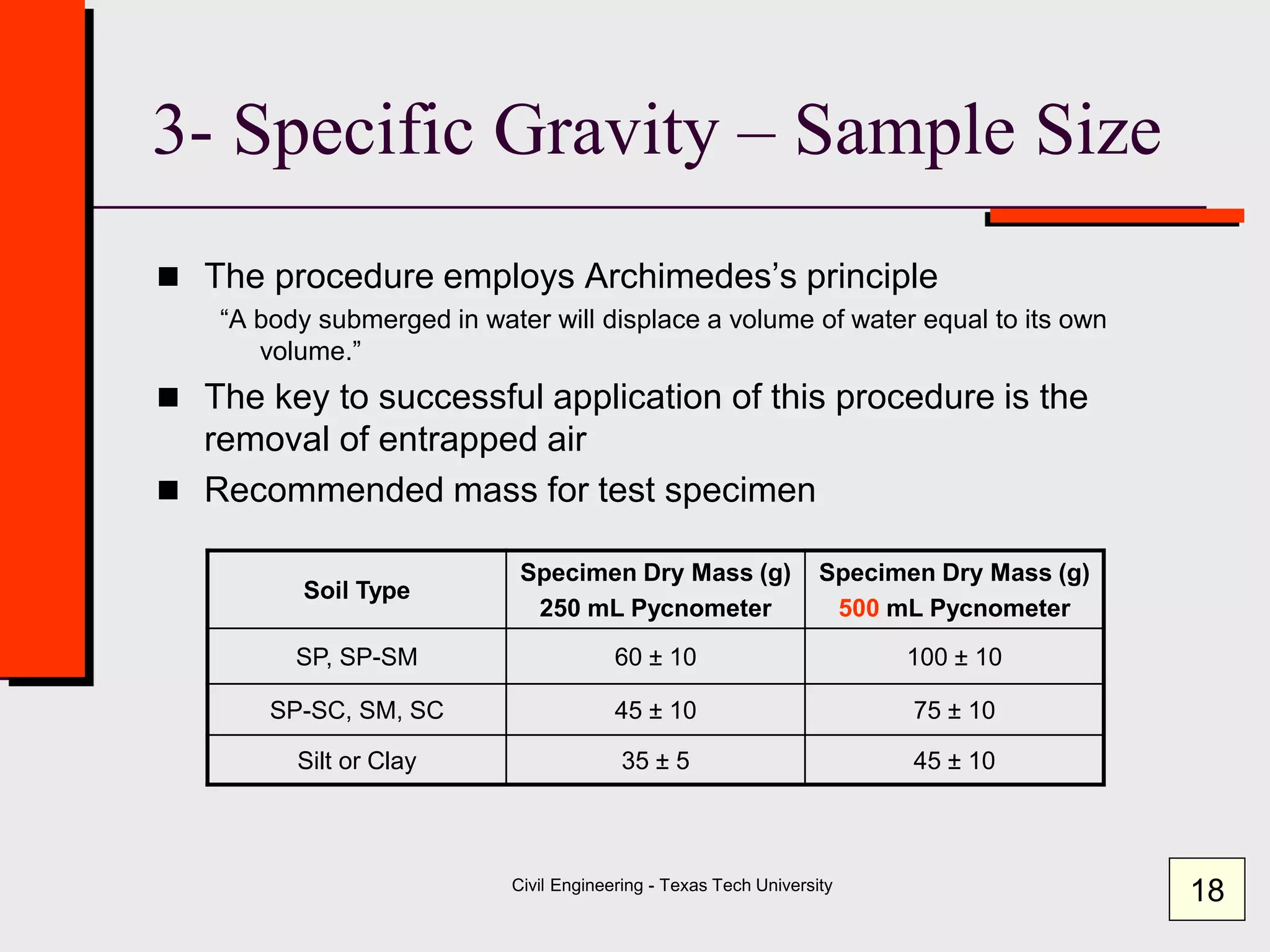
3- Specific Gravity – Sample Size
 The procedure employs Archimedes’s principle
“A body submerged in water will displace a volume of water equal to its own
volume.”
 The key to successful application of this procedure is the
removal of entrapped air
 Recommended mass for test specimen
Soil Type
Specimen Dry Mass (g)
250 mL Pycnometer
Specimen Dry Mass (g)
500 mL Pycnometer
SP, SP-SM 60 ± 10 100 ± 10
SP-SC, SM, SC 45 ± 10 75 ± 10
Silt or Clay 35 ± 5 45 ± 10
18
Civil Engineering - Texas Tech University
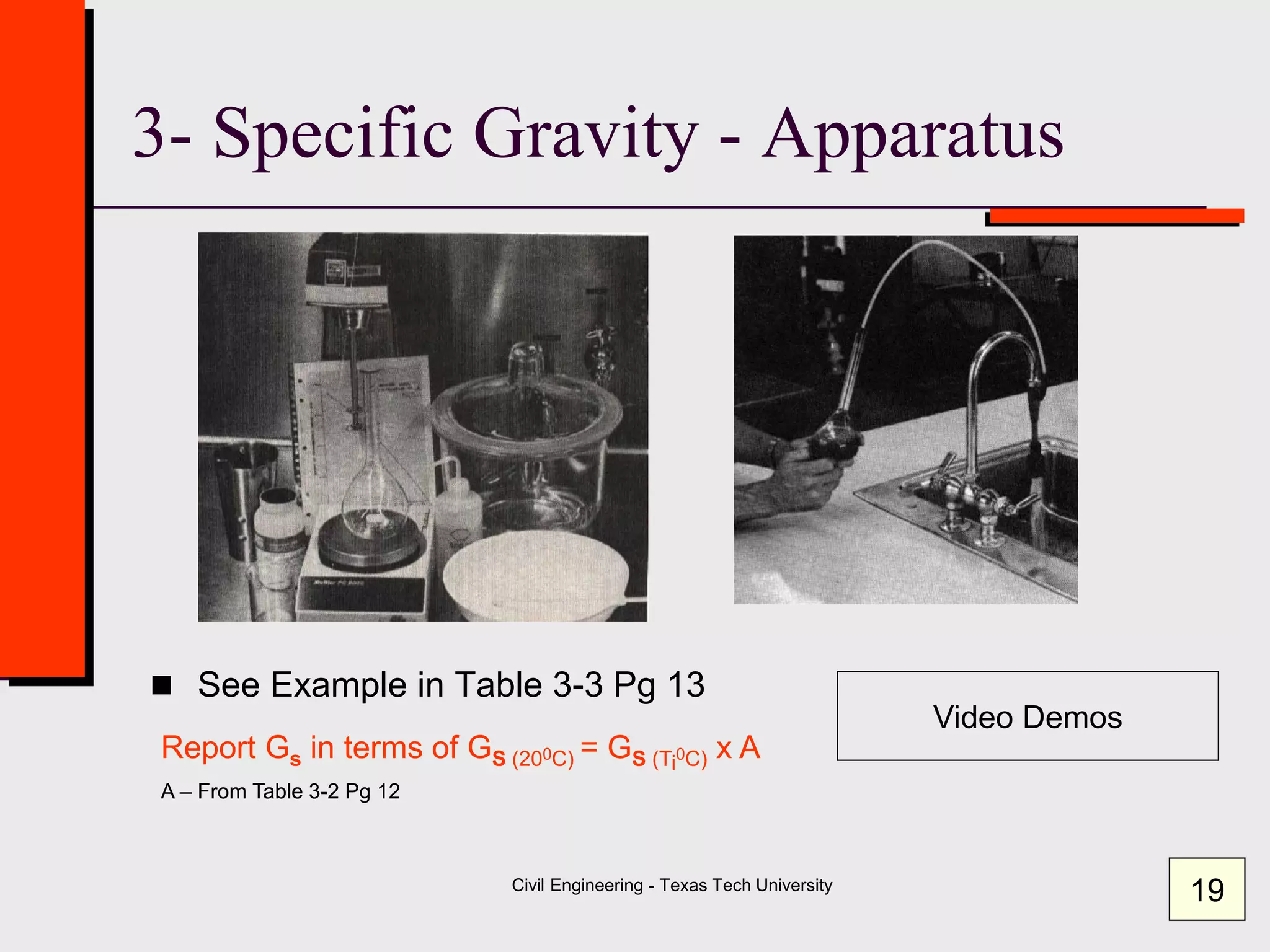
3- Specific Gravity - Apparatus
Report Gs in terms of GS (200C) = GS (Ti0C) x A
A – From Table 3-2 Pg 12
 See Example in Table 3-3 Pg 13
19
Video Demos
Civil Engineering - Texas Tech University
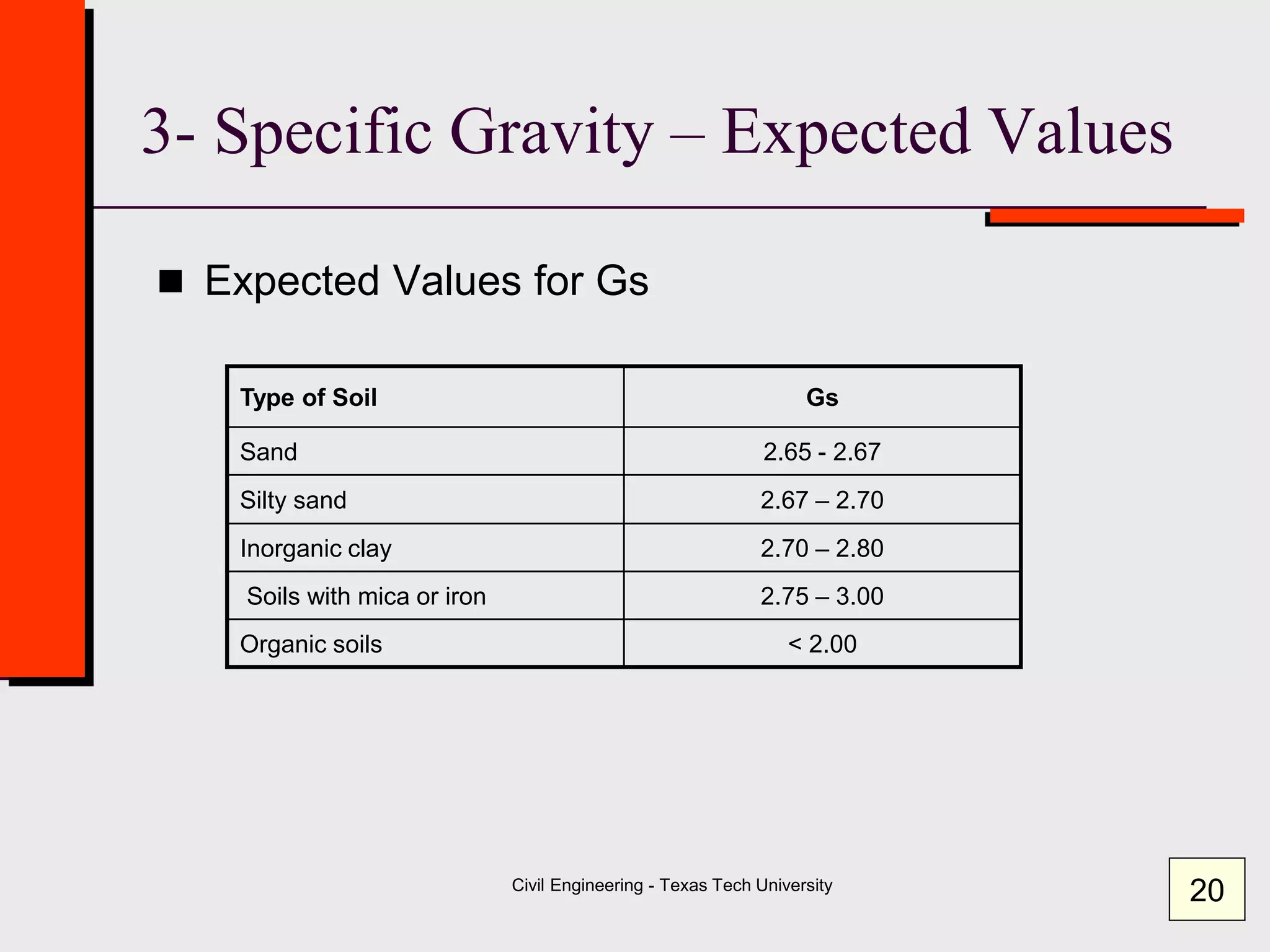
3- Specific Gravity – Expected Values
 Expected Values for Gs
Type of Soil Gs
Sand 2.65 - 2.67
Silty sand 2.67 – 2.70
Inorganic clay 2.70 – 2.80
Soils with mica or iron 2.75 – 3.00
Organic soils < 2.00
20
Civil Engineering - Texas Tech University
 Phase Relationships
 Three phase diagram
 Weight relationships
 Volumetric relationships
 Weight – Volume relationship
 Examples
Phase Relationships
21
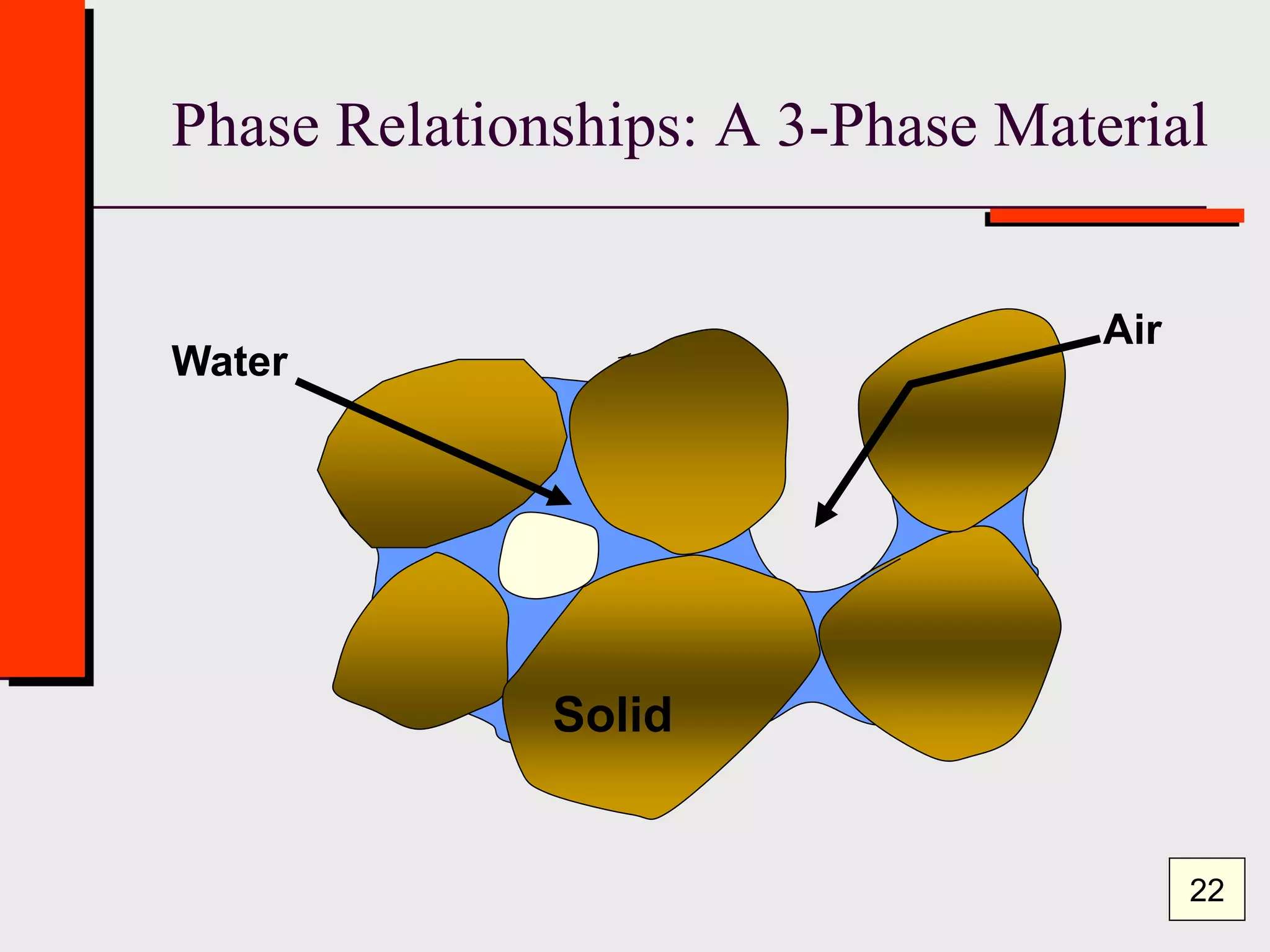
Phase Relationships: A 3-Phase Material
Solid
Water
Air
22
Civil Engineering - Texas Tech University
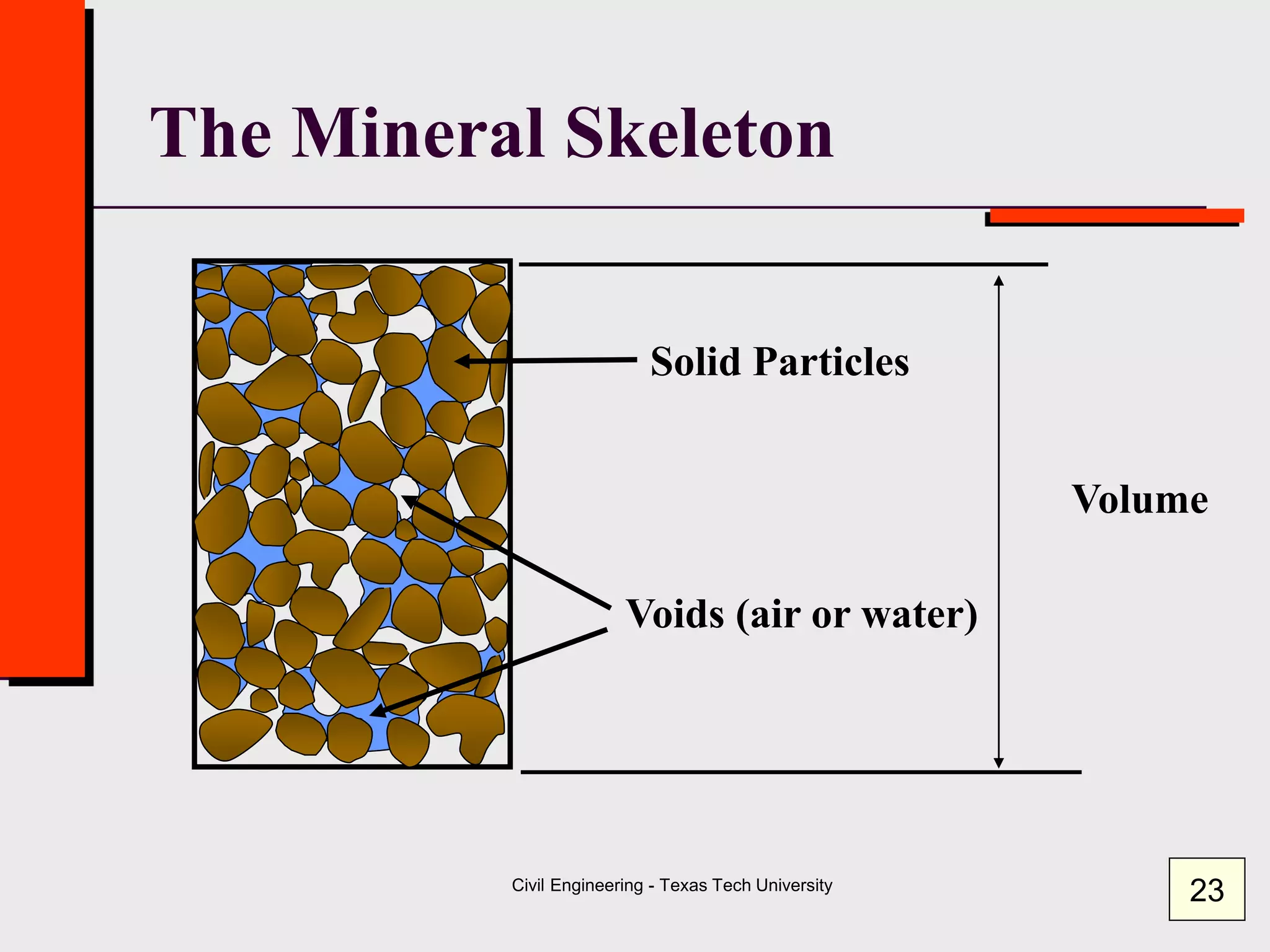
The Mineral Skeleton
Volume
Solid Particles
Voids (air or water)
23
Civil Engineering - Texas Tech University
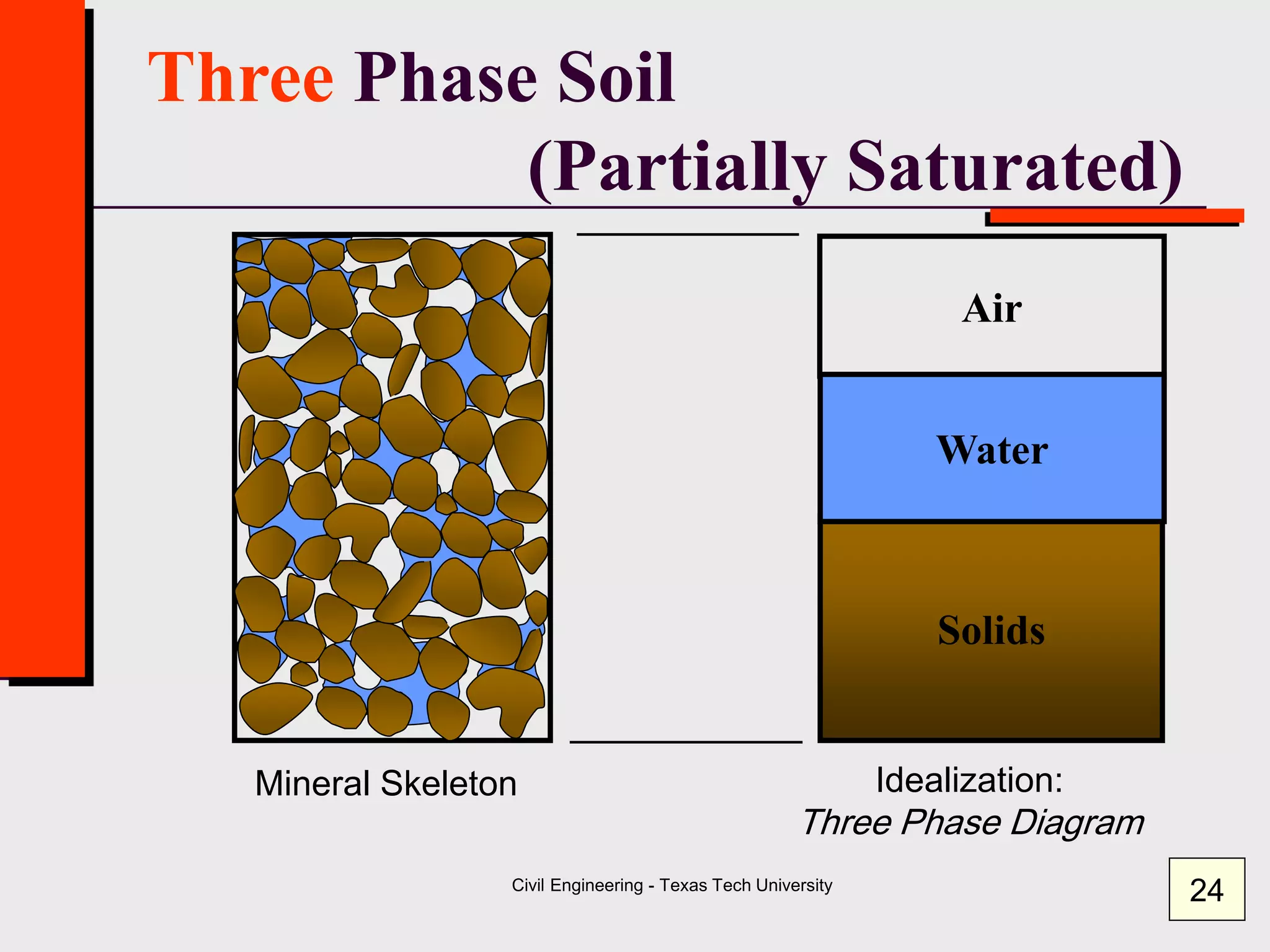
Three Phase Soil
(Partially Saturated)
Solids
Air
Water
Mineral Skeleton Idealization:
Three Phase Diagram
24
Civil Engineering - Texas Tech University
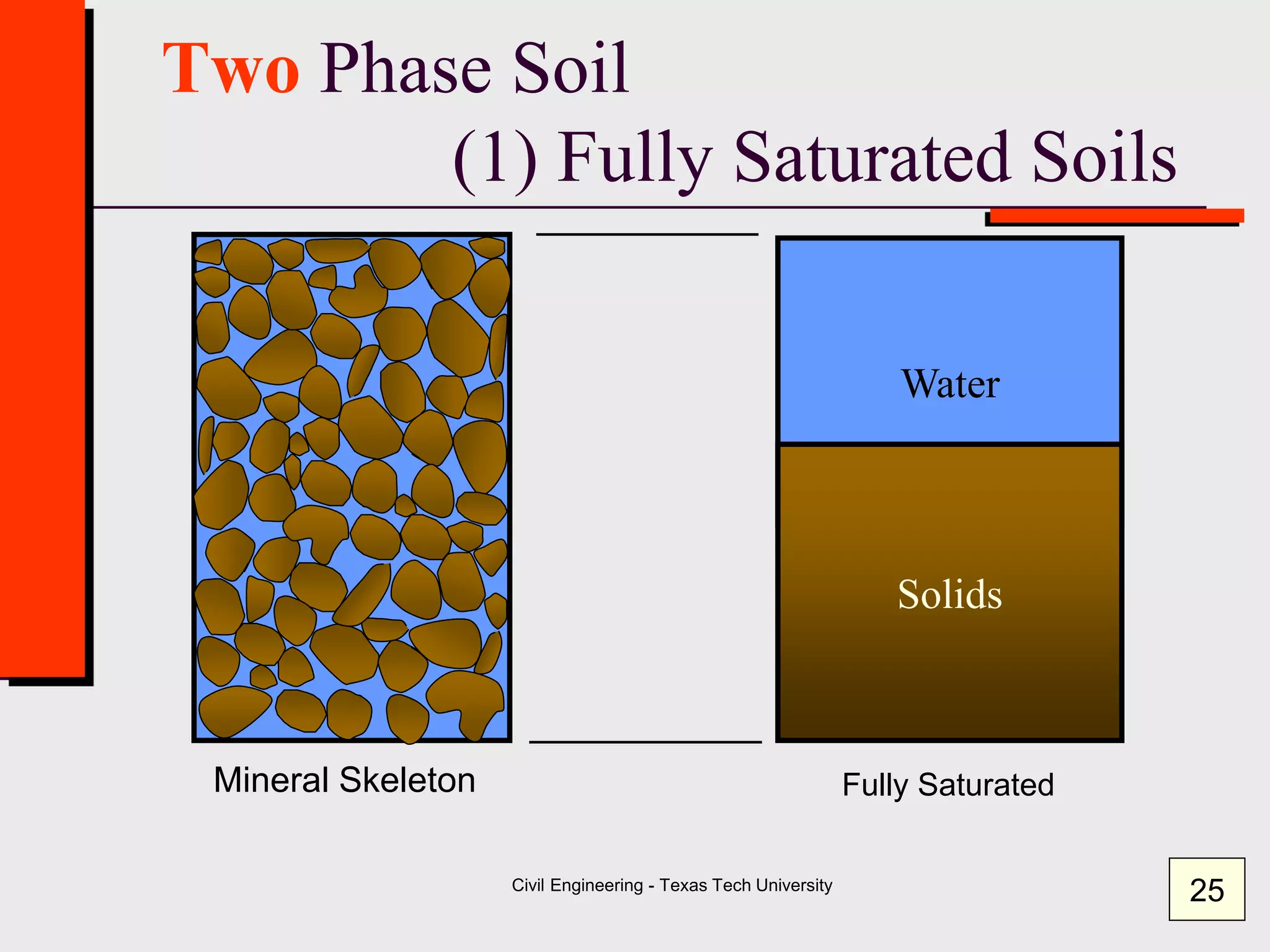
Two Phase Soil
(1) Fully Saturated Soils
Fully Saturated
Water
Solids
Mineral Skeleton
25
Civil Engineering - Texas Tech University
Two Phase Soil
(2) Dry Soils [Oven Dried]
Mineral Skeleton Dry Soil
Air
Solids
26
Civil Engineering - Texas Tech University
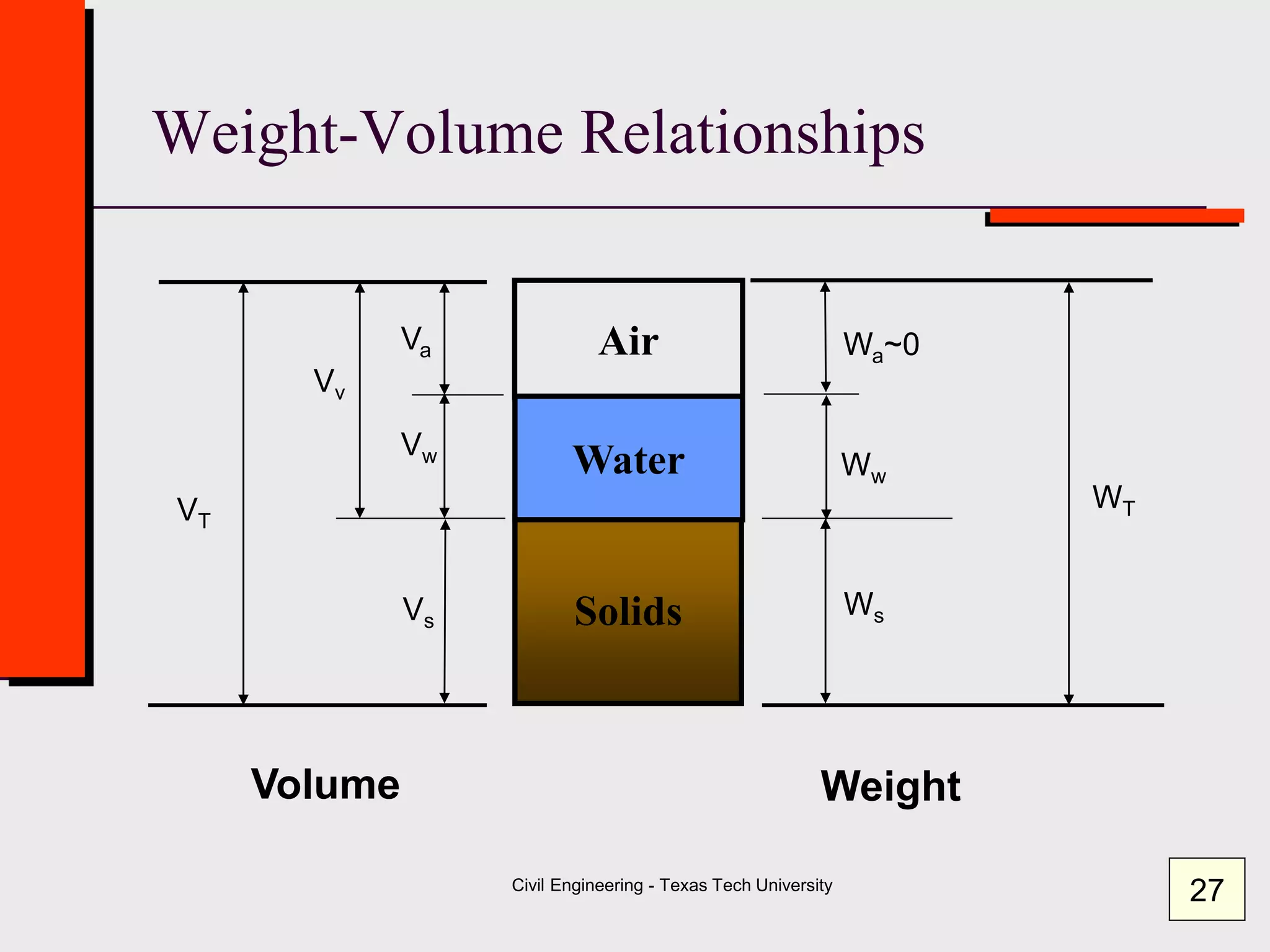
Weight-Volume Relationships
Volume Weight
Solids
Air
Water
WT
Ws
Ww
Wa~0
Vs
Va
Vw
Vv
VT
27
Civil Engineering - Texas Tech University
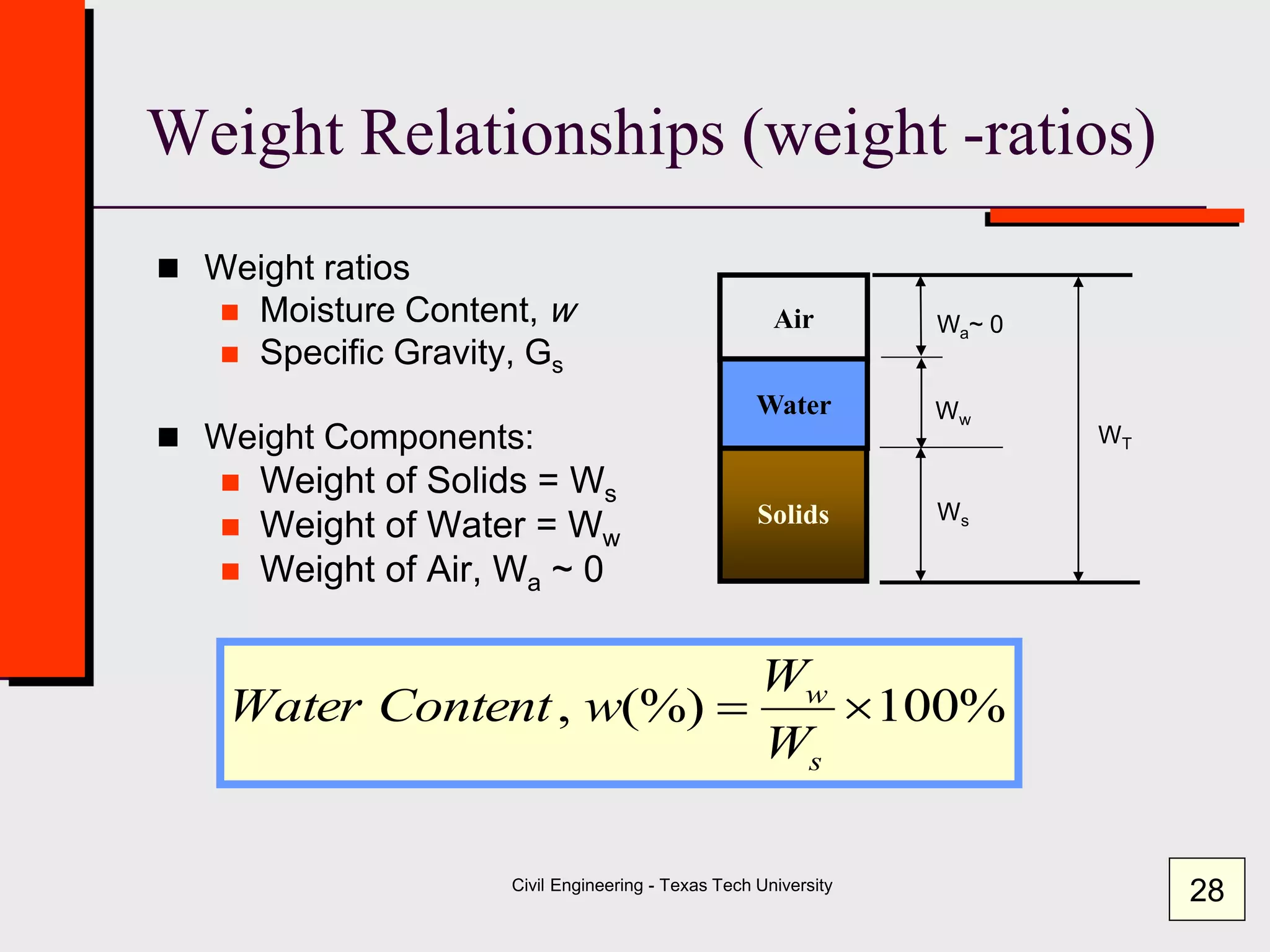
Weight Relationships (weight -ratios)
 Weight ratios
 Moisture Content, w
 Specific Gravity, Gs
 Weight Components:
 Weight of Solids = Ws
 Weight of Water = Ww
 Weight of Air, Wa ~ 0
%100(%), 
s
w
W
W
wContentWater
Solids
Air
Water
WT
Ws
Ww
Wa~ 0
28
Civil Engineering - Texas Tech University
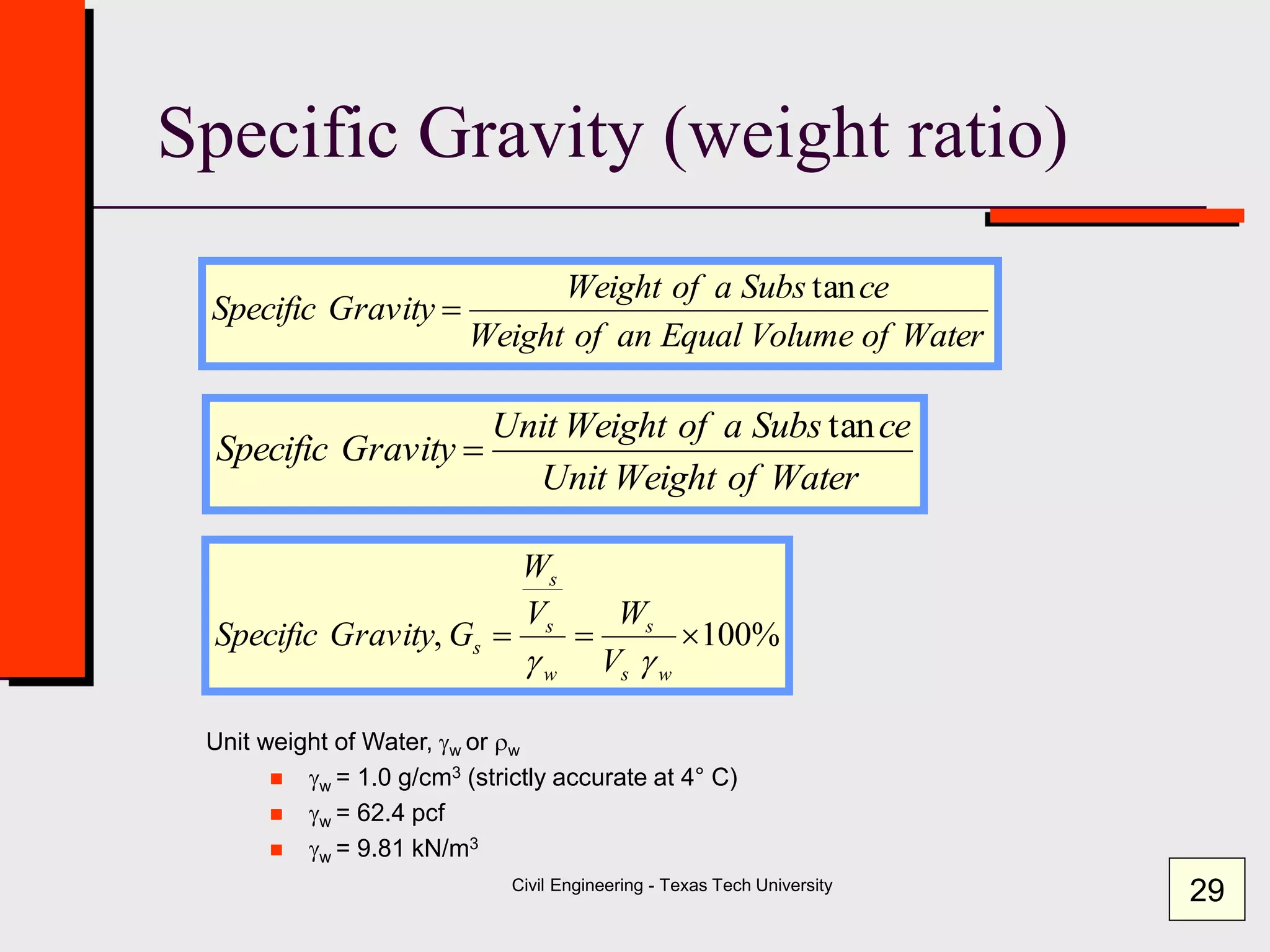
Specific Gravity (weight ratio)
WaterofVolumeEqualanofWeight
ceSubsaofWeight
GravitySpecific
tan

WaterofWeightUnit
ceSubsaofWeightUnit
GravitySpecific
tan

%100, 
ws
s
w
s
s
s
V
WV
W
GGravitySpecific
gg
Unit weight of Water, gw or w
 gw = 1.0 g/cm3 (strictly accurate at 4° C)
 gw = 62.4 pcf
 gw = 9.81 kN/m3
29
Civil Engineering - Texas Tech University
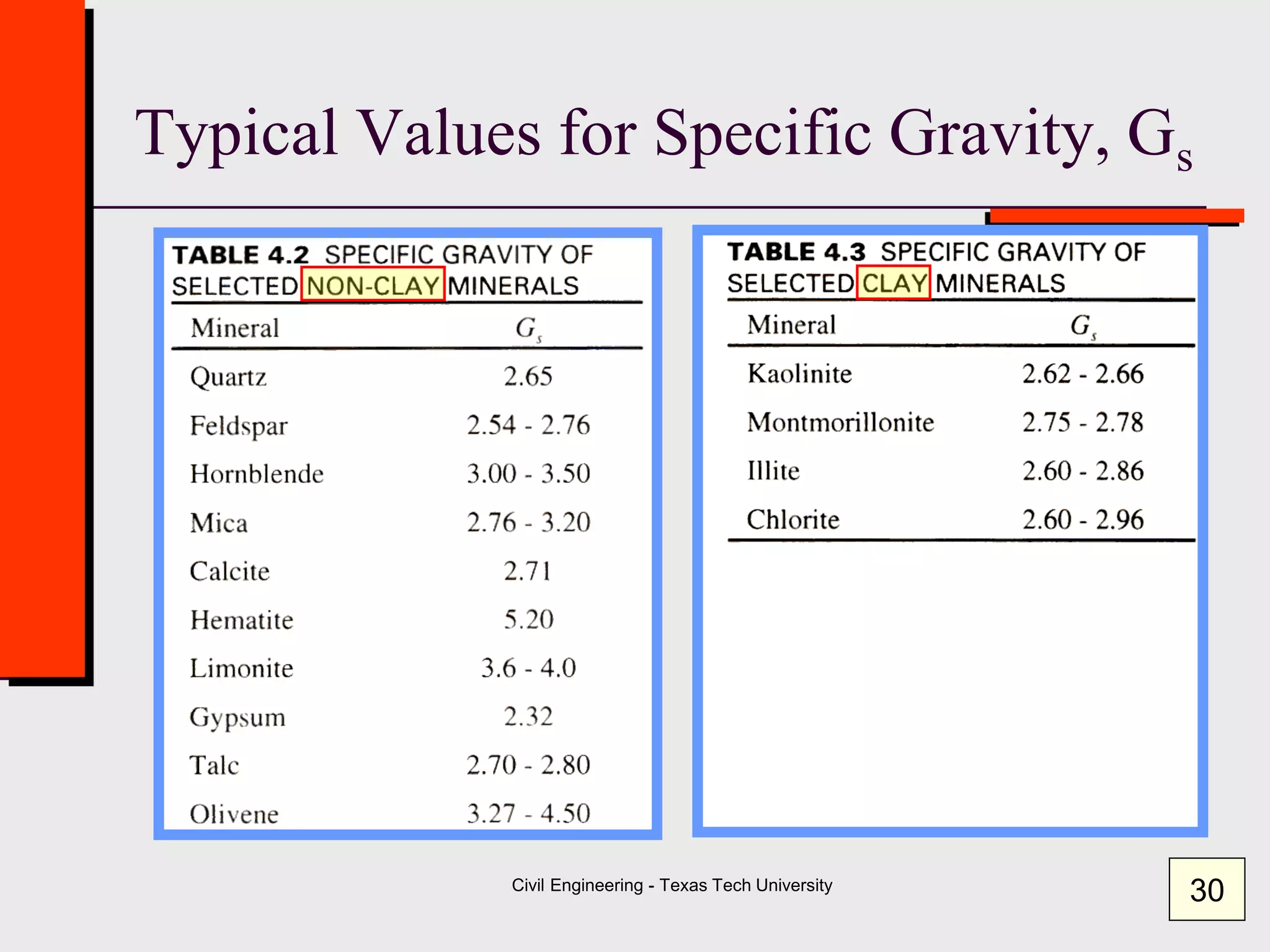
Typical Values for Specific Gravity, Gs
30
Civil Engineering - Texas Tech University
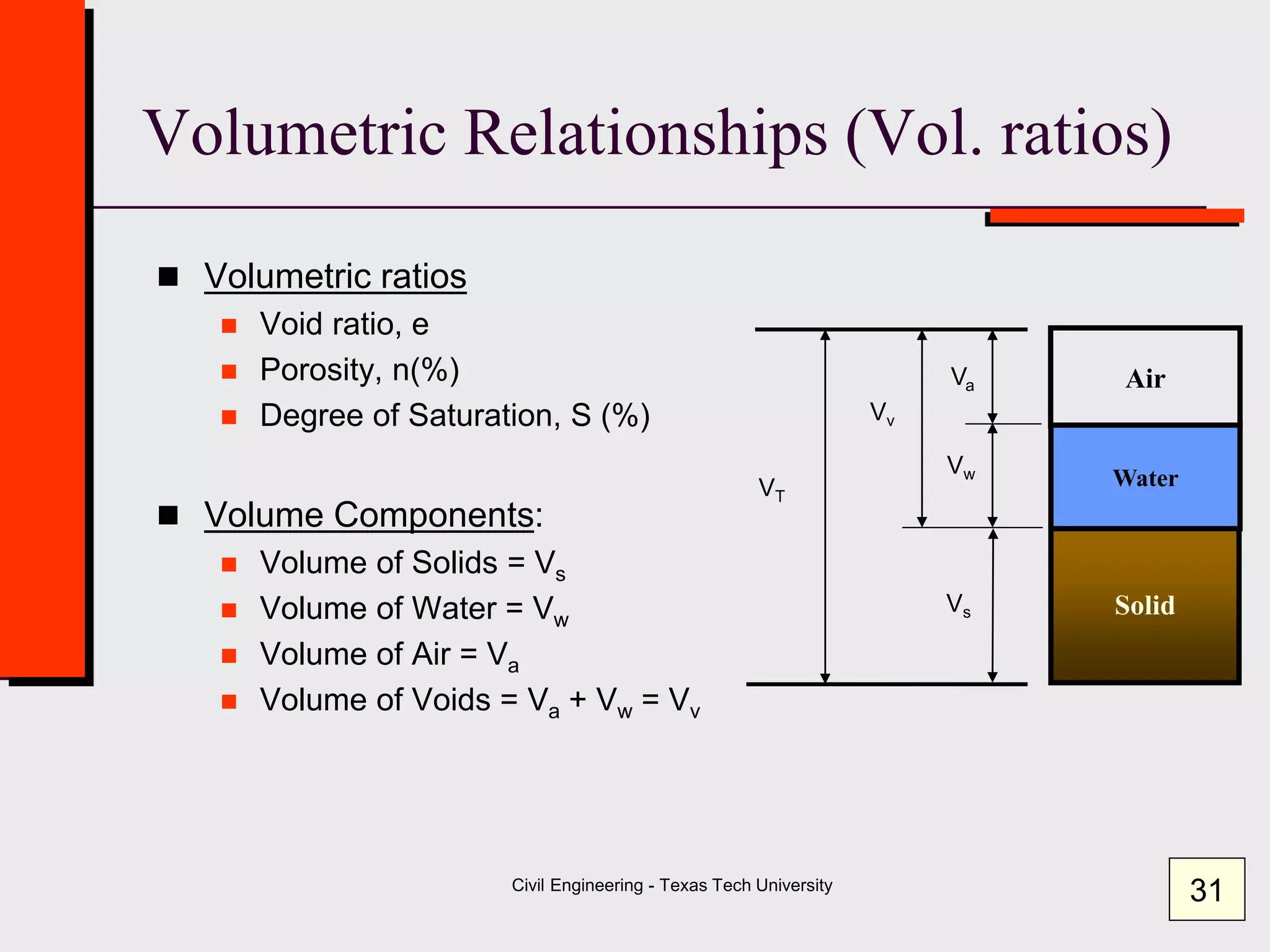
Volumetric Relationships (Vol. ratios)
 Volumetric ratios
 Void ratio, e
 Porosity, n(%)
 Degree of Saturation, S (%)
 Volume Components:
 Volume of Solids = Vs
 Volume of Water = Vw
 Volume of Air = Va
 Volume of Voids = Va + Vw = Vv
Solid
Air
Water
Vs
Va
Vw
Vv
VT
31
Civil Engineering - Texas Tech University
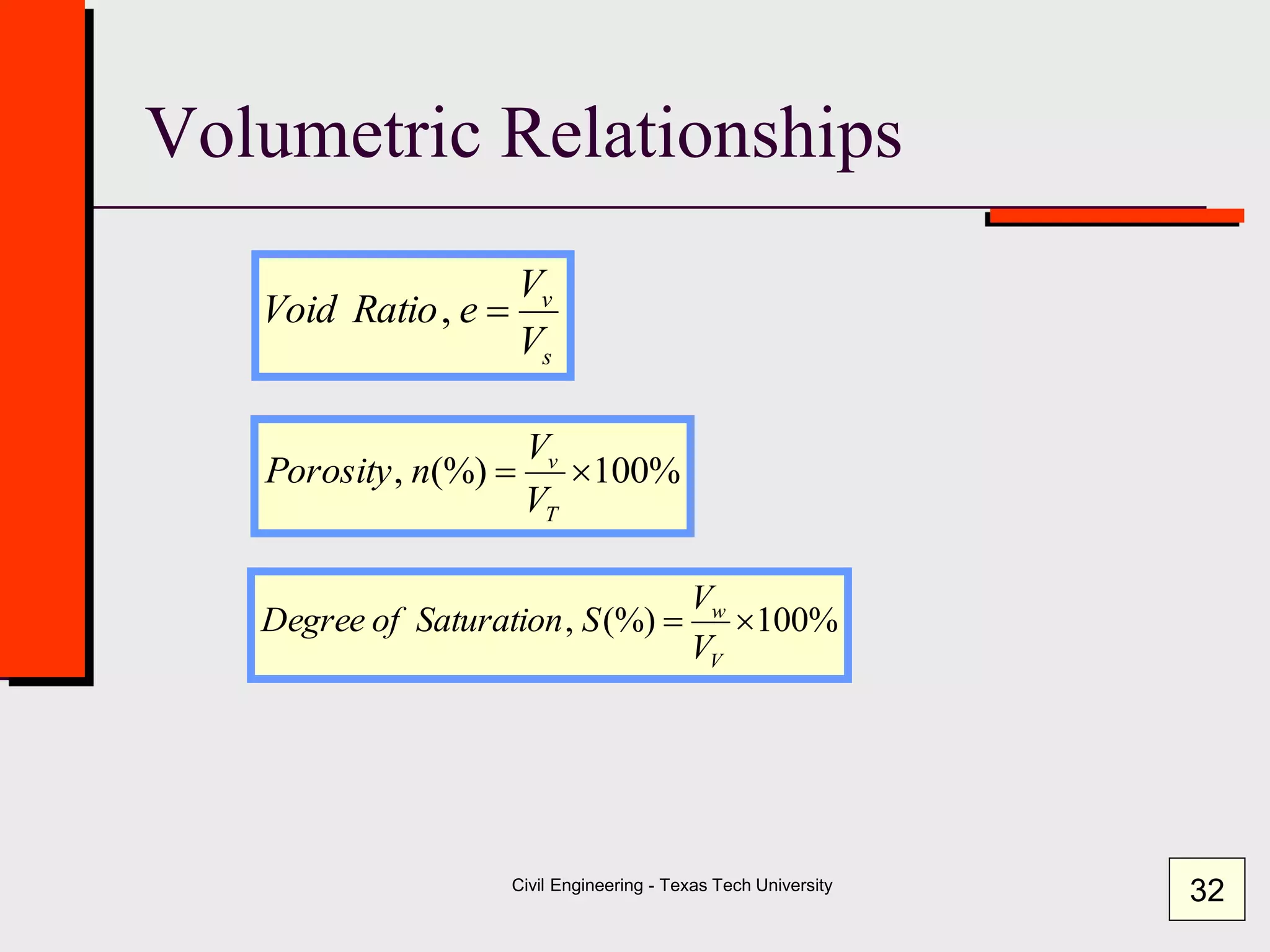
Volumetric Relationships
s
v
V
V
eRatioVoid ,
%100(%), 
V
w
V
V
SSaturationofDegree
%100(%), 
T
v
V
V
nPorosity
32
Civil Engineering - Texas Tech University
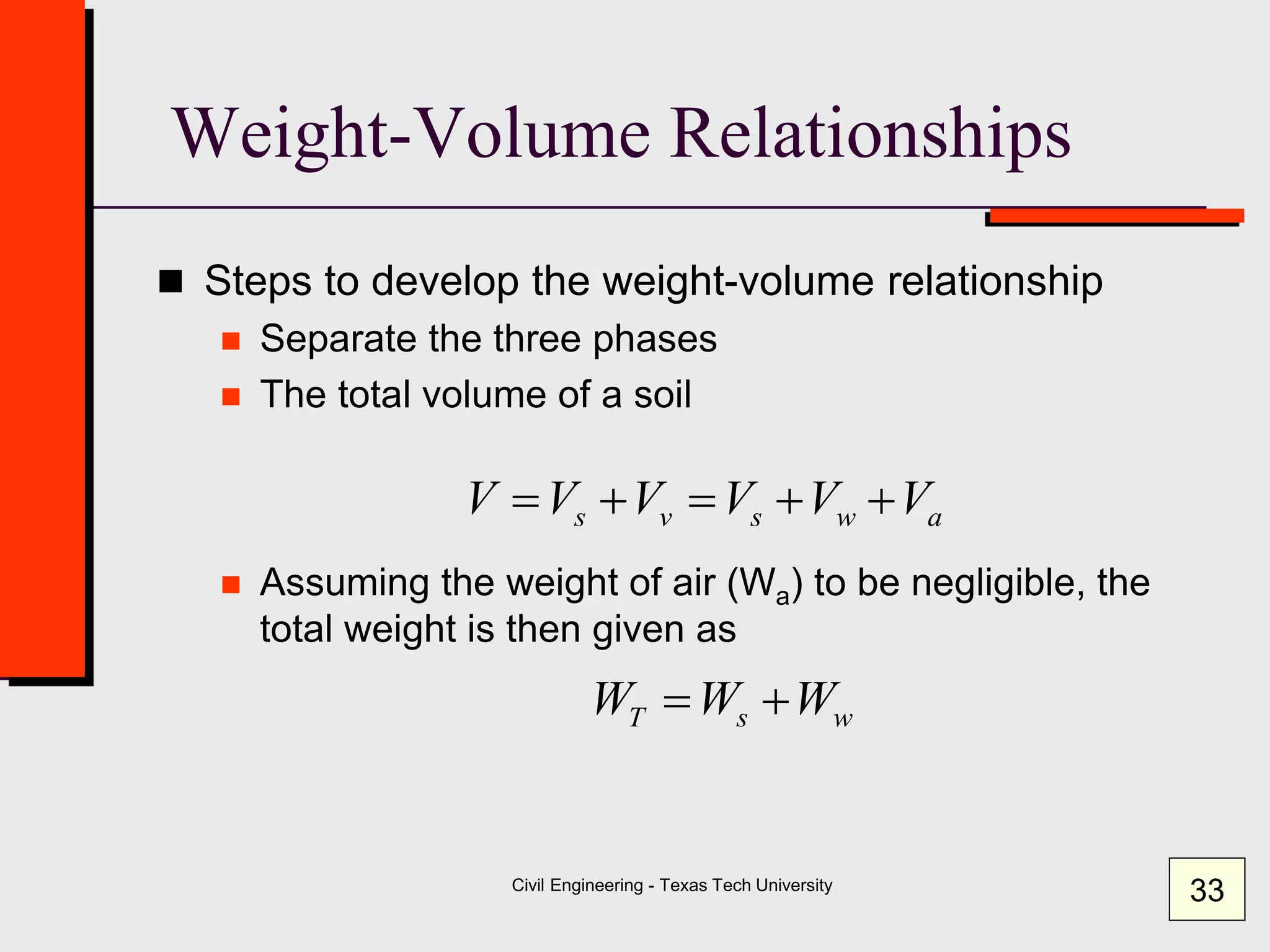
Weight-Volume Relationships
 Steps to develop the weight-volume relationship
 Separate the three phases
 The total volume of a soil
 Assuming the weight of air (Wa) to be negligible, the
total weight is then given as
awsvs VVVVVV 
wsT WWW 
33
Civil Engineering - Texas Tech University
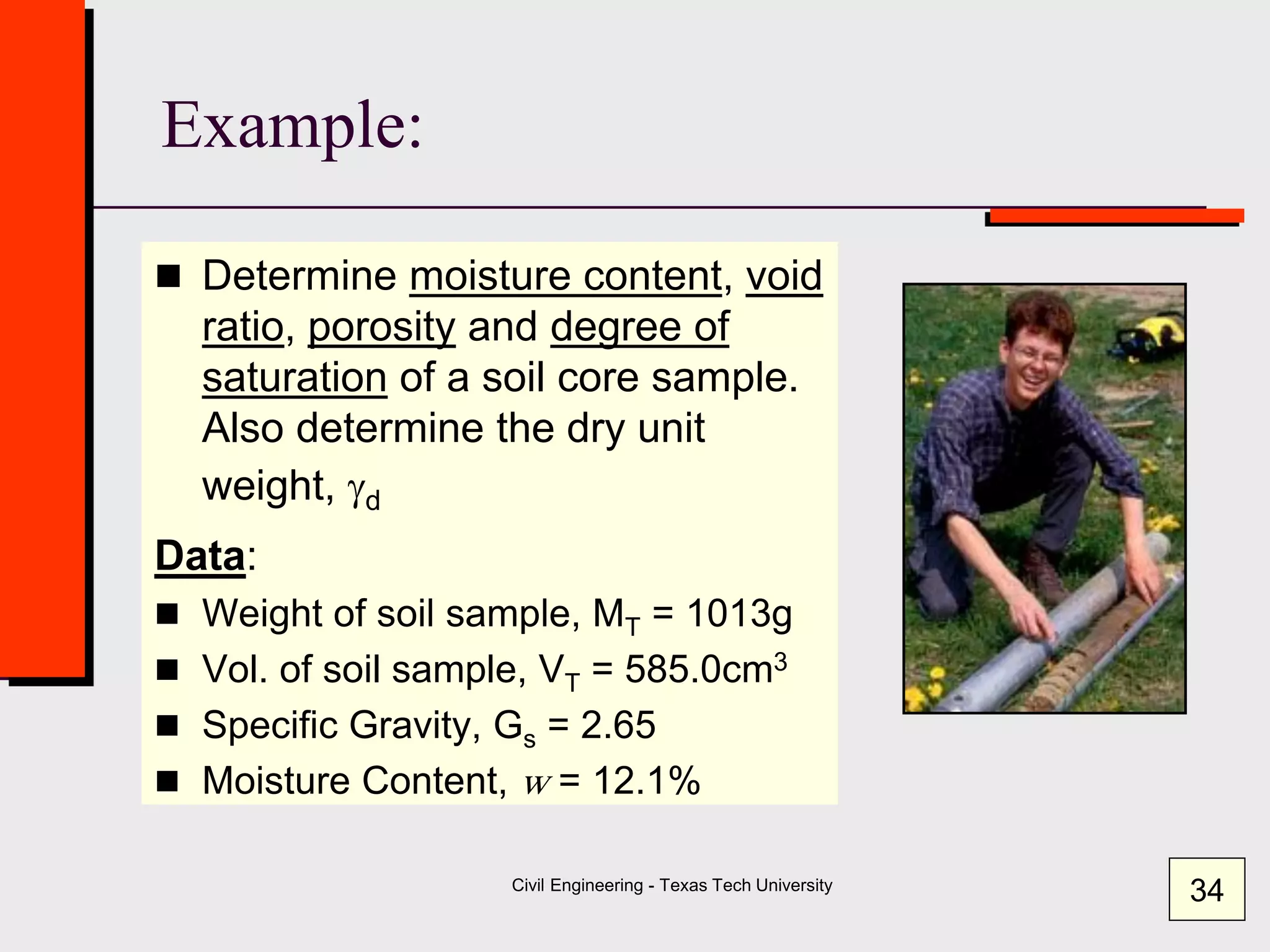
Example:
 Determine moisture content, void
ratio, porosity and degree of
saturation of a soil core sample.
Also determine the dry unit
weight, gd
Data:
 Weight of soil sample, MT = 1013g
 Vol. of soil sample, VT = 585.0cm3
 Specific Gravity, Gs = 2.65
 Moisture Content, w = 12.1%
34
Civil Engineering - Texas Tech University
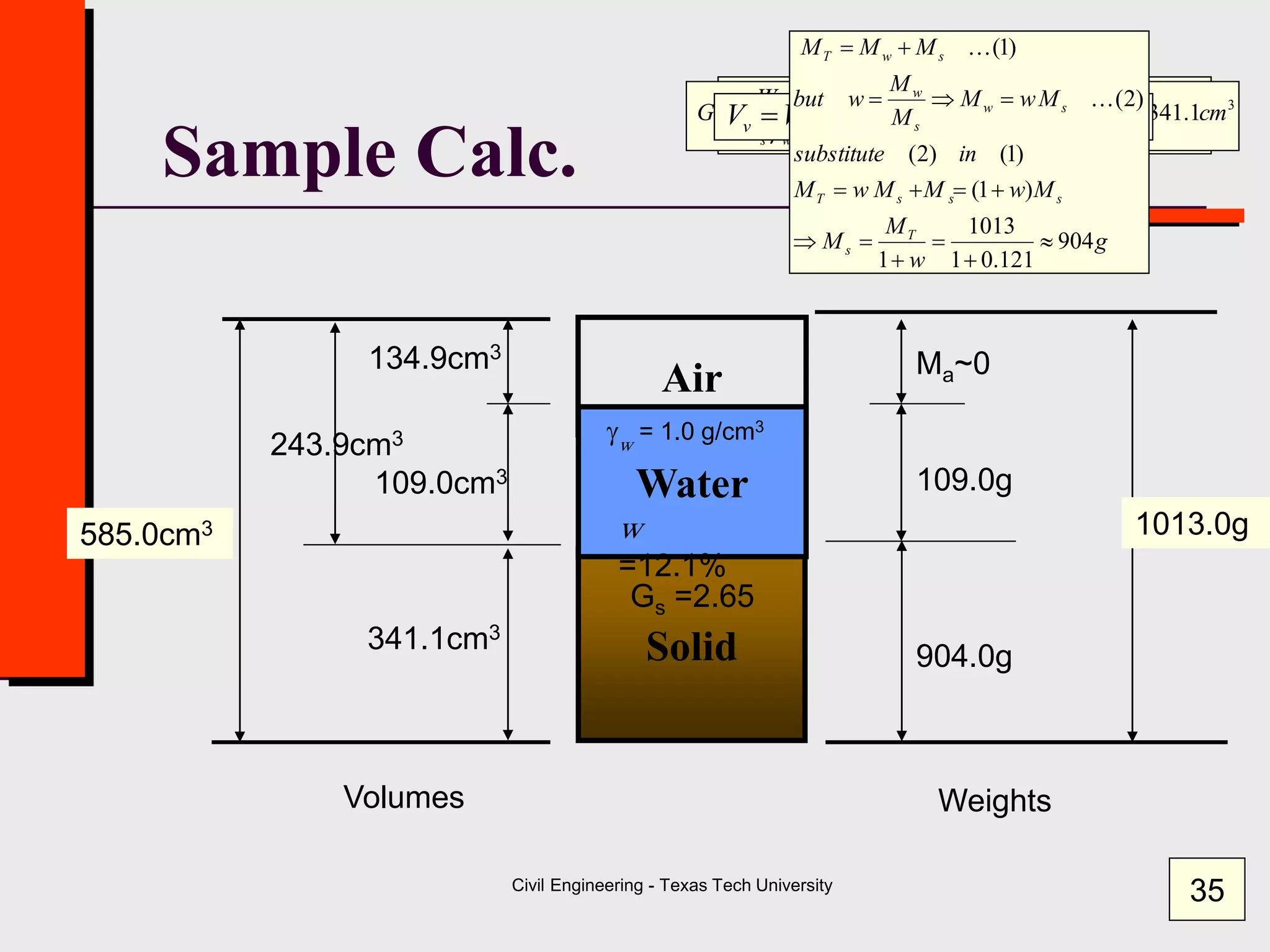
Solid
Air
Water
Ma~0
Volumes Weights
1013.0g585.0cm3
904.0g
Gs =2.65
109.0g
341.1cm3
109.0cm3
243.9cm3
134.9cm3
gw
= 1.0 g/cm3
Sample Calc.
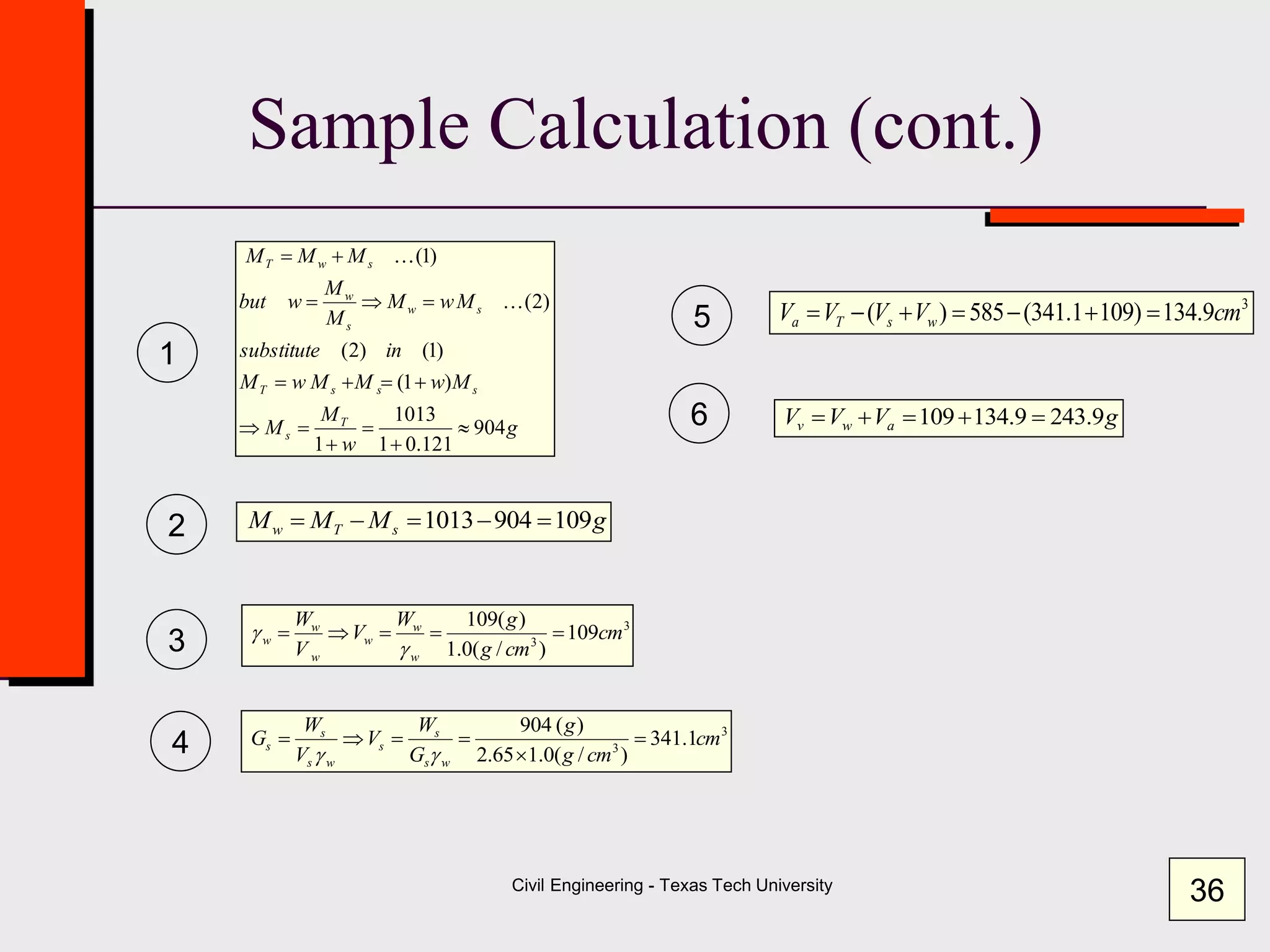
gMMM sTw 1099041013 
3
9.134)1091.341(585)( cmVVVV wsTa 
3
3
109
)/(0.1
)(109
cm
cmg
gW
V
V
W
w
w
w
w
w
w 
g
g 3
3
1.341
)/(0.165.2
)(904
cm
cmg
g
G
W
V
V
W
G
ws
s
s
ws
s
s 


gg
gVVV awv 9.2439.134109 
35
g
w
M
M
MwMMwM
insubstitute
MwM
M
M
wbut
MMM
T
s
sssT
sw
s
w
swT
904
121.01
1013
1
)1(
)1()2(
)2(
)1(










w
=12.1%
Civil Engineering - Texas Tech University
Sample Calculation (cont.)
g
w
M
M
MwMMwM
insubstitute
MwM
M
M
wbut
MMM
T
s
sssT
sw
s
w
swT
904
121.01
1013
1
)1(
)1()2(
)2(
)1(










gVVV awv 9.2439.134109 
3
3
1.341
)/(0.165.2
)(904
cm
cmg
g
G
W
V
V
W
G
ws
s
s
ws
s
s 


gg
3
3
109
)/(0.1
)(109
cm
cmg
gW
V
V
W
w
w
w
w
w
w 
g
g
3
9.134)1091.341(585)( cmVVVV wsTa 
gMMM sTw 1099041013 
1
2
3
4
5
6
36
Civil Engineering - Texas Tech University
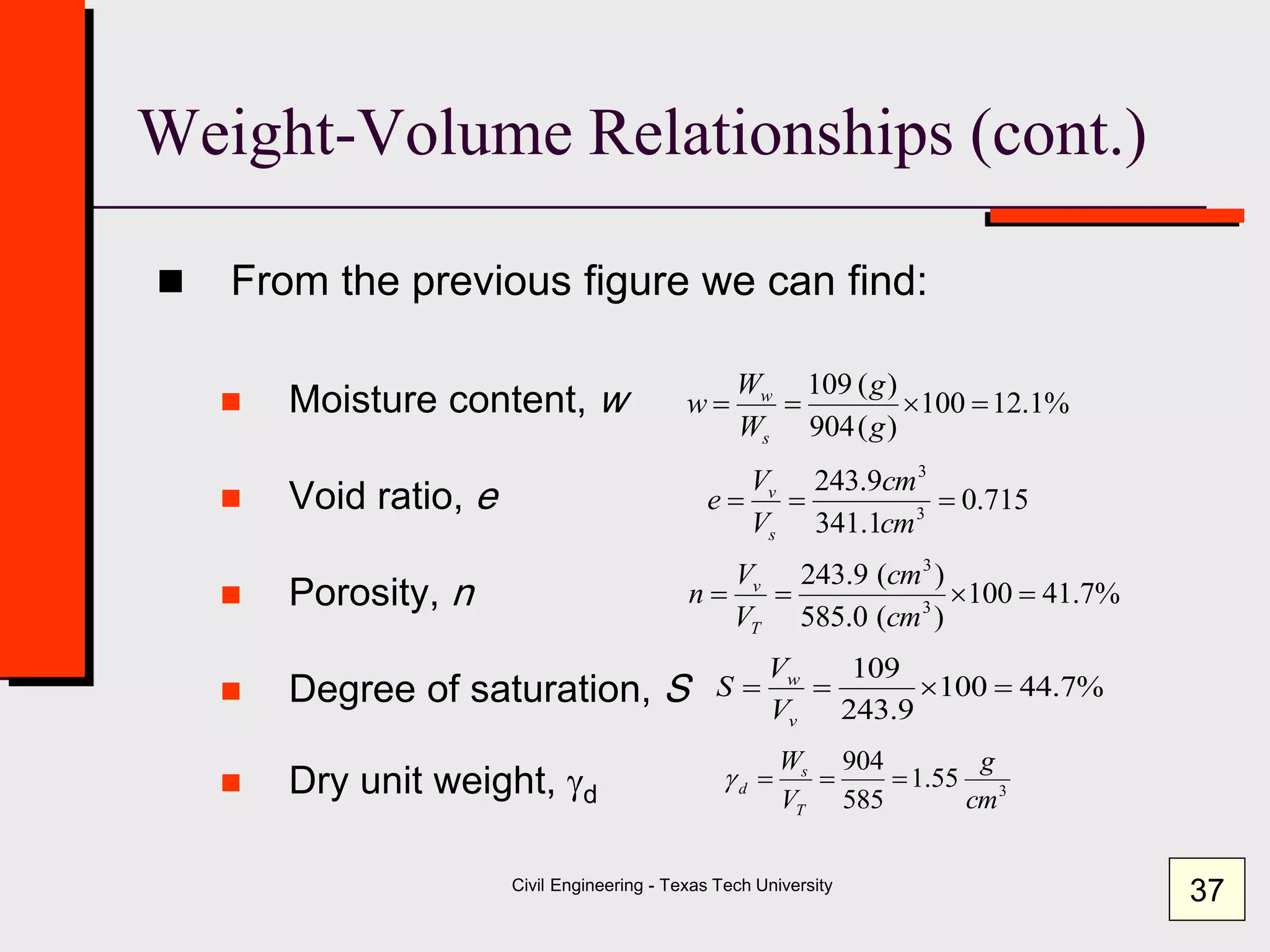
Weight-Volume Relationships (cont.)
 From the previous figure we can find:
 Moisture content, w
 Void ratio, e
 Porosity, n
 Degree of saturation, S
 Dry unit weight, gd 3
55.1
585
904
cm
g
V
W
T
s
d g
%7.44100
9.243
109

v
w
V
V
S
715.0
1.341
9.243
3
3

cm
cm
V
V
e
s
v
%7.41100
)(0.585
)(9.243
3
3

cm
cm
V
V
n
T
v
%1.12100
)(904
)(109

g
g
W
W
w
s
w
37
Civil Engineering - Texas Tech University
Weight-Volume Relationships (cont.)
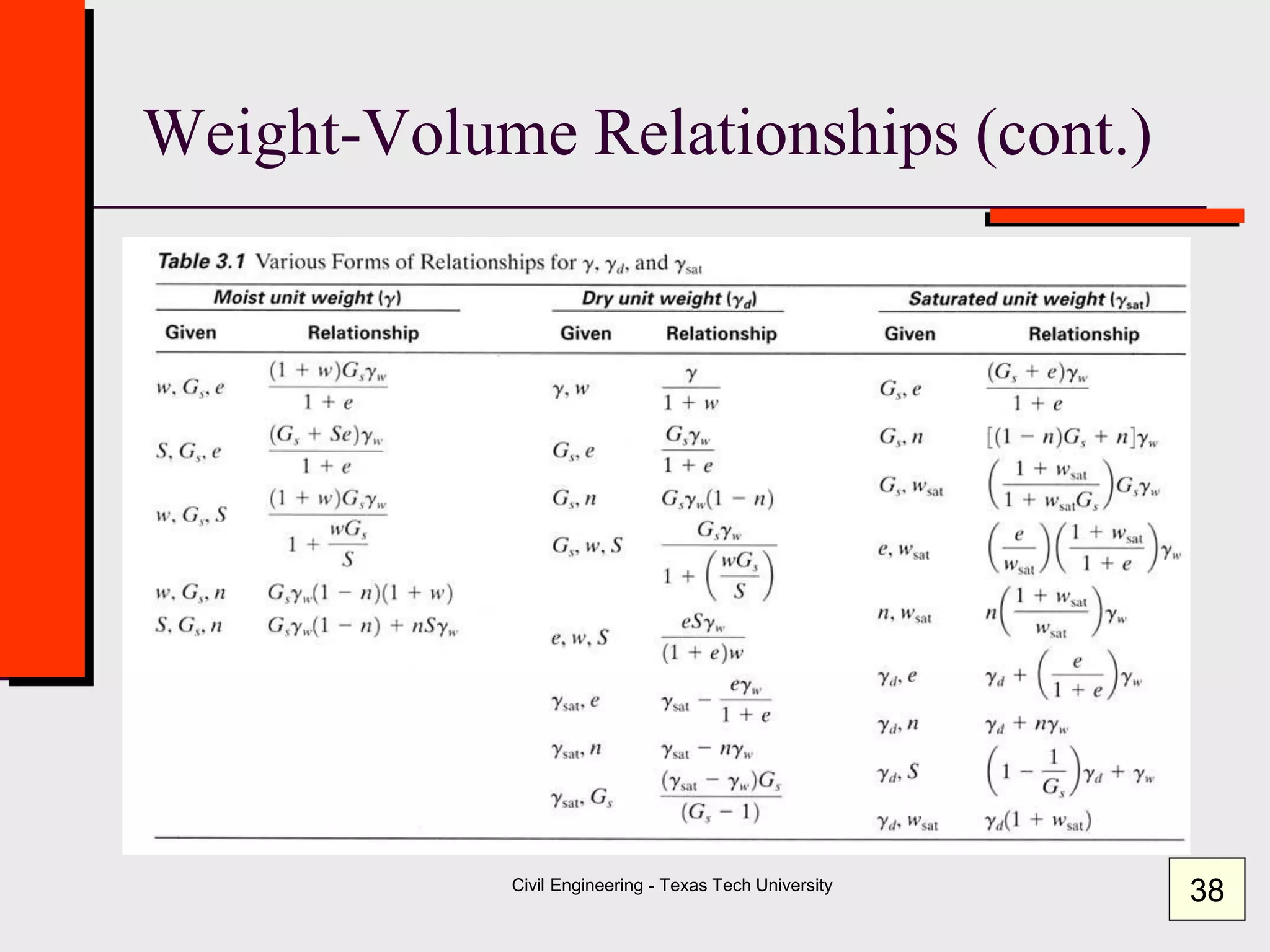
38
Civil Engineering - Texas Tech University
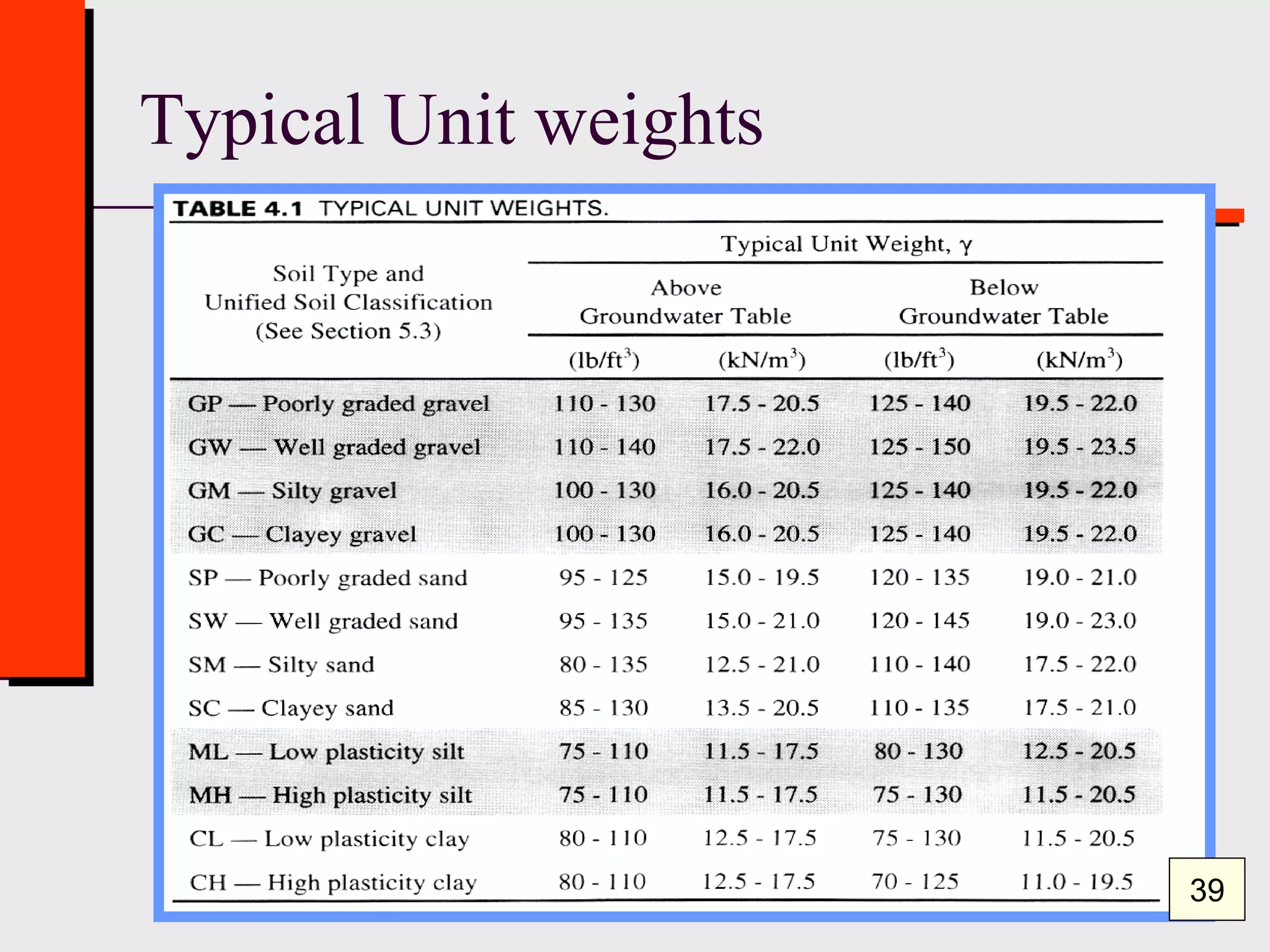
Typical Unit weights
39
Civil Engineering - Texas Tech University
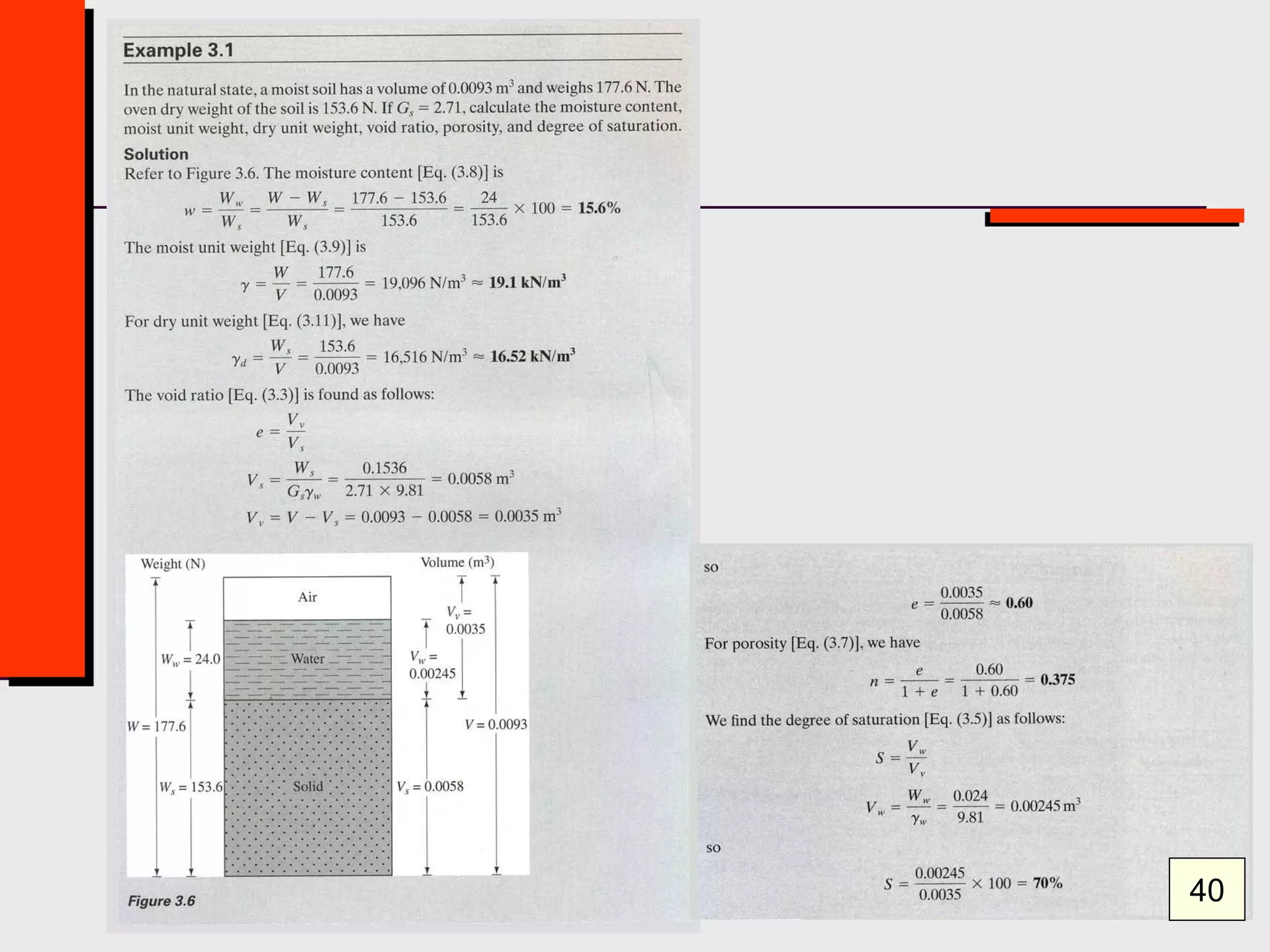
40
Civil Engineering - Texas Tech University
This Report Should Include
1. Unit Weight of Soil, g
2. Water Content, w
3. Specific Gravity, Gs
4. Three Phase Diagram
5. Void ratio, e
6. Porosity, n
7. Degree of Saturation, S
8. Dry Unit Weight, gd
41

Class 1 Moisture Content - Specific Gravity ( Geotechnical Engineering )

  • 1.
    Civil Engineering -Texas Tech University CE 3121: Geotechnical Engineering Laboratory Introduction Moisture Content, Unit Weight, Specific Gravity and Phase Relationships Abdulrahman Alhabshi Sources: Soil Mechanics – Laboratory Manual, B.M. DAS (Chapters 2 - 3) 1
  • 2.
    Civil Engineering -Texas Tech University  Handouts: Syllabus, Report Format  Class website: http://www.classes.ce.ttu.edu/ce3121/  Significance of the Class  Lab No.1: Moisture Content, Specific gravity and Unit Weight of soil  Background: Phase Relationship Class Outlines 2
  • 3.
    Civil Engineering -Texas Tech University Syllabus  Text books:  Soil Mechanics: Laboratory Manual by Braja M. Das  Lecture Notes  ASTM Standards 2005  Class organization  1 hour class  2 hours lab  Class Schedule (No classes Oct 18 & 19)  Attendance 3
  • 4.
    Civil Engineering -Texas Tech University Report Format  Each group will submit one report per lab  Reports are due one day before the class at 9am (Ex: for Wed. class, submit report on Tuesday at 9am)  All reports should follow the report format  Title and Table of Contents  Purpose & Objective  Apparatus & Procedures  Deviation from ASTM Standards  Table of results  Figures  Sample Calculations  Discussion and Conclusion 4
  • 5.
    Civil Engineering -Texas Tech University Report Format - Conclusion  Report your results (use a table)  Do the results fall within the expected range or not? (Check tables and match your results)  If not, Explain why (what went wrong?) 5
  • 6.
    Civil Engineering -Texas Tech University Significance of this Class  Why do you need to learn about soils? Almost all structures are either constructed of soil, supported on soil, or both.  Who must be concerned with soils? Civil engineers (structural, environmental and geotechnical) must have basic understanding of the soil properties in order to use them effectively in construction. 6
  • 7.
    Civil Engineering -Texas Tech University Transcosna Grain Elevator, Canada Oct. 18, 1913 West side of foundation sank 24-ft 7
  • 8.
    Civil Engineering -Texas Tech University Settlement Palacio de las Bellas, Artes, Mexico City Leaning Tower, Pisa 8
  • 9.
    Civil Engineering -Texas Tech University Shear Failure – Slope Stability 9
  • 10.
    Civil Engineering -Texas Tech University Organization of the Lab Tests Physical (Soil Characteristics) Mechanical Moisture Content Unit Weight CompressibilityPermeability Specific Gravity Gradation Atterberg Limits Strength (Shear) Geotechnical engineering Structural engineering Pavement engineering Environmental engineering Geotechnical engineering Structural engineering Pavement engineering Soil Properties (Soil Classification) 10
  • 11.
    Civil Engineering -Texas Tech University Today’s Lab  Determination of unit weight (density)  Determination of moisture content  Determination of specific gravity  Establishing the phase (weight-volume) relationship diagram  Calculation of:  Dry unit weight  Void ratio  Porosity  Degree of saturation 11
  • 12.
    Civil Engineering -Texas Tech University 1- Unit Weight, g  Take several measurements for diameter and height  Take the average for H, D  Calculate g V M g  H D V where 4 2   H D 12
  • 13.
    Civil Engineering -Texas Tech University 2- Moisture Content, w  Definition: Moisture content is an indicator of the amount of the water present in soil.  Moisture content, w(%)  ASTM 2216 (Conventional Oven Method)  ASTM D 4643 (Microwave Oven Method)  3 minutes at 50% Power (mass ≈ 50 g)   T w s w M M notbut M M w 100%  Mw – Mass of waters Ms – Mass of solids MT – Total mass 13
  • 14.
    Civil Engineering -Texas Tech University 2- Moisture Content – Sample Size  Minimum mass of moist material selected to be representative of the total samples: Maximum Particle Size (95-100% Passing) Standard Sieve Size Recommended Min. Mass of moist specimen 2 mm or less # 10 20 g 4.75 mm # 4 100 g 9.5 mm 3/8-in 50 g 19.0 mm ¾-in 250 g 37.5 mm 11/2 -in 1000 g 75.0 mm 3-in 5000 g 14
  • 15.
    Civil Engineering -Texas Tech University 2- Moisture Content - Procedure Video Demos
  • 16.
    Civil Engineering -Texas Tech University 2- Moisture Content – Sample Calculation 16
  • 17.
    Civil Engineering -Texas Tech University 3- Specific Gravity, Gs  Definition; specific gravity, Gs, of soil solids is the ratio of the density of the aggregate soil solids to the density of water.  Mathematically,  ASTM D 854  This method is applicable for soils composed of “Particles smaller than 4.75mm in size”. w s sws w w s s w s s M M GhenceVVbut V M V M G   ;  g w = 1 g/cm3 at 40C or w = 62.4 lb/ft3 17
  • 18.
    Civil Engineering -Texas Tech University 3- Specific Gravity – Sample Size  The procedure employs Archimedes’s principle “A body submerged in water will displace a volume of water equal to its own volume.”  The key to successful application of this procedure is the removal of entrapped air  Recommended mass for test specimen Soil Type Specimen Dry Mass (g) 250 mL Pycnometer Specimen Dry Mass (g) 500 mL Pycnometer SP, SP-SM 60 ± 10 100 ± 10 SP-SC, SM, SC 45 ± 10 75 ± 10 Silt or Clay 35 ± 5 45 ± 10 18
  • 19.
    Civil Engineering -Texas Tech University 3- Specific Gravity - Apparatus Report Gs in terms of GS (200C) = GS (Ti0C) x A A – From Table 3-2 Pg 12  See Example in Table 3-3 Pg 13 19 Video Demos
  • 20.
    Civil Engineering -Texas Tech University 3- Specific Gravity – Expected Values  Expected Values for Gs Type of Soil Gs Sand 2.65 - 2.67 Silty sand 2.67 – 2.70 Inorganic clay 2.70 – 2.80 Soils with mica or iron 2.75 – 3.00 Organic soils < 2.00 20
  • 21.
    Civil Engineering -Texas Tech University  Phase Relationships  Three phase diagram  Weight relationships  Volumetric relationships  Weight – Volume relationship  Examples Phase Relationships 21
  • 22.
    Phase Relationships: A3-Phase Material Solid Water Air 22
  • 23.
    Civil Engineering -Texas Tech University The Mineral Skeleton Volume Solid Particles Voids (air or water) 23
  • 24.
    Civil Engineering -Texas Tech University Three Phase Soil (Partially Saturated) Solids Air Water Mineral Skeleton Idealization: Three Phase Diagram 24
  • 25.
    Civil Engineering -Texas Tech University Two Phase Soil (1) Fully Saturated Soils Fully Saturated Water Solids Mineral Skeleton 25
  • 26.
    Civil Engineering -Texas Tech University Two Phase Soil (2) Dry Soils [Oven Dried] Mineral Skeleton Dry Soil Air Solids 26
  • 27.
    Civil Engineering -Texas Tech University Weight-Volume Relationships Volume Weight Solids Air Water WT Ws Ww Wa~0 Vs Va Vw Vv VT 27
  • 28.
    Civil Engineering -Texas Tech University Weight Relationships (weight -ratios)  Weight ratios  Moisture Content, w  Specific Gravity, Gs  Weight Components:  Weight of Solids = Ws  Weight of Water = Ww  Weight of Air, Wa ~ 0 %100(%),  s w W W wContentWater Solids Air Water WT Ws Ww Wa~ 0 28
  • 29.
    Civil Engineering -Texas Tech University Specific Gravity (weight ratio) WaterofVolumeEqualanofWeight ceSubsaofWeight GravitySpecific tan  WaterofWeightUnit ceSubsaofWeightUnit GravitySpecific tan  %100,  ws s w s s s V WV W GGravitySpecific gg Unit weight of Water, gw or w  gw = 1.0 g/cm3 (strictly accurate at 4° C)  gw = 62.4 pcf  gw = 9.81 kN/m3 29
  • 30.
    Civil Engineering -Texas Tech University Typical Values for Specific Gravity, Gs 30
  • 31.
    Civil Engineering -Texas Tech University Volumetric Relationships (Vol. ratios)  Volumetric ratios  Void ratio, e  Porosity, n(%)  Degree of Saturation, S (%)  Volume Components:  Volume of Solids = Vs  Volume of Water = Vw  Volume of Air = Va  Volume of Voids = Va + Vw = Vv Solid Air Water Vs Va Vw Vv VT 31
  • 32.
    Civil Engineering -Texas Tech University Volumetric Relationships s v V V eRatioVoid , %100(%),  V w V V SSaturationofDegree %100(%),  T v V V nPorosity 32
  • 33.
    Civil Engineering -Texas Tech University Weight-Volume Relationships  Steps to develop the weight-volume relationship  Separate the three phases  The total volume of a soil  Assuming the weight of air (Wa) to be negligible, the total weight is then given as awsvs VVVVVV  wsT WWW  33
  • 34.
    Civil Engineering -Texas Tech University Example:  Determine moisture content, void ratio, porosity and degree of saturation of a soil core sample. Also determine the dry unit weight, gd Data:  Weight of soil sample, MT = 1013g  Vol. of soil sample, VT = 585.0cm3  Specific Gravity, Gs = 2.65  Moisture Content, w = 12.1% 34
  • 35.
    Civil Engineering -Texas Tech University Solid Air Water Ma~0 Volumes Weights 1013.0g585.0cm3 904.0g Gs =2.65 109.0g 341.1cm3 109.0cm3 243.9cm3 134.9cm3 gw = 1.0 g/cm3 Sample Calc. gMMM sTw 1099041013  3 9.134)1091.341(585)( cmVVVV wsTa  3 3 109 )/(0.1 )(109 cm cmg gW V V W w w w w w w  g g 3 3 1.341 )/(0.165.2 )(904 cm cmg g G W V V W G ws s s ws s s    gg gVVV awv 9.2439.134109  35 g w M M MwMMwM insubstitute MwM M M wbut MMM T s sssT sw s w swT 904 121.01 1013 1 )1( )1()2( )2( )1(           w =12.1%
  • 36.
    Civil Engineering -Texas Tech University Sample Calculation (cont.) g w M M MwMMwM insubstitute MwM M M wbut MMM T s sssT sw s w swT 904 121.01 1013 1 )1( )1()2( )2( )1(           gVVV awv 9.2439.134109  3 3 1.341 )/(0.165.2 )(904 cm cmg g G W V V W G ws s s ws s s    gg 3 3 109 )/(0.1 )(109 cm cmg gW V V W w w w w w w  g g 3 9.134)1091.341(585)( cmVVVV wsTa  gMMM sTw 1099041013  1 2 3 4 5 6 36
  • 37.
    Civil Engineering -Texas Tech University Weight-Volume Relationships (cont.)  From the previous figure we can find:  Moisture content, w  Void ratio, e  Porosity, n  Degree of saturation, S  Dry unit weight, gd 3 55.1 585 904 cm g V W T s d g %7.44100 9.243 109  v w V V S 715.0 1.341 9.243 3 3  cm cm V V e s v %7.41100 )(0.585 )(9.243 3 3  cm cm V V n T v %1.12100 )(904 )(109  g g W W w s w 37
  • 38.
    Civil Engineering -Texas Tech University Weight-Volume Relationships (cont.) 38
  • 39.
    Civil Engineering -Texas Tech University Typical Unit weights 39
  • 40.
    Civil Engineering -Texas Tech University 40
  • 41.
    Civil Engineering -Texas Tech University This Report Should Include 1. Unit Weight of Soil, g 2. Water Content, w 3. Specific Gravity, Gs 4. Three Phase Diagram 5. Void ratio, e 6. Porosity, n 7. Degree of Saturation, S 8. Dry Unit Weight, gd 41