HIGHWAY ENGINEERING
HIGHWAY GEOMETRIC DESIGN :
CROSS SECTIONAL ELEMENTS
WIDTH, SURFACE , CAMBER
-: CREATED BY :-
 ALAY MEHTA 141080106011
 SHIVANI PATEL 141080106021
 KAVIN RAVAL 141080106026
 KUNTAL SONI 141080106028
-:CONTENT:-
 Geometric design
 Road alignment
 Cross-Section of road & its
elements
Definition of Geometric Design :
 Geometric design of highways deals with the dimensions
and layout of visible features of the highway.
 Geometric design fulfills the requirements of the driver
and the vehicle, such as comfort, efficiency and safety.
 Proper geometric design will help in the reduction of
accidents and their severity.
Goals of Geometric design :
 Maximize the comfort, safety and economy of facilities.
 Provide efficiency in traffic operation.
 Provide maximum safety at reasonable cost.
 Minimize the environmental impacts.
Factors affecting geometric design :
 Design speed.
 Topography.
 Traffic.
 Environmental factors.
 Economical factors.
 Vehicles properties (dimensions, weight, operating characteristics,
etc.).
 Humans (the physical, mental and psychological characteristics of
the driver and pedestrians like the reaction time).
Road alignment :
Alignment : is an arrangement in a straight line or in correct
relative positions.
 The position or the layout of the central line of the highway
on the ground is called the alignment.
 Horizontal alignment includes straight and curved paths.
 Vertical alignment includes level and gradients.
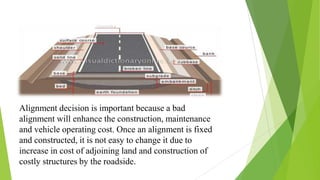
Alignment decision is important because a bad
alignment will enhance the construction, maintenance
and vehicle operating cost. Once an alignment is fixed
and constructed, it is not easy to change it due to
increase in cost of adjoining land and construction of
costly structures by the roadside.
Types of alignment :
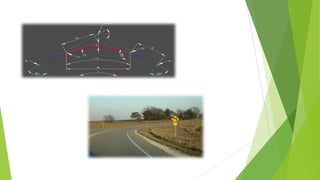
 Horizontal Alignment : Horizontal alignment in road design
consists of straight sections of road, known as tangents,
connected by circular horizontal curves.
 It is the design of the road in the horizontal plane.
 Consists of a series of tangents (straight lines), circular curves
and transition curves.
 Should provide safe travel at a uniform design speed.
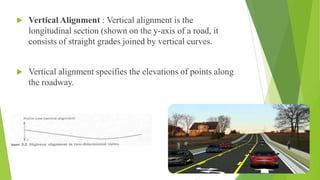
 Vertical Alignment : Vertical alignment is the
longitudinal section (shown on the y-axis of a road, it
consists of straight grades joined by vertical curves.
 Vertical alignment specifies the elevations of points along
the roadway.
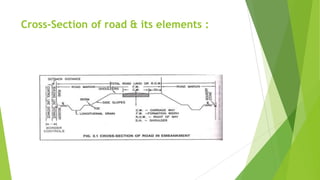
Cross-Section of road & its elements :
Carriage way :
 The Width of pavement way on which vehicles travel is
called carriage way .
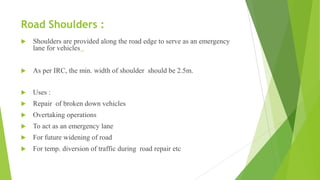
Road Shoulders :
 Shoulders are provided along the road edge to serve as an emergency
lane for vehicles .
 As per IRC, the min. width of shoulder should be 2.5m.
 Uses :
 Repair of broken down vehicles
 Overtaking operations
 To act as an emergency lane
 For future widening of road
 For temp. diversion of traffic during road repair etc
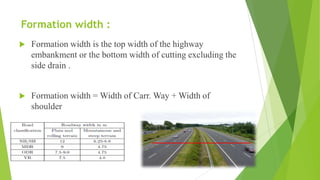
Formation width :
 Formation width is the top width of the highway
embankment or the bottom width of cutting excluding the
side drain .
 Formation width = Width of Carr. Way + Width of
shoulder
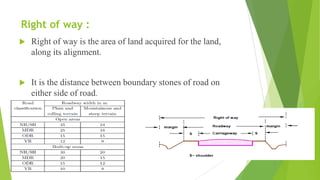
Right of way :
 Right of way is the area of land acquired for the land,
along its alignment.
 It is the distance between boundary stones of road on
either side of road.
Side slope :
 The slope of earthwork in Filling(embankment) or cutting
is called sideslope.
Berm :
 The distance between the road toe and inner edge of
borrow pit is called berm.
 It prevents the erosion of embankment soil.
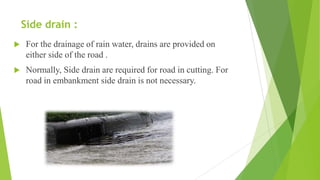
Side drain :
 For the drainage of rain water, drains are provided on
either side of the road .
 Normally, Side drain are required for road in cutting. For
road in embankment side drain is not necessary.
Building line :
 The distance from the centre line of road on either side, within
which construction of building is not permitted is called building
line.
 Purposes :
 For future widening of road
 To reduce the chance of accidents
 To relieve residents from noise pollution
 To prevent disturbance to the traffic by nearby residents
Central line :
 At the location like bank, hospital, factory, theatre etc. on
the road where more people gather disturbance to the
traffic will be more.
 The distance from the centre line to such building is
called control line.
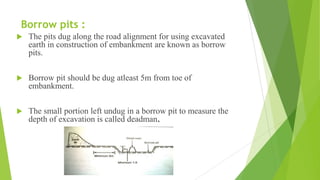
Borrow pits :
 The pits dug along the road alignment for using excavated
earth in construction of embankment are known as borrow
pits.
 Borrow pit should be dug atleast 5m from toe of
embankment.
 The small portion left undug in a borrow pit to measure the
depth of excavation is called deadman.
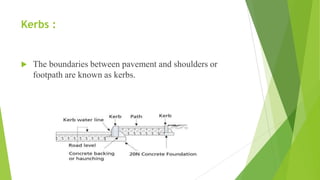
Kerbs :
 The boundaries between pavement and shoulders or
footpath are known as kerbs.
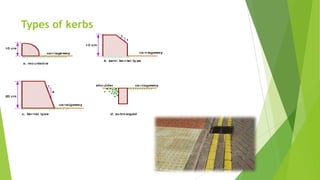
Mountable kerbs :
These kerbs are indicator between the boundary of a road and shoulder .
The height of the kerb is such that driver find no difficulty in crossing these
kerbs and use the shoulder incase of emergency.
Its height is kept on 10cm above the pavement edge.
Semi-barrier kerbs :
It prevents encroachment of slow speed or parking vehicles to the footpath
But at emergency vehicle can climb over and can be parked on footpath or
shoulder.
Its height is 15 to 20cm
Barrier kerbs :
They are mainly provided to cause obstruction to the vehicles leaving the
carriage way under emergency.
Its height is 23 to 45cm
Generally, such kerbs are provided on hills bridges etc.
Types of kerbs
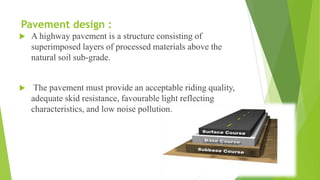
Pavement design :
 A highway pavement is a structure consisting of
superimposed layers of processed materials above the
natural soil sub-grade.
 The pavement must provide an acceptable riding quality,
adequate skid resistance, favourable light reflecting
characteristics, and low noise pollution.
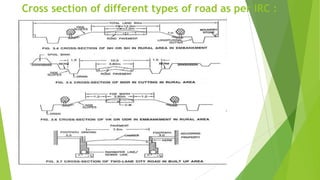
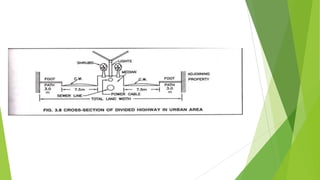
Cross section of different types of road as per IRC :
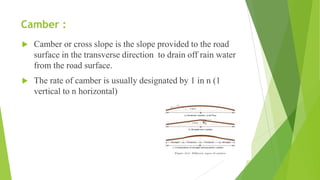
Camber :
 Camber or cross slope is the slope provided to the road
surface in the transverse direction to drain off rain water
from the road surface.
 The rate of camber is usually designated by 1 in n (1
vertical to n horizontal)
Purposes of camber :
 To remove the rain water from the pavement surface as quickly as
possible.
 To prevent entry of water into bituminous pavement layers.
 To prevert entry of surface water into subgrade soil through
pavement.
 To make pavement surface attractive.
Super elevation :
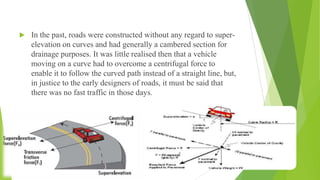
 It is the slope across pavement surface and is fully developed in the circular curve.
(or)
 Super-elevation (banking) is the transverse slope provided at horizontal curve to
counteract the centrifugal force, by raising the outer edge of the pavement with
respect to the inner edge, throughout the length of the horizontal curve.
 So super elevation helps the vehicle to over come the centrifugal force on the
curves on pavements
 The need for super-elevation on road curves, to ensure safety against skidding and
over turning with the advent of fast moving traffic.
 In the past, roads were constructed without any regard to super-
elevation on curves and had generally a cambered section for
drainage purposes. It was little realised then that a vehicle
moving on a curve had to overcome a centrifugal force to
enable it to follow the curved path instead of a straight line, but,
in justice to the early designers of roads, it must be said that
there was no fast traffic in those days.
Highway engineering PPT

Highway engineering PPT

  • 1.
    HIGHWAY ENGINEERING HIGHWAY GEOMETRICDESIGN : CROSS SECTIONAL ELEMENTS WIDTH, SURFACE , CAMBER
  • 2.
    -: CREATED BY:-  ALAY MEHTA 141080106011  SHIVANI PATEL 141080106021  KAVIN RAVAL 141080106026  KUNTAL SONI 141080106028 -:CONTENT:-  Geometric design  Road alignment  Cross-Section of road & its elements
  • 3.
    Definition of GeometricDesign :  Geometric design of highways deals with the dimensions and layout of visible features of the highway.  Geometric design fulfills the requirements of the driver and the vehicle, such as comfort, efficiency and safety.  Proper geometric design will help in the reduction of accidents and their severity.
  • 4.
    Goals of Geometricdesign :  Maximize the comfort, safety and economy of facilities.  Provide efficiency in traffic operation.  Provide maximum safety at reasonable cost.  Minimize the environmental impacts.
  • 5.
    Factors affecting geometricdesign :  Design speed.  Topography.  Traffic.  Environmental factors.  Economical factors.  Vehicles properties (dimensions, weight, operating characteristics, etc.).  Humans (the physical, mental and psychological characteristics of the driver and pedestrians like the reaction time).
  • 6.
    Road alignment : Alignment: is an arrangement in a straight line or in correct relative positions.  The position or the layout of the central line of the highway on the ground is called the alignment.  Horizontal alignment includes straight and curved paths.  Vertical alignment includes level and gradients.
  • 7.
    Alignment decision isimportant because a bad alignment will enhance the construction, maintenance and vehicle operating cost. Once an alignment is fixed and constructed, it is not easy to change it due to increase in cost of adjoining land and construction of costly structures by the roadside.
  • 8.
    Types of alignment:  Horizontal Alignment : Horizontal alignment in road design consists of straight sections of road, known as tangents, connected by circular horizontal curves.  It is the design of the road in the horizontal plane.  Consists of a series of tangents (straight lines), circular curves and transition curves.  Should provide safe travel at a uniform design speed.
  • 10.
     Vertical Alignment: Vertical alignment is the longitudinal section (shown on the y-axis of a road, it consists of straight grades joined by vertical curves.  Vertical alignment specifies the elevations of points along the roadway.
  • 11.
    Cross-Section of road& its elements :
  • 12.
    Carriage way : The Width of pavement way on which vehicles travel is called carriage way .
  • 13.
    Road Shoulders : Shoulders are provided along the road edge to serve as an emergency lane for vehicles .  As per IRC, the min. width of shoulder should be 2.5m.  Uses :  Repair of broken down vehicles  Overtaking operations  To act as an emergency lane  For future widening of road  For temp. diversion of traffic during road repair etc
  • 14.
    Formation width : Formation width is the top width of the highway embankment or the bottom width of cutting excluding the side drain .  Formation width = Width of Carr. Way + Width of shoulder
  • 15.
    Right of way:  Right of way is the area of land acquired for the land, along its alignment.  It is the distance between boundary stones of road on either side of road.
  • 16.
    Side slope : The slope of earthwork in Filling(embankment) or cutting is called sideslope.
  • 17.
    Berm :  Thedistance between the road toe and inner edge of borrow pit is called berm.  It prevents the erosion of embankment soil.
  • 18.
    Side drain : For the drainage of rain water, drains are provided on either side of the road .  Normally, Side drain are required for road in cutting. For road in embankment side drain is not necessary.
  • 19.
    Building line : The distance from the centre line of road on either side, within which construction of building is not permitted is called building line.  Purposes :  For future widening of road  To reduce the chance of accidents  To relieve residents from noise pollution  To prevent disturbance to the traffic by nearby residents
  • 20.
    Central line : At the location like bank, hospital, factory, theatre etc. on the road where more people gather disturbance to the traffic will be more.  The distance from the centre line to such building is called control line.
  • 21.
    Borrow pits : The pits dug along the road alignment for using excavated earth in construction of embankment are known as borrow pits.  Borrow pit should be dug atleast 5m from toe of embankment.  The small portion left undug in a borrow pit to measure the depth of excavation is called deadman.
  • 22.
    Kerbs :  Theboundaries between pavement and shoulders or footpath are known as kerbs.
  • 23.
    Mountable kerbs : Thesekerbs are indicator between the boundary of a road and shoulder . The height of the kerb is such that driver find no difficulty in crossing these kerbs and use the shoulder incase of emergency. Its height is kept on 10cm above the pavement edge. Semi-barrier kerbs : It prevents encroachment of slow speed or parking vehicles to the footpath But at emergency vehicle can climb over and can be parked on footpath or shoulder. Its height is 15 to 20cm Barrier kerbs : They are mainly provided to cause obstruction to the vehicles leaving the carriage way under emergency. Its height is 23 to 45cm Generally, such kerbs are provided on hills bridges etc.
  • 24.
  • 25.
    Pavement design : A highway pavement is a structure consisting of superimposed layers of processed materials above the natural soil sub-grade.  The pavement must provide an acceptable riding quality, adequate skid resistance, favourable light reflecting characteristics, and low noise pollution.
  • 26.
    Cross section ofdifferent types of road as per IRC :
  • 28.
    Camber :  Camberor cross slope is the slope provided to the road surface in the transverse direction to drain off rain water from the road surface.  The rate of camber is usually designated by 1 in n (1 vertical to n horizontal)
  • 29.
    Purposes of camber:  To remove the rain water from the pavement surface as quickly as possible.  To prevent entry of water into bituminous pavement layers.  To prevert entry of surface water into subgrade soil through pavement.  To make pavement surface attractive.
  • 30.
    Super elevation : It is the slope across pavement surface and is fully developed in the circular curve. (or)  Super-elevation (banking) is the transverse slope provided at horizontal curve to counteract the centrifugal force, by raising the outer edge of the pavement with respect to the inner edge, throughout the length of the horizontal curve.  So super elevation helps the vehicle to over come the centrifugal force on the curves on pavements  The need for super-elevation on road curves, to ensure safety against skidding and over turning with the advent of fast moving traffic.
  • 31.
     In thepast, roads were constructed without any regard to super- elevation on curves and had generally a cambered section for drainage purposes. It was little realised then that a vehicle moving on a curve had to overcome a centrifugal force to enable it to follow the curved path instead of a straight line, but, in justice to the early designers of roads, it must be said that there was no fast traffic in those days.