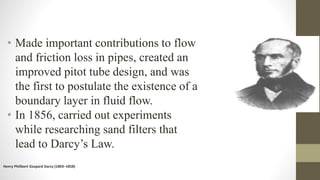
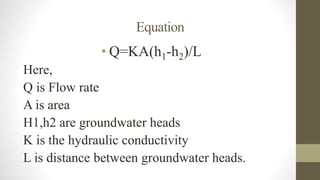
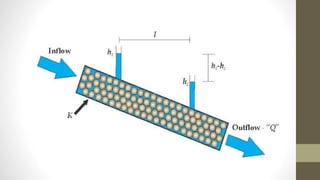
Henry Darcy developed Darcy's law in 1856 based on experiments studying the flow of water through sand filters. Darcy's law states that for laminar flow through saturated soil or porous media, the discharge rate is proportional to the hydraulic gradient. The law is expressed mathematically as Q=KA(h1-h2)/L, where Q is the flow rate, K is the hydraulic conductivity, A is the cross-sectional area, h1 and h2 are the water levels, and L is the distance between them. Darcy's law is valid for laminar flow in saturated, homogeneous, isotropic porous media, but may not apply to turbulent or unsaturated flow conditions. It has wide applications in areas like