ENERGY DISSIPATION
IRRIGATION ENGINEERING
-:CREATED BY:-
KAVIN RAVAL
141080106026
-:SUBMITED TO:-
PROF. HEMALI DESAI
CIVIL DEPARTMENT
ACET
CONTENT
• ENERGY DISSIPATION BELOW SPILLWAY
• HYDRAULIC JUMP
• STILLING BASINS
• BUCKET TYPE ENERGY DISSIPATION
• PLUNGE POOLS
ENERGY DISSIPATION BELOW
SPILLWAY
CHAPTER -1
ENERGY DISSIPATION BELOW SPILLWAY
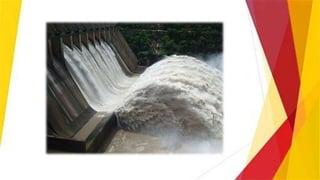
• Water flowing over a spillway acquires a lot of kinetic energy because of the
conversion of the potential energy into kinetic energy.
• If the water flowing with such a velocity is discharged into kinetic energy.
• If the water flowing with such a high velocity is discharged into river it will
scour the river bed.
• If the scour is not properly controlled, it may extend backward and may
endanger the spillway and the dam.
• In order to protect the channel bed against scour, the kinetic energy of the water
should be dissipated before it is discharged into the d/s channel.
• For the dissipation of the excessive kinetic energy of water, the following two
methods are commonly adopted.
1. By developing a hydraulic jump
2. By using different types of buckets
HYDRAULIC JUMP
CHAPTER - 2
HYDRAULIC JUMP
• Hydraulic jump is the sudden rise of water that takes place when the
flow changes from supercritical flow state to the subcritical state.
• When a stream of water moving with a high velocity and low depth
strikes another stream of water moving with low velocity and high
depth, a sudden rise in the surface of water place.
• This phenomenon is called hydraulic jump.
• This is generally accompanied by a large scale turbulence,
dissipating most of the kinetic energy of supercritical flow.
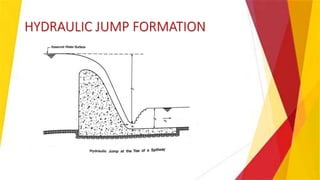
• Such a phenomenon may occur in a canal below a regulating sluice,
at the bottom of the spillway, or at a place where a steep channel
slope turns flat.
HYDRAULIC JUMP
HYDRAULIC JUMP
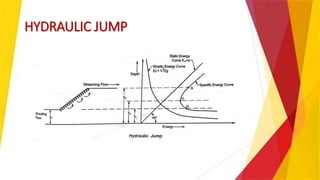
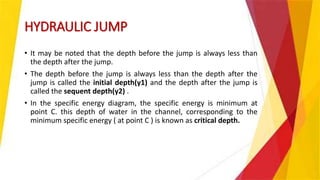
• It may be noted that the depth before the jump is always less than
the depth after the jump.
• The depth before the jump is always less than the depth after the
jump is called the initial depth(y1) and the depth after the jump is
called the sequent depth(y2) .
• In the specific energy diagram, the specific energy is minimum at
point C. this depth of water in the channel, corresponding to the
minimum specific energy ( at point C ) is known as critical depth.
HYDRAULIC JUMP
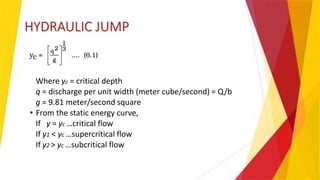
Where yc = critical depth
q = discharge per unit width (meter cube/second) = Q/b
g = 9.81 meter/second square
• From the static energy curve,
If y = yc …critical flow
If y1 < yc …supercritical flow
If y2 > yc …subcritical flow
HYDRAULIC JUMP FORMATION
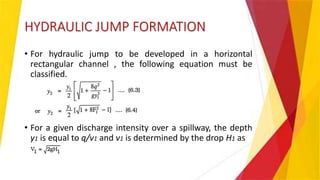
• For hydraulic jump to be developed in a horizontal
rectangular channel , the following equation must be
classified.
• For a given discharge intensity over a spillway, the depth
y1 is equal to q/v1 and v1 is determined by the drop H1 as
HYDRAULIC JUMP FORMATION
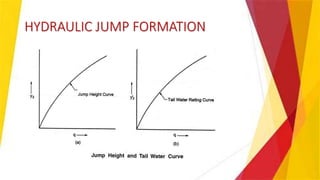
JUMP HEIGHT CURVE(J.H.C.)
• y’2 for different discharges,
the tail water depth is found
by actual gauge discharge
observations and by hydraulic
computations. The post jump
depths(y2) for all those
discharges , are also computed
from equation. If a graph is
now plotted between q and y2
, the curve is known as jump
height curve(J.H.C.) or y2
curve.
JUMP WATER CURVE (J.W.C.)
• The actual tail water depth
(y’2) corresponding to any
discharge intensity q will
however depend on the
hydraulic condition of the
river channel on the
downstream side. The
values of y’2
corresponding to different
HYDRAULIC JUMP FORMATION
Relative Position Of J.H.C. And T.W.C.
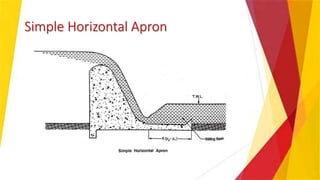
Simple Horizontal Apron
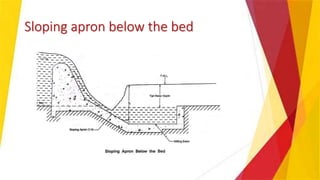
Sloping apron below the bed
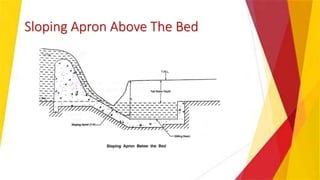
Sloping Apron Above The Bed
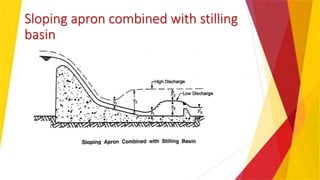
Sloping apron combined with stilling
basin
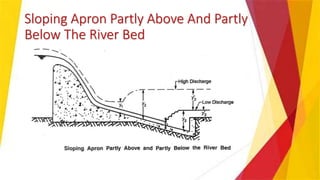
Sloping Apron Partly Above And Partly
Below The River Bed
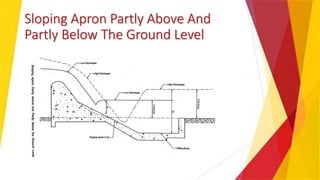
Sloping Apron Partly Above And
Partly Below The Ground Level
STILLING BASINS
CHAPTER - 3
STILLING BASINS
• Stilling basins are external energy dissipators placed at
the outlet of a culvert, chute or rundown.
• These basins are characterized by some combination of
chute blocks, baffle blocks and sills designed to trigger a
hydraulic jump in combination with a required tail water
condition.
• With the required tail water, velocity leaving a properly
designed stilling basin is equal to the velocity in the
receiving channel.
• While various stilling basin designs ODOT practice is to
use the St. Anthony Falls (SAF) stilling basin, which can
operate over a range of approach flow Froude numbers
from 1.7 to 17
TYPES OF STILLING BASINS
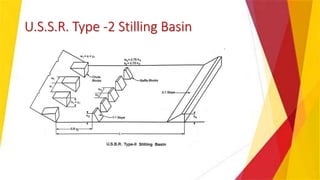
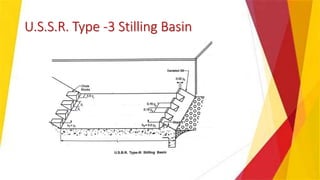
• [A] U.S.B.R. Stilling basin
1. Type – 1 Basin
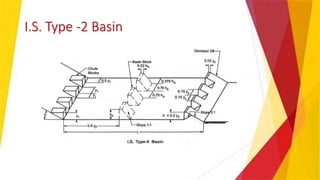
2. Type – 2 Basin
3. Type – 3 Basin
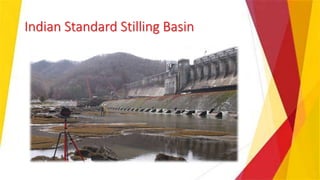
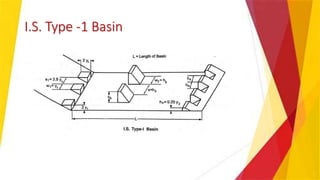
• [B] Indian Standard Basin
1. Horizontal Apron Type -1
2. Horizontal Apron Type -2
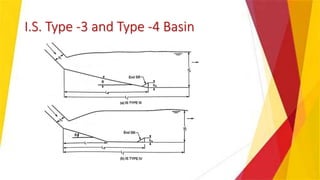
3. Sloping Apron Type -3
4. Sloping Apron Type -4
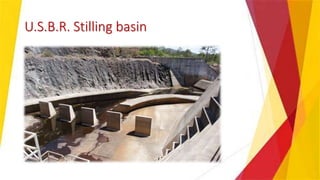
U.S.B.R. Stilling basin
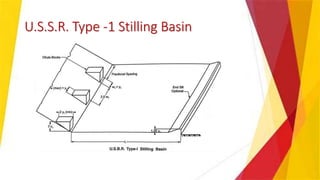
U.S.S.R. Type -1 Stilling Basin
U.S.S.R. Type -2 Stilling Basin
U.S.S.R. Type -3 Stilling Basin
Indian Standard Stilling Basin
I.S. Type -1 Basin
I.S. Type -2 Basin
I.S. Type -3 and Type -4 Basin
BUCKET TYPE ENERGY
DISSIPATION
CHAPTER - 4
BUCKET TYPE ENERGY DISSIPATION
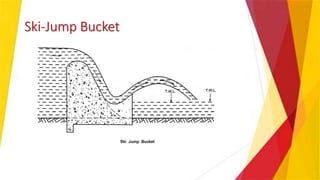
• Types of bucket type energy dissipation.
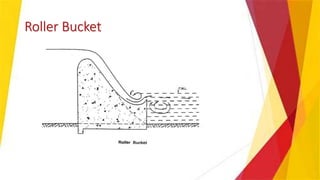
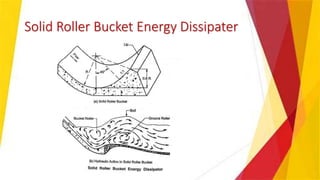
1. Solid roller bucket
2. slotted roller bucket
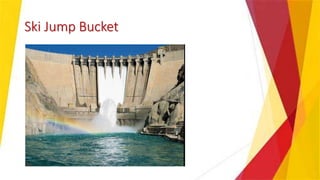
3. ski jump bucket
Roller Bucket
Solid Roller Bucket Energy Dissipater
Slotted Roller Bucket
Ski-Jump Bucket
Ski Jump Bucket
PLUNGE POOLS
CHAPTER - 5
Plunge Pools
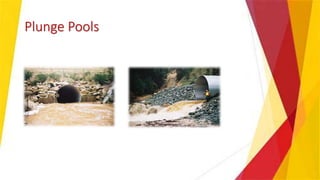
• Plunge pool is an energy dissipater structure
constructed below water fall or rapids.
• In case of high supercritical flow, swirling of water or
formation of eddies takes place and it is not possible to
dissipate the energy by hydraulic jump type stilling
basin.
• In such cases energy can be dissipated the energy by
plunge pools.
Plunge Pools
• Plunge pool can develop as the result of :
-> scour from spillway and bridge abutments
-> jet issued from ski-jump bucket type energy dissipater
-> jet issued from gated spillway
• Plunge pool is constructed in high dam structure. It is not
feasible in case of low dam structure as it is
uneconomical.
• Plunge pool scour involves a significant risk with
trajectory of spillway may cause structural undermining at
the foot of a dam.
Plunge Pools
• The plunge pool scour depends upon the following factors
1. Jet velocity
2. Jet shape
3. Air content of the jet
4. Level of tail water
5. Velocity of upstream flow
6. Gradation of sediment
Plunge Pools
THANK YOU

Energy dissipation - irrigation engineering

  • 1.
  • 2.
    -:CREATED BY:- KAVIN RAVAL 141080106026 -:SUBMITEDTO:- PROF. HEMALI DESAI CIVIL DEPARTMENT ACET
  • 3.
    CONTENT • ENERGY DISSIPATIONBELOW SPILLWAY • HYDRAULIC JUMP • STILLING BASINS • BUCKET TYPE ENERGY DISSIPATION • PLUNGE POOLS
  • 4.
  • 5.
    ENERGY DISSIPATION BELOWSPILLWAY • Water flowing over a spillway acquires a lot of kinetic energy because of the conversion of the potential energy into kinetic energy. • If the water flowing with such a velocity is discharged into kinetic energy. • If the water flowing with such a high velocity is discharged into river it will scour the river bed. • If the scour is not properly controlled, it may extend backward and may endanger the spillway and the dam. • In order to protect the channel bed against scour, the kinetic energy of the water should be dissipated before it is discharged into the d/s channel. • For the dissipation of the excessive kinetic energy of water, the following two methods are commonly adopted. 1. By developing a hydraulic jump 2. By using different types of buckets
  • 6.
  • 7.
    HYDRAULIC JUMP • Hydraulicjump is the sudden rise of water that takes place when the flow changes from supercritical flow state to the subcritical state. • When a stream of water moving with a high velocity and low depth strikes another stream of water moving with low velocity and high depth, a sudden rise in the surface of water place. • This phenomenon is called hydraulic jump. • This is generally accompanied by a large scale turbulence, dissipating most of the kinetic energy of supercritical flow. • Such a phenomenon may occur in a canal below a regulating sluice, at the bottom of the spillway, or at a place where a steep channel slope turns flat.
  • 8.
  • 9.
    HYDRAULIC JUMP • Itmay be noted that the depth before the jump is always less than the depth after the jump. • The depth before the jump is always less than the depth after the jump is called the initial depth(y1) and the depth after the jump is called the sequent depth(y2) . • In the specific energy diagram, the specific energy is minimum at point C. this depth of water in the channel, corresponding to the minimum specific energy ( at point C ) is known as critical depth.
  • 10.
    HYDRAULIC JUMP Where yc= critical depth q = discharge per unit width (meter cube/second) = Q/b g = 9.81 meter/second square • From the static energy curve, If y = yc …critical flow If y1 < yc …supercritical flow If y2 > yc …subcritical flow
  • 11.
    HYDRAULIC JUMP FORMATION •For hydraulic jump to be developed in a horizontal rectangular channel , the following equation must be classified. • For a given discharge intensity over a spillway, the depth y1 is equal to q/v1 and v1 is determined by the drop H1 as
  • 12.
  • 14.
    HYDRAULIC JUMP FORMATION JUMPHEIGHT CURVE(J.H.C.) • y’2 for different discharges, the tail water depth is found by actual gauge discharge observations and by hydraulic computations. The post jump depths(y2) for all those discharges , are also computed from equation. If a graph is now plotted between q and y2 , the curve is known as jump height curve(J.H.C.) or y2 curve. JUMP WATER CURVE (J.W.C.) • The actual tail water depth (y’2) corresponding to any discharge intensity q will however depend on the hydraulic condition of the river channel on the downstream side. The values of y’2 corresponding to different
  • 15.
  • 16.
    Relative Position OfJ.H.C. And T.W.C.
  • 17.
  • 18.
  • 19.
  • 20.
    Sloping apron combinedwith stilling basin
  • 21.
    Sloping Apron PartlyAbove And Partly Below The River Bed
  • 22.
    Sloping Apron PartlyAbove And Partly Below The Ground Level
  • 23.
  • 24.
    STILLING BASINS • Stillingbasins are external energy dissipators placed at the outlet of a culvert, chute or rundown. • These basins are characterized by some combination of chute blocks, baffle blocks and sills designed to trigger a hydraulic jump in combination with a required tail water condition. • With the required tail water, velocity leaving a properly designed stilling basin is equal to the velocity in the receiving channel. • While various stilling basin designs ODOT practice is to use the St. Anthony Falls (SAF) stilling basin, which can operate over a range of approach flow Froude numbers from 1.7 to 17
  • 25.
    TYPES OF STILLINGBASINS • [A] U.S.B.R. Stilling basin 1. Type – 1 Basin 2. Type – 2 Basin 3. Type – 3 Basin • [B] Indian Standard Basin 1. Horizontal Apron Type -1 2. Horizontal Apron Type -2 3. Sloping Apron Type -3 4. Sloping Apron Type -4
  • 26.
  • 27.
    U.S.S.R. Type -1Stilling Basin
  • 28.
    U.S.S.R. Type -2Stilling Basin
  • 29.
    U.S.S.R. Type -3Stilling Basin
  • 30.
  • 31.
  • 32.
  • 33.
    I.S. Type -3and Type -4 Basin
  • 34.
  • 35.
    BUCKET TYPE ENERGYDISSIPATION
  • 36.
    BUCKET TYPE ENERGYDISSIPATION • Types of bucket type energy dissipation. 1. Solid roller bucket 2. slotted roller bucket 3. ski jump bucket
  • 37.
  • 38.
    Solid Roller BucketEnergy Dissipater
  • 39.
  • 40.
  • 41.
  • 42.
  • 43.
    Plunge Pools • Plungepool is an energy dissipater structure constructed below water fall or rapids. • In case of high supercritical flow, swirling of water or formation of eddies takes place and it is not possible to dissipate the energy by hydraulic jump type stilling basin. • In such cases energy can be dissipated the energy by plunge pools.
  • 44.
    Plunge Pools • Plungepool can develop as the result of : -> scour from spillway and bridge abutments -> jet issued from ski-jump bucket type energy dissipater -> jet issued from gated spillway • Plunge pool is constructed in high dam structure. It is not feasible in case of low dam structure as it is uneconomical. • Plunge pool scour involves a significant risk with trajectory of spillway may cause structural undermining at the foot of a dam.
  • 45.
    Plunge Pools • Theplunge pool scour depends upon the following factors 1. Jet velocity 2. Jet shape 3. Air content of the jet 4. Level of tail water 5. Velocity of upstream flow 6. Gradation of sediment
  • 46.
  • 47.