PERMEABILITY
OF SOIL
By:
Rajath kumar
INDEX
• Introduction
• Importance of Permeability
• Darcy’s law
• Factors affecting permeability of soil
• Laboratory Testing to find coefficient of permeability
INTRODUCTION
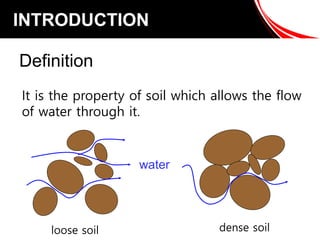
Definition
It is the property of soil which allows the flow
of water through it.
loose soil dense soil
water
Importance of Permeability
• The design of earth dams is very much based upon the
permeability of the soils used.
• The stability of slopes and retaining structures can be
greatly affected by the permeability of the soils involved.
• Filters made of soils are designed based upon their
permeability
• Estimating the quantity of underground seepage
Darcy’s law
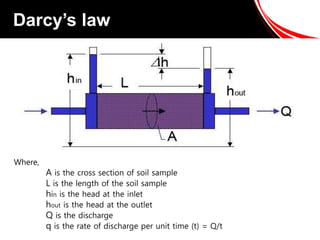
Where,
A is the cross section of soil sample
L is the length of the soil sample
hin is the head at the inlet
hout is the head at the outlet
Q is the discharge
q is the rate of discharge per unit time (t) = Q/t
Darcy’s law
It states that “In a saturated soil, under laminar
flow condition, the rate of flow of water
through given sample of soil is directly
proportional to hydraulic gradient”
V=q/A=ki
q=kiA
Where,
V is the superficial velocity (m/sec)
k is the co-efficent of permeability (m/sec)
i is the hydraulic gradient= (hin-hout)/L
Superficial velocity
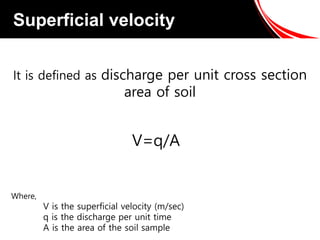
It is defined as discharge per unit cross section
area of soil
V=q/A
Where,
V is the superficial velocity (m/sec)
q is the discharge per unit time
A is the area of the soil sample
Seepage velocity
It is defined as discharge per unit cross section
area of voids to the direction of the flow soil
Vs=q/As
Where,
Vs is the seepage velocity (m/sec)
q is the discharge per unit time
As is the area of voids
Relationship between superficial velocity and
seepage velocity is
Vs = V/n
n is the porosity
Factors affecting permeability
• Particle size
• Properties of pore water
• Degree of saturation
• Presence of entrapped air & other foreign matter
• Structural arrangement
• Stratification of soil
Factors affecting permeability
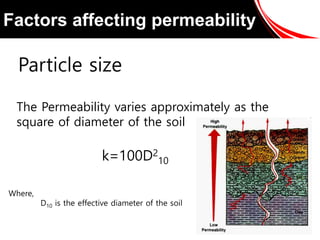
Particle size
The Permeability varies approximately as the
square of diameter of the soil
k=100D2
10
Where,
D10 is the effective diameter of the soil
Factors affecting permeability
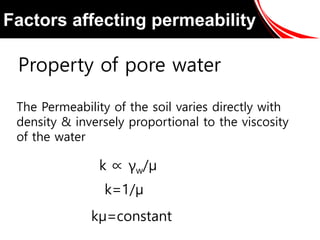
Property of pore water
The Permeability of the soil varies directly with
density & inversely proportional to the viscosity
of the water
k ∝ γw/μ
k=1/μ
kμ=constant
Factors affecting permeability
Void ratio
Increase in the void ratio increases the area
available for flow hence permeability increases.
k ∝ e3/1+e
Where,
e is the void ratio for the soil
permeability k
Factors affecting permeability
Degree of saturation
Higher the degree of saturation, higher will be
the permeability.
Presence of entrapped air &
Other foreign matter
The entrapped air and foreign matter will block the
voids in soil results in decreasing in permeability
Factors affecting permeability
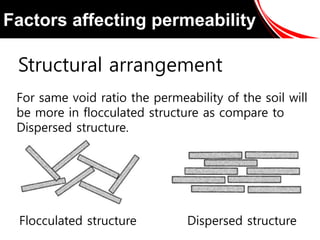
Structural arrangement
For same void ratio the permeability of the soil will
be more in flocculated structure as compare to
Dispersed structure.
Flocculated structure Dispersed structure
Factors affecting permeability
Stratification of soil
Stratified soil deposits have grater permeability
parallel to the plane when compare to perpendicular
to the plane.
k1>k2
Laboratory Testing to find
coefficient of permeability
Two standard laboratory tests are us to
determine the coefficient of permeability
of soil
• The constant-head test
• The falling-head test.
Laboratory Testing to find
coefficient of permeability
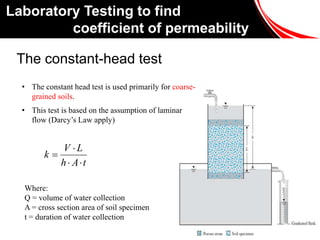
The constant-head test
• The constant head test is used primarily for coarse-
grained soils.
• This test is based on the assumption of laminar
flow (Darcy’s Law apply)
tAh
LV
k



Where:
Q = volume of water collection
A = cross section area of soil specimen
t = duration of water collection
Laboratory Testing to find
coefficient of permeability
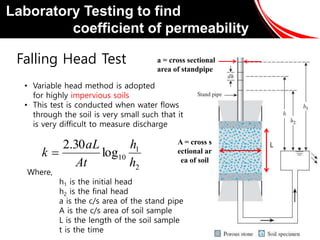
Falling Head Test a = cross sectional
area of standpipe
A = cross s
ectional ar
ea of soil
L
• Variable head method is adopted
for highly impervious soils
• This test is conducted when water flows
through the soil is very small such that it
is very difficult to measure discharge
2
1
10log
30.2
h
h
At
aL
k 
Where,
h1 is the initial head
h2 is the final head
a is the c/s area of the stand pipe
A is the c/s area of soil sample
L is the length of the soil sample
t is the time
Permeability

Permeability

  • 1.
  • 2.
    INDEX • Introduction • Importanceof Permeability • Darcy’s law • Factors affecting permeability of soil • Laboratory Testing to find coefficient of permeability
  • 3.
    INTRODUCTION Definition It is theproperty of soil which allows the flow of water through it. loose soil dense soil water
  • 4.
    Importance of Permeability •The design of earth dams is very much based upon the permeability of the soils used. • The stability of slopes and retaining structures can be greatly affected by the permeability of the soils involved. • Filters made of soils are designed based upon their permeability • Estimating the quantity of underground seepage
  • 5.
    Darcy’s law Where, A isthe cross section of soil sample L is the length of the soil sample hin is the head at the inlet hout is the head at the outlet Q is the discharge q is the rate of discharge per unit time (t) = Q/t
  • 6.
    Darcy’s law It statesthat “In a saturated soil, under laminar flow condition, the rate of flow of water through given sample of soil is directly proportional to hydraulic gradient” V=q/A=ki q=kiA Where, V is the superficial velocity (m/sec) k is the co-efficent of permeability (m/sec) i is the hydraulic gradient= (hin-hout)/L
  • 7.
    Superficial velocity It isdefined as discharge per unit cross section area of soil V=q/A Where, V is the superficial velocity (m/sec) q is the discharge per unit time A is the area of the soil sample
  • 8.
    Seepage velocity It isdefined as discharge per unit cross section area of voids to the direction of the flow soil Vs=q/As Where, Vs is the seepage velocity (m/sec) q is the discharge per unit time As is the area of voids Relationship between superficial velocity and seepage velocity is Vs = V/n n is the porosity
  • 9.
    Factors affecting permeability •Particle size • Properties of pore water • Degree of saturation • Presence of entrapped air & other foreign matter • Structural arrangement • Stratification of soil
  • 10.
    Factors affecting permeability Particlesize The Permeability varies approximately as the square of diameter of the soil k=100D2 10 Where, D10 is the effective diameter of the soil
  • 11.
    Factors affecting permeability Propertyof pore water The Permeability of the soil varies directly with density & inversely proportional to the viscosity of the water k ∝ γw/μ k=1/μ kμ=constant
  • 12.
    Factors affecting permeability Voidratio Increase in the void ratio increases the area available for flow hence permeability increases. k ∝ e3/1+e Where, e is the void ratio for the soil permeability k
  • 13.
    Factors affecting permeability Degreeof saturation Higher the degree of saturation, higher will be the permeability. Presence of entrapped air & Other foreign matter The entrapped air and foreign matter will block the voids in soil results in decreasing in permeability
  • 14.
    Factors affecting permeability Structuralarrangement For same void ratio the permeability of the soil will be more in flocculated structure as compare to Dispersed structure. Flocculated structure Dispersed structure
  • 15.
    Factors affecting permeability Stratificationof soil Stratified soil deposits have grater permeability parallel to the plane when compare to perpendicular to the plane. k1>k2
  • 16.
    Laboratory Testing tofind coefficient of permeability Two standard laboratory tests are us to determine the coefficient of permeability of soil • The constant-head test • The falling-head test.
  • 17.
    Laboratory Testing tofind coefficient of permeability The constant-head test • The constant head test is used primarily for coarse- grained soils. • This test is based on the assumption of laminar flow (Darcy’s Law apply) tAh LV k    Where: Q = volume of water collection A = cross section area of soil specimen t = duration of water collection
  • 18.
    Laboratory Testing tofind coefficient of permeability Falling Head Test a = cross sectional area of standpipe A = cross s ectional ar ea of soil L • Variable head method is adopted for highly impervious soils • This test is conducted when water flows through the soil is very small such that it is very difficult to measure discharge 2 1 10log 30.2 h h At aL k  Where, h1 is the initial head h2 is the final head a is the c/s area of the stand pipe A is the c/s area of soil sample L is the length of the soil sample t is the time