


Arches And Force Transferring
Mechanism
-: CREATED BY :-
ALAY MEHTA 141080106011
SHIVANI PATEL 141080106021
KAVIN RAVAL 141080106026
KUNTAL SONI 141080106028
SUBMITED TO :-
Prof. ROCKY PATEL
Arch
• An arch is a curved structure that spans a space and may or may not
support weight above it. Arch may be synonymous with vault, but a vault
may be distinguished as a continuous arch forming a roof.
• An arch is a pure compression form.
• It can span a large area by resolving forces into compressive stresses and, in
turn eliminating tensile stresses.
• This is sometimes referred to as arch action.
Arch
• As the forces in the arch are carried to the ground, the arch will push
outward at the base, called thrust.
• As the rise, or height of the arch decreases, the outward thrust
increases.
• In order to maintain arch action and prevent the arch from
collapsing, the thrust needs to be restrained, either with internal ties
or external bracing, such as abutments.
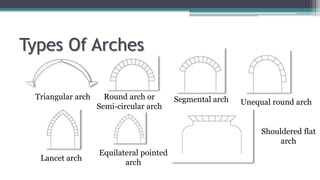
Types Of Arches
Triangular arch Round arch or
Semi-circular arch
Segmental arch Unequal round arch
Lancet arch
Equilateral pointed
arch
Shouldered flat
arch
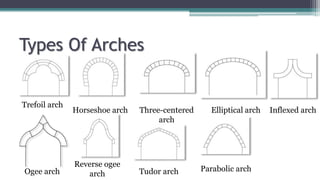
Types Of Arches
Trefoil arch
Horseshoe arch Three-centered
arch
Elliptical arch Inflexed arch
Ogee arch
Reverse ogee
arch Tudor arch Parabolic arch
Forces
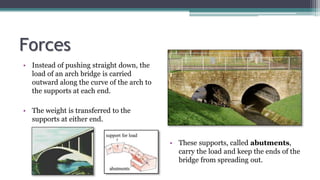
• Instead of pushing straight down, the
load of an arch bridge is carried
outward along the curve of the arch to
the supports at each end.
• The weight is transferred to the
supports at either end.
• These supports, called abutments,
carry the load and keep the ends of the
bridge from spreading out.
Forces
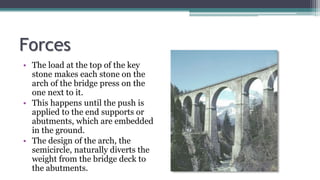
• The load at the top of the key
stone makes each stone on the
arch of the bridge press on the
one next to it.
• This happens until the push is
applied to the end supports or
abutments, which are embedded
in the ground.
• The design of the arch, the
semicircle, naturally diverts the
weight from the bridge deck to
the abutments.
Forces
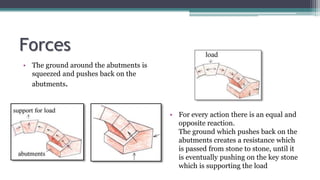
• The ground around the abutments is
squeezed and pushes back on the
abutments.
• For every action there is an equal and
opposite reaction.
The ground which pushes back on the
abutments creates a resistance which
is passed from stone to stone, until it
is eventually pushing on the key stone
which is supporting the load
Forces
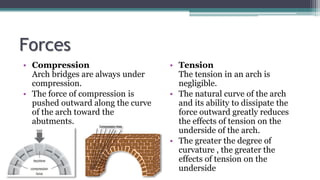
• Compression
Arch bridges are always under
compression.
• The force of compression is
pushed outward along the curve
of the arch toward the
abutments.
• Tension
The tension in an arch is
negligible.
• The natural curve of the arch
and its ability to dissipate the
force outward greatly reduces
the effects of tension on the
underside of the arch.
• The greater the degree of
curvature , the greater the
effects of tension on the
underside
Arches
• Dissipation
As we just mentioned, the shape of the arch itself is all that is needed to effectively
dissipate the weight from the center of the deck to the abutments.
• As with the beam bridge, the limits of size will eventually overtake the natural
strength of the arch
• Arch types are few -- .
The only real subcategories come in the form of cosmetic design.
There are, for example, Roman, Baroque and Renaissance arches, all of which are
architecturally different but structurally the same .
• Arches are fascinating in that they are a truly natural form of bridge.
Arches
• It is the shape of the structure that gives it its strength.
• An arch bridge doesn't need additional supports or cables.
• In fact, an arch made of stone doesn't even need mortar.
• Ancient Romans built arch bridges (and aqueducts) that are still
standing, and structurally sound, today.
• These bridges and aqueducts are real testaments to the natural
effectiveness of an arch as a bridge structure.
ARCHES
ARCHES

ARCHES

  • 2.
    Arches And ForceTransferring Mechanism -: CREATED BY :- ALAY MEHTA 141080106011 SHIVANI PATEL 141080106021 KAVIN RAVAL 141080106026 KUNTAL SONI 141080106028 SUBMITED TO :- Prof. ROCKY PATEL
  • 3.
    Arch • An archis a curved structure that spans a space and may or may not support weight above it. Arch may be synonymous with vault, but a vault may be distinguished as a continuous arch forming a roof. • An arch is a pure compression form. • It can span a large area by resolving forces into compressive stresses and, in turn eliminating tensile stresses. • This is sometimes referred to as arch action.
  • 4.
    Arch • As theforces in the arch are carried to the ground, the arch will push outward at the base, called thrust. • As the rise, or height of the arch decreases, the outward thrust increases. • In order to maintain arch action and prevent the arch from collapsing, the thrust needs to be restrained, either with internal ties or external bracing, such as abutments.
  • 5.
    Types Of Arches Triangulararch Round arch or Semi-circular arch Segmental arch Unequal round arch Lancet arch Equilateral pointed arch Shouldered flat arch
  • 6.
    Types Of Arches Trefoilarch Horseshoe arch Three-centered arch Elliptical arch Inflexed arch Ogee arch Reverse ogee arch Tudor arch Parabolic arch
  • 7.
    Forces • Instead ofpushing straight down, the load of an arch bridge is carried outward along the curve of the arch to the supports at each end. • The weight is transferred to the supports at either end. • These supports, called abutments, carry the load and keep the ends of the bridge from spreading out.
  • 8.
    Forces • The loadat the top of the key stone makes each stone on the arch of the bridge press on the one next to it. • This happens until the push is applied to the end supports or abutments, which are embedded in the ground. • The design of the arch, the semicircle, naturally diverts the weight from the bridge deck to the abutments.
  • 9.
    Forces • The groundaround the abutments is squeezed and pushes back on the abutments. • For every action there is an equal and opposite reaction. The ground which pushes back on the abutments creates a resistance which is passed from stone to stone, until it is eventually pushing on the key stone which is supporting the load
  • 10.
    Forces • Compression Arch bridgesare always under compression. • The force of compression is pushed outward along the curve of the arch toward the abutments. • Tension The tension in an arch is negligible. • The natural curve of the arch and its ability to dissipate the force outward greatly reduces the effects of tension on the underside of the arch. • The greater the degree of curvature , the greater the effects of tension on the underside
  • 11.
    Arches • Dissipation As wejust mentioned, the shape of the arch itself is all that is needed to effectively dissipate the weight from the center of the deck to the abutments. • As with the beam bridge, the limits of size will eventually overtake the natural strength of the arch • Arch types are few -- . The only real subcategories come in the form of cosmetic design. There are, for example, Roman, Baroque and Renaissance arches, all of which are architecturally different but structurally the same . • Arches are fascinating in that they are a truly natural form of bridge.
  • 12.
    Arches • It isthe shape of the structure that gives it its strength. • An arch bridge doesn't need additional supports or cables. • In fact, an arch made of stone doesn't even need mortar. • Ancient Romans built arch bridges (and aqueducts) that are still standing, and structurally sound, today. • These bridges and aqueducts are real testaments to the natural effectiveness of an arch as a bridge structure.