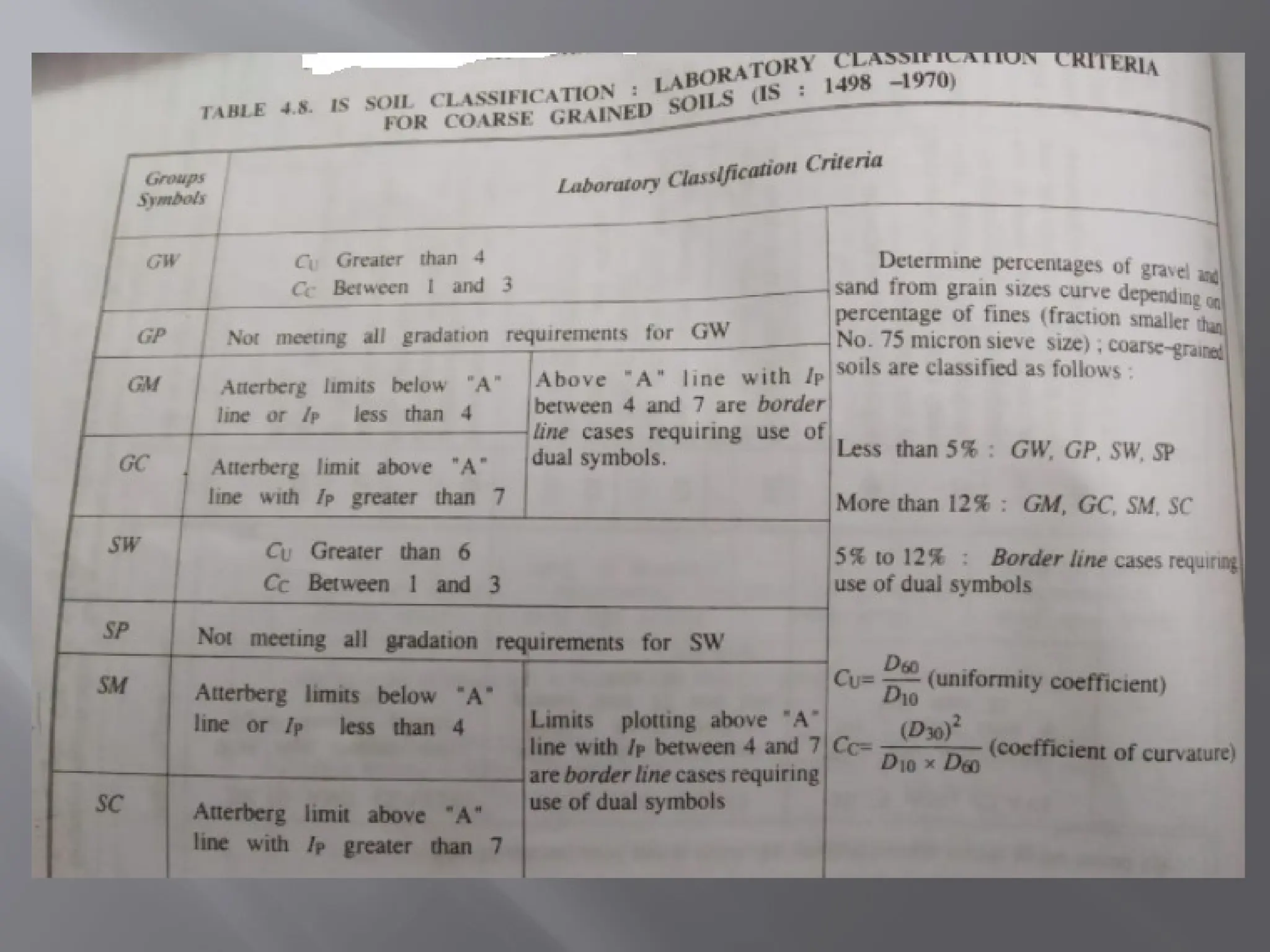
classification of soil details aas per is ,us,classification geotechnical engineering
1.
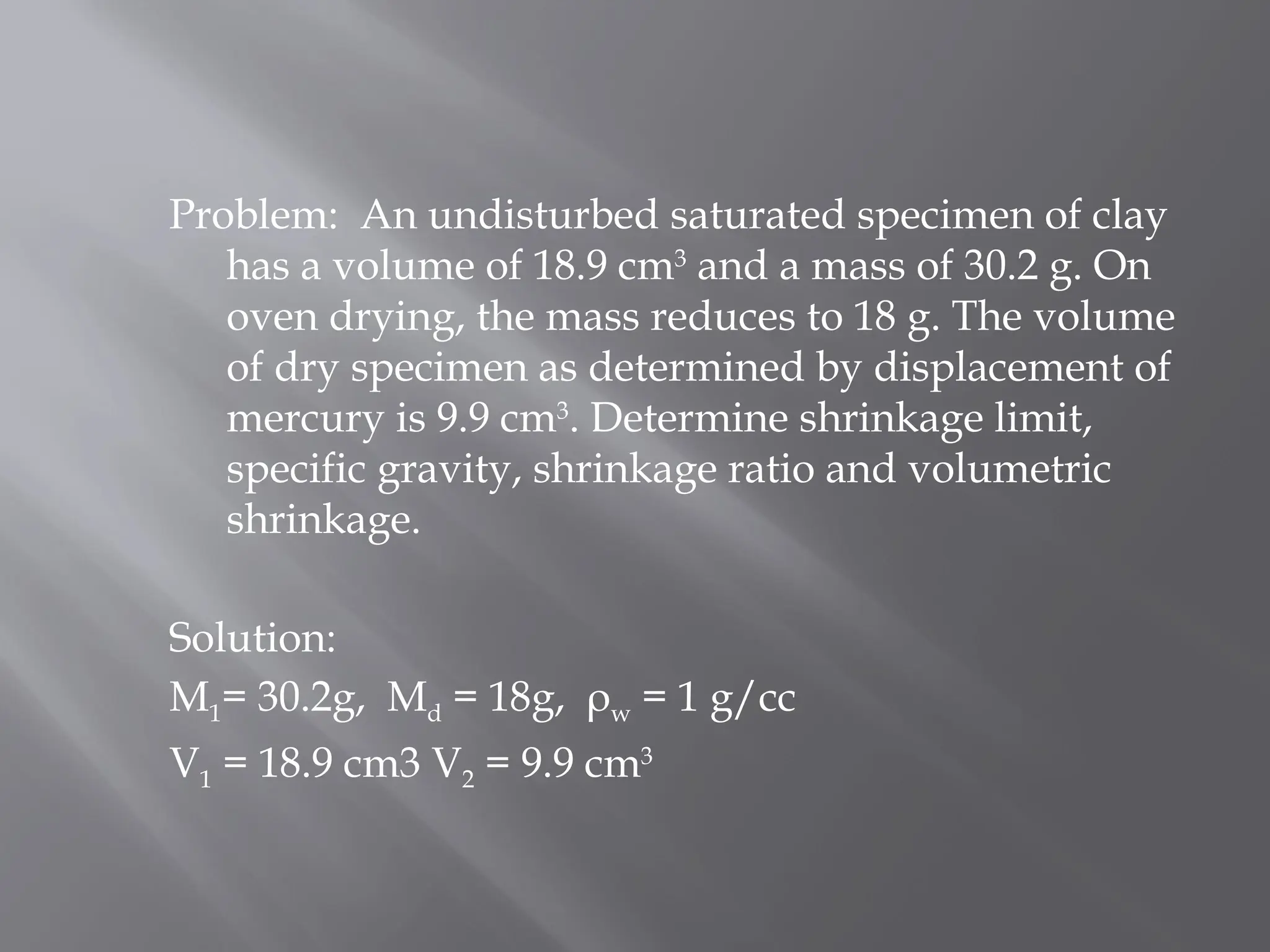
Problem: An undisturbedsaturated specimen of clay
has a volume of 18.9 cm3
and a mass of 30.2 g. On
oven drying, the mass reduces to 18 g. The volume
of dry specimen as determined by displacement of
mercury is 9.9 cm3
. Determine shrinkage limit,
specific gravity, shrinkage ratio and volumetric
shrinkage.
Solution:
M1= 30.2g, Md = 18g, ρw = 1 g/cc
V1 = 18.9 cm3 V2 = 9.9 cm3
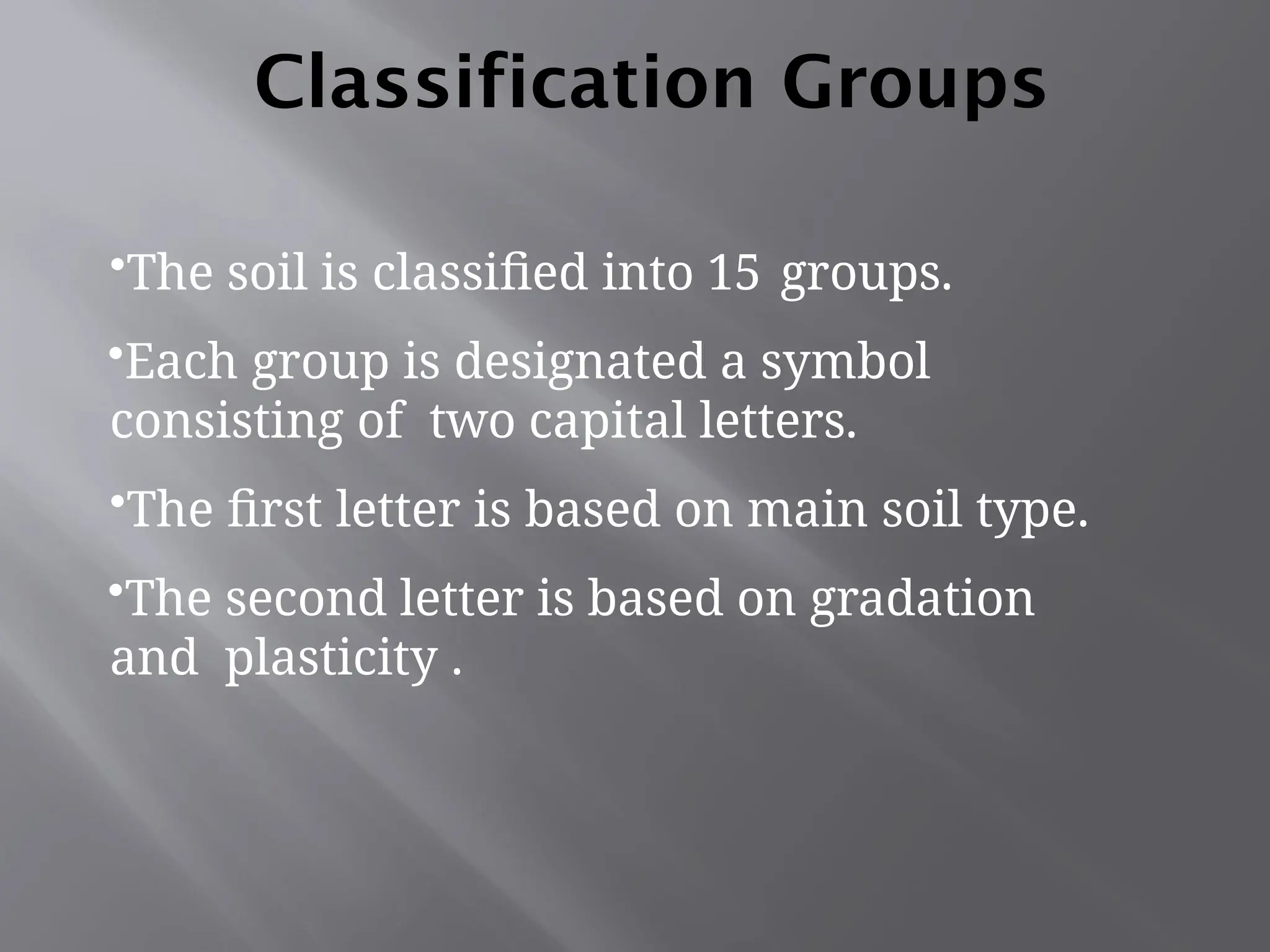
i) ws =[(M1 – Md)/Md] – [(V1 – V2)x ρw /Md] x 100
= [(30.2-18)/18] – [(18.9 – 9.9) x 1/18] x 100
= 17.8%
ii) G = Md/(V1-(M1 – Md))
= 18/(18.9 –(30.2- 18))
= 2.69
Alternatively G = 1 /[(ρw / ρd) – (ws /100)]
ρd = 18/9.9 = 1.818 g/cc
ρw = 1 g/cc
From i), ws = 17.8%
G = 2.69
8.
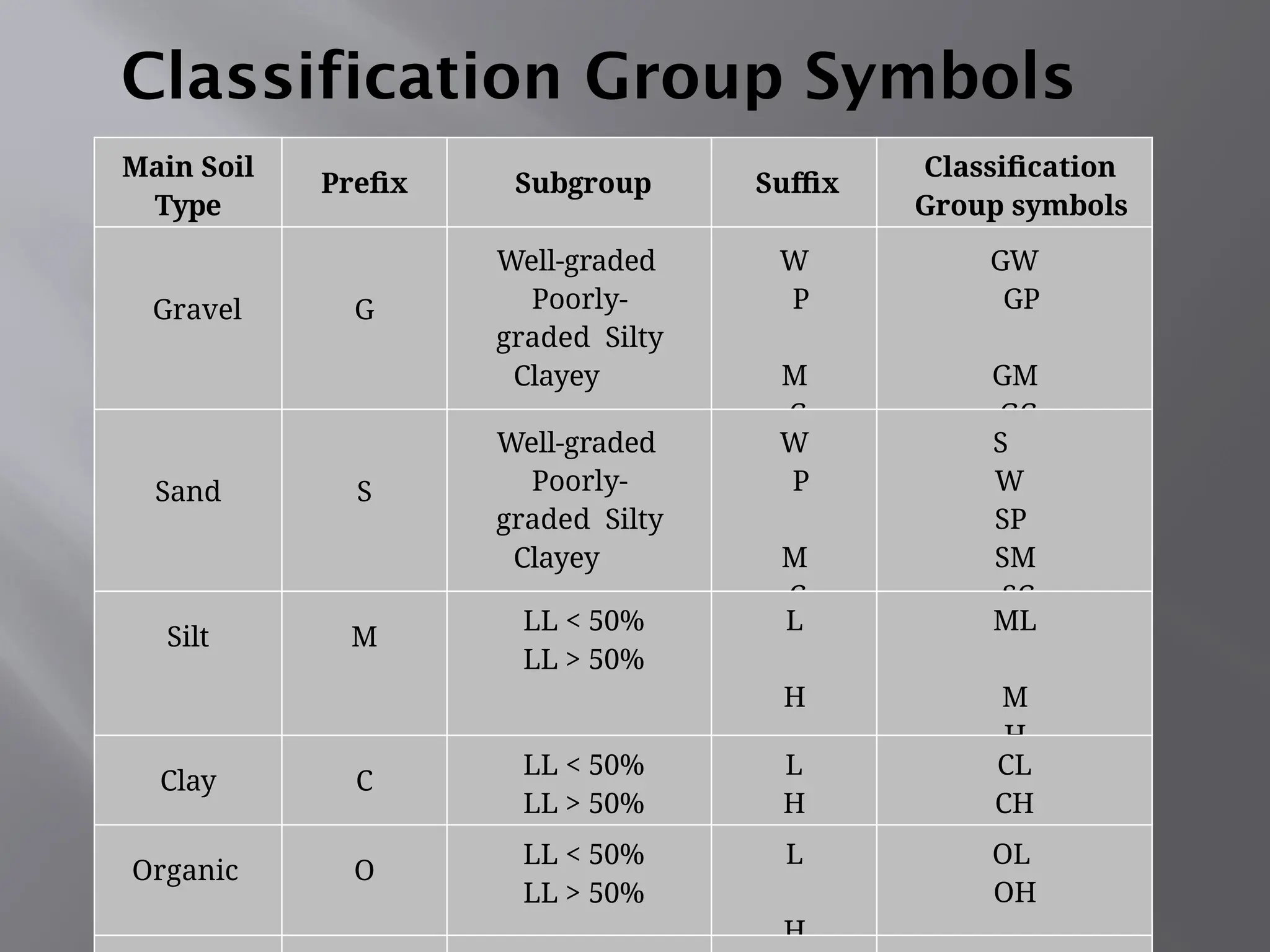
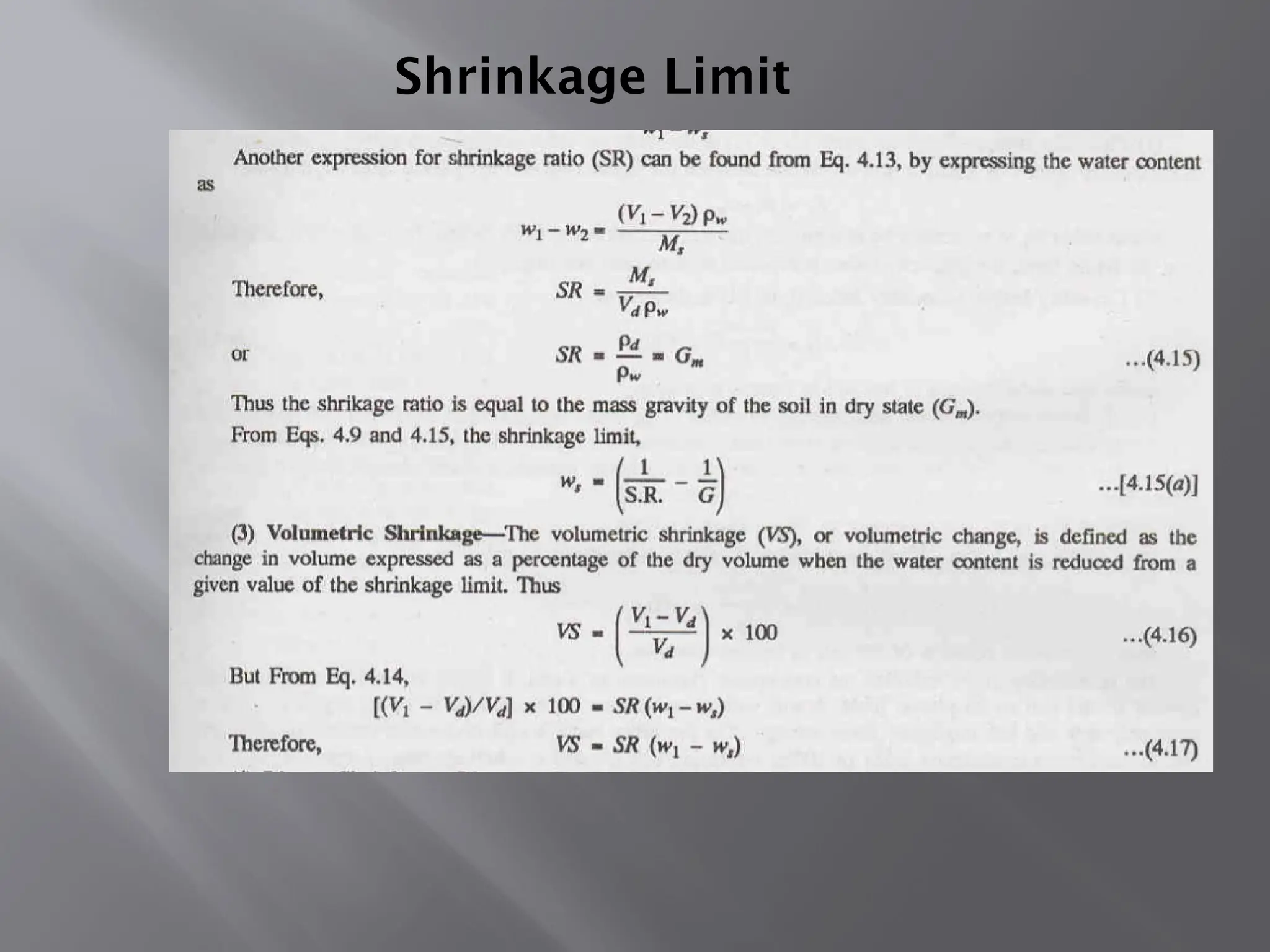
iii) SR =ϒd/ϒw = ρd/ ρw = Gm = 1.818/1
= 1.82
IV) Volumetric Shrinkage (VS)
VS = [(V1 – Vd) x 100]/Vd
= [(18.9 – 9.9) X 100] /9.9 = 91%
Alternatively,
VS = (w1 –ws) SR
= (67.8 – 17.8) X 1.82 = 91%
9.
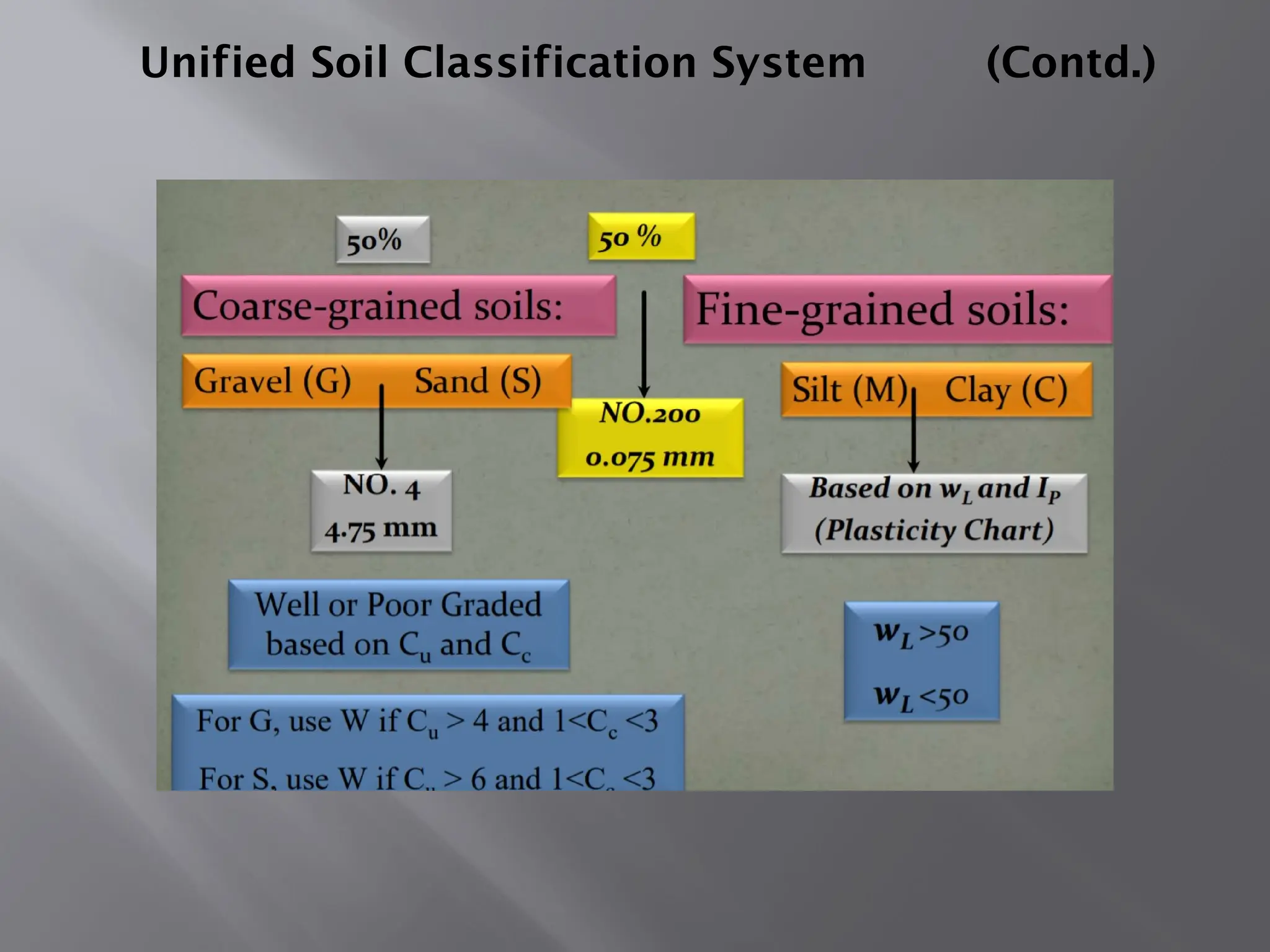
Pr 2: Themass specific gravity of a fully saturated specimen of
clay having a water content of 36% is 1.86. On oven drying, the
mass specific gravity drops to 1.72. Calculate the specific
gravity and its shrinkage limit.
Solution:
e = wsat . G = 0.36 G Gm = ϒsat / ϒw
Gm =[[(G+e) ϒw]/(1+e)] X 1/ ϒw
1.86 = (G+0.36G)/1+0.36G) = 1.36G/(1+0.36G)
G= 2.69
From which,
ws = (ϒw / ϒd) – 1/G
where ϒd / ϒw = 1.72 = mass specific gravity of dry soil
ws = [(1/1.72) – (1/2.69)] = 0.21 = 21%
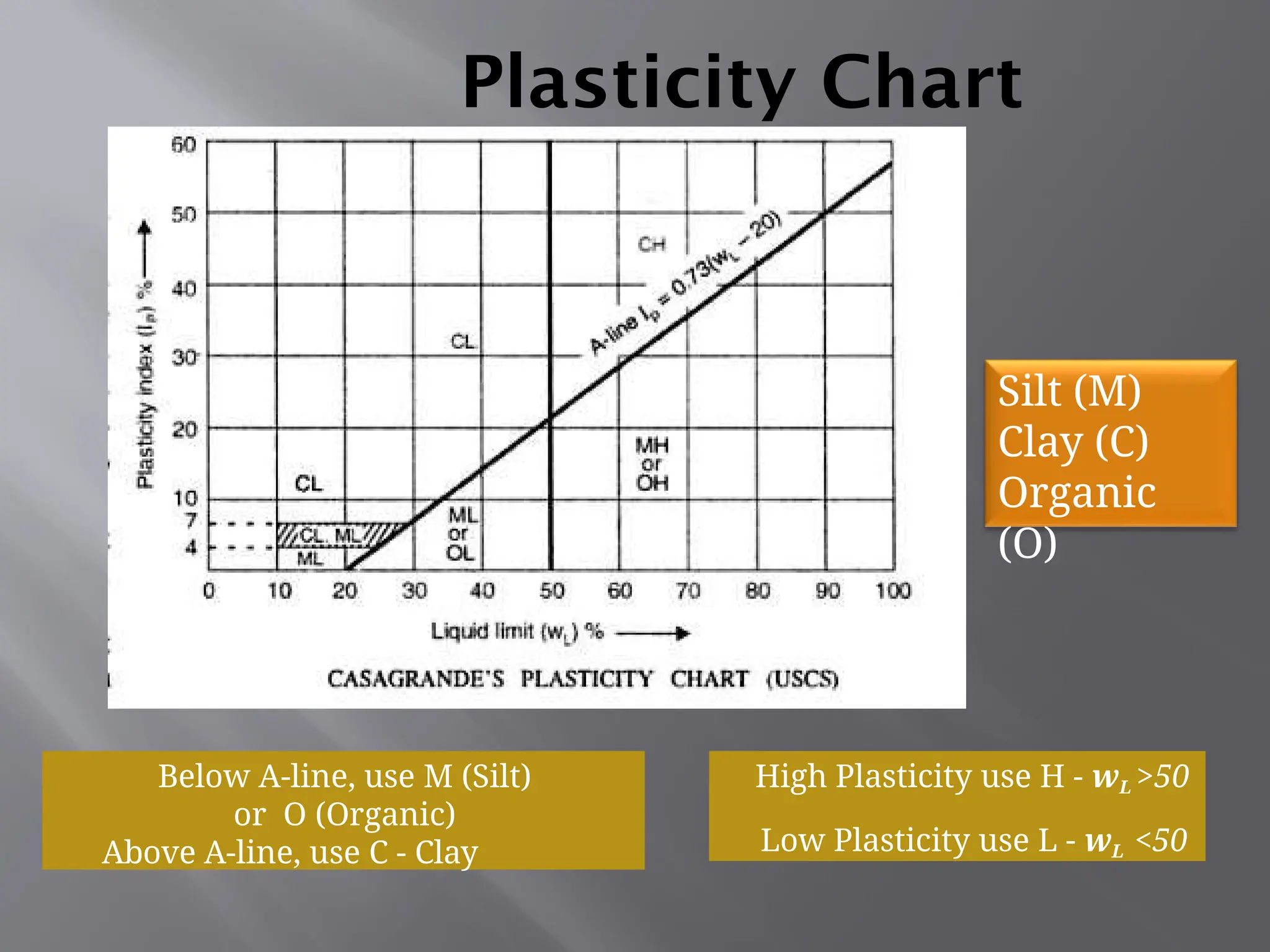
Alternatively,
Soils - Whatare they?
Particulate materials
- Sedimentary origins (usually)
- Residual
Wide range of particle sizes
- larger particles: quartz, feldspar
- very small particles: clay minerals
Voids between particles
13.
Need for SimpleClassification
Usually soil on site has to be used.
Soils differ from other engineering materials in that
one has little control over their properties
Extent and properties of the soil have to be determined
Cheap and simple tests are required to give an
indication of engineering properties, e.g. stiffness,
strength, for preliminary design
The classification must use core samples obtained from the
ground. This information is often supplemented by in-situ tests
such as cone penetration tests.
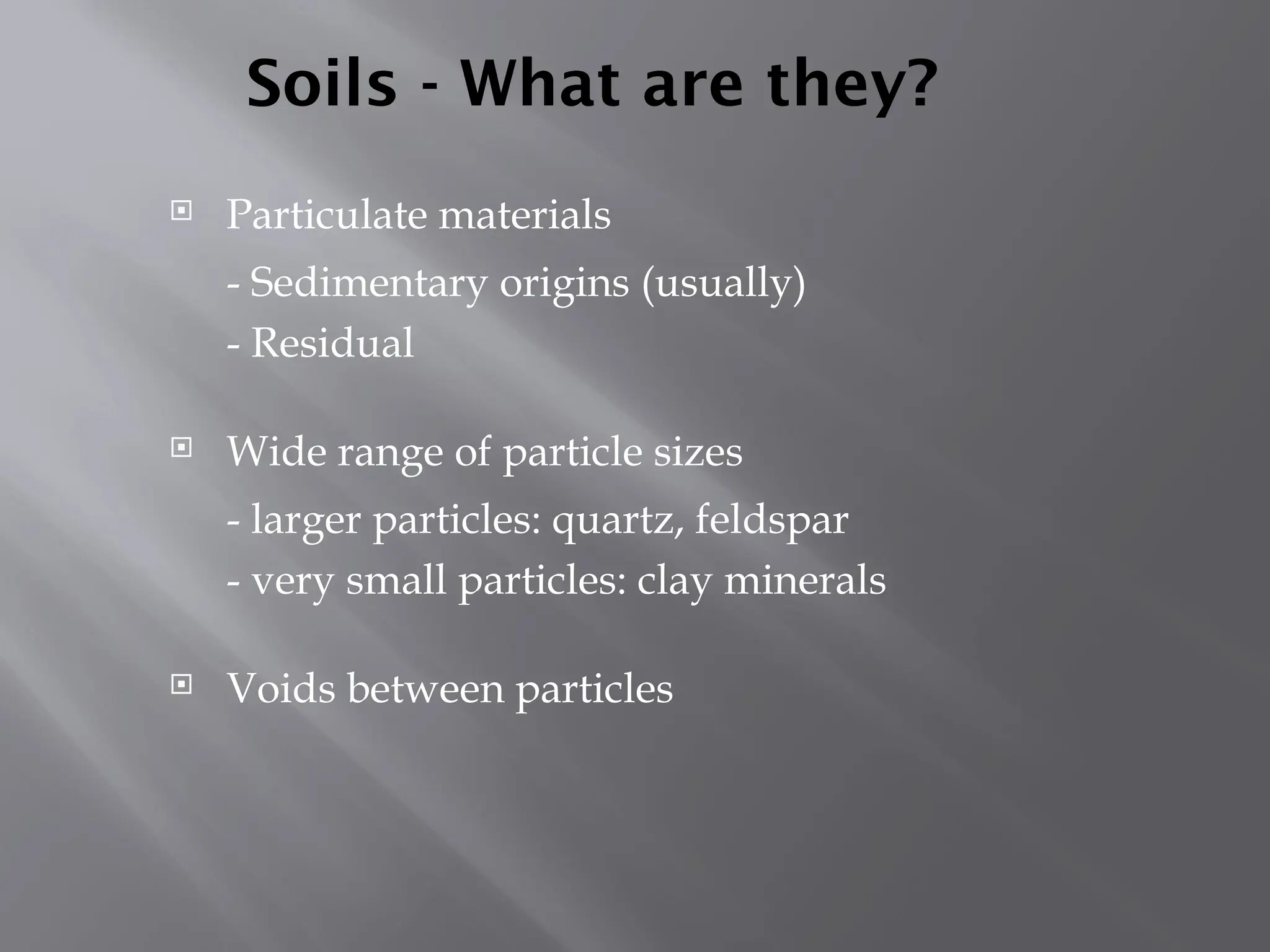
Purpose
Arrange various typesof soils into
groups according to their engineering or
various other characteristics.
Soil possessing similar characteristics
can be placed in the same group.
16.
Soil Classification
Systems
1.Particle SizeClassification
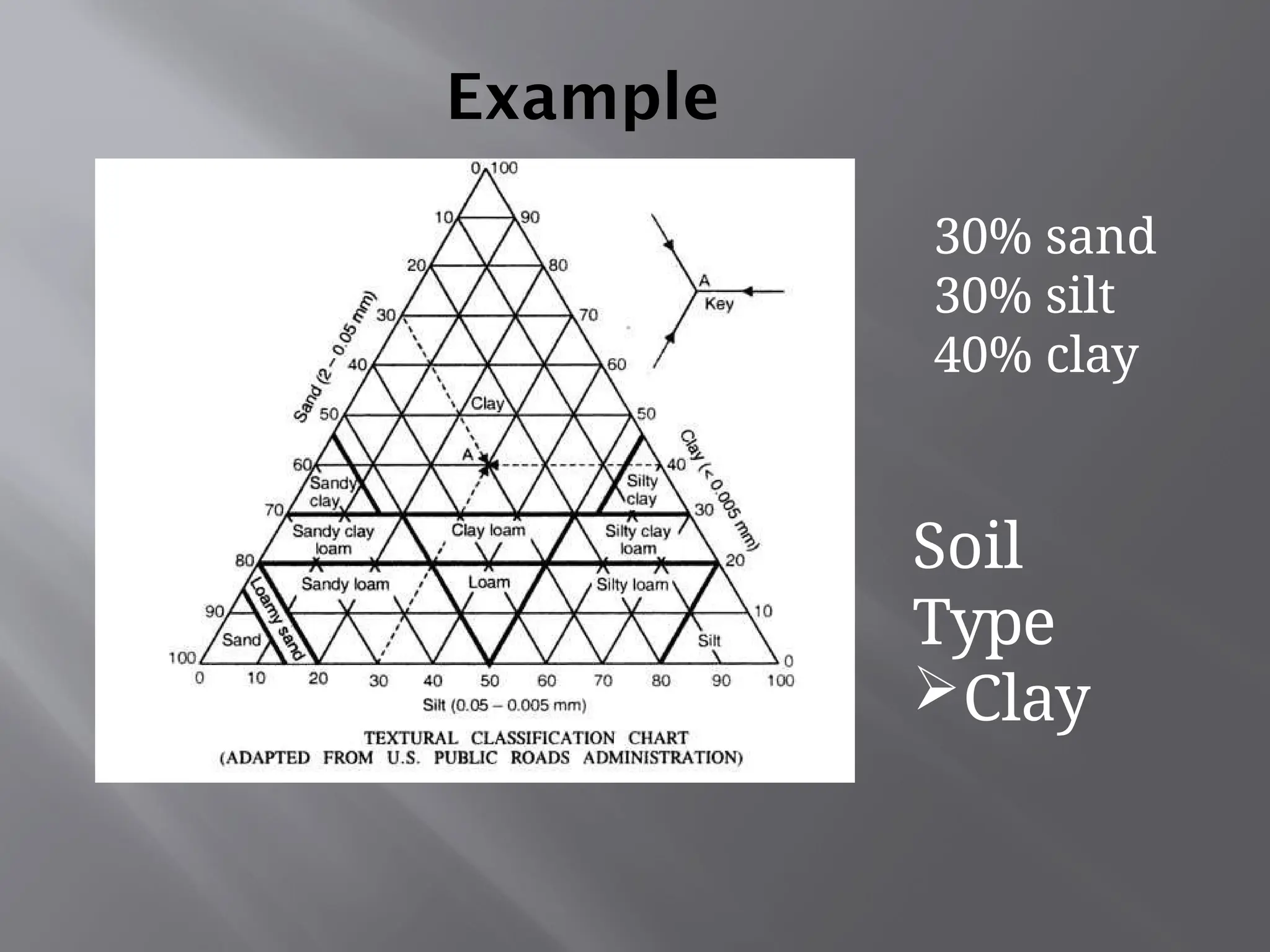
2. Textural Classification
3. Highway Research Board (HRB)
Classification
4. Unified Soil Classification System (USCS)
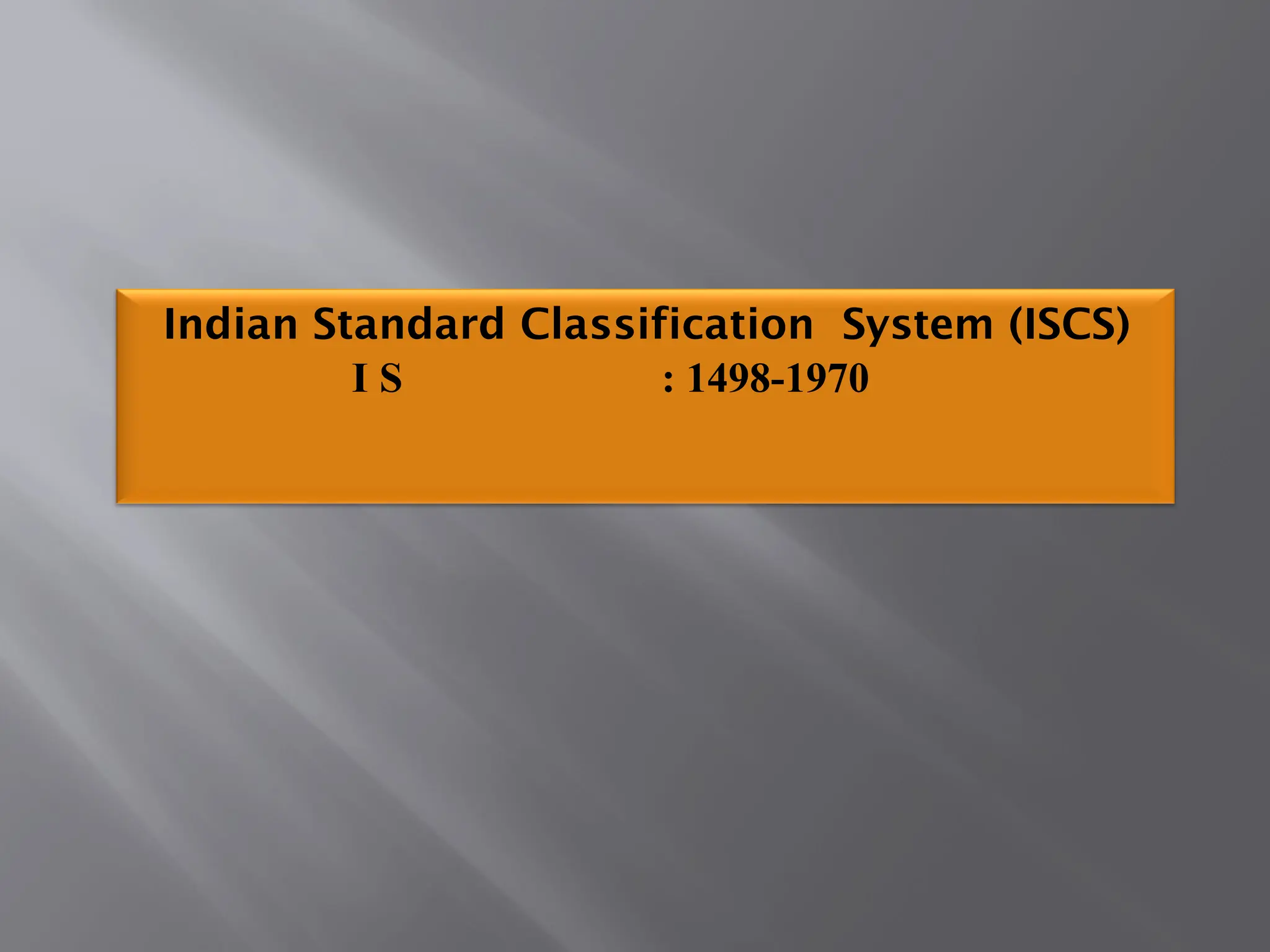
5. Indian Standard Classification System
(ISCS)
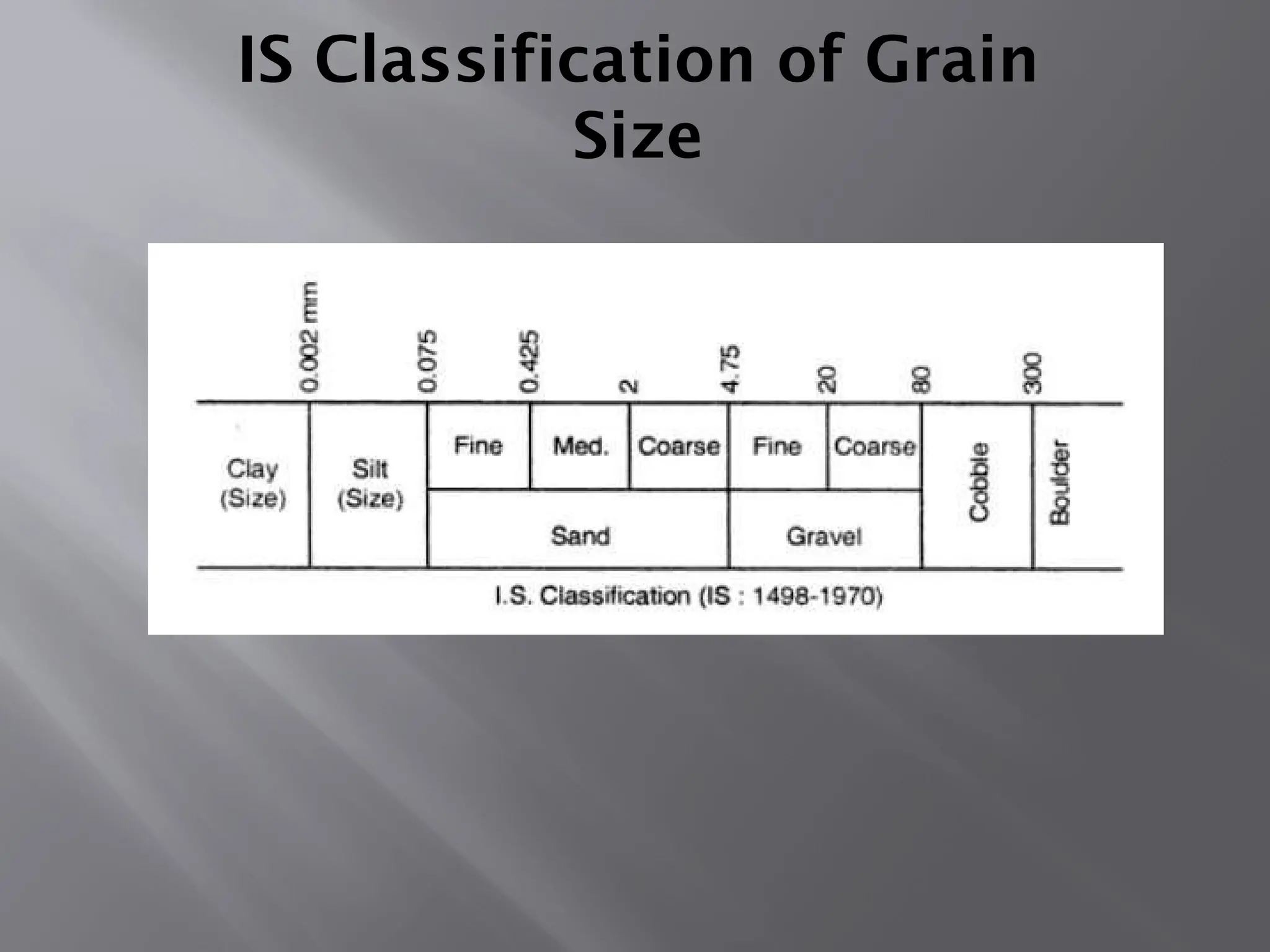
Soils arranged accordingto grain sizes.
Terms such as gravel, sand, silt and clay are
used to indicate grain sizes.
These terms are used only as designation of
particle sizes.
They do not signify naturally occurring
soil types.
Naturally occurring soil are mixture of
particles of different sizes.
Introduction
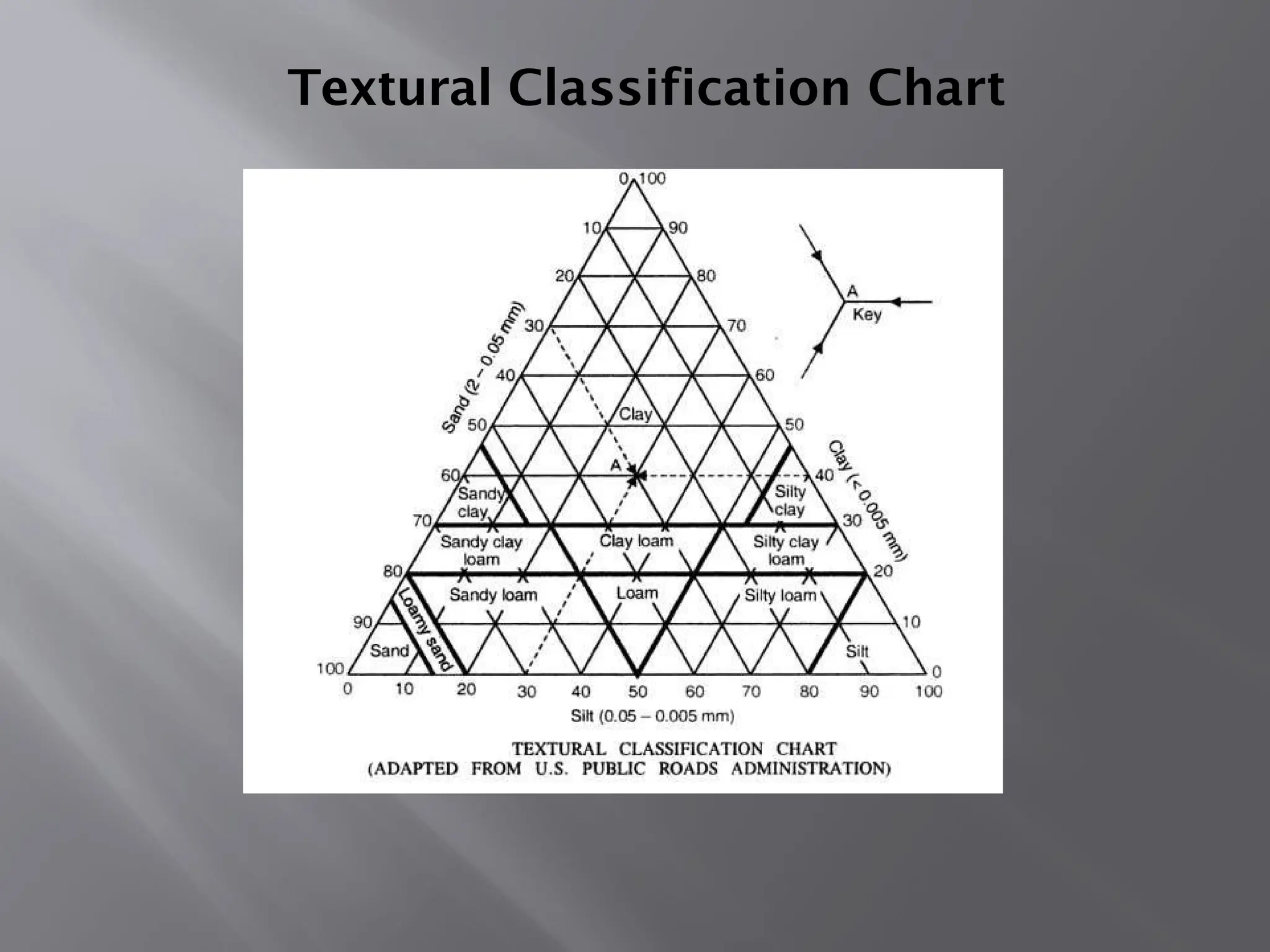
Soil classification ofcomposite soils
exclusively based on Particle Size
Distribution.
Most popular is the Triangular Classification of
U.S. Public Roads Administration.
Classification based on % of sand, silt and clay
size.
More suitable for describing coarse grained
soil.
Clay soil properties are less dependent on
Introduction
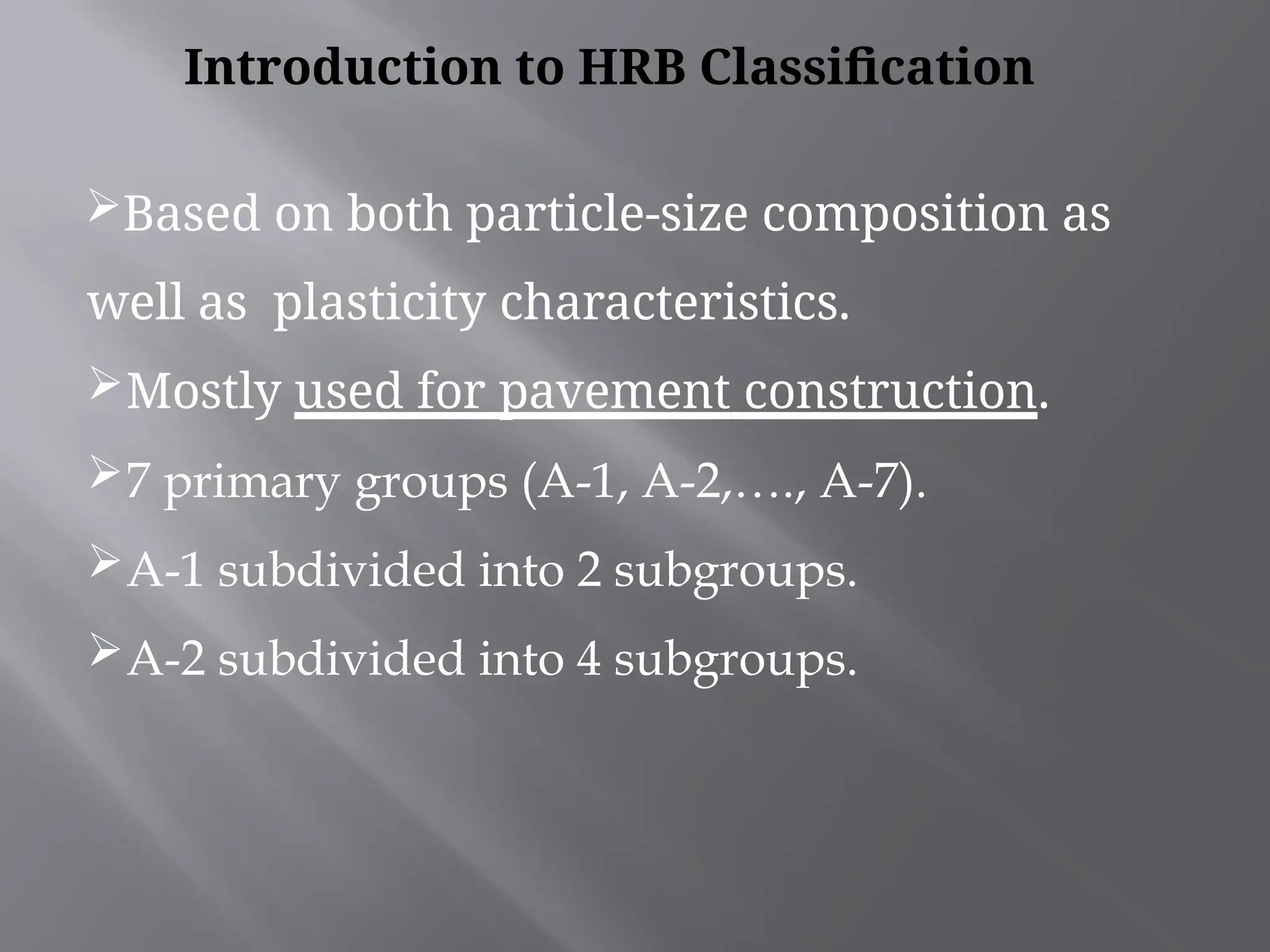
Based on bothparticle-size composition as
well as plasticity characteristics.
Mostly used for pavement construction.
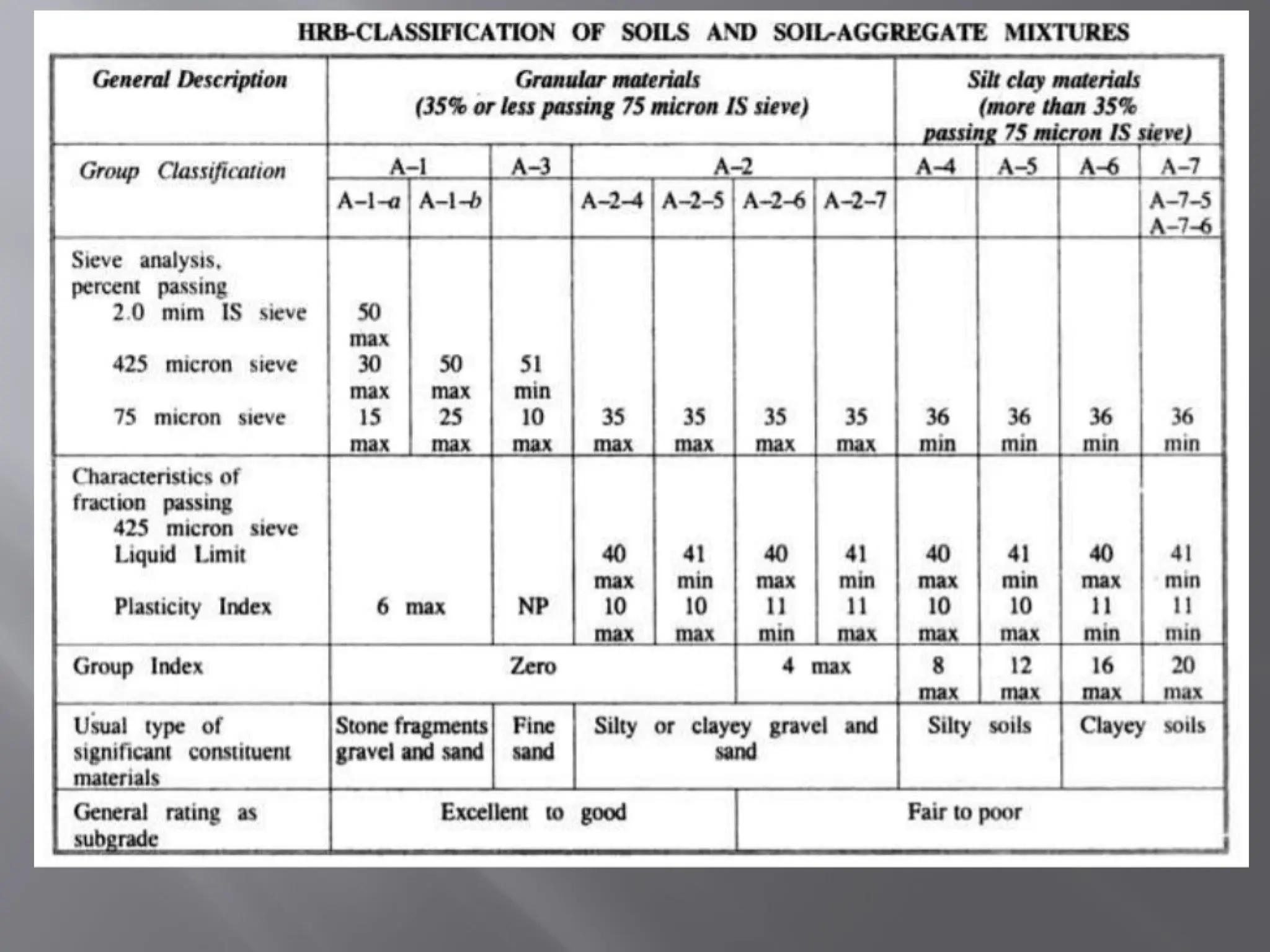
7 primary groups (A-1, A-2,…., A-7).
A-1 subdivided into 2 subgroups.
A-2 subdivided into 4 subgroups.
Introduction to HRB Classification
26.
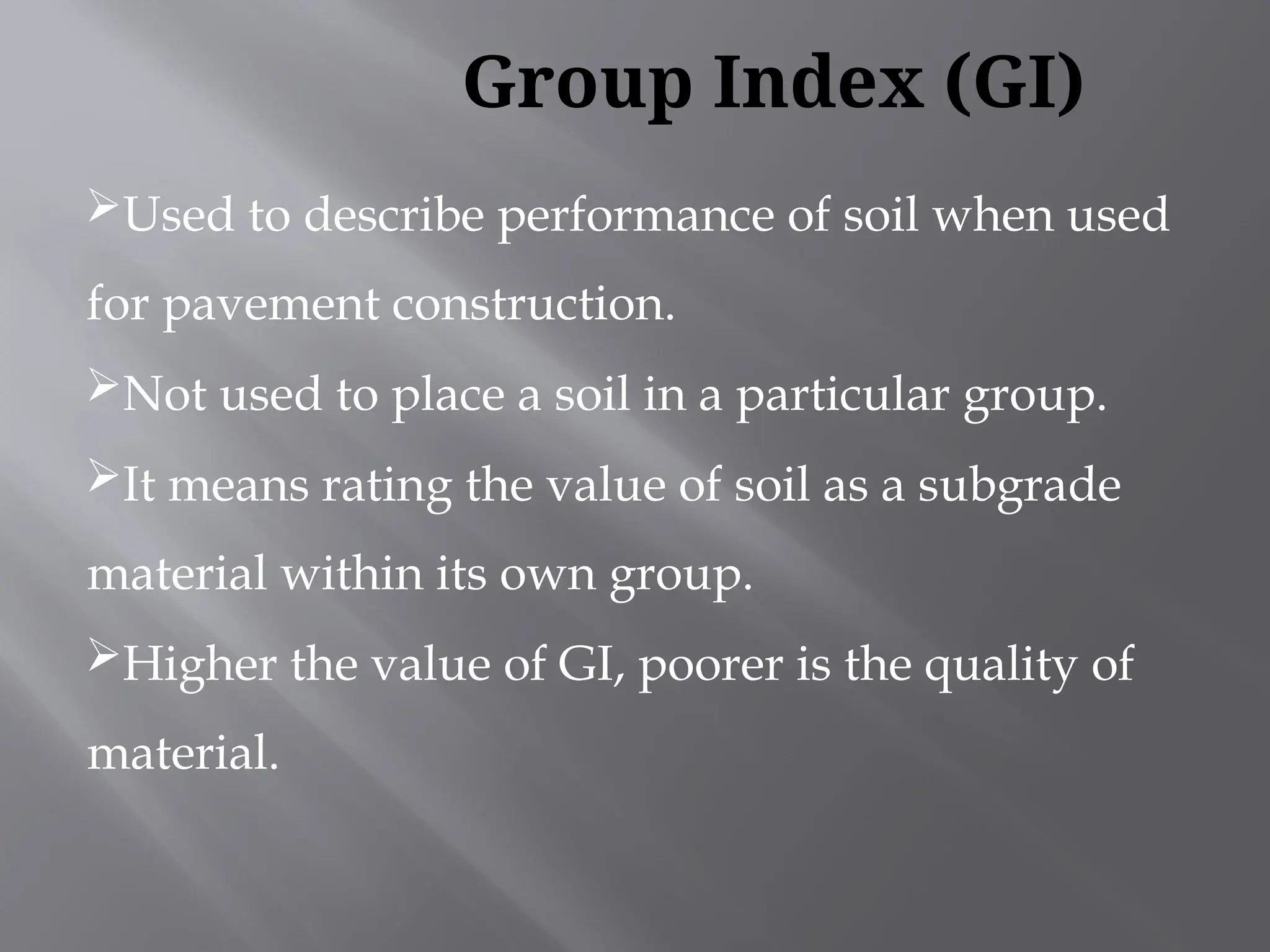
Used to describeperformance of soil when used
for pavement construction.
Not used to place a soil in a particular group.
It means rating the value of soil as a subgrade
material within its own group.
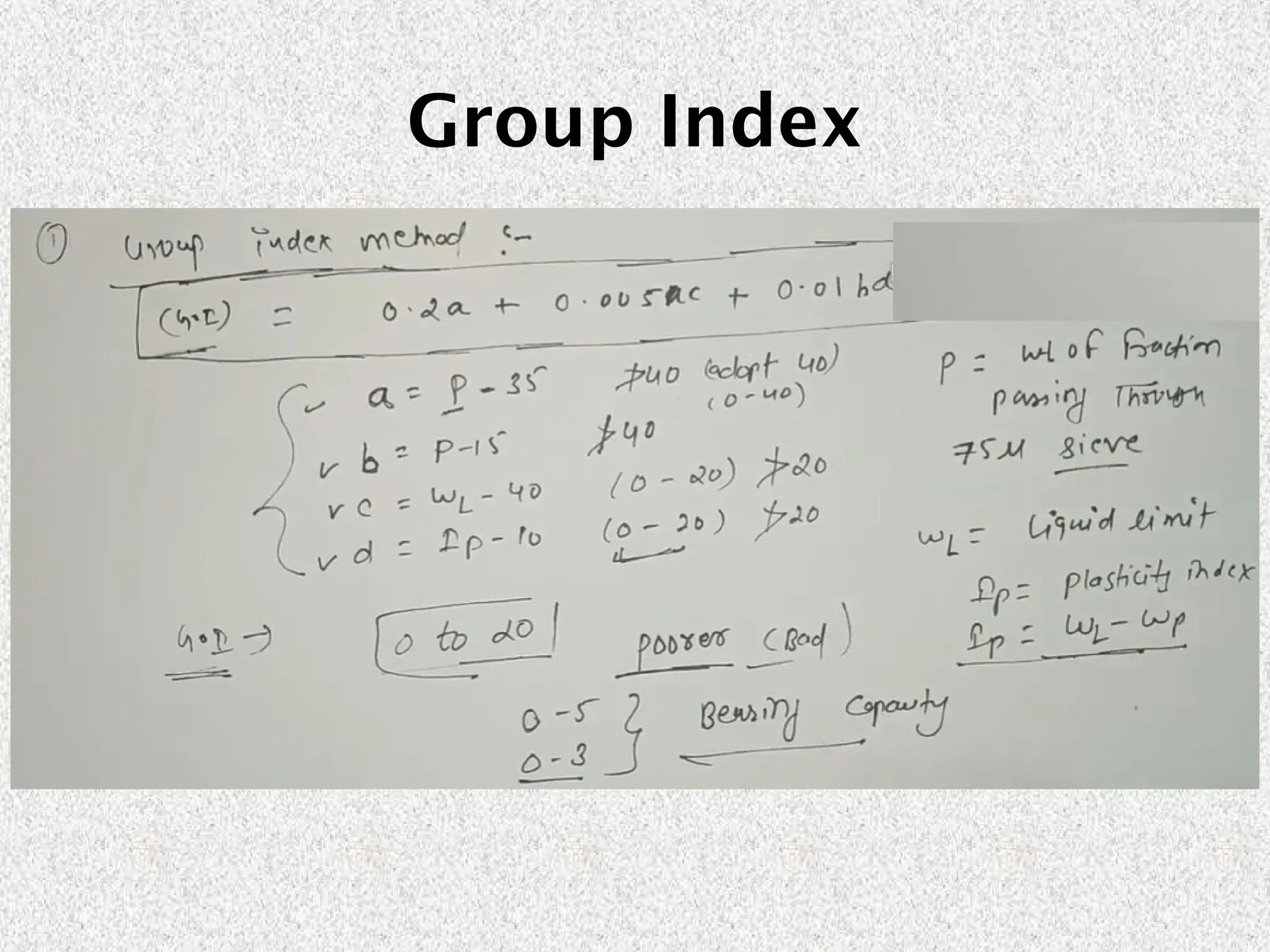
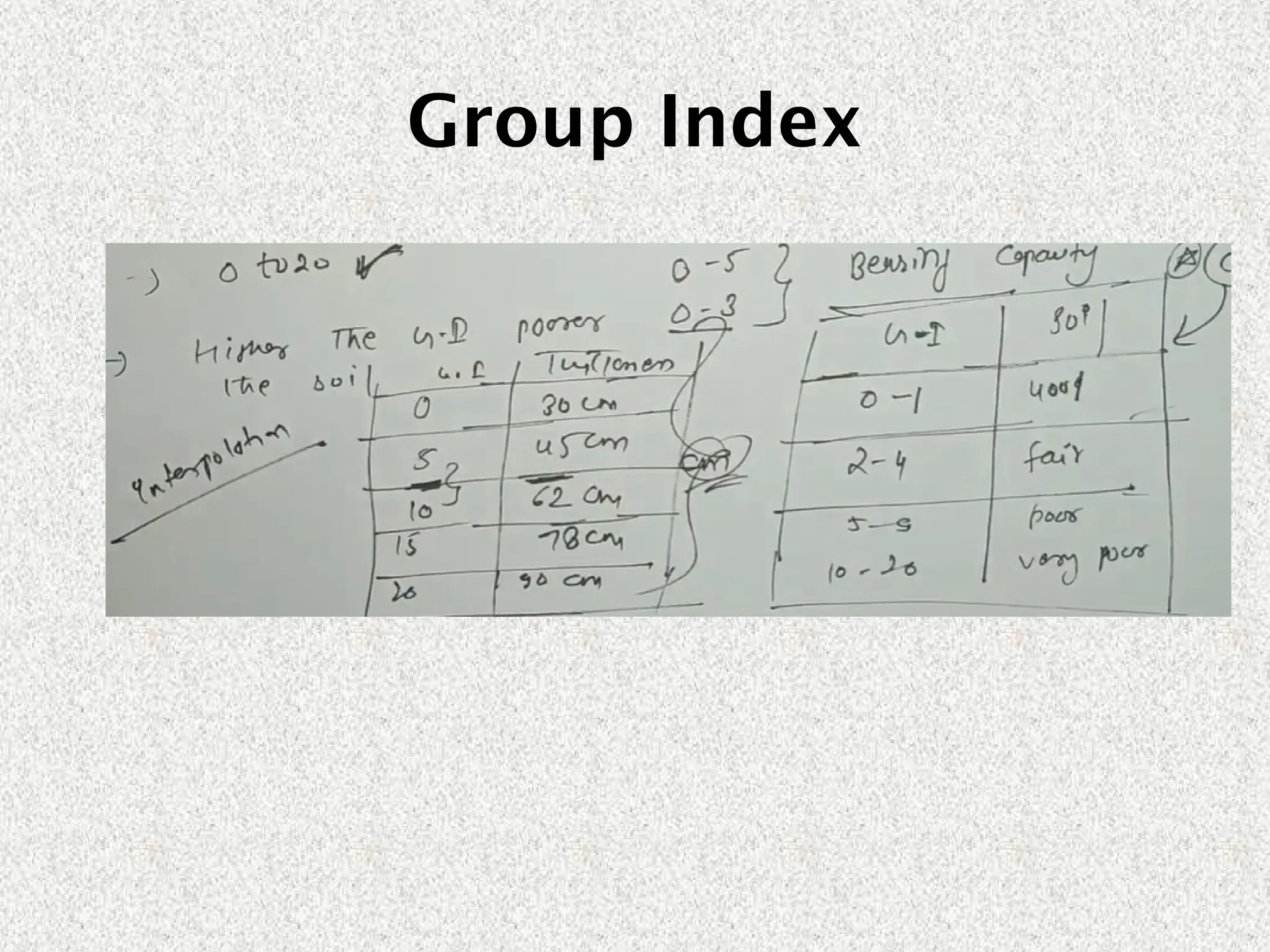
Higher the value of GI, poorer is the quality of
material.
Group Index (GI)
27.
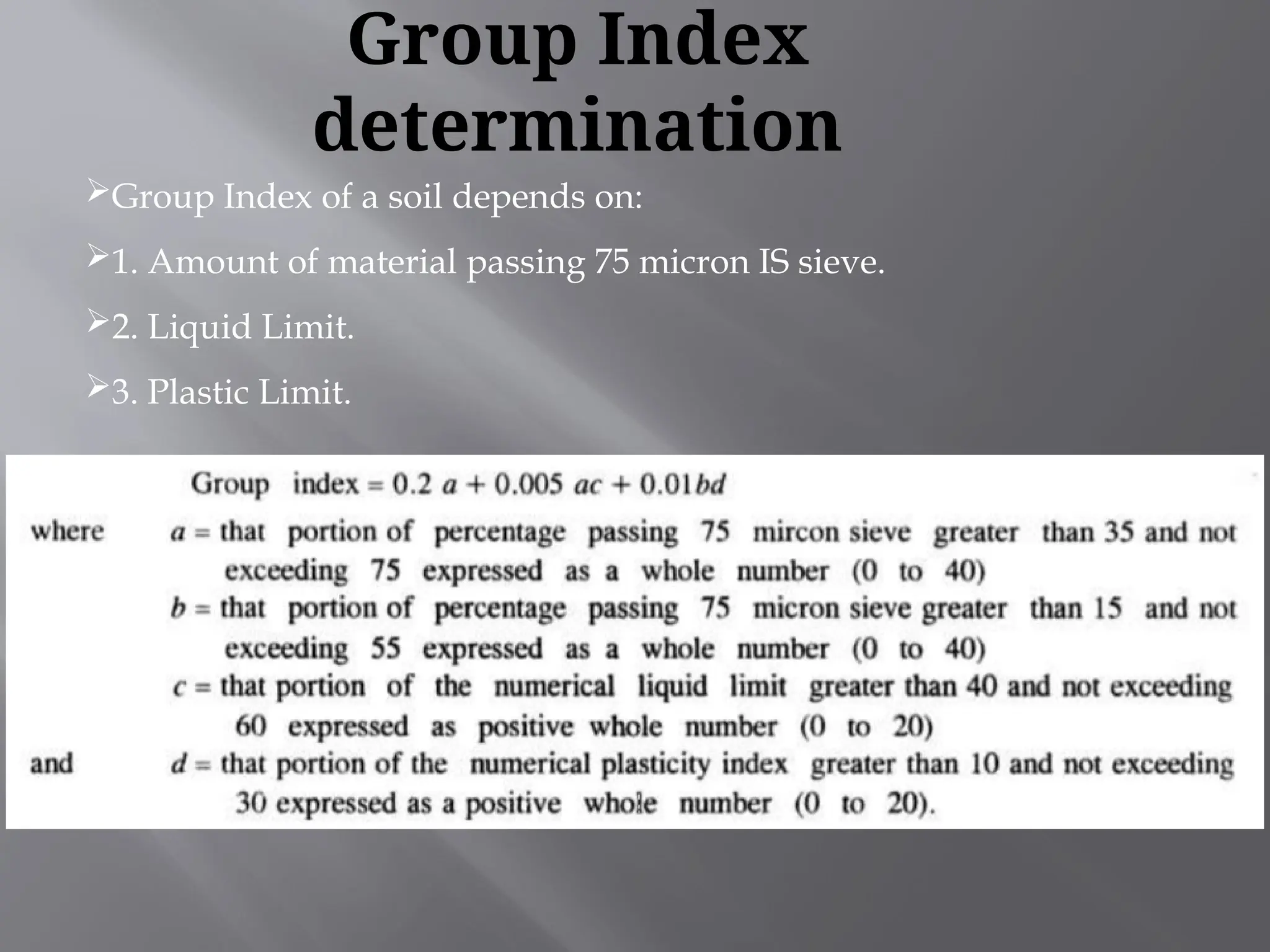
Group Index ofa soil depends on:
1. Amount of material passing 75 micron IS sieve.
2. Liquid Limit.
3. Plastic Limit.
Group Index
determination
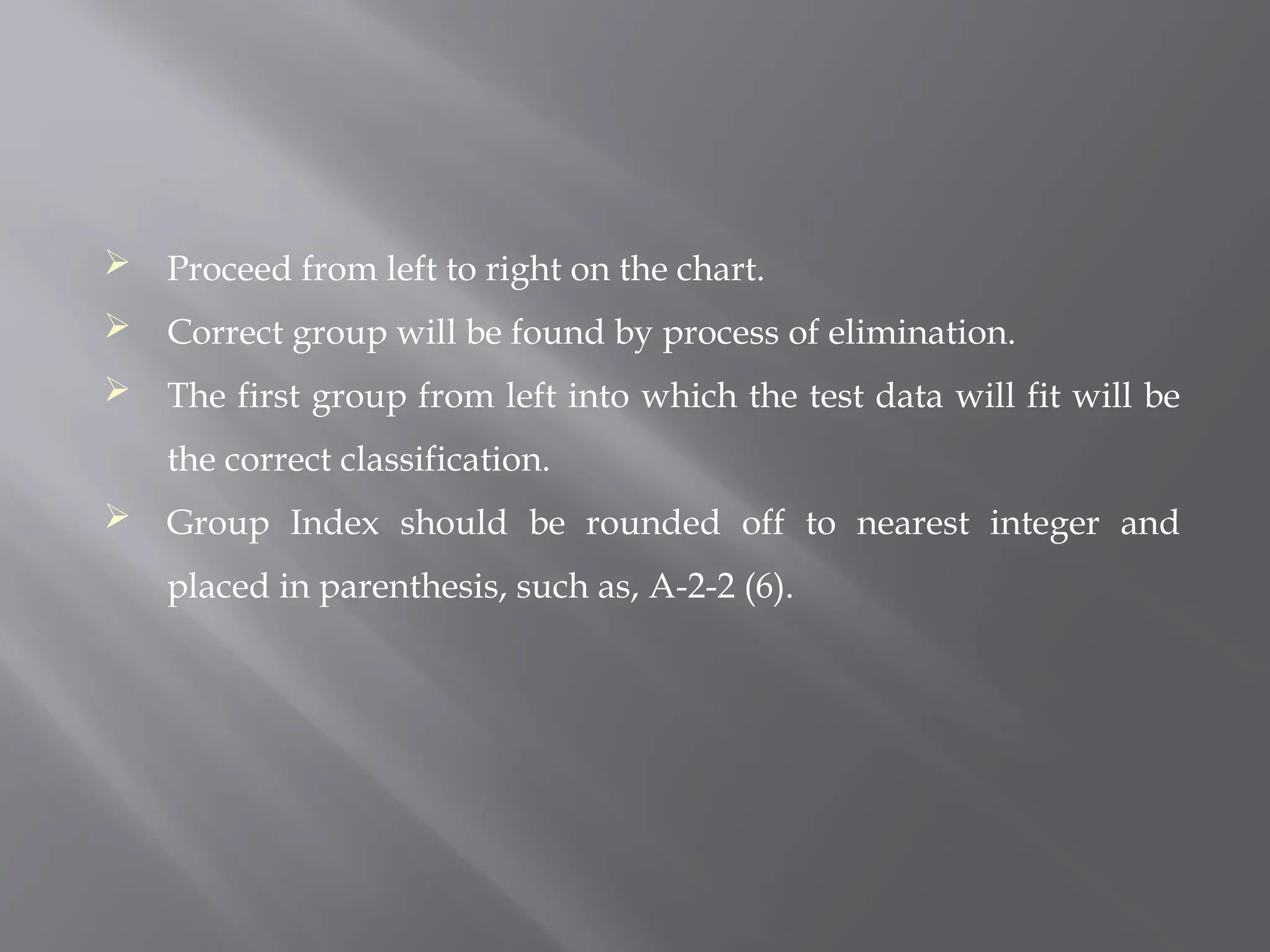
Proceed fromleft to right on the chart.
Correct group will be found by process of elimination.
The first group from left into which the test data will fit will be
the correct classification.
Group Index should be rounded off to nearest integer and
placed in parenthesis, such as, A-2-2 (6).
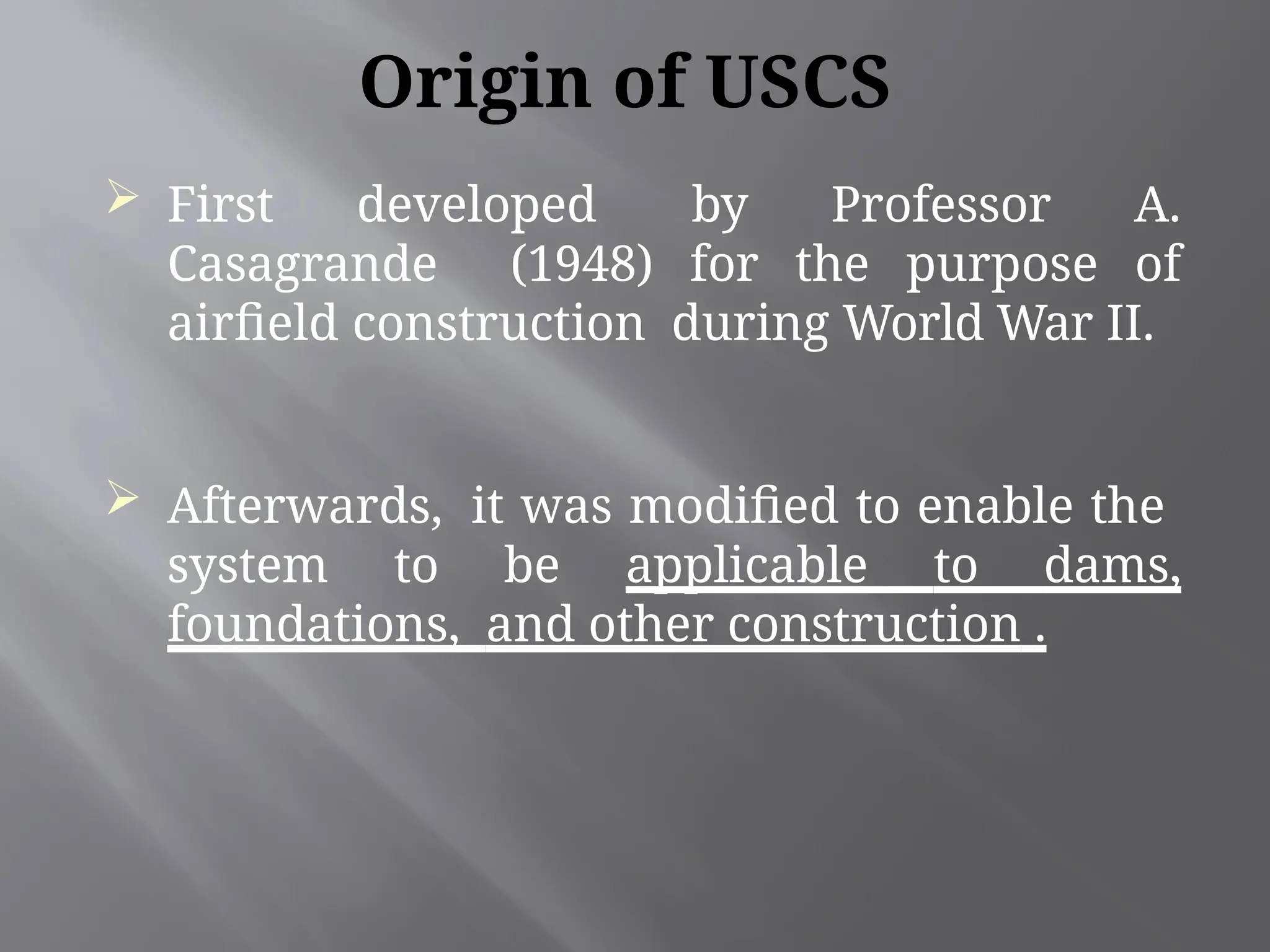
Origin of USCS
First developed by Professor A.
Casagrande (1948) for the purpose of
airfield construction during World War II.
Afterwards, it was modified to enable the
system to be applicable to dams,
foundations, and other construction .
Classification Groups
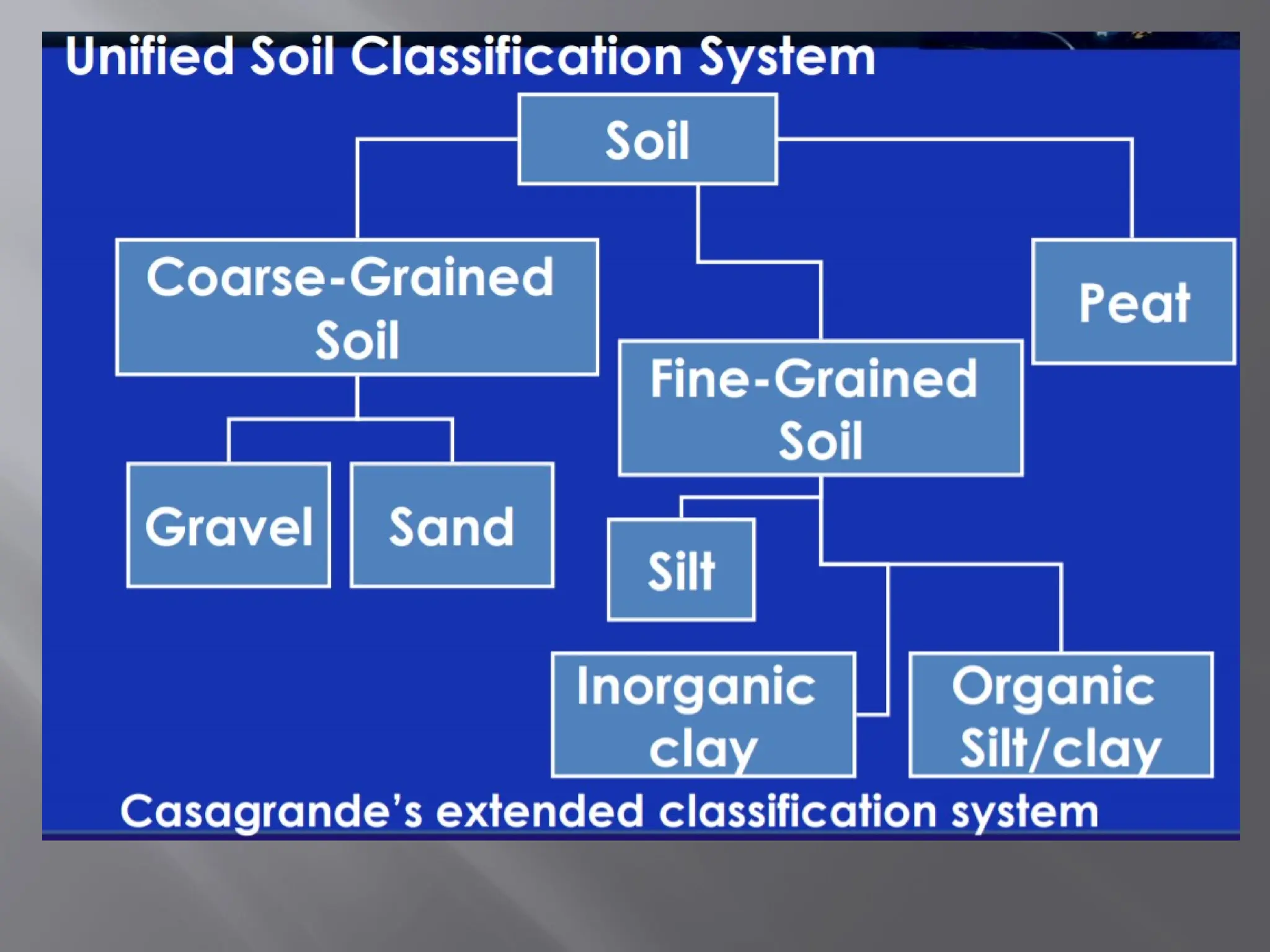
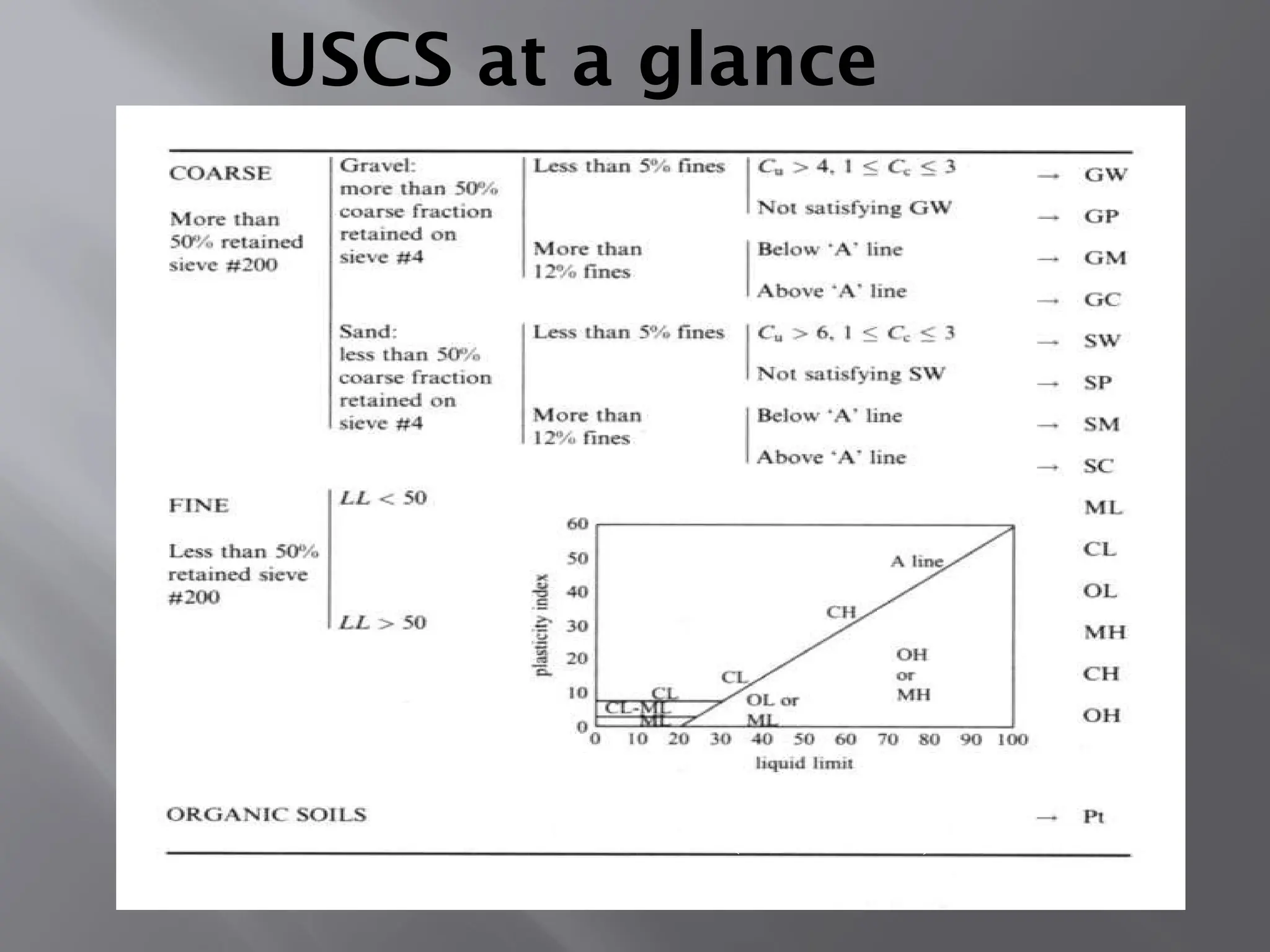
•The soilis classified into 15 groups.
•Each group is designated a symbol
consisting of two capital letters.
•The first letter is based on main soil type.
•The second letter is based on gradation
and plasticity .
37.
Classification Group Symbols
MainSoil
Type
Prefix Subgroup Suffix
Classification
Group symbols
Gravel G
Well-graded
Poorly-
graded Silty
Clayey
W
P
M
C
GW
GP
GM
GC
Sand S
Well-graded
Poorly-
graded Silty
Clayey
W
P
M
C
S
W
SP
SM
SC
Silt M
LL < 50%
LL > 50%
L
H
ML
M
H
Clay C
LL < 50%
LL > 50%
L
H
CL
CH
Organic O
LL < 50%
LL > 50%
L
H
OL
OH
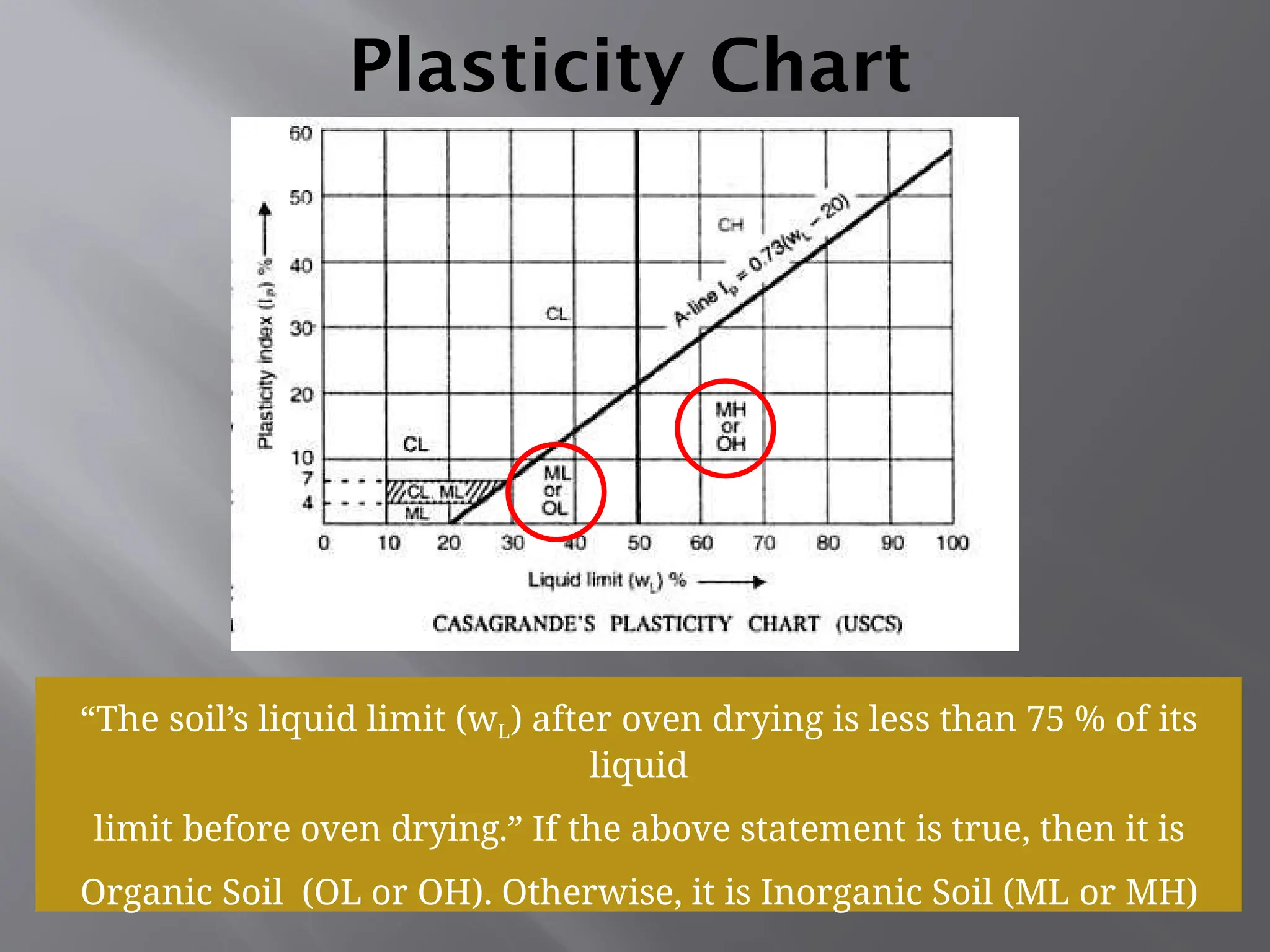
Plasticity Chart
Below A-line,use M (Silt)
or O (Organic)
Above A-line, use C - Clay
High Plasticity use H - wL >50
Low Plasticity use L - wL <50
Silt (M)
Clay (C)
Organic
(O)
40.
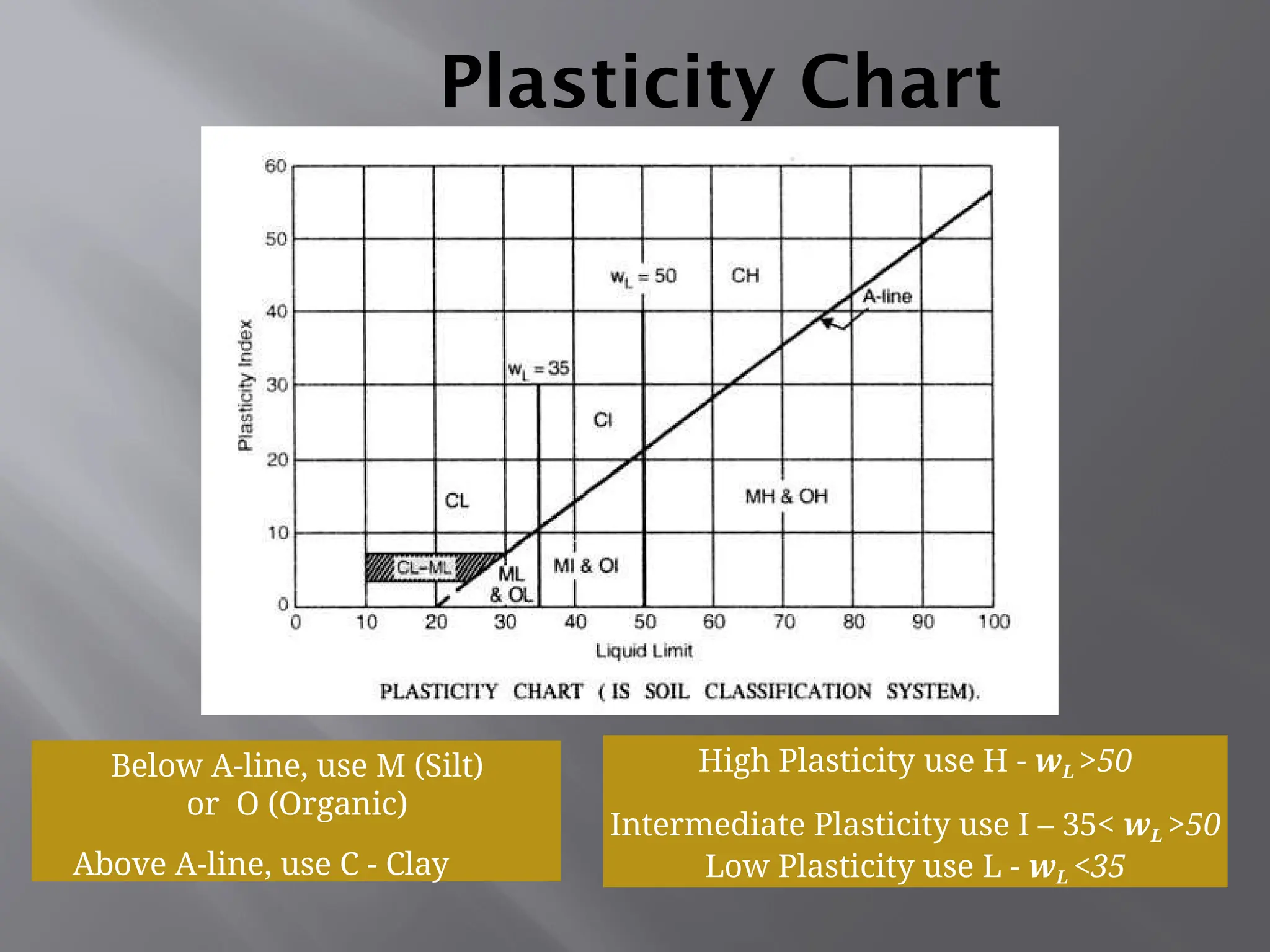
Plasticity Chart
“The soil’sliquid limit (wL) after oven drying is less than 75 % of its
liquid
limit before oven drying.” If the above statement is true, then it is
Organic Soil (OL or OH). Otherwise, it is Inorganic Soil (ML or MH)
41.
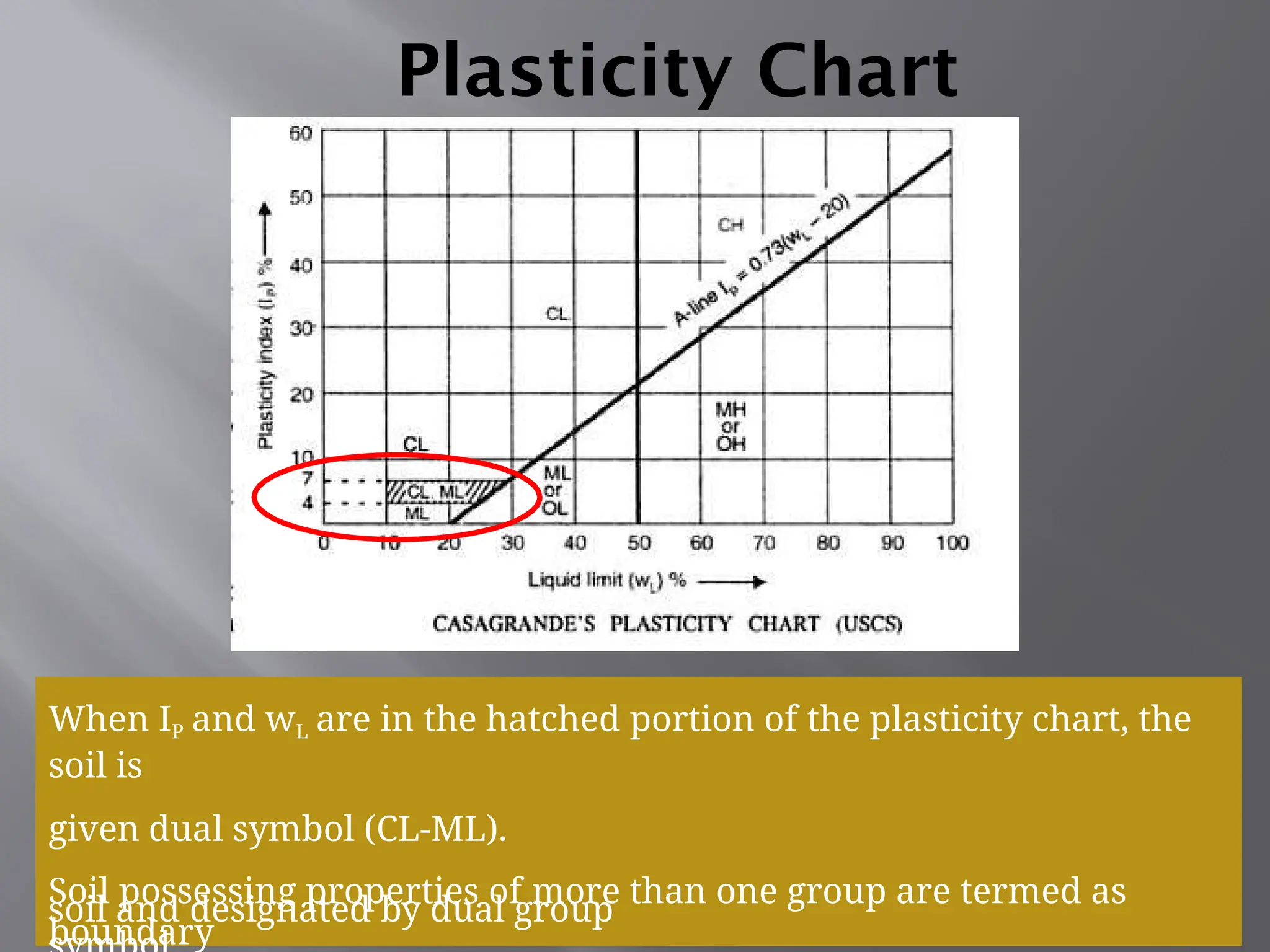
Plasticity Chart
When IPand wL are in the hatched portion of the plasticity chart, the
soil is
given dual symbol (CL-ML).
Soil possessing properties of more than one group are termed as
boundary
soil and designated by dual group
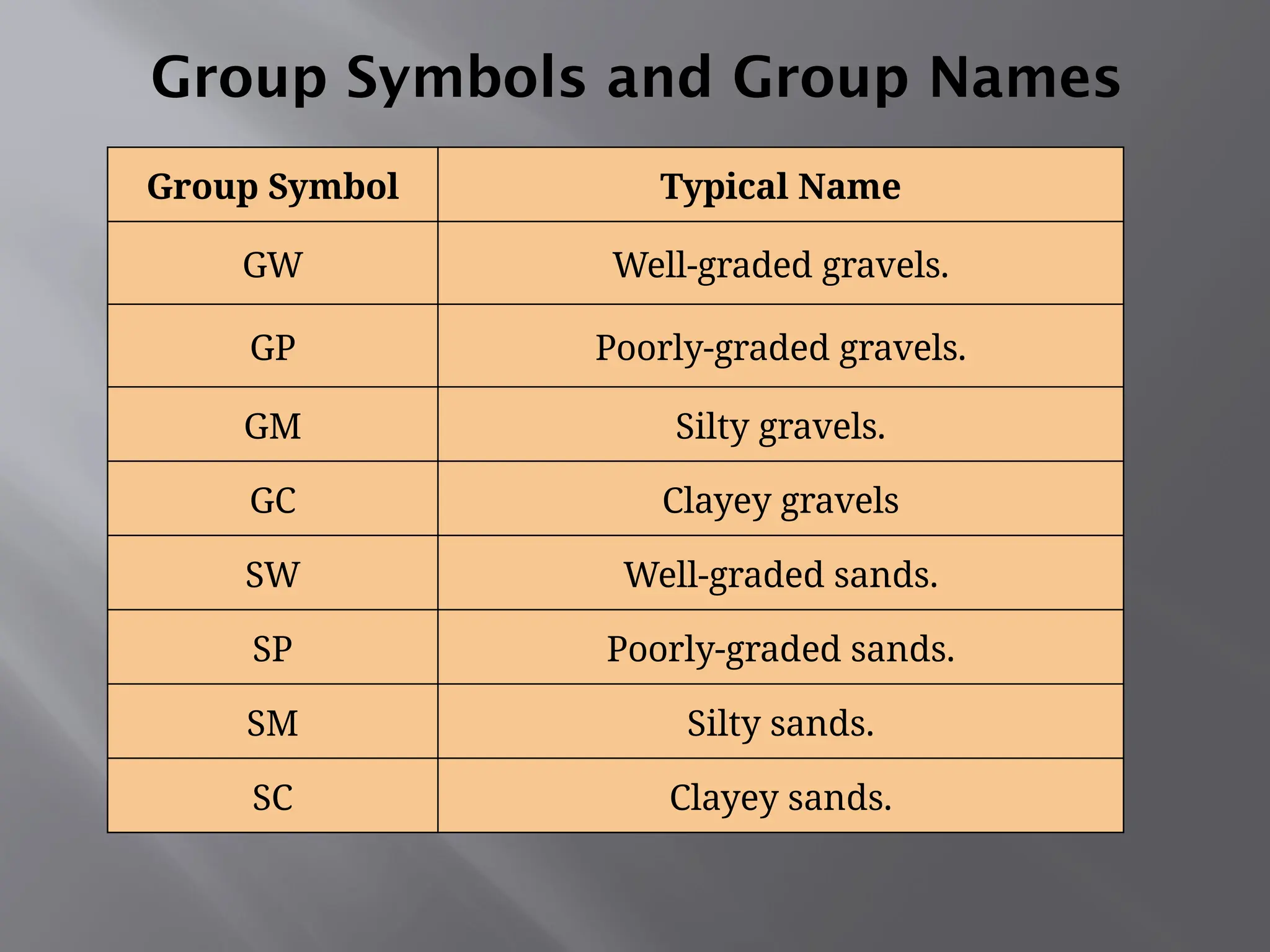
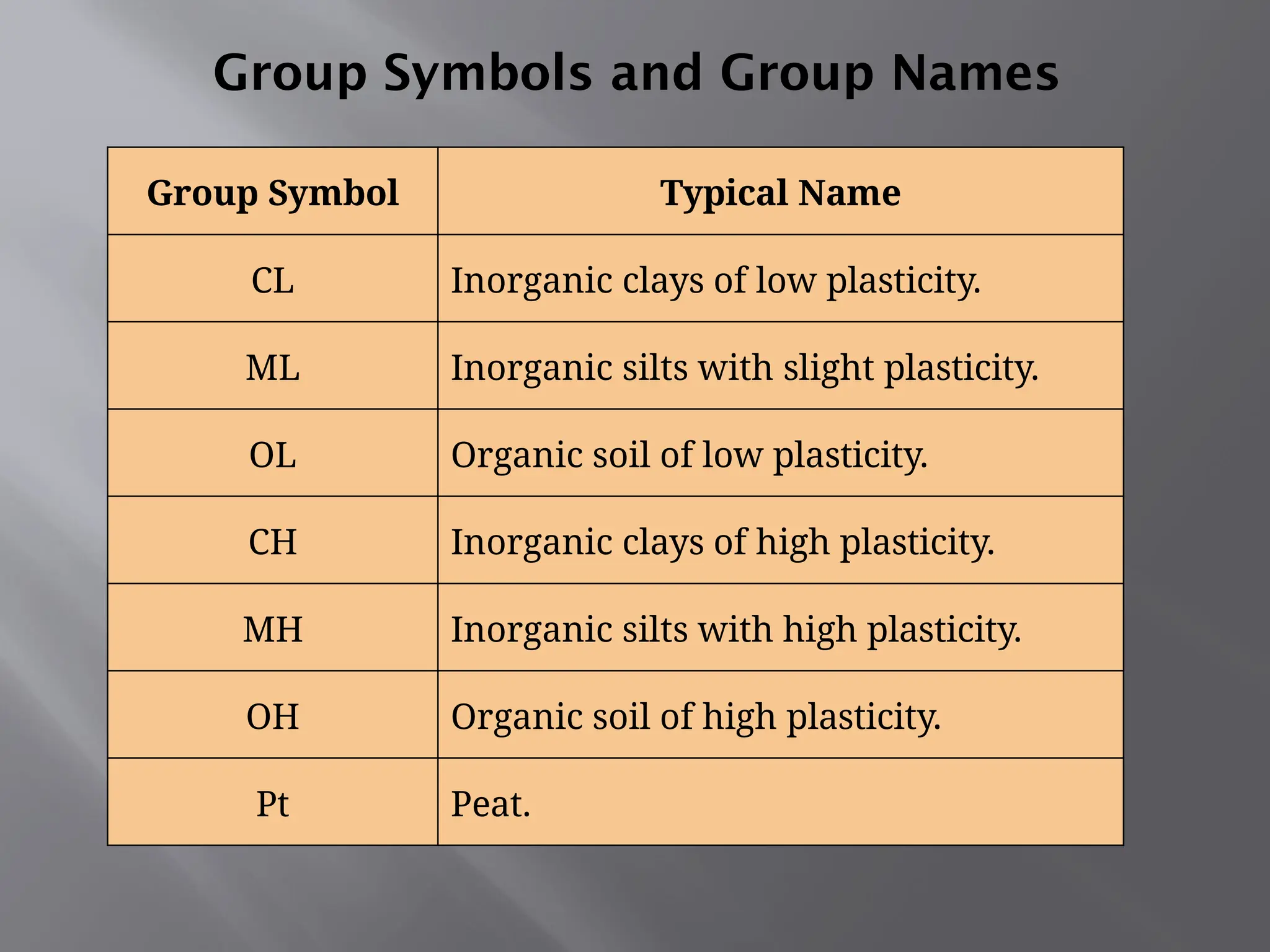
Group Symbols andGroup Names
Group Symbol Typical Name
GW Well-graded gravels.
GP Poorly-graded gravels.
GM Silty gravels.
GC Clayey gravels
SW Well-graded sands.
SP Poorly-graded sands.
SM Silty sands.
SC Clayey sands.
44.
Group Symbol TypicalName
CL Inorganic clays of low plasticity.
ML Inorganic silts with slight plasticity.
OL Organic soil of low plasticity.
CH Inorganic clays of high plasticity.
MH Inorganic silts with high plasticity.
OH Organic soil of high plasticity.
Pt Peat.
Group Symbols and Group Names
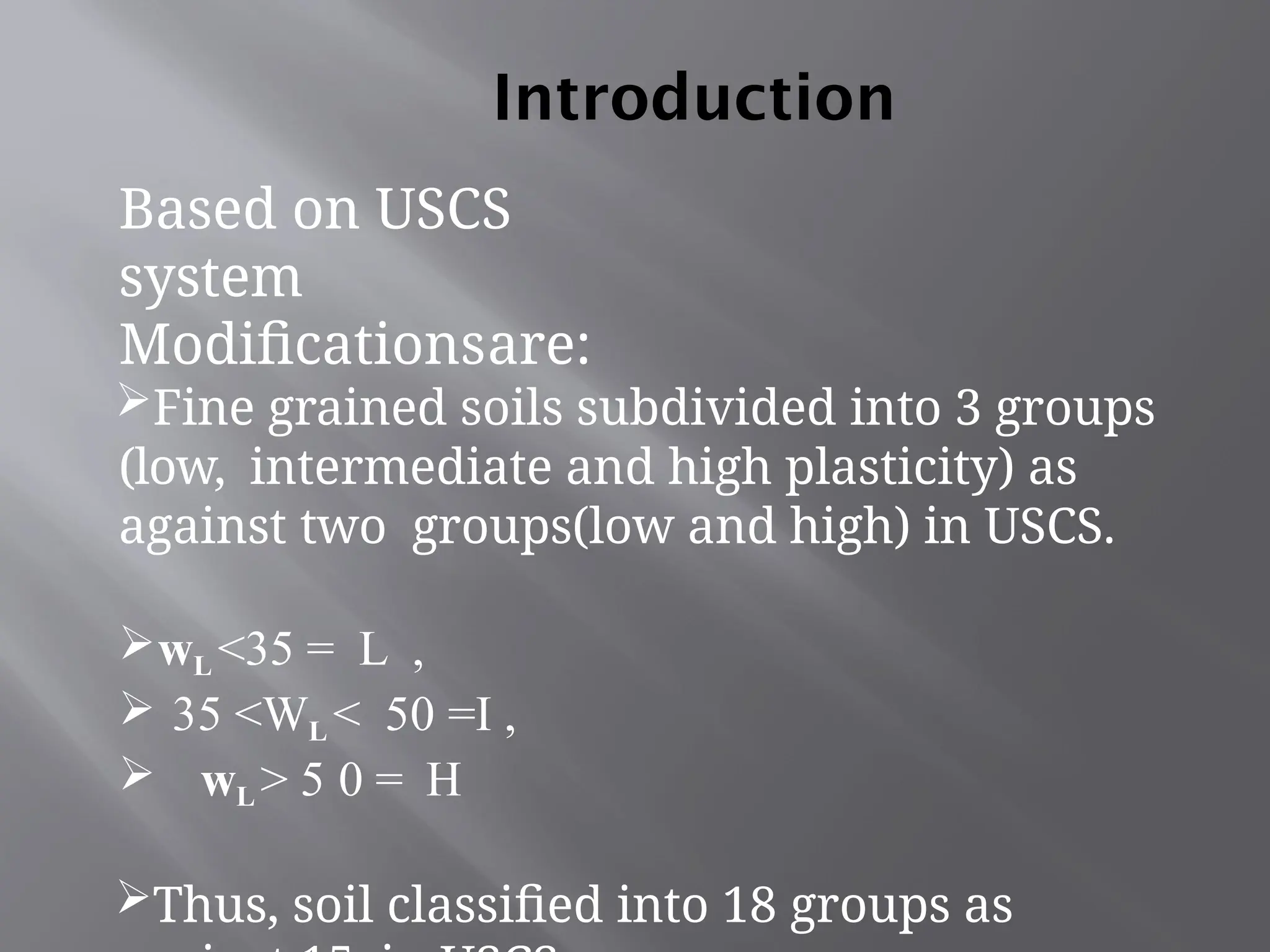
Introduction
Based on USCS
system
Modificationsare:
Finegrained soils subdivided into 3 groups
(low, intermediate and high plasticity) as
against two groups(low and high) in USCS.
wL <35 = L ,
35 <WL < 50 =I ,
wL > 5 0 = H
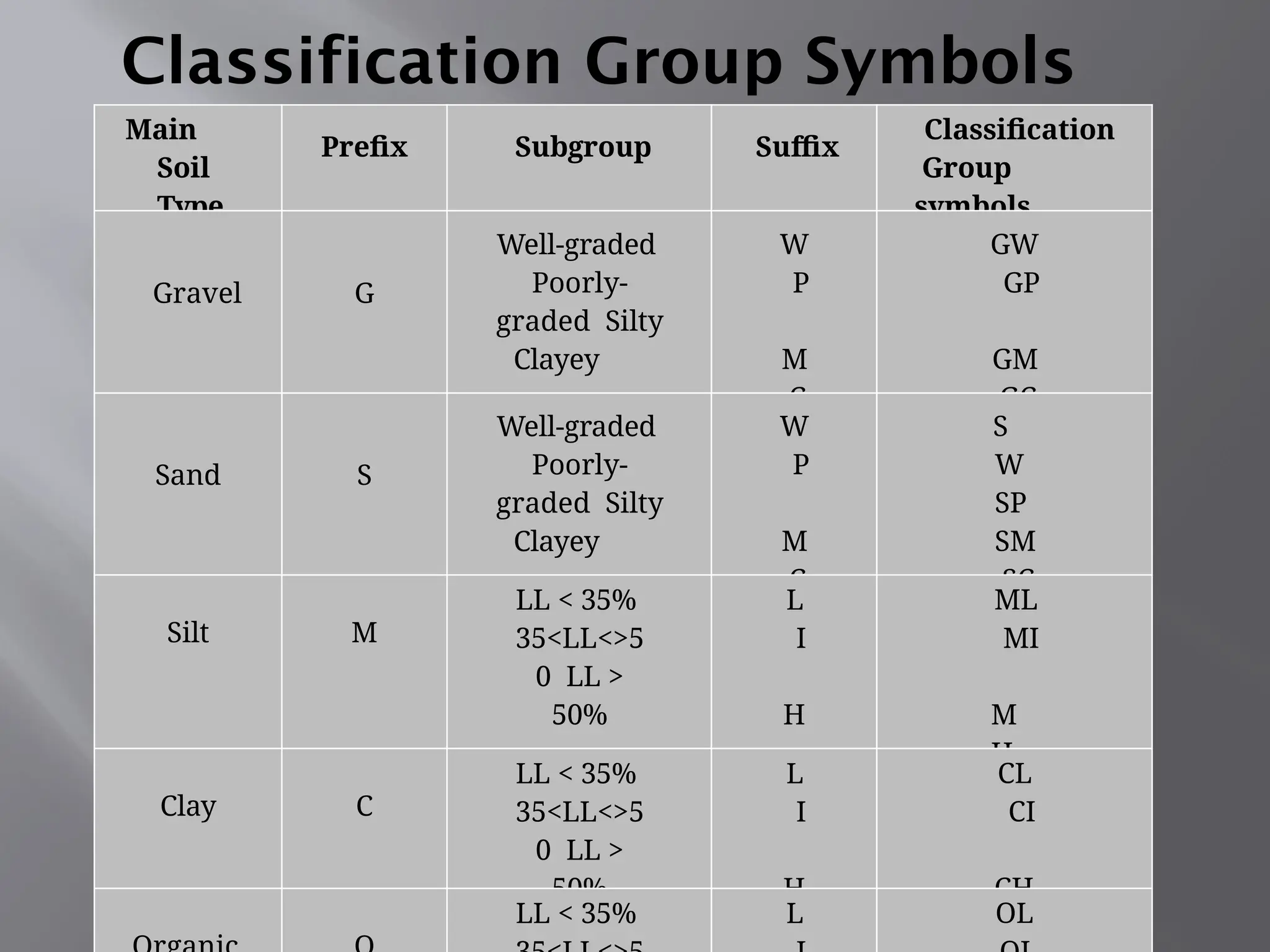
Thus, soil classified into 18 groups as
48.
Classification Group Symbols
Main
Soil
Type
PrefixSubgroup Suffix
Classification
Group
symbols
Gravel G
Well-graded
Poorly-
graded Silty
Clayey
W
P
M
C
GW
GP
GM
GC
Sand S
Well-graded
Poorly-
graded Silty
Clayey
W
P
M
C
S
W
SP
SM
SC
Silt M
LL < 35%
35<LL<>5
0 LL >
50%
L
I
H
ML
MI
M
H
Clay C
LL < 35%
35<LL<>5
0 LL >
50%
L
I
H
CL
CI
CH
LL < 35% L OL
49.
Plasticity Chart
High Plasticityuse H - wL >50
Intermediate Plasticity use I – 35< wL >50
Low Plasticity use L - wL <35
Below A-line, use M (Silt)
or O (Organic)
Above A-line, use C - Clay
50.
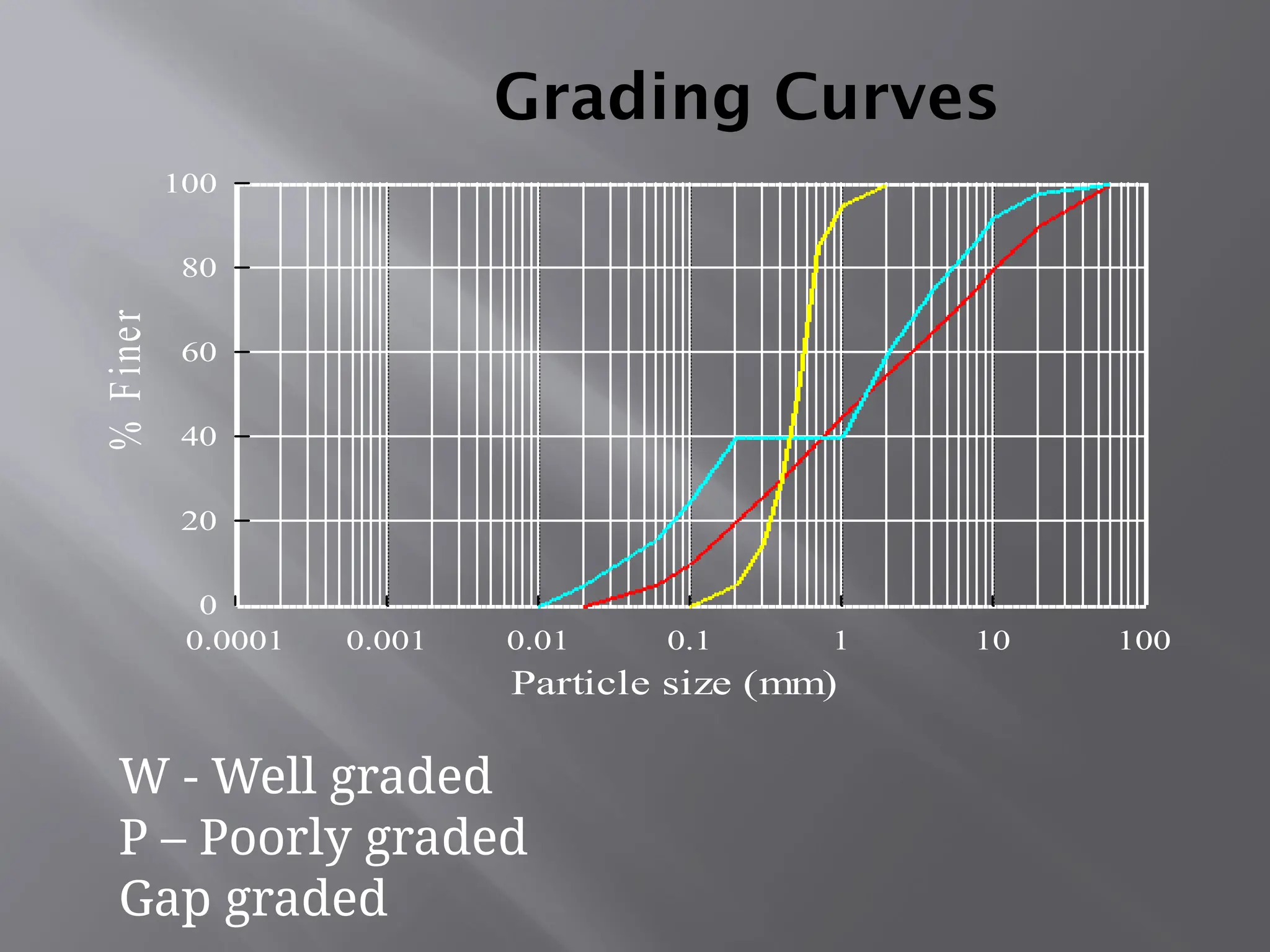
Grading Curves
0.0001 0.0010.01 0.1 1 10 100
0
20
40
60
80
100
Particle size (mm)
%
F
ine
r
W - Well graded
P – Poorly graded
Gap graded
51.
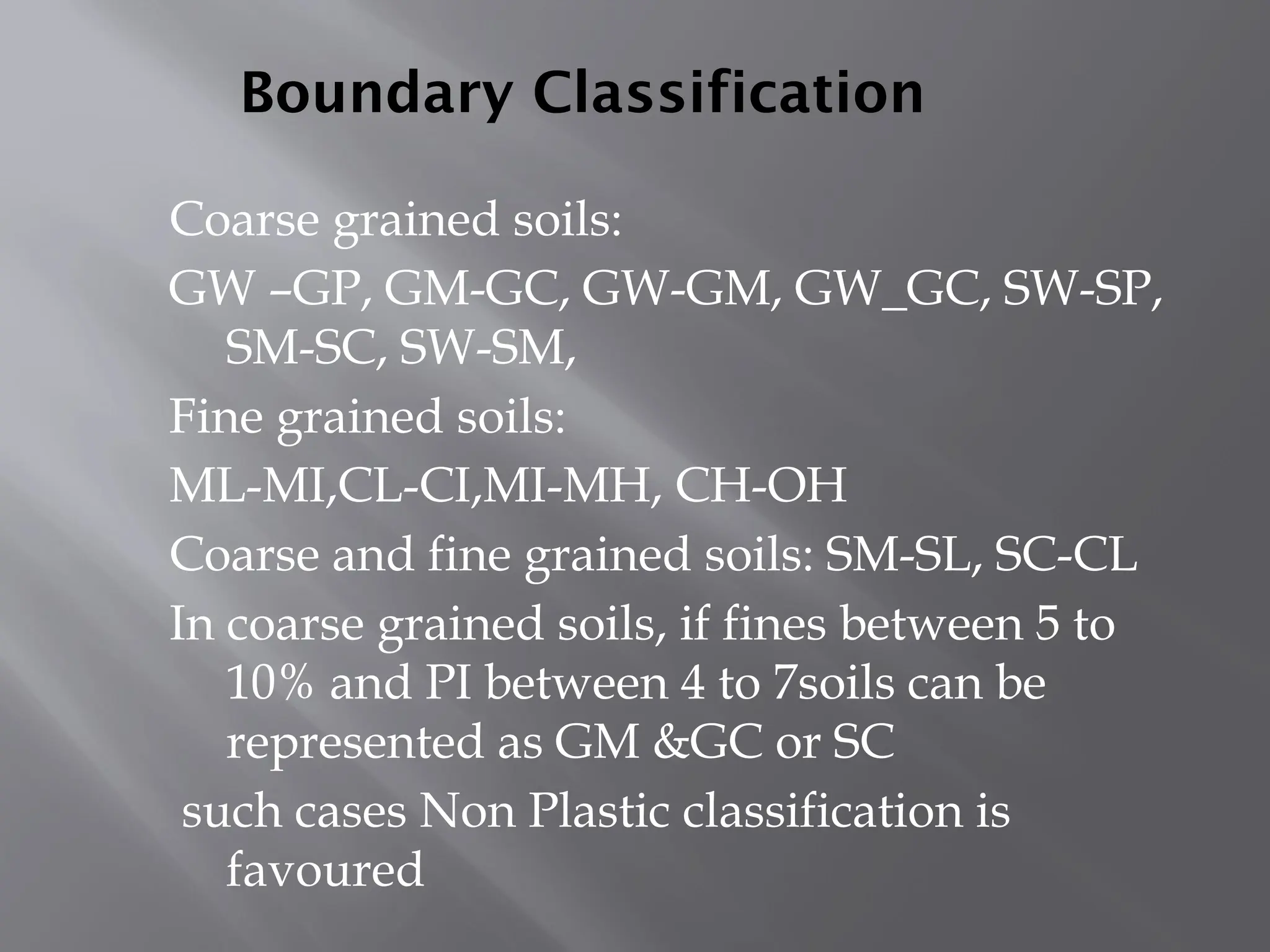
Boundary Classification
Coarse grainedsoils:
GW –GP, GM-GC, GW-GM, GW_GC, SW-SP,
SM-SC, SW-SM,
Fine grained soils:
ML-MI,CL-CI,MI-MH, CH-OH
Coarse and fine grained soils: SM-SL, SC-CL
In coarse grained soils, if fines between 5 to
10% and PI between 4 to 7soils can be
represented as GM &GC or SC
such cases Non Plastic classification is
favoured
52.
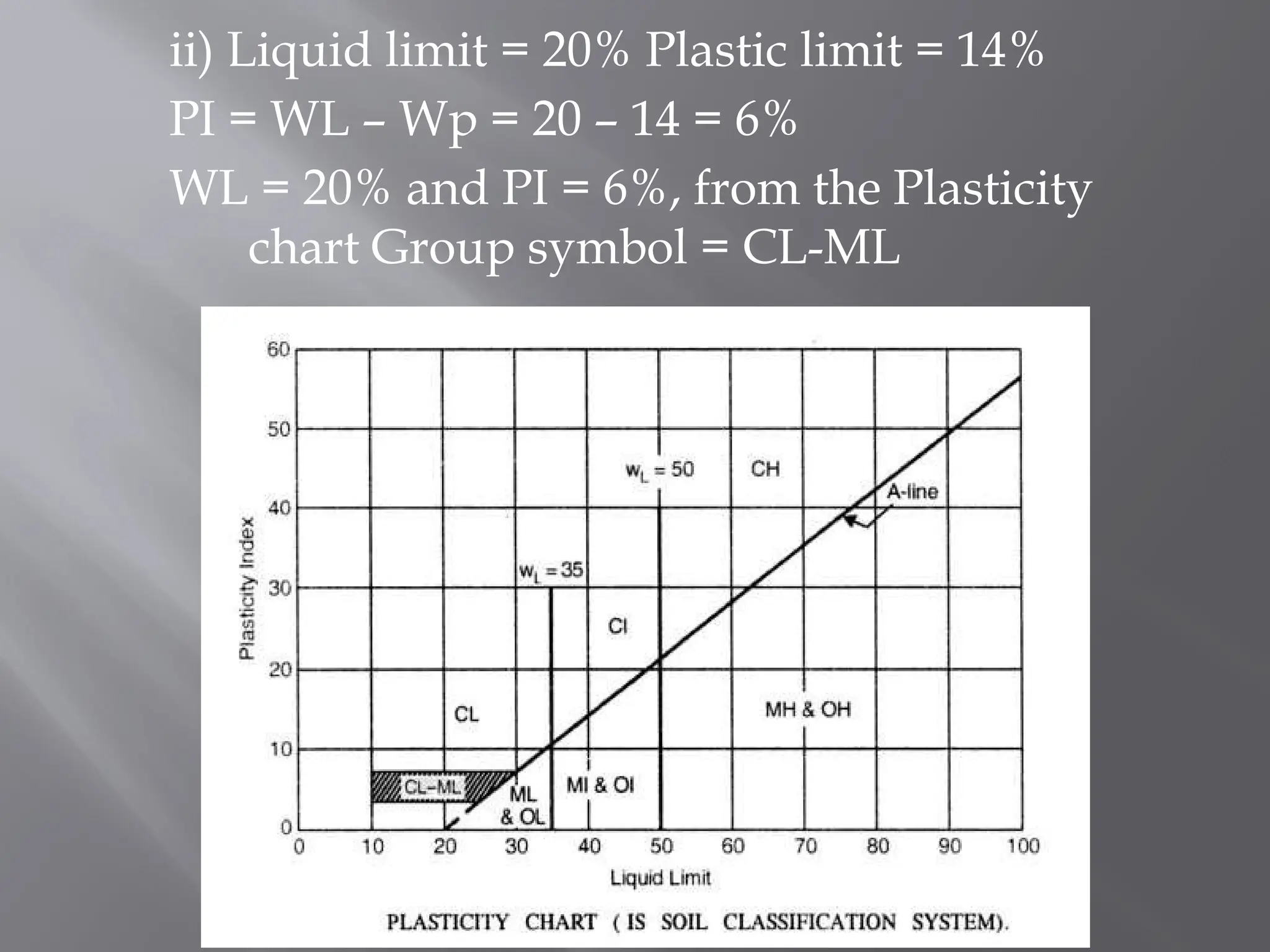
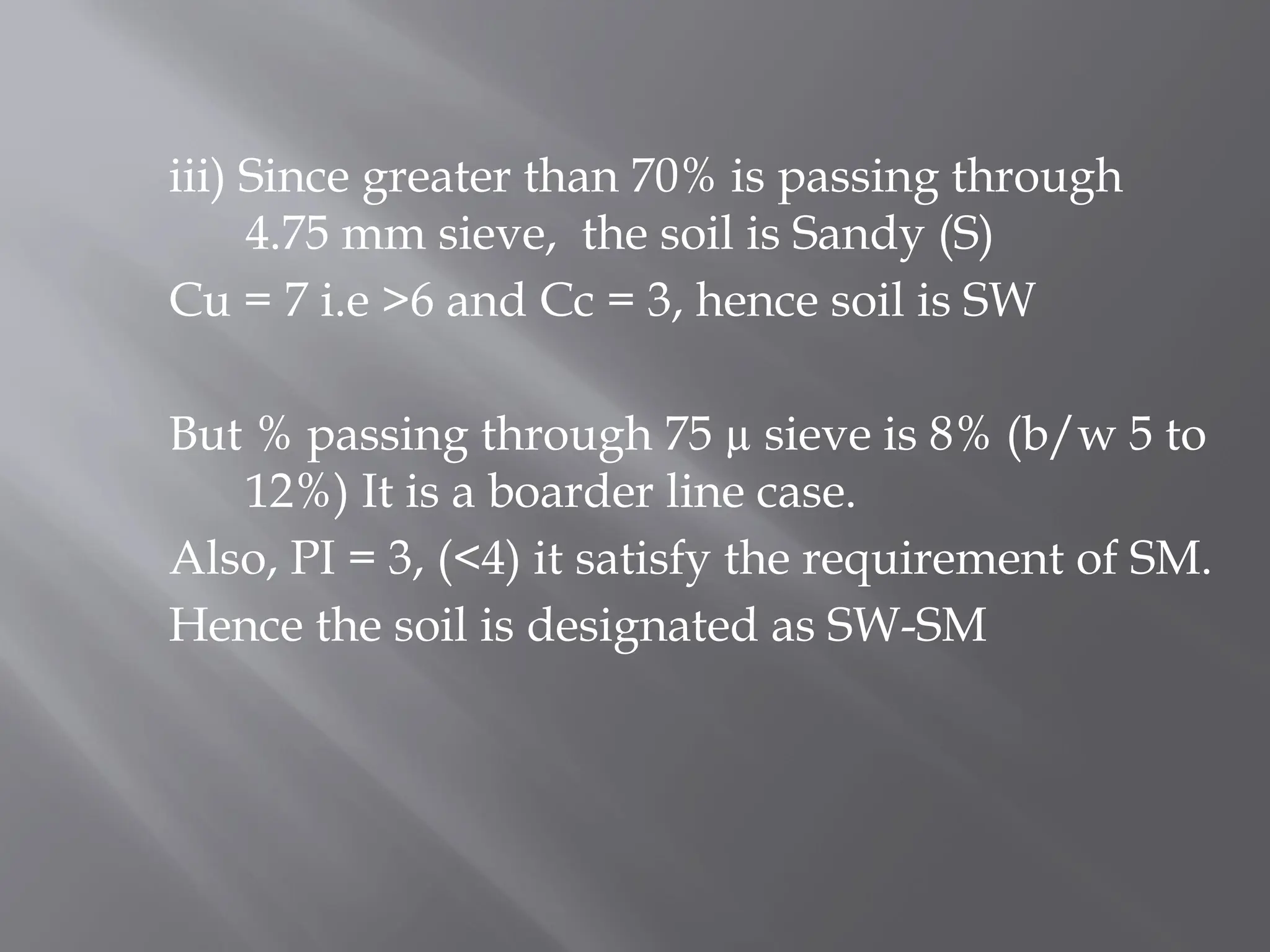
Problem:
Sketch the plasticitychart used for classifying fine
grained soil in the IS soil classification system.
Give the group symbols for the following soils
i) Liquid limit = 40% Plastic limit = 22%
ii) Liquid limit = 20% Plastic limit = 14%
iii) Passing 4.75 mm sieve = 70%, Passing 75 µ sieve = 8%
Cu = 7, Cc = 3, PI = 3
53.
Solution
i) Liquid limit= 40% Plastic limit = 22%
PI = WL – Wp = 40 – 22 = 18%
WL = 40% and PI = 18%, from the Plasticity
chart Group symbol = CI
54.
ii) Liquid limit= 20% Plastic limit = 14%
PI = WL – Wp = 20 – 14 = 6%
WL = 20% and PI = 6%, from the Plasticity
chart Group symbol = CL-ML
55.
iii) Since greaterthan 70% is passing through
4.75 mm sieve, the soil is Sandy (S)
Cu = 7 i.e >6 and Cc = 3, hence soil is SW
But % passing through 75 µ sieve is 8% (b/w 5 to
12%) It is a boarder line case.
Also, PI = 3, (<4) it satisfy the requirement of SM.
Hence the soil is designated as SW-SM
![i) ws = [(M1 – Md)/Md] – [(V1 – V2)x ρw /Md] x 100
= [(30.2-18)/18] – [(18.9 – 9.9) x 1/18] x 100
= 17.8%
ii) G = Md/(V1-(M1 – Md))
= 18/(18.9 –(30.2- 18))
= 2.69
Alternatively G = 1 /[(ρw / ρd) – (ws /100)]
ρd = 18/9.9 = 1.818 g/cc
ρw = 1 g/cc
From i), ws = 17.8%
G = 2.69](https://image.slidesharecdn.com/classificationofsoil-250302064413-fe300125/75/classification-of-soil-details-aas-per-is-us-classification-geotechnical-engineering-7-2048.jpg)
![iii) SR = ϒd/ϒw = ρd/ ρw = Gm = 1.818/1
= 1.82
IV) Volumetric Shrinkage (VS)
VS = [(V1 – Vd) x 100]/Vd
= [(18.9 – 9.9) X 100] /9.9 = 91%
Alternatively,
VS = (w1 –ws) SR
= (67.8 – 17.8) X 1.82 = 91%](https://image.slidesharecdn.com/classificationofsoil-250302064413-fe300125/75/classification-of-soil-details-aas-per-is-us-classification-geotechnical-engineering-8-2048.jpg)
![Pr 2: The mass specific gravity of a fully saturated specimen of
clay having a water content of 36% is 1.86. On oven drying, the
mass specific gravity drops to 1.72. Calculate the specific
gravity and its shrinkage limit.
Solution:
e = wsat . G = 0.36 G Gm = ϒsat / ϒw
Gm =[[(G+e) ϒw]/(1+e)] X 1/ ϒw
1.86 = (G+0.36G)/1+0.36G) = 1.36G/(1+0.36G)
G= 2.69
From which,
ws = (ϒw / ϒd) – 1/G
where ϒd / ϒw = 1.72 = mass specific gravity of dry soil
ws = [(1/1.72) – (1/2.69)] = 0.21 = 21%
Alternatively,](https://image.slidesharecdn.com/classificationofsoil-250302064413-fe300125/75/classification-of-soil-details-aas-per-is-us-classification-geotechnical-engineering-9-2048.jpg)
![Alternatively,
edry = {[(G ϒw / ϒd)] -1 } = {[G ρw/ ρd] -1} = [[2.69 x 1/1.72] -1]
= 0.565
ws = e/G = 0.565/2.69
= 0.21 =21%](https://image.slidesharecdn.com/classificationofsoil-250302064413-fe300125/75/classification-of-soil-details-aas-per-is-us-classification-geotechnical-engineering-10-2048.jpg)