Dr. Harisingh Gour University Sagar (M.P.)
Department of Applied Geology
Seminar Presentation on
Engineering Properties of Soil
Guided By Presented By:
Prof . R.K. Rawat Amarnath
M.Tech. (6th Sem)
Roll No. Y152510106
5/5/2018 2
Outline……..
• Introduction
• Methods of Determination of Soil Properties
• Engineering Properties of Soil
• Physical and Chemical Properties
• Soil particles and structures
• Soil phase relationships
• Mechanical Properties
• Consistency of soil
• Moisture content
• Thixotropic and Syneresis
• Stresses considered in soil mechanics
• References
5/5/2018 3
Introduction
For a geologist, it is the material which is formed by the disintegration of the
rocks.
For a pedologist, it is the substance existing on the earth surface, which
supports plant life.
For an engineer, it is a material that can be
built on: foundations of buildings, bridges
built in: basements, culverts, tunnels
built with: embankments, roads, dams
supported: retaining walls
The term "soil" can have different meanings, depending upon
the field in which it is considered.
5/5/2018 4
Methods of Determining Soil Properties
Geotechnical soil properties of geologic strata are typically
determined using one or more of the following methods:
• In-situ testing data from the field exploration program
• Laboratory testing
Engineering Properties of Soil
1. Physical and Mineralogical Properties
2. Mechanical Properties
Physical and Mineralogical
Properties
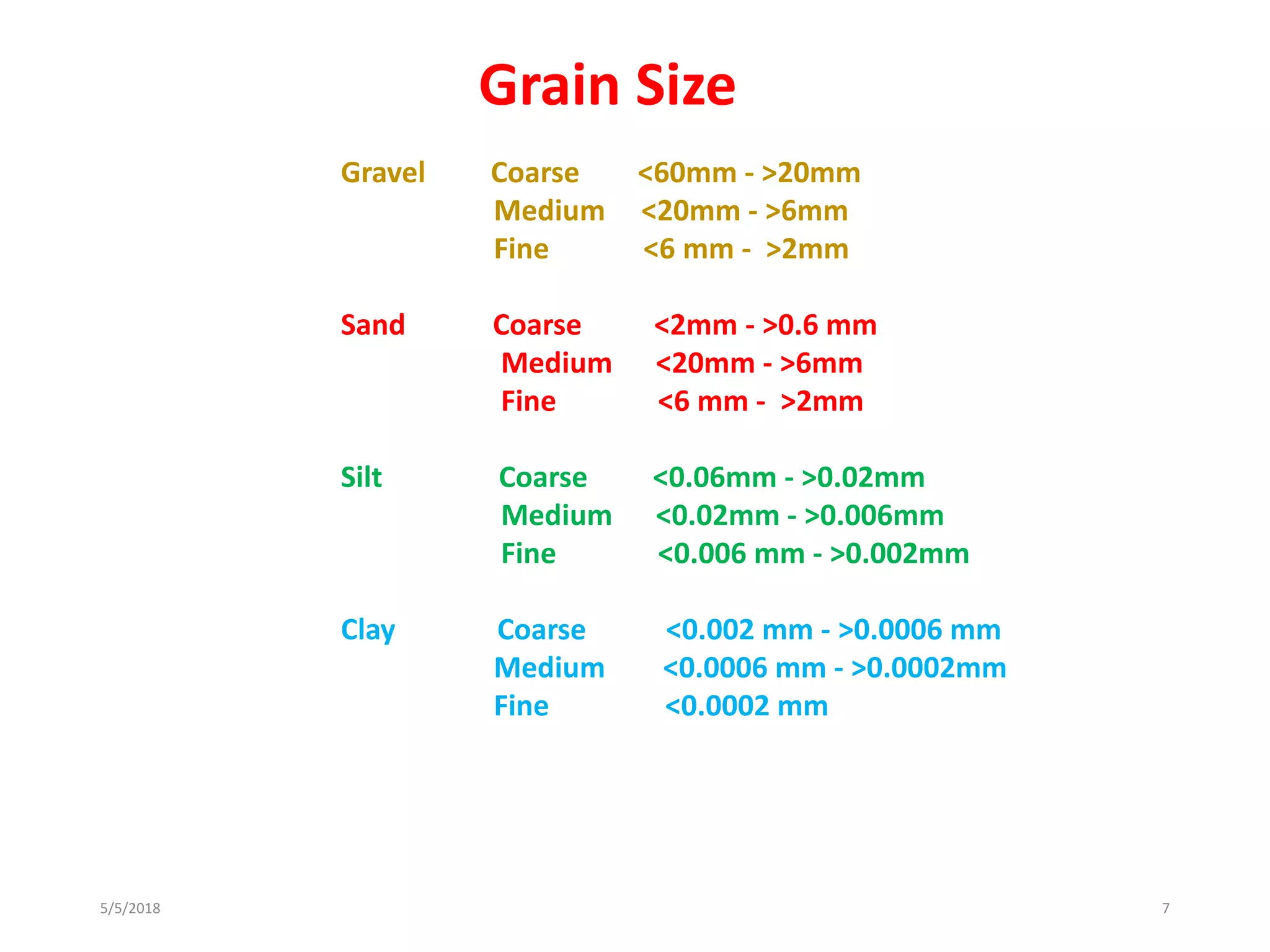
Grain Size
5/5/2018 7
Gravel Coarse <60mm - >20mm
Medium <20mm - >6mm
Fine <6 mm - >2mm
Sand Coarse <2mm - >0.6 mm
Medium <20mm - >6mm
Fine <6 mm - >2mm
Silt Coarse <0.06mm - >0.02mm
Medium <0.02mm - >0.006mm
Fine <0.006 mm - >0.002mm
Clay Coarse <0.002 mm - >0.0006 mm
Medium <0.0006 mm - >0.0002mm
Fine <0.0002 mm
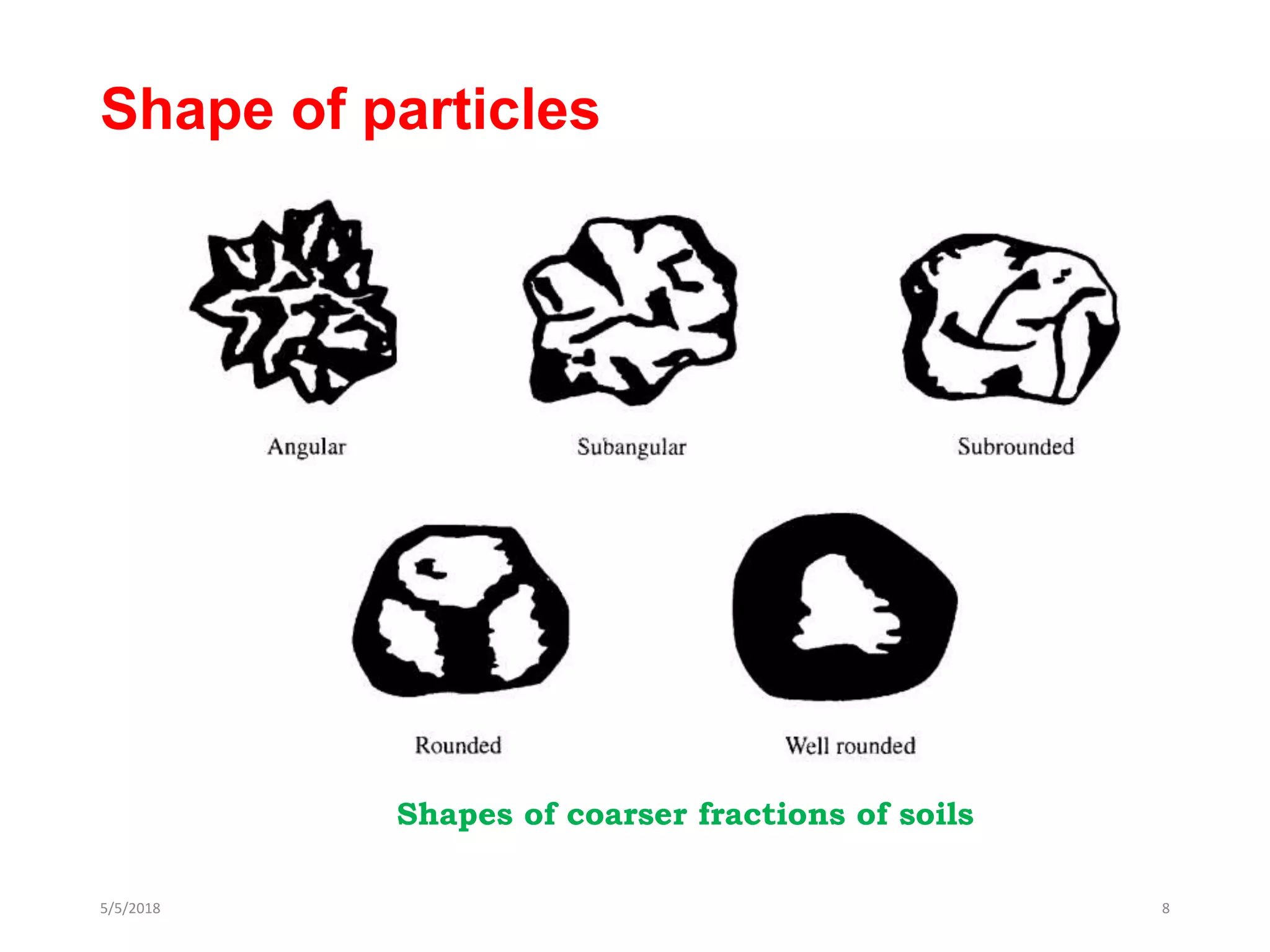
Shape of particles
5/5/2018 8
Shapes of coarser fractions of soils
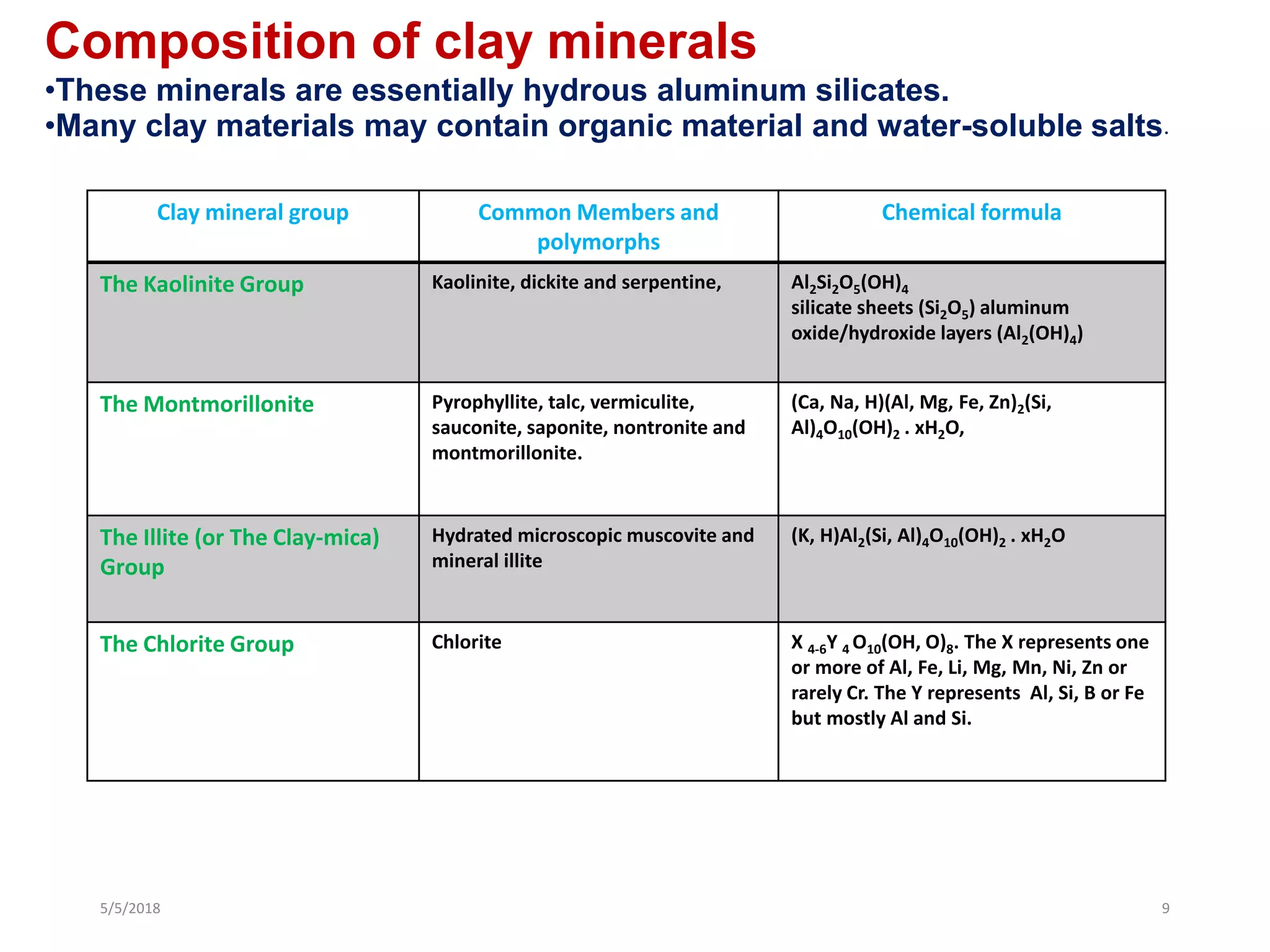
Clay mineral group Common Members and
polymorphs
Chemical formula
The Kaolinite Group Kaolinite, dickite and serpentine, Al2Si2O5(OH)4
silicate sheets (Si2O5) aluminum
oxide/hydroxide layers (Al2(OH)4)
The Montmorillonite Pyrophyllite, talc, vermiculite,
sauconite, saponite, nontronite and
montmorillonite.
(Ca, Na, H)(Al, Mg, Fe, Zn)2(Si,
Al)4O10(OH)2 . xH2O,
The Illite (or The Clay-mica)
Group
Hydrated microscopic muscovite and
mineral illite
(K, H)Al2(Si, Al)4O10(OH)2 . xH2O
The Chlorite Group Chlorite X 4-6Y 4 O10(OH, O)8. The X represents one
or more of Al, Fe, Li, Mg, Mn, Ni, Zn or
rarely Cr. The Y represents Al, Si, B or Fe
but mostly Al and Si.
Composition of clay minerals
5/5/2018 9
•These minerals are essentially hydrous aluminum silicates.
•Many clay materials may contain organic material and water-soluble salts.
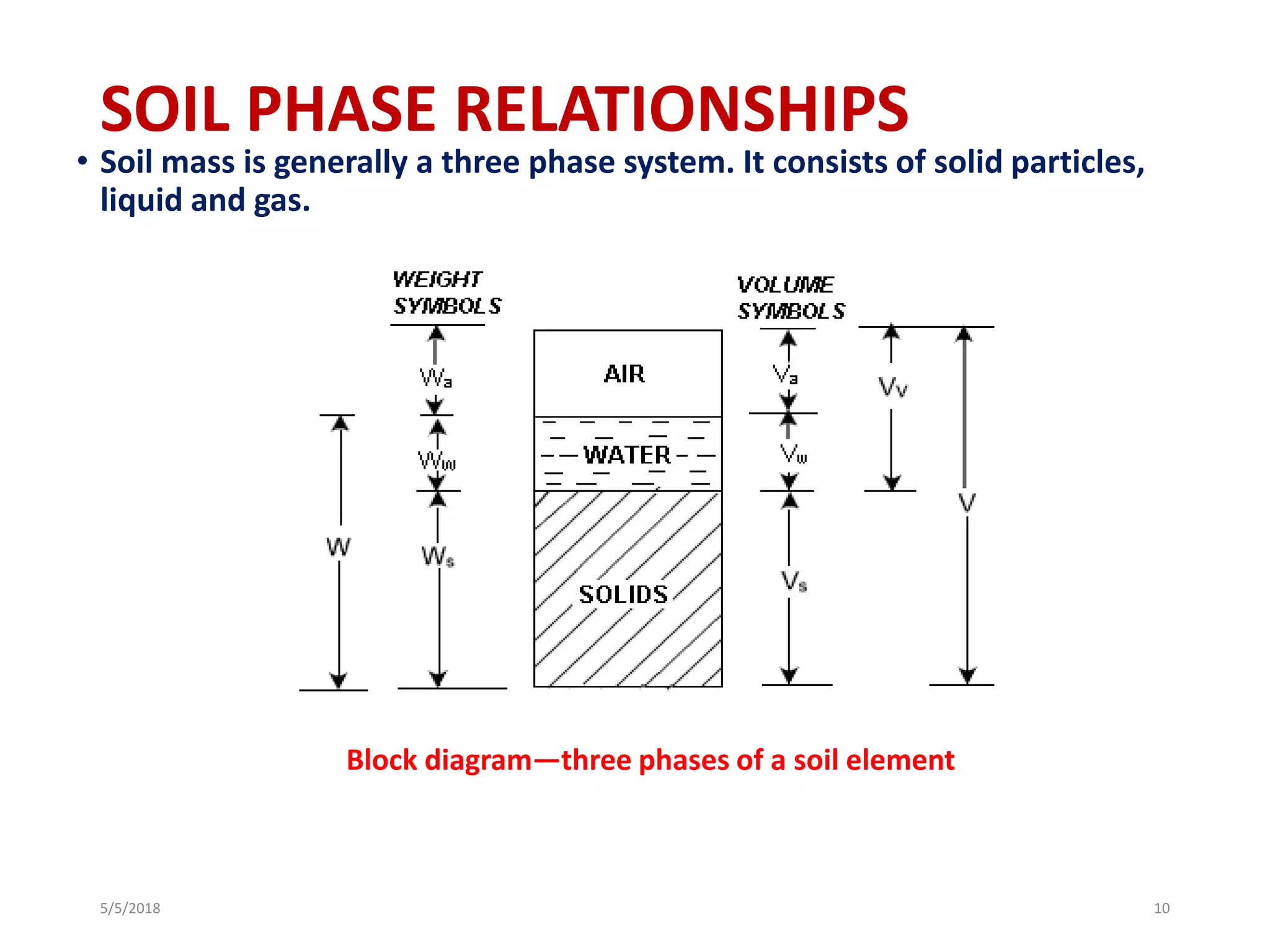
SOIL PHASE RELATIONSHIPS
• Soil mass is generally a three phase system. It consists of solid particles,
liquid and gas.
5/5/2018 10
Block diagram—three phases of a soil element
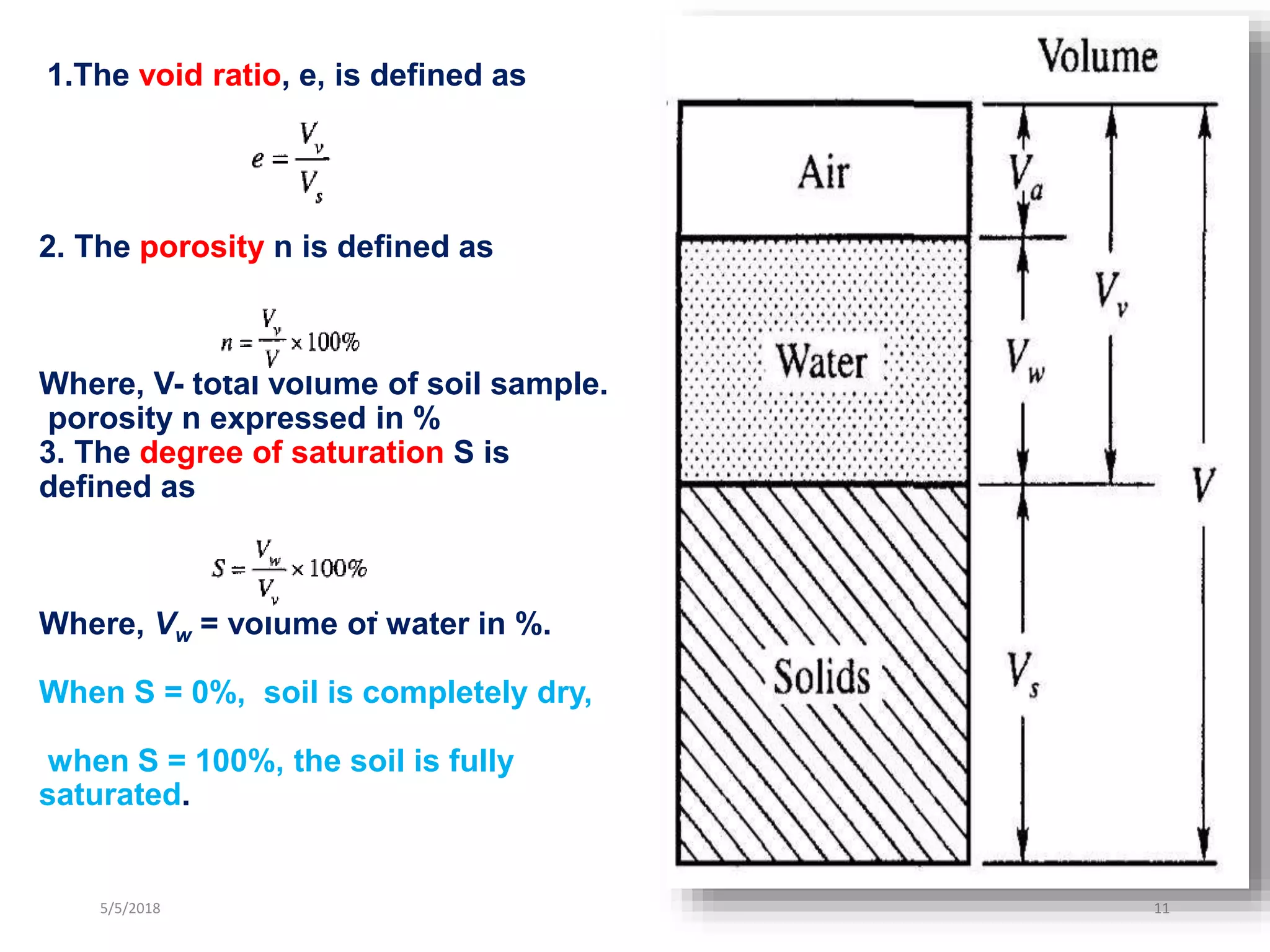
1.The void ratio, e, is defined as
2. The porosity n is defined as
Where, V- total volume of soil sample.
porosity n expressed in %
3. The degree of saturation S is
defined as
Where, Vw = volume of water in %.
When S = 0%, soil is completely dry,
when S = 100%, the soil is fully
saturated.
5/5/2018 11
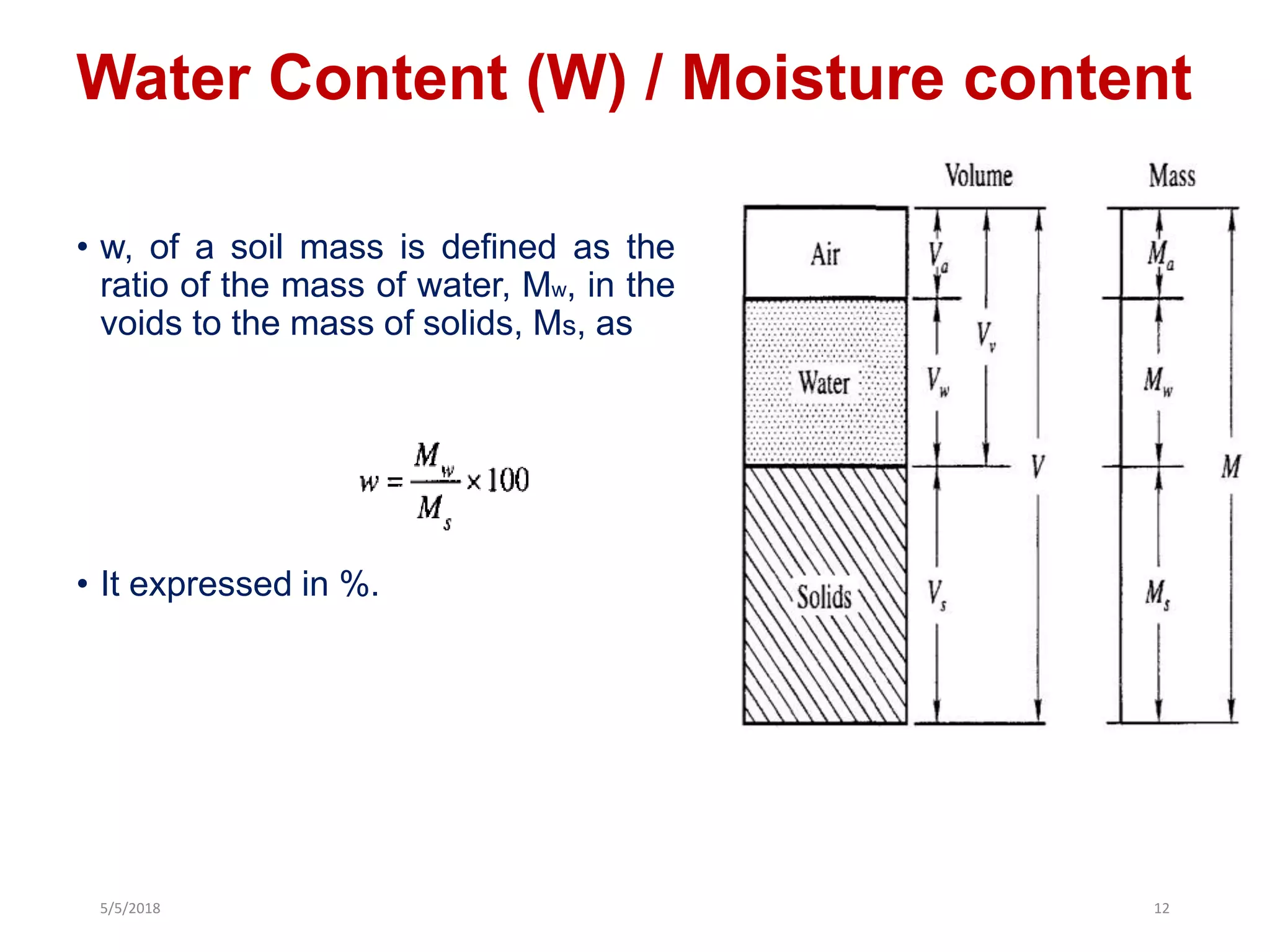
Water Content (W) / Moisture content
• w, of a soil mass is defined as the
ratio of the mass of water, Mw, in the
voids to the mass of solids, Ms, as
• It expressed in %.
5/5/2018 12
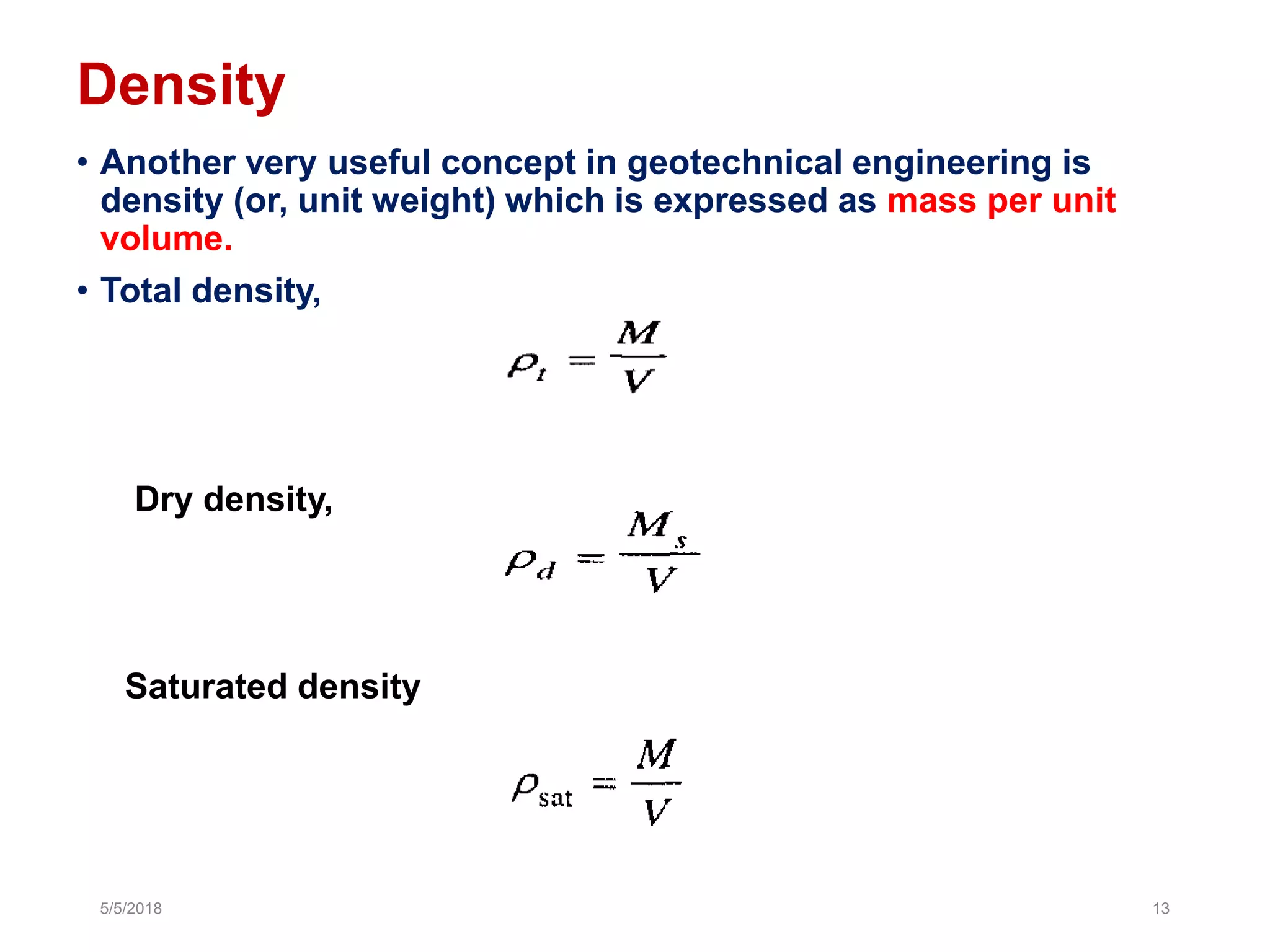
Density
• Another very useful concept in geotechnical engineering is
density (or, unit weight) which is expressed as mass per unit
volume.
• Total density,
Dry density,
5/5/2018 13
Saturated density
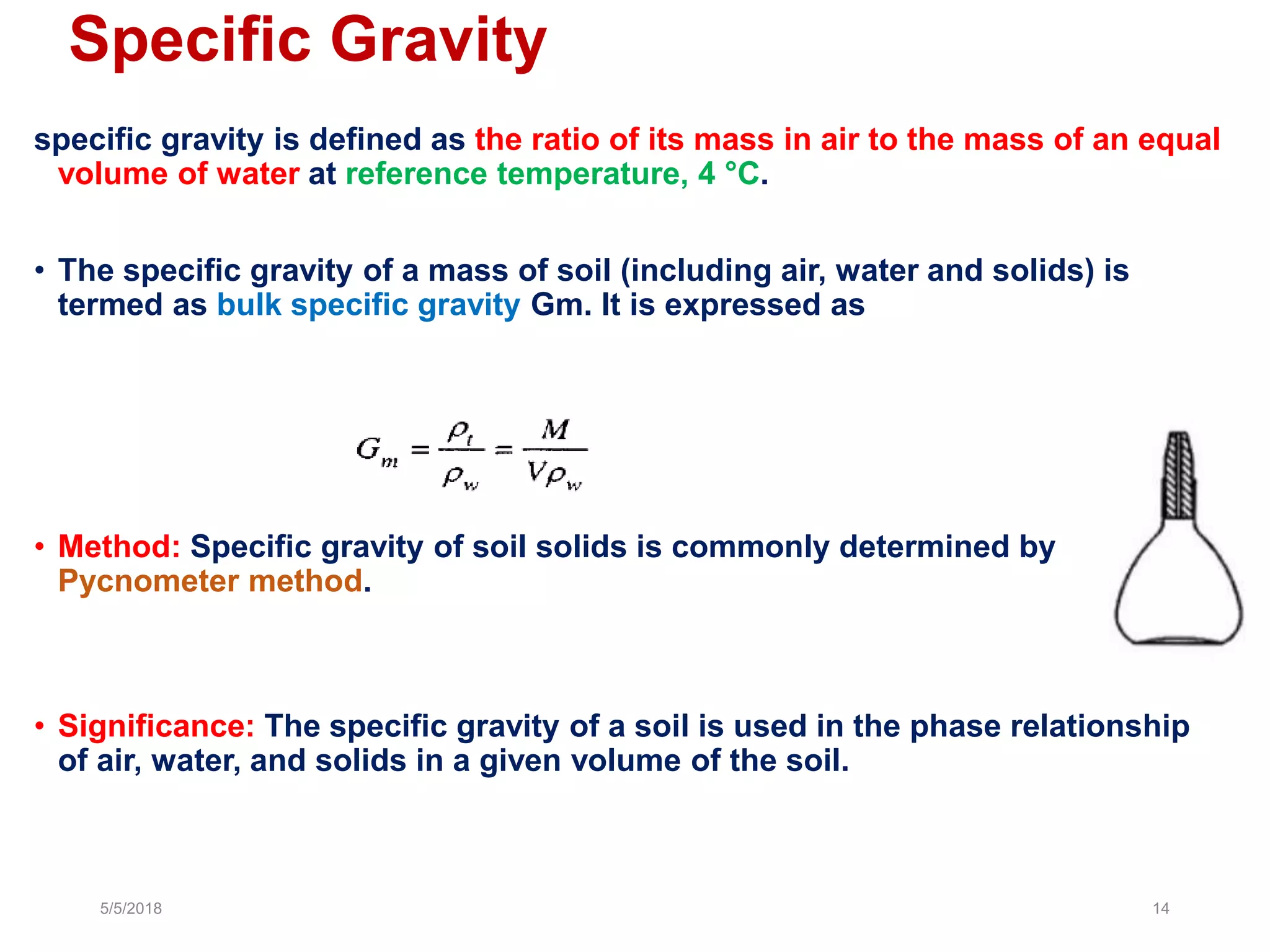
Specific Gravity
specific gravity is defined as the ratio of its mass in air to the mass of an equal
volume of water at reference temperature, 4 °C.
• The specific gravity of a mass of soil (including air, water and solids) is
termed as bulk specific gravity Gm. It is expressed as
• Method: Specific gravity of soil solids is commonly determined by
Pycnometer method.
• Significance: The specific gravity of a soil is used in the phase relationship
of air, water, and solids in a given volume of the soil.
5/5/2018 14
Mechanical Properties
5/5/2018 15
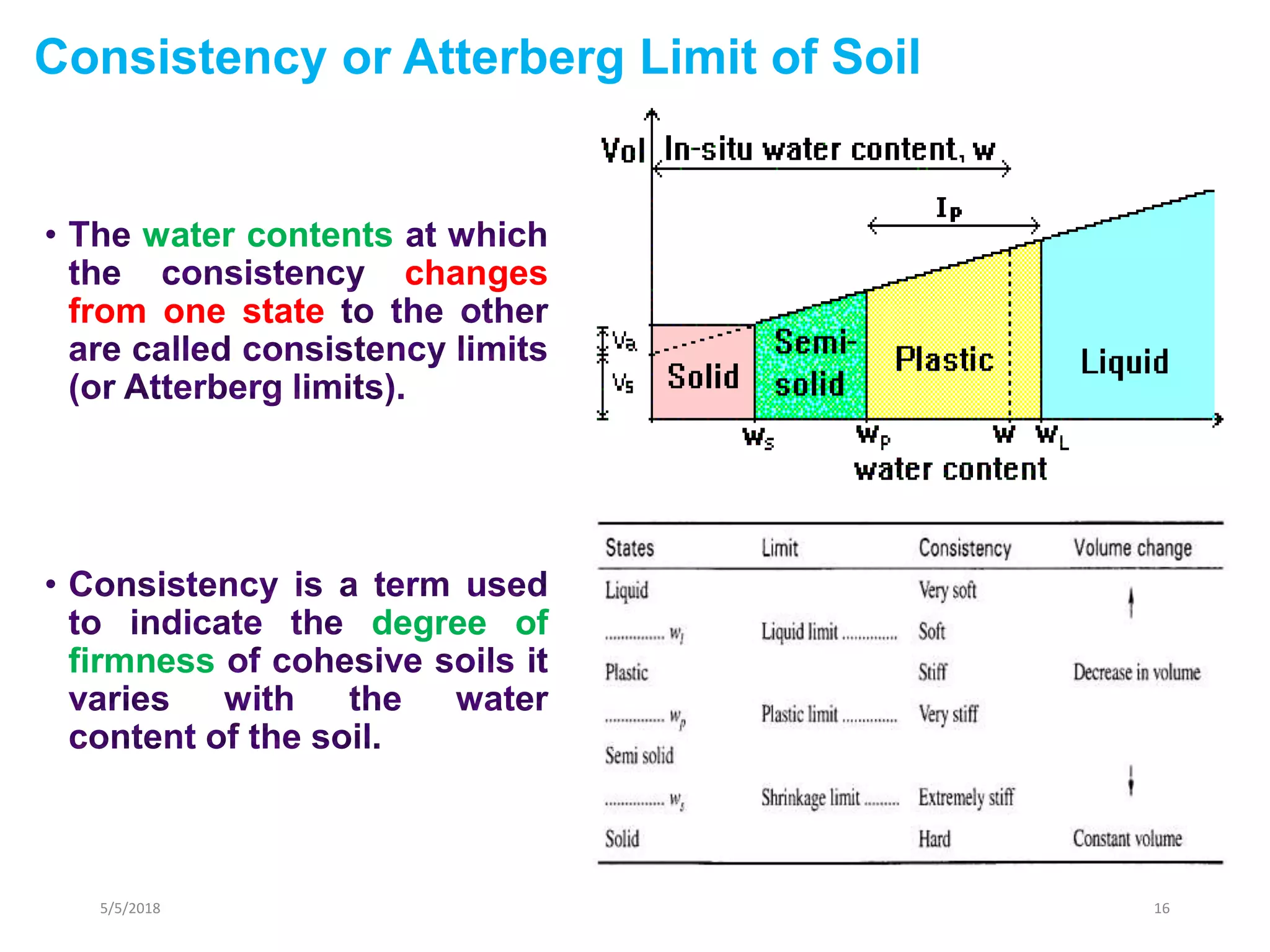
Consistency or Atterberg Limit of Soil
water contents
changes
from one state
degree of
firmness
5/5/2018 16
•Liquid limit (LL) : The moisture content at which a soil
transitions from a plastic state to a liquid state.
•Plastic limit (PL) :The moisture content at which a soil
transitions from being in a semisolid state to a plastic
state.
•Shrinkage Limit (SL): It is arbitrary water content limit
between semi-solid and solid states of consistency of a
soil
5/5/2018 17
Plasticity Index (Ip)
• The difference between the liquid limit and the plastic limit is known
as the plasticity index and it is in this range of water content that the
soil has a plastic consistency.
PI=LL-PL
• It indicates the degree of plasticity of a soil. The greater the difference
between liquid and plastic limits, the greater is the plasticity of the soil.
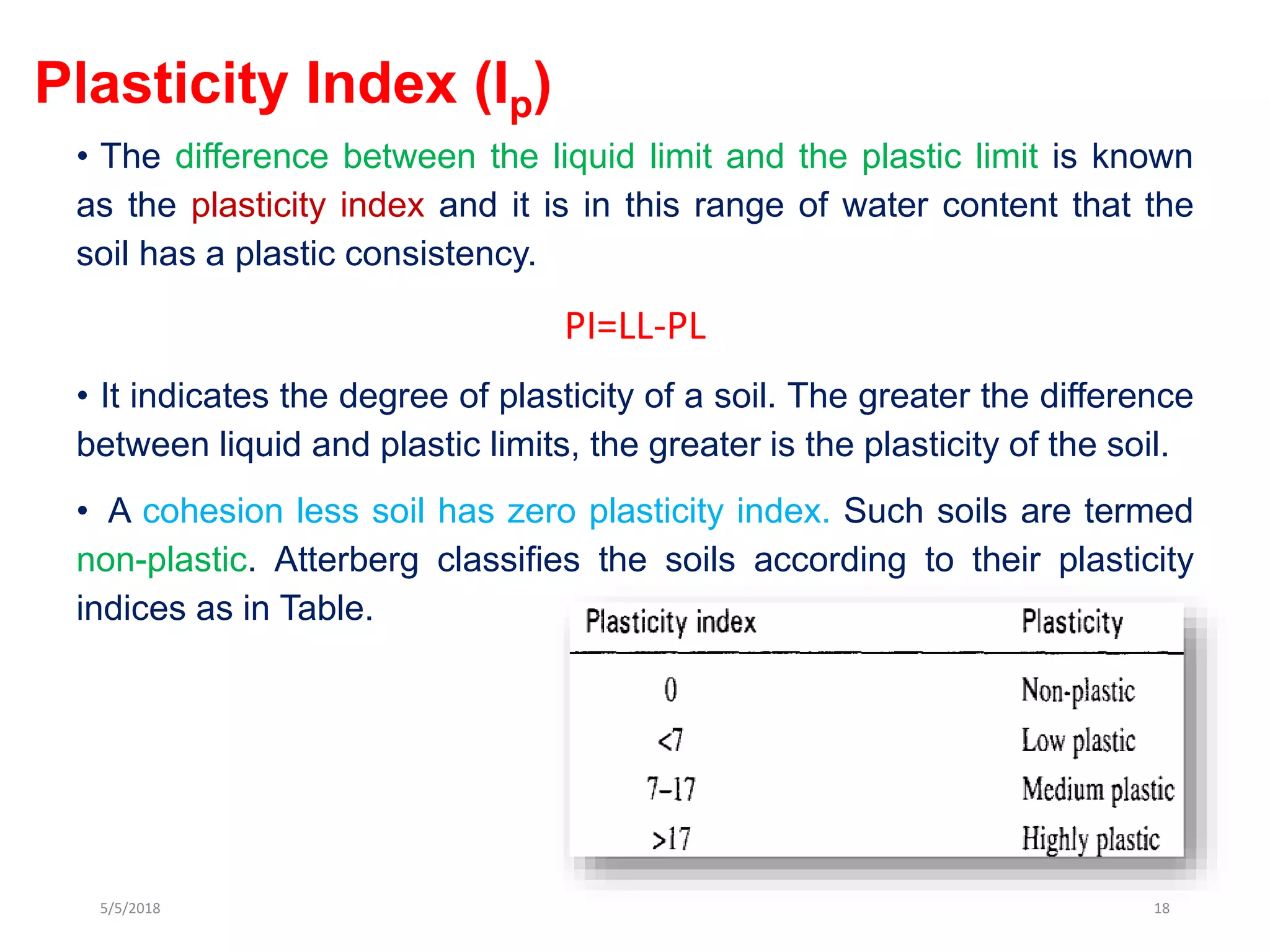
• A cohesion less soil has zero plasticity index. Such soils are termed
non-plastic. Atterberg classifies the soils according to their plasticity
indices as in Table.
5/5/2018 18
Toughness Index (IT)
The shearing strength of clay at the plastic limit is a measure of its
toughness.
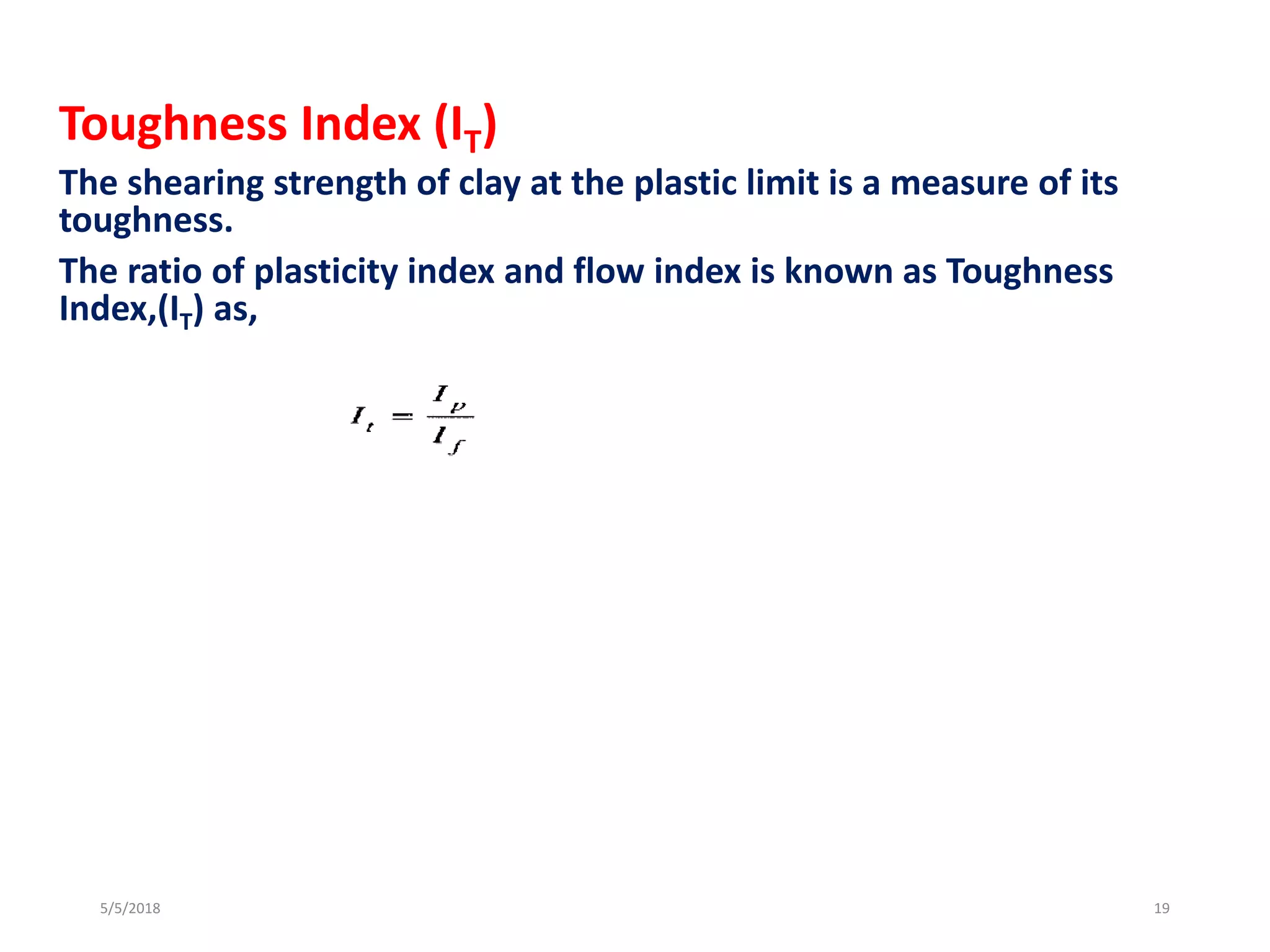
The ratio of plasticity index and flow index is known as Toughness
Index,(IT) as,
5/5/2018 19
Shrinkage and Swell
Certain soil types (highly plastic) have a large potential for volumetric
change depending on the moisture content of the soil.
These soils can shrink with decreasing moisture or swell with increasing
moisture.
Shrinkage can cause soil to pull away from structure thus reducing the
bearing area or causing settlement of the structure beyond that
predicted by settlement analysis.
Swelling of the soil can cause an extra load to be applied to the structure
that was not accounted for in design.
5/5/2018 20
Thixotropic and Syneresis
• If a clay sample (sensitivity >1) without disturbance and change in water
content, it may regain part of its original strength and stiffness. This is
called thixotropic
• Syneresis - separation of an initially homogeneous colloidal system into
both a coherent gel and a liquid. The phenomena is the drawing of
together of particles under the action of increased van der Walls forces.
5/5/2018 21
Shear Strength of Soils
5/5/2018 22
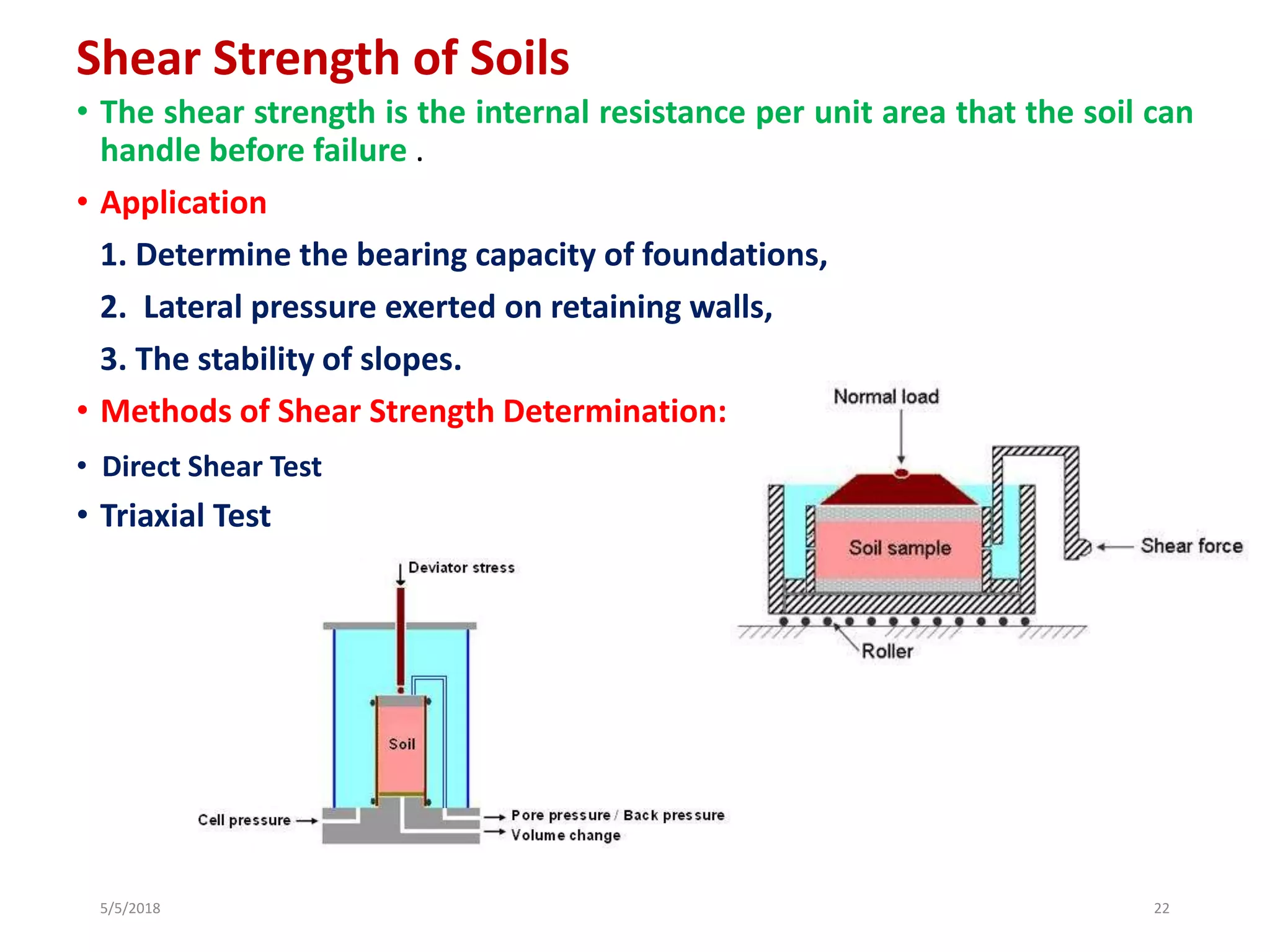
• The shear strength is the internal resistance per unit area that the soil can
handle before failure .
• Application
1. Determine the bearing capacity of foundations,
2. Lateral pressure exerted on retaining walls,
3. The stability of slopes.
• Methods of Shear Strength Determination:
• Triaxial Test
• Direct Shear Test
5/5/2018 23
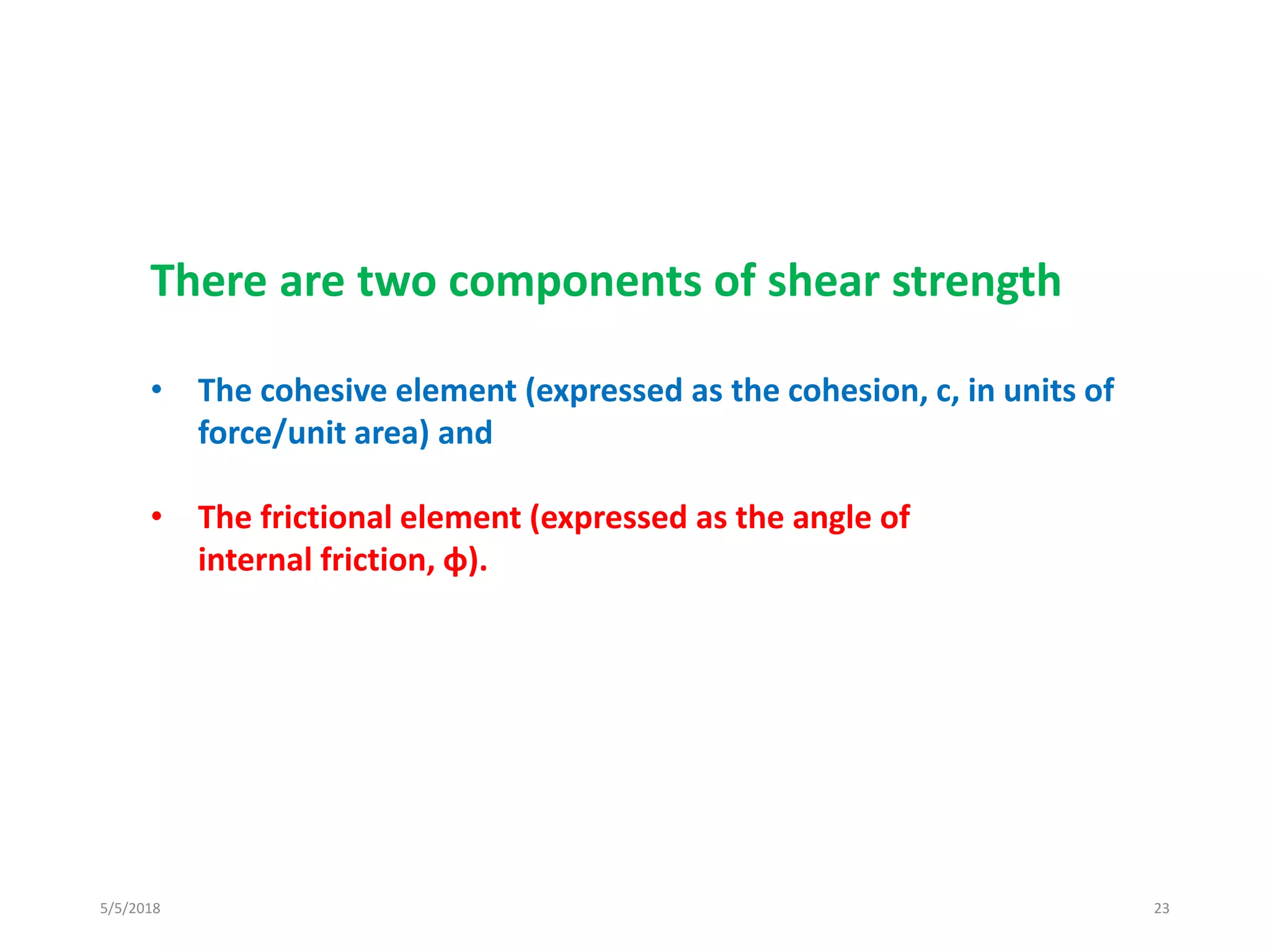
There are two components of shear strength
• The cohesive element (expressed as the cohesion, c, in units of
force/unit area) and
• The frictional element (expressed as the angle of
internal friction, φ).
5/5/2018 24
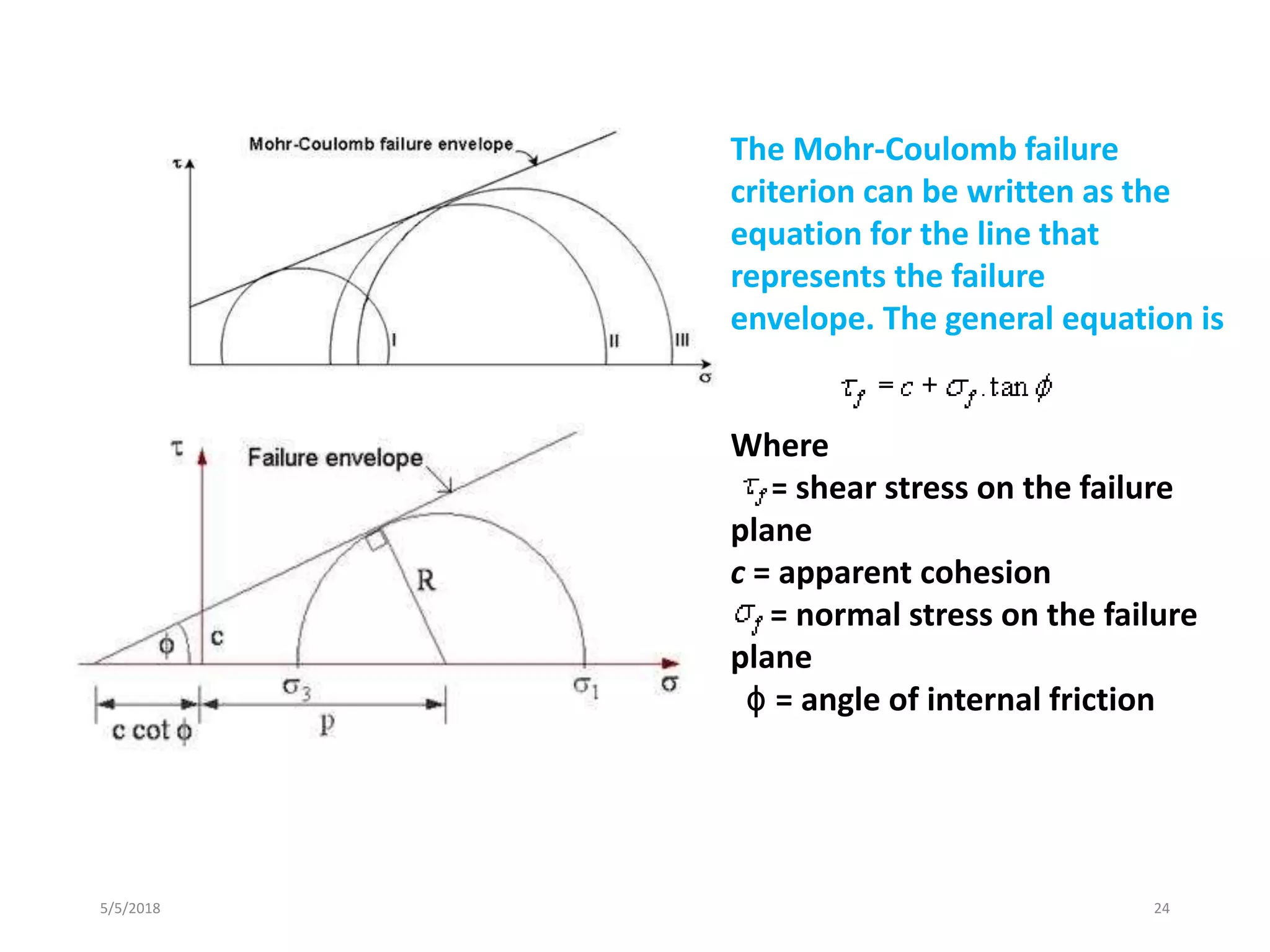
The Mohr-Coulomb failure
criterion can be written as the
equation for the line that
represents the failure
envelope. The general equation is
Where
= shear stress on the failure
plane
c = apparent cohesion
= normal stress on the failure
plane
ɸ = angle of internal friction
5/5/2018 25
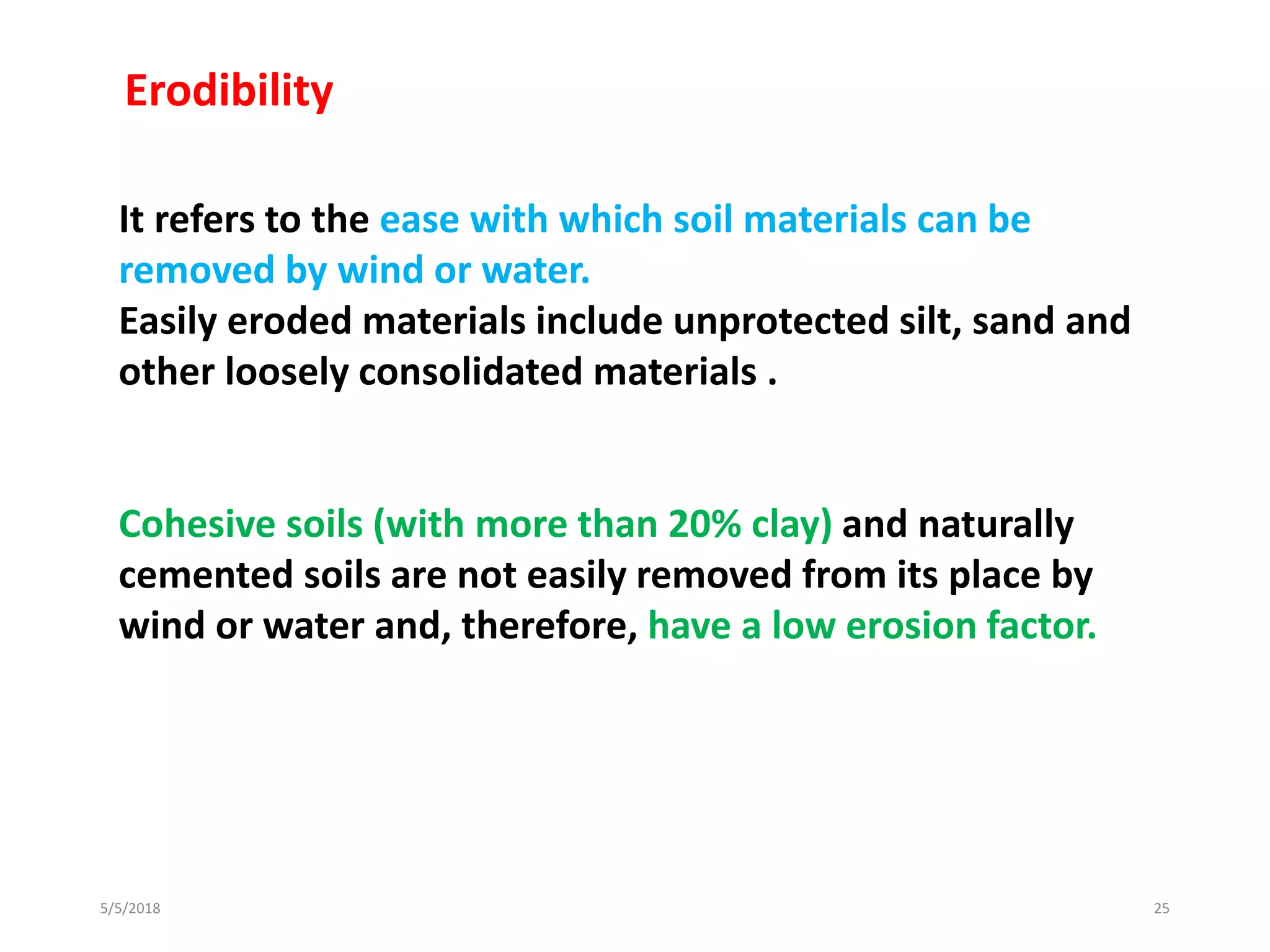
It refers to the ease with which soil materials can be
removed by wind or water.
Easily eroded materials include unprotected silt, sand and
other loosely consolidated materials .
Cohesive soils (with more than 20% clay) and naturally
cemented soils are not easily removed from its place by
wind or water and, therefore, have a low erosion factor.
Erodibility
References
• Bell, FG; Engineering geology; Elsevier 2nd ed.2007; pp.201-259.
• Price, DG; Engineering geology Principal and Practice; Springer 2009;
pp.22-34, 43-47.
• Nptel Civil engineering module on Soil Mechanics by IIT Guwahati.
5/5/2018 26
Thank you
5/5/2018 27

Engineering properties of soil

  • 1.
    Dr. Harisingh GourUniversity Sagar (M.P.) Department of Applied Geology Seminar Presentation on Engineering Properties of Soil Guided By Presented By: Prof . R.K. Rawat Amarnath M.Tech. (6th Sem) Roll No. Y152510106
  • 2.
    5/5/2018 2 Outline…….. • Introduction •Methods of Determination of Soil Properties • Engineering Properties of Soil • Physical and Chemical Properties • Soil particles and structures • Soil phase relationships • Mechanical Properties • Consistency of soil • Moisture content • Thixotropic and Syneresis • Stresses considered in soil mechanics • References
  • 3.
    5/5/2018 3 Introduction For ageologist, it is the material which is formed by the disintegration of the rocks. For a pedologist, it is the substance existing on the earth surface, which supports plant life. For an engineer, it is a material that can be built on: foundations of buildings, bridges built in: basements, culverts, tunnels built with: embankments, roads, dams supported: retaining walls The term "soil" can have different meanings, depending upon the field in which it is considered.
  • 4.
    5/5/2018 4 Methods ofDetermining Soil Properties Geotechnical soil properties of geologic strata are typically determined using one or more of the following methods: • In-situ testing data from the field exploration program • Laboratory testing
  • 5.
    Engineering Properties ofSoil 1. Physical and Mineralogical Properties 2. Mechanical Properties
  • 6.
  • 7.
    Grain Size 5/5/2018 7 GravelCoarse <60mm - >20mm Medium <20mm - >6mm Fine <6 mm - >2mm Sand Coarse <2mm - >0.6 mm Medium <20mm - >6mm Fine <6 mm - >2mm Silt Coarse <0.06mm - >0.02mm Medium <0.02mm - >0.006mm Fine <0.006 mm - >0.002mm Clay Coarse <0.002 mm - >0.0006 mm Medium <0.0006 mm - >0.0002mm Fine <0.0002 mm
  • 8.
    Shape of particles 5/5/20188 Shapes of coarser fractions of soils
  • 9.
    Clay mineral groupCommon Members and polymorphs Chemical formula The Kaolinite Group Kaolinite, dickite and serpentine, Al2Si2O5(OH)4 silicate sheets (Si2O5) aluminum oxide/hydroxide layers (Al2(OH)4) The Montmorillonite Pyrophyllite, talc, vermiculite, sauconite, saponite, nontronite and montmorillonite. (Ca, Na, H)(Al, Mg, Fe, Zn)2(Si, Al)4O10(OH)2 . xH2O, The Illite (or The Clay-mica) Group Hydrated microscopic muscovite and mineral illite (K, H)Al2(Si, Al)4O10(OH)2 . xH2O The Chlorite Group Chlorite X 4-6Y 4 O10(OH, O)8. The X represents one or more of Al, Fe, Li, Mg, Mn, Ni, Zn or rarely Cr. The Y represents Al, Si, B or Fe but mostly Al and Si. Composition of clay minerals 5/5/2018 9 •These minerals are essentially hydrous aluminum silicates. •Many clay materials may contain organic material and water-soluble salts.
  • 10.
    SOIL PHASE RELATIONSHIPS •Soil mass is generally a three phase system. It consists of solid particles, liquid and gas. 5/5/2018 10 Block diagram—three phases of a soil element
  • 11.
    1.The void ratio,e, is defined as 2. The porosity n is defined as Where, V- total volume of soil sample. porosity n expressed in % 3. The degree of saturation S is defined as Where, Vw = volume of water in %. When S = 0%, soil is completely dry, when S = 100%, the soil is fully saturated. 5/5/2018 11
  • 12.
    Water Content (W)/ Moisture content • w, of a soil mass is defined as the ratio of the mass of water, Mw, in the voids to the mass of solids, Ms, as • It expressed in %. 5/5/2018 12
  • 13.
    Density • Another veryuseful concept in geotechnical engineering is density (or, unit weight) which is expressed as mass per unit volume. • Total density, Dry density, 5/5/2018 13 Saturated density
  • 14.
    Specific Gravity specific gravityis defined as the ratio of its mass in air to the mass of an equal volume of water at reference temperature, 4 °C. • The specific gravity of a mass of soil (including air, water and solids) is termed as bulk specific gravity Gm. It is expressed as • Method: Specific gravity of soil solids is commonly determined by Pycnometer method. • Significance: The specific gravity of a soil is used in the phase relationship of air, water, and solids in a given volume of the soil. 5/5/2018 14
  • 15.
  • 16.
    Consistency or AtterbergLimit of Soil water contents changes from one state degree of firmness 5/5/2018 16
  • 17.
    •Liquid limit (LL): The moisture content at which a soil transitions from a plastic state to a liquid state. •Plastic limit (PL) :The moisture content at which a soil transitions from being in a semisolid state to a plastic state. •Shrinkage Limit (SL): It is arbitrary water content limit between semi-solid and solid states of consistency of a soil 5/5/2018 17
  • 18.
    Plasticity Index (Ip) •The difference between the liquid limit and the plastic limit is known as the plasticity index and it is in this range of water content that the soil has a plastic consistency. PI=LL-PL • It indicates the degree of plasticity of a soil. The greater the difference between liquid and plastic limits, the greater is the plasticity of the soil. • A cohesion less soil has zero plasticity index. Such soils are termed non-plastic. Atterberg classifies the soils according to their plasticity indices as in Table. 5/5/2018 18
  • 19.
    Toughness Index (IT) Theshearing strength of clay at the plastic limit is a measure of its toughness. The ratio of plasticity index and flow index is known as Toughness Index,(IT) as, 5/5/2018 19
  • 20.
    Shrinkage and Swell Certainsoil types (highly plastic) have a large potential for volumetric change depending on the moisture content of the soil. These soils can shrink with decreasing moisture or swell with increasing moisture. Shrinkage can cause soil to pull away from structure thus reducing the bearing area or causing settlement of the structure beyond that predicted by settlement analysis. Swelling of the soil can cause an extra load to be applied to the structure that was not accounted for in design. 5/5/2018 20
  • 21.
    Thixotropic and Syneresis •If a clay sample (sensitivity >1) without disturbance and change in water content, it may regain part of its original strength and stiffness. This is called thixotropic • Syneresis - separation of an initially homogeneous colloidal system into both a coherent gel and a liquid. The phenomena is the drawing of together of particles under the action of increased van der Walls forces. 5/5/2018 21
  • 22.
    Shear Strength ofSoils 5/5/2018 22 • The shear strength is the internal resistance per unit area that the soil can handle before failure . • Application 1. Determine the bearing capacity of foundations, 2. Lateral pressure exerted on retaining walls, 3. The stability of slopes. • Methods of Shear Strength Determination: • Triaxial Test • Direct Shear Test
  • 23.
    5/5/2018 23 There aretwo components of shear strength • The cohesive element (expressed as the cohesion, c, in units of force/unit area) and • The frictional element (expressed as the angle of internal friction, φ).
  • 24.
    5/5/2018 24 The Mohr-Coulombfailure criterion can be written as the equation for the line that represents the failure envelope. The general equation is Where = shear stress on the failure plane c = apparent cohesion = normal stress on the failure plane ɸ = angle of internal friction
  • 25.
    5/5/2018 25 It refersto the ease with which soil materials can be removed by wind or water. Easily eroded materials include unprotected silt, sand and other loosely consolidated materials . Cohesive soils (with more than 20% clay) and naturally cemented soils are not easily removed from its place by wind or water and, therefore, have a low erosion factor. Erodibility
  • 26.
    References • Bell, FG;Engineering geology; Elsevier 2nd ed.2007; pp.201-259. • Price, DG; Engineering geology Principal and Practice; Springer 2009; pp.22-34, 43-47. • Nptel Civil engineering module on Soil Mechanics by IIT Guwahati. 5/5/2018 26
  • 27.