

CYBER SECURITY
Distributed Denial of Service Attacks
-:CREATED BY :-
ALAY MEHTA - 141080106011
SHIVANI PATEL- 141080106021
KAVIN RAVAL- 141080106026
KUNTAL SONI- 141080106028
Introduction
 What is a Denial of Service attack?
 Using up resources and / or bandwidth of a server in a malicious way to prevent
legitimate users from accessing its services.
 What is a DDoS?
 A DoS attack carried out using a large number of compromised systems improving its
potency and reducing traceability of the originator.
 Some common DoS methodologies
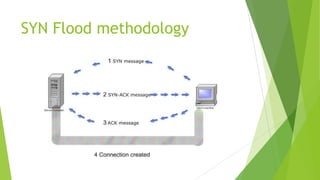
 SYN flood – exploits poor implementation of TCP in some OSs.
 Ping of Death – uses inherent weakness in IP fragmentation and reassembly
 Notorious DDoS attacks
 MyDoom
 Smurf attack
SYN Flood methodology
Ping of Death
 Maximum legal size of IP packets is 65535 bytes.
 Because of limitations in the physical layer, packets
may have to be fragmented and then reassembled at
the destination.
 A fragmented packet with the maximum offset and
size greater than 7 bytes will cause the server to
allocate a buffer of size > 65535 bytes.
Distributed DoS attacks
 Involves using some common DoS methodology, but
the attack is carried out from a large number of
machines
 IP spoofing is a common technique used in almost all
forms of attack.
 Botnets consist of a large number of “zombie”
machines controlled by a single user which can be
used to carry out all sorts of attacks (including DDoS)
 Network and protocol implementation loopholes can
also be used for launching such attacks
Distributed DoS attacks (contd.)
© Copyright 2008, WSTA, All Rights Reserved.
Techniques to mitigate
Security Threats
 Access Lists
 NAT
Access Lists
 Introduction
 Purpose of Access Lists
 Need for Access Lists
 Definition
 List of conditions
Attacks mitigated by ALs
 IP address spoofing
 DOS smurf attacks
 DOS sync attacks
 Filtering traceroute
Network Address
Translation
“Network Address Translation also
known as IP Masquerading or NAT, is an
Internet standard that enables
translation of IP addresses used
within one network to different IP
addresses known within another
network”
Need for NAT
 Shortage of IP addresses with protocol IPv4
-IP address is a unique 32 bit number
-100 million of hosts & 350 million of users
-NAT comes into picture requires only single
IP address to represent a group of computers.
Types of NAT
 Basic NAT :
Involves IP translation only - not port mapping
 PAT (Port Address Translation):
Involves translation of both IP addresses & port numbers.
a. SNAT : Translation of Source IP address & port number
b. DNAT: Translation of Destination IP address & port
number
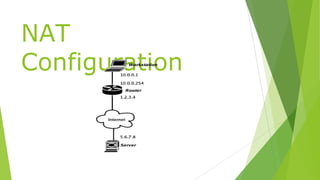
NAT
Configuration
Cyber security PPT

Cyber security PPT

  • 1.
  • 2.
    -:CREATED BY :- ALAYMEHTA - 141080106011 SHIVANI PATEL- 141080106021 KAVIN RAVAL- 141080106026 KUNTAL SONI- 141080106028
  • 3.
    Introduction  What isa Denial of Service attack?  Using up resources and / or bandwidth of a server in a malicious way to prevent legitimate users from accessing its services.  What is a DDoS?  A DoS attack carried out using a large number of compromised systems improving its potency and reducing traceability of the originator.  Some common DoS methodologies  SYN flood – exploits poor implementation of TCP in some OSs.  Ping of Death – uses inherent weakness in IP fragmentation and reassembly  Notorious DDoS attacks  MyDoom  Smurf attack
  • 4.
  • 5.
    Ping of Death Maximum legal size of IP packets is 65535 bytes.  Because of limitations in the physical layer, packets may have to be fragmented and then reassembled at the destination.  A fragmented packet with the maximum offset and size greater than 7 bytes will cause the server to allocate a buffer of size > 65535 bytes.
  • 6.
    Distributed DoS attacks Involves using some common DoS methodology, but the attack is carried out from a large number of machines  IP spoofing is a common technique used in almost all forms of attack.  Botnets consist of a large number of “zombie” machines controlled by a single user which can be used to carry out all sorts of attacks (including DDoS)  Network and protocol implementation loopholes can also be used for launching such attacks
  • 7.
    Distributed DoS attacks(contd.) © Copyright 2008, WSTA, All Rights Reserved.
  • 8.
    Techniques to mitigate SecurityThreats  Access Lists  NAT
  • 9.
    Access Lists  Introduction Purpose of Access Lists  Need for Access Lists  Definition  List of conditions
  • 10.
    Attacks mitigated byALs  IP address spoofing  DOS smurf attacks  DOS sync attacks  Filtering traceroute
  • 11.
    Network Address Translation “Network AddressTranslation also known as IP Masquerading or NAT, is an Internet standard that enables translation of IP addresses used within one network to different IP addresses known within another network”
  • 12.
    Need for NAT Shortage of IP addresses with protocol IPv4 -IP address is a unique 32 bit number -100 million of hosts & 350 million of users -NAT comes into picture requires only single IP address to represent a group of computers.
  • 13.
    Types of NAT Basic NAT : Involves IP translation only - not port mapping  PAT (Port Address Translation): Involves translation of both IP addresses & port numbers. a. SNAT : Translation of Source IP address & port number b. DNAT: Translation of Destination IP address & port number
  • 14.