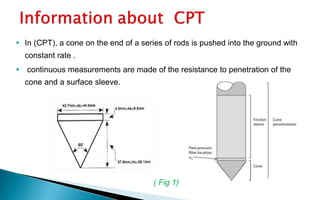
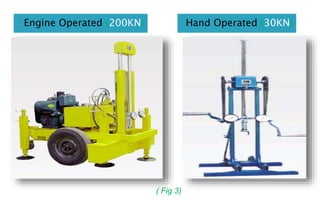
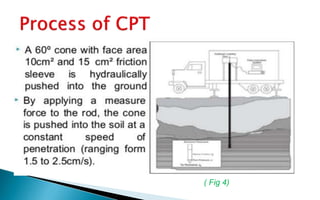
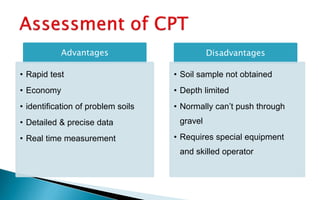
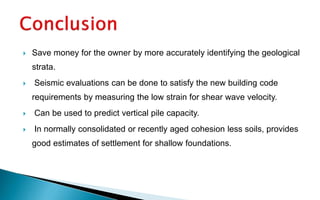
The document summarizes information about the cone penetration test (CPT), a method used to determine geotechnical engineering properties of soils. It provides a brief history of the CPT, describing how it has evolved from a mechanical cone in the 1930s to electric cones in the 1960s. It then explains that the CPT involves pushing a cone tip into the ground to continuously measure resistance, and describes the components of the CPT device and how the test is conducted. Finally, it outlines the advantages and disadvantages of the CPT and how the results can be used to evaluate soil types, densities, and shear strengths for foundation design purposes.