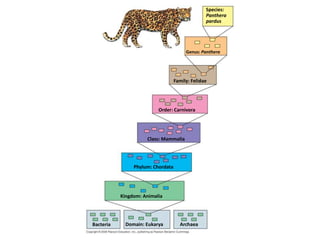
Species:
Panthera
pardus
Genus: Panthera
Family: Felidae
Order: Carnivora
Class: Mammalia
Phylum: Chordata
Kingdom: Animalia
ArchaeaDomain: EukaryaBacteria
Linnaeus
1735[1]
Haeckel
1866[29]
Chatton
1925[30][31]
Copeland
1938[32][33]
Whittaker
1969[22]
Woese et al.
1977[4][34]
Woese et al.
1990[35]
Cavalier-Smith
1993[36][37][38]
Cavalier-Smith
1998[39][25][40]
2 kingdoms 3 kingdoms 2 empires 4 kingdoms 5 kingdoms 6 kingdoms 3 domains 8 kingdoms 6 kingdoms
(not treated) Protista
Prokaryota Monera Monera
Eubacteria Bacteria Eubacteria
Bacteria
Archaebacteria Archaea Archaebacteria
Eukaryota
Protista Protista Protista
Eucarya
Archezoa
Protozoa
Protozoa
Chromista Chromista
Vegetabilia Plantae Plantae
Plantae Plantae Plantae Plantae
Fungi Fungi Fungi Fungi
Animalia Animalia Animalia Animalia Animalia Animalia Animalia
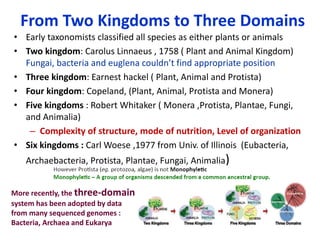
From Two Kingdoms to Three Domains
• Early taxonomists classified all species as either plants or animals
• Two kingdom: Carolus Linnaeus , 1758 ( Plant and Animal Kingdom)
Fungai, bacteria and euglena couldn’t find appropriate position
• Three kingdom: Earnest hackel ( Plant, Animal and Protista)
• Four kingdom: Copeland, (Plant, Animal, Protista and Monera)
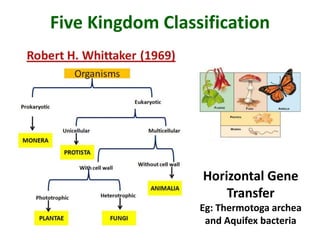
• Five kingdoms : Robert Whitaker ( Monera ,Protista, Plantae, Fungi,
and Animalia)
– Complexity of structure, mode of nutrition, Level of organization
• Six kingdoms : Carl Woese ,1977 from Univ. of Illinois (Eubacteria,
Archaebacteria, Protista, Plantae, Fungai, Animalia)
More recently, the three-domain
system has been adopted by data
from many sequenced genomes :
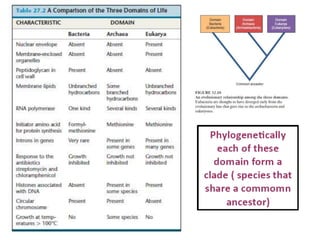
Bacteria, Archaea and Eukarya
Key Characteristics of Eukaryotes
• Compartmentalization
– Increased specialization within the cell
– Additional level of control by transcription and translation
• Multicellularity
– Allowed dealing with environment in novel ways
• Sexual Reproduction
– Greater genetic diversity through meiosis (crossing over)
Five Kingdom Classification
Horizontal Gene
Transfer
Eg: Thermotoga archea
and Aquifex bacteria
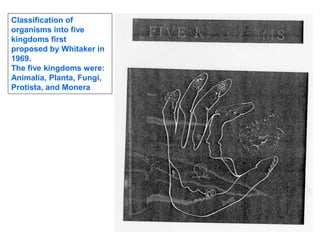
Classification of
organisms into five
kingdoms first
proposed by Whitaker in
1969.
The five kingdoms were:
Animalia, Planta, Fungi,
Protista, and Monera
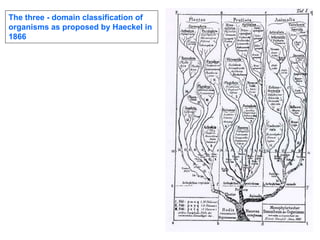
The three - domain classification of
organisms as proposed by Haeckel in
1866
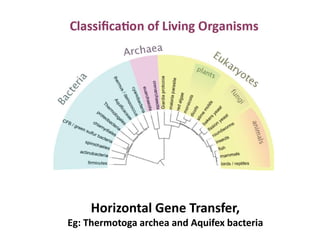
Horizontal Gene Transfer,
Eg: Thermotoga archea and Aquifex bacteria
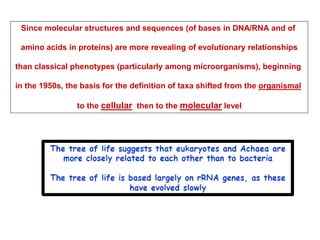
Since molecular structures and sequences (of bases in DNA/RNA and of
amino acids in proteins) are more revealing of evolutionary relationships
than classical phenotypes (particularly among microorganisms), beginning
in the 1950s, the basis for the definition of taxa shifted from the organismal
to the cellular then to the molecular level
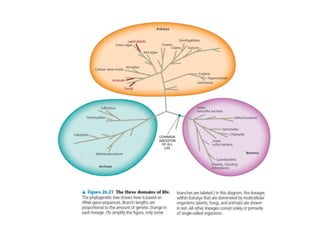
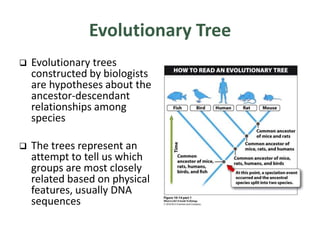
Evolutionary Tree
 Evolutionary trees
constructed by biologists
are hypotheses about the
ancestor-descendant
relationships among
species
 The trees represent an
attempt to tell us which
groups are most closely
related based on physical
features, usually DNA
sequences
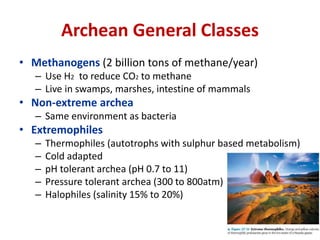
Archean General Classes
• Methanogens (2 billion tons of methane/year)
– Use H2 to reduce CO2 to methane
– Live in swamps, marshes, intestine of mammals
• Non-extreme archea
– Same environment as bacteria
• Extremophiles
– Thermophiles (autotrophs with sulphur based metabolism)
– Cold adapted
– pH tolerant archea (pH 0.7 to 11)
– Pressure tolerant archea (300 to 800atm)
– Halophiles (salinity 15% to 20%)
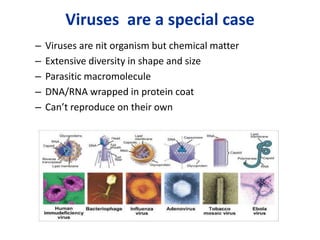
Viruses are a special case
– Viruses are nit organism but chemical matter
– Extensive diversity in shape and size
– Parasitic macromolecule
– DNA/RNA wrapped in protein coat
– Can’t reproduce on their own
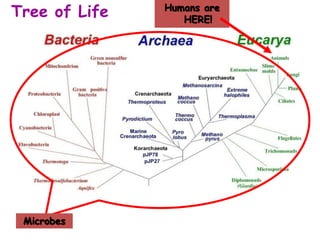
Microbes
Humans are
HERE!
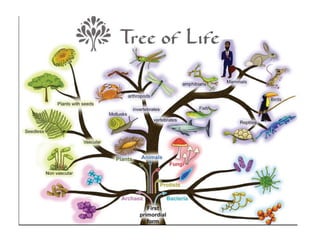
Tree of Life

Classification of organisms

  • 2.
    Species: Panthera pardus Genus: Panthera Family: Felidae Order:Carnivora Class: Mammalia Phylum: Chordata Kingdom: Animalia ArchaeaDomain: EukaryaBacteria
  • 3.
    Linnaeus 1735[1] Haeckel 1866[29] Chatton 1925[30][31] Copeland 1938[32][33] Whittaker 1969[22] Woese et al. 1977[4][34] Woeseet al. 1990[35] Cavalier-Smith 1993[36][37][38] Cavalier-Smith 1998[39][25][40] 2 kingdoms 3 kingdoms 2 empires 4 kingdoms 5 kingdoms 6 kingdoms 3 domains 8 kingdoms 6 kingdoms (not treated) Protista Prokaryota Monera Monera Eubacteria Bacteria Eubacteria Bacteria Archaebacteria Archaea Archaebacteria Eukaryota Protista Protista Protista Eucarya Archezoa Protozoa Protozoa Chromista Chromista Vegetabilia Plantae Plantae Plantae Plantae Plantae Plantae Fungi Fungi Fungi Fungi Animalia Animalia Animalia Animalia Animalia Animalia Animalia From Two Kingdoms to Three Domains
  • 4.
    From Two Kingdomsto Three Domains • Early taxonomists classified all species as either plants or animals • Two kingdom: Carolus Linnaeus , 1758 ( Plant and Animal Kingdom) Fungai, bacteria and euglena couldn’t find appropriate position • Three kingdom: Earnest hackel ( Plant, Animal and Protista) • Four kingdom: Copeland, (Plant, Animal, Protista and Monera) • Five kingdoms : Robert Whitaker ( Monera ,Protista, Plantae, Fungi, and Animalia) – Complexity of structure, mode of nutrition, Level of organization • Six kingdoms : Carl Woese ,1977 from Univ. of Illinois (Eubacteria, Archaebacteria, Protista, Plantae, Fungai, Animalia) More recently, the three-domain system has been adopted by data from many sequenced genomes : Bacteria, Archaea and Eukarya
  • 6.
    Key Characteristics ofEukaryotes • Compartmentalization – Increased specialization within the cell – Additional level of control by transcription and translation • Multicellularity – Allowed dealing with environment in novel ways • Sexual Reproduction – Greater genetic diversity through meiosis (crossing over)
  • 7.
    Five Kingdom Classification HorizontalGene Transfer Eg: Thermotoga archea and Aquifex bacteria
  • 8.
    Classification of organisms intofive kingdoms first proposed by Whitaker in 1969. The five kingdoms were: Animalia, Planta, Fungi, Protista, and Monera
  • 11.
    The three -domain classification of organisms as proposed by Haeckel in 1866
  • 12.
    Horizontal Gene Transfer, Eg:Thermotoga archea and Aquifex bacteria
  • 14.
    Since molecular structuresand sequences (of bases in DNA/RNA and of amino acids in proteins) are more revealing of evolutionary relationships than classical phenotypes (particularly among microorganisms), beginning in the 1950s, the basis for the definition of taxa shifted from the organismal to the cellular then to the molecular level
  • 15.
    Evolutionary Tree  Evolutionarytrees constructed by biologists are hypotheses about the ancestor-descendant relationships among species  The trees represent an attempt to tell us which groups are most closely related based on physical features, usually DNA sequences
  • 17.
    Archean General Classes •Methanogens (2 billion tons of methane/year) – Use H2 to reduce CO2 to methane – Live in swamps, marshes, intestine of mammals • Non-extreme archea – Same environment as bacteria • Extremophiles – Thermophiles (autotrophs with sulphur based metabolism) – Cold adapted – pH tolerant archea (pH 0.7 to 11) – Pressure tolerant archea (300 to 800atm) – Halophiles (salinity 15% to 20%)
  • 18.
    Viruses are aspecial case – Viruses are nit organism but chemical matter – Extensive diversity in shape and size – Parasitic macromolecule – DNA/RNA wrapped in protein coat – Can’t reproduce on their own
  • 19.