STD-11 BIOLOGY
CHAPTER- 2
BIOLOGICAL
CLASSIFICATION
Sanjay Siddhapura
M.Sc., B. Ed., GSET, GPSC.
Introduction
• Taxonomy : It is branch of science that deals with identification, nomenclature and
classification of living beings. The term Taxonomy used by A.P. de Candolle.
• Systematics : It is the study of diversity and differentiation of organisms based on
their phenotypic, genetic and phylogenetic relationships. The term systematics coined
by Carolus Linnaeus. The latter is known as ‘Father of Taxonomy’.
• Classification : Organisms are divided into different groups on the basis of their
similiarities & dissimiliarities that is called classification.
Taxonomy
• Turril used the term -Taxonomy.
• Turril (1938) divided taxonomy into three types.
• (i) Alpha taxonomy : Gross morphology, compilation of flora and
monographs are used for the collection and identification of organisms.
• (ii) Beta taxonomy : It is based on morphology and evidences from genetics,
cytology, anatomy, physiology etc.
• (iii) Omega taxonomy : It involves study of all microscopic and biochemical
evidences along with evolutionary relationship of organisms.
Systematics
• Systematics is of two parts.
• (i) Classical Systematics : Only Morphological characters are used to classify
organisms. It is also called taxonomy.
• (ii) New systematics or biosytematics : New systematics used phylogenetic
classification that is based on evolutionary relationships or lineages of organisms. It is
called Cladistics.
• It involves study of all types of characters from morphology, physiology, cytology,
ecology, genetics, biochemistry.
Branches Of Systematics
• (a) Cytotaxonomy : It is based on cytological information of cell. Karyotaxonomy is used to
develop taxonomic interrelations based on the study of chromosome number, chromosome
structure and chromosome behaviour during meiosis.
• (b) Numerical Taxonomy (Phenetics or Taximetrics) or Adansonian Taxonomy : It is
based on the analysis of various types of taxonomic data by mathematical or computerised
methods. In this branch, statistical methods based on as many morphological characters as
possible are used for evaluating similarities and differences between species. It was developed by
Adanson.
• (c) Chemotaxonomy or Biochemical taxonomy : It is based on the study of biomolecules
particularly secondary metabolites of the cell like betacyanin pigment in beet roots, raphides and
cystolith crystals, sequencing of DNA and chemical nature of proteins.
• (d) Experimental Taxonomy : It is based on study of experimental determination of the
genetic interrelationship, identification of evolutionary units within a species.
Systems of Biological Classification
• Initially, habit or morphological features were used as basis of classification.
• Later on organisms classified by scientists on the basis of their natural affinities.
• After Darwin’s work, they classified on the basis of evolutionary tendencies or phylogeny.
• Three types of systems of classification have been recognized.
• (I) Artificial systems of classification
• (II) Natural systems of Classification
• (III) Phylogenetic Systems of Classification
(I) Artificial systems of classification
• It was based on few morphologicial characters for grouping of organisms.
• Theophrastus firstly proposed artificial system of classification.
• On the basis of habit, He classified 480 plants into four groups herbs, undershrubs, shrub
and trees. That’s why he was known as Father of Botany.
• Aristotle (Father of Zoology) classified animals into two groups –
• (a)Anaima (Invertebrates with no red blood) and
• (b)Enaima(vertebrates with red blood). Enaima further classified into
(1) ovipara (Lays eggs)
(2) vivipara. (Gives birth of animal)
(I) Artificial systems of classification
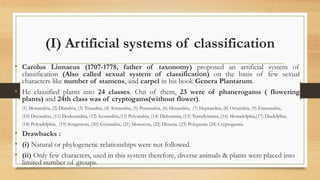
• Carolus Linnaeus (1707-1778, father of taxonomy) proposed an artificial system of
classification (Also called sexual system of classification) on the basis of few sexual
characters like number of stamens, and carpel in his book Genera Plantarum.
• He classified plants into 24 classes. Out of them, 23 were of phanerogams ( flowering
plants) and 24th class was of cryptogams(without flower).
(1) Monandria, (2) Diandria, (3) Triandria, (4) Tetrandria, (5) Pentandria, (6) Hexandria, (7) Heptandria, (8) Octandria, (9) Enneandria,
(10) Decandria, (11) Dodecandria, (12) Icosandria,(13) Polyandria, (14) Didynamia, (15) Tetradynamia, (16) Monadelphia,(17) Diadelphia,
(18) Polyadelphia, (19) Syngenesia, (20) Gynandria, (21) Monoecia, (22) Dioecia, (23) Polygamia (24) Cryptogamia.
• Drawbacks :
• (i) Natural or phylogenetic relationships were not followed.
• (ii) Only few characters, used in this system therefore, diverse animals & plants were placed into
limited number of groups.
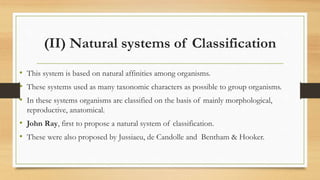
(II) Natural systems of Classification
• This system is based on natural affinities among organisms.
• These systems used as many taxonomic characters as possible to group organisms.
• In these systems organisms are classified on the basis of mainly morphological,
reproductive, anatomical.
• John Ray, first to propose a natural system of classification.
• These were also proposed by Jussiaeu, de Candolle and Bentham & Hooker.
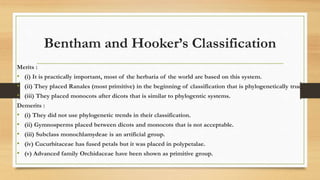
Bentham and Hooker’s Classification
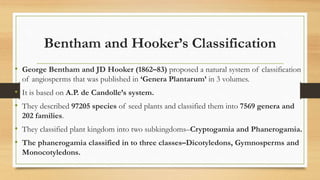
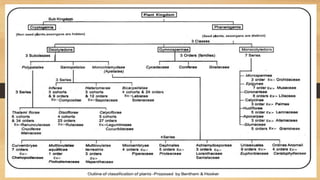
• George Bentham and JD Hooker (1862–83) proposed a natural system of classification
of angiosperms that was published in ‘Genera Plantarum’ in 3 volumes.
• It is based on A.P. de Candolle’s system.
• They described 97205 species of seed plants and classified them into 7569 genera and
202 families.
• They classified plant kingdom into two subkingdoms–Cryptogamia and Phanerogamia.
• The phanerogamia classified in to three classes–Dicotyledons, Gymnosperms and
Monocotyledons.
Bentham and Hooker’s Classification
Merits :
• (i) It is practically important, most of the herbaria of the world are based on this system.
• (ii) They placed Ranales (most primitive) in the beginning of classification that is phylogenetically true.
• (iii) They placed monocots after dicots that is similar to phylogentic systems.
Demerits :
• (i) They did not use phylogenetic trends in their classification.
• (ii) Gymnosperms placed between dicots and monocots that is not acceptable.
• (iii) Subclass monochlamydeae is an artificial group.
• (iv) Cucurbitaceae has fused petals but it was placed in polypetalae.
• (v) Advanced family Orchidaceae have been shown as primitive group.
(III) Phylogenetic Systems of Classification
• Evolutionary history of the organism is called Phylogeny (this term coined the by Lamarck).
• These systems are based on Phylogenetic relationships of organisms.
• Phylogenetic systems are also called Cladistics and the graphic representation of evolutionary
relationships is called family tree or Cladogram.
• Eichler and Endlicher firstly proposed a phylogenetic classification system.
• Engler and Prantl published his classification in their book “Die Naturlichen Pflanzenfamilien”
in 23 volumes.
• Later on well developed phylogenetic systems of classification were created by Hutchinson, Tippo,
• Takhtajan and Cronquist.
KINGDOMS OF LIFE
• 1. Two kingdom system–Plant and animal
• 2. Three kingdom system- Protista, Plantae, Animalia.
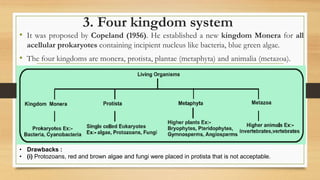
• 3. Four kingdom system - Monera, Protista, Plantae (metaphyta) and Animalia (metazoa).
• 4. Five kingdom system- Monera – Protista – Fungi – Plantae – Animalia.
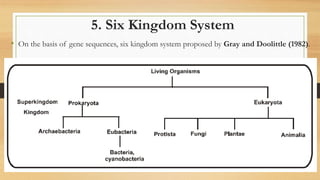
• 5. Six Kingdom System- Archaebacteria- Eubacteria- Protista – Fungi – Plantae – Animalia.
• 6. Domain System - Archaea, Bacteria and Eukarya
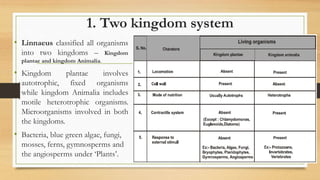
1. Two kingdom system
• Linnaeus classified all organisms
into two kingdoms – Kingdom
plantae and kingdom Animalia.
• Kingdom plantae involves
autotrophic, fixed organisms
while kingdom Animalia includes
motile heterotrophic organisms.
Microorganisms involved in both
the kingdoms.
• Bacteria, blue green algae, fungi,
mosses, ferns, gymnosperms and
the angiosperms under ‘Plants’.
Drawbacks of Two kingdom system
• (i) Unicellular and multicellular forms have been placed in both the kingdoms though they have
different organisation.
• (ii) Bacteria, cyanobacteria, Fungi, Mosses, Ferns, Gymnosperms and the Angiosperms are
included under plants but Bacteria and cyanobacteria are prokaryotes.
• (iii) Viruses are neither plants nor animals and placed at the border line of living and non
living.
• (iv) Tunicates are chordate animals that have cellulose, branching pattern as plant.
• (v) Fungi of kingdom plantae are nonphotosynthetic, have chitin cell wall and glycogen as
reserve food.
Thus two kingdom system of classifiaction is inappropriate and inadequate.
2. Three kingdom system
• Ernst Haeckel proposed it. He separated all one celled eukaryotes into separate
kingdom protista.
• These three kingdoms are (a)Protista, (b)Plantae, ©Animalia.
• Kingdom protista includes algae, slime moulds, Protozoans, Fungi, bacteria.
Drawbacks :
• (i) Bacteria and fungi are placed with algae and protozoan.
• (ii) in this kingdom, Acellular and multicellular organisms were kept together.
3. Four kingdom system
• It was proposed by Copeland (1956). He established a new kingdom Monera for all
acellular prokaryotes containing incipient nucleus like bacteria, blue green algae.
• The four kingdoms are monera, protista, plantae (metaphyta) and animalia (metazoa).
• Drawbacks :
• (i) Protozoans, red and brown algae and fungi were placed in protista that is not acceptable.
4. Five kingdom system
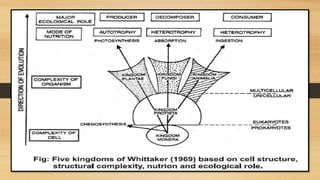
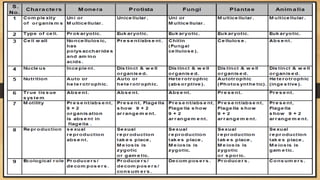
• It was proposed by Whittaker (1969). It is a phylogenetic system that is based on following
criteria.
• (i) Complexity of cell structure : Prokaryotes and eukaryotes.
• (ii) Complexity of organisms : i.e., thallus organisation (unicellular or multicellular organisms).
• (iii) Mode of nutrition : Autotrophic (holophytic) or heterotrophic [absorptive parasitic or
saprozoic ingestive (holozoic)]. It is major criteria of classification in this system.
• (iv) Ecological role of organism.
• (v) Phylogenetic relationship.
• The five kingdoms are Monera – Protista – Fungi – Plantae – Animalia.
Five kingdom system
Merits :
• (i) Fungi are separated from plants or protista and established as kingdom.
• (ii) Prokaryotes and eukaryotes are separately recognised in this system.
Demerits :
• (i) The position of Viruses is not clear.
• (ii) Algae is placed into monera, protista and Plantae.
• (iii) Protista is an artificial group.
5. Six Kingdom System
• On the basis of gene sequences, six kingdom system proposed by Gray and Doolittle (1982).
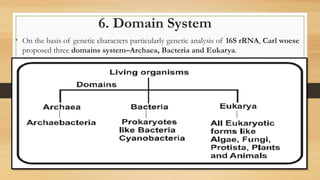
6. Domain System
• On the basis of genetic characters particularly genetic analysis of 16S rRNA, Carl woese
proposed three domains system–Archaea, Bacteria and Eukarya.
KINGDOM MONERA
• Copeland (1956) established kingdom monera in which all prokaryotes were included.
• General Characters :
• (i) It involves unicellular / conlonial / multicellular with prokaryotic organisms.
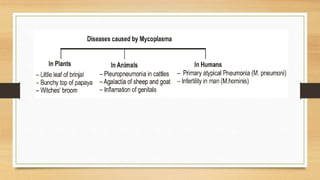
• Ex: Archaebacteria, Bacteria, Actinomycetes, Mycoplasma, Rickettsiae, Spirochaetes,
Chlamydiae, Cyanobacteria.
• (ii) Cell wall bears peptidoglycan except archaebacteria and mycoplasma.
• (iii) Genetic material is naked DNA (Histone is absent) that is called nucleoid or
Prochromosome or genophore. nuclear envelope, nucleoplasm, nucleolus and chromatin are
absent.
• (iv) All membrane bound organelles are absent thus they bear one envelope system.
• (v) If Photosynthetic pigments present, they are distributed in thylakoid
membranes or chromatophores.
• (vi) 70 S type of Ribosomes are present.
• (vii) Respiratory enzymes are associated with plasma membrane.
• (viii) Nutrition is autotrophic/heterotrophic.
• (ix) Reproduction takes place by asexual methods only.
• (x) Mitosis, meiosis, sexual reproduction are absent.
KINGDOM MONERA
General Characters
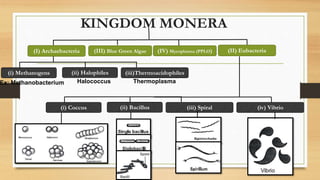
KINGDOM MONERA
(I) Archaebacteria (II) Eubacteria
(i) Methanogens (ii) Halophiles (iii)Thermoacidophiles
Ex: Methanobacterium Halococcus Thermoplasma
(i) Coccus (ii) Bacillus (iii) Spiral (iv) Vibrio
(III) Blue Green Algae (IV) Mycoplasma (PPLO)
(I) Archaebacteria
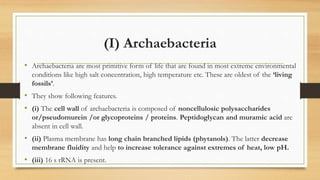
• Archaebacteria are most primitive form of life that are found in most extreme environmental
conditions like high salt concentration, high temperature etc. These are oldest of the ‘living
fossils’.
• They show following features.
• (i) The cell wall of archaebacteria is composed of noncellulosic polysaccharides
or/pseudomurein /or glycoproteins / proteins. Peptidoglycan and muramic acid are
absent in cell wall.
• (ii) Plasma membrane has long chain branched lipids (phytanols). The latter decrease
membrane fluidity and help to increase tolerance against extremes of heat, low pH.
• (iii) 16 s rRNA is present.
Types of Archaebacteria
• These are of three types
• (i) Methanogens (ii) Halophiles (iii) Thermoacidophiles
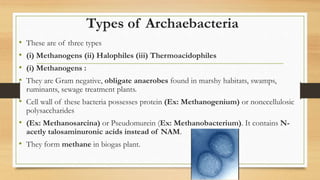
• (i) Methanogens :
• They are Gram negative, obligate anaerobes found in marshy habitats, swamps,
ruminants, sewage treatment plants.
• Cell wall of these bacteria possesses protein (Ex: Methanogenium) or nonecellulosic
polysaccharides
• (Ex: Methanosarcina) or Pseudomurein (Ex: Methanobacterium). It contains N-
acetly talosaminuronic acids instead of NAM.
• They form methane in biogas plant.
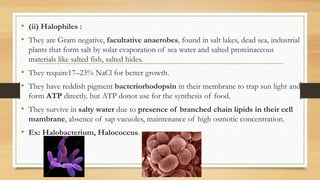
• (ii) Halophiles :
• They are Gram negative, facultative anaerobes, found in salt lakes, dead sea, industrial
plants that form salt by solar evaporation of sea water and salted proteinaceous
materials like salted fish, salted hides.
• They require17–23% NaCl for better growth.
• They have reddish pigment bacteriorhodopsin in their membrane to trap sun light and
form ATP directly. but ATP donot use for the synthesis of food.
• They survive in salty water due to presence of branched chain lipids in their cell
mambrane, absence of sap vacuoles, maintenance of high osmotic concentration.
• Ex: Halobacterium, Halococcus.
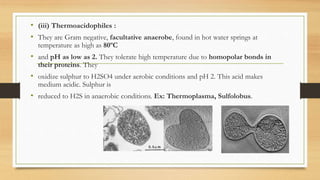
• (iii) Thermoacidophiles :
• They are Gram negative, facultative anaerobe, found in hot water springs at
temperature as high as 80ºC
• and pH as low as 2. They tolerate high temperature due to homopolar bonds in
their proteins. They
• oxidize sulphur to H2SO4 under aerobic conditions and pH 2. This acid makes
medium acidic. Sulphur is
• reduced to H2S in anaerobic conditions. Ex: Thermoplasma, Sulfolobus.
(II) Eubacteria
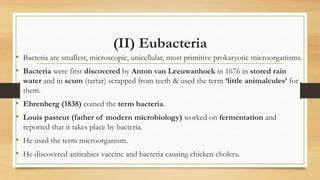
• Bacteria are smallest, microscopic, unicellular, most primitive prokaryotic microorganisms.
• Bacteria were first discovered by Anton van Leeuwanhoek in 1676 in stored rain
water and in scum (tartar) scrapped from teeth & used the term ‘little animalcules’ for
them.
• Ehrenberg (1838) coined the term bacteria.
• Louis pasteur (father of modern microbiology) worked on fermentation and
reported that it takes place by bacteria.
• He used the term microorganism.
• He discovered antirabies vaccine and bacteria causing chicken cholera.
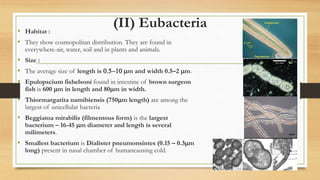
(II) Eubacteria• Habitat :
• They show cosmopolitan distribution. They are found in
everywhere-air, water, soil and in plants and animals.
• Size :
• The average size of length is 0.5-10 mm and width 0.5–2 mm.
• Epulopscium fishelsoni found in intestine of brown surgeon
fish is 600 mm in length and 80mm in width.
• Thiormargarita namibiensis (750mm length) are among the
largest of unicellular bacteria
• Beggiatoa mirabilis (filmentous form) is the largest
bacterium – 16-45 mm diameter and length is several
milimeters.
• Smallest bacterium is Dialister pneumonsintes (0.15 – 0.3mm
long) present in nasal chamber of humancausing cold.
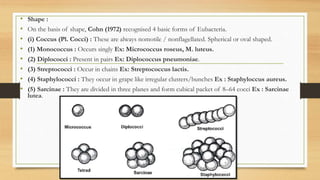
• Shape :
• On the basis of shape, Cohn (1972) recognised 4 basic forms of Eubacteria.
• (i) Coccus (Pl. Cocci) : These are always nomotile / nonflagellated. Spherical or oval shaped.
• (1) Monococcus : Occurs singly Ex: Micrococcus roseus, M. luteus.
• (2) Diplococci : Present in pairs Ex: Diplococcus pneumoniae.
• (3) Streptococci : Occur in chains Ex: Streptococcus lactis.
• (4) Staphylococci : They occur in grape like irregular clusters/bunches Ex : Staphyloccus aureus.
• (5) Sarcinae : They are divided in three planes and form cubical packet of 8–64 cocci Ex : Sarcinae
lutea.
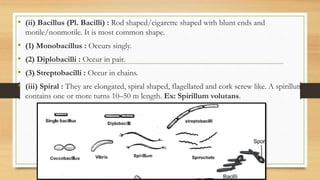
• (ii) Bacillus (Pl. Bacilli) : Rod shaped/cigarette shaped with blunt ends and
motile/nonmotile. It is most common shape.
• (1) Monobacillus : Occurs singly.
• (2) Diplobacilli : Occur in pair.
• (3) Streptobacilli : Occur in chains.
• (iii) Spiral : They are elongated, spiral shaped, flagellated and cork screw like. A spirillum
contains one or more turns 10–50 m length. Ex: Spirillum volutans.
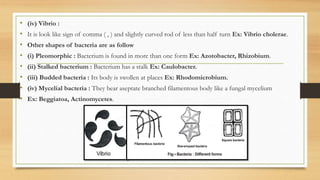
• (iv) Vibrio :
• It is look like sign of comma ( , ) and slightly curved rod of less than half turn Ex: Vibrio cholerae.
• Other shapes of bacteria are as follow
• (i) Pleomorphic : Bacterium is found in more than one form Ex: Azotobacter, Rhizobium.
• (ii) Stalked bacterium : Bacterium has a stalk Ex: Caulobacter.
• (iii) Budded bacteria : Its body is swollen at places Ex: Rhodomicrobium.
• (iv) Mycelial bacteria : They bear aseptate branched filamentous body like a fungal mycelium
• Ex: Beggiatoa, Actinomycetes.
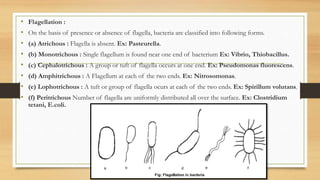
• Flagellation :
• On the basis of presence or absence of flagella, bacteria are classified into following forms.
• (a) Atrichous : Flagella is absent. Ex: Pasteurella.
• (b) Monotrichous : Single flagellum is found near one end of bacterium Ex: Vibrio, Thiobacillus.
• (c) Cephalotrichous : A group or tuft of flagella occurs at one end. Ex: Pseudomonas fluorescens.
• (d) Amphitrichous : A Flagellum at each of the two ends. Ex: Nitrosomonas.
• (e) Lophotrichous : A tuft or group of flagella ocurs at each of the two ends. Ex: Spirillum volutans.
• (f) Peritrichous Number of flagella are uniformly distributed all over the surface. Ex: Clostridium
tetani, E.coli.
Gram Staining Technique
• Hans Christian Gram (1884) developed this technique to stain bacteria.
• In this technique, Bacteria are firstly stained by weak alkaline solution of crystal violet
(Gram stain)resulting the former up blue colour.
• Now they are treated with 0.5% iodine solution and washed with water.
• Then absolute alcohol or acetone.
• Bacteria that retain blue or purple colour are called Gram +ve bacteria
• Ex: Bacillus subtilis.
• Bacteria that become colourless are called Gram–ve bacteria. Ex: E.coli.
• This difference due to differentiation in the lipid contents and thickness of cell wall in
these bacteria.
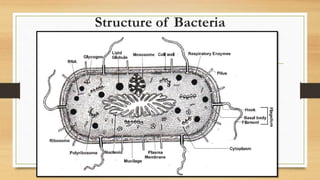
Structure of Bacteria
• A) Cell Envelope : It consists of three layers–outer glycocalyx, middle cell wall and innermost
cell membrane.
• (1) Glycocalyx : It consists of only polysaccharides and protects cell from loss of water,
nutrients and viral attack.
• It is found either as loose gelatinous thin sheath (loose slime layer) or as persistent layer around
cell wall. Ex: Bacillus anthracis, Diplococcus pneumoniae.
• The latter also have D-glutamic acid alongwith polysaccharides in cell wall resulting thick slime
layer is formed called capsule which provides protection against phagocytosis and antibiotics.
• (2) Cell wall :
• It is thick, rigid and forms 10–40% part of bacteria.
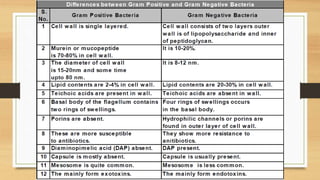
• The cell wall of Gram positive bacteria is single layered and composed of peptidogylcan or
murein or mucopeptide.
• The glycan part forms backbone of cell wall and composed of alternating units of two amino
sugars NAG (N-acetyl glucosamine) and NAM (N-acetyl muramic acid) that are linked
with , 1-4 glycosidic bonds.
• Four amino acids form short peptide chain that is attached to NAM only.
• Gram +ve bacteria have teichoic acids (these are acid polymers containing glucose, phosphate
and alcohol) that act as receptor sites and surface antigens. They also attract chemicals which
provide protection from pH and thermal changes.
• Gram–ve bacteria possess double layered cell wall. Inner layer of these bacteria is composed of
peptidoglycan while outer layer contains lipopolysaccharides, proteins and phospholipids.
Lipids having antigenic properties.
• Porins are found as channels in the outer layer of Gram–ve bacteria. the former take part in entry
and exit of hydrophilic low molecular weight substances.
• Periplasmic space is found between plasma membrane and cell wall.
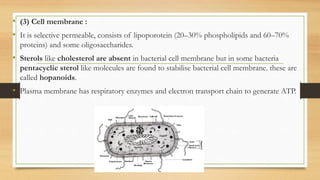
• (3) Cell membrane :
• It is selective permeable, consists of lipoporotein (20–30% phospholipids and 60–70%
proteins) and some oligosaccharides.
• Sterols like cholesterol are absent in bacterial cell membrane but in some bacteria
pentacyclic sterol like molecules are found to stabilise bacterial cell membrane. these are
called hopanoids.
• Plasma membrane has respiratory enzymes and electron transport chain to generate ATP.
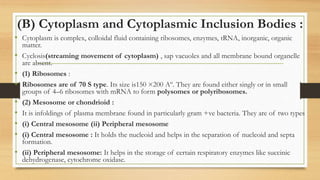
(B) Cytoplasm and Cytoplasmic Inclusion Bodies :
• Cytoplasm is complex, colloidal fluid containing ribosomes, enzymes, tRNA, inorganic, organic
matter.
• Cyclosis(streaming movement of cytoplasm) , sap vacuoles and all membrane bound organelle
are absent.
• (1) Ribosomes :
• Ribosomes are of 70 S type. Its size is150 ×200 Aº. They are found either singly or in small
groups of 4–6 ribosomes with mRNA to form polysomes or polyribosomes.
• (2) Mesosome or chondrioid :
• It is infoldings of plasma membrane found in particularly gram +ve bacteria. They are of two types
• (i) Central mesosome (ii) Peripheral mesosome
• (i) Central mesosome : It holds the nucleoid and helps in the separation of nucleoid and septa
formation.
• (ii) Peripheral mesosome: It helps in the storage of certain respiratory enzymes like succinic
dehydrogenase, cytochrome oxidase.
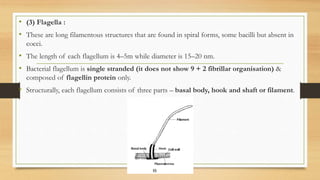
• (3) Flagella :
• These are long filamentous structures that are found in spiral forms, some bacilli but absent in
cocci.
• The length of each flagellum is 4–5m while diameter is 15–20 nm.
• Bacterial flagellum is single stranded (it does not show 9 + 2 fibrillar organisation) &
composed of flagellin protein only.
• Structurally, each flagellum consists of three parts – basal body, hook and shaft or filament.
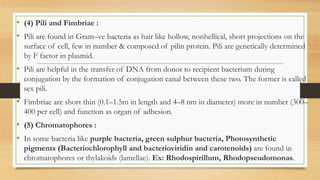
• (4) Pili and Fimbriae :
• Pili are found in Gram–ve bacteria as hair like hollow, nonhellical, short projections on the
surface of cell, few in number & composed of pilin protein. Pili are genetically determined
by F factor in plasmid.
• Pili are helpful in the transfer of DNA from donor to recipient bacterium during
conjugation by the formation of conjugation canal between these two. The former is called
sex pili.
• Fimbriae are short thin (0.1–1.5m in length and 4–8 nm in diameter) more in number (300–
400 per cell) and function as organ of adhesion.
• (5) Chromatophores :
• In some bacteria like purple bacteria, green sulphur bacteria, Photosynthetic
pigments (Bacteriochlorophyll and bacterioviridin and carotenoids) are found in
chromatophores or thylakoids (lamellae). Ex: Rhodospirillum, Rhodopseudomonas.
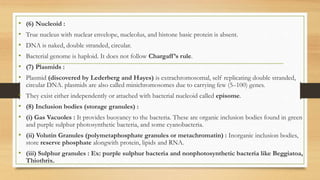
• (6) Nucleoid :
• True nucleus with nuclear envelope, nucleolus, and histone basic protein is absent.
• DNA is naked, double stranded, circular.
• Bacterial genome is haploid. It does not follow Chargaff’s rule.
• (7) Plasmids :
• Plasmid (discovered by Lederberg and Hayes) is extrachromosomal, self replicating double stranded,
circular DNA. plasmids are also called minichromosomes due to carrying few (5–100) genes.
• They exist either independently or attached with bacterial nucleoid called episome.
• (8) Inclusion bodies (storage granules) :
• (i) Gas Vacuoles : It provides buoyancy to the bacteria. These are organic inclusion bodies found in green
and purple sulphur photosynthetic bacteria, and some cyanobacteria.
• (ii) Volutin Granules (polymetaphosphate granules or metachromatin) : Inorganic inclusion bodies,
store reserve phosphate alongwith protein, lipids and RNA.
• (iii) Sulphur granules : Ex: purple sulphur bacteria and nonphotosynthetic bacteria like Beggiatoa,
Thiothrix.
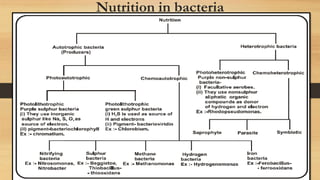
Nutrition in bacteria
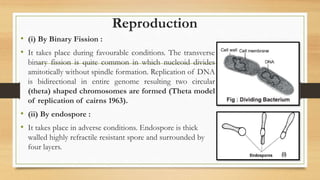
Reproduction
• (i) By Binary Fission :
• It takes place during favourable conditions. The transverse
binary fission is quite common in which nucleoid divides
amitotically without spindle formation. Replication of DNA
is bidirectional in entire genome resulting two circular
(theta) shaped chromosomes are formed (Theta model
of replication of cairns 1963).
• (ii) By endospore :
• It takes place in adverse conditions. Endospore is thick
walled highly refractile resistant spore and surrounded by
four layers.
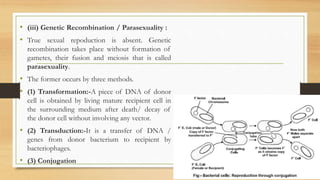
• (iii) Genetic Recombination / Parasexuality :
• True sexual repoduction is absent. Genetic
recombination takes place without formation of
gametes, their fusion and meiosis that is called
parasexuality.
• The former occurs by three methods.
• (1) Transformation:-A piece of DNA of donor
cell is obtained by living mature recipient cell in
the surrounding medium after death/ decay of
the donor cell without involving any vector.
• (2) Transduction:-It is a transfer of DNA /
genes from donor bacterium to recipient by
bacteriophages.
• (3) Conjugation
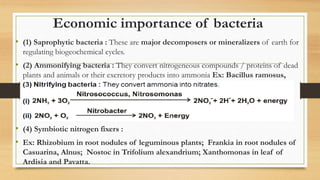
Economic importance of bacteria
• (1) Saprophytic bacteria : These are major decomposers or mineralizers of earth for
regulating biogeochemical cycles.
• (2) Ammonifying bacteria : They convert nitrogeneous compounds / proteins of dead
plants and animals or their excretory products into ammonia Ex: Bacillus ramosus,
• (4) Symbiotic nitrogen fixers :
• Ex: Rhizobium in root nodules of leguminous plants; Frankia in root nodules of
Casuarina, Alnus; Nostoc in Trifolium alexandrium; Xanthomonas in leaf of
Ardisia and Pavatta.
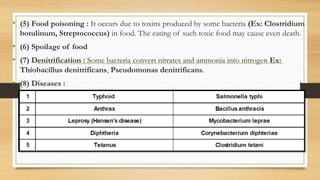
• (5) Food poisoning : It occurs due to toxins produced by some bacteria (Ex: Clostridium
botulinum, Streptococcus) in food. The eating of such toxic food may cause even death.
• (6) Spoilage of food
• (7) Denitrification : Some bacteria convert nitrates and ammonia into nitrogen Ex:
Thiobacillus denitrificans, Pseudomonas denitrificans.
• (8) Diseases :
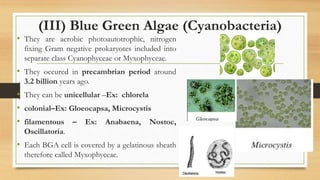
(III) Blue Green Algae (Cyanobacteria)
• They are aerobic photoautotrophic, nitrogen
fixing Gram negative prokaryotes included into
separate class Cyanophyceae or Myxophyceae.
• They occured in precambrian period around
3.2 billion years ago.
• They can be unicellular –Ex: chlorela
• colonial–Ex: Gloeocapsa, Microcystis
• filamentous – Ex: Anabaena, Nostoc,
Oscillatoria.
• Each BGA cell is covered by a gelatinous sheath
therefore called Myxophyceae.
• Definite nucleus and definite plastid with grana are absent. Motile forms, mesosome,
chlorophyll b, meiosis, and all membrane bounded organelle are absent.
• BGA is able to fix atmospheric nitrogen in to ammonium compounds. for this purspose
some of their cells become pale yellow and thick walled structure called heterocysts.
• The heterocysts has nitrogenase enzyme that performs nitrogen fixation in anaerobic
conditions Ex: Anabaena, Nostoc, Aulosira.
• They were first to oxygenic photosynthesis to evolve O2 in photosynthesis
• Sexual reproduction is absent in BGA but gene recombination occurs by conjugation,
transformation, and transduction.
• The most common method of reproduction is by binary fission in unicellular forms.
(IV) Mycoplasma (PPLO)
• Nocard and Roux (1898) discovered PPLO (Pleuropneumonia like organisms).
• They are Gram–ve, smallest (0.1–0.3 m in size–Ex: Mycoplasma gallisepticum),
unicellular, aerobic, heterotrophic, walls less prokayotes and pleomorpic organisms.
• They can change their shape hence called jokers of the plant kingdom or mollicutes.
• They can pass through bacteria proof filters. Cell membrane is trilaminar, highly flexible
and composed of lipoprotein.
• DNA is linear note circular, but coiled and double stranded.
• 70 S type of ribosomes, RNA, protein, fat particles are found in cytoplasm.
• They perform reproduction by binary fission and elementary bodies.
• In culture medium their colonies shows fried egg appearance.
• They are either saprophytic or cause diseases in plants and animals.
KINGDOM PROTISTA
• Ernst Heackel coined the term protista.
General Characters :
• (i) They are unicellular or colonial, eukaryotic organisms mostly found in
aquatic habitat.
• (ii) They bear well defined nucleus. Protists can be uninucleate, binucleate or
multinucleate.
• (iii) Locomotion takes place by flagella or cilia, pseudopodia, contractions and
mucilage extrusion.
• (iv) Cyclosis or cytoplasmic streaming is found in cytoplasm.
• (v) Cell wall, if present, contains cellulose.
KINGDOM PROTISTA
• (vi) Mode of nutrition is of various types – Holophytic (Photosynthetic), ingestive (=Holozoic),
absorp tive (parasitic, saprobic).
• (vii) 80% of the photosynthesis on earth is performed by photosynthetic protists.
• (viii) Reserve food is starch, glycogen, paramylon, chrsolaminarin and fat.
• (ix) Flagella and cilia, when present, have 9 + 2 pattern of microtubular strands.
• (x) The common mode of reproduction is Asexual reproduction. The latter occurs through binary
fission, budding, plasmotomy, sporulation, cyst formation etc.
• (xi) Sexual reproduction involves meiosis and karyogamy. Meiosis is zygotic in some forms and gametic
in others.
• (xii) Some forms are parasitic, some are found symbiotically in the gut of animals and few are
decomposers.
General Characters
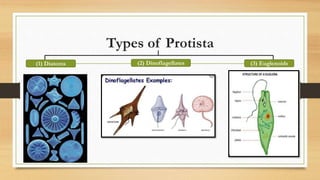
Types of Protista
(1) Diatoms (2) Dinoflagellates (3) Euglenoids
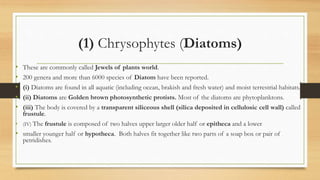
(1) Chrysophytes (Diatoms)
• These are commonly called Jewels of plants world.
• 200 genera and more than 6000 species of Diatom have been reported.
• (i) Diatoms are found in all aquatic (including ocean, brakish and fresh water) and moist terrestrial habitats.
• (ii) Diatoms are Golden brown photosynthetic protists. Most of the diatoms are phytoplanktons.
• (iii) The body is covered by a transparent siliceous shell (silica deposited in cellulosic cell wall) called
frustule.
• (IV) The frustule is composed of two halves upper larger older half or epitheca and a lower
• smaller younger half or hypotheca. Both halves fit together like two parts of a soap box or pair of
petridishes.
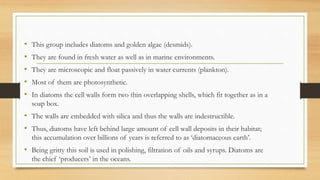
• This group includes diatoms and golden algae (desmids).
• They are found in fresh water as well as in marine environments.
• They are microscopic and float passively in water currents (plankton).
• Most of them are photosynthetic.
• In diatoms the cell walls form two thin overlapping shells, which fit together as in a
soap box.
• The walls are embedded with silica and thus the walls are indestructible.
• Thus, diatoms have left behind large amount of cell wall deposits in their habitat;
this accumulation over billions of years is referred to as ‘diatomaceous earth’.
• Being gritty this soil is used in polishing, filtration of oils and syrups. Diatoms are
the chief ‘producers’ in the oceans.
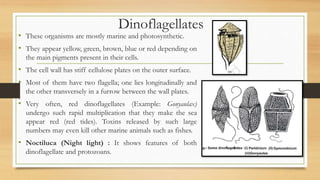
Dinoflagellates
• These organisms are mostly marine and photosynthetic.
• They appear yellow, green, brown, blue or red depending on
the main pigments present in their cells.
• The cell wall has stiff cellulose plates on the outer surface.
• Most of them have two flagella; one lies longitudinally and
the other transversely in a furrow between the wall plates.
• Very often, red dinoflagellates (Example: Gonyaulax)
undergo such rapid multiplication that they make the sea
appear red (red tides). Toxins released by such large
numbers may even kill other marine animals such as fishes.
• Noctiluca (Night light) : It shows features of both
dinoflagellate and protozoans.
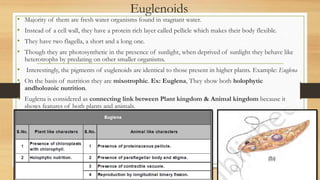
Euglenoids
• Majority of them are fresh water organisms found in stagnant water.
• Instead of a cell wall, they have a protein rich layer called pellicle which makes their body flexible.
• They have two flagella, a short and a long one.
• Though they are photosynthetic in the presence of sunlight, when deprived of sunlight they behave like
heterotrophs by predating on other smaller organisms.
• Interestingly, the pigments of euglenoids are identical to those present in higher plants. Example: Euglena
• On the basis of nutrition they are mixotrophic. Ex: Euglena, They show both holophytic
andholozoic nutrition.
• Euglena is considered as connecting link between Plant kingdom & Animal kingdom because it
shows features of both plants and animals.
Slime Moulds
• The body moves along decaying twigs and leaves engulfing organic material.
• (i) Cell wall is absent around somatic cell but it is formed during reproduction. During
unfavourable conditions, the plasmodium differentiates and forms fruiting bodies bearing
spores at their tips. The spores possess true walls. The spores are dispersed by air currents.
• (ii) The protoplasts are covered by plasmalemma. Under suitable conditions, they form an
aggregation called plasmodium which may grow and spread over several feet.
• (iii) Chloroplasts absent. They show phagotrophic nutrition.
Slime moulds are saprophytic protists.
• (iv) The reserve food is Glycogen and oil.
• (v) Reproduction takes place through both asexual and sexual methods.
• (VI) They are extremely resistant and survive for many years, even under adverse
conditions.
Protozoans
• All protozoans are heterotrophs and live as predators or parasites.
• They are believed to be primitive relatives of animals.
• There are four major groups of protozoans.
• Amoeboid protozoans
• Flagellated protozoans
• Ciliated protozoans
• Sporozoans
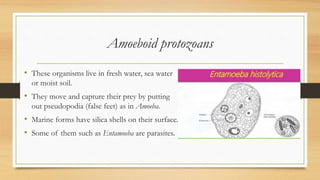
Amoeboid protozoans
• These organisms live in fresh water, sea water
or moist soil.
• They move and capture their prey by putting
out pseudopodia (false feet) as in Amoeba.
• Marine forms have silica shells on their surface.
• Some of them such as Entamoeba are parasites.
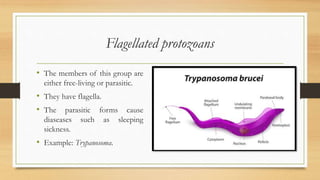
Flagellated protozoans
• The members of this group are
either free-living or parasitic.
• They have flagella.
• The parasitic forms cause
diaseases such as sleeping
sickness.
• Example: Trypanosoma.
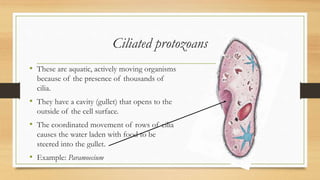
Ciliated protozoans
• These are aquatic, actively moving organisms
because of the presence of thousands of
cilia.
• They have a cavity (gullet) that opens to the
outside of the cell surface.
• The coordinated movement of rows of cilia
causes the water laden with food to be
steered into the gullet.
• Example: Paramoecium
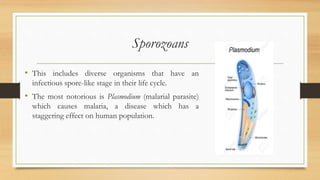
Sporozoans
• This includes diverse organisms that have an
infectious spore-like stage in their life cycle.
• The most notorious is Plasmodium (malarial parasite)
which causes malaria, a disease which has a
staggering effect on human population.
• Fungi are eukaryotic, achlorophyllous, heterotrophic, non vascular, non
flowering, gametophytic, haploid (n), multicellular organisms.
• The study of fungi is called Mycology.
• Pier Antonio micheli is called ‘Father of Mycology.’
• E.J. Butler is known as ‘Father of Inidan Mycology’.
• R.H. Whittaker (1969) established it as kingdom Fungi.
KINGDOM FUNGI
• The fungi constitute a unique kingdom of heterotrophic organisms.
• They show a great diversity in morphology and habitat.
• You must have seen fungi on a moist bread and rotten fruits.
• The common mushroom you eat and toadstools are also fungi.
• White spots seen on mustard leaves are due to a parasitic fungus.
• Some unicellular fungi, e.g., yeast are used to make bread and beer.
• Other fungi cause diseases in plants and animals; wheat rust-causing Puccinia is an
important example.
• Some are the source of antibiotics, e.g., Penicillium.
• Fungi are cosmopolitan and occur in air, water, soil and on animals and plants.
• They prefer to grow in warm and humid places.
• HABITAT:- These are found in all habitat like soil, water, air, mouth, skin, hair, eye,
on decaying matter etc. and the distribution is cosmopolitan (ubiquitous). Most of the
fungi are terrestrial and found in soil, some are aquatic, parasitic or saporophytic or
symobiont.
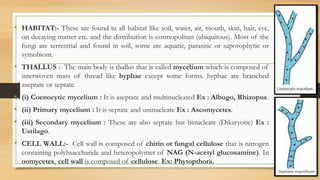
• THALLUS :- The main body is thallus that is called mycelium which is composed of
interwoven mass of thread like hyphae except some forms. hyphae are branched
aseptate or septate.
• (i) Coenocytic mycelium : It is aseptate and multinucleated Ex : Albugo, Rhizopus.
• (ii) Primary mycelium : It is septate and uninucleate Ex : Ascomycetes.
• (iii) Secondary mycelium : These are also septate but binucleate (Dikaryotic) Ex :
Ustilago.
• CELL WALL:- Cell wall is composed of chitin or fungal cellulose that is nitrogen
containing polyhsaccharide and heteropolymer of NAG (N-acetyl glucosamine). In
oomycetes, cell wall is composed of cellulose. Ex: Phytopthora.
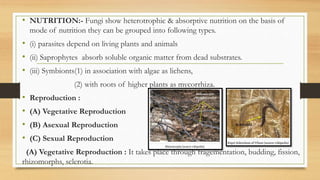
• NUTRITION:- Fungi show heterotrophic & absorptive nutrition on the basis of
mode of nutrition they can be grouped into following types.
• (i) parasites depend on living plants and animals
• (ii) Saprophytes absorb soluble organic matter from dead substrates.
• (iii) Symbionts(1) in association with algae as lichens,
(2) with roots of higher plants as mycorrhiza.
• Reproduction :
• (A) Vegetative Reproduction
• (B) Asexual Reproduction
• (C) Sexual Reproduction
(A) Vegetative Reproduction : It takes place through fragementation, budding, fission,
rhizomorphs, sclerotia.
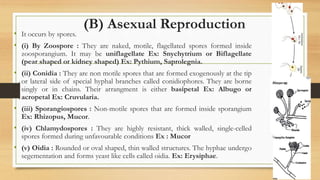
(B) Asexual Reproduction
• It occurs by spores.
• (i) By Zoospore : They are naked, motile, flagellated spores formed inside
zoosporangium. It may be uniflagellate Ex: Snychytrium or Biflagellate
(pear shaped or kidney shaped) Ex: Pythium, Saprolegnia.
• (ii) Conidia : They are non motile spores that are formed exogenously at the tip
or lateral side of special hyphal branches called conidiophores. They are borne
singly or in chains. Their arrangment is either basipetal Ex: Albugo or
acropetal Ex: Cruvularia.
• (iii) Sporangiospores : Non-motile spores that are formed inside sporangium
Ex: Rhizopus, Mucor.
• (iv) Chlamydospores : They are highly resistant, thick walled, single-celled
spores formed during unfavourable conditions Ex : Mucor
• (v) Oidia : Rounded or oval shaped, thin walled structures. The hyphae undergo
segementation and forms yeast like cells called oidia. Ex: Erysiphae.
Sexual Reproduction
• Sexual reproduction is by oospores, ascospores and basidiospores. The various spores are
produced in distinct structures called fruiting bodies.
• The sexual cycle involves the following three steps:
• (i) Fusion of protoplasms between two motile or non-motile gametes called plasmogamy.
• (ii) Fusion of two nuclei called karyogamy.
• (iii) Meiosis in zygote resulting in haploid spores.
• When a fungus reproduces sexually, two haploid hyphae of compatible mating types come
together and fuse. In some fungi the fusion of two haploid cells immediately results in diploid
cells (2n). However, in other fungi (ascomycetes and basidiomycetes), an intervening dikaryotic
stage (n + n, i.e., two nuclei per cell) occurs; such a condition is called a dikaryon and the phase is
called dikaryophase of fungus. Later, the parental nuclei fuse and the cells become diploid. The
fungi form fruiting bodies in which reduction division occurs, leading to formation of haploid
spores.
• Sexual Spores :
• They are formed during sexual reproduction. They are of following types.
• (i) Oospore : It is formed by the fertilization of the egg present in the oogonium Ex:
Albugo.
• (ii) Zygospore : It is thick walled spore formed by fusion of similar motile or non-motile
gametes
• Ex: Synchytrium or complete gametangia Ex: Mucor.
• (iii) Ascospores : Single celled haploid spores formed endogenosusly in sac like structure -
ascus, generally eight in number Ex: Members of Ascomycetes.
• (iv) Basidiospores : These are haploid spores formed exogenously on specieal cells or
basidium Ex: Members of Basidiomycetes.
• The morphology of the mycelium, mode of spore formation and fruiting bodies form
the basis for the division of the kingdom into four classes.
• (i) Phycomycetes
• (ii) Ascomycetes
• (iii) Basidiomycetes
• (iv) Deuteromycetes
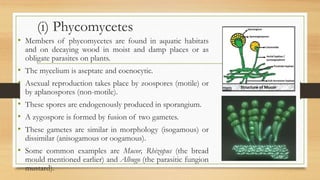
(i) Phycomycetes
• Members of phycomycetes are found in aquatic habitats
and on decaying wood in moist and damp places or as
obligate parasites on plants.
• The mycelium is aseptate and coenocytic.
• Asexual reproduction takes place by zoospores (motile) or
by aplanospores (non-motile).
• These spores are endogenously produced in sporangium.
• A zygospore is formed by fusion of two gametes.
• These gametes are similar in morphology (isogamous) or
dissimilar (anisogamous or oogamous).
• Some common examples are Mucor, Rhizopus (the bread
mould mentioned earlier) and Albugo (the parasitic fungion
mustard).
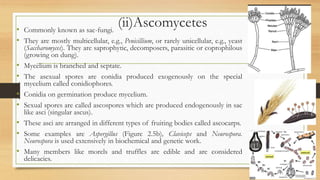
(ii)Ascomycetes• Commonly known as sac-fungi.
• They are mostly multicellular, e.g., Penicillium, or rarely unicellular, e.g., yeast
(Saccharomyces). They are saprophytic, decomposers, parasitic or coprophilous
(growing on dung).
• Mycelium is branched and septate.
• The asexual spores are conidia produced exogenously on the special
mycelium called conidiophores.
• Conidia on germination produce mycelium.
• Sexual spores are called ascospores which are produced endogenously in sac
like asci (singular ascus).
• These asci are arranged in different types of fruiting bodies called ascocarps.
• Some examples are Aspergillus (Figure 2.5b), Claviceps and Neurospora.
Neurospora is used extensively in biochemical and genetic work.
• Many members like morels and truffles are edible and are considered
delicacies.
Basidiomycetes
• Commonly known forms of basidiomycetes are mushrooms, bracket fungi or
puffballs.
• They grow in soil, on logs and tree stumps and in living plant bodies as
parasites, e.g., rusts and smuts.
• The mycelium is branched and septate.
• The asexual spores are generally not found, but vegetative reproduction by
fragmentation is common.
• The sex organs are absent, but plasmogamy is brought about by fusion of two
vegetative or somatic cells of different strains or genotypes.
• The resultant structure is dikaryotic which ultimately gives rise to basidium.
• Karyogamy and meiosis take place in the basidium producing four
basidiospores.
• The basidiospores are exogenously produced on the basidium (pl.: basidia).
• The basidia are arranged in fruiting bodies called basidiocarps.
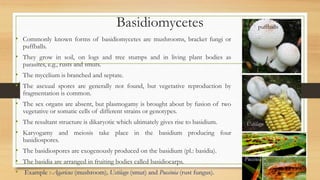
• Example :-Agaricus (mushroom), Ustilago (smut) and Puccinia (rust fungus).
puffballs
Ustilago
Puccinia
Deuteromycetes
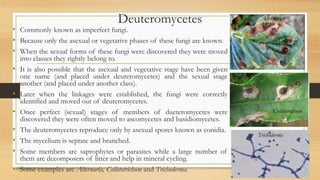
• Commonly known as imperfect fungi.
• Because only the asexual or vegetative phases of these fungi are known.
• When the sexual forms of these fungi were discovered they were moved
into classes they rightly belong to.
• It is also possible that the asexual and vegetative stage have been given
one name (and placed under deuteromycetes) and the sexual stage
another (and placed under another class).
• Later when the linkages were established, the fungi were correctly
identified and moved out of deuteromycetes.
• Once perfect (sexual) stages of members of dueteromycetes were
discovered they were often moved to ascomycetes and basidiomycetes.
• The deuteromycetes reproduce only by asexual spores known as conidia.
• The mycelium is septate and branched.
• Some members are saprophytes or parasites while a large number of
them are decomposers of litter and help in mineral cycling.
• Some examples are Alternaria, Colletotrichum and Trichoderma.
Alternaria
Colletotrichum
Trichoderma
KINGDOM PLANTAE
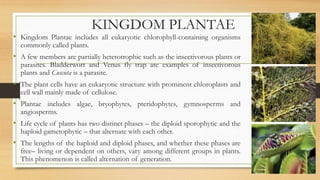
• Kingdom Plantae includes all eukaryotic chlorophyll-containing organisms
commonly called plants.
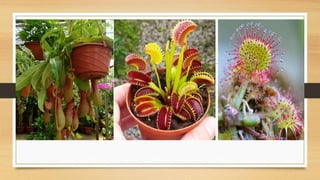
• A few members are partially heterotrophic such as the insectivorous plants or
parasites. Bladderwort and Venus fly trap are examples of insectivorous
plants and Cuscuta is a parasite.
• The plant cells have an eukaryotic structure with prominent chloroplasts and
cell wall mainly made of cellulose.
• Plantae includes algae, bryophytes, pteridophytes, gymnosperms and
angiosperms.
• Life cycle of plants has two distinct phases – the diploid sporophytic and the
haploid gametophytic – that alternate with each other.
• The lengths of the haploid and diploid phases, and whether these phases are
free– living or dependent on others, vary among different groups in plants.
This phenomenon is called alternation of generation.
KINGDOM ANIMALIA
• Heterotrophic, eukaryotic, multicellular.
• Cells lack cell walls.
• They directly or indirectly depend on plants for food.
• They digest their food in an internal cavity and store food reserves as glycogen or fat.
• Their mode of nutrition is holozoic – by ingestion of food.
• They follow a definite growth pattern and grow into adults that have a definite shape and
size.
• Higher forms show elaborate sensory and neuromotor mechanism.
• Most of them are capable of locomotion.
• The sexual reproduction is by copulation of male and female followed by embryological
development.
VIRUSES
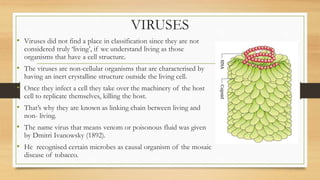
• Viruses did not find a place in classification since they are not
considered truly ‘living’, if we understand living as those
organisms that have a cell structure.
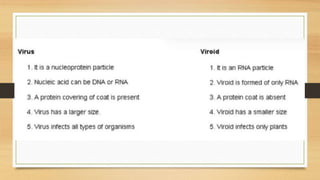
• The viruses are non-cellular organisms that are characterised by
having an inert crystalline structure outside the living cell.
• Once they infect a cell they take over the machinery of the host
cell to replicate themselves, killing the host.
• That’s why they are known as linking chain between living and
non- living.
• The name virus that means venom or poisonous fluid was given
by Dmitri Ivanowsky (1892).
• He recognised certain microbes as causal organism of the mosaic
disease of tobacco.
• M.W. Beijerinek (1898) demonstrated that the extract of the infected plants of tobacco
could cause infection in healthy plants and called the fluid as Contagium vivum fluidum
(infectious living fluid).
• W.M. Stanley (1935) showed that viruses could be crystallised and crystals consist
largely of proteins.
• Viruses are obligateparasites.
• They are inert outside their specific host cell.
• They are smaller than bacteria because they passed through bacteria-proof filters.
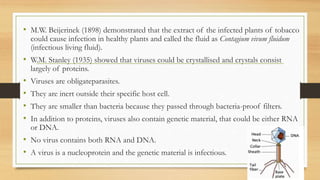
• In addition to proteins, viruses also contain genetic material, that could be either RNA
or DNA.
• No virus contains both RNA and DNA.
• A virus is a nucleoprotein and the genetic material is infectious.
• In general, viruses that infect plants have single stranded
RNA and viruses.
• Viruses that infect animals have either single or double
stranded RNA or double stranded DNA.
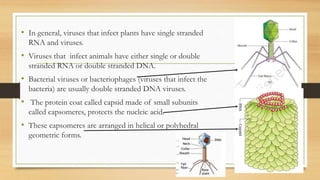
• Bacterial viruses or bacteriophages (viruses that infect the
bacteria) are usually double stranded DNA viruses.
• The protein coat called capsid made of small subunits
called capsomeres, protects the nucleic acid.
• These capsomeres are arranged in helical or polyhedral
geometric forms.
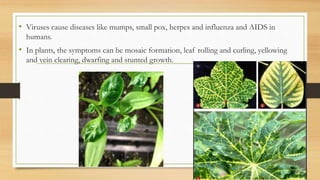
• Viruses cause diseases like mumps, small pox, herpes and influenza and AIDS in
humans.
• In plants, the symptoms can be mosaic formation, leaf rolling and curling, yellowing
and vein clearing, dwarfing and stunted growth.
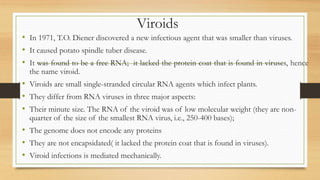
Viroids
• In 1971, T.O. Diener discovered a new infectious agent that was smaller than viruses.
• It caused potato spindle tuber disease.
• It was found to be a free RNA; it lacked the protein coat that is found in viruses, hence
the name viroid.
• Viroids are small single-stranded circular RNA agents which infect plants.
• They differ from RNA viruses in three major aspects:
• Their minute size. The RNA of the viroid was of low molecular weight (they are non-
quarter of the size of the smallest RNA virus, i.e., 250-400 bases);
• The genome does not encode any proteins
• They are not encapsidated( it lacked the protein coat that is found in viruses).
• Viroid infections is mediated mechanically.
Prions
• Prions are highly resistant glycoprotein particles which function as infectious agents.
• They are formed due to mutation in gene PRNP.
• They consisting of abnormally folded protein.
• Common disease caused by them are scrapie of sheep,
• bovine spongiform encephalopathy (BSE) also known as mad cow disease,
• Cruetzfeldt-Jakob disease (Cr–Jacob disease -CJD) in humans and kuru.
• It causes certain infectious neurological diseases
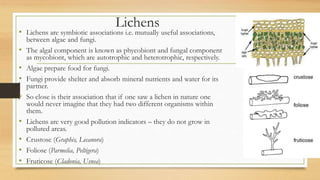
Lichens
• Lichens are symbiotic associations i.e. mutually useful associations,
between algae and fungi.
• The algal component is known as phycobiont and fungal component
as mycobiont, which are autotrophic and heterotrophic, respectively.
• Algae prepare food for fungi.
• Fungi provide shelter and absorb mineral nutrients and water for its
partner.
• So close is their association that if one saw a lichen in nature one
would never imagine that they had two different organisms within
them.
• Lichens are very good pollution indicators – they do not grow in
polluted areas.
• Crustose (Graphis, Lecanora)
• Foliose (Parmelia, Peltigera)
• Fruticose (Cladonia, Usnea)
THANK
YOU

Chapter 2 biological classification main

  • 1.
  • 2.
    Introduction • Taxonomy :It is branch of science that deals with identification, nomenclature and classification of living beings. The term Taxonomy used by A.P. de Candolle. • Systematics : It is the study of diversity and differentiation of organisms based on their phenotypic, genetic and phylogenetic relationships. The term systematics coined by Carolus Linnaeus. The latter is known as ‘Father of Taxonomy’. • Classification : Organisms are divided into different groups on the basis of their similiarities & dissimiliarities that is called classification.
  • 3.
    Taxonomy • Turril usedthe term -Taxonomy. • Turril (1938) divided taxonomy into three types. • (i) Alpha taxonomy : Gross morphology, compilation of flora and monographs are used for the collection and identification of organisms. • (ii) Beta taxonomy : It is based on morphology and evidences from genetics, cytology, anatomy, physiology etc. • (iii) Omega taxonomy : It involves study of all microscopic and biochemical evidences along with evolutionary relationship of organisms.
  • 4.
    Systematics • Systematics isof two parts. • (i) Classical Systematics : Only Morphological characters are used to classify organisms. It is also called taxonomy. • (ii) New systematics or biosytematics : New systematics used phylogenetic classification that is based on evolutionary relationships or lineages of organisms. It is called Cladistics. • It involves study of all types of characters from morphology, physiology, cytology, ecology, genetics, biochemistry.
  • 5.
    Branches Of Systematics •(a) Cytotaxonomy : It is based on cytological information of cell. Karyotaxonomy is used to develop taxonomic interrelations based on the study of chromosome number, chromosome structure and chromosome behaviour during meiosis. • (b) Numerical Taxonomy (Phenetics or Taximetrics) or Adansonian Taxonomy : It is based on the analysis of various types of taxonomic data by mathematical or computerised methods. In this branch, statistical methods based on as many morphological characters as possible are used for evaluating similarities and differences between species. It was developed by Adanson. • (c) Chemotaxonomy or Biochemical taxonomy : It is based on the study of biomolecules particularly secondary metabolites of the cell like betacyanin pigment in beet roots, raphides and cystolith crystals, sequencing of DNA and chemical nature of proteins. • (d) Experimental Taxonomy : It is based on study of experimental determination of the genetic interrelationship, identification of evolutionary units within a species.
  • 6.
    Systems of BiologicalClassification • Initially, habit or morphological features were used as basis of classification. • Later on organisms classified by scientists on the basis of their natural affinities. • After Darwin’s work, they classified on the basis of evolutionary tendencies or phylogeny. • Three types of systems of classification have been recognized. • (I) Artificial systems of classification • (II) Natural systems of Classification • (III) Phylogenetic Systems of Classification
  • 7.
    (I) Artificial systemsof classification • It was based on few morphologicial characters for grouping of organisms. • Theophrastus firstly proposed artificial system of classification. • On the basis of habit, He classified 480 plants into four groups herbs, undershrubs, shrub and trees. That’s why he was known as Father of Botany. • Aristotle (Father of Zoology) classified animals into two groups – • (a)Anaima (Invertebrates with no red blood) and • (b)Enaima(vertebrates with red blood). Enaima further classified into (1) ovipara (Lays eggs) (2) vivipara. (Gives birth of animal)
  • 8.
    (I) Artificial systemsof classification • Carolus Linnaeus (1707-1778, father of taxonomy) proposed an artificial system of classification (Also called sexual system of classification) on the basis of few sexual characters like number of stamens, and carpel in his book Genera Plantarum. • He classified plants into 24 classes. Out of them, 23 were of phanerogams ( flowering plants) and 24th class was of cryptogams(without flower). (1) Monandria, (2) Diandria, (3) Triandria, (4) Tetrandria, (5) Pentandria, (6) Hexandria, (7) Heptandria, (8) Octandria, (9) Enneandria, (10) Decandria, (11) Dodecandria, (12) Icosandria,(13) Polyandria, (14) Didynamia, (15) Tetradynamia, (16) Monadelphia,(17) Diadelphia, (18) Polyadelphia, (19) Syngenesia, (20) Gynandria, (21) Monoecia, (22) Dioecia, (23) Polygamia (24) Cryptogamia. • Drawbacks : • (i) Natural or phylogenetic relationships were not followed. • (ii) Only few characters, used in this system therefore, diverse animals & plants were placed into limited number of groups.
  • 9.
    (II) Natural systemsof Classification • This system is based on natural affinities among organisms. • These systems used as many taxonomic characters as possible to group organisms. • In these systems organisms are classified on the basis of mainly morphological, reproductive, anatomical. • John Ray, first to propose a natural system of classification. • These were also proposed by Jussiaeu, de Candolle and Bentham & Hooker.
  • 10.
    Bentham and Hooker’sClassification • George Bentham and JD Hooker (1862–83) proposed a natural system of classification of angiosperms that was published in ‘Genera Plantarum’ in 3 volumes. • It is based on A.P. de Candolle’s system. • They described 97205 species of seed plants and classified them into 7569 genera and 202 families. • They classified plant kingdom into two subkingdoms–Cryptogamia and Phanerogamia. • The phanerogamia classified in to three classes–Dicotyledons, Gymnosperms and Monocotyledons.
  • 12.
    Bentham and Hooker’sClassification Merits : • (i) It is practically important, most of the herbaria of the world are based on this system. • (ii) They placed Ranales (most primitive) in the beginning of classification that is phylogenetically true. • (iii) They placed monocots after dicots that is similar to phylogentic systems. Demerits : • (i) They did not use phylogenetic trends in their classification. • (ii) Gymnosperms placed between dicots and monocots that is not acceptable. • (iii) Subclass monochlamydeae is an artificial group. • (iv) Cucurbitaceae has fused petals but it was placed in polypetalae. • (v) Advanced family Orchidaceae have been shown as primitive group.
  • 13.
    (III) Phylogenetic Systemsof Classification • Evolutionary history of the organism is called Phylogeny (this term coined the by Lamarck). • These systems are based on Phylogenetic relationships of organisms. • Phylogenetic systems are also called Cladistics and the graphic representation of evolutionary relationships is called family tree or Cladogram. • Eichler and Endlicher firstly proposed a phylogenetic classification system. • Engler and Prantl published his classification in their book “Die Naturlichen Pflanzenfamilien” in 23 volumes. • Later on well developed phylogenetic systems of classification were created by Hutchinson, Tippo, • Takhtajan and Cronquist.
  • 14.
    KINGDOMS OF LIFE •1. Two kingdom system–Plant and animal • 2. Three kingdom system- Protista, Plantae, Animalia. • 3. Four kingdom system - Monera, Protista, Plantae (metaphyta) and Animalia (metazoa). • 4. Five kingdom system- Monera – Protista – Fungi – Plantae – Animalia. • 5. Six Kingdom System- Archaebacteria- Eubacteria- Protista – Fungi – Plantae – Animalia. • 6. Domain System - Archaea, Bacteria and Eukarya
  • 15.
    1. Two kingdomsystem • Linnaeus classified all organisms into two kingdoms – Kingdom plantae and kingdom Animalia. • Kingdom plantae involves autotrophic, fixed organisms while kingdom Animalia includes motile heterotrophic organisms. Microorganisms involved in both the kingdoms. • Bacteria, blue green algae, fungi, mosses, ferns, gymnosperms and the angiosperms under ‘Plants’.
  • 16.
    Drawbacks of Twokingdom system • (i) Unicellular and multicellular forms have been placed in both the kingdoms though they have different organisation. • (ii) Bacteria, cyanobacteria, Fungi, Mosses, Ferns, Gymnosperms and the Angiosperms are included under plants but Bacteria and cyanobacteria are prokaryotes. • (iii) Viruses are neither plants nor animals and placed at the border line of living and non living. • (iv) Tunicates are chordate animals that have cellulose, branching pattern as plant. • (v) Fungi of kingdom plantae are nonphotosynthetic, have chitin cell wall and glycogen as reserve food. Thus two kingdom system of classifiaction is inappropriate and inadequate.
  • 17.
    2. Three kingdomsystem • Ernst Haeckel proposed it. He separated all one celled eukaryotes into separate kingdom protista. • These three kingdoms are (a)Protista, (b)Plantae, ©Animalia. • Kingdom protista includes algae, slime moulds, Protozoans, Fungi, bacteria. Drawbacks : • (i) Bacteria and fungi are placed with algae and protozoan. • (ii) in this kingdom, Acellular and multicellular organisms were kept together.
  • 18.
    3. Four kingdomsystem • It was proposed by Copeland (1956). He established a new kingdom Monera for all acellular prokaryotes containing incipient nucleus like bacteria, blue green algae. • The four kingdoms are monera, protista, plantae (metaphyta) and animalia (metazoa). • Drawbacks : • (i) Protozoans, red and brown algae and fungi were placed in protista that is not acceptable.
  • 19.
    4. Five kingdomsystem • It was proposed by Whittaker (1969). It is a phylogenetic system that is based on following criteria. • (i) Complexity of cell structure : Prokaryotes and eukaryotes. • (ii) Complexity of organisms : i.e., thallus organisation (unicellular or multicellular organisms). • (iii) Mode of nutrition : Autotrophic (holophytic) or heterotrophic [absorptive parasitic or saprozoic ingestive (holozoic)]. It is major criteria of classification in this system. • (iv) Ecological role of organism. • (v) Phylogenetic relationship. • The five kingdoms are Monera – Protista – Fungi – Plantae – Animalia.
  • 22.
    Five kingdom system Merits: • (i) Fungi are separated from plants or protista and established as kingdom. • (ii) Prokaryotes and eukaryotes are separately recognised in this system. Demerits : • (i) The position of Viruses is not clear. • (ii) Algae is placed into monera, protista and Plantae. • (iii) Protista is an artificial group.
  • 23.
    5. Six KingdomSystem • On the basis of gene sequences, six kingdom system proposed by Gray and Doolittle (1982).
  • 24.
    6. Domain System •On the basis of genetic characters particularly genetic analysis of 16S rRNA, Carl woese proposed three domains system–Archaea, Bacteria and Eukarya.
  • 25.
    KINGDOM MONERA • Copeland(1956) established kingdom monera in which all prokaryotes were included. • General Characters : • (i) It involves unicellular / conlonial / multicellular with prokaryotic organisms. • Ex: Archaebacteria, Bacteria, Actinomycetes, Mycoplasma, Rickettsiae, Spirochaetes, Chlamydiae, Cyanobacteria. • (ii) Cell wall bears peptidoglycan except archaebacteria and mycoplasma. • (iii) Genetic material is naked DNA (Histone is absent) that is called nucleoid or Prochromosome or genophore. nuclear envelope, nucleoplasm, nucleolus and chromatin are absent. • (iv) All membrane bound organelles are absent thus they bear one envelope system.
  • 26.
    • (v) IfPhotosynthetic pigments present, they are distributed in thylakoid membranes or chromatophores. • (vi) 70 S type of Ribosomes are present. • (vii) Respiratory enzymes are associated with plasma membrane. • (viii) Nutrition is autotrophic/heterotrophic. • (ix) Reproduction takes place by asexual methods only. • (x) Mitosis, meiosis, sexual reproduction are absent. KINGDOM MONERA General Characters
  • 27.
    KINGDOM MONERA (I) Archaebacteria(II) Eubacteria (i) Methanogens (ii) Halophiles (iii)Thermoacidophiles Ex: Methanobacterium Halococcus Thermoplasma (i) Coccus (ii) Bacillus (iii) Spiral (iv) Vibrio (III) Blue Green Algae (IV) Mycoplasma (PPLO)
  • 28.
    (I) Archaebacteria • Archaebacteriaare most primitive form of life that are found in most extreme environmental conditions like high salt concentration, high temperature etc. These are oldest of the ‘living fossils’. • They show following features. • (i) The cell wall of archaebacteria is composed of noncellulosic polysaccharides or/pseudomurein /or glycoproteins / proteins. Peptidoglycan and muramic acid are absent in cell wall. • (ii) Plasma membrane has long chain branched lipids (phytanols). The latter decrease membrane fluidity and help to increase tolerance against extremes of heat, low pH. • (iii) 16 s rRNA is present.
  • 29.
    Types of Archaebacteria •These are of three types • (i) Methanogens (ii) Halophiles (iii) Thermoacidophiles • (i) Methanogens : • They are Gram negative, obligate anaerobes found in marshy habitats, swamps, ruminants, sewage treatment plants. • Cell wall of these bacteria possesses protein (Ex: Methanogenium) or nonecellulosic polysaccharides • (Ex: Methanosarcina) or Pseudomurein (Ex: Methanobacterium). It contains N- acetly talosaminuronic acids instead of NAM. • They form methane in biogas plant.
  • 30.
    • (ii) Halophiles: • They are Gram negative, facultative anaerobes, found in salt lakes, dead sea, industrial plants that form salt by solar evaporation of sea water and salted proteinaceous materials like salted fish, salted hides. • They require17–23% NaCl for better growth. • They have reddish pigment bacteriorhodopsin in their membrane to trap sun light and form ATP directly. but ATP donot use for the synthesis of food. • They survive in salty water due to presence of branched chain lipids in their cell mambrane, absence of sap vacuoles, maintenance of high osmotic concentration. • Ex: Halobacterium, Halococcus.
  • 31.
    • (iii) Thermoacidophiles: • They are Gram negative, facultative anaerobe, found in hot water springs at temperature as high as 80ºC • and pH as low as 2. They tolerate high temperature due to homopolar bonds in their proteins. They • oxidize sulphur to H2SO4 under aerobic conditions and pH 2. This acid makes medium acidic. Sulphur is • reduced to H2S in anaerobic conditions. Ex: Thermoplasma, Sulfolobus.
  • 32.
    (II) Eubacteria • Bacteriaare smallest, microscopic, unicellular, most primitive prokaryotic microorganisms. • Bacteria were first discovered by Anton van Leeuwanhoek in 1676 in stored rain water and in scum (tartar) scrapped from teeth & used the term ‘little animalcules’ for them. • Ehrenberg (1838) coined the term bacteria. • Louis pasteur (father of modern microbiology) worked on fermentation and reported that it takes place by bacteria. • He used the term microorganism. • He discovered antirabies vaccine and bacteria causing chicken cholera.
  • 33.
    (II) Eubacteria• Habitat: • They show cosmopolitan distribution. They are found in everywhere-air, water, soil and in plants and animals. • Size : • The average size of length is 0.5-10 mm and width 0.5–2 mm. • Epulopscium fishelsoni found in intestine of brown surgeon fish is 600 mm in length and 80mm in width. • Thiormargarita namibiensis (750mm length) are among the largest of unicellular bacteria • Beggiatoa mirabilis (filmentous form) is the largest bacterium – 16-45 mm diameter and length is several milimeters. • Smallest bacterium is Dialister pneumonsintes (0.15 – 0.3mm long) present in nasal chamber of humancausing cold.
  • 34.
    • Shape : •On the basis of shape, Cohn (1972) recognised 4 basic forms of Eubacteria. • (i) Coccus (Pl. Cocci) : These are always nomotile / nonflagellated. Spherical or oval shaped. • (1) Monococcus : Occurs singly Ex: Micrococcus roseus, M. luteus. • (2) Diplococci : Present in pairs Ex: Diplococcus pneumoniae. • (3) Streptococci : Occur in chains Ex: Streptococcus lactis. • (4) Staphylococci : They occur in grape like irregular clusters/bunches Ex : Staphyloccus aureus. • (5) Sarcinae : They are divided in three planes and form cubical packet of 8–64 cocci Ex : Sarcinae lutea.
  • 35.
    • (ii) Bacillus(Pl. Bacilli) : Rod shaped/cigarette shaped with blunt ends and motile/nonmotile. It is most common shape. • (1) Monobacillus : Occurs singly. • (2) Diplobacilli : Occur in pair. • (3) Streptobacilli : Occur in chains. • (iii) Spiral : They are elongated, spiral shaped, flagellated and cork screw like. A spirillum contains one or more turns 10–50 m length. Ex: Spirillum volutans.
  • 36.
    • (iv) Vibrio: • It is look like sign of comma ( , ) and slightly curved rod of less than half turn Ex: Vibrio cholerae. • Other shapes of bacteria are as follow • (i) Pleomorphic : Bacterium is found in more than one form Ex: Azotobacter, Rhizobium. • (ii) Stalked bacterium : Bacterium has a stalk Ex: Caulobacter. • (iii) Budded bacteria : Its body is swollen at places Ex: Rhodomicrobium. • (iv) Mycelial bacteria : They bear aseptate branched filamentous body like a fungal mycelium • Ex: Beggiatoa, Actinomycetes.
  • 37.
    • Flagellation : •On the basis of presence or absence of flagella, bacteria are classified into following forms. • (a) Atrichous : Flagella is absent. Ex: Pasteurella. • (b) Monotrichous : Single flagellum is found near one end of bacterium Ex: Vibrio, Thiobacillus. • (c) Cephalotrichous : A group or tuft of flagella occurs at one end. Ex: Pseudomonas fluorescens. • (d) Amphitrichous : A Flagellum at each of the two ends. Ex: Nitrosomonas. • (e) Lophotrichous : A tuft or group of flagella ocurs at each of the two ends. Ex: Spirillum volutans. • (f) Peritrichous Number of flagella are uniformly distributed all over the surface. Ex: Clostridium tetani, E.coli.
  • 38.
    Gram Staining Technique •Hans Christian Gram (1884) developed this technique to stain bacteria. • In this technique, Bacteria are firstly stained by weak alkaline solution of crystal violet (Gram stain)resulting the former up blue colour. • Now they are treated with 0.5% iodine solution and washed with water. • Then absolute alcohol or acetone. • Bacteria that retain blue or purple colour are called Gram +ve bacteria • Ex: Bacillus subtilis. • Bacteria that become colourless are called Gram–ve bacteria. Ex: E.coli. • This difference due to differentiation in the lipid contents and thickness of cell wall in these bacteria.
  • 40.
  • 41.
    Structure of Bacteria •A) Cell Envelope : It consists of three layers–outer glycocalyx, middle cell wall and innermost cell membrane. • (1) Glycocalyx : It consists of only polysaccharides and protects cell from loss of water, nutrients and viral attack. • It is found either as loose gelatinous thin sheath (loose slime layer) or as persistent layer around cell wall. Ex: Bacillus anthracis, Diplococcus pneumoniae. • The latter also have D-glutamic acid alongwith polysaccharides in cell wall resulting thick slime layer is formed called capsule which provides protection against phagocytosis and antibiotics.
  • 42.
    • (2) Cellwall : • It is thick, rigid and forms 10–40% part of bacteria. • The cell wall of Gram positive bacteria is single layered and composed of peptidogylcan or murein or mucopeptide. • The glycan part forms backbone of cell wall and composed of alternating units of two amino sugars NAG (N-acetyl glucosamine) and NAM (N-acetyl muramic acid) that are linked with , 1-4 glycosidic bonds. • Four amino acids form short peptide chain that is attached to NAM only. • Gram +ve bacteria have teichoic acids (these are acid polymers containing glucose, phosphate and alcohol) that act as receptor sites and surface antigens. They also attract chemicals which provide protection from pH and thermal changes. • Gram–ve bacteria possess double layered cell wall. Inner layer of these bacteria is composed of peptidoglycan while outer layer contains lipopolysaccharides, proteins and phospholipids. Lipids having antigenic properties. • Porins are found as channels in the outer layer of Gram–ve bacteria. the former take part in entry and exit of hydrophilic low molecular weight substances. • Periplasmic space is found between plasma membrane and cell wall.
  • 43.
    • (3) Cellmembrane : • It is selective permeable, consists of lipoporotein (20–30% phospholipids and 60–70% proteins) and some oligosaccharides. • Sterols like cholesterol are absent in bacterial cell membrane but in some bacteria pentacyclic sterol like molecules are found to stabilise bacterial cell membrane. these are called hopanoids. • Plasma membrane has respiratory enzymes and electron transport chain to generate ATP.
  • 44.
    (B) Cytoplasm andCytoplasmic Inclusion Bodies : • Cytoplasm is complex, colloidal fluid containing ribosomes, enzymes, tRNA, inorganic, organic matter. • Cyclosis(streaming movement of cytoplasm) , sap vacuoles and all membrane bound organelle are absent. • (1) Ribosomes : • Ribosomes are of 70 S type. Its size is150 ×200 Aº. They are found either singly or in small groups of 4–6 ribosomes with mRNA to form polysomes or polyribosomes. • (2) Mesosome or chondrioid : • It is infoldings of plasma membrane found in particularly gram +ve bacteria. They are of two types • (i) Central mesosome (ii) Peripheral mesosome • (i) Central mesosome : It holds the nucleoid and helps in the separation of nucleoid and septa formation. • (ii) Peripheral mesosome: It helps in the storage of certain respiratory enzymes like succinic dehydrogenase, cytochrome oxidase.
  • 45.
    • (3) Flagella: • These are long filamentous structures that are found in spiral forms, some bacilli but absent in cocci. • The length of each flagellum is 4–5m while diameter is 15–20 nm. • Bacterial flagellum is single stranded (it does not show 9 + 2 fibrillar organisation) & composed of flagellin protein only. • Structurally, each flagellum consists of three parts – basal body, hook and shaft or filament.
  • 46.
    • (4) Piliand Fimbriae : • Pili are found in Gram–ve bacteria as hair like hollow, nonhellical, short projections on the surface of cell, few in number & composed of pilin protein. Pili are genetically determined by F factor in plasmid. • Pili are helpful in the transfer of DNA from donor to recipient bacterium during conjugation by the formation of conjugation canal between these two. The former is called sex pili. • Fimbriae are short thin (0.1–1.5m in length and 4–8 nm in diameter) more in number (300– 400 per cell) and function as organ of adhesion. • (5) Chromatophores : • In some bacteria like purple bacteria, green sulphur bacteria, Photosynthetic pigments (Bacteriochlorophyll and bacterioviridin and carotenoids) are found in chromatophores or thylakoids (lamellae). Ex: Rhodospirillum, Rhodopseudomonas.
  • 47.
    • (6) Nucleoid: • True nucleus with nuclear envelope, nucleolus, and histone basic protein is absent. • DNA is naked, double stranded, circular. • Bacterial genome is haploid. It does not follow Chargaff’s rule. • (7) Plasmids : • Plasmid (discovered by Lederberg and Hayes) is extrachromosomal, self replicating double stranded, circular DNA. plasmids are also called minichromosomes due to carrying few (5–100) genes. • They exist either independently or attached with bacterial nucleoid called episome. • (8) Inclusion bodies (storage granules) : • (i) Gas Vacuoles : It provides buoyancy to the bacteria. These are organic inclusion bodies found in green and purple sulphur photosynthetic bacteria, and some cyanobacteria. • (ii) Volutin Granules (polymetaphosphate granules or metachromatin) : Inorganic inclusion bodies, store reserve phosphate alongwith protein, lipids and RNA. • (iii) Sulphur granules : Ex: purple sulphur bacteria and nonphotosynthetic bacteria like Beggiatoa, Thiothrix.
  • 48.
  • 49.
    Reproduction • (i) ByBinary Fission : • It takes place during favourable conditions. The transverse binary fission is quite common in which nucleoid divides amitotically without spindle formation. Replication of DNA is bidirectional in entire genome resulting two circular (theta) shaped chromosomes are formed (Theta model of replication of cairns 1963). • (ii) By endospore : • It takes place in adverse conditions. Endospore is thick walled highly refractile resistant spore and surrounded by four layers.
  • 50.
    • (iii) GeneticRecombination / Parasexuality : • True sexual repoduction is absent. Genetic recombination takes place without formation of gametes, their fusion and meiosis that is called parasexuality. • The former occurs by three methods. • (1) Transformation:-A piece of DNA of donor cell is obtained by living mature recipient cell in the surrounding medium after death/ decay of the donor cell without involving any vector. • (2) Transduction:-It is a transfer of DNA / genes from donor bacterium to recipient by bacteriophages. • (3) Conjugation
  • 51.
    Economic importance ofbacteria • (1) Saprophytic bacteria : These are major decomposers or mineralizers of earth for regulating biogeochemical cycles. • (2) Ammonifying bacteria : They convert nitrogeneous compounds / proteins of dead plants and animals or their excretory products into ammonia Ex: Bacillus ramosus, • (4) Symbiotic nitrogen fixers : • Ex: Rhizobium in root nodules of leguminous plants; Frankia in root nodules of Casuarina, Alnus; Nostoc in Trifolium alexandrium; Xanthomonas in leaf of Ardisia and Pavatta.
  • 52.
    • (5) Foodpoisoning : It occurs due to toxins produced by some bacteria (Ex: Clostridium botulinum, Streptococcus) in food. The eating of such toxic food may cause even death. • (6) Spoilage of food • (7) Denitrification : Some bacteria convert nitrates and ammonia into nitrogen Ex: Thiobacillus denitrificans, Pseudomonas denitrificans. • (8) Diseases :
  • 53.
    (III) Blue GreenAlgae (Cyanobacteria) • They are aerobic photoautotrophic, nitrogen fixing Gram negative prokaryotes included into separate class Cyanophyceae or Myxophyceae. • They occured in precambrian period around 3.2 billion years ago. • They can be unicellular –Ex: chlorela • colonial–Ex: Gloeocapsa, Microcystis • filamentous – Ex: Anabaena, Nostoc, Oscillatoria. • Each BGA cell is covered by a gelatinous sheath therefore called Myxophyceae.
  • 54.
    • Definite nucleusand definite plastid with grana are absent. Motile forms, mesosome, chlorophyll b, meiosis, and all membrane bounded organelle are absent. • BGA is able to fix atmospheric nitrogen in to ammonium compounds. for this purspose some of their cells become pale yellow and thick walled structure called heterocysts. • The heterocysts has nitrogenase enzyme that performs nitrogen fixation in anaerobic conditions Ex: Anabaena, Nostoc, Aulosira. • They were first to oxygenic photosynthesis to evolve O2 in photosynthesis • Sexual reproduction is absent in BGA but gene recombination occurs by conjugation, transformation, and transduction. • The most common method of reproduction is by binary fission in unicellular forms.
  • 55.
    (IV) Mycoplasma (PPLO) •Nocard and Roux (1898) discovered PPLO (Pleuropneumonia like organisms). • They are Gram–ve, smallest (0.1–0.3 m in size–Ex: Mycoplasma gallisepticum), unicellular, aerobic, heterotrophic, walls less prokayotes and pleomorpic organisms. • They can change their shape hence called jokers of the plant kingdom or mollicutes. • They can pass through bacteria proof filters. Cell membrane is trilaminar, highly flexible and composed of lipoprotein. • DNA is linear note circular, but coiled and double stranded. • 70 S type of ribosomes, RNA, protein, fat particles are found in cytoplasm. • They perform reproduction by binary fission and elementary bodies. • In culture medium their colonies shows fried egg appearance. • They are either saprophytic or cause diseases in plants and animals.
  • 58.
    KINGDOM PROTISTA • ErnstHeackel coined the term protista. General Characters : • (i) They are unicellular or colonial, eukaryotic organisms mostly found in aquatic habitat. • (ii) They bear well defined nucleus. Protists can be uninucleate, binucleate or multinucleate. • (iii) Locomotion takes place by flagella or cilia, pseudopodia, contractions and mucilage extrusion. • (iv) Cyclosis or cytoplasmic streaming is found in cytoplasm. • (v) Cell wall, if present, contains cellulose.
  • 59.
    KINGDOM PROTISTA • (vi)Mode of nutrition is of various types – Holophytic (Photosynthetic), ingestive (=Holozoic), absorp tive (parasitic, saprobic). • (vii) 80% of the photosynthesis on earth is performed by photosynthetic protists. • (viii) Reserve food is starch, glycogen, paramylon, chrsolaminarin and fat. • (ix) Flagella and cilia, when present, have 9 + 2 pattern of microtubular strands. • (x) The common mode of reproduction is Asexual reproduction. The latter occurs through binary fission, budding, plasmotomy, sporulation, cyst formation etc. • (xi) Sexual reproduction involves meiosis and karyogamy. Meiosis is zygotic in some forms and gametic in others. • (xii) Some forms are parasitic, some are found symbiotically in the gut of animals and few are decomposers. General Characters
  • 60.
    Types of Protista (1)Diatoms (2) Dinoflagellates (3) Euglenoids
  • 61.
    (1) Chrysophytes (Diatoms) •These are commonly called Jewels of plants world. • 200 genera and more than 6000 species of Diatom have been reported. • (i) Diatoms are found in all aquatic (including ocean, brakish and fresh water) and moist terrestrial habitats. • (ii) Diatoms are Golden brown photosynthetic protists. Most of the diatoms are phytoplanktons. • (iii) The body is covered by a transparent siliceous shell (silica deposited in cellulosic cell wall) called frustule. • (IV) The frustule is composed of two halves upper larger older half or epitheca and a lower • smaller younger half or hypotheca. Both halves fit together like two parts of a soap box or pair of petridishes.
  • 62.
    • This groupincludes diatoms and golden algae (desmids). • They are found in fresh water as well as in marine environments. • They are microscopic and float passively in water currents (plankton). • Most of them are photosynthetic. • In diatoms the cell walls form two thin overlapping shells, which fit together as in a soap box. • The walls are embedded with silica and thus the walls are indestructible. • Thus, diatoms have left behind large amount of cell wall deposits in their habitat; this accumulation over billions of years is referred to as ‘diatomaceous earth’. • Being gritty this soil is used in polishing, filtration of oils and syrups. Diatoms are the chief ‘producers’ in the oceans.
  • 63.
    Dinoflagellates • These organismsare mostly marine and photosynthetic. • They appear yellow, green, brown, blue or red depending on the main pigments present in their cells. • The cell wall has stiff cellulose plates on the outer surface. • Most of them have two flagella; one lies longitudinally and the other transversely in a furrow between the wall plates. • Very often, red dinoflagellates (Example: Gonyaulax) undergo such rapid multiplication that they make the sea appear red (red tides). Toxins released by such large numbers may even kill other marine animals such as fishes. • Noctiluca (Night light) : It shows features of both dinoflagellate and protozoans.
  • 64.
    Euglenoids • Majority ofthem are fresh water organisms found in stagnant water. • Instead of a cell wall, they have a protein rich layer called pellicle which makes their body flexible. • They have two flagella, a short and a long one. • Though they are photosynthetic in the presence of sunlight, when deprived of sunlight they behave like heterotrophs by predating on other smaller organisms. • Interestingly, the pigments of euglenoids are identical to those present in higher plants. Example: Euglena • On the basis of nutrition they are mixotrophic. Ex: Euglena, They show both holophytic andholozoic nutrition. • Euglena is considered as connecting link between Plant kingdom & Animal kingdom because it shows features of both plants and animals.
  • 65.
    Slime Moulds • Thebody moves along decaying twigs and leaves engulfing organic material. • (i) Cell wall is absent around somatic cell but it is formed during reproduction. During unfavourable conditions, the plasmodium differentiates and forms fruiting bodies bearing spores at their tips. The spores possess true walls. The spores are dispersed by air currents. • (ii) The protoplasts are covered by plasmalemma. Under suitable conditions, they form an aggregation called plasmodium which may grow and spread over several feet. • (iii) Chloroplasts absent. They show phagotrophic nutrition. Slime moulds are saprophytic protists. • (iv) The reserve food is Glycogen and oil. • (v) Reproduction takes place through both asexual and sexual methods. • (VI) They are extremely resistant and survive for many years, even under adverse conditions.
  • 66.
    Protozoans • All protozoansare heterotrophs and live as predators or parasites. • They are believed to be primitive relatives of animals. • There are four major groups of protozoans. • Amoeboid protozoans • Flagellated protozoans • Ciliated protozoans • Sporozoans
  • 67.
    Amoeboid protozoans • Theseorganisms live in fresh water, sea water or moist soil. • They move and capture their prey by putting out pseudopodia (false feet) as in Amoeba. • Marine forms have silica shells on their surface. • Some of them such as Entamoeba are parasites.
  • 68.
    Flagellated protozoans • Themembers of this group are either free-living or parasitic. • They have flagella. • The parasitic forms cause diaseases such as sleeping sickness. • Example: Trypanosoma.
  • 69.
    Ciliated protozoans • Theseare aquatic, actively moving organisms because of the presence of thousands of cilia. • They have a cavity (gullet) that opens to the outside of the cell surface. • The coordinated movement of rows of cilia causes the water laden with food to be steered into the gullet. • Example: Paramoecium
  • 70.
    Sporozoans • This includesdiverse organisms that have an infectious spore-like stage in their life cycle. • The most notorious is Plasmodium (malarial parasite) which causes malaria, a disease which has a staggering effect on human population.
  • 71.
    • Fungi areeukaryotic, achlorophyllous, heterotrophic, non vascular, non flowering, gametophytic, haploid (n), multicellular organisms. • The study of fungi is called Mycology. • Pier Antonio micheli is called ‘Father of Mycology.’ • E.J. Butler is known as ‘Father of Inidan Mycology’. • R.H. Whittaker (1969) established it as kingdom Fungi.
  • 72.
    KINGDOM FUNGI • Thefungi constitute a unique kingdom of heterotrophic organisms. • They show a great diversity in morphology and habitat. • You must have seen fungi on a moist bread and rotten fruits. • The common mushroom you eat and toadstools are also fungi. • White spots seen on mustard leaves are due to a parasitic fungus. • Some unicellular fungi, e.g., yeast are used to make bread and beer. • Other fungi cause diseases in plants and animals; wheat rust-causing Puccinia is an important example. • Some are the source of antibiotics, e.g., Penicillium. • Fungi are cosmopolitan and occur in air, water, soil and on animals and plants. • They prefer to grow in warm and humid places.
  • 73.
    • HABITAT:- Theseare found in all habitat like soil, water, air, mouth, skin, hair, eye, on decaying matter etc. and the distribution is cosmopolitan (ubiquitous). Most of the fungi are terrestrial and found in soil, some are aquatic, parasitic or saporophytic or symobiont. • THALLUS :- The main body is thallus that is called mycelium which is composed of interwoven mass of thread like hyphae except some forms. hyphae are branched aseptate or septate. • (i) Coenocytic mycelium : It is aseptate and multinucleated Ex : Albugo, Rhizopus. • (ii) Primary mycelium : It is septate and uninucleate Ex : Ascomycetes. • (iii) Secondary mycelium : These are also septate but binucleate (Dikaryotic) Ex : Ustilago. • CELL WALL:- Cell wall is composed of chitin or fungal cellulose that is nitrogen containing polyhsaccharide and heteropolymer of NAG (N-acetyl glucosamine). In oomycetes, cell wall is composed of cellulose. Ex: Phytopthora.
  • 74.
    • NUTRITION:- Fungishow heterotrophic & absorptive nutrition on the basis of mode of nutrition they can be grouped into following types. • (i) parasites depend on living plants and animals • (ii) Saprophytes absorb soluble organic matter from dead substrates. • (iii) Symbionts(1) in association with algae as lichens, (2) with roots of higher plants as mycorrhiza. • Reproduction : • (A) Vegetative Reproduction • (B) Asexual Reproduction • (C) Sexual Reproduction (A) Vegetative Reproduction : It takes place through fragementation, budding, fission, rhizomorphs, sclerotia.
  • 75.
    (B) Asexual Reproduction •It occurs by spores. • (i) By Zoospore : They are naked, motile, flagellated spores formed inside zoosporangium. It may be uniflagellate Ex: Snychytrium or Biflagellate (pear shaped or kidney shaped) Ex: Pythium, Saprolegnia. • (ii) Conidia : They are non motile spores that are formed exogenously at the tip or lateral side of special hyphal branches called conidiophores. They are borne singly or in chains. Their arrangment is either basipetal Ex: Albugo or acropetal Ex: Cruvularia. • (iii) Sporangiospores : Non-motile spores that are formed inside sporangium Ex: Rhizopus, Mucor. • (iv) Chlamydospores : They are highly resistant, thick walled, single-celled spores formed during unfavourable conditions Ex : Mucor • (v) Oidia : Rounded or oval shaped, thin walled structures. The hyphae undergo segementation and forms yeast like cells called oidia. Ex: Erysiphae.
  • 76.
    Sexual Reproduction • Sexualreproduction is by oospores, ascospores and basidiospores. The various spores are produced in distinct structures called fruiting bodies. • The sexual cycle involves the following three steps: • (i) Fusion of protoplasms between two motile or non-motile gametes called plasmogamy. • (ii) Fusion of two nuclei called karyogamy. • (iii) Meiosis in zygote resulting in haploid spores. • When a fungus reproduces sexually, two haploid hyphae of compatible mating types come together and fuse. In some fungi the fusion of two haploid cells immediately results in diploid cells (2n). However, in other fungi (ascomycetes and basidiomycetes), an intervening dikaryotic stage (n + n, i.e., two nuclei per cell) occurs; such a condition is called a dikaryon and the phase is called dikaryophase of fungus. Later, the parental nuclei fuse and the cells become diploid. The fungi form fruiting bodies in which reduction division occurs, leading to formation of haploid spores.
  • 77.
    • Sexual Spores: • They are formed during sexual reproduction. They are of following types. • (i) Oospore : It is formed by the fertilization of the egg present in the oogonium Ex: Albugo. • (ii) Zygospore : It is thick walled spore formed by fusion of similar motile or non-motile gametes • Ex: Synchytrium or complete gametangia Ex: Mucor. • (iii) Ascospores : Single celled haploid spores formed endogenosusly in sac like structure - ascus, generally eight in number Ex: Members of Ascomycetes. • (iv) Basidiospores : These are haploid spores formed exogenously on specieal cells or basidium Ex: Members of Basidiomycetes.
  • 78.
    • The morphologyof the mycelium, mode of spore formation and fruiting bodies form the basis for the division of the kingdom into four classes. • (i) Phycomycetes • (ii) Ascomycetes • (iii) Basidiomycetes • (iv) Deuteromycetes
  • 79.
    (i) Phycomycetes • Membersof phycomycetes are found in aquatic habitats and on decaying wood in moist and damp places or as obligate parasites on plants. • The mycelium is aseptate and coenocytic. • Asexual reproduction takes place by zoospores (motile) or by aplanospores (non-motile). • These spores are endogenously produced in sporangium. • A zygospore is formed by fusion of two gametes. • These gametes are similar in morphology (isogamous) or dissimilar (anisogamous or oogamous). • Some common examples are Mucor, Rhizopus (the bread mould mentioned earlier) and Albugo (the parasitic fungion mustard).
  • 80.
    (ii)Ascomycetes• Commonly knownas sac-fungi. • They are mostly multicellular, e.g., Penicillium, or rarely unicellular, e.g., yeast (Saccharomyces). They are saprophytic, decomposers, parasitic or coprophilous (growing on dung). • Mycelium is branched and septate. • The asexual spores are conidia produced exogenously on the special mycelium called conidiophores. • Conidia on germination produce mycelium. • Sexual spores are called ascospores which are produced endogenously in sac like asci (singular ascus). • These asci are arranged in different types of fruiting bodies called ascocarps. • Some examples are Aspergillus (Figure 2.5b), Claviceps and Neurospora. Neurospora is used extensively in biochemical and genetic work. • Many members like morels and truffles are edible and are considered delicacies.
  • 81.
    Basidiomycetes • Commonly knownforms of basidiomycetes are mushrooms, bracket fungi or puffballs. • They grow in soil, on logs and tree stumps and in living plant bodies as parasites, e.g., rusts and smuts. • The mycelium is branched and septate. • The asexual spores are generally not found, but vegetative reproduction by fragmentation is common. • The sex organs are absent, but plasmogamy is brought about by fusion of two vegetative or somatic cells of different strains or genotypes. • The resultant structure is dikaryotic which ultimately gives rise to basidium. • Karyogamy and meiosis take place in the basidium producing four basidiospores. • The basidiospores are exogenously produced on the basidium (pl.: basidia). • The basidia are arranged in fruiting bodies called basidiocarps. • Example :-Agaricus (mushroom), Ustilago (smut) and Puccinia (rust fungus). puffballs Ustilago Puccinia
  • 82.
    Deuteromycetes • Commonly knownas imperfect fungi. • Because only the asexual or vegetative phases of these fungi are known. • When the sexual forms of these fungi were discovered they were moved into classes they rightly belong to. • It is also possible that the asexual and vegetative stage have been given one name (and placed under deuteromycetes) and the sexual stage another (and placed under another class). • Later when the linkages were established, the fungi were correctly identified and moved out of deuteromycetes. • Once perfect (sexual) stages of members of dueteromycetes were discovered they were often moved to ascomycetes and basidiomycetes. • The deuteromycetes reproduce only by asexual spores known as conidia. • The mycelium is septate and branched. • Some members are saprophytes or parasites while a large number of them are decomposers of litter and help in mineral cycling. • Some examples are Alternaria, Colletotrichum and Trichoderma. Alternaria Colletotrichum Trichoderma
  • 83.
    KINGDOM PLANTAE • KingdomPlantae includes all eukaryotic chlorophyll-containing organisms commonly called plants. • A few members are partially heterotrophic such as the insectivorous plants or parasites. Bladderwort and Venus fly trap are examples of insectivorous plants and Cuscuta is a parasite. • The plant cells have an eukaryotic structure with prominent chloroplasts and cell wall mainly made of cellulose. • Plantae includes algae, bryophytes, pteridophytes, gymnosperms and angiosperms. • Life cycle of plants has two distinct phases – the diploid sporophytic and the haploid gametophytic – that alternate with each other. • The lengths of the haploid and diploid phases, and whether these phases are free– living or dependent on others, vary among different groups in plants. This phenomenon is called alternation of generation.
  • 85.
    KINGDOM ANIMALIA • Heterotrophic,eukaryotic, multicellular. • Cells lack cell walls. • They directly or indirectly depend on plants for food. • They digest their food in an internal cavity and store food reserves as glycogen or fat. • Their mode of nutrition is holozoic – by ingestion of food. • They follow a definite growth pattern and grow into adults that have a definite shape and size. • Higher forms show elaborate sensory and neuromotor mechanism. • Most of them are capable of locomotion. • The sexual reproduction is by copulation of male and female followed by embryological development.
  • 86.
    VIRUSES • Viruses didnot find a place in classification since they are not considered truly ‘living’, if we understand living as those organisms that have a cell structure. • The viruses are non-cellular organisms that are characterised by having an inert crystalline structure outside the living cell. • Once they infect a cell they take over the machinery of the host cell to replicate themselves, killing the host. • That’s why they are known as linking chain between living and non- living. • The name virus that means venom or poisonous fluid was given by Dmitri Ivanowsky (1892). • He recognised certain microbes as causal organism of the mosaic disease of tobacco.
  • 87.
    • M.W. Beijerinek(1898) demonstrated that the extract of the infected plants of tobacco could cause infection in healthy plants and called the fluid as Contagium vivum fluidum (infectious living fluid). • W.M. Stanley (1935) showed that viruses could be crystallised and crystals consist largely of proteins. • Viruses are obligateparasites. • They are inert outside their specific host cell. • They are smaller than bacteria because they passed through bacteria-proof filters. • In addition to proteins, viruses also contain genetic material, that could be either RNA or DNA. • No virus contains both RNA and DNA. • A virus is a nucleoprotein and the genetic material is infectious.
  • 88.
    • In general,viruses that infect plants have single stranded RNA and viruses. • Viruses that infect animals have either single or double stranded RNA or double stranded DNA. • Bacterial viruses or bacteriophages (viruses that infect the bacteria) are usually double stranded DNA viruses. • The protein coat called capsid made of small subunits called capsomeres, protects the nucleic acid. • These capsomeres are arranged in helical or polyhedral geometric forms.
  • 89.
    • Viruses causediseases like mumps, small pox, herpes and influenza and AIDS in humans. • In plants, the symptoms can be mosaic formation, leaf rolling and curling, yellowing and vein clearing, dwarfing and stunted growth.
  • 90.
    Viroids • In 1971,T.O. Diener discovered a new infectious agent that was smaller than viruses. • It caused potato spindle tuber disease. • It was found to be a free RNA; it lacked the protein coat that is found in viruses, hence the name viroid. • Viroids are small single-stranded circular RNA agents which infect plants. • They differ from RNA viruses in three major aspects: • Their minute size. The RNA of the viroid was of low molecular weight (they are non- quarter of the size of the smallest RNA virus, i.e., 250-400 bases); • The genome does not encode any proteins • They are not encapsidated( it lacked the protein coat that is found in viruses). • Viroid infections is mediated mechanically.
  • 91.
    Prions • Prions arehighly resistant glycoprotein particles which function as infectious agents. • They are formed due to mutation in gene PRNP. • They consisting of abnormally folded protein. • Common disease caused by them are scrapie of sheep, • bovine spongiform encephalopathy (BSE) also known as mad cow disease, • Cruetzfeldt-Jakob disease (Cr–Jacob disease -CJD) in humans and kuru. • It causes certain infectious neurological diseases
  • 92.
    Lichens • Lichens aresymbiotic associations i.e. mutually useful associations, between algae and fungi. • The algal component is known as phycobiont and fungal component as mycobiont, which are autotrophic and heterotrophic, respectively. • Algae prepare food for fungi. • Fungi provide shelter and absorb mineral nutrients and water for its partner. • So close is their association that if one saw a lichen in nature one would never imagine that they had two different organisms within them. • Lichens are very good pollution indicators – they do not grow in polluted areas. • Crustose (Graphis, Lecanora) • Foliose (Parmelia, Peltigera) • Fruticose (Cladonia, Usnea)
  • 96.