TIGER
Presented By
Group-B1
ID NO: 1201040 – 1201052
Level-4;Semester-1
Faculty of Veterinary Science
 Introduction
 Taxonomic classification
 Description
 Biological characteristics
 Reproduction
 Feeds & feeding
 Restraining
 Important diseases
 The tiger is the largest member of the Felidae family
 Genus Panthera are called roaring cats because they
have an incompletely ossified hyoid apparatus
 Historic tiger range ran from Turkey through South &
South-East Asia to the eastern part of the continent
 Today they are only found in South & South-East
Asia, China & Russia
 In the early 1900s there were 100000 tigers
throughout their range
 Today approximately 3200 exist in the wild
Kingdom: Animalia
Phylum: Chordata
Subphylum: Vertebrata
Class: Mammalia
Order: Carnivora
Family: Felidae
Genus: Panthera
Species: Panthera tigris
Length: 4.6-12.2 ft.
Height: 3-3.5 ft.
Weight: 220-675 pounds
Colors and markings: Orange with a white belly
and black stripes
Shape: oval body that is low to the ground
Six surviving subspecies of tiger:
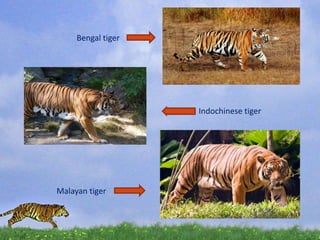
 Bengal tiger (Panthera tigris tigris)
 Indochinese tiger (Panthera tigris corbetti)
 Malayan tiger (Panthera tigris jacksoni)
 Siberian tiger (Panthera tigris altaica)
 Southchina tiger (Panthera tigris amoyensis)
 Sumatran tiger (Panthera tigris sumatrae)
Bengal tiger
Indochinese tiger
Malayan tiger
Siberian tiger
South-china tiger
Sumatran tiger
Three extinct subspecies of tiger:
 Bali tiger ( Panthera tigris balica)
 Caspian tiger (Panthera tigris virgata)
 Javan tiger (Panthera tigris sondaica)
Bali tiger
Caspian tiger
Javan tiger
 Tigers live in Asia. Larger subspecies, such as the
Siberian tiger, tend to live in Northern, colder areas,
such as Eastern Russia and North-Eastern China.
 Smaller subspecies live in Southern, warmer
countries, such as India, Bangladesh, Nepal, Bhutan,
Myanmar, Laos, Cambodia, Vietnam, Malaysia and
Indonesia
 They live in arid forests, flooded mangrove forests,
tropical forests and taiga, depending on the
subspecies
 All subspecies of tigers are extremely territorial
 Tigers mostly live solitary lives with exception of when
they are courting, mating, or raising their offspring in
case of females
 Nocturnal in nature
 Tiger's stripes are like fingerprints, each tiger has
different stripes
 Tigers have retractable claws that are covered by an
envelop when retracted
 Males have wider forepaw pads than females, enabling
gender to be told from tracks
 Tigresses are smaller than the males in each
subspecies
 Average speed of tiger is around 56-64 km/h
 A tiger can leap forward up to 33 feet at a time
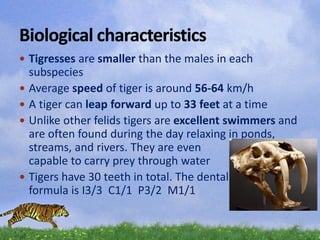
 Unlike other felids tigers are excellent swimmers and
are often found during the day relaxing in ponds,
streams, and rivers. They are even
capable to carry prey through water
 Tigers have 30 teeth in total. The dental
formula is I3/3 C1/1 P3/2 M1/1
 Tigers typically live 14 to 18 years
 Mothers guard their young so that the
wandering males don't eat them
 Tigers are sexually dimorphic species
 Although tigers can mate throughout the year,
copulation usually happens between November and
April
 Females reach sexual maturity at around three to
four years of age, while males are a little older, at an
average of four or five years old
 Females usually wait about 2.5 years between
pregnancies
 Gestation period is 103 days
 3-4 cubs are born in a litter
 Cubs come out of den in 8 weeks
 At 2 years old, the cubs will set out on their own, and
their mother will have another set of cubs
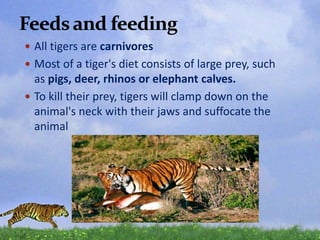
 All tigers are carnivores
 Most of a tiger's diet consists of large prey, such
as pigs, deer, rhinos or elephant calves.
 To kill their prey, tigers will clamp down on the
animal's neck with their jaws and suffocate the
animal
There are two methods of restraining tiger:
1. Physical method
a) Confinement (Squeeze cages, special bags &
towels)
b) Physical barriers (shields and blankets)
c) Arms and nets
Squeeze cage
2. Chemical method
 Mainly blowgun tranquilization is prefered
 Usually Tilazol (Tiletamine HCl and Zolazepam HCl) is used as
2-7 mg/kg bw, IM
 Acts within 10 to 15 min & recovers after 4hrs
1. Viral diseases
 Rabies
 Pseudorabies
 Feline Immunodeficiency Virus (Feline AIDS or FIV )
 Feline Leukaemia Virus (FeLV)
 Canine distemper
2. Bacterial diseases
 Tuberculosis
 Salmonellosis
 Anthrax
 Bacterial meningitis
3. Fungal diseases
 Microsporum
 Dermatophilosis
 Coccidioidomycosis
4. Parasitic diseases
 Babesiosis
 Toxoplasmosis
 Tick bite fever
 There is about 3200; around 1411 Bengal tigers, about 450
Siberian and the same with Sumatran, Indo-Chinese is
anywhere between 1100 and 1800, and the South China tiger
is close to none, to be precise, less than 20
 Just 440 tiger left in Bangladesh according to the latest survey
 The illegal poaching of tigers for their parts and destruction of
their habitat are the biggest challenges faced in the fight to
save tigers
 The Corbett Foundation, Big Cat Rescue, Global Tiger Forum,
Asian Conservation Awareness Programme
 The mission of saving the tigers will succeed only if measures
are taken with full initiative and care
 Fowler, M.E. ; Zoo and Wild Animal Medicine
 Fowler, M.E. ; Restraint and Handling of Wild and
Domestic Animals
 http://www.wikipedia.org/wiki/Tiger
 http://www.defenders.org/wildlife
 http://www.habitat/wildlife/tiger.php
 http://www.lairweb.org.nz/tiger/taxonomy2.html
 http://www.zooschool.ersd.net/Tiger.html
Special Thanks to
 Dr. Md. Ariful Islam
Associate Professor
Departmentof Medicine
 Dr. Mst. Sonia Parvin
Assistant Professor
Departmentof Medicine
Thank
you!!!
Tiger

Tiger

  • 1.
    TIGER Presented By Group-B1 ID NO:1201040 – 1201052 Level-4;Semester-1 Faculty of Veterinary Science
  • 2.
     Introduction  Taxonomicclassification  Description  Biological characteristics  Reproduction  Feeds & feeding  Restraining  Important diseases
  • 3.
     The tigeris the largest member of the Felidae family  Genus Panthera are called roaring cats because they have an incompletely ossified hyoid apparatus  Historic tiger range ran from Turkey through South & South-East Asia to the eastern part of the continent  Today they are only found in South & South-East Asia, China & Russia  In the early 1900s there were 100000 tigers throughout their range  Today approximately 3200 exist in the wild
  • 4.
    Kingdom: Animalia Phylum: Chordata Subphylum:Vertebrata Class: Mammalia Order: Carnivora Family: Felidae Genus: Panthera Species: Panthera tigris
  • 5.
    Length: 4.6-12.2 ft. Height:3-3.5 ft. Weight: 220-675 pounds Colors and markings: Orange with a white belly and black stripes Shape: oval body that is low to the ground
  • 6.
    Six surviving subspeciesof tiger:  Bengal tiger (Panthera tigris tigris)  Indochinese tiger (Panthera tigris corbetti)  Malayan tiger (Panthera tigris jacksoni)  Siberian tiger (Panthera tigris altaica)  Southchina tiger (Panthera tigris amoyensis)  Sumatran tiger (Panthera tigris sumatrae)
  • 7.
  • 8.
  • 9.
    Three extinct subspeciesof tiger:  Bali tiger ( Panthera tigris balica)  Caspian tiger (Panthera tigris virgata)  Javan tiger (Panthera tigris sondaica)
  • 10.
  • 11.
     Tigers livein Asia. Larger subspecies, such as the Siberian tiger, tend to live in Northern, colder areas, such as Eastern Russia and North-Eastern China.  Smaller subspecies live in Southern, warmer countries, such as India, Bangladesh, Nepal, Bhutan, Myanmar, Laos, Cambodia, Vietnam, Malaysia and Indonesia  They live in arid forests, flooded mangrove forests, tropical forests and taiga, depending on the subspecies
  • 13.
     All subspeciesof tigers are extremely territorial  Tigers mostly live solitary lives with exception of when they are courting, mating, or raising their offspring in case of females  Nocturnal in nature  Tiger's stripes are like fingerprints, each tiger has different stripes  Tigers have retractable claws that are covered by an envelop when retracted  Males have wider forepaw pads than females, enabling gender to be told from tracks
  • 14.
     Tigresses aresmaller than the males in each subspecies  Average speed of tiger is around 56-64 km/h  A tiger can leap forward up to 33 feet at a time  Unlike other felids tigers are excellent swimmers and are often found during the day relaxing in ponds, streams, and rivers. They are even capable to carry prey through water  Tigers have 30 teeth in total. The dental formula is I3/3 C1/1 P3/2 M1/1
  • 15.
     Tigers typicallylive 14 to 18 years  Mothers guard their young so that the wandering males don't eat them
  • 16.
     Tigers aresexually dimorphic species  Although tigers can mate throughout the year, copulation usually happens between November and April  Females reach sexual maturity at around three to four years of age, while males are a little older, at an average of four or five years old
  • 17.
     Females usuallywait about 2.5 years between pregnancies  Gestation period is 103 days  3-4 cubs are born in a litter  Cubs come out of den in 8 weeks  At 2 years old, the cubs will set out on their own, and their mother will have another set of cubs
  • 18.
     All tigersare carnivores  Most of a tiger's diet consists of large prey, such as pigs, deer, rhinos or elephant calves.  To kill their prey, tigers will clamp down on the animal's neck with their jaws and suffocate the animal
  • 19.
    There are twomethods of restraining tiger: 1. Physical method a) Confinement (Squeeze cages, special bags & towels) b) Physical barriers (shields and blankets) c) Arms and nets Squeeze cage
  • 20.
    2. Chemical method Mainly blowgun tranquilization is prefered  Usually Tilazol (Tiletamine HCl and Zolazepam HCl) is used as 2-7 mg/kg bw, IM  Acts within 10 to 15 min & recovers after 4hrs
  • 21.
    1. Viral diseases Rabies  Pseudorabies  Feline Immunodeficiency Virus (Feline AIDS or FIV )  Feline Leukaemia Virus (FeLV)  Canine distemper 2. Bacterial diseases  Tuberculosis  Salmonellosis  Anthrax  Bacterial meningitis
  • 22.
    3. Fungal diseases Microsporum  Dermatophilosis  Coccidioidomycosis 4. Parasitic diseases  Babesiosis  Toxoplasmosis  Tick bite fever
  • 23.
     There isabout 3200; around 1411 Bengal tigers, about 450 Siberian and the same with Sumatran, Indo-Chinese is anywhere between 1100 and 1800, and the South China tiger is close to none, to be precise, less than 20  Just 440 tiger left in Bangladesh according to the latest survey  The illegal poaching of tigers for their parts and destruction of their habitat are the biggest challenges faced in the fight to save tigers  The Corbett Foundation, Big Cat Rescue, Global Tiger Forum, Asian Conservation Awareness Programme  The mission of saving the tigers will succeed only if measures are taken with full initiative and care
  • 25.
     Fowler, M.E.; Zoo and Wild Animal Medicine  Fowler, M.E. ; Restraint and Handling of Wild and Domestic Animals  http://www.wikipedia.org/wiki/Tiger  http://www.defenders.org/wildlife  http://www.habitat/wildlife/tiger.php  http://www.lairweb.org.nz/tiger/taxonomy2.html  http://www.zooschool.ersd.net/Tiger.html
  • 26.
    Special Thanks to Dr. Md. Ariful Islam Associate Professor Departmentof Medicine  Dr. Mst. Sonia Parvin Assistant Professor Departmentof Medicine
  • 27.