taks-AHN-uh-mee Sorting out the whatchamacallits
Definition of Terms Taxonomy:  the science of identifying, classifying, and naming living things. Classification:  the arrangement of organisms into orderly groups based on their similarities.
Why Classify? Humans have an innate need to seek order in their surroundings. Order helps us understand how the world works. We can communicate better when everyone knows what we are talking about.
History of Classification Aristotle  (384-322 B.C.) had a simple method:  Plants and Animals Animals lived on land, in water, or in air Plants had three different types of stems This worked until explorers found many new organisms that didn’t fit his system.   Common names often varied from region to region or were inaccurate (ex: Jellyfish)
History of Classification Carolus Linnaeus  (1707-1778) developed a system with hierarchical categories. Based on shared physical characteristics. Uses seven levels of organization The largest is  Kingdom  and the most specific is  Species .
 
 
Classification Hierarchy Kingdom Phylum (Division….for plants) Class Order Family Genus  Species
Classification Hierarchy K P C O F G  S
Binomial Nomenclature Binomial nomenclature :  bi  =two  nom  =name Always  in Latin. Why? Latin is a universal language. Species name  (scientific name) Always in this form: Genus   species identifier Species identifier is often descriptive, geographical, or named after someone
Binomial Nomenclature Additional levels of classification beyond Genus and Species include: Varieties : PLANTS with slightly different qualities Subspecies : ANIMALS in different geographical regions
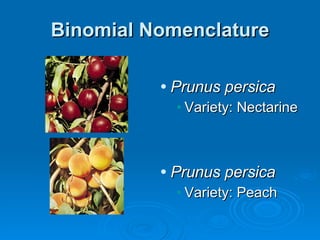
Binomial Nomenclature Prunus persica   Variety: Nectarine Prunus persica  Variety: Peach
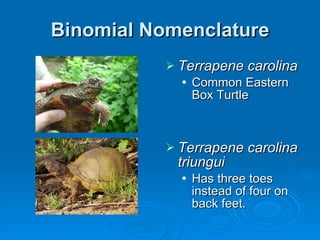
Binomial Nomenclature Terrapene carolina Common Eastern Box Turtle   Terrapene carolina triungui Has three toes instead of four on back feet.
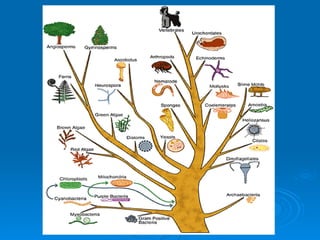
Modern Taxonomy Phylogeny : The evolutionary history of an organism A Phylogeny tree diagram shows the relationship of organisms. Uses the same evidence used by evolutionary biologists: Fossil Record Comparing structures Embryo development DNA
 
 
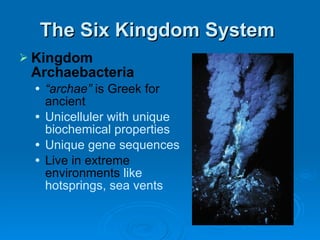
The Six Kingdom System  Kingdom Archaebacteria   “ archae”  is Greek for ancient Unicelluler with unique biochemical properties Unique gene sequences Live in extreme environments  like hotsprings, sea vents
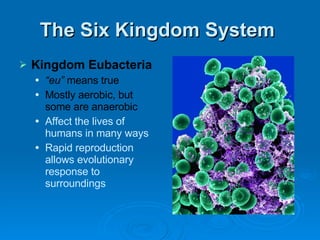
The Six Kingdom System  Kingdom Eubacteria “ eu”  means true Mostly aerobic, but some are anaerobic Affect the lives of humans in many ways Rapid reproduction allows evolutionary response to surroundings
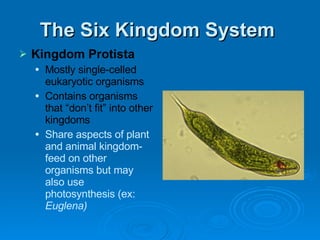
The Six Kingdom System  Kingdom Protista   Mostly single-celled eukaryotic organisms Contains organisms that “don’t fit” into other kingdoms Share aspects of plant and animal kingdom- feed on other organisms but may also use photosynthesis (ex:  Euglena)
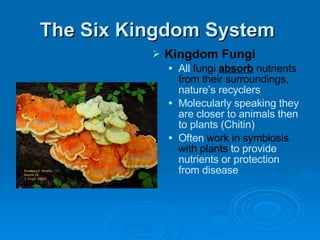
The Six Kingdom System  Kingdom Fungi All  fungi  absorb  nutrients from their surroundings,  nature’s recyclers Molecularly speaking they are closer to animals then to plants (Chitin) Often  work in symbiosis with plants  to provide nutrients or protection from disease
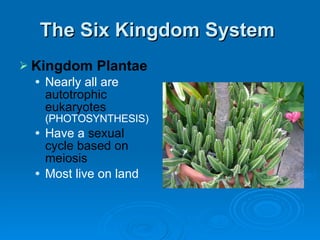
The Six Kingdom System  Kingdom Plantae   Nearly all are  autotrophic eukaryotes   (PHOTOSYNTHESIS) Have a  sexual cycle based on meiosis Most live on land
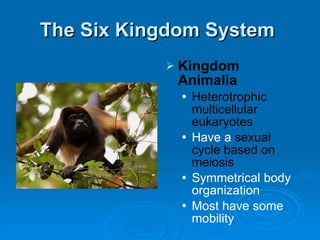
The Six Kingdom System  Kingdom Animalia Heterotrophic multicellular eukaryotes Have a  sexual cycle based on meiosis Symmetrical body organization Most have some mobility
 
The Three Domain System  Based on molecular work with Ribosomal RNA All organisms tested fall into one of three distinct Domains Introduced in 1990 by Carl Woese (discovered Archeabacteria)
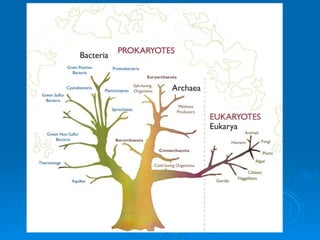
The Three Domain System  Domain Archaea   The same members as Kingdom Archaebacteria Domain Bacteria   The same members as Kingdom Eubacteria Domain Eukarya Consists of Kingdoms Protista, Plantae, Fungi, and Animalia


Classification Ms

  • 1.
    taks-AHN-uh-mee Sorting outthe whatchamacallits
  • 2.
    Definition of TermsTaxonomy: the science of identifying, classifying, and naming living things. Classification: the arrangement of organisms into orderly groups based on their similarities.
  • 3.
    Why Classify? Humanshave an innate need to seek order in their surroundings. Order helps us understand how the world works. We can communicate better when everyone knows what we are talking about.
  • 4.
    History of ClassificationAristotle (384-322 B.C.) had a simple method: Plants and Animals Animals lived on land, in water, or in air Plants had three different types of stems This worked until explorers found many new organisms that didn’t fit his system. Common names often varied from region to region or were inaccurate (ex: Jellyfish)
  • 5.
    History of ClassificationCarolus Linnaeus (1707-1778) developed a system with hierarchical categories. Based on shared physical characteristics. Uses seven levels of organization The largest is Kingdom and the most specific is Species .
  • 6.
  • 7.
  • 8.
    Classification Hierarchy KingdomPhylum (Division….for plants) Class Order Family Genus Species
  • 9.
  • 10.
    Binomial Nomenclature Binomialnomenclature : bi =two nom =name Always in Latin. Why? Latin is a universal language. Species name (scientific name) Always in this form: Genus species identifier Species identifier is often descriptive, geographical, or named after someone
  • 11.
    Binomial Nomenclature Additionallevels of classification beyond Genus and Species include: Varieties : PLANTS with slightly different qualities Subspecies : ANIMALS in different geographical regions
  • 12.
    Binomial Nomenclature Prunuspersica Variety: Nectarine Prunus persica Variety: Peach
  • 13.
    Binomial Nomenclature Terrapenecarolina Common Eastern Box Turtle Terrapene carolina triungui Has three toes instead of four on back feet.
  • 14.
    Modern Taxonomy Phylogeny: The evolutionary history of an organism A Phylogeny tree diagram shows the relationship of organisms. Uses the same evidence used by evolutionary biologists: Fossil Record Comparing structures Embryo development DNA
  • 15.
  • 16.
  • 17.
    The Six KingdomSystem Kingdom Archaebacteria “ archae” is Greek for ancient Unicelluler with unique biochemical properties Unique gene sequences Live in extreme environments like hotsprings, sea vents
  • 18.
    The Six KingdomSystem Kingdom Eubacteria “ eu” means true Mostly aerobic, but some are anaerobic Affect the lives of humans in many ways Rapid reproduction allows evolutionary response to surroundings
  • 19.
    The Six KingdomSystem Kingdom Protista Mostly single-celled eukaryotic organisms Contains organisms that “don’t fit” into other kingdoms Share aspects of plant and animal kingdom- feed on other organisms but may also use photosynthesis (ex: Euglena)
  • 20.
    The Six KingdomSystem Kingdom Fungi All fungi absorb nutrients from their surroundings, nature’s recyclers Molecularly speaking they are closer to animals then to plants (Chitin) Often work in symbiosis with plants to provide nutrients or protection from disease
  • 21.
    The Six KingdomSystem Kingdom Plantae Nearly all are autotrophic eukaryotes (PHOTOSYNTHESIS) Have a sexual cycle based on meiosis Most live on land
  • 22.
    The Six KingdomSystem Kingdom Animalia Heterotrophic multicellular eukaryotes Have a sexual cycle based on meiosis Symmetrical body organization Most have some mobility
  • 23.
  • 24.
    The Three DomainSystem Based on molecular work with Ribosomal RNA All organisms tested fall into one of three distinct Domains Introduced in 1990 by Carl Woese (discovered Archeabacteria)
  • 25.
    The Three DomainSystem Domain Archaea The same members as Kingdom Archaebacteria Domain Bacteria The same members as Kingdom Eubacteria Domain Eukarya Consists of Kingdoms Protista, Plantae, Fungi, and Animalia
  • 26.
  • 27.