PROPERTIES
OF MATTER
Objectives
 Define matter.
 Explain the gas, liquid, and solid states of matter in terms of particles.
 Distinguish between the physical properties and chemical properties of
matter.
 Classify Changes of matter as physical or chemical.
 Distinguish between a mixture and a pure substance.
 Identify the chemical symbols of elements, and name elements, given
their symbols.
 Identify important families of elements on the periodic table.
TEKS: 2A,2D,2E,3B,3C,3D,3E,4A,4B,4C,4D,5A,11A,11B
Definition of Matter
The two properties of matter are:
•Mass – amount of matter
•Volume – amount of space occupied
•Therefore…matter is anything that has
mass and takes up space.
•The study of Matter is Chemistry.
•Density = Mass (m)/ Volume (V)
•D= m/V or g/mL
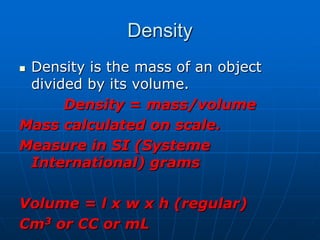
Density
 Density is the mass of an object
divided by its volume.
Density = mass/volume
Mass calculated on scale.
Measure in SI (Systeme
International) grams
Volume = l x w x h (regular)
Cm3 or CC or mL
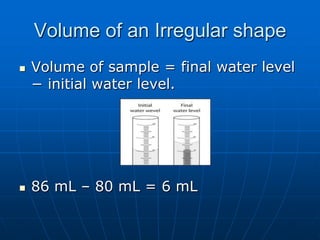
Volume of an Irregular shape
 Volume of sample = final water level
− initial water level.
 86 mL – 80 mL = 6 mL
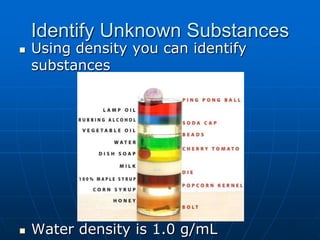
Identify Unknown Substances
 Using density you can identify
substances
 Water density is 1.0 g/mL
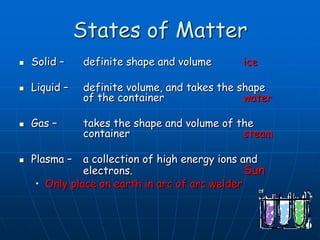
States of Matter
 Solid – definite shape and volume ice
 Liquid – definite volume, and takes the shape
of the container water
 Gas – takes the shape and volume of the
container steam
 Plasma – a collection of high energy ions and
electrons. Sun
• Only place on earth in arc of arc welder
Physical Changes
 Physical change
alters the
substance without
changing its
composition or
chemical identity.
 From a solid to a
liquid, boil, melt
cut break, split
, grind crush
, bend, condense
freeze , dissolve
and crack are
examples of
physical changes.
Physical Properties
 A physical property is a condition
that can be measured or observed
without changing the identity of
the substance.
Examples of physical properties
include
color, solubility, odor, hardness, de
nsity, melting point and boiling
Chemical Properties
The ability of a substance to
undergo a chemical reaction to
form a new substance is called a
chemical property. Chemical
properties are observed when a
substance undergoes a chemical
change.
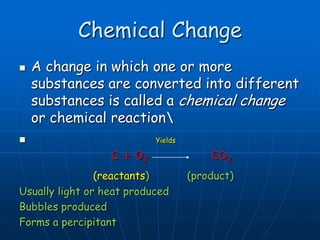
Chemical Change
 A change in which one or more
substances are converted into different
substances is called a chemical change
or chemical reaction
 Yields
C + O2 CO2
(reactants) (product)
Usually light or heat produced
Bubbles produced
Forms a percipitant
Look for terms such as . . .
 burn
 rot
 rust
 decompose
 ferment
 explode
 oxidize
 corrode
 grow
 precipitate
 gas formation
 digest
Classifying Properties
 Both physical and chemical
properties can be classified as
being either extensive or intensive
properties.
Extensive vs. Intensive
Extensive Properties
 Depend on the amount
of matter present
 Mass, volume, length, he
ight, amount of
energy, etc.
Intensive Properties
 Do not depend on the
amount of matter
present
 Density, boiling point,
melting point, color,
ability to conduct
electricity, etc.
Classifying Matter
 Matter is classified by the number of
phases it contains.
 Any part of a system with uniform
composition and properties is called a
phase.
 Matter can be classified as either
Homogeneous or Heterogeneous.
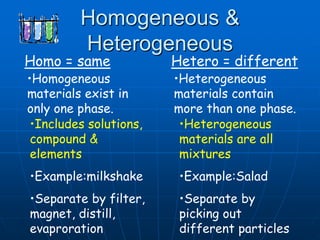
Homogeneous &
Heterogeneous
Homo = same Hetero = different
•Homogeneous
materials exist in
only one phase.
•Heterogeneous
materials contain
more than one phase.
•Includes solutions,
compound &
elements
•Example:milkshake
•Separate by filter,
magnet, distill,
evaproration
•Heterogeneous
materials are all
mixtures
•Example:Salad
•Separate by
picking out
different particles
Mixtures
 Mixtures are a physical blend of 2 or more
kinds of matter.
 Mixtures can be either homogeneous
(solutions) or heterogeneous.
 Separation of mixtures is done by physical
means such as
magnets, distillation, chromatography and
filtration.
Pure Substances
•A pure substance has a fixed composition .
Elements and compounds are pure
substances.
•Unlike mixtures, every sample of a pure
substance has exactly the same
characteristic properties and composition.
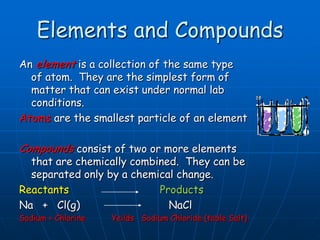
Elements and Compounds
An element is a collection of the same type
of atom. They are the simplest form of
matter that can exist under normal lab
conditions.
Atoms are the smallest particle of an element
Compounds consist of two or more elements
that are chemically combined. They can be
separated only by a chemical change.
Reactants Products
Na + Cl(g) NaCl
Sodium + Chlorine Yeilds Sodium Chloride (table Salt)
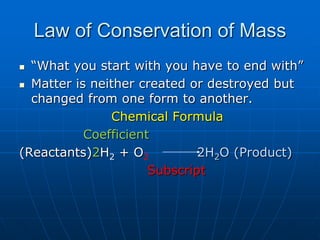
Law of Conservation of Mass
 “What you start with you have to end with”
 Matter is neither created or destroyed but
changed from one form to another.
Chemical Formula
Coefficient
(Reactants)2H2 + O2 2H2O (Product)
Subscript
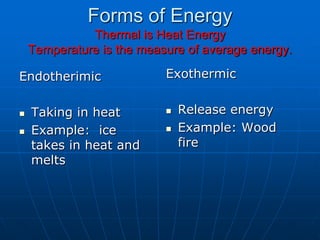
Forms of Energy
Thermal is Heat Energy
Temperature is the measure of average energy.
Endotherimic
 Taking in heat
 Example: ice
takes in heat and
melts
Exothermic
 Release energy
 Example: Wood
fire
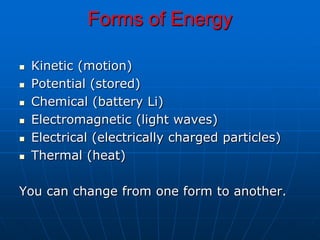
Forms of Energy
 Kinetic (motion)
 Potential (stored)
 Chemical (battery Li)
 Electromagnetic (light waves)
 Electrical (electrically charged particles)
 Thermal (heat)
You can change from one form to another.
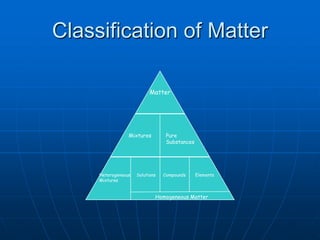
Classification of Matter
Matter
Mixtures Pure
Substances
Heterogeneous
Mixtures
Solutions Compounds Elements
Homogeneous Matter

Classification of matter

  • 1.
  • 2.
    Objectives  Define matter. Explain the gas, liquid, and solid states of matter in terms of particles.  Distinguish between the physical properties and chemical properties of matter.  Classify Changes of matter as physical or chemical.  Distinguish between a mixture and a pure substance.  Identify the chemical symbols of elements, and name elements, given their symbols.  Identify important families of elements on the periodic table. TEKS: 2A,2D,2E,3B,3C,3D,3E,4A,4B,4C,4D,5A,11A,11B
  • 3.
    Definition of Matter Thetwo properties of matter are: •Mass – amount of matter •Volume – amount of space occupied •Therefore…matter is anything that has mass and takes up space. •The study of Matter is Chemistry. •Density = Mass (m)/ Volume (V) •D= m/V or g/mL
  • 4.
    Density  Density isthe mass of an object divided by its volume. Density = mass/volume Mass calculated on scale. Measure in SI (Systeme International) grams Volume = l x w x h (regular) Cm3 or CC or mL
  • 5.
    Volume of anIrregular shape  Volume of sample = final water level − initial water level.  86 mL – 80 mL = 6 mL
  • 6.
    Identify Unknown Substances Using density you can identify substances  Water density is 1.0 g/mL
  • 7.
    States of Matter Solid – definite shape and volume ice  Liquid – definite volume, and takes the shape of the container water  Gas – takes the shape and volume of the container steam  Plasma – a collection of high energy ions and electrons. Sun • Only place on earth in arc of arc welder
  • 8.
    Physical Changes  Physicalchange alters the substance without changing its composition or chemical identity.  From a solid to a liquid, boil, melt cut break, split , grind crush , bend, condense freeze , dissolve and crack are examples of physical changes.
  • 9.
    Physical Properties  Aphysical property is a condition that can be measured or observed without changing the identity of the substance. Examples of physical properties include color, solubility, odor, hardness, de nsity, melting point and boiling
  • 10.
    Chemical Properties The abilityof a substance to undergo a chemical reaction to form a new substance is called a chemical property. Chemical properties are observed when a substance undergoes a chemical change.
  • 11.
    Chemical Change  Achange in which one or more substances are converted into different substances is called a chemical change or chemical reaction  Yields C + O2 CO2 (reactants) (product) Usually light or heat produced Bubbles produced Forms a percipitant
  • 12.
    Look for termssuch as . . .  burn  rot  rust  decompose  ferment  explode  oxidize  corrode  grow  precipitate  gas formation  digest
  • 13.
    Classifying Properties  Bothphysical and chemical properties can be classified as being either extensive or intensive properties.
  • 14.
    Extensive vs. Intensive ExtensiveProperties  Depend on the amount of matter present  Mass, volume, length, he ight, amount of energy, etc. Intensive Properties  Do not depend on the amount of matter present  Density, boiling point, melting point, color, ability to conduct electricity, etc.
  • 15.
    Classifying Matter  Matteris classified by the number of phases it contains.  Any part of a system with uniform composition and properties is called a phase.  Matter can be classified as either Homogeneous or Heterogeneous.
  • 16.
    Homogeneous & Heterogeneous Homo =same Hetero = different •Homogeneous materials exist in only one phase. •Heterogeneous materials contain more than one phase. •Includes solutions, compound & elements •Example:milkshake •Separate by filter, magnet, distill, evaproration •Heterogeneous materials are all mixtures •Example:Salad •Separate by picking out different particles
  • 17.
    Mixtures  Mixtures area physical blend of 2 or more kinds of matter.  Mixtures can be either homogeneous (solutions) or heterogeneous.  Separation of mixtures is done by physical means such as magnets, distillation, chromatography and filtration.
  • 18.
    Pure Substances •A puresubstance has a fixed composition . Elements and compounds are pure substances. •Unlike mixtures, every sample of a pure substance has exactly the same characteristic properties and composition.
  • 19.
    Elements and Compounds Anelement is a collection of the same type of atom. They are the simplest form of matter that can exist under normal lab conditions. Atoms are the smallest particle of an element Compounds consist of two or more elements that are chemically combined. They can be separated only by a chemical change. Reactants Products Na + Cl(g) NaCl Sodium + Chlorine Yeilds Sodium Chloride (table Salt)
  • 20.
    Law of Conservationof Mass  “What you start with you have to end with”  Matter is neither created or destroyed but changed from one form to another. Chemical Formula Coefficient (Reactants)2H2 + O2 2H2O (Product) Subscript
  • 21.
    Forms of Energy Thermalis Heat Energy Temperature is the measure of average energy. Endotherimic  Taking in heat  Example: ice takes in heat and melts Exothermic  Release energy  Example: Wood fire
  • 22.
    Forms of Energy Kinetic (motion)  Potential (stored)  Chemical (battery Li)  Electromagnetic (light waves)  Electrical (electrically charged particles)  Thermal (heat) You can change from one form to another.
  • 23.
    Classification of Matter Matter MixturesPure Substances Heterogeneous Mixtures Solutions Compounds Elements Homogeneous Matter