Chapter 3Matter and Changes
Properties of Matter (3.1)Matter is anything that takes up space and has mass.Mass is the amount of matter in an object.
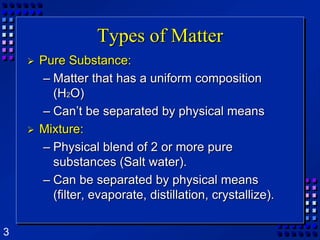
Types of MatterPure Substance:Matter that has a uniform composition (H2O)Can’t be separated by physical meansMixture:Physical blend of 2 or more pure substances (Salt water). Can be separated by physical means (filter, evaporate, distillation, crystallize).
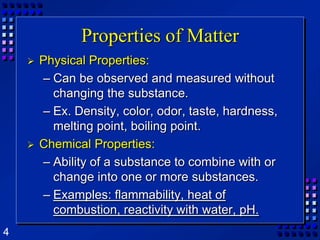
Properties of MatterPhysical Properties:Can be observed and measured without changing the substance.Ex. Density, color, odor, taste, hardness, melting point, boiling point.Chemical Properties:Ability of a substance to combine with or change into one or more substances.Examples: flammability, heat of combustion, reactivity with water, pH.
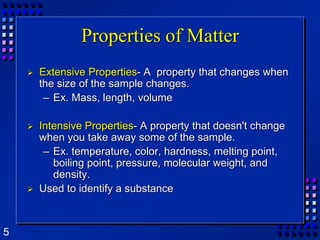
Properties of MatterExtensive Properties- A  property that changes when the size of the sample changes.Ex. Mass, length, volumeIntensive Properties- A property that doesn't change when you take away some of the sample.Ex. temperature, color, hardness, melting point, boiling point, pressure, molecular weight, and density. Used to identify a substance
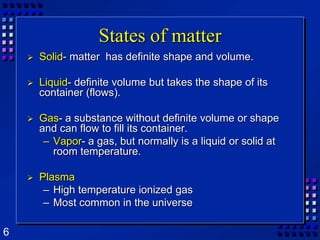
States of matterSolid- matter  has definite shape and volume.Liquid- definite volume but takes the shape of its container (flows).Gas- a substance without definite volume or shape and can flow to fill its container.Vapor- a gas, but normally is a liquid or solid at room temperature.PlasmaHigh temperature ionized gasMost common in the universe
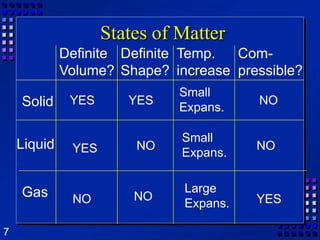
States of MatterDefinite Volume?Definite Shape?Temp.  increaseCom-pressible?Small Expans.SolidYESYESNOSmall Expans.LiquidNONOYESLarge Expans.GasNONOYES
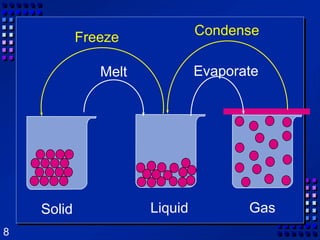
CondenseFreezeEvaporateMeltGas Liquid Solid
Changes in Matter (3.2)Physical changes - a change that changes appearances, without changing the composition.Examples? Melting Ice, Bend a spoon,Chemical changes - a change where a new form of matter is formed.Also called chemical reaction.Examples? rusting, explode, burn, rot, tarnishNot phase changes!Ice is still water.
Conservation of Mass Mass can not be created or destroyed in ordinary (not nuclear) changes.All the mass can be accounted for.Mass at the start (Reactants) = mass at end (Products)
Mixtures of Matter (3.3) Mixtures are made up of two substances.Variable composition. Mixtures can be:Heterogeneous- mixture is not the same from place to place. (Chocolate chip cookie, gravel, soil). Or,Homogeneous- same composition throughout. (Kool-aid, air). Every part keeps its properties. A Homogeneous mixture is also referred to as Solution.
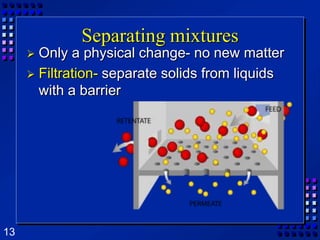
Separating mixturesOnly a physical change- no new matterFiltration- separate solids from liquids with a barrier
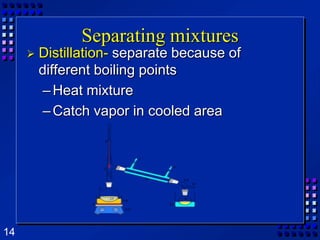
Separating mixturesDistillation- separate because of different boiling pointsHeat mixtureCatch vapor in cooled area
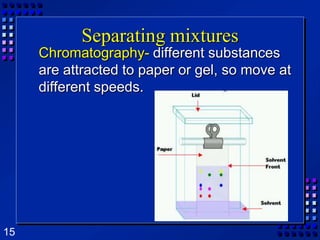
Separating mixtures	Chromatography- different substances are attracted to paper or gel, so move at different speeds.
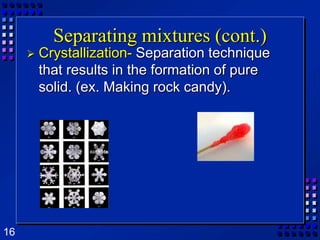
Separating mixtures (cont.)Crystallization- Separation technique that results in the formation of pure solid. (ex. Making rock candy).
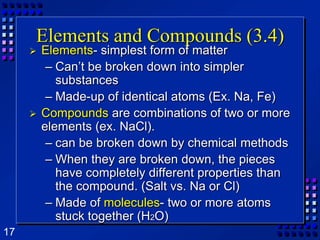
Elements and Compounds (3.4)Elements- simplest form of matterCan’t be broken down into simpler substancesMade-up of identical atoms (Ex. Na, Fe)Compounds are combinations of two or more elements (ex. NaCl).can be broken down by chemical methodsWhen they are broken down, the pieces have completely different properties than the compound. (Salt vs. Na or Cl)Made of molecules- two or more atoms stuck together (H2O)
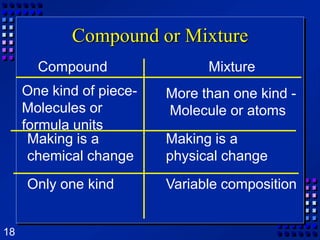
Compound or MixtureCompoundMixtureOne kind of piece-Molecules orformula units  More than one kind - Molecule or atoms Making is a chemical change Making is a physical change Only one kind Variable composition
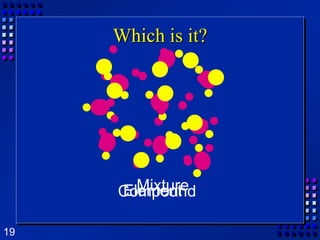
Which is it?ElementCompoundMixture
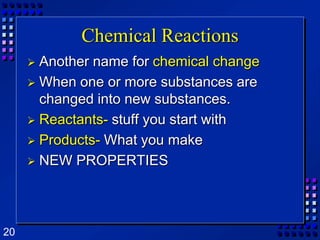
Chemical ReactionsAnother name for chemical changeWhen one or more substances are changed into new substances.Reactants- stuff you start withProducts- What you makeNEW PROPERTIES
Indications of a chemical reactionEnergy absorbed or releasedColor changeOdor changePrecipitate- solid that separates from solutionNot easily reversed
Chemical symbolsThere are 118 elements (He, Fe, etc.)Each has a 1 or two letter symbolFirst letter always capitalized, second never (Pb)
Chemical symbolsUsed to write chemical formulasSubscripts tell us how many of each atomH2OC3H8HBrO3
EnergyThe  ability to do work.Work - cause a change or move an object.Many types- all can be changed into the other.
Types of energyPotential- stored energyKinetic Energy- energy something has because its movingHeat- the energy that moves because of a temperature difference.Chemical energy- energy released or absorbed in a chemical change.Electrical energy - energy of moving charges
Types of EnergyRadiant Energy- energy that can travel through empty space (light, UV, infrared, radio)Nuclear Energy – Energy from changing the nucleus of atomsAll types of energy can be converted into others.If you trace the source far enough back, you will end up at nuclear energy.
Conservation of EnergyEnergy can be neither created or destroyed in ordinary changes (not nuclear), it can only change form.Its not just a good idea, its the law.
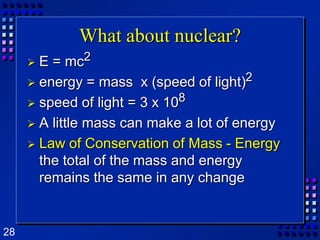
What about nuclear?E = mc2energy = mass  x (speed of light)2speed of light = 3 x 10⁸A little mass can make a lot of energyLaw of Conservation of Mass - Energy the total of the mass and energy remains the same in any change

Chapter 3 Matter Properties And Changes

  • 1.
  • 2.
    Properties of Matter(3.1)Matter is anything that takes up space and has mass.Mass is the amount of matter in an object.
  • 3.
    Types of MatterPureSubstance:Matter that has a uniform composition (H2O)Can’t be separated by physical meansMixture:Physical blend of 2 or more pure substances (Salt water). Can be separated by physical means (filter, evaporate, distillation, crystallize).
  • 4.
    Properties of MatterPhysicalProperties:Can be observed and measured without changing the substance.Ex. Density, color, odor, taste, hardness, melting point, boiling point.Chemical Properties:Ability of a substance to combine with or change into one or more substances.Examples: flammability, heat of combustion, reactivity with water, pH.
  • 5.
    Properties of MatterExtensiveProperties- A property that changes when the size of the sample changes.Ex. Mass, length, volumeIntensive Properties- A property that doesn't change when you take away some of the sample.Ex. temperature, color, hardness, melting point, boiling point, pressure, molecular weight, and density. Used to identify a substance
  • 6.
    States of matterSolid-matter has definite shape and volume.Liquid- definite volume but takes the shape of its container (flows).Gas- a substance without definite volume or shape and can flow to fill its container.Vapor- a gas, but normally is a liquid or solid at room temperature.PlasmaHigh temperature ionized gasMost common in the universe
  • 7.
    States of MatterDefiniteVolume?Definite Shape?Temp. increaseCom-pressible?Small Expans.SolidYESYESNOSmall Expans.LiquidNONOYESLarge Expans.GasNONOYES
  • 8.
  • 9.
    Changes in Matter(3.2)Physical changes - a change that changes appearances, without changing the composition.Examples? Melting Ice, Bend a spoon,Chemical changes - a change where a new form of matter is formed.Also called chemical reaction.Examples? rusting, explode, burn, rot, tarnishNot phase changes!Ice is still water.
  • 10.
    Conservation of MassMass can not be created or destroyed in ordinary (not nuclear) changes.All the mass can be accounted for.Mass at the start (Reactants) = mass at end (Products)
  • 12.
    Mixtures of Matter(3.3) Mixtures are made up of two substances.Variable composition. Mixtures can be:Heterogeneous- mixture is not the same from place to place. (Chocolate chip cookie, gravel, soil). Or,Homogeneous- same composition throughout. (Kool-aid, air). Every part keeps its properties. A Homogeneous mixture is also referred to as Solution.
  • 13.
    Separating mixturesOnly aphysical change- no new matterFiltration- separate solids from liquids with a barrier
  • 14.
    Separating mixturesDistillation- separatebecause of different boiling pointsHeat mixtureCatch vapor in cooled area
  • 15.
    Separating mixtures Chromatography- differentsubstances are attracted to paper or gel, so move at different speeds.
  • 16.
    Separating mixtures (cont.)Crystallization-Separation technique that results in the formation of pure solid. (ex. Making rock candy).
  • 17.
    Elements and Compounds(3.4)Elements- simplest form of matterCan’t be broken down into simpler substancesMade-up of identical atoms (Ex. Na, Fe)Compounds are combinations of two or more elements (ex. NaCl).can be broken down by chemical methodsWhen they are broken down, the pieces have completely different properties than the compound. (Salt vs. Na or Cl)Made of molecules- two or more atoms stuck together (H2O)
  • 18.
    Compound or MixtureCompoundMixtureOnekind of piece-Molecules orformula units More than one kind - Molecule or atoms Making is a chemical change Making is a physical change Only one kind Variable composition
  • 19.
  • 20.
    Chemical ReactionsAnother namefor chemical changeWhen one or more substances are changed into new substances.Reactants- stuff you start withProducts- What you makeNEW PROPERTIES
  • 21.
    Indications of achemical reactionEnergy absorbed or releasedColor changeOdor changePrecipitate- solid that separates from solutionNot easily reversed
  • 22.
    Chemical symbolsThere are118 elements (He, Fe, etc.)Each has a 1 or two letter symbolFirst letter always capitalized, second never (Pb)
  • 23.
    Chemical symbolsUsed towrite chemical formulasSubscripts tell us how many of each atomH2OC3H8HBrO3
  • 24.
    EnergyThe abilityto do work.Work - cause a change or move an object.Many types- all can be changed into the other.
  • 25.
    Types of energyPotential-stored energyKinetic Energy- energy something has because its movingHeat- the energy that moves because of a temperature difference.Chemical energy- energy released or absorbed in a chemical change.Electrical energy - energy of moving charges
  • 26.
    Types of EnergyRadiantEnergy- energy that can travel through empty space (light, UV, infrared, radio)Nuclear Energy – Energy from changing the nucleus of atomsAll types of energy can be converted into others.If you trace the source far enough back, you will end up at nuclear energy.
  • 27.
    Conservation of EnergyEnergycan be neither created or destroyed in ordinary changes (not nuclear), it can only change form.Its not just a good idea, its the law.
  • 28.
    What about nuclear?E= mc2energy = mass x (speed of light)2speed of light = 3 x 10⁸A little mass can make a lot of energyLaw of Conservation of Mass - Energy the total of the mass and energy remains the same in any change