Rocks: mineral mixturesEarth ScienceChapter 2.1
Objectives:Describetwo ways rocks have been used by humans.Describefour processes that shape Earth’s features.Describe how each type of rock changes into another type as it moves through the rock cycle.List two characteristics of rock that are used to help classify it.
The Rock CycleRocknaturally occurring solid mixture of one or more minerals or organic matterNew rock forms from old rock material constantlyRock cycleThe series of processes in which a rock forms, changes from one type to another, is destroyed, and forms again by geological processes
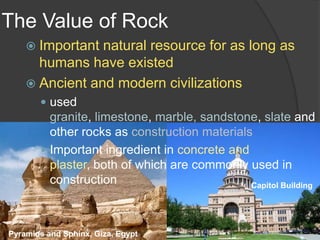
The Value of RockImportant natural resource for as long as humans have existedAncient and modern civilizationsused granite, limestone, marble, sandstone, slate and other rocks as construction materialsImportant ingredient in concrete and plaster, both of which are commonly used in constructionCapitol BuildingPyramids and Sphinx, Giza, Egypt
TajMahal, IndiaGranite CountertopsBrooklyn BridgeStonehenge
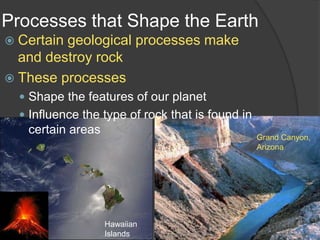
Processes that Shape the EarthCertain geological processes make and destroy rockThese processesShape the features of our planetInfluence the type of rock that is found in certain areasGrand Canyon, ArizonaHawaiian Islands
Weathering, Erosion, and DepositionWeatheringProcess in which water, wind, ice, and heat break down rockImportant because it breaks down rock into fragments of which sedimentary rock is made
ErosionProcess by which wind, water, ice, or gravity transports soil and sediment from one location to anotherIceWindWater
DepositionProcess in which sediment moved by erosion is dropped and comes to rest
Heat and PressureSedimentary rock can also form when buried sediment is squeezed by the weight of overlaying layers of sedimentIf the temperature and pressure are high enough, the rock can change into metamorphic rockIf the rock gets hot enough to melt, this creates the magma that eventually cools to form igneous rock
How the Cycle ContinuesBuried rock is exposed at the Earth’s surface by a combination of uplift and erosionUpliftMovement within the Earth that causes rocks inside the Earth to be moved to the surfaceWhen uplifted rock reaches the Earth’s surface, weathering, erosion, and deposition begin
Rock Cycle illustratedand erosion
Rock ClassificationThree main classesIgneous rockSedimentary rockMetamorphic rockEach class of rock can be divided further, based on differences in the ways rocks formgraniteobsidianshalesandstoneslatemarble
Igneous rock can be divided againbased on whether the magma from which it forms cools on the Earth’s surfaceor below groundSedimentary and metamorphic rocks are also divided into smaller groupsScientists study rocks in detail using two important criteria:CompositionTexture
CompositionChemical makeup of  a rockCan describe either the minerals or other materials in the rockTextureQuality of a rock that is based on the sizes, shapes, and positions of the rock’s grains95%calcitelimestone5%aragonitesiltstonesandstoneConglomerateFine-grainedmedium-grainedCoarse-grained

Earth Science 2.1 : The Rock Cycle

  • 1.
  • 2.
    Objectives:Describetwo ways rockshave been used by humans.Describefour processes that shape Earth’s features.Describe how each type of rock changes into another type as it moves through the rock cycle.List two characteristics of rock that are used to help classify it.
  • 3.
    The Rock CycleRocknaturallyoccurring solid mixture of one or more minerals or organic matterNew rock forms from old rock material constantlyRock cycleThe series of processes in which a rock forms, changes from one type to another, is destroyed, and forms again by geological processes
  • 5.
    The Value ofRockImportant natural resource for as long as humans have existedAncient and modern civilizationsused granite, limestone, marble, sandstone, slate and other rocks as construction materialsImportant ingredient in concrete and plaster, both of which are commonly used in constructionCapitol BuildingPyramids and Sphinx, Giza, Egypt
  • 6.
  • 7.
    Processes that Shapethe EarthCertain geological processes make and destroy rockThese processesShape the features of our planetInfluence the type of rock that is found in certain areasGrand Canyon, ArizonaHawaiian Islands
  • 8.
    Weathering, Erosion, andDepositionWeatheringProcess in which water, wind, ice, and heat break down rockImportant because it breaks down rock into fragments of which sedimentary rock is made
  • 9.
    ErosionProcess by whichwind, water, ice, or gravity transports soil and sediment from one location to anotherIceWindWater
  • 10.
    DepositionProcess in whichsediment moved by erosion is dropped and comes to rest
  • 11.
    Heat and PressureSedimentaryrock can also form when buried sediment is squeezed by the weight of overlaying layers of sedimentIf the temperature and pressure are high enough, the rock can change into metamorphic rockIf the rock gets hot enough to melt, this creates the magma that eventually cools to form igneous rock
  • 12.
    How the CycleContinuesBuried rock is exposed at the Earth’s surface by a combination of uplift and erosionUpliftMovement within the Earth that causes rocks inside the Earth to be moved to the surfaceWhen uplifted rock reaches the Earth’s surface, weathering, erosion, and deposition begin
  • 13.
  • 14.
    Rock ClassificationThree mainclassesIgneous rockSedimentary rockMetamorphic rockEach class of rock can be divided further, based on differences in the ways rocks formgraniteobsidianshalesandstoneslatemarble
  • 15.
    Igneous rock canbe divided againbased on whether the magma from which it forms cools on the Earth’s surfaceor below groundSedimentary and metamorphic rocks are also divided into smaller groupsScientists study rocks in detail using two important criteria:CompositionTexture
  • 16.
    CompositionChemical makeup of a rockCan describe either the minerals or other materials in the rockTextureQuality of a rock that is based on the sizes, shapes, and positions of the rock’s grains95%calcitelimestone5%aragonitesiltstonesandstoneConglomerateFine-grainedmedium-grainedCoarse-grained