Cladophora
Vegetative
Structure
and
Reproductio
n
Kamaljit Sidhu
Associate Professor
Department of Botany
Khalsa College for Women
Civil Lines
Ludhiana
Cladophora-Classification
• Division-Chlorophyta
• Class-Chlorophyceae
• Order-Cladophorales
• Family-Cladophoraceae
• Genus-Cladophora
Occurrence and Vegetative
Structure
• All species are aquatic , abundant in fresh water
and marine habitat
• Usually attached to the substratum and epizoic
• Common species-Cladophora glomerata
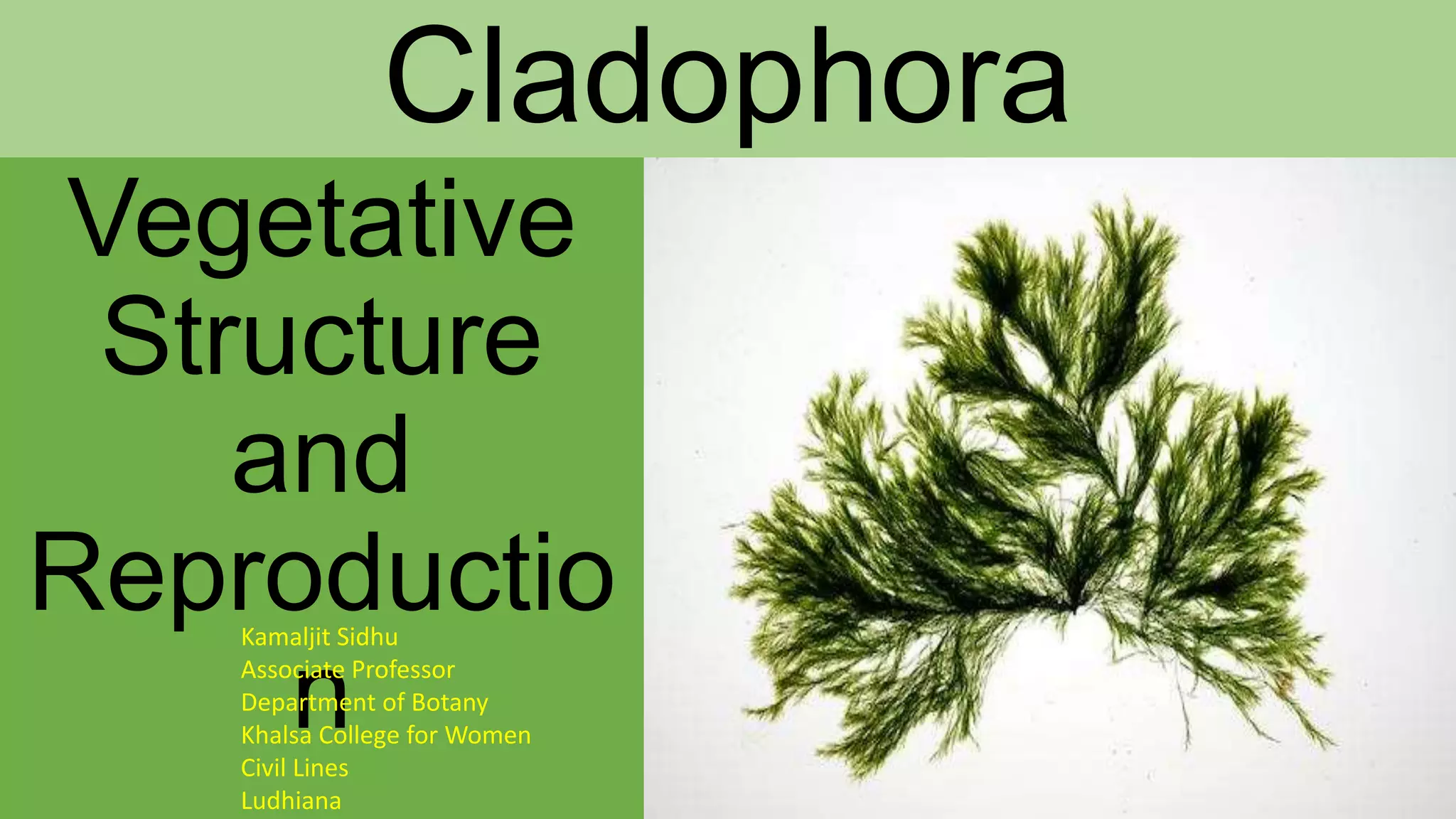
• This green alga is macroscopic
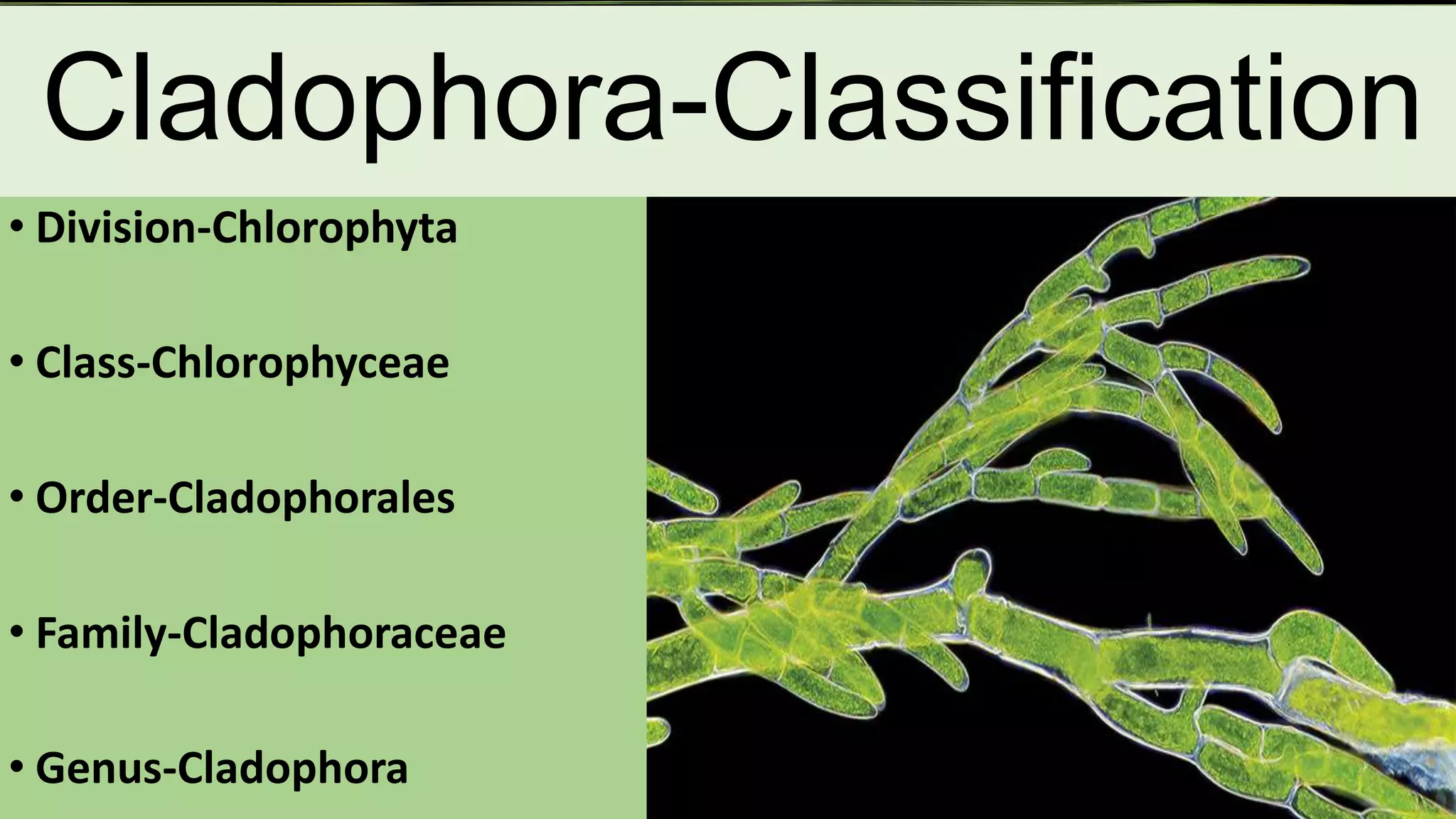
• Plant body multicellulae,filamentous,profusely
branched
• It is coarse and stringy to touch
• Species growing in stagnant water, not attached
to the substratum-aegagropilous
• Attached forms attached to the substratum by
rhizoidal cell
Cladohora-Branching
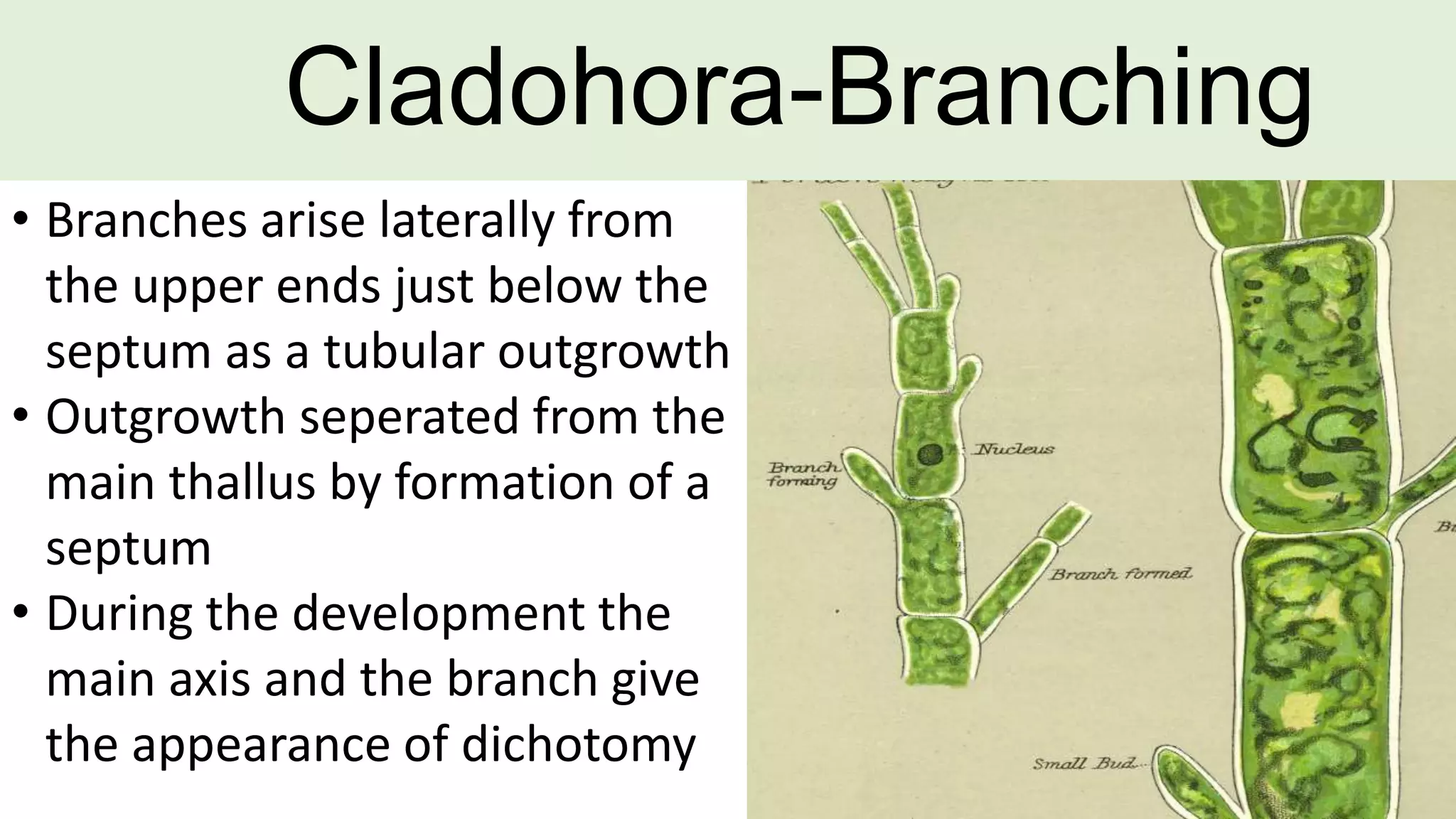
• Branches arise laterally from
the upper ends just below the
septum as a tubular outgrowth
• Outgrowth seperated from the
main thallus by formation of a
septum
• During the development the
main axis and the branch give
the appearance of dichotomy
Cladophora-Cell Structure
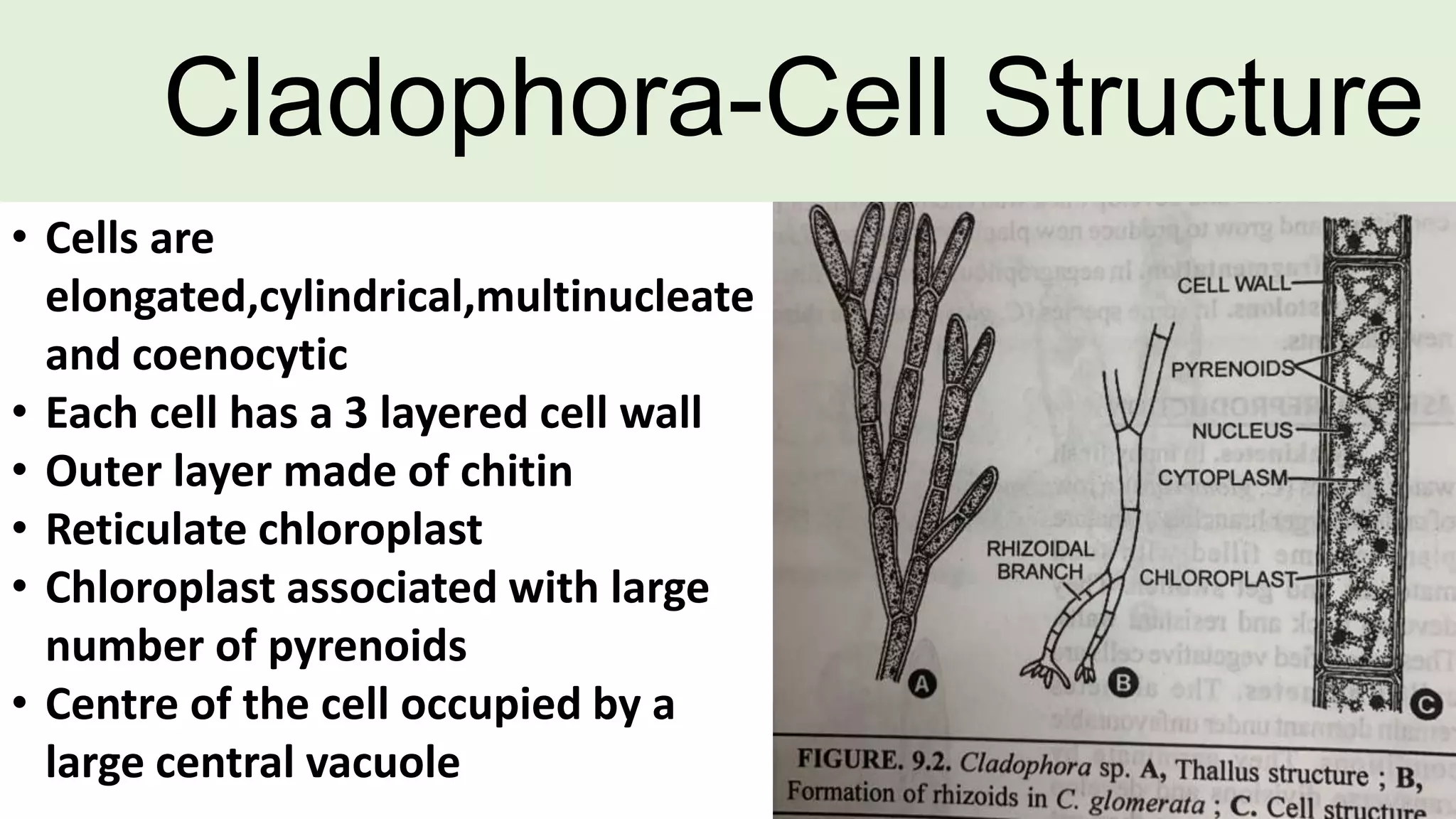
• Cells are
elongated,cylindrical,multinucleate
and coenocytic
• Each cell has a 3 layered cell wall
• Outer layer made of chitin
• Reticulate chloroplast
• Chloroplast associated with large
number of pyrenoids
• Centre of the cell occupied by a
large central vacuole
Reproduction
Vegetative Reproduction
•Storage cells-Rhizoids grow into the substratum , undergo
repeated cell divisions , produce short filaments , store food ,
thick walled, perennate over unfavourable conditions
•Fragmentation-Aegagropilous species filaments break into
small fragments and develop into seperate plants
•Stolons-Rhizoidal branches form stolons and grow into new
filaments
Asexual Reproduction
• Akinetes-Cells in larger branches become
filled with food materials and get swollen.
They develop thick and resistant walls
called akinetes which remain dormant
under unfavourable conditions,germinate
under favourable conditions
• Zoospores-zoospores produced inside the
terminal cells which behave as a
zoosporangium, zoospores are haploid,
produce gametophytic thallus
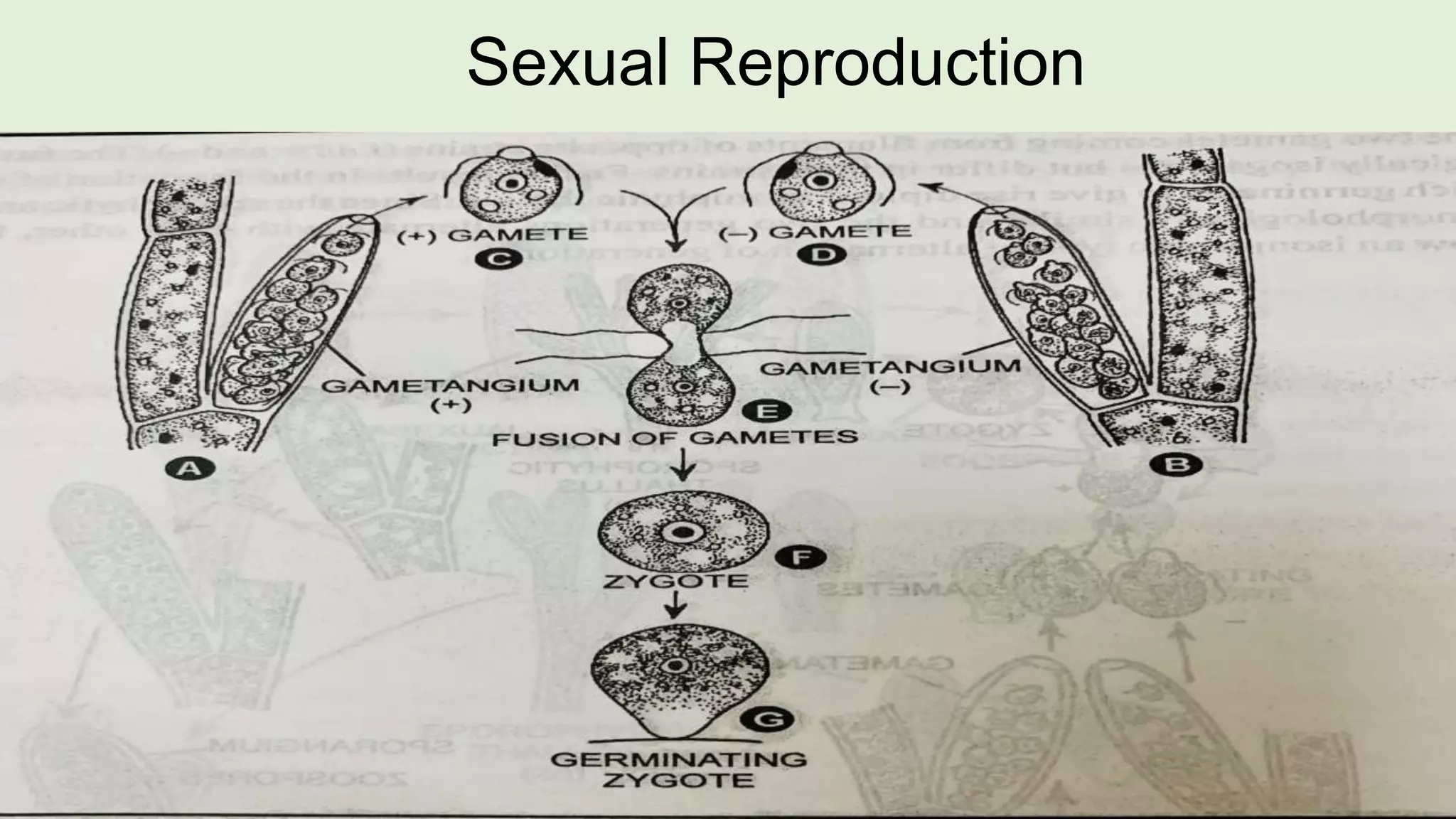
Sexual Reproduction
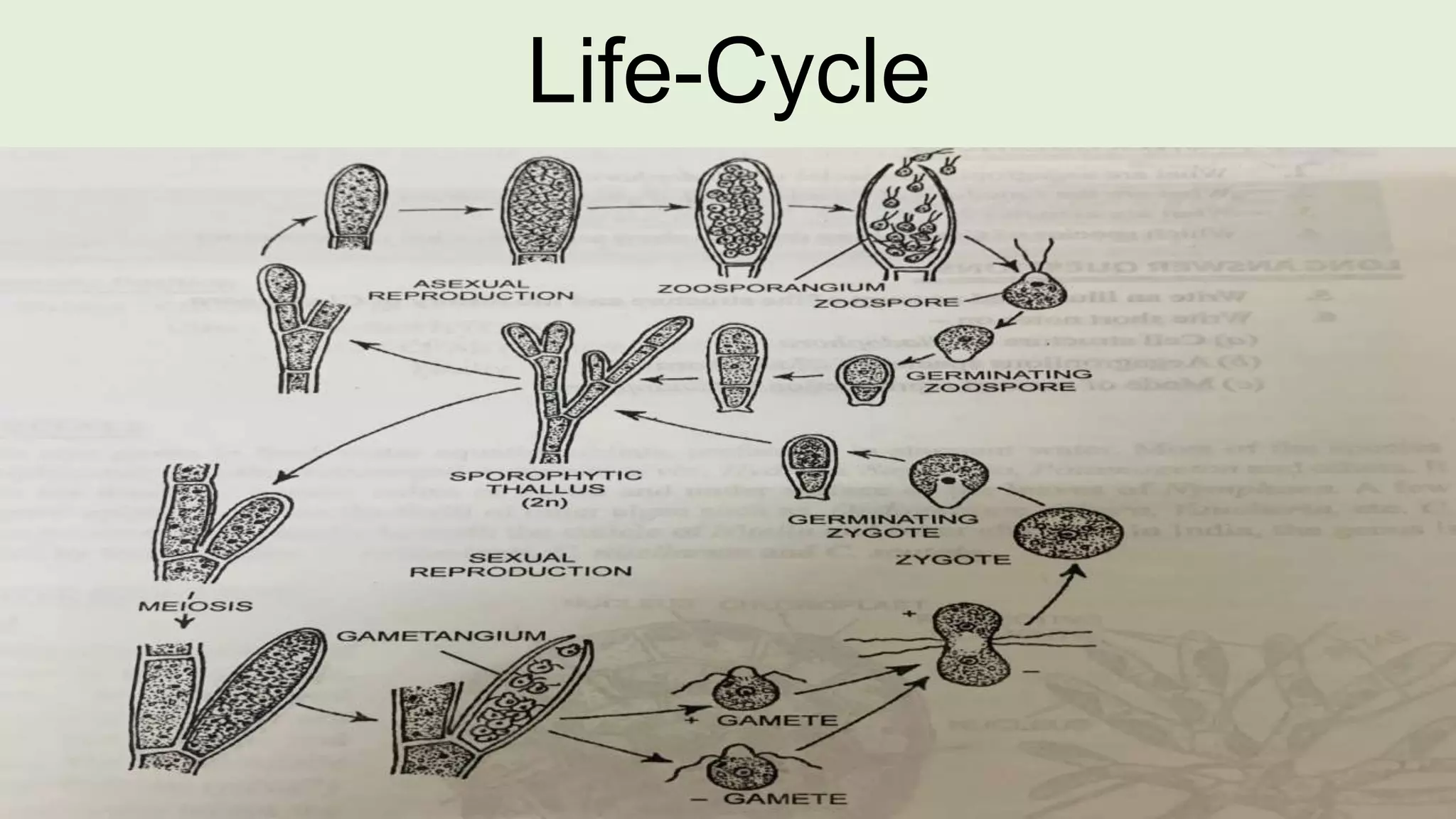
Life-Cycle
Life-Cycle

Cladophora -green alga

  • 1.
  • 2.
    Cladophora-Classification • Division-Chlorophyta • Class-Chlorophyceae •Order-Cladophorales • Family-Cladophoraceae • Genus-Cladophora
  • 3.
    Occurrence and Vegetative Structure •All species are aquatic , abundant in fresh water and marine habitat • Usually attached to the substratum and epizoic • Common species-Cladophora glomerata • This green alga is macroscopic • Plant body multicellulae,filamentous,profusely branched • It is coarse and stringy to touch • Species growing in stagnant water, not attached to the substratum-aegagropilous • Attached forms attached to the substratum by rhizoidal cell
  • 4.
    Cladohora-Branching • Branches ariselaterally from the upper ends just below the septum as a tubular outgrowth • Outgrowth seperated from the main thallus by formation of a septum • During the development the main axis and the branch give the appearance of dichotomy
  • 5.
    Cladophora-Cell Structure • Cellsare elongated,cylindrical,multinucleate and coenocytic • Each cell has a 3 layered cell wall • Outer layer made of chitin • Reticulate chloroplast • Chloroplast associated with large number of pyrenoids • Centre of the cell occupied by a large central vacuole
  • 6.
  • 7.
    Vegetative Reproduction •Storage cells-Rhizoidsgrow into the substratum , undergo repeated cell divisions , produce short filaments , store food , thick walled, perennate over unfavourable conditions •Fragmentation-Aegagropilous species filaments break into small fragments and develop into seperate plants •Stolons-Rhizoidal branches form stolons and grow into new filaments
  • 8.
    Asexual Reproduction • Akinetes-Cellsin larger branches become filled with food materials and get swollen. They develop thick and resistant walls called akinetes which remain dormant under unfavourable conditions,germinate under favourable conditions • Zoospores-zoospores produced inside the terminal cells which behave as a zoosporangium, zoospores are haploid, produce gametophytic thallus
  • 9.
  • 10.
  • 11.