Algae : Anabaena
Prepared by:
Md. Shakiur Rahman
ID: 170711
Biotechnology and Genetic Engineering
Discipline
Khulna University,Bangladesh.
What is Anabaena?
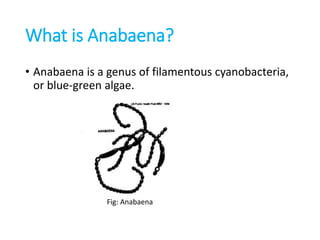
• Anabaena is a genus of filamentous cyanobacteria,
or blue-green algae.
Fig: Anabaena
Structure of Anabaena
• It has filamentous structure. Its filament resembles the
filament of Nostoc.
• The filaments of Nostoc are covered by mucilage and form a
colony which is absent in Anabaena. The filament of
Anabaena consists of string of beaded cells.
• Several intercalary heterocysts are present in the trichome.
• Heterocysts are of same shape as of vegetative cell.
• The filaments are ordinarily straight. But they may be
circinate or irregular.
• Filaments occur singly within a sheath. Sheaths are always
hyaline and watery gelatinous.
Structure of cells of Anabaena
• The cells are spherical or barrel shaped. They are rarely
cylindrical and never discoid.
• The majority of the cells of a colony are similar in size.
Its cells have following components:
• Each cell has outer cell wall. This wall consists of three layers.
The inner layer is thin cellular layer, medium is pectic layer and
outer is mucilage layer.
• The peripheral of the protoplasm is composed of part called
chromoplasm. It contains pigment. Hence it is colored. The
central colourless part of protoplasm contains nucleus like
material called central body or chromatin granules.
• Heterocysts are of same shape as of vegetative cell.
• Golgi bodies, encoplasmic reticulum and mitochondria are
absent in their cells.
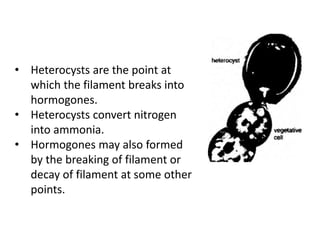
• Heterocysts are the point at
which the filament breaks into
hormogones.
• Heterocysts convert nitrogen
into ammonia.
• Hormogones may also formed
by the breaking of filament or
decay of filament at some other
points.
Occurrence of Anabaena
• Anabaena is found as plankton.
• They form symbiotic relationships with certain plants, such
as the mosquito fern.
• Some species of Anabaena are endophytes. They live in the
roots of Cycas and Azolla.
• Anabaena is found in all types of water.
• Blooms or massive growths can occur in waters with a lot
of nutrients. These blooms discolor the water and give it a
bad odor when the cells die and decay.
Characteristics of Anabaena
• Anabaena is a genus of filamentous cyanobacteria that exist as
plankton.
• They perform oxygenic photosynthesis.
• They are heterocyst forming and photoautotrophic.
• During times of low environmental nitrogen,about one cell out
of every ten will differentiate into heterocyst.
• They are known for nitrogen-fixing abilities, and they form
symbiotic relationships with certain plants, such as the
mosquito fern.
• They are one of four genera of cyanobacteria that produce
neurotoxins, which are harmful to local wildlife, as well as farm
animals and pets.
• Production of these neurotoxins is assumed to be an input into
its symbiotic relationships, protecting the plant from grazing
pressure.
Importance of Anabaena
• It is believed that cyanobacteria on Earth are responsible as
being the producer for most, if not all, the oxygen in the
atmosphere.
• Plants also produce oxygen, however, they depend on
chloroplasts. These plant organelles are believed to have
been derived from the cyanobacteria.
• The Anabaena variabilis strain has been extensively studied
because it also undergoes a process where it produces
hydrogen gas by using sunlight. This product could provide a
reusable source of energy. By further studying the genome
and understanding the process, the hydrogen gas could be
mass produced and used as fuel or energy.
• Certain species of Anabaena have been used on rice,
paddy fields. They act as natural fertilizer.
• The cyanobacteria seem to have been the foundation of
changing the Earth’s atmosphere because it takes care of
half of the Earth’s photosynthesis.
• A more recent study indicated that the Phenylalanine
ammonia lyase (PAL), could be a potential solution to the
disease known as phenylketonuria. Current research is
being done on the possible effects on animals and how
they would carry over to humans.
Anabaena

Anabaena

  • 1.
    Algae : Anabaena Preparedby: Md. Shakiur Rahman ID: 170711 Biotechnology and Genetic Engineering Discipline Khulna University,Bangladesh.
  • 2.
    What is Anabaena? •Anabaena is a genus of filamentous cyanobacteria, or blue-green algae. Fig: Anabaena
  • 3.
    Structure of Anabaena •It has filamentous structure. Its filament resembles the filament of Nostoc. • The filaments of Nostoc are covered by mucilage and form a colony which is absent in Anabaena. The filament of Anabaena consists of string of beaded cells. • Several intercalary heterocysts are present in the trichome. • Heterocysts are of same shape as of vegetative cell. • The filaments are ordinarily straight. But they may be circinate or irregular. • Filaments occur singly within a sheath. Sheaths are always hyaline and watery gelatinous.
  • 4.
    Structure of cellsof Anabaena • The cells are spherical or barrel shaped. They are rarely cylindrical and never discoid. • The majority of the cells of a colony are similar in size. Its cells have following components: • Each cell has outer cell wall. This wall consists of three layers. The inner layer is thin cellular layer, medium is pectic layer and outer is mucilage layer. • The peripheral of the protoplasm is composed of part called chromoplasm. It contains pigment. Hence it is colored. The central colourless part of protoplasm contains nucleus like material called central body or chromatin granules. • Heterocysts are of same shape as of vegetative cell. • Golgi bodies, encoplasmic reticulum and mitochondria are absent in their cells.
  • 5.
    • Heterocysts arethe point at which the filament breaks into hormogones. • Heterocysts convert nitrogen into ammonia. • Hormogones may also formed by the breaking of filament or decay of filament at some other points.
  • 6.
    Occurrence of Anabaena •Anabaena is found as plankton. • They form symbiotic relationships with certain plants, such as the mosquito fern. • Some species of Anabaena are endophytes. They live in the roots of Cycas and Azolla. • Anabaena is found in all types of water. • Blooms or massive growths can occur in waters with a lot of nutrients. These blooms discolor the water and give it a bad odor when the cells die and decay.
  • 7.
    Characteristics of Anabaena •Anabaena is a genus of filamentous cyanobacteria that exist as plankton. • They perform oxygenic photosynthesis. • They are heterocyst forming and photoautotrophic. • During times of low environmental nitrogen,about one cell out of every ten will differentiate into heterocyst. • They are known for nitrogen-fixing abilities, and they form symbiotic relationships with certain plants, such as the mosquito fern. • They are one of four genera of cyanobacteria that produce neurotoxins, which are harmful to local wildlife, as well as farm animals and pets. • Production of these neurotoxins is assumed to be an input into its symbiotic relationships, protecting the plant from grazing pressure.
  • 8.
    Importance of Anabaena •It is believed that cyanobacteria on Earth are responsible as being the producer for most, if not all, the oxygen in the atmosphere. • Plants also produce oxygen, however, they depend on chloroplasts. These plant organelles are believed to have been derived from the cyanobacteria. • The Anabaena variabilis strain has been extensively studied because it also undergoes a process where it produces hydrogen gas by using sunlight. This product could provide a reusable source of energy. By further studying the genome and understanding the process, the hydrogen gas could be mass produced and used as fuel or energy.
  • 9.
    • Certain speciesof Anabaena have been used on rice, paddy fields. They act as natural fertilizer. • The cyanobacteria seem to have been the foundation of changing the Earth’s atmosphere because it takes care of half of the Earth’s photosynthesis. • A more recent study indicated that the Phenylalanine ammonia lyase (PAL), could be a potential solution to the disease known as phenylketonuria. Current research is being done on the possible effects on animals and how they would carry over to humans.