ALGAE
General Characters
Kamaljit Sidhu
Associate professor
Department of Botany
KCW , Civil lines Ludhiana
General Characters
• Phycology-The branch of science which deals with the
study of algae
• The word Phycology is derived from two words Phykos-
Sea weeds and logos-discourse
• Phycologist- A Scientist who studies different aspects of
algae
• Algae-It is a group of most primitive organisms with
simple thalloid plant body.
• They are autotrophic,o2 evolving green plants
• 90% of the oxygen comes from these simple plants
• They can be unicellular or multicellular
• They show wide variation in their morphology , pigments
and other metabolic products
• They bear unicellular or multicellular sex organs
• They differ in their life histories as well
Distribution and Habitat
• Includes 30,000 species distributed world-wide
• They are found growing in a wide variety of habitats
• They are ubiquitous and cosmopolitan
• Predominantly aquatic , could be terrestrial
• Depending upon habitat divided into 3 categories
• Aquatic habitat
• Terrestrial habitat
• Special habitat
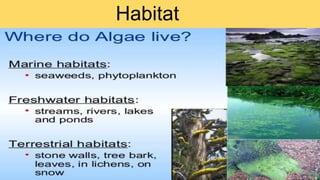
Habitat
Habitat
• Aquatic habitat-They occur in fresh water aquatic habitats and in
marine habitat they are grouped as
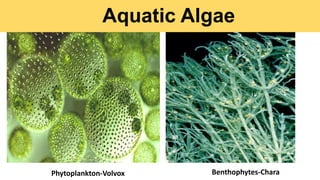
• Phyto planktons-Plants growing and covering the surface of water
body , move on the mercy of the water currents , color of the water
changes due to the colour of the of water blooms example Chlorella,
volvox, Chlamydomonas
• Benthos-All the bottom dwelling organisms both the plants and
animals , Algae growing attached to the bottom of the water reservoir
are called benthophytes , forms growing at the bottom of the soil-
epipellic, those which are attached to the rocks and stones- epilithic
Aquatic Algae
Phytoplankton-Volvox Benthophytes-Chara
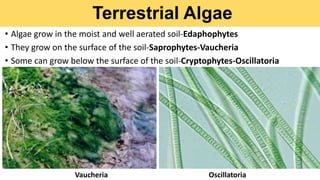
Terrestrial Algae
• Algae grow in the moist and well aerated soil-Edaphophytes
• They grow on the surface of the soil-Saprophytes-Vaucheria
• Some can grow below the surface of the soil-Cryptophytes-Oscillatoria
Vaucheria Oscillatoria
Special Habitats
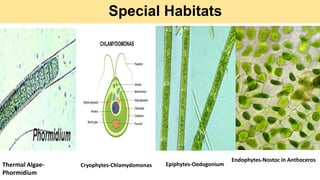
• Thermal Algae-They grow in hot water springs with a temperature ranging
from70-85°C,Example-Phormidium
• Cryophytes-Algae growing in the polar regions on ice and Snow-Chlamydomonas
• Epiphytes-Algae growing on the surface of other plant parts Oedogonium
• Surface of the Angiosperms leaves-Epiphyllophytes
• On the barks of Angiosperms-Epiphloeophytes
• Endophytes-Algae grow within the tissues of the other plants-Anabaena growing
inside Azolla
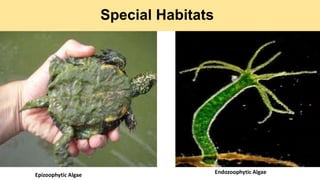
• Epizoophytes-Algae growing on the body of other animals-Cladophora on the
snails
• Endozoophytes-Algae growing inside the body of the animals-Chlorella within the
tissues of Hydra
Special Habitats
Thermal Algae-
Phormidium
Cryophytes-Chlamydomonas Epiphytes-Oedogonium
Endophytes-Nostoc in Anthoceros
Special Habitats
Epizoophytic Algae Endozoophytic Algae
Special Habitats
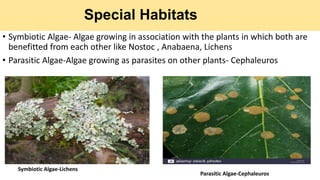
• Symbiotic Algae- Algae growing in association with the plants in which both are
benefitted from each other like Nostoc , Anabaena, Lichens
• Parasitic Algae-Algae growing as parasites on other plants- Cephaleuros
Symbiotic Algae-Lichens
Parasitic Algae-Cephaleuros
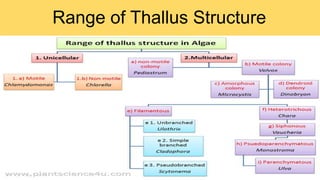
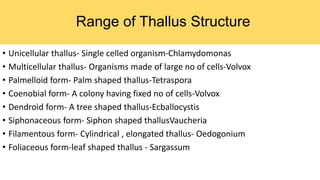
Range of Thallus Structure
• Unicellular thallus- Single celled organism-Chlamydomonas
• Multicellular thallus- Organisms made of large no of cells-Volvox
• Palmelloid form- Palm shaped thallus-Tetraspora
• Coenobial form- A colony having fixed no of cells-Volvox
• Dendroid form- A tree shaped thallus-Ecballocystis
• Siphonaceous form- Siphon shaped thallusVaucheria
• Filamentous form- Cylindrical , elongated thallus- Oedogonium
• Foliaceous form-leaf shaped thallus - Sargassum
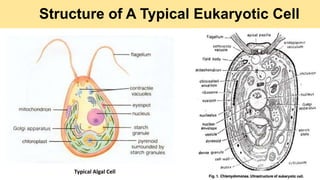
Structure of A Typical Eukaryotic Cell
Typical Algal Cell
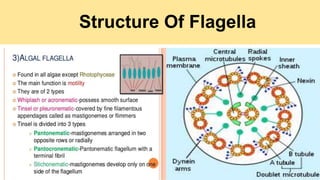
Structure Of Flagella
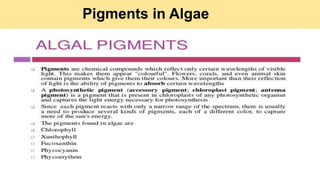
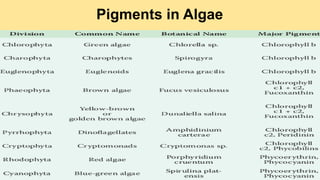
Pigments in Algae
Pigments in Algae
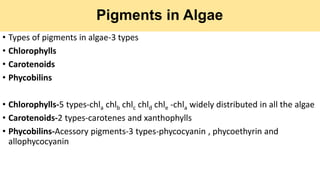
• Types of pigments in algae-3 types
• Chlorophylls
• Carotenoids
• Phycobilins
• Chlorophylls-5 types-chla chlb chlc chld chle -chla widely distributed in all the algae
• Carotenoids-2 types-carotenes and xanthophylls
• Phycobilins-Acessory pigments-3 types-phycocyanin , phycoethyrin and
allophycocyanin
Pigments in Algae
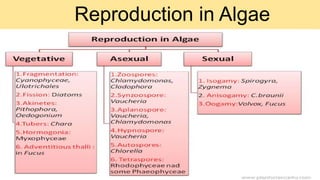
Reproduction in Algae
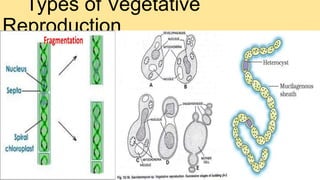
Types of Vegetative
Reproduction
Asexual Reproduction
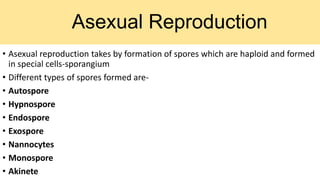
• Asexual reproduction takes by formation of spores which are haploid and formed
in special cells-sporangium
• Different types of spores formed are-
• Autospore
• Hypnospore
• Endospore
• Exospore
• Nannocytes
• Monospore
• Akinete
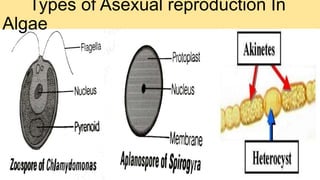
Types of Asexual reproduction In
Algae
Sexual Reproduction
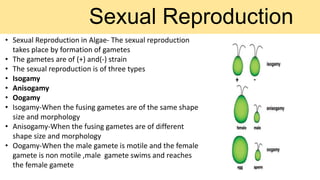
• Sexual Reproduction in Algae- The sexual reproduction
takes place by formation of gametes
• The gametes are of (+) and(-) strain
• The sexual reproduction is of three types
• Isogamy
• Anisogamy
• Oogamy
• Isogamy-When the fusing gametes are of the same shape
size and morphology
• Anisogamy-When the fusing gametes are of different
shape size and morphology
• Oogamy-When the male gamete is motile and the female
gamete is non motile ,male gamete swims and reaches
the female gamete

Algae bsc 1

  • 1.
    ALGAE General Characters Kamaljit Sidhu Associateprofessor Department of Botany KCW , Civil lines Ludhiana
  • 2.
    General Characters • Phycology-Thebranch of science which deals with the study of algae • The word Phycology is derived from two words Phykos- Sea weeds and logos-discourse • Phycologist- A Scientist who studies different aspects of algae • Algae-It is a group of most primitive organisms with simple thalloid plant body. • They are autotrophic,o2 evolving green plants • 90% of the oxygen comes from these simple plants • They can be unicellular or multicellular • They show wide variation in their morphology , pigments and other metabolic products • They bear unicellular or multicellular sex organs • They differ in their life histories as well
  • 3.
    Distribution and Habitat •Includes 30,000 species distributed world-wide • They are found growing in a wide variety of habitats • They are ubiquitous and cosmopolitan • Predominantly aquatic , could be terrestrial • Depending upon habitat divided into 3 categories • Aquatic habitat • Terrestrial habitat • Special habitat
  • 4.
  • 5.
    Habitat • Aquatic habitat-Theyoccur in fresh water aquatic habitats and in marine habitat they are grouped as • Phyto planktons-Plants growing and covering the surface of water body , move on the mercy of the water currents , color of the water changes due to the colour of the of water blooms example Chlorella, volvox, Chlamydomonas • Benthos-All the bottom dwelling organisms both the plants and animals , Algae growing attached to the bottom of the water reservoir are called benthophytes , forms growing at the bottom of the soil- epipellic, those which are attached to the rocks and stones- epilithic
  • 6.
  • 7.
    Terrestrial Algae • Algaegrow in the moist and well aerated soil-Edaphophytes • They grow on the surface of the soil-Saprophytes-Vaucheria • Some can grow below the surface of the soil-Cryptophytes-Oscillatoria Vaucheria Oscillatoria
  • 8.
    Special Habitats • ThermalAlgae-They grow in hot water springs with a temperature ranging from70-85°C,Example-Phormidium • Cryophytes-Algae growing in the polar regions on ice and Snow-Chlamydomonas • Epiphytes-Algae growing on the surface of other plant parts Oedogonium • Surface of the Angiosperms leaves-Epiphyllophytes • On the barks of Angiosperms-Epiphloeophytes • Endophytes-Algae grow within the tissues of the other plants-Anabaena growing inside Azolla • Epizoophytes-Algae growing on the body of other animals-Cladophora on the snails • Endozoophytes-Algae growing inside the body of the animals-Chlorella within the tissues of Hydra
  • 9.
    Special Habitats Thermal Algae- Phormidium Cryophytes-ChlamydomonasEpiphytes-Oedogonium Endophytes-Nostoc in Anthoceros
  • 10.
  • 11.
    Special Habitats • SymbioticAlgae- Algae growing in association with the plants in which both are benefitted from each other like Nostoc , Anabaena, Lichens • Parasitic Algae-Algae growing as parasites on other plants- Cephaleuros Symbiotic Algae-Lichens Parasitic Algae-Cephaleuros
  • 12.
  • 13.
    Range of ThallusStructure • Unicellular thallus- Single celled organism-Chlamydomonas • Multicellular thallus- Organisms made of large no of cells-Volvox • Palmelloid form- Palm shaped thallus-Tetraspora • Coenobial form- A colony having fixed no of cells-Volvox • Dendroid form- A tree shaped thallus-Ecballocystis • Siphonaceous form- Siphon shaped thallusVaucheria • Filamentous form- Cylindrical , elongated thallus- Oedogonium • Foliaceous form-leaf shaped thallus - Sargassum
  • 14.
    Structure of ATypical Eukaryotic Cell Typical Algal Cell
  • 15.
  • 16.
  • 17.
    Pigments in Algae •Types of pigments in algae-3 types • Chlorophylls • Carotenoids • Phycobilins • Chlorophylls-5 types-chla chlb chlc chld chle -chla widely distributed in all the algae • Carotenoids-2 types-carotenes and xanthophylls • Phycobilins-Acessory pigments-3 types-phycocyanin , phycoethyrin and allophycocyanin
  • 18.
  • 19.
  • 20.
  • 21.
    Asexual Reproduction • Asexualreproduction takes by formation of spores which are haploid and formed in special cells-sporangium • Different types of spores formed are- • Autospore • Hypnospore • Endospore • Exospore • Nannocytes • Monospore • Akinete
  • 22.
    Types of Asexualreproduction In Algae
  • 23.
    Sexual Reproduction • SexualReproduction in Algae- The sexual reproduction takes place by formation of gametes • The gametes are of (+) and(-) strain • The sexual reproduction is of three types • Isogamy • Anisogamy • Oogamy • Isogamy-When the fusing gametes are of the same shape size and morphology • Anisogamy-When the fusing gametes are of different shape size and morphology • Oogamy-When the male gamete is motile and the female gamete is non motile ,male gamete swims and reaches the female gamete