MICROALGAL TECNNOLOGY
CHLOROPHYCEAE
M.SANGEETHA
I-MSC MICROBIOLOGY
VIVEKANANDHA ART’S AND SCIENCE COLLEGE FOR WOMEN
SANKAGIRI ,SALEM, TAMILNADU
DEPARTMENT OF MICROBIOLOGY
VIVEKANANDHA ART’S AND SCIENCE COLLEGE FOR
WOMEN
SANKAGIRI
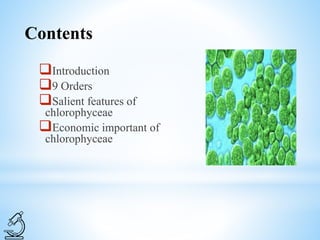
Introduction
9 Orders
Salient features of
chlorophyceae
Economic important of
chlorophyceae
Contents
INTRODUCTION OF CHLOROPHYCEAE
Fresh water or marine algae, with unicellular or
multicellular body.
Cells are eukaryotic, containing cellulose in the cell
wall.
Chief pigments include
Chlorophyll a and b
Alpha carotenes
Beta carotenes
Gamma carotenes
Lycopene
Hexanthin
 Lentin
Violaxanthin
Astaxanthin.
1.Volvocales
2.Chlorococcales
3.Ulotrichales
4.Cladophorales
5.Chaetophorales
6.Oedogoniales
7.Conjugales
8.Siphonales
9.Charales
9 Orders
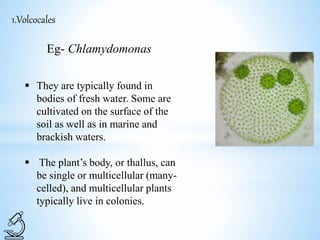
1.Volcocales
Eg- Chlamydomonas
 They are typically found in
bodies of fresh water. Some are
cultivated on the surface of the
soil as well as in marine and
brackish waters.
 The plant’s body, or thallus, can
be single or multicellular (many-
celled), and multicellular plants
typically live in colonies.
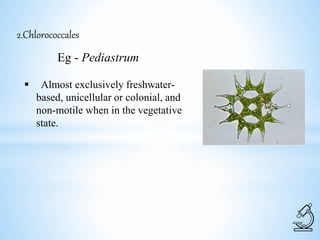
2.Chlorococcales
Eg - Pediastrum
 Almost exclusively freshwater-
based, unicellular or colonial, and
non-motile when in the vegetative
state.
3.Cheatophorales
 Chaetophorales members are
typically found in freshwater.
 Although the plant body is
filamentous and exhibits a prominent
heterotrichous (prostrate + erect
system) habit, Coleochaete has a well-
developed prostrate system (creeping),
while Microthamnion has a well-
developed erect system.
Eg- cephaleurous
4.Ulotricales
Eg- ulothrix
 They are mostly found on soil or in
freshwater bodies of water (like Ulothrix),
however, a few are marine (e.g., Ulva,
Enteromorpha).
 The body of a plant is typically
unbranched and filamentous, however, in the
ulvaceae family, it is parenchymatous or
foliaceous. Cells have a single uninucleate
nucleus and different forms of chloroplast,
including axial, parietal, and C-shaped
chloroplast.
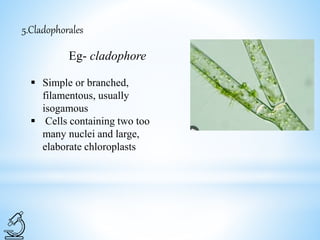
5.Cladophorales
Eg- cladophore
 Simple or branched,
filamentous, usually
isogamous
 Cells containing two too
many nuclei and large,
elaborate chloroplasts
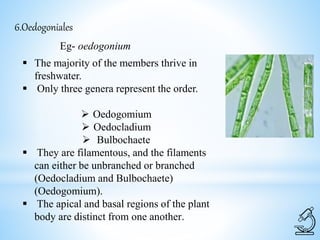
6.Oedogoniales
Eg- oedogonium
 The majority of the members thrive in
freshwater.
 Only three genera represent the order.
 Oedogomium
 Oedocladium
 Bulbochaete
 They are filamentous, and the filaments
can either be unbranched or branched
(Oedocladium and Bulbochaete)
(Oedogomium).
 The apical and basal regions of the plant
body are distinct from one another.
7.Siphonales
Eg- codium
 Siphonales consist primarily of marine
species.
 A few are freshwater species.
 A few of the members develop as
endophytes or epiphytes.
 The thalloid plant body is coenocytic,
multinucleate, and variably branching.
 Plant bodies can range from being very
branching filamentous types to simple
vesicular types (Protosiphon).
 Small, discoid chromatophores are widely
dispersed throughout the thallus.
8.Conjucales
Eg- spirogyra
 They are primarily unicellular
or colonial (typically filamen-
tous), have complex
chloroplasts, and motile
gametes
 Reproduce only in freshwater
through vegetative cell division
or the conjugation of amoeboid
gametes.
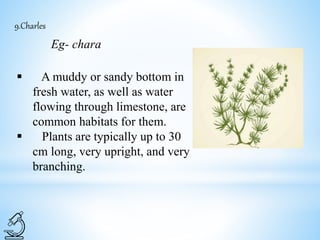
9.Charles
Eg- chara
 A muddy or sandy bottom in
fresh water, as well as water
flowing through limestone, are
common habitats for them.
 Plants are typically up to 30
cm long, very upright, and very
branching.
Salient features of chlorophyceae
1. Chlorophyceae commonly called as green algae.
2. Mostly aquatic (fresh water or marine), few terrestrial.
3. Shape of chloroplast differs. It may be cup shaped
(Chlamydomonas) or girdle – shaped or reticulate, or stellate .
4. Chlorophyll ‘a’ and ‘b’ are photosynthetic pigments.
5. Pyrenoids store starch & also proteins.
6. Outer cell wall is made of pectin and inner is cellulose.
7. Vegetative reproduction is by fragmentation.
8. Asexual reproduction by zoospores, aplanospores and akinetes.
9. Sexual reproduction may be isogamous, anisogamous or
oogamous. E.g. Chlamydomonas, Volvox and Spirogyra
Economic Importants
 Chlorophycae is used as food; chlorella is known to
produce food which is rich in proteins, vitamins, fats, and
minerals. It is also used in space research to fight for
oxygen, food, removal of carbon dioxide, and organic
matter.
 It is even used as Larvicide as it gathers calcium over its
surface and killes larva of different sides producing
organism.
 It is even used in the sewage tank as certain green algae
like chlorella, Scenedesmus and Chlamydomonus cause
oxidation of sewage tank and clean up.
 It is also used as antibiotics as Chlorella yields antibiotic
type called the chlorellin.
Chlorophyceae.pptx

Chlorophyceae.pptx

  • 1.
    MICROALGAL TECNNOLOGY CHLOROPHYCEAE M.SANGEETHA I-MSC MICROBIOLOGY VIVEKANANDHAART’S AND SCIENCE COLLEGE FOR WOMEN SANKAGIRI ,SALEM, TAMILNADU DEPARTMENT OF MICROBIOLOGY VIVEKANANDHA ART’S AND SCIENCE COLLEGE FOR WOMEN SANKAGIRI
  • 2.
    Introduction 9 Orders Salient featuresof chlorophyceae Economic important of chlorophyceae Contents
  • 3.
    INTRODUCTION OF CHLOROPHYCEAE Freshwater or marine algae, with unicellular or multicellular body. Cells are eukaryotic, containing cellulose in the cell wall. Chief pigments include Chlorophyll a and b Alpha carotenes Beta carotenes Gamma carotenes Lycopene Hexanthin  Lentin Violaxanthin Astaxanthin.
  • 4.
  • 5.
    1.Volcocales Eg- Chlamydomonas  Theyare typically found in bodies of fresh water. Some are cultivated on the surface of the soil as well as in marine and brackish waters.  The plant’s body, or thallus, can be single or multicellular (many- celled), and multicellular plants typically live in colonies.
  • 6.
    2.Chlorococcales Eg - Pediastrum Almost exclusively freshwater- based, unicellular or colonial, and non-motile when in the vegetative state.
  • 7.
    3.Cheatophorales  Chaetophorales membersare typically found in freshwater.  Although the plant body is filamentous and exhibits a prominent heterotrichous (prostrate + erect system) habit, Coleochaete has a well- developed prostrate system (creeping), while Microthamnion has a well- developed erect system. Eg- cephaleurous
  • 8.
    4.Ulotricales Eg- ulothrix  Theyare mostly found on soil or in freshwater bodies of water (like Ulothrix), however, a few are marine (e.g., Ulva, Enteromorpha).  The body of a plant is typically unbranched and filamentous, however, in the ulvaceae family, it is parenchymatous or foliaceous. Cells have a single uninucleate nucleus and different forms of chloroplast, including axial, parietal, and C-shaped chloroplast.
  • 9.
    5.Cladophorales Eg- cladophore  Simpleor branched, filamentous, usually isogamous  Cells containing two too many nuclei and large, elaborate chloroplasts
  • 10.
    6.Oedogoniales Eg- oedogonium  Themajority of the members thrive in freshwater.  Only three genera represent the order.  Oedogomium  Oedocladium  Bulbochaete  They are filamentous, and the filaments can either be unbranched or branched (Oedocladium and Bulbochaete) (Oedogomium).  The apical and basal regions of the plant body are distinct from one another.
  • 11.
    7.Siphonales Eg- codium  Siphonalesconsist primarily of marine species.  A few are freshwater species.  A few of the members develop as endophytes or epiphytes.  The thalloid plant body is coenocytic, multinucleate, and variably branching.  Plant bodies can range from being very branching filamentous types to simple vesicular types (Protosiphon).  Small, discoid chromatophores are widely dispersed throughout the thallus.
  • 12.
    8.Conjucales Eg- spirogyra  Theyare primarily unicellular or colonial (typically filamen- tous), have complex chloroplasts, and motile gametes  Reproduce only in freshwater through vegetative cell division or the conjugation of amoeboid gametes.
  • 13.
    9.Charles Eg- chara  Amuddy or sandy bottom in fresh water, as well as water flowing through limestone, are common habitats for them.  Plants are typically up to 30 cm long, very upright, and very branching.
  • 14.
    Salient features ofchlorophyceae 1. Chlorophyceae commonly called as green algae. 2. Mostly aquatic (fresh water or marine), few terrestrial. 3. Shape of chloroplast differs. It may be cup shaped (Chlamydomonas) or girdle – shaped or reticulate, or stellate . 4. Chlorophyll ‘a’ and ‘b’ are photosynthetic pigments. 5. Pyrenoids store starch & also proteins. 6. Outer cell wall is made of pectin and inner is cellulose. 7. Vegetative reproduction is by fragmentation. 8. Asexual reproduction by zoospores, aplanospores and akinetes. 9. Sexual reproduction may be isogamous, anisogamous or oogamous. E.g. Chlamydomonas, Volvox and Spirogyra
  • 15.
    Economic Importants  Chlorophycaeis used as food; chlorella is known to produce food which is rich in proteins, vitamins, fats, and minerals. It is also used in space research to fight for oxygen, food, removal of carbon dioxide, and organic matter.  It is even used as Larvicide as it gathers calcium over its surface and killes larva of different sides producing organism.  It is even used in the sewage tank as certain green algae like chlorella, Scenedesmus and Chlamydomonus cause oxidation of sewage tank and clean up.  It is also used as antibiotics as Chlorella yields antibiotic type called the chlorellin.