Class- Chlorophyceae
Order- Volvocales
Family- Volvocaceae
VOLVOX
 Colonial-hollow sphear with mucilage
 Fresh water
 Found in ponds, lakes, tanks,puddles,pools etc.
 Blooms during favourable condition
 Float during day – deep during night
 6/20
 V. africanus, V. prolificus, V. merelli, V.
globator, V rouseletii,
OCCURRENCE
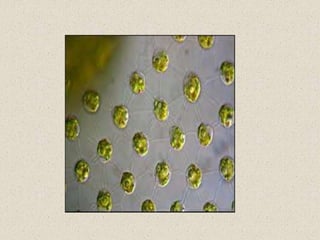
 Colonial, spherical or broadly elliptical
 Macroscopic –pin head – 0.5- 1.5 mm
 500 – 50000 chlamydomonas like cells
 Haploid gametophyte
 Arrangement is definite
 Coenobium (specific arrangement and definite number
 Embeded in a mass of mucilage
 Each cell surrounded by mucilage sheath
 Each cell of coenobium performs its own function of nutrition,
respiration & excretion
 Cells are inter connected by plasmodesmata
STRUCTURE
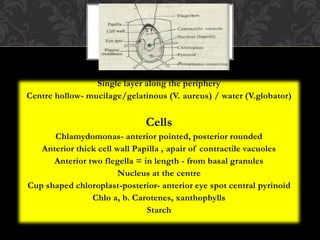
Single layer along the periphery
Centre hollow- mucilage/gelatinous (V. aureus) / water (V.globator)
Cells
Chlamydomonas- anterior pointed, posterior rounded
Anterior thick cell wall Papilla , apair of contractile vacuoles
Anterior two flegella = in length - from basal granules
Nucleus at the centre
Cup shaped chloroplast-posterior- anterior eye spot central pyrinoid
Chlo a, b. Carotenes, xanthophylls
Starch
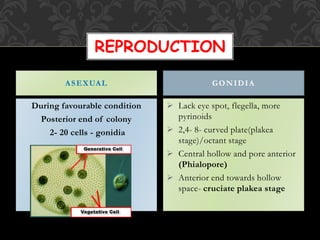
During favourable condition
Posterior end of colony
2- 20 cells - gonidia
 Lack eye spot, flegella, more
pyrinoids
 2,4- 8- curved plate(plakea
stage)/octant stage
 Central hollow and pore anterior
(Phialopore)
 Anterior end towards hollow
space- cruciate plakea stage
ASEXUAL GONIDIA
REPRODUCTION
 Sphere cell turn completely
inside out through phialopore
 Develop eye spot and flegella
 Duaghter colony inside the
gonidial wall
 Release through repture
INVAGINATION/INVERSION
Oogamous
End of the season
Homothallic (V. globator)
Heterothallic (V. aureus)
Monoecious – protandrous
V. aureus- Protogynous
Male- antheredium
Female – oogonium
Haploid gametophyte
SEXUAL
REPRODUCTION
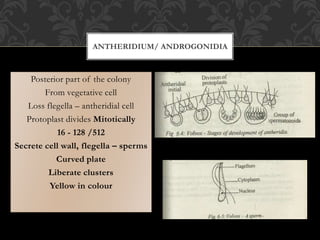
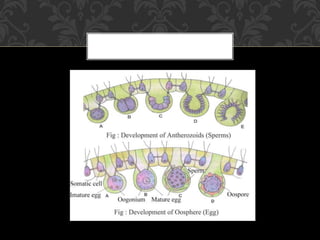
Posterior part of the colony
From vegetative cell
Loss flegella – antheridial cell
Protoplast divides Mitotically
16 - 128 /512
Secrete cell wall, flegella – sperms
Curved plate
Liberate clusters
Yellow in colour
ANTHERIDIUM/ ANDROGONIDIA
Posterior
Develops to oogonial cell
Loses flegella, eye spot
Protoplast gets rounded- egg /
ovum
Haploid
Peripheral chloroplast
Yellow
OOGONIUM / GYNOGONIDIA
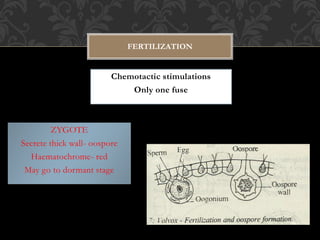
Chemotactic stimulations
Only one fuse
ZYGOTE
Secrete thick wall- oospore
Haematochrome- red
May go to dormant stage
FERTILIZATION
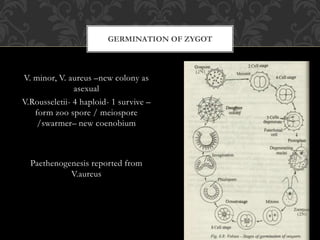
V. minor, V. aureus –new colony as
asexual
V.Rousseletii- 4 haploid- 1 survive –
form zoo spore / meiospore
/swarmer– new coenobium
Paethenogenesis reported from
V.aureus
GERMINATION OF ZYGOT
LIFE CYCLE

Volvox

  • 1.
  • 2.
     Colonial-hollow sphearwith mucilage  Fresh water  Found in ponds, lakes, tanks,puddles,pools etc.  Blooms during favourable condition  Float during day – deep during night  6/20  V. africanus, V. prolificus, V. merelli, V. globator, V rouseletii, OCCURRENCE
  • 3.
     Colonial, sphericalor broadly elliptical  Macroscopic –pin head – 0.5- 1.5 mm  500 – 50000 chlamydomonas like cells  Haploid gametophyte  Arrangement is definite  Coenobium (specific arrangement and definite number  Embeded in a mass of mucilage  Each cell surrounded by mucilage sheath  Each cell of coenobium performs its own function of nutrition, respiration & excretion  Cells are inter connected by plasmodesmata STRUCTURE
  • 5.
    Single layer alongthe periphery Centre hollow- mucilage/gelatinous (V. aureus) / water (V.globator) Cells Chlamydomonas- anterior pointed, posterior rounded Anterior thick cell wall Papilla , apair of contractile vacuoles Anterior two flegella = in length - from basal granules Nucleus at the centre Cup shaped chloroplast-posterior- anterior eye spot central pyrinoid Chlo a, b. Carotenes, xanthophylls Starch
  • 6.
    During favourable condition Posteriorend of colony 2- 20 cells - gonidia  Lack eye spot, flegella, more pyrinoids  2,4- 8- curved plate(plakea stage)/octant stage  Central hollow and pore anterior (Phialopore)  Anterior end towards hollow space- cruciate plakea stage ASEXUAL GONIDIA REPRODUCTION
  • 7.
     Sphere cellturn completely inside out through phialopore  Develop eye spot and flegella  Duaghter colony inside the gonidial wall  Release through repture INVAGINATION/INVERSION
  • 8.
    Oogamous End of theseason Homothallic (V. globator) Heterothallic (V. aureus) Monoecious – protandrous V. aureus- Protogynous Male- antheredium Female – oogonium Haploid gametophyte SEXUAL REPRODUCTION
  • 9.
    Posterior part ofthe colony From vegetative cell Loss flegella – antheridial cell Protoplast divides Mitotically 16 - 128 /512 Secrete cell wall, flegella – sperms Curved plate Liberate clusters Yellow in colour ANTHERIDIUM/ ANDROGONIDIA
  • 10.
    Posterior Develops to oogonialcell Loses flegella, eye spot Protoplast gets rounded- egg / ovum Haploid Peripheral chloroplast Yellow OOGONIUM / GYNOGONIDIA
  • 12.
    Chemotactic stimulations Only onefuse ZYGOTE Secrete thick wall- oospore Haematochrome- red May go to dormant stage FERTILIZATION
  • 13.
    V. minor, V.aureus –new colony as asexual V.Rousseletii- 4 haploid- 1 survive – form zoo spore / meiospore /swarmer– new coenobium Paethenogenesis reported from V.aureus GERMINATION OF ZYGOT
  • 14.