•In the beginning,scientists divided
organisms that live on the earth to the
plants and animals based on their
characteristics:
Animals Plants
Organic
materials
Photosynthesi
s
Energy
source
No Present Chlorophyll
Glycogen and
fats
Starch Stored
materials
Motile Non- motile Motility
Not present Present Cell wall
Classification of plant kingdom
19.
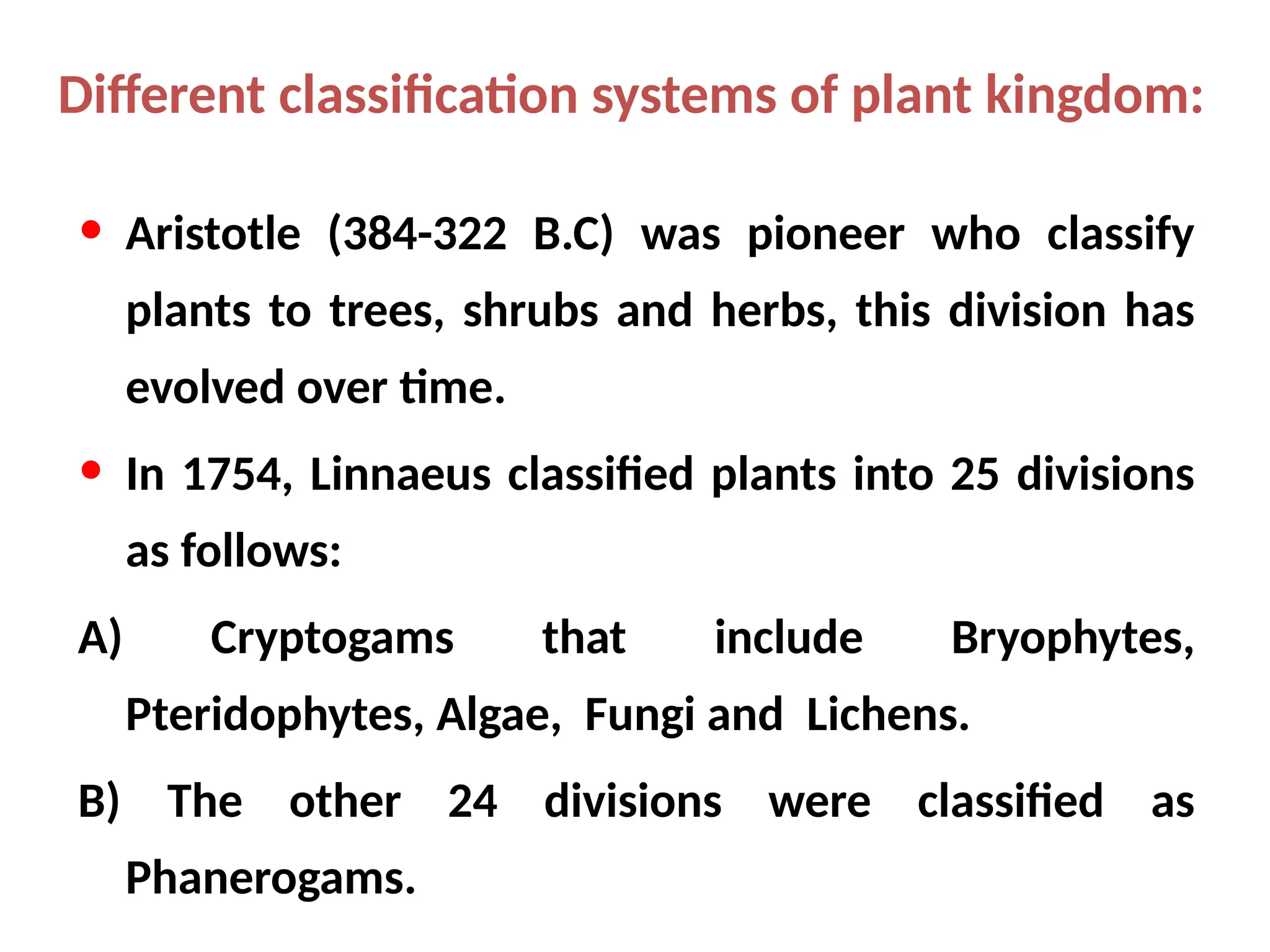
Different classification systemsof plant kingdom:
• Aristotle (384-322 B.C) was pioneer who classify
plants to trees, shrubs and herbs, this division has
evolved over time.
• In 1754, Linnaeus classified plants into 25 divisions
as follows:
A) Cryptogams that include Bryophytes,
Pteridophytes, Algae, Fungi and Lichens.
B) The other 24 divisions were classified as
Phanerogams.
20.
Haeckel's three Kingdomssystem
• In 1866, Haeckel suggested to put the microorganisms
in a separate kingdom named Protista, it includes all
microorganisms such as algae, fungi and bacteria, in
addition to the plant kingdom and the animal
kingdom.
Three Kingdom: Protista, Plantae, Animalia
21.
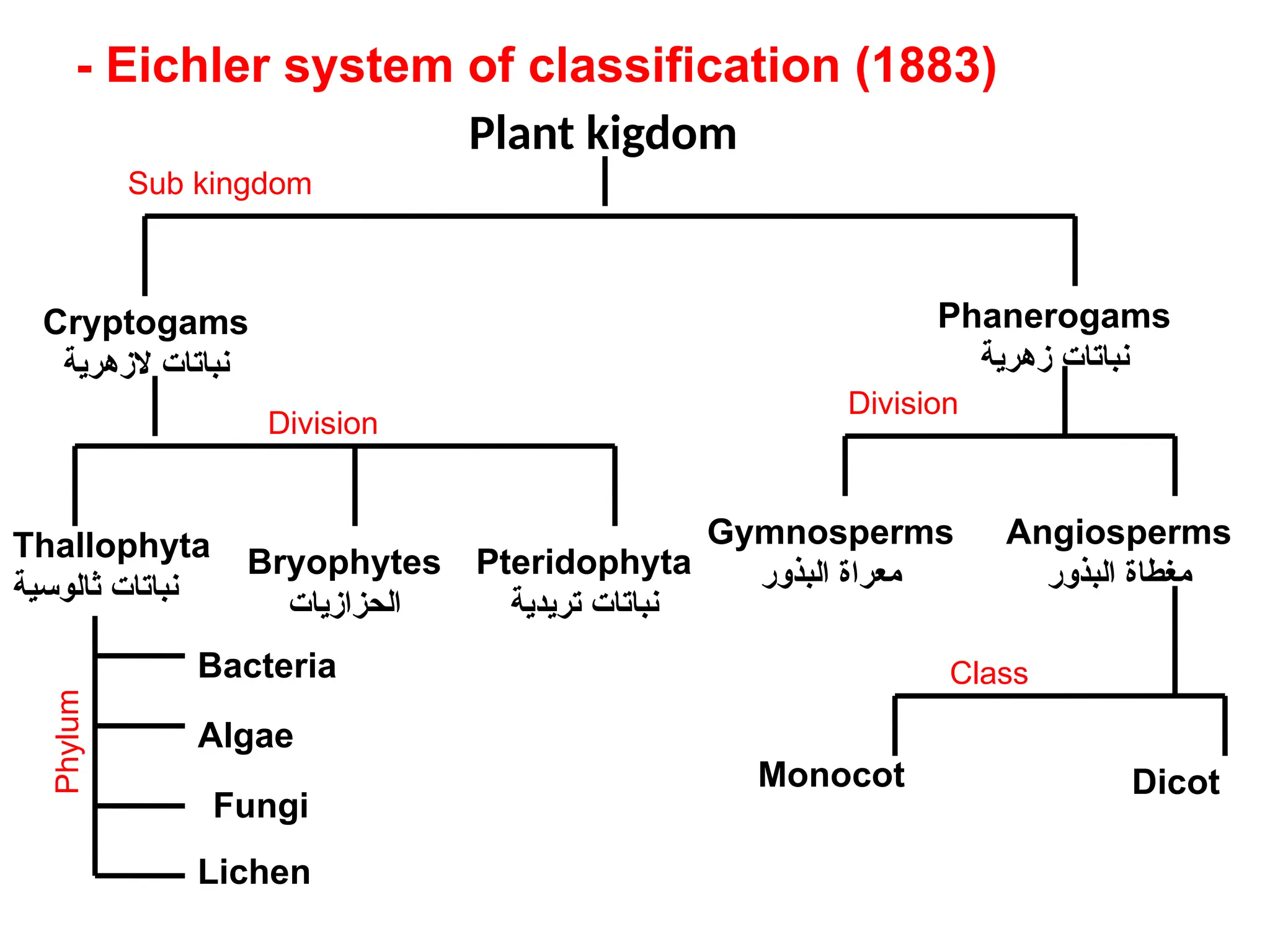
Plant kigdom
Cryptogams
الزهرية نباتات
Phanerogams
زهريةنباتات
Thallophyta
ثالوسية نباتات
Bryophytes
الحزازيات
Pteridophyta
تريدية نباتات
Gymnosperms
البذور معراة
Angiosperms
البذور مغطاة
Bacteria
Algae
Fungi
Lichen
Monocot Dicot
Sub kingdom
Phylum
Division
Division
Class
- Eichler system of classification (1883)
22.
- Five kingdomsclassification system by Robert Whittaker (1969)
• On the basis of:
1- Cell structure (prokaryotic or eukaryotic)
2- Body structure (unicellular or multicellular)
3- Mode of nutrition (autotrophic or heterotrophic)
4- Ecological role (producer, decomposer, consumer)
- Three domainsclassification system by Carl Woese
(1990)
In this system organisms were classified into three
domains based on differences of the sequences of
nucleotides of ribosomal RNA (rRNA) of the cell as well
as the lipid structure of the cell membrane.
Domain: a taxonomic subdivision larger than kingdom
What is differencebetween archaea and
Eubacteria??
Archaebacteria and eubacteria are two domains of the
kingdom: Monera, which contains the least organized
unicellular prokaryotic microorganisms on earth.
Both archaebacteria and eubacteria are single
celled
microorganisms, which are usually called prokaryotes.
The main difference between archaebacteria and
eubacteria is that archaebacteria are usually found in
extreme environmental conditions whereas Eubacteria
available from everywhere on earth.
27.
Algae
•Algae are thallophytes(plants lacking roots, stems, and
leaves) that have chlorophyll a as their primary photo
synthetic pigment.
28.
• Habitats: algaeare commonly distributed in water (fresh
water, marine, or brackish(, soils, rocks, desert soils, hot
springs, they also grow in the snow of some high
mountains or living in lichen associations on rocks
( an alga and a fungus living together in symbiosis).
• They function as the primary producers in the food chain,
producing organic material from sunlight, carbon dioxide,
and water.
• They also form the oxygen necessary for the metabolism
of the consumer organisms.
29.
Morphological forms ofalgae
• Unicellular (consist of a single cell such as Chlamydomonas)
• Colonial (include different numbers of cells such as Gonium)
• Coenobium (specialized colonies contain a specific number of cells,
each with their own tasks, that cannot survive alone such as Volvox)
30.
• Filamentous (Filamentousalgae undergo cell division but
remain connected, forming long filaments of attached cells.
Each cell within the filament has its own internal structures)
• Unbranched filaments such as spirogyra
• Branched filaments such as cladophora
31.
• Coenocytic algae,in which the protoplast is not divided into cells,
the absence of cell boundaries and the distribution of nuclei in a d
ense mass of cytoplasm such as Vaucheria
32.
Classification of algae
•Algae are grouped in eleven divisions based
on pigments, stored food, cell wall
composition and flagellation.
33.
Cyanophycophyta (Blue-green algae)or
cyanobacteria
• They are belong to the prokaryotes, in which the nucleus is
primitive (DNA is not surrounded by nuclear membrane) as in
bacteria.
• They are characterized by the presence of the blue pigment
phycocyanin in addition to chlorophyll.
• They are widely distributed in fresh and marine water, soils, hot
springs, cold water and as lichen with a fungus.
34.
Nostoc
• Habitats: stagnantwater and damp soils.
• It is in the form of unbranched filaments with bead-like
rows of cells.
• There are an enlarged thick walled cells called
heterocysts which have the ability to fix nitrogen,
between each two heterocysts, a number of cells are
found called hormogonia.
• The whole filament is surrounded by gelatinous sheath.
35.
• Some vegetativecells in the filament enlarge
in size, become rich in food materials and
form a thick wall which are very resistant to
unfavorable conditions, Known as akinetes.
Chlorophycophyta (Green algae)
•They contain the green pigment chlorophyll which localized
in the chloroplastids.
• They live in both aquatic and terrestrial habitats especially in
fresh water.
38.
• Forms ofchlorophyta:
1- Unicellular: the individual is formed of a
single cell having the capacity to perform all
the vital activities such as chlamydomonas.
2- Colonial forms: there are two types of
colonial forms as follow:
39.
# Colonial formsin which there is no divition of labour
(each cell in the colony is responsible for all the vital
activities of the organism such as Pandorina.
# Colonial forms in which there is a division of labour
(the vital activities of the organism are divided
between the cells; each kind of cells can perform a
single function such as Volvox.
40.
3- Filamentous forms:in which the alga is formed of a row of cells
identical in both shape and function.
# Unbranched filaments such as spirogyra
# Branched filaments such as cladophora
41.
chlamydomonas
• Pear-shaped, motileunicellular green algae.
• It live in fresh water, standing water rich in ammonium compounds
and also in wet soils.
• It swims with two flagella.
• It contains a large cup-shaped chloroplast, a large pyrenoid, and an
"eyespot" that senses light.
43.
Volvox
• Each matureVolvox colony is composed of
numerous flagellate cells similar
to Chlamydomonas,
• There is a division of labour between the cells of
the colony, there are four types:
44.
• Vegetative (somatic)cells: they are small in size and
biflagellate, and represent the majority of the colony,
are specialized for nutrition and motion.
• Gonidia: less in number, slightly large in size and are
specialized for asexual reproduction.
• Antheridia: few in number, they act as male sexual cells
producing biflagellate antherozoids.
• Oogonia: few in number, they act as female sexual cells
which produces one egg.
spirogyra
• Filamentous unbranchedmulticellular green alga.
• It is found in streams, pons and pools.
• It consists of a row of cylindrical cells, each cell
surrounded by a cellulose cell wall covered with
mucilage sheath which makes the filament slimy to
touch.
• Each cell contains spiral-shaped chloroplast carrying
several pyrenoids.
• The nucleus is suspended in the central vacuole of the
cell by means of cytoplasmic strands.
48.
Bacillariophyta (Diatoms)
•Unicellular orcolonies.
• The cell contains carotenes, xanthophylls, and chlorophyll.
• They live in fresh and marine waters, some of them being fixed
to rocks or growing on other water plants, others are free-floating
as planktonic.
49.
• A uniquefeature of diatom cells is that they are enclosed
within a cell wall made of silica (hydrated silicon dioxide)
called a frustule.
• After death and decay of cells, the silica of the walls
remain unaffected and accumulate in huge amounts
forming deposits of fossil diatoms known as
diatomaceous earth (األرضية الدياتومية )الرواسب
• Fossil evidence suggests that they originated during, or
before the early Jurassic period.
50.
• The cellwall consists of two overlapping halves that
fit together as the halves of a box.
- The outer half is known as epitheca الفوقى الغمد
- The inner one is known as hypotheca التحتى الغمد
Structure of the cell
52.
• According tothe type of silica wall
ornamentation, diatoms are classified into two
general patterns:
1- Pennales: are bilaterally symmetrical.
2- Centrales: are radially symmetrical.
53.
Fungi (Eumycophyta)
General characteristicsof fungi:
• Fungi are eukaryotic organisms.
• They are unicellular (Yeasts) or multicellular.
• The body of the fungi is Known as mycelium
which is composed of microscopic threads called
hyphae which are either septated or non-septated.
54.
Classification of fungi
**Based on the septation of the mycelium,
and the characters of produced spores,
fungi are classified into four divisions:
55.
1- Phycomyceteae (Lowerfungi or Algal fungi)
• The hyphae are coenocytic lacking cross walls (non-septate).
• This class includes both parasitic or saprophytic fungi.
• Phycomyceteae divided into two subclass according to the
similarity of sexual gametangia,
Zygomycetes: produce similar gametangia.
Oomycetes: produce dissimilar gametangia (female oogonia
and male antheridia).
56.
2- Ascomyceteae:
• Themycelium is septate.
• Spores are endogenous produced inside
small cup-shaped sacs called asci, hence the
name ascomycota. The mature sac fungi
spores are known as ascospores.
57.
3- Basidiomyceteae:
• Themycelium is septate.
• Spores are exogenous, produced externally
on basidia (basidium).4 basidiospores
58.
4- Deuteromyceteae:
• Themycelium is septate.
• They are known as imperfect fungi because
they lack sexual reproduction. They reproduce
by asexual spores known as conidia.
• Most of these fungi causes diseases to humans.
Ascomyceteae (sac fungi)
Aspergillus
•The conidiophore is unbranched, non-septate
and terminate with swollen heads, each of which
carries radiating sterigmata which carry chains of
conidia.
Lichens
• Lichens arecompound organisms, composed of a
fungus and an alga living together in symbiosis.
• They grow on bark of trees, decayed wood, on roks
and on the soil.
• The fungus usually belongs to Ascomycetes or
Basidiomycetes.
• The algae usually belongs to Cyanophyta or
Chlorophyta.