Reference based on: Global Strategy
for Diagnosis, Management and
Prevention of COPD, 2011
REVISED 2011

A common preventable and treatable
disease,
Characterized by persistent airflow limitation
Usually progressive and associated with an
enhanced chronic inflammatory response in
the airways and the lung to noxious particles
or gases.
Definition:
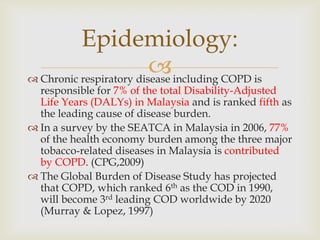
 Chronic respiratory disease including COPD is
responsible for 7% of the total Disability-Adjusted
Life Years (DALYs) in Malaysia and is ranked fifth as
the leading cause of disease burden.
 In a survey by the SEATCA in Malaysia in 2006, 77%
of the health economy burden among the three major
tobacco-related diseases in Malaysia is contributed
by COPD. (CPG,2009)
 The Global Burden of Disease Study has projected
that COPD, which ranked 6th as the COD in 1990,
will become 3rd leading COD worldwide by 2020
(Murray & Lopez, 1997)
Epidemiology:

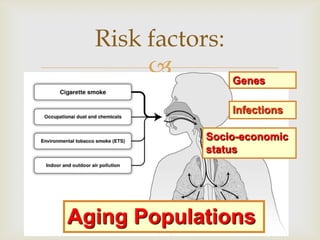
Risk factors:
Aging Populations
Genes
Infections
Socio-economic
status
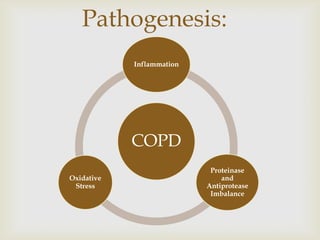
COPD
Inflammation
Proteinase
and
Antiprotease
Imbalance
Oxidative
Stress
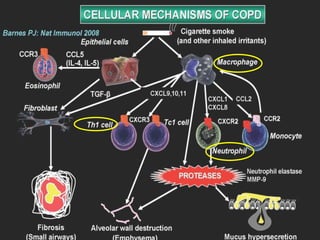
Pathogenesis:

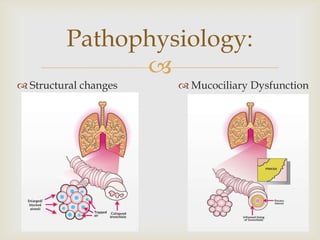
Pathophysiology:
 Mucociliary Dysfunction Structural changes

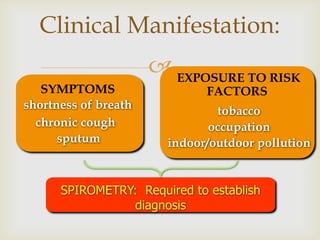
Clinical Manifestation:
SYMPTOMS
chronic cough
shortness of breath
EXPOSURE TO RISK
FACTORS
tobacco
occupation
indoor/outdoor pollution
SPIROMETRY: Required to establish
diagnosis
sputum

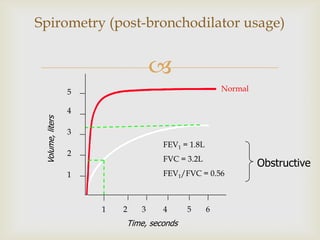
Spirometry (post-bronchodilator usage)
Volume,liters
5
4
3
2
1
1 2 3 4 5 6
Time, seconds
FEV1 = 1.8L
FVC = 3.2L
FEV1/FVC = 0.56
Normal
Obstructive

Additional Investigations
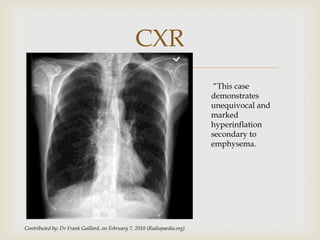
Chest X-ray: Seldom diagnostic but valuable to exclude
alternative diagnoses and establish presence of significant
comorbidities.
Lung Volumes and Diffusing Capacity: Help to characterize
severity, but not essential to patient management.
Oximetry and Arterial Blood Gases: Pulse oximetry can be
used to evaluate a patient’s oxygen saturation and need for
supplemental oxygen therapy.
Alpha-1 Antitrypsin Deficiency Screening: Perform when COPD
develops in patients of Caucasian descent under 45 years or
with a strong family history of COPD.

CXR
“This case
demonstrates
unequivocal and
marked
hyperinflation
secondary to
emphysema.
Contributed by: Dr Frank Gaillard, on February 7, 2010 (Radiopaedia.org)

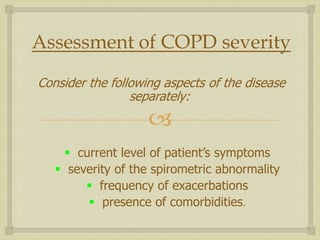
Assessment of COPD severity
Consider the following aspects of the disease
separately:
 current level of patient’s symptoms
 severity of the spirometric abnormality
 frequency of exacerbations
 presence of comorbidities.

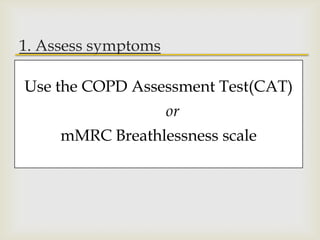
1. Assess symptoms
Assess degree of airflow limitation using
spirometry
Assess risk of exacerbations
Assess comorbidities
Use the COPD Assessment Test(CAT)
or
mMRC Breathlessness scale
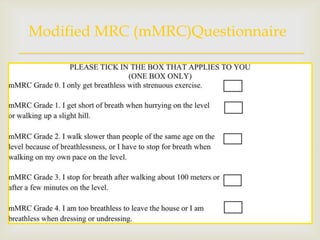
Modified MRC (mMRC)Questionnaire

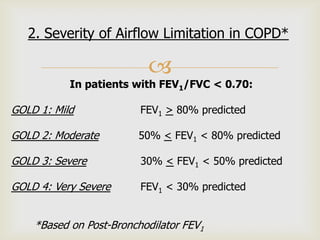
In patients with FEV1/FVC < 0.70:
GOLD 1: Mild FEV1 > 80% predicted
GOLD 2: Moderate 50% < FEV1 < 80% predicted
GOLD 3: Severe 30% < FEV1 < 50% predicted
GOLD 4: Very Severe FEV1 < 30% predicted
*Based on Post-Bronchodilator FEV1
2. Severity of Airflow Limitation in COPD*

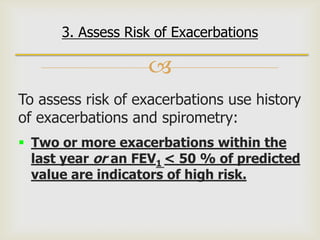
3. Assess Risk of Exacerbations
To assess risk of exacerbations use history
of exacerbations and spirometry:
 Two or more exacerbations within the
last year or an FEV1 < 50 % of predicted
value are indicators of high risk.
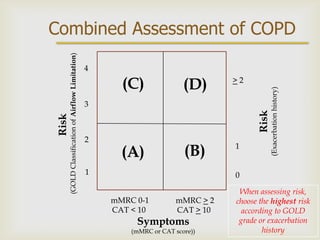
Combined Assessment of COPD
Risk
(GOLDClassificationofAirflowLimitation)
Risk
(Exacerbationhistory)
> 2
1
0
(C) (D)
(A) (B)
mMRC 0-1
CAT < 10
4
3
2
1
mMRC > 2
CAT > 10
Symptoms
(mMRC or CAT score))
When assessing risk,
choose the highest risk
according to GOLD
grade or exacerbation
history

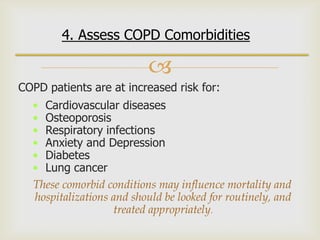
4. Assess COPD Comorbidities
COPD patients are at increased risk for:
• Cardiovascular diseases
• Osteoporosis
• Respiratory infections
• Anxiety and Depression
• Diabetes
• Lung cancer
These comorbid conditions may influence mortality and
hospitalizations and should be looked for routinely, and
treated appropriately.

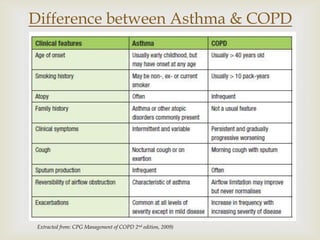
Extracted from: CPG Management of COPD 2nd edition, 2009)
Difference between Asthma & COPD
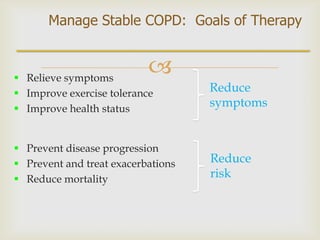
 Relieve symptoms
 Improve exercise tolerance
 Improve health status
 Prevent disease progression
 Prevent and treat exacerbations
 Reduce mortality
Reduce
symptoms
Reduce
risk
Manage Stable COPD: Goals of Therapy
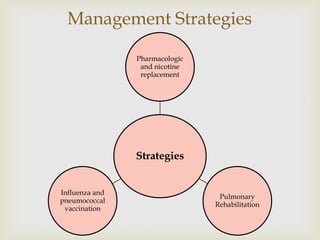
Strategies
Pharmacologic
and nicotine
replacement
Pulmonary
Rehabilitation
Influenza and
pneumococcal
vaccination
Management Strategies

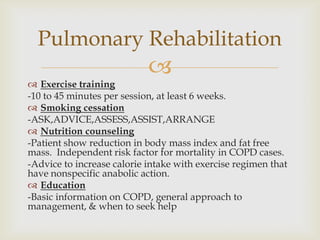
 Exercise training
-10 to 45 minutes per session, at least 6 weeks.
 Smoking cessation
-ASK,ADVICE,ASSESS,ASSIST,ARRANGE
 Nutrition counseling
-Patient show reduction in body mass index and fat free
mass. Independent risk factor for mortality in COPD cases.
-Advice to increase calorie intake with exercise regimen that
have nonspecific anabolic action.
 Education
-Basic information on COPD, general approach to
management, & when to seek help
Pulmonary Rehabilitation

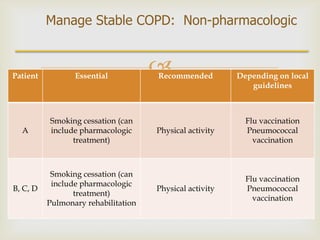
Manage Stable COPD: Non-pharmacologic
Patient Essential Recommended Depending on local
guidelines
A
Smoking cessation (can
include pharmacologic
treatment)
Physical activity
Flu vaccination
Pneumococcal
vaccination
B, C, D
Smoking cessation (can
include pharmacologic
treatment)
Pulmonary rehabilitation
Physical activity
Flu vaccination
Pneumococcal
vaccination
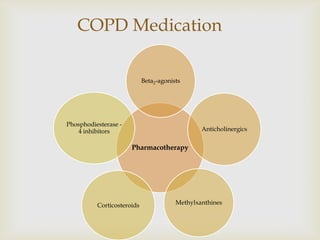
COPD Medication
Pharmacotherapy
Beta2-agonists
Anticholinergics
MethylxanthinesCorticosteroids
Phosphodiesterase -
4 inhibitors

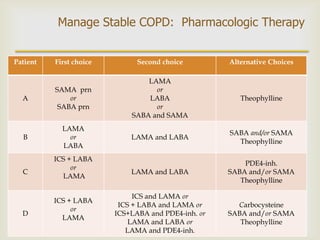
Manage Stable COPD: Pharmacologic Therapy
Patient First choice Second choice Alternative Choices
A
SAMA prn
or
SABA prn
LAMA
or
LABA
or
SABA and SAMA
Theophylline
B
LAMA
or
LABA
LAMA and LABA
SABA and/or SAMA
Theophylline
C
ICS + LABA
or
LAMA
LAMA and LABA
PDE4-inh.
SABA and/or SAMA
Theophylline
D
ICS + LABA
or
LAMA
ICS and LAMA or
ICS + LABA and LAMA or
ICS+LABA and PDE4-inh. or
LAMA and LABA or
LAMA and PDE4-inh.
Carbocysteine
SABA and/or SAMA
Theophylline

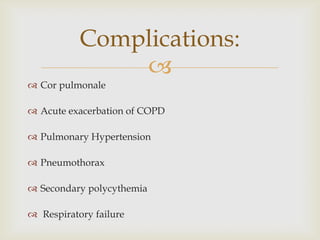
 Cor pulmonale
 Acute exacerbation of COPD
 Pulmonary Hypertension
 Pneumothorax
 Secondary polycythemia
 Respiratory failure
Complications:

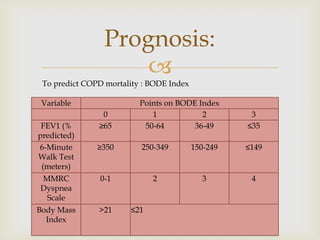
Prognosis:
Variable Points on BODE Index
0 1 2 3
FEV1 (%
predicted)
≥65 50-64 36-49 ≤35
6-Minute
Walk Test
(meters)
≥350 250-349 150-249 ≤149
MMRC
Dyspnea
Scale
0-1 2 3 4
Body Mass
Index
>21 ≤21
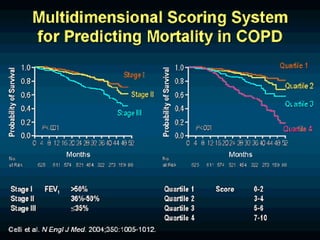
To predict COPD mortality : BODE Index

Chronic obstructive airway disease (coad)

Chronic obstructive airway disease (coad)

  • 1.
    Reference based on:Global Strategy for Diagnosis, Management and Prevention of COPD, 2011 REVISED 2011
  • 2.
     A common preventableand treatable disease, Characterized by persistent airflow limitation Usually progressive and associated with an enhanced chronic inflammatory response in the airways and the lung to noxious particles or gases. Definition:
  • 3.
     Chronic respiratorydisease including COPD is responsible for 7% of the total Disability-Adjusted Life Years (DALYs) in Malaysia and is ranked fifth as the leading cause of disease burden.  In a survey by the SEATCA in Malaysia in 2006, 77% of the health economy burden among the three major tobacco-related diseases in Malaysia is contributed by COPD. (CPG,2009)  The Global Burden of Disease Study has projected that COPD, which ranked 6th as the COD in 1990, will become 3rd leading COD worldwide by 2020 (Murray & Lopez, 1997) Epidemiology:
  • 4.
  • 5.
  • 7.
  • 8.
     Clinical Manifestation: SYMPTOMS chronic cough shortnessof breath EXPOSURE TO RISK FACTORS tobacco occupation indoor/outdoor pollution SPIROMETRY: Required to establish diagnosis sputum
  • 9.
     Spirometry (post-bronchodilator usage) Volume,liters 5 4 3 2 1 12 3 4 5 6 Time, seconds FEV1 = 1.8L FVC = 3.2L FEV1/FVC = 0.56 Normal Obstructive
  • 10.
     Additional Investigations Chest X-ray:Seldom diagnostic but valuable to exclude alternative diagnoses and establish presence of significant comorbidities. Lung Volumes and Diffusing Capacity: Help to characterize severity, but not essential to patient management. Oximetry and Arterial Blood Gases: Pulse oximetry can be used to evaluate a patient’s oxygen saturation and need for supplemental oxygen therapy. Alpha-1 Antitrypsin Deficiency Screening: Perform when COPD develops in patients of Caucasian descent under 45 years or with a strong family history of COPD.
  • 11.
     CXR “This case demonstrates unequivocal and marked hyperinflation secondaryto emphysema. Contributed by: Dr Frank Gaillard, on February 7, 2010 (Radiopaedia.org)
  • 12.
     Assessment of COPDseverity Consider the following aspects of the disease separately:  current level of patient’s symptoms  severity of the spirometric abnormality  frequency of exacerbations  presence of comorbidities.
  • 13.
     1. Assess symptoms Assessdegree of airflow limitation using spirometry Assess risk of exacerbations Assess comorbidities Use the COPD Assessment Test(CAT) or mMRC Breathlessness scale
  • 14.
  • 15.
     In patients withFEV1/FVC < 0.70: GOLD 1: Mild FEV1 > 80% predicted GOLD 2: Moderate 50% < FEV1 < 80% predicted GOLD 3: Severe 30% < FEV1 < 50% predicted GOLD 4: Very Severe FEV1 < 30% predicted *Based on Post-Bronchodilator FEV1 2. Severity of Airflow Limitation in COPD*
  • 16.
     3. Assess Riskof Exacerbations To assess risk of exacerbations use history of exacerbations and spirometry:  Two or more exacerbations within the last year or an FEV1 < 50 % of predicted value are indicators of high risk.
  • 17.
    Combined Assessment ofCOPD Risk (GOLDClassificationofAirflowLimitation) Risk (Exacerbationhistory) > 2 1 0 (C) (D) (A) (B) mMRC 0-1 CAT < 10 4 3 2 1 mMRC > 2 CAT > 10 Symptoms (mMRC or CAT score)) When assessing risk, choose the highest risk according to GOLD grade or exacerbation history
  • 18.
     4. Assess COPDComorbidities COPD patients are at increased risk for: • Cardiovascular diseases • Osteoporosis • Respiratory infections • Anxiety and Depression • Diabetes • Lung cancer These comorbid conditions may influence mortality and hospitalizations and should be looked for routinely, and treated appropriately.
  • 19.
     Extracted from: CPGManagement of COPD 2nd edition, 2009) Difference between Asthma & COPD
  • 20.
     Relieve symptoms Improve exercise tolerance  Improve health status  Prevent disease progression  Prevent and treat exacerbations  Reduce mortality Reduce symptoms Reduce risk Manage Stable COPD: Goals of Therapy
  • 21.
  • 22.
      Exercise training -10to 45 minutes per session, at least 6 weeks.  Smoking cessation -ASK,ADVICE,ASSESS,ASSIST,ARRANGE  Nutrition counseling -Patient show reduction in body mass index and fat free mass. Independent risk factor for mortality in COPD cases. -Advice to increase calorie intake with exercise regimen that have nonspecific anabolic action.  Education -Basic information on COPD, general approach to management, & when to seek help Pulmonary Rehabilitation
  • 23.
     Manage Stable COPD:Non-pharmacologic Patient Essential Recommended Depending on local guidelines A Smoking cessation (can include pharmacologic treatment) Physical activity Flu vaccination Pneumococcal vaccination B, C, D Smoking cessation (can include pharmacologic treatment) Pulmonary rehabilitation Physical activity Flu vaccination Pneumococcal vaccination
  • 24.
  • 25.
     Manage Stable COPD:Pharmacologic Therapy Patient First choice Second choice Alternative Choices A SAMA prn or SABA prn LAMA or LABA or SABA and SAMA Theophylline B LAMA or LABA LAMA and LABA SABA and/or SAMA Theophylline C ICS + LABA or LAMA LAMA and LABA PDE4-inh. SABA and/or SAMA Theophylline D ICS + LABA or LAMA ICS and LAMA or ICS + LABA and LAMA or ICS+LABA and PDE4-inh. or LAMA and LABA or LAMA and PDE4-inh. Carbocysteine SABA and/or SAMA Theophylline
  • 26.
      Cor pulmonale Acute exacerbation of COPD  Pulmonary Hypertension  Pneumothorax  Secondary polycythemia  Respiratory failure Complications:
  • 27.
     Prognosis: Variable Points onBODE Index 0 1 2 3 FEV1 (% predicted) ≥65 50-64 36-49 ≤35 6-Minute Walk Test (meters) ≥350 250-349 150-249 ≤149 MMRC Dyspnea Scale 0-1 2 3 4 Body Mass Index >21 ≤21 To predict COPD mortality : BODE Index
  • 28.

Editor's Notes

  • #4 Southeast Asia Tobacco Control Alliance
  • #5 Divided into 2: host factor n exposure to noxious stimuli
  • #23 ASK,ADVISE,ASSESS,ASSIST,ARRANGE