Dr. Sameh Ahmad Muhamad abdelghany
Lecturer Of Clinical Pharmacology
Mansura Faculty of medicine
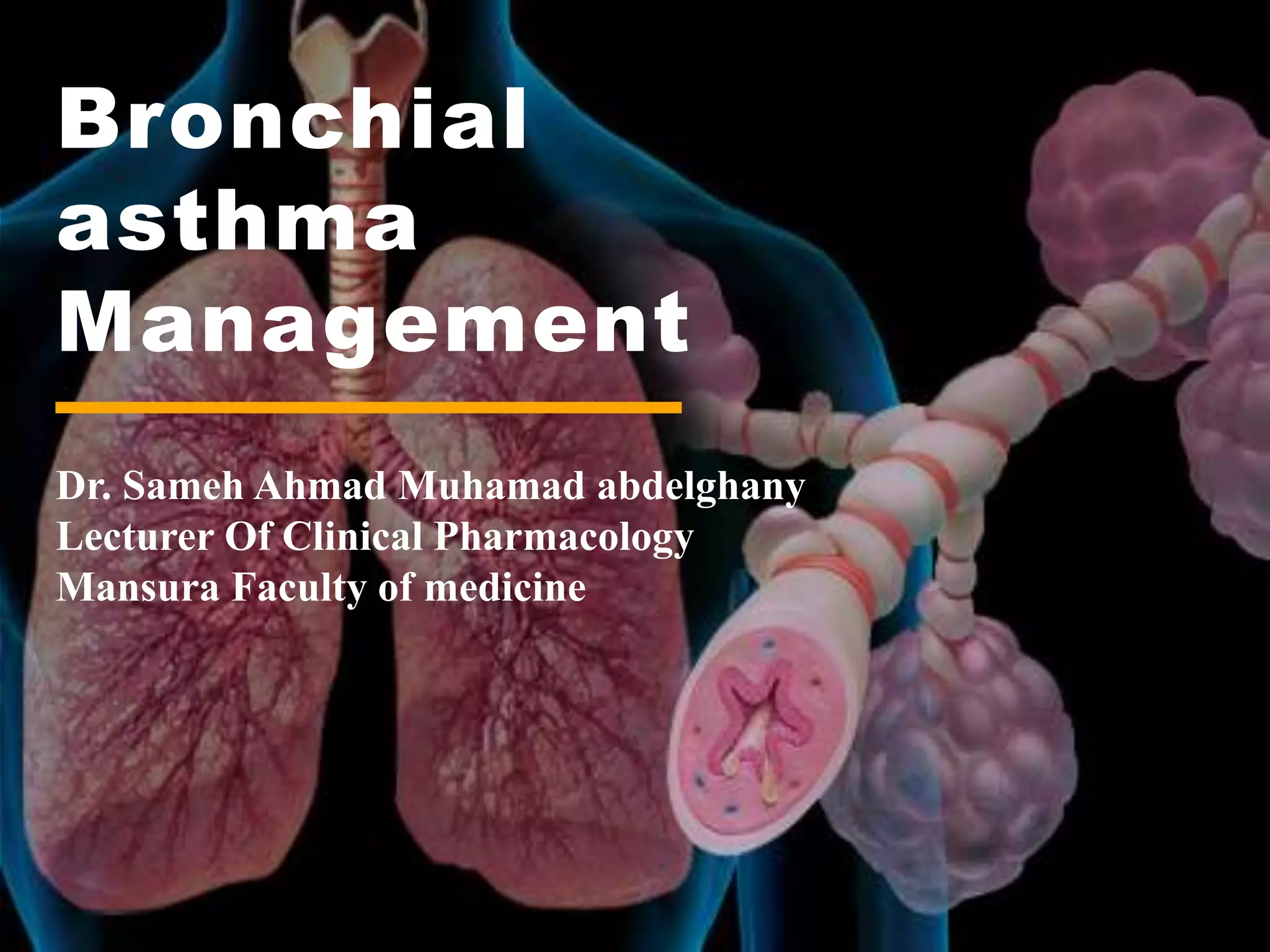
Bronchial
asthma
Management
2
ASTHMA
INTRODUCTION
CLASSIFICATION
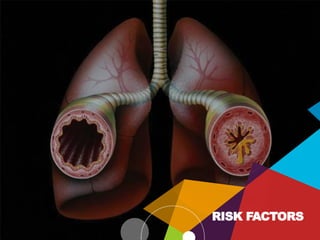
RISK FACTORS
Diagnosis
Treatment & Prevention
CONTENTS
INTRODUCTION
4
Introduction
 Asthma is a chronic inflammatory disorder
of the airways that is characterized:
o clinically by recurrent episodes of wheezing,
breathlessness, chest tightness, and cough,
particularly at night/early morning.
o physiologically by widespread, reversible
narrowing of the bronchial airways and a
marked increase in bronchial
responsiveness.
5
Introduction
 In 2015, 358 million people globally had
asthma, up from 183 million in 1990.
 It caused about 397,100 deaths in 2015,
most of which occurred in the developing
world.
 Asthma was recognized as early as Ancient
Egypt.
 The word "asthma" is from the Greek
ἅσθμα, ásthma, which means "panting".
CLASSFICATION
7
Classification
 A heterogenous disorder.
 Atopic /extrinsic /allergic ( 70%):
o Most common type
o Environmental agent: dust, pollen,
food, animal dander
o Family history - present
o Serum IgE levels - increased
o Skin test with offending agent –wheal
flare
8
Classification
 Non-atopic/ intrinsic /non-allergic( 30%)
 Triggered by respiratory tract infection
 Viruses - most common cause
 Family history uncommon
 IgE level normal
 No associated allergy
 Skin tests NEGATIVE
 Cause- hyperirritability of bronchial tree
9
Classification
 Drug induced asthma
 Several pharmacologic agents
 Aspirin sensitive asthma
o Increased bronchoconstrictor leukotrienes.
o sensitive to small doses of aspirin.
o Inhibits COX pathway, without affecting
LPO pathway
10
Pathophysiology
I. Chronic inflammation
II. Airway Hyperresponsiveness
11
Pathophysiology
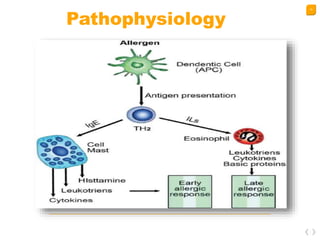
I. Inflammation
 Chronic inflammatory state
 Involves respiratory mucosa from trachea
to terminal bronchioles, predominantly in
the bronchi.
 Activation of mast cell , infiltration of
eosinophils & T-helper type 2 (Th2)
lymphocytes
12
Pathophysiology
I. Inflammation
 Exact cause of airway inflammation is
unknown.
 Thought to be an interplay between
endogenous and environmental factors.
 Endogenous factors
 Atopy
 Genetic predisposition to IgE mediated
type I hypersensitivity
 The major risk factor for asthma
 Genetics
13
Pathophysiology
I. Inflammation
 Environmental factors
 Viral infections: RSV, Mycoplasma,
Chlamydia
 Air pollution
 Allergens :house dust mite
14
Pathophysiology
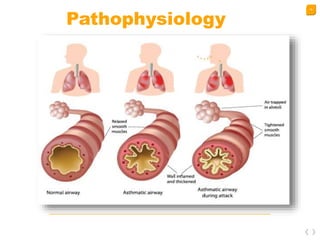
II. Airway Hyperresponsiveness (AHR)
 The excessive bronchoconstrictor response
to multiple inhaled triggers that would
have no effect on normal airways.
 Characteristic physiologic abnormality of
asthma.
15
Pathophysiology
16
Pathophysiology
RISK FACTORS
18
Risk factors
 Host factors:
 predispose individuals to, or protect
them from, developing asthma
i. Genetic
o Atopy
o Airway hyperresponsiveness
ii. Gender
iii. Obesity
19
Risk factors
 Environmental factors:
 influence susceptibility to development of
asthma in predisposed individuals,
precipitate asthma exacerbations, and/or
cause symptoms to persist
o Indoor allergens , Outdoor allergens
o Occupational sensitizers
o Tobacco smoke , Air Pollution
o Respiratory Infections
o Diet
20
Triggers
 Asthma Triggers
 Allergens
 Virus Infections
 Drugs
 Exercise
 Food
 Air pollutants
 Physical factors
 GERD
 Stress
 Occupational factors
DIAGNOSIS
22
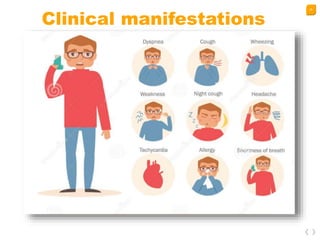
Clinical manifestations
 Symptoms
 Wheezing, dyspnea and cough.
 Variable – both spontaneously and with
therapy.
 Symptoms worse at night.
 Nonproductive cough
 Limitation of activity
23
Clinical manifestations
 Signs
 ↑ respiratory rate, with use of accessory
muscles
 Hyper-resonant percussion note
 Expiratory rhonchi
 No findings when asthma is under control or
b/w attacks
24
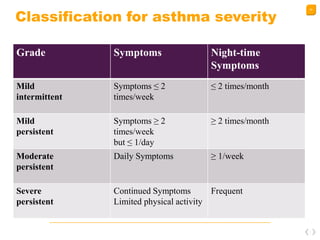
Classification for asthma severity
Grade Symptoms Night-time
Symptoms
Mild
intermittent
Symptoms ≤ 2
times/week
≤ 2 times/month
Mild
persistent
Symptoms ≥ 2
times/week
but ≤ 1/day
≥ 2 times/month
Moderate
persistent
Daily Symptoms ≥ 1/week
Severe
persistent
Continued Symptoms
Limited physical activity
Frequent
25
Clinical manifestations
26
Laboratory diagnosis
 Pulmonary function
tests:
 Using Spirometry
 estimate degree of
obstruction
 ↓FEV1, ↓FEV1/FVC,
↓PEF.
27
Laboratory diagnosis
 CXR :
 hyperinflation,emphysema
 Arterial blood-gas analysis
 hypoxia & hypocarbia
 Skin hypersensitivity test
 Sputum & blood eosinophilia
 Elevated serum IgE levels
TREATMENT
29
Management
I. Non-Pharmacological
II. Pharmacological
30
Non-Pharmacological
 Reduce exposure to indoor allergens
 Avoid tobacco smoke
 Avoid vehicle emission
 Identify irritants in the workplace
 Explore role of infections on asthma
development, especially in children and
young infants
31
Non-Pharmacological
 Influenza Vaccination
o should be provided to patients with asthma
when vaccination of the general population is
advised
o routine influenza vaccination of children and
adults with asthma does not appear to protect
them from asthma exacerbations or improve
asthma control
32
Pharmacological treatment
 Classification of drugs
 Bronchodilators : rapid relief, by relaxation of
airway smooth muscle
 β2 Agonists
 Anticholinergic Agents
 Methylxanthines
 Controllers : inhibit the inflammatory process
 Glucocorticoids
 Leukotrienes pathway inhibitors
 Cromones
 Anti-IgE therapy
33
Pharmacological treatment
 β2 Agonists in asthma
 Potent bronchodilators.
 Usually given by inhalation route.
 Effects:
o Relaxation of airway smooth muscle
o Inhibition of mast cell mediator release
o Reduction in plasma exudation
o Increased mucociliary transport
o Inhibition of sensory nerve activation
 No effect on airway inflammation
34
Pharmacological treatment
 β2 Agonists in asthma
a) Short-Acting β2 Agonists
 E.g salbutamol , terbutaline
 Convenient,rapid onset,without significant
systemic side effect
 Bronchodil. of choice in acute severe asthma
 Used for symptomatic relief
 Only treatment required for mild, intermittent
asthma.
 Use >2 times a week indicates need of a regular
controller therapy.
35
Pharmacological treatment
 β2 Agonists in asthma
b) Long-Acting β2Agonists
 E.g salmeterol, formoterol
 Duration of action - >12 hrs.
 Used in combination with inhaled corticosteroid
therapy.
 Improve asthma control and reduce frequency
of exacerbations.
 Should not be used as monotherapy (increased
mortality).
 Not effective for acute bronchospasm.
36
Pharmacological treatment
 Anticholinergic agents
 E.g Ipratropium bromide, tiotropium.
 Prevent cholinergic nerve induced
bronchoconstriction.
 Less effective than β2 agonists.
 Response varies with existing vagal tone.
 Use in asthma
o Intolerance to inhaled β2 agonist.
o Status asthmaticus –additive effect with β2
agonist
37
Pharmacological treatment
 Anticholinergic agents
 Ipratropium:
o slow,bitter taste
o precipitate glaucoma
o paradoxical bronchoconstriction
 Tiotropium:
o longer acting, approved for treatment of COPD.
o Dryness of mouth
38
Pharmacological treatment
 Methylxanthines
 Medium potency bronchodilator
 E.g Theophylline, theobromine, caffeine
 Recently interest has declined in this class of
drugs:
o Side effects
o Need for plasma drug levels
o Pharmacokinetics
o Availability of other effective drugs
 Still widely used drugs especially in developing
countries due to their lower cost.
39
Pharmacological treatment
 Methylxanthines
 Adverse effects
o Anorexia, nausea, vomiting, abdominal
discomfort
o headache, and anxiety
o Seizures or arrhythmias
o Diuresis
 Doxyphylline
o long acting,oral
40
Pharmacological treatment
 Corticosteroids in asthma
 Effective drugs for treatment of asthma.
 Development of inhaled corticosteroids is a
major advance in asthma therapy.
 Used prophylactically as a controller therapy.
 Reduce the need for rescue β2 agonist.
 Benefit starts in 1week but continues up to
several months.
 If asthma not controlled at low dose of ICS then
addition of long acting β2 agonist is more
effective than doubling steroid dose.
41
Pharmacological treatment
 Corticosteroids in asthma
 Effects: Broad anti-inflammatory effects:
o Marked inhibition of infiltration of airways by
inflammatory cells.
o Modulation of cytokine and chemokine
production
o Inhibition of eicosanoid synthesis
o Decreased vascular permeability.
o Potentiate effect of β2 agonist.
42
Pharmacological treatment
 Corticosteroids in asthma
 Inhaled corticosteroids( ICS)
o Use of β2Agonists >2 times a week indicates
need of a ICS
o E.g Beclomethasone , Budesonide , Fluticasone
43
Pharmacological treatment
 Corticosteroids in asthma
 Inhaled corticosteroids( ICS)
 Adverse effects:
o Oropharyngeal candidiasis, dysphonia
o Decreased bone mineral density.
o Skin thinning, purpura
o Growth retardation in children
44
Pharmacological treatment
 Corticosteroids in asthma
 Systemic steroids in asthma
 Indication
1. Acute exacerbation(lung function <30%
predicted)
2. Chronic severe asthma
 A 5-10 day course of prednisolone 30-
45mg/d is used.
 1% of patients may require regular
maintenance therapy.
45
Pharmacological treatment
 Leukotrienes pathway inhibitors
a) Inhibition of 5-lipoxygenase, thereby
preventing leukotriene synthesis. Zileuton.
b) Inhibition of the binding of LTD4 to its
receptor on target tissues, thereby preventing
its action. E.g Zafirlukast, montelukast.
 Oral route.
 Adverse effects
o Liver toxicity
o vasculitis with eosinophilia
46
Pharmacological treatment
 Leukotrienes pathway inhibitors
 They are less effective than ICSs in
controlling asthma
 Use in asthma
o Patients unable to manipulate inhaler devices.
o Aspirin induced asthma.
o Mild asthma – alternative to ICS.
o Moderate to severe asthma – may allow
reduction of ICS dose
47
Pharmacological treatment
 Cromones
 E.g Cromolyn sodium & nedocromil sodium
 On chronic use (four times daily) reduce the
overall level of bronchial reactivity.
 have no effect on airway smooth muscle tone
and are ineffective in reversing asthmatic
bronchospasm; they are only of value when
taken prophylactically.
 Inhalation route
48
Pharmacological treatment
 Cromones
 May act by stabilization of Mast cells with
inhibition of mediator release
 Uses
o Asthma - Prevention of asthmatic attacks in
mild to moderate asthma
 Adverse effects
o Well tolerated drugs
o Minor side effects- throat irritation, cough, and
mouth dryness, rarely, chest tightness, and
wheezing
49
Pharmacological treatment
 Anti-IgE therapy:
 Omalizumab
 recombinant humanized monoclonal antibody
targeted against IgE.
 Action:
o IgE bound to omalizumab cannot bind to IgE
receptors on mast cells and basophils, thereby
preventing the allergic reaction at a very early
step in the process.
50
Pharmacological treatment
 Anti-IgE therapy:
 Use in asthma
o Persons >12 years of age with moderate-to-
severe persistent asthma.
 Omalizumab is not an acute bronchodilator and
should not be used as a rescue medication or as
a treatment of status asthmaticus.
 Expensive drug
 Has to be given under direct medical
supervision due to the risk of anaphylaxis
51
Status asthmaticus
(severe acute asthma)
 Severe airway obstruction
 Symptoms persist despite initial standard
acute asthma therapy.
o Severe dyspnea & unproductive cough
o Sweating , central cyanosis ,tachycardia
52
Status asthmaticus
(severe acute asthma)
 Treatment of Status asthmaticus
 High conc. of oxygen through facemask
 Nebulised salbutamol in oxygen given
immediately
 Ipratopium bromide + salbutamol
nebulised in oxygen,who don’t respond
within 15-30 min
53
Status asthmaticus
(severe acute asthma)
 Treatment of Status asthmaticus
 Terbutaline s.c. or i.v.
 excessive coughing or too weak to inspire
adequately.
 Hydrocortisone hemisuccinate i.v. ,
followed by infusion.
 Endotracheal intubation & mechanical
ventilation if above ttt fails
54
Prophylaxis
 Preservation of the environment, healthy
life-style (smoking cessation, physical
training) – are the basis of primary asthma
prophylaxis.
 These measures in combination with
adequate drug therapy are effective for
secondary prophylaxis.
55
thanksF o r W a t c h i n g

Bronchial asthma management

  • 1.
    Dr. Sameh AhmadMuhamad abdelghany Lecturer Of Clinical Pharmacology Mansura Faculty of medicine Bronchial asthma Management
  • 2.
  • 3.
  • 4.
    4 Introduction  Asthma isa chronic inflammatory disorder of the airways that is characterized: o clinically by recurrent episodes of wheezing, breathlessness, chest tightness, and cough, particularly at night/early morning. o physiologically by widespread, reversible narrowing of the bronchial airways and a marked increase in bronchial responsiveness.
  • 5.
    5 Introduction  In 2015,358 million people globally had asthma, up from 183 million in 1990.  It caused about 397,100 deaths in 2015, most of which occurred in the developing world.  Asthma was recognized as early as Ancient Egypt.  The word "asthma" is from the Greek ἅσθμα, ásthma, which means "panting".
  • 6.
  • 7.
    7 Classification  A heterogenousdisorder.  Atopic /extrinsic /allergic ( 70%): o Most common type o Environmental agent: dust, pollen, food, animal dander o Family history - present o Serum IgE levels - increased o Skin test with offending agent –wheal flare
  • 8.
    8 Classification  Non-atopic/ intrinsic/non-allergic( 30%)  Triggered by respiratory tract infection  Viruses - most common cause  Family history uncommon  IgE level normal  No associated allergy  Skin tests NEGATIVE  Cause- hyperirritability of bronchial tree
  • 9.
    9 Classification  Drug inducedasthma  Several pharmacologic agents  Aspirin sensitive asthma o Increased bronchoconstrictor leukotrienes. o sensitive to small doses of aspirin. o Inhibits COX pathway, without affecting LPO pathway
  • 10.
  • 11.
    11 Pathophysiology I. Inflammation  Chronicinflammatory state  Involves respiratory mucosa from trachea to terminal bronchioles, predominantly in the bronchi.  Activation of mast cell , infiltration of eosinophils & T-helper type 2 (Th2) lymphocytes
  • 12.
    12 Pathophysiology I. Inflammation  Exactcause of airway inflammation is unknown.  Thought to be an interplay between endogenous and environmental factors.  Endogenous factors  Atopy  Genetic predisposition to IgE mediated type I hypersensitivity  The major risk factor for asthma  Genetics
  • 13.
    13 Pathophysiology I. Inflammation  Environmentalfactors  Viral infections: RSV, Mycoplasma, Chlamydia  Air pollution  Allergens :house dust mite
  • 14.
    14 Pathophysiology II. Airway Hyperresponsiveness(AHR)  The excessive bronchoconstrictor response to multiple inhaled triggers that would have no effect on normal airways.  Characteristic physiologic abnormality of asthma.
  • 15.
  • 16.
  • 17.
  • 18.
    18 Risk factors  Hostfactors:  predispose individuals to, or protect them from, developing asthma i. Genetic o Atopy o Airway hyperresponsiveness ii. Gender iii. Obesity
  • 19.
    19 Risk factors  Environmentalfactors:  influence susceptibility to development of asthma in predisposed individuals, precipitate asthma exacerbations, and/or cause symptoms to persist o Indoor allergens , Outdoor allergens o Occupational sensitizers o Tobacco smoke , Air Pollution o Respiratory Infections o Diet
  • 20.
    20 Triggers  Asthma Triggers Allergens  Virus Infections  Drugs  Exercise  Food  Air pollutants  Physical factors  GERD  Stress  Occupational factors
  • 21.
  • 22.
    22 Clinical manifestations  Symptoms Wheezing, dyspnea and cough.  Variable – both spontaneously and with therapy.  Symptoms worse at night.  Nonproductive cough  Limitation of activity
  • 23.
    23 Clinical manifestations  Signs ↑ respiratory rate, with use of accessory muscles  Hyper-resonant percussion note  Expiratory rhonchi  No findings when asthma is under control or b/w attacks
  • 24.
    24 Classification for asthmaseverity Grade Symptoms Night-time Symptoms Mild intermittent Symptoms ≤ 2 times/week ≤ 2 times/month Mild persistent Symptoms ≥ 2 times/week but ≤ 1/day ≥ 2 times/month Moderate persistent Daily Symptoms ≥ 1/week Severe persistent Continued Symptoms Limited physical activity Frequent
  • 25.
  • 26.
    26 Laboratory diagnosis  Pulmonaryfunction tests:  Using Spirometry  estimate degree of obstruction  ↓FEV1, ↓FEV1/FVC, ↓PEF.
  • 27.
    27 Laboratory diagnosis  CXR:  hyperinflation,emphysema  Arterial blood-gas analysis  hypoxia & hypocarbia  Skin hypersensitivity test  Sputum & blood eosinophilia  Elevated serum IgE levels
  • 28.
  • 29.
  • 30.
    30 Non-Pharmacological  Reduce exposureto indoor allergens  Avoid tobacco smoke  Avoid vehicle emission  Identify irritants in the workplace  Explore role of infections on asthma development, especially in children and young infants
  • 31.
    31 Non-Pharmacological  Influenza Vaccination oshould be provided to patients with asthma when vaccination of the general population is advised o routine influenza vaccination of children and adults with asthma does not appear to protect them from asthma exacerbations or improve asthma control
  • 32.
    32 Pharmacological treatment  Classificationof drugs  Bronchodilators : rapid relief, by relaxation of airway smooth muscle  β2 Agonists  Anticholinergic Agents  Methylxanthines  Controllers : inhibit the inflammatory process  Glucocorticoids  Leukotrienes pathway inhibitors  Cromones  Anti-IgE therapy
  • 33.
    33 Pharmacological treatment  β2Agonists in asthma  Potent bronchodilators.  Usually given by inhalation route.  Effects: o Relaxation of airway smooth muscle o Inhibition of mast cell mediator release o Reduction in plasma exudation o Increased mucociliary transport o Inhibition of sensory nerve activation  No effect on airway inflammation
  • 34.
    34 Pharmacological treatment  β2Agonists in asthma a) Short-Acting β2 Agonists  E.g salbutamol , terbutaline  Convenient,rapid onset,without significant systemic side effect  Bronchodil. of choice in acute severe asthma  Used for symptomatic relief  Only treatment required for mild, intermittent asthma.  Use >2 times a week indicates need of a regular controller therapy.
  • 35.
    35 Pharmacological treatment  β2Agonists in asthma b) Long-Acting β2Agonists  E.g salmeterol, formoterol  Duration of action - >12 hrs.  Used in combination with inhaled corticosteroid therapy.  Improve asthma control and reduce frequency of exacerbations.  Should not be used as monotherapy (increased mortality).  Not effective for acute bronchospasm.
  • 36.
    36 Pharmacological treatment  Anticholinergicagents  E.g Ipratropium bromide, tiotropium.  Prevent cholinergic nerve induced bronchoconstriction.  Less effective than β2 agonists.  Response varies with existing vagal tone.  Use in asthma o Intolerance to inhaled β2 agonist. o Status asthmaticus –additive effect with β2 agonist
  • 37.
    37 Pharmacological treatment  Anticholinergicagents  Ipratropium: o slow,bitter taste o precipitate glaucoma o paradoxical bronchoconstriction  Tiotropium: o longer acting, approved for treatment of COPD. o Dryness of mouth
  • 38.
    38 Pharmacological treatment  Methylxanthines Medium potency bronchodilator  E.g Theophylline, theobromine, caffeine  Recently interest has declined in this class of drugs: o Side effects o Need for plasma drug levels o Pharmacokinetics o Availability of other effective drugs  Still widely used drugs especially in developing countries due to their lower cost.
  • 39.
    39 Pharmacological treatment  Methylxanthines Adverse effects o Anorexia, nausea, vomiting, abdominal discomfort o headache, and anxiety o Seizures or arrhythmias o Diuresis  Doxyphylline o long acting,oral
  • 40.
    40 Pharmacological treatment  Corticosteroidsin asthma  Effective drugs for treatment of asthma.  Development of inhaled corticosteroids is a major advance in asthma therapy.  Used prophylactically as a controller therapy.  Reduce the need for rescue β2 agonist.  Benefit starts in 1week but continues up to several months.  If asthma not controlled at low dose of ICS then addition of long acting β2 agonist is more effective than doubling steroid dose.
  • 41.
    41 Pharmacological treatment  Corticosteroidsin asthma  Effects: Broad anti-inflammatory effects: o Marked inhibition of infiltration of airways by inflammatory cells. o Modulation of cytokine and chemokine production o Inhibition of eicosanoid synthesis o Decreased vascular permeability. o Potentiate effect of β2 agonist.
  • 42.
    42 Pharmacological treatment  Corticosteroidsin asthma  Inhaled corticosteroids( ICS) o Use of β2Agonists >2 times a week indicates need of a ICS o E.g Beclomethasone , Budesonide , Fluticasone
  • 43.
    43 Pharmacological treatment  Corticosteroidsin asthma  Inhaled corticosteroids( ICS)  Adverse effects: o Oropharyngeal candidiasis, dysphonia o Decreased bone mineral density. o Skin thinning, purpura o Growth retardation in children
  • 44.
    44 Pharmacological treatment  Corticosteroidsin asthma  Systemic steroids in asthma  Indication 1. Acute exacerbation(lung function <30% predicted) 2. Chronic severe asthma  A 5-10 day course of prednisolone 30- 45mg/d is used.  1% of patients may require regular maintenance therapy.
  • 45.
    45 Pharmacological treatment  Leukotrienespathway inhibitors a) Inhibition of 5-lipoxygenase, thereby preventing leukotriene synthesis. Zileuton. b) Inhibition of the binding of LTD4 to its receptor on target tissues, thereby preventing its action. E.g Zafirlukast, montelukast.  Oral route.  Adverse effects o Liver toxicity o vasculitis with eosinophilia
  • 46.
    46 Pharmacological treatment  Leukotrienespathway inhibitors  They are less effective than ICSs in controlling asthma  Use in asthma o Patients unable to manipulate inhaler devices. o Aspirin induced asthma. o Mild asthma – alternative to ICS. o Moderate to severe asthma – may allow reduction of ICS dose
  • 47.
    47 Pharmacological treatment  Cromones E.g Cromolyn sodium & nedocromil sodium  On chronic use (four times daily) reduce the overall level of bronchial reactivity.  have no effect on airway smooth muscle tone and are ineffective in reversing asthmatic bronchospasm; they are only of value when taken prophylactically.  Inhalation route
  • 48.
    48 Pharmacological treatment  Cromones May act by stabilization of Mast cells with inhibition of mediator release  Uses o Asthma - Prevention of asthmatic attacks in mild to moderate asthma  Adverse effects o Well tolerated drugs o Minor side effects- throat irritation, cough, and mouth dryness, rarely, chest tightness, and wheezing
  • 49.
    49 Pharmacological treatment  Anti-IgEtherapy:  Omalizumab  recombinant humanized monoclonal antibody targeted against IgE.  Action: o IgE bound to omalizumab cannot bind to IgE receptors on mast cells and basophils, thereby preventing the allergic reaction at a very early step in the process.
  • 50.
    50 Pharmacological treatment  Anti-IgEtherapy:  Use in asthma o Persons >12 years of age with moderate-to- severe persistent asthma.  Omalizumab is not an acute bronchodilator and should not be used as a rescue medication or as a treatment of status asthmaticus.  Expensive drug  Has to be given under direct medical supervision due to the risk of anaphylaxis
  • 51.
    51 Status asthmaticus (severe acuteasthma)  Severe airway obstruction  Symptoms persist despite initial standard acute asthma therapy. o Severe dyspnea & unproductive cough o Sweating , central cyanosis ,tachycardia
  • 52.
    52 Status asthmaticus (severe acuteasthma)  Treatment of Status asthmaticus  High conc. of oxygen through facemask  Nebulised salbutamol in oxygen given immediately  Ipratopium bromide + salbutamol nebulised in oxygen,who don’t respond within 15-30 min
  • 53.
    53 Status asthmaticus (severe acuteasthma)  Treatment of Status asthmaticus  Terbutaline s.c. or i.v.  excessive coughing or too weak to inspire adequately.  Hydrocortisone hemisuccinate i.v. , followed by infusion.  Endotracheal intubation & mechanical ventilation if above ttt fails
  • 54.
    54 Prophylaxis  Preservation ofthe environment, healthy life-style (smoking cessation, physical training) – are the basis of primary asthma prophylaxis.  These measures in combination with adequate drug therapy are effective for secondary prophylaxis.
  • 55.
    55 thanksF o rW a t c h i n g