ASTHMA
BY
IBEKWE CHIGOZIE BLESSING
GROUP 310
Definition
• Reactive airway disease
• Chronic inflammatory lung disease
Inflammation causes varying degrees ofInflammation causes varying degrees of
obstruction in the airwaysobstruction in the airways
• Asthma is reversible in early stages
Signs and Symptoms
• Wheezing
• Coughing
• Shortness of breathe
• Chest tightness or pain
Risk factors
Endogenous factors
• Genetic predisposition
• Atopy
• Airway
hyperresponsiveness
• Gender
• Ethnicity
• Obesity
• Viral infections
Exogenous factors
• Indoor allergens
• Outdoor allergens
• Occupational sensitizers
• Passive smoking
• Respiratory infections
Triggers
• Allergens-Dermatophagoides species(dust mite), environmental
exposure, grass pollen, ragweed, tree pollen, fungal spores, pets
furs, cockroaches etc
• Virus infection-upper respiratory tract virus such as rhinovirus,
respiratory syncytial virus, coronavirus etc
• Pharmacological agents-beta blockers, ACE inhibitors, aspirin
• Exercise(may exacerbate )
• Physical factors-cold air, hyperventilation
• Food
• Air pollutants-sulfur dioxide, irritant gases
• Irritants-household sprays paint fumes
• Occupational factors
• Hormonal factors-fall in progesterone thyrotoxicosis
Gastrointestinal reflex
Types of asthma
• Atopic asthma-classical type I IgE mediated
hypersensitivity, allergen sensitization, seen from
childhood, +ve history of asthma in family, skin test
+ve
• Non-atopic asthma-no allergen sensitization, no such
history, skin test –ve, virus infection?
• Drug induced asthma-sensitive to certain drugs like
aspirin, NSAIDS etc
• Occupational asthma-stimulants such as fumes,
organic and chemical dusts(wood, cotton),
gas(toluene), penicillin products etc
• Exercise induced asthma-begins after exercise and
stops after 30 minutes, worsen in cold and dry climate
Pathogenesis
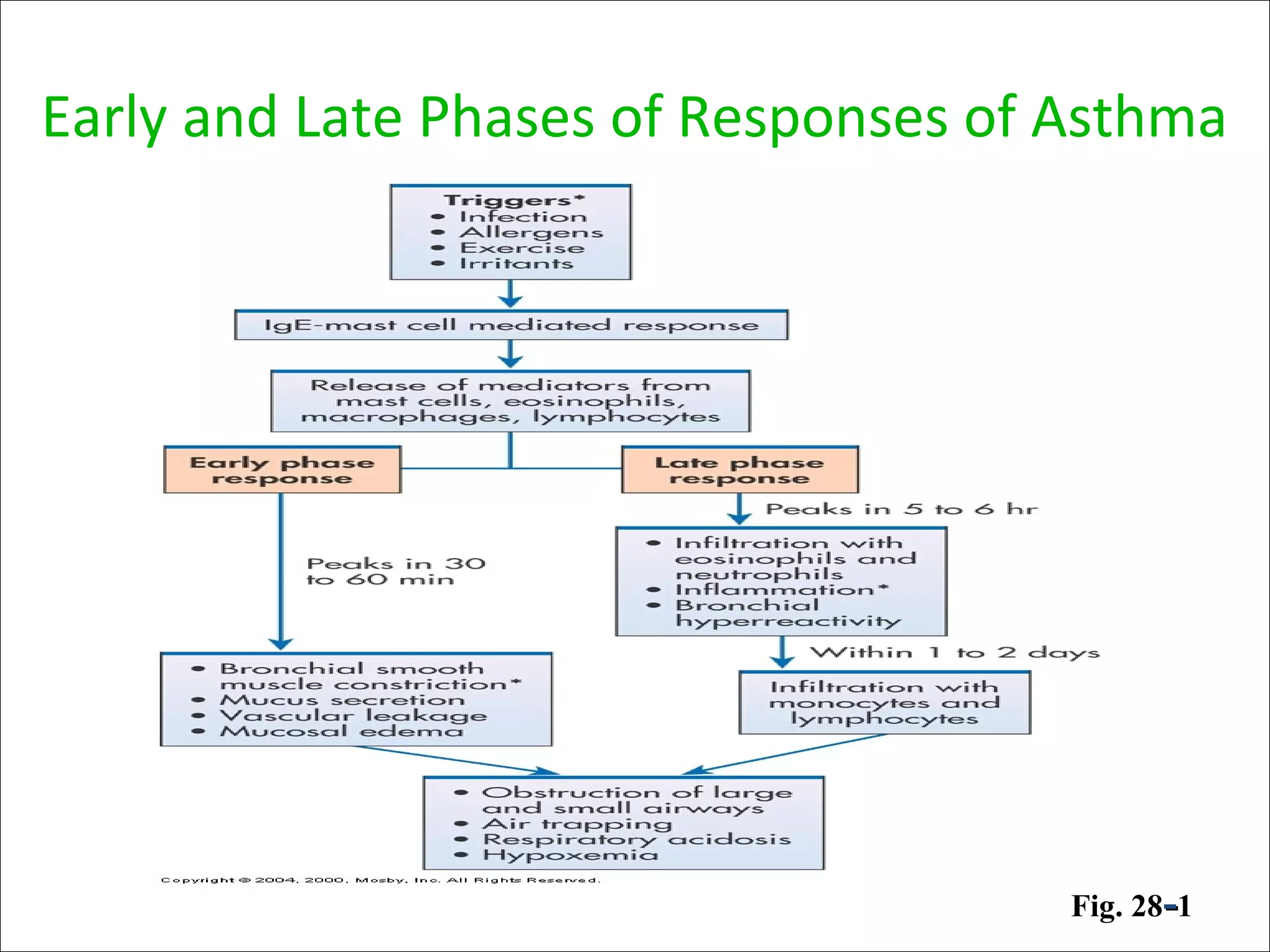
• Early phase
• Late phase
Early-Phase ResponseEarly-Phase Response
– PPeaks 30-60 minutes post exposure, subsides 30-
90 minutes later
– Characterized primarily by bronchospasm
– Increased mucous secretion, edema formation,
and increased amounts of tenacious sputum
– Patient experiences wheezing, cough, chest
tightness, and dyspnea
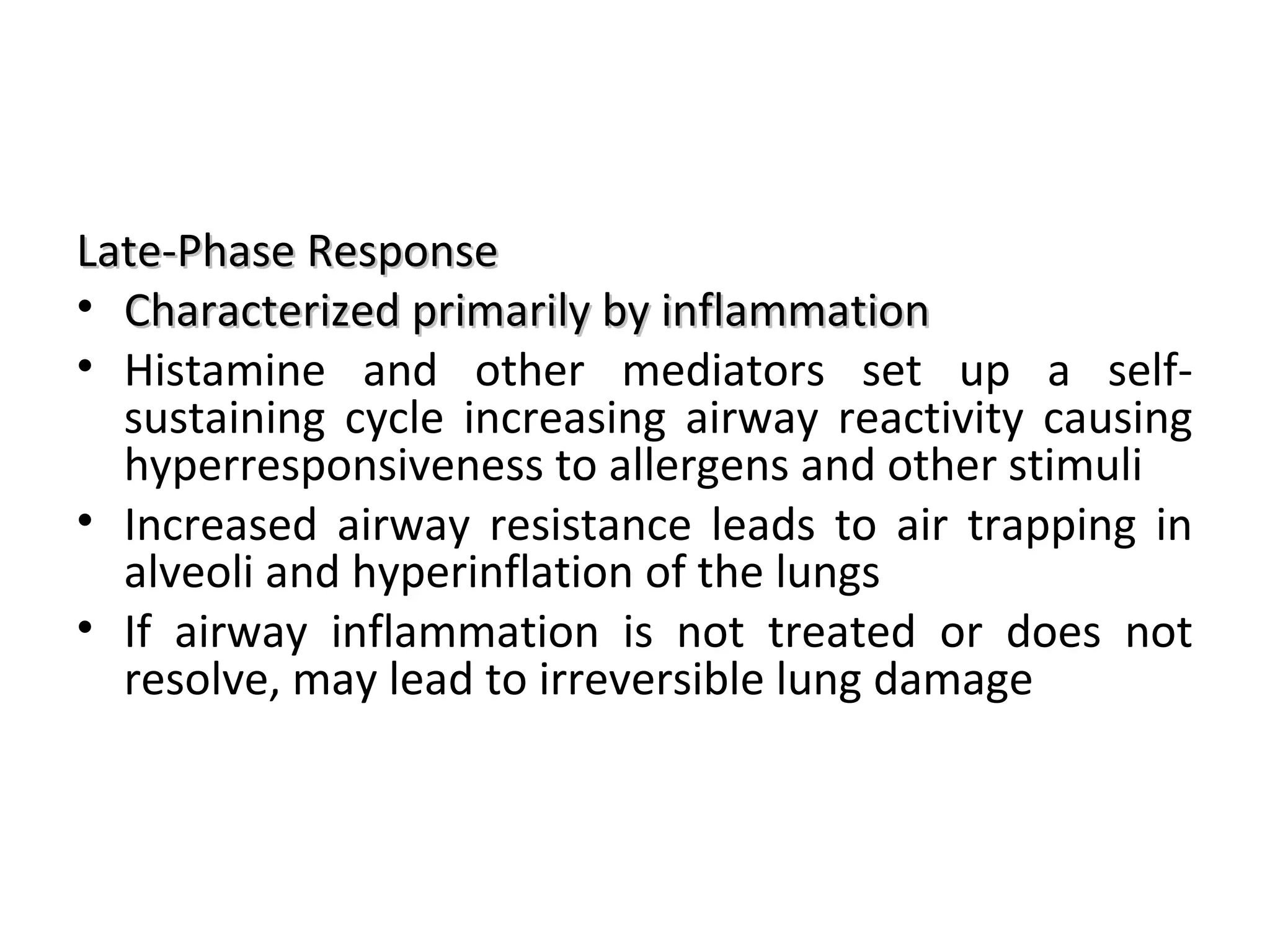
Late-Phase ResponseLate-Phase Response
• Characterized primarily by inflammationCharacterized primarily by inflammation
• Histamine and other mediators set up a self-
sustaining cycle increasing airway reactivity causing
hyperresponsiveness to allergens and other stimuli
• Increased airway resistance leads to air trapping in
alveoli and hyperinflation of the lungs
• If airway inflammation is not treated or does not
resolve, may lead to irreversible lung damage
Early and Late Phases of Responses of Asthma
Fig. 28--1
Pathophysiology
• The pathophysiology of asthma is complex
and involves the following components:
• Airway inflammation
• Intermittent airflow obstruction
• Bronchial hyperresponsiveness
• Airway remodelling
Airway inflammation
• Chronic inflammation of the airways is
associated with increased bronchial
hyperresponsiveness, which leads to
bronchospasm and typical symptoms of
wheezing, shortness of breath, and coughing
after exposure to allergens, environmental
irritants, viruses, cold air, or exercise. In some
patients with chronic asthma, airflow
limitation may be only partially reversible
• Airway inflammation in asthma may represent
a loss of normal balance between two
"opposing" populations of Th lymphocytes.
Two types of Th lymphocytes have been
characterized: Th1 and Th2. Th1 cells produce
interleukin (IL)-2 and IFN-α, which are critical
in cellular defense mechanisms in response to
infection. Th2, in contrast, generates a family
of cytokines (IL-4, IL-5, IL-6, IL-9, and IL-13)
that can mediate allergic inflammation
Cells involved in inflammation
• Mast Cells: activated by IgE dependant
mechanism, initiate acute bronchoconstriction
action by releasing histamine,
prostaglandinD2,leukotrienes etc
• Macrophages: activated by low affinity IgE
receptor, produce various inflammatory
mediators
• Dendritic cell-macrophage like major APC in
airways, TSLP(Thymic stromal lymphopoietin) by
epithelial cell induced chemokine release for TH2
cells
• Eosinophils: infiltration is characteristic
feature of asthma, activated by IL-5, causes
exacerbation of asthma by producing
mediators
• Neutrophils: activated and infiltration.
• T cell: release cytokines, causes recruitment of
eosinophils, also causes maintenance of mast
cells, in asthma TH2 cell produce IL-
5(eosinophil recruitment) IL-4, IL-13(increase
IgE production and mucus secretion).CD4+ cell
also involved
Inflamatory mediators
• Histamine, prostaglandin D2, cysteinly
leukotrienes-cause smooth muscle contraction,
increased microvascular leakage, increased
mucus secretion, act as chemoattractant for
inflammatory cells
• Cytokines- IL-4, IL-5, IL-13-causes allergic
inflammation, IL-1beta, TNF-alpha-amplification
of inflammation, TSLP(Tymic stromal
lmphopoietin)- from epithelial cells act as
chemoattractant for TH2 cells, IL-10, IL-12-anti
inflammatory
• Chemokines-attract inflammatory cells,
Eotaxin(CCL11) attract eosinophil via CCR3
receptor, TARC(CCL17) and MDC (CCL 22)
from epithelial cell attract TH2 cell via CCR4.
• Oxidative stress-increase in ROS production 
NO-act as relaxant but mainly causes
vasodilatation leading to leakage.
• Transcription factor-NF-kB, activator protein-1
Various inflammatory mediators
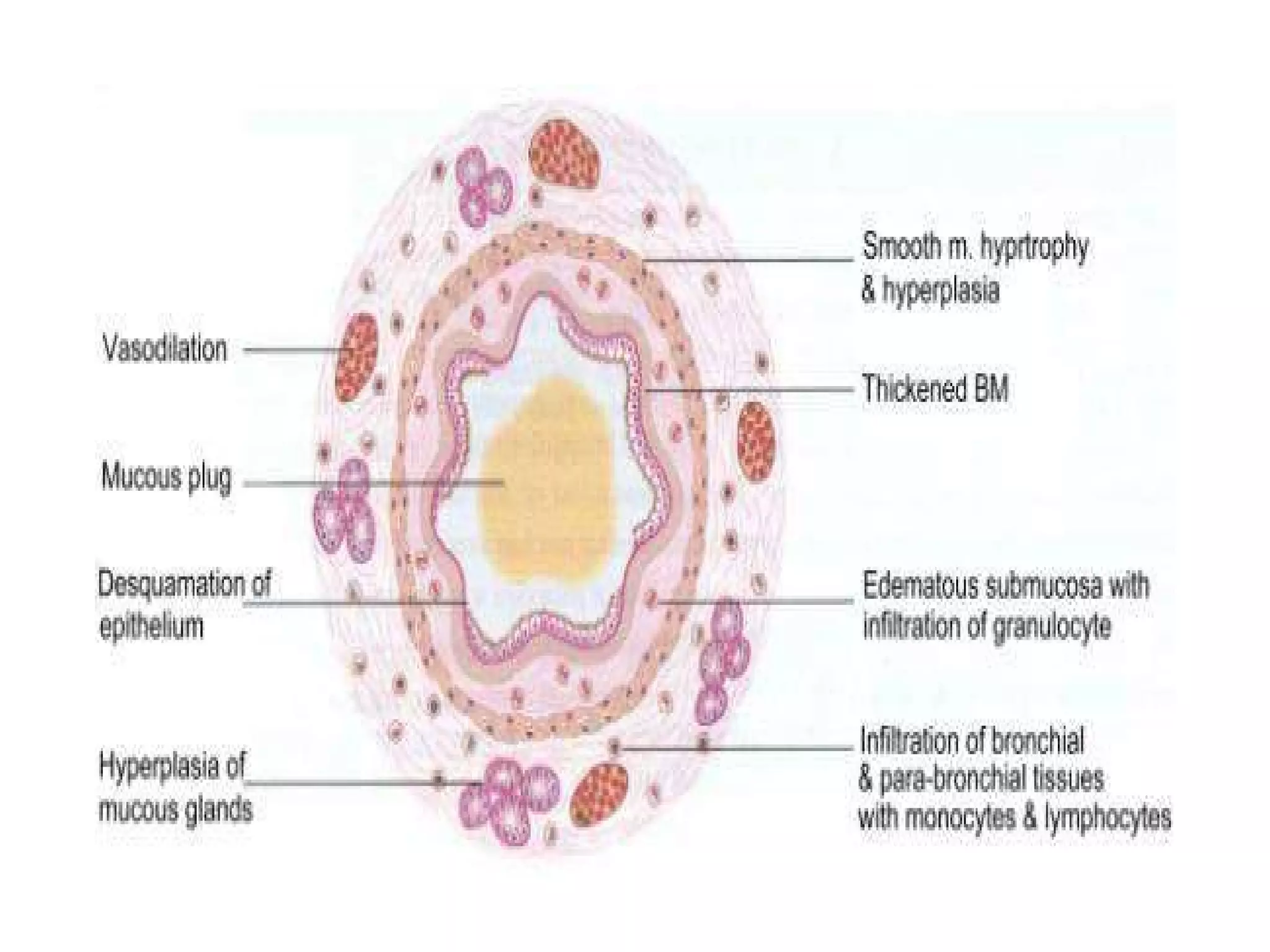
Effects of inflammation
• Epithelium-dysfunction, damage, loss of enzyme,
loss of relaxant factors, loss of barrier function
• Fibrosis- subepithelial fibrosis, basement
membrane thickening, deposition of III and V
collagen(by factors release from eosinophil)
• Smooth muscle- increased responsiveness to
constrictor mediators, in chronic cases
hypertrophy/hyperplasia by growth factors
released by inflammatory mediators
• Vascular response-vasodilation, angiogenesis,
microvascular leakage
• Mucus hypersecrection- by goblet cell
hyperplasia, increase in mucus plug, leading to
blocking of airway
• Neural effect-reflex cholinergic
bronchoconstriction by increased muscarinic
action
Air flow obstruction
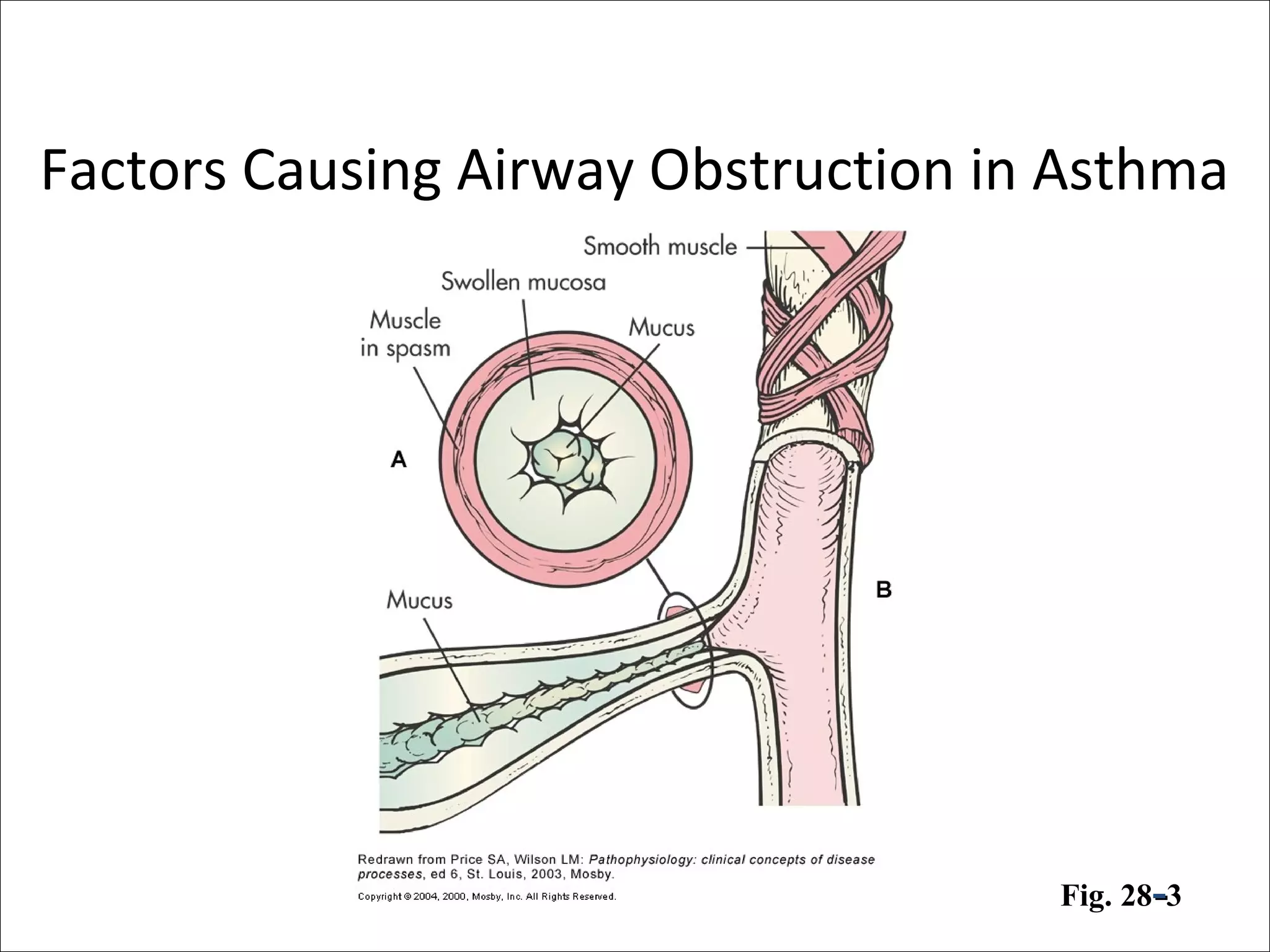
• Airflow obstruction can be caused by a variety of changes, including
acute bronchoconstriction, airway edema, chronic mucous plug
formation, and airway remodeling.
• Acute bronchoconstriction is the consequence of immunoglobulin
E-dependent mediator release upon exposure to aeroallergens and
is the primary component of the early asthmatic response. Airway
edema occurs 6-24 hours following an allergen challenge and is
referred to as the late asthmatic response. Chronic mucous plug
formation consists of an exudate of serum proteins and cell debris
that may take weeks to resolve. Airway remodeling is associated
with structural changes due to long-standing inflammation and may
profoundly affect the extent of reversibility of airway obstruction.[9]
• Airway obstruction causes increased
resistance to airflow and decreased expiratory
flow rates. These changes lead to a decreased
ability to expel air and may result in
hyperinflation. The resulting overdistention
helps maintain airway patency, thereby
improving expiratory flow; however, it also
alters pulmonary mechanics and increases the
work of breathing.
Factors Causing Airway Obstruction in Asthma
Fig. 28--3
Bronchial Hyperresponsiveness
• Hyperinflation compensates for the airflow
obstruction, but this compensation is limited when the
tidal volume approaches the volume of the pulmonary
dead space; the result is alveolar hypoventilation.
Uneven changes in airflow resistance, the resulting
uneven distribution of air, and alterations in circulation
from increased intra-alveolar pressure due to
hyperinflation all lead to ventilation-perfusion
mismatch. Vasoconstriction due to alveolar hypoxia
also contributes to this mismatch. Vasoconstriction is
also considered an adaptive response to
ventilation/perfusion mismatch.
Airway remodelling
• Several changes can be seen
• Irreversible narrowing of lumen
• Decline in lung function
• Smooth muscle hyperplasia
• Fibrosis
THANK YOU

Pathophysiology of Asthma

  • 1.
  • 2.
    Definition • Reactive airwaydisease • Chronic inflammatory lung disease Inflammation causes varying degrees ofInflammation causes varying degrees of obstruction in the airwaysobstruction in the airways • Asthma is reversible in early stages
  • 4.
    Signs and Symptoms •Wheezing • Coughing • Shortness of breathe • Chest tightness or pain
  • 5.
    Risk factors Endogenous factors •Genetic predisposition • Atopy • Airway hyperresponsiveness • Gender • Ethnicity • Obesity • Viral infections Exogenous factors • Indoor allergens • Outdoor allergens • Occupational sensitizers • Passive smoking • Respiratory infections
  • 6.
    Triggers • Allergens-Dermatophagoides species(dustmite), environmental exposure, grass pollen, ragweed, tree pollen, fungal spores, pets furs, cockroaches etc • Virus infection-upper respiratory tract virus such as rhinovirus, respiratory syncytial virus, coronavirus etc • Pharmacological agents-beta blockers, ACE inhibitors, aspirin • Exercise(may exacerbate ) • Physical factors-cold air, hyperventilation • Food • Air pollutants-sulfur dioxide, irritant gases • Irritants-household sprays paint fumes • Occupational factors • Hormonal factors-fall in progesterone thyrotoxicosis Gastrointestinal reflex
  • 7.
    Types of asthma •Atopic asthma-classical type I IgE mediated hypersensitivity, allergen sensitization, seen from childhood, +ve history of asthma in family, skin test +ve • Non-atopic asthma-no allergen sensitization, no such history, skin test –ve, virus infection? • Drug induced asthma-sensitive to certain drugs like aspirin, NSAIDS etc • Occupational asthma-stimulants such as fumes, organic and chemical dusts(wood, cotton), gas(toluene), penicillin products etc • Exercise induced asthma-begins after exercise and stops after 30 minutes, worsen in cold and dry climate
  • 8.
  • 9.
    Early-Phase ResponseEarly-Phase Response –PPeaks 30-60 minutes post exposure, subsides 30- 90 minutes later – Characterized primarily by bronchospasm – Increased mucous secretion, edema formation, and increased amounts of tenacious sputum – Patient experiences wheezing, cough, chest tightness, and dyspnea
  • 10.
    Late-Phase ResponseLate-Phase Response •Characterized primarily by inflammationCharacterized primarily by inflammation • Histamine and other mediators set up a self- sustaining cycle increasing airway reactivity causing hyperresponsiveness to allergens and other stimuli • Increased airway resistance leads to air trapping in alveoli and hyperinflation of the lungs • If airway inflammation is not treated or does not resolve, may lead to irreversible lung damage
  • 11.
    Early and LatePhases of Responses of Asthma Fig. 28--1
  • 12.
    Pathophysiology • The pathophysiologyof asthma is complex and involves the following components: • Airway inflammation • Intermittent airflow obstruction • Bronchial hyperresponsiveness • Airway remodelling
  • 13.
    Airway inflammation • Chronicinflammation of the airways is associated with increased bronchial hyperresponsiveness, which leads to bronchospasm and typical symptoms of wheezing, shortness of breath, and coughing after exposure to allergens, environmental irritants, viruses, cold air, or exercise. In some patients with chronic asthma, airflow limitation may be only partially reversible
  • 14.
    • Airway inflammationin asthma may represent a loss of normal balance between two "opposing" populations of Th lymphocytes. Two types of Th lymphocytes have been characterized: Th1 and Th2. Th1 cells produce interleukin (IL)-2 and IFN-α, which are critical in cellular defense mechanisms in response to infection. Th2, in contrast, generates a family of cytokines (IL-4, IL-5, IL-6, IL-9, and IL-13) that can mediate allergic inflammation
  • 15.
    Cells involved ininflammation • Mast Cells: activated by IgE dependant mechanism, initiate acute bronchoconstriction action by releasing histamine, prostaglandinD2,leukotrienes etc • Macrophages: activated by low affinity IgE receptor, produce various inflammatory mediators • Dendritic cell-macrophage like major APC in airways, TSLP(Thymic stromal lymphopoietin) by epithelial cell induced chemokine release for TH2 cells
  • 16.
    • Eosinophils: infiltrationis characteristic feature of asthma, activated by IL-5, causes exacerbation of asthma by producing mediators • Neutrophils: activated and infiltration. • T cell: release cytokines, causes recruitment of eosinophils, also causes maintenance of mast cells, in asthma TH2 cell produce IL- 5(eosinophil recruitment) IL-4, IL-13(increase IgE production and mucus secretion).CD4+ cell also involved
  • 17.
    Inflamatory mediators • Histamine,prostaglandin D2, cysteinly leukotrienes-cause smooth muscle contraction, increased microvascular leakage, increased mucus secretion, act as chemoattractant for inflammatory cells • Cytokines- IL-4, IL-5, IL-13-causes allergic inflammation, IL-1beta, TNF-alpha-amplification of inflammation, TSLP(Tymic stromal lmphopoietin)- from epithelial cells act as chemoattractant for TH2 cells, IL-10, IL-12-anti inflammatory
  • 18.
    • Chemokines-attract inflammatorycells, Eotaxin(CCL11) attract eosinophil via CCR3 receptor, TARC(CCL17) and MDC (CCL 22) from epithelial cell attract TH2 cell via CCR4. • Oxidative stress-increase in ROS production  NO-act as relaxant but mainly causes vasodilatation leading to leakage. • Transcription factor-NF-kB, activator protein-1
  • 19.
  • 20.
    Effects of inflammation •Epithelium-dysfunction, damage, loss of enzyme, loss of relaxant factors, loss of barrier function • Fibrosis- subepithelial fibrosis, basement membrane thickening, deposition of III and V collagen(by factors release from eosinophil) • Smooth muscle- increased responsiveness to constrictor mediators, in chronic cases hypertrophy/hyperplasia by growth factors released by inflammatory mediators • Vascular response-vasodilation, angiogenesis, microvascular leakage
  • 21.
    • Mucus hypersecrection-by goblet cell hyperplasia, increase in mucus plug, leading to blocking of airway • Neural effect-reflex cholinergic bronchoconstriction by increased muscarinic action
  • 23.
    Air flow obstruction •Airflow obstruction can be caused by a variety of changes, including acute bronchoconstriction, airway edema, chronic mucous plug formation, and airway remodeling. • Acute bronchoconstriction is the consequence of immunoglobulin E-dependent mediator release upon exposure to aeroallergens and is the primary component of the early asthmatic response. Airway edema occurs 6-24 hours following an allergen challenge and is referred to as the late asthmatic response. Chronic mucous plug formation consists of an exudate of serum proteins and cell debris that may take weeks to resolve. Airway remodeling is associated with structural changes due to long-standing inflammation and may profoundly affect the extent of reversibility of airway obstruction.[9]
  • 24.
    • Airway obstructioncauses increased resistance to airflow and decreased expiratory flow rates. These changes lead to a decreased ability to expel air and may result in hyperinflation. The resulting overdistention helps maintain airway patency, thereby improving expiratory flow; however, it also alters pulmonary mechanics and increases the work of breathing.
  • 25.
    Factors Causing AirwayObstruction in Asthma Fig. 28--3
  • 26.
    Bronchial Hyperresponsiveness • Hyperinflationcompensates for the airflow obstruction, but this compensation is limited when the tidal volume approaches the volume of the pulmonary dead space; the result is alveolar hypoventilation. Uneven changes in airflow resistance, the resulting uneven distribution of air, and alterations in circulation from increased intra-alveolar pressure due to hyperinflation all lead to ventilation-perfusion mismatch. Vasoconstriction due to alveolar hypoxia also contributes to this mismatch. Vasoconstriction is also considered an adaptive response to ventilation/perfusion mismatch.
  • 27.
    Airway remodelling • Severalchanges can be seen • Irreversible narrowing of lumen • Decline in lung function • Smooth muscle hyperplasia • Fibrosis
  • 29.