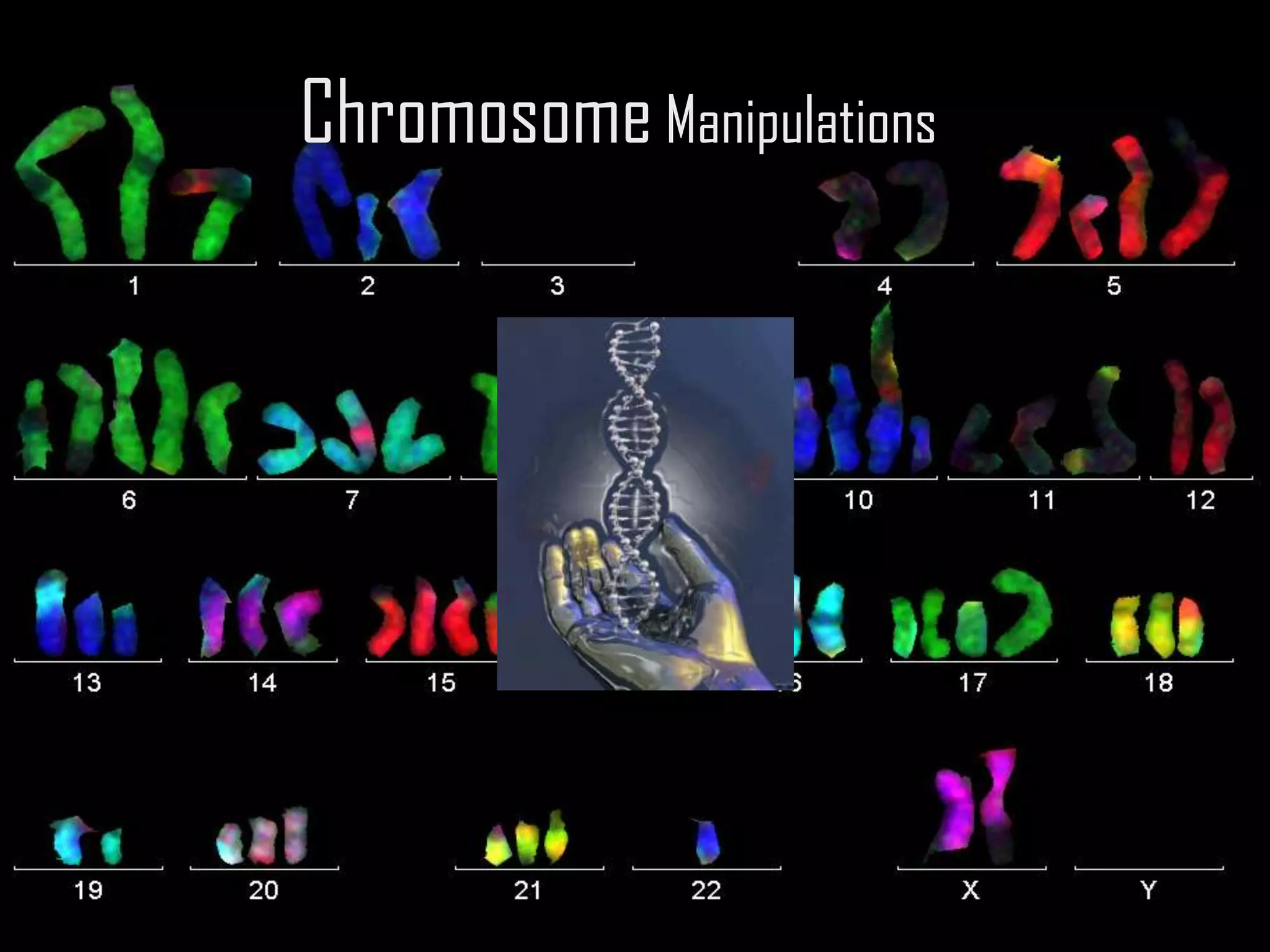


Chromosome Manipulations

ANIMAL BIOTECHNOLOGY
Benefits of Genetically Engineered Animals

 Used to develop new medical treatments
 Improve our food supply
 Enhance our understanding of biology of all

animals, including humans
Animal Models
 Animal systems are a model for the human system
 Polio vaccine was developed using animals as test systems
 Cataract surgical procedures were developed with animals
 Dialysis was tested first in animals before being applied to
human conditions
Regulation of animal research
 Animal Welfare Act
 Sets specific regulations regarding, housing, feeding, cleanliness
and medical care of animals
 Researchers must first develop a plan describing
Appropriateness of species to be used
 Minimum number of animals needed for test





Oversight committee reviews and approves plan
Government agencies monitor welfare of the test animals
Phase Testing
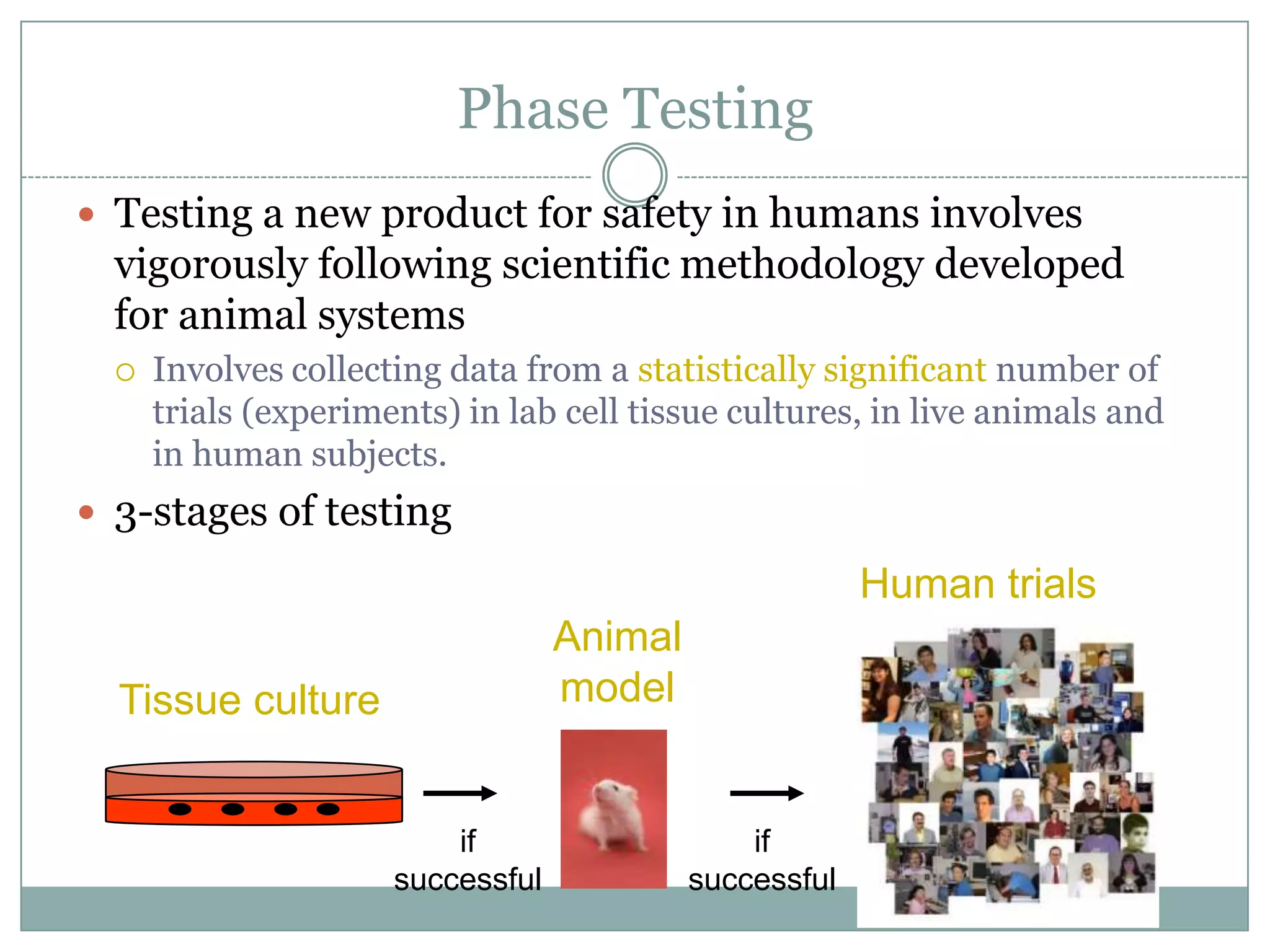
 Testing a new product for safety in humans involves

vigorously following scientific methodology developed
for animal systems


Involves collecting data from a statistically significant number of
trials (experiments) in lab cell tissue cultures, in live animals and
in human subjects.

 3-stages of testing

Human trials
Animal
model

Tissue culture

if
successful

if
successful
Testing
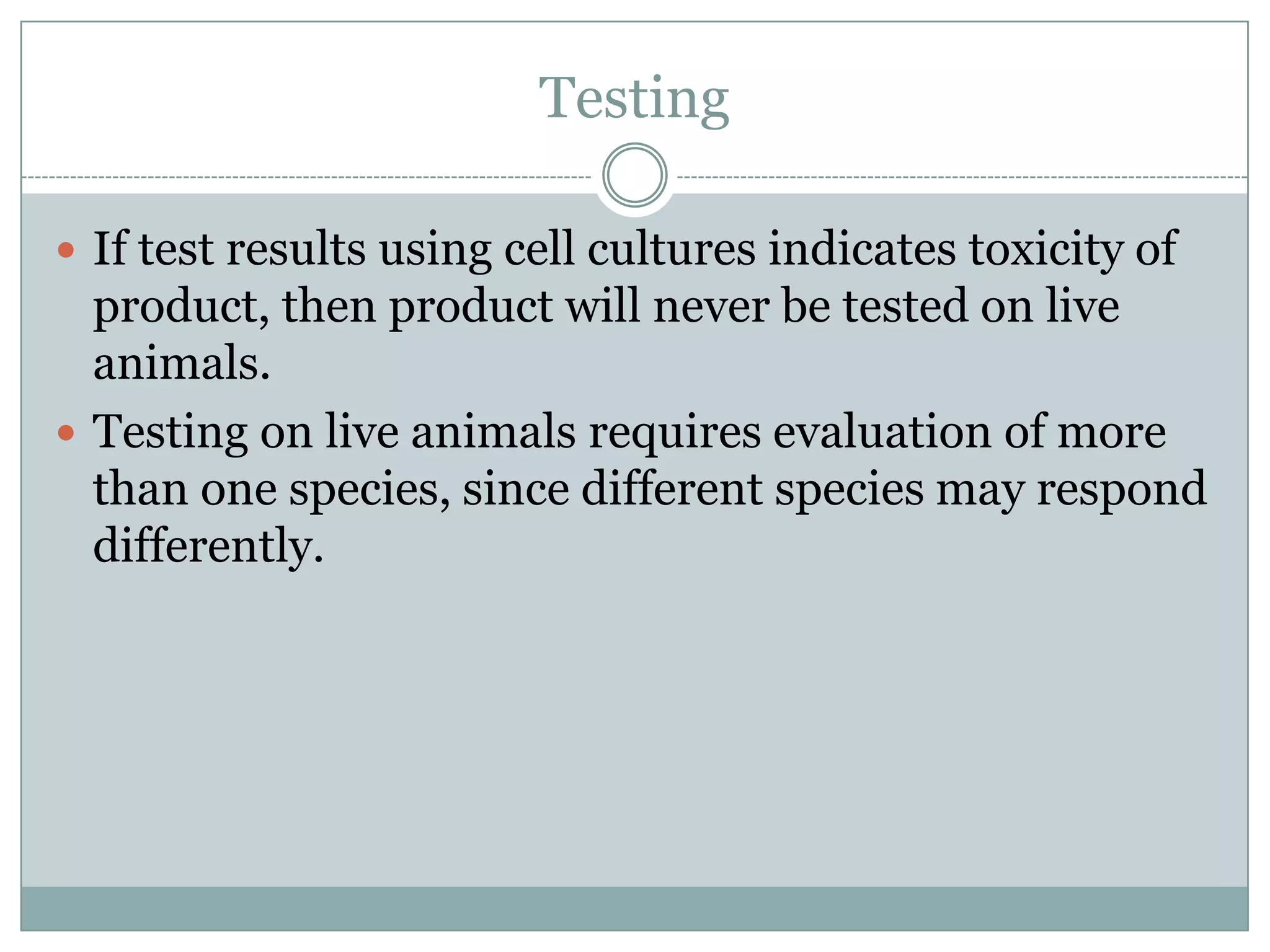
 If test results using cell cultures indicates toxicity of

product, then product will never be tested on live
animals.
 Testing on live animals requires evaluation of more
than one species, since different species may respond
differently.
Phase Testing
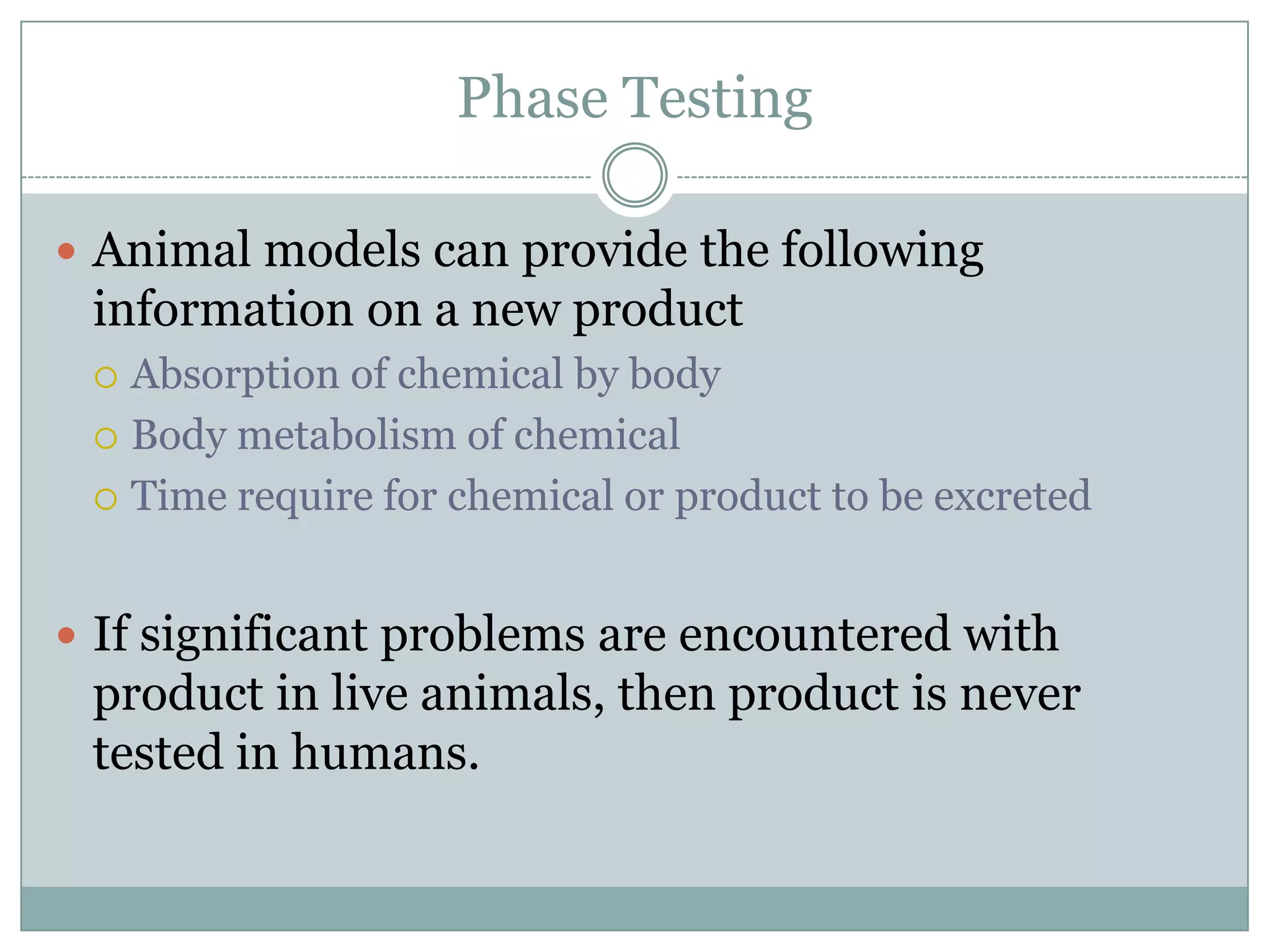
 Animal models can provide the following

information on a new product
Absorption of chemical by body
 Body metabolism of chemical
 Time require for chemical or product to be excreted


 If significant problems are encountered with

product in live animals, then product is never
tested in humans.
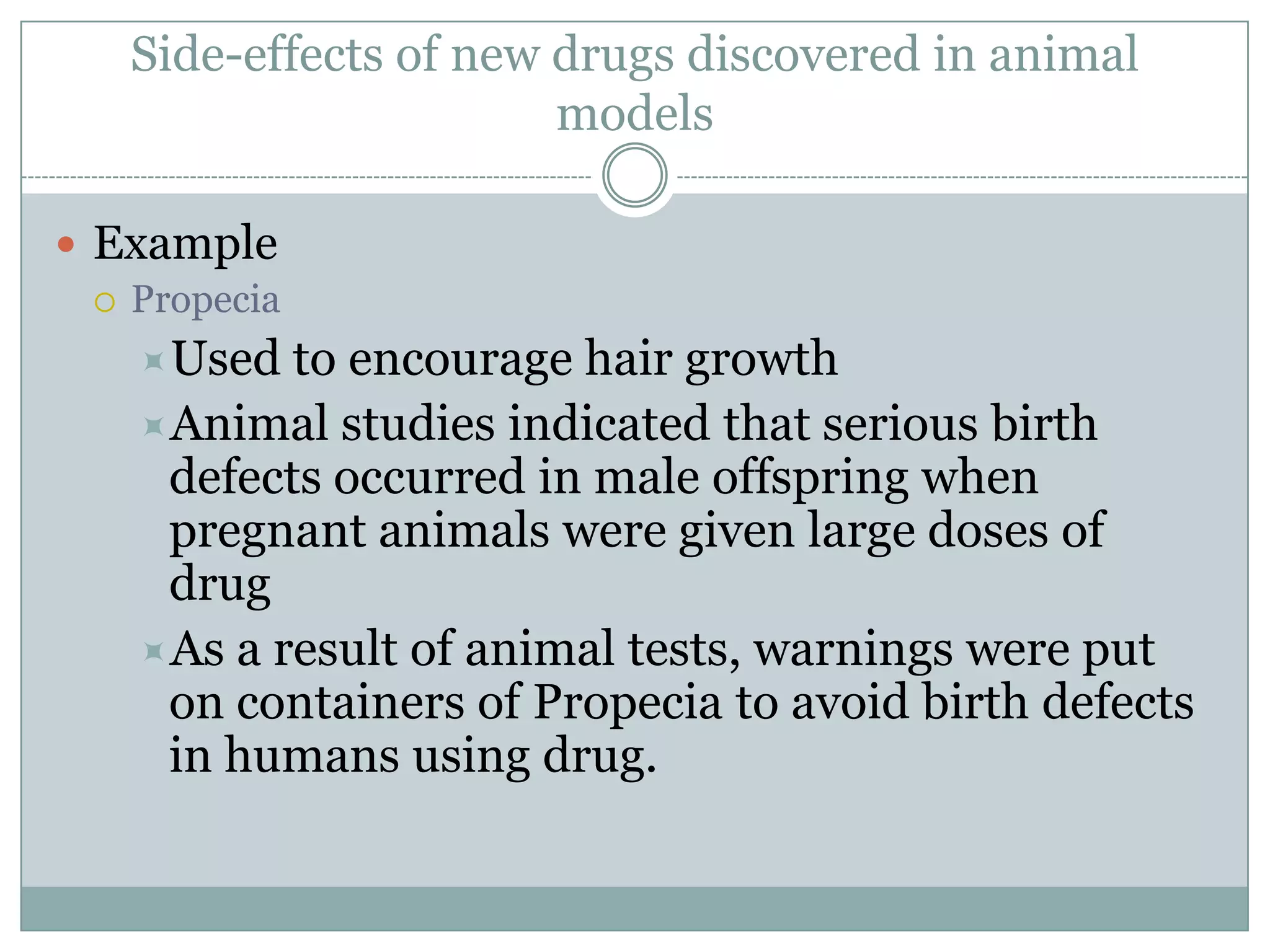
Side-effects of new drugs discovered in animal
models
 Example
 Propecia
Used

to encourage hair growth
Animal studies indicated that serious birth
defects occurred in male offspring when
pregnant animals were given large doses of
drug
As a result of animal tests, warnings were put
on containers of Propecia to avoid birth defects
in humans using drug.
How do you select appropriate animal as a model for the
human system?

 Look for genetic homology between animal and

human systems.
 In addition, identify animal that





Has short time between generations
Can produce lots of offspring in each generation
Can be easily maintained and manipulated in the laboratory
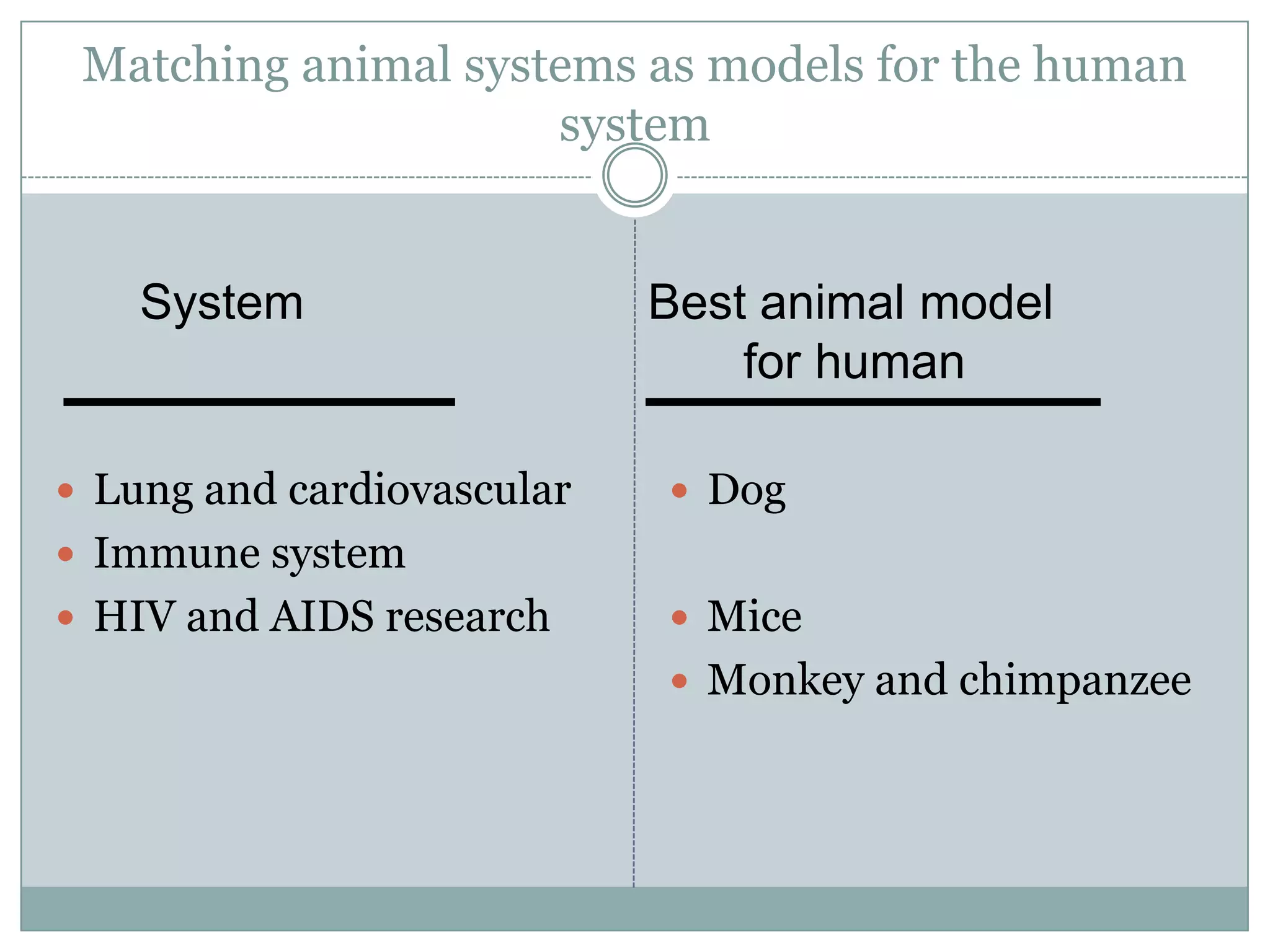
Matching animal systems as models for the human
system

System

 Lung and cardiovascular

Best animal model
for human
 Dog

 Immune system
 HIV and AIDS research

 Mice
 Monkey and chimpanzee
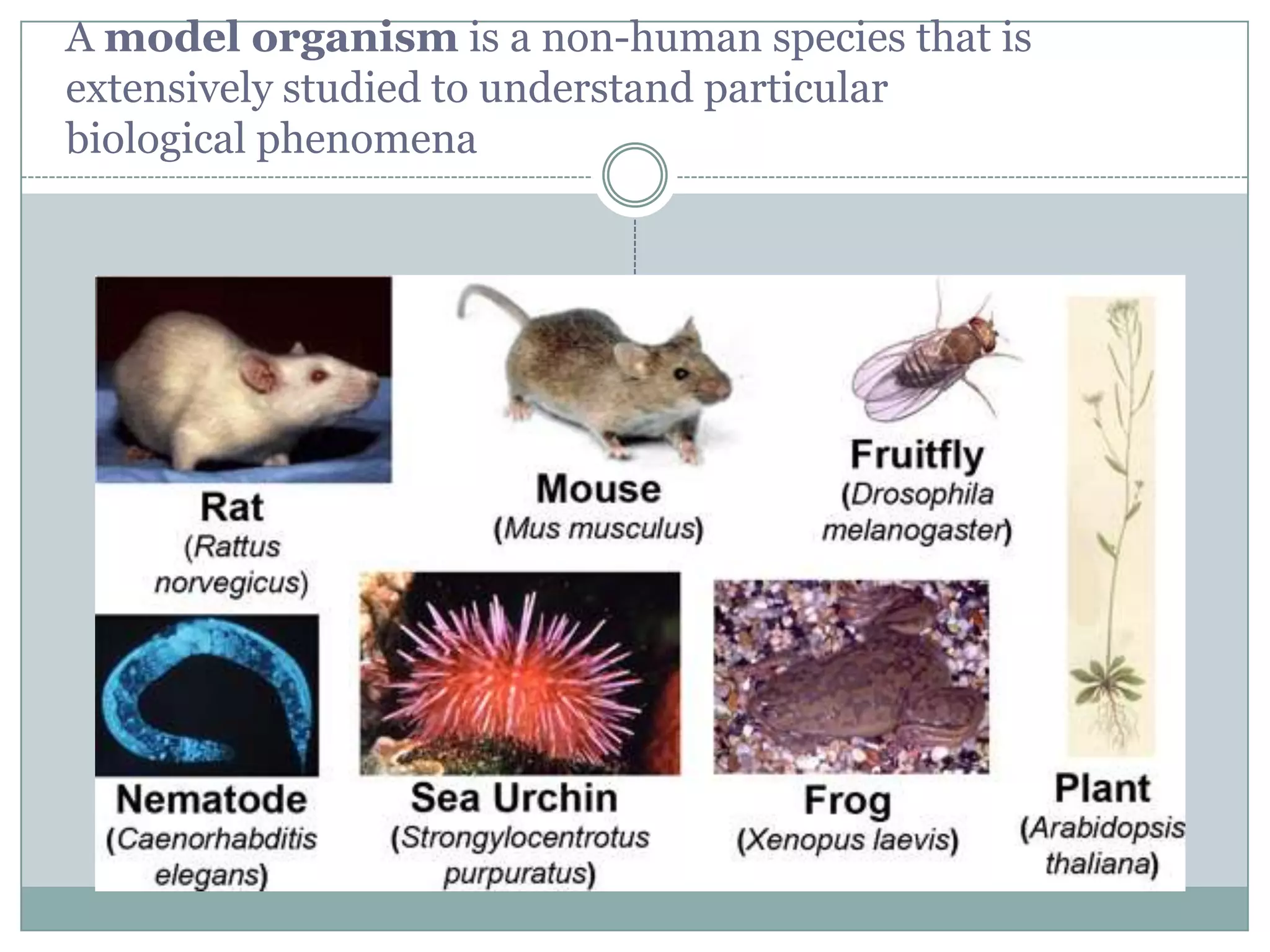
A model organism is a non-human species that is
extensively studied to understand particular
biological phenomena
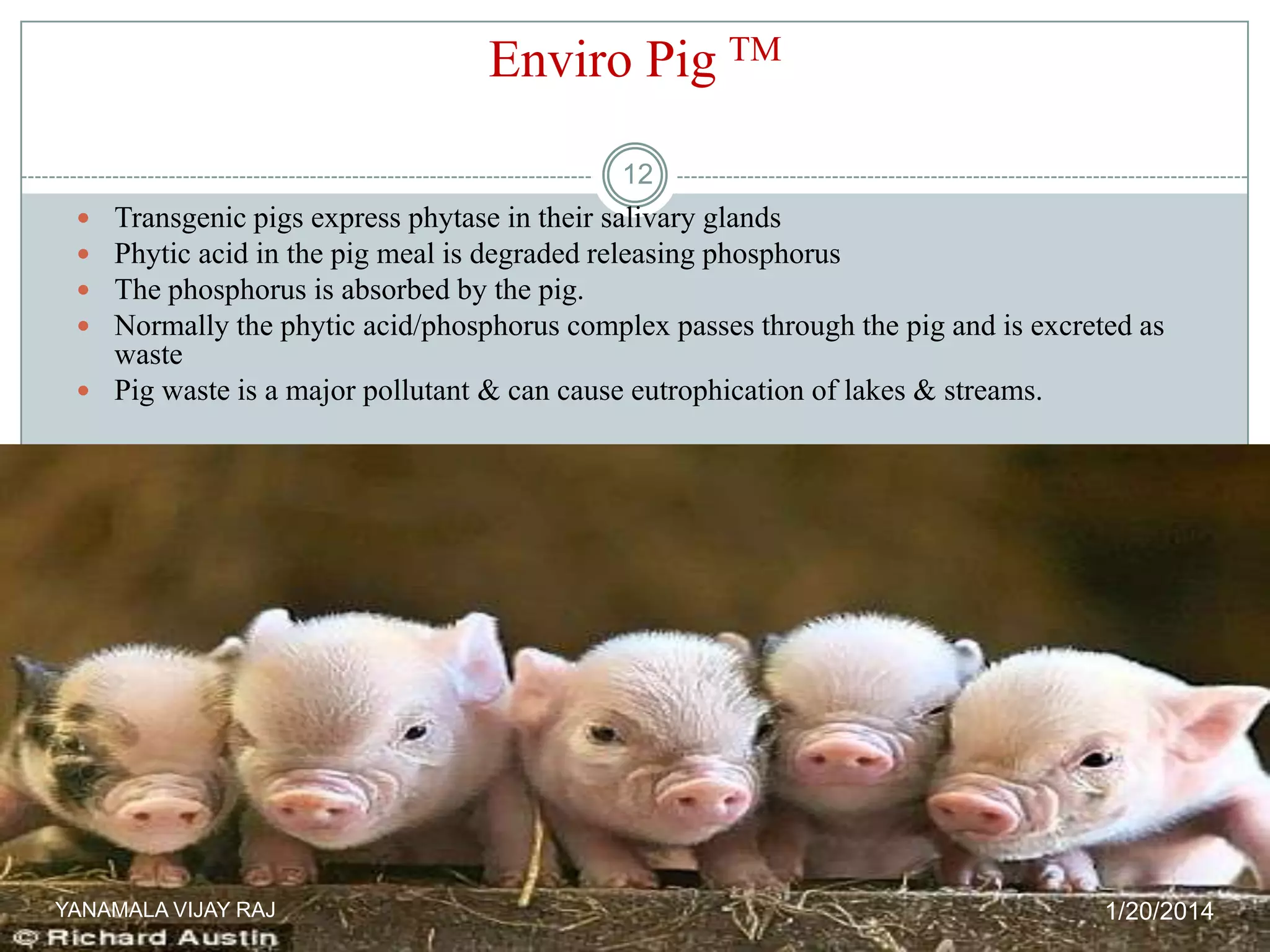
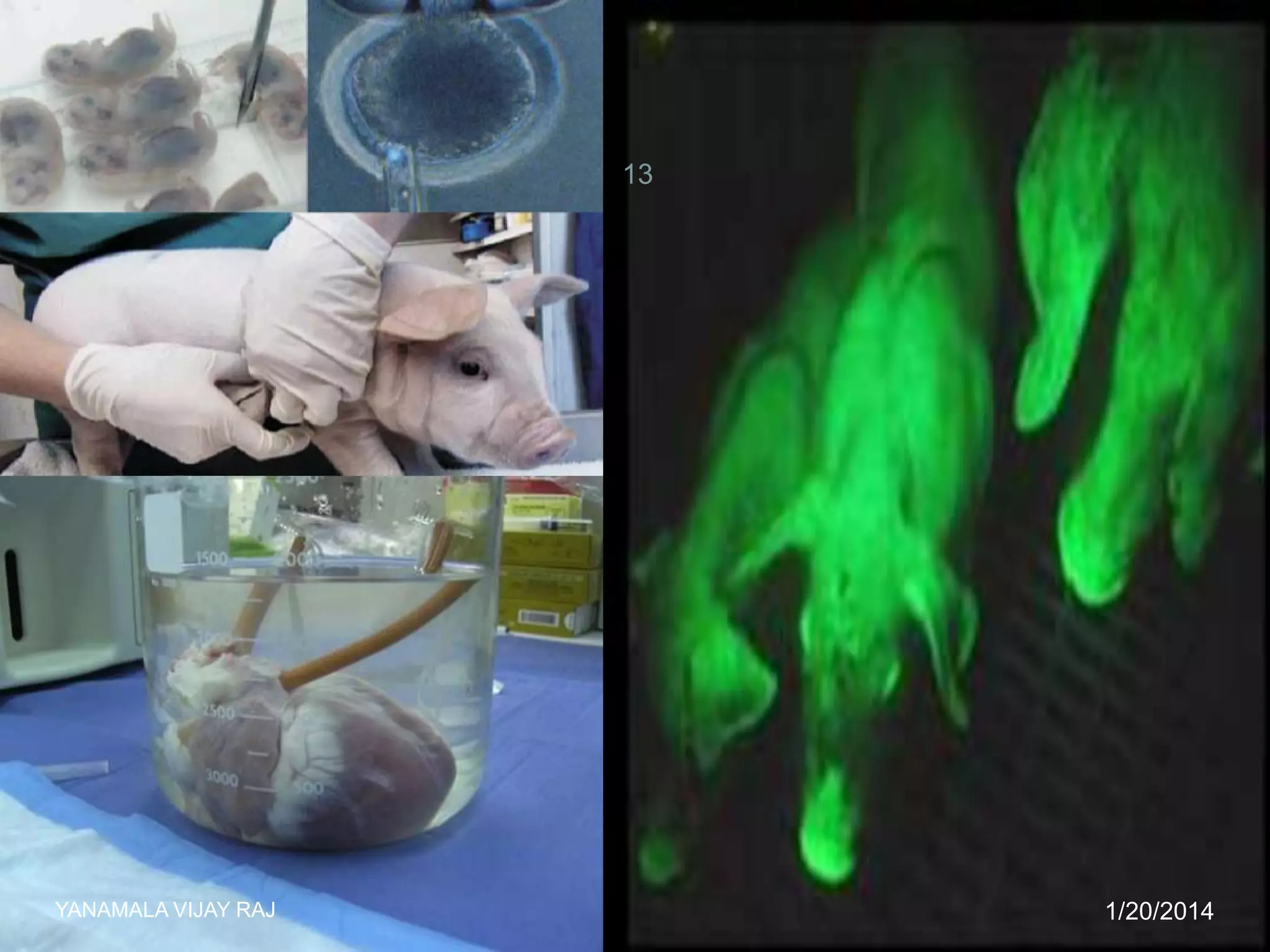
Enviro Pig TM
12





Transgenic pigs express phytase in their salivary glands
Phytic acid in the pig meal is degraded releasing phosphorus
The phosphorus is absorbed by the pig.
Normally the phytic acid/phosphorus complex passes through the pig and is excreted as
waste
 Pig waste is a major pollutant & can cause eutrophication of lakes & streams.

YANAMALA VIJAY RAJ

1/20/2014
13

YANAMALA VIJAY RAJ

1/20/2014
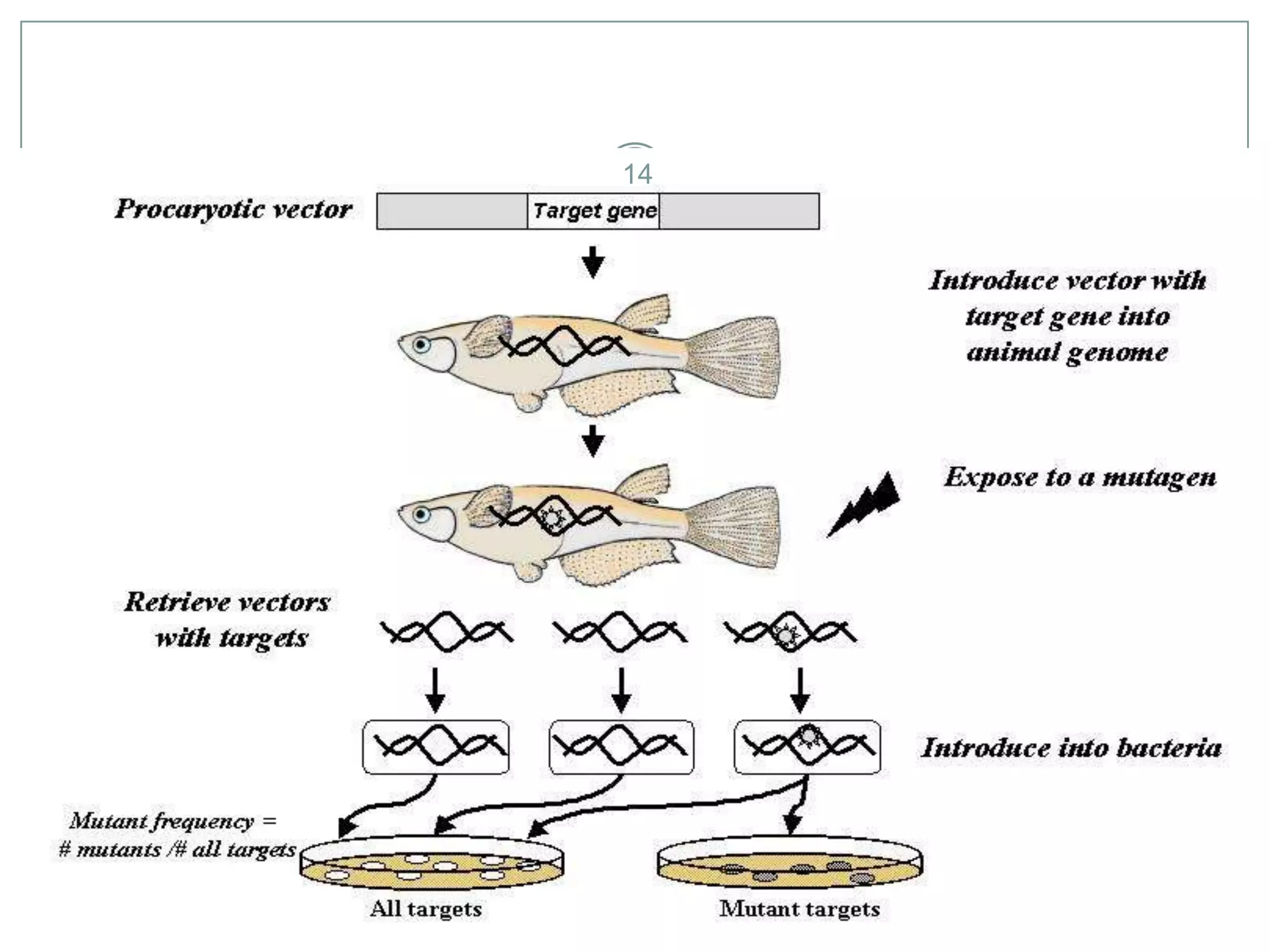
transgenic fish
14

YANAMALA VIJAY RAJ

1/20/2014
15

YANAMALA VIJAY RAJ

1/20/2014
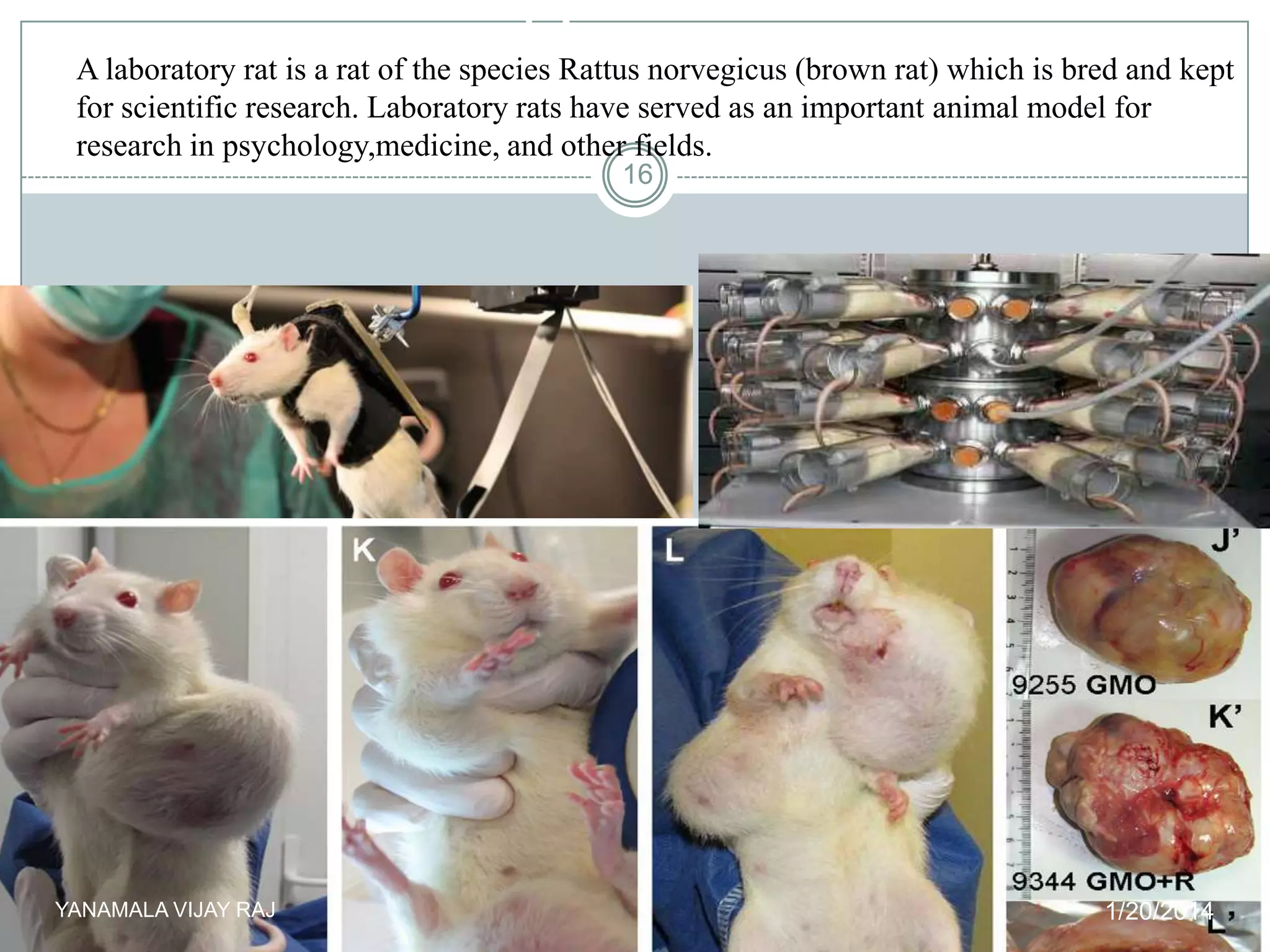
Laboratory rat

A laboratory rat is a rat of the species Rattus norvegicus (brown rat) which is bred and kept
for scientific research. Laboratory rats have served as an important animal model for
research in psychology,medicine, and other fields.
16

YANAMALA VIJAY RAJ

1/20/2014
17

YANAMALA VIJAY RAJ

1/20/2014
18

YANAMALA VIJAY RAJ

1/20/2014
19

YANAMALA VIJAY RAJ

1/20/2014
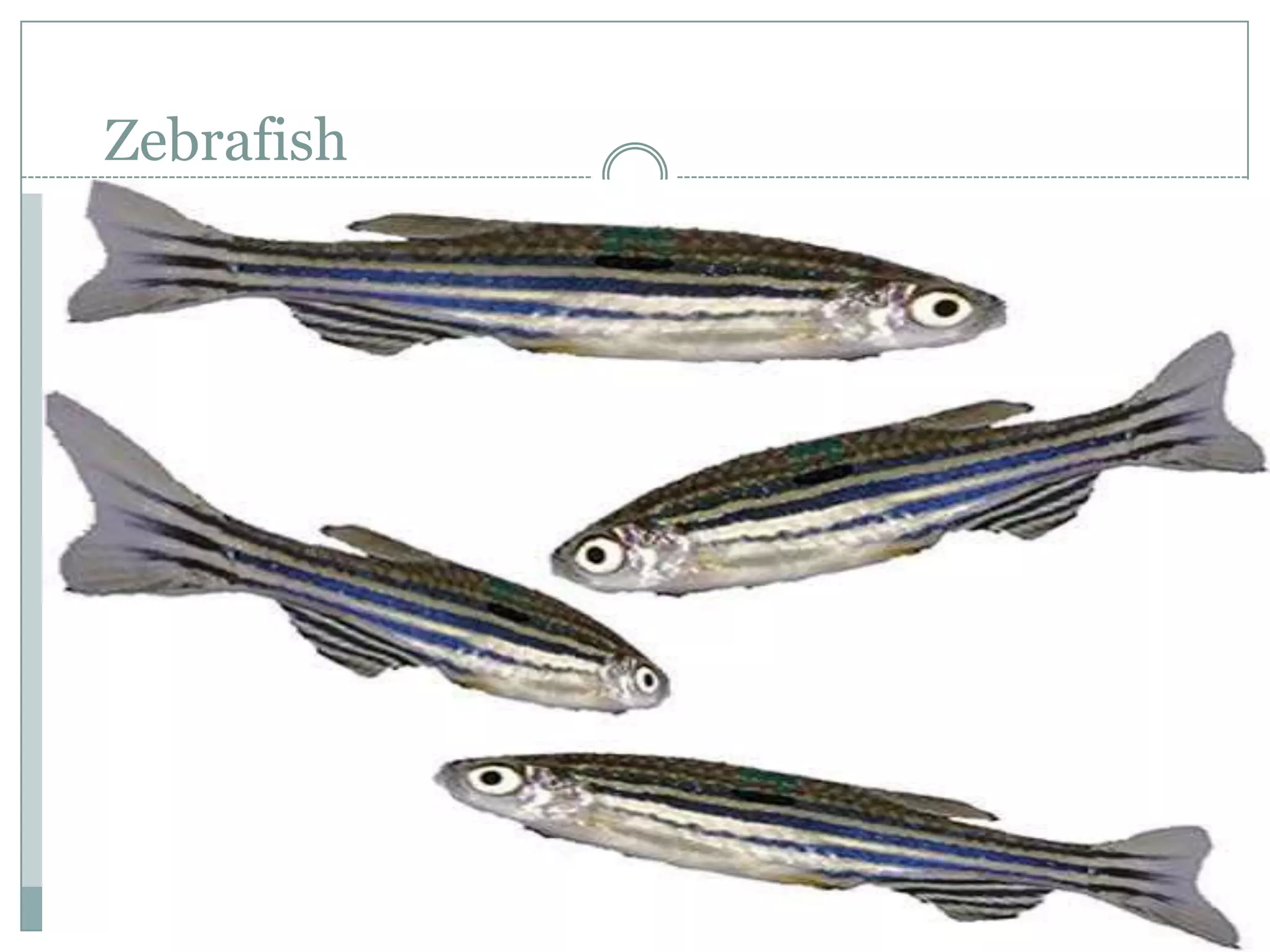
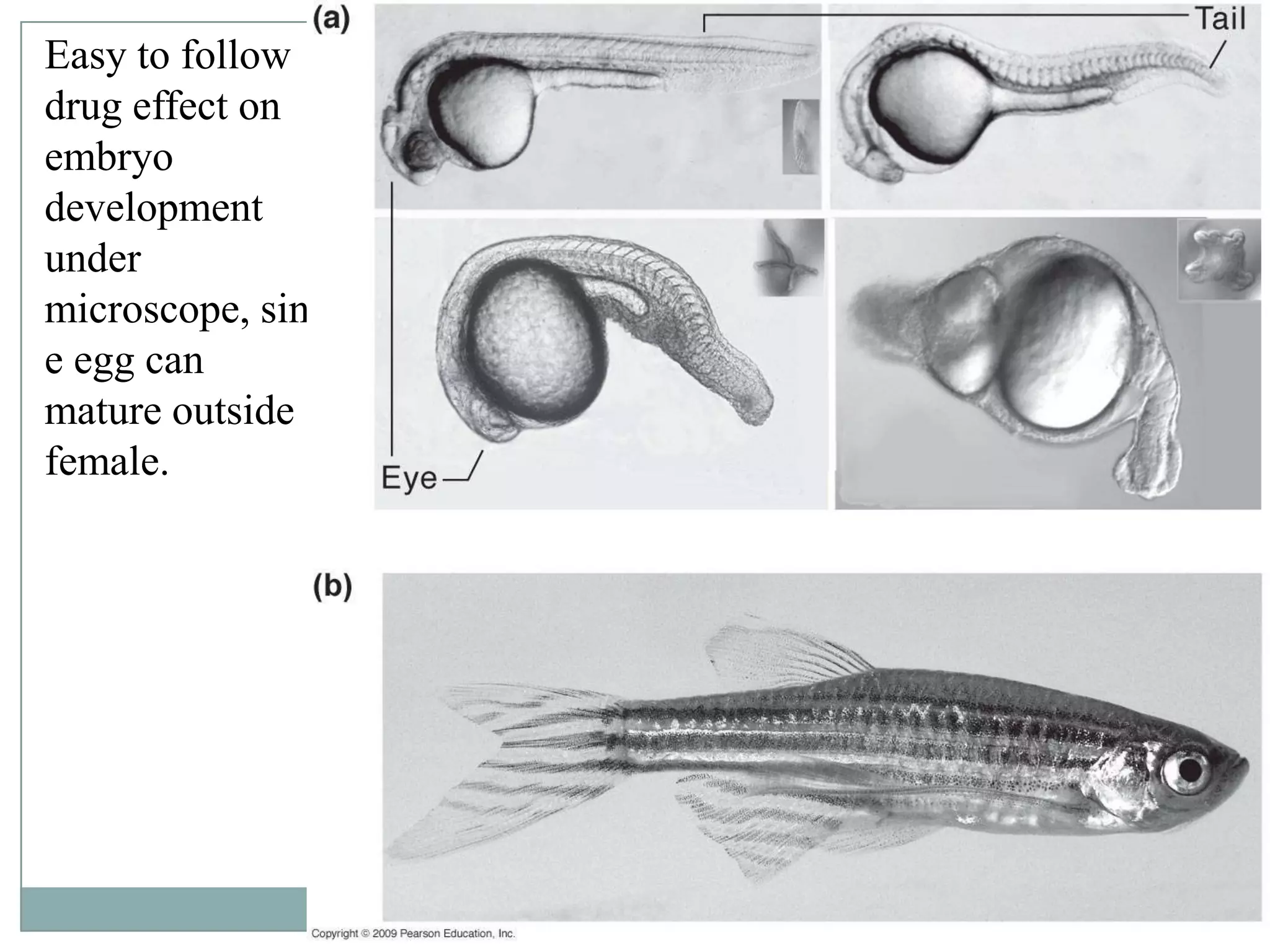
Zebrafish
Zebrafish
 Lots of genetic similarity to humans
 Egg lends itself to genetic transfer
 no need to implant an egg inside a donor mother for gestation.
 Embryos are transparent, making it possible to study

cell division under microscope from first hour of
creation.


transplant gene into embryo

 Because the genetics of zebrafish and humans are

similar, they are ideal animal systems for determining
whether a new drug induces genetic mutations
Easy to follow
drug effect on
embryo
development
under
microscope, sinc
e egg can
mature outside
female.
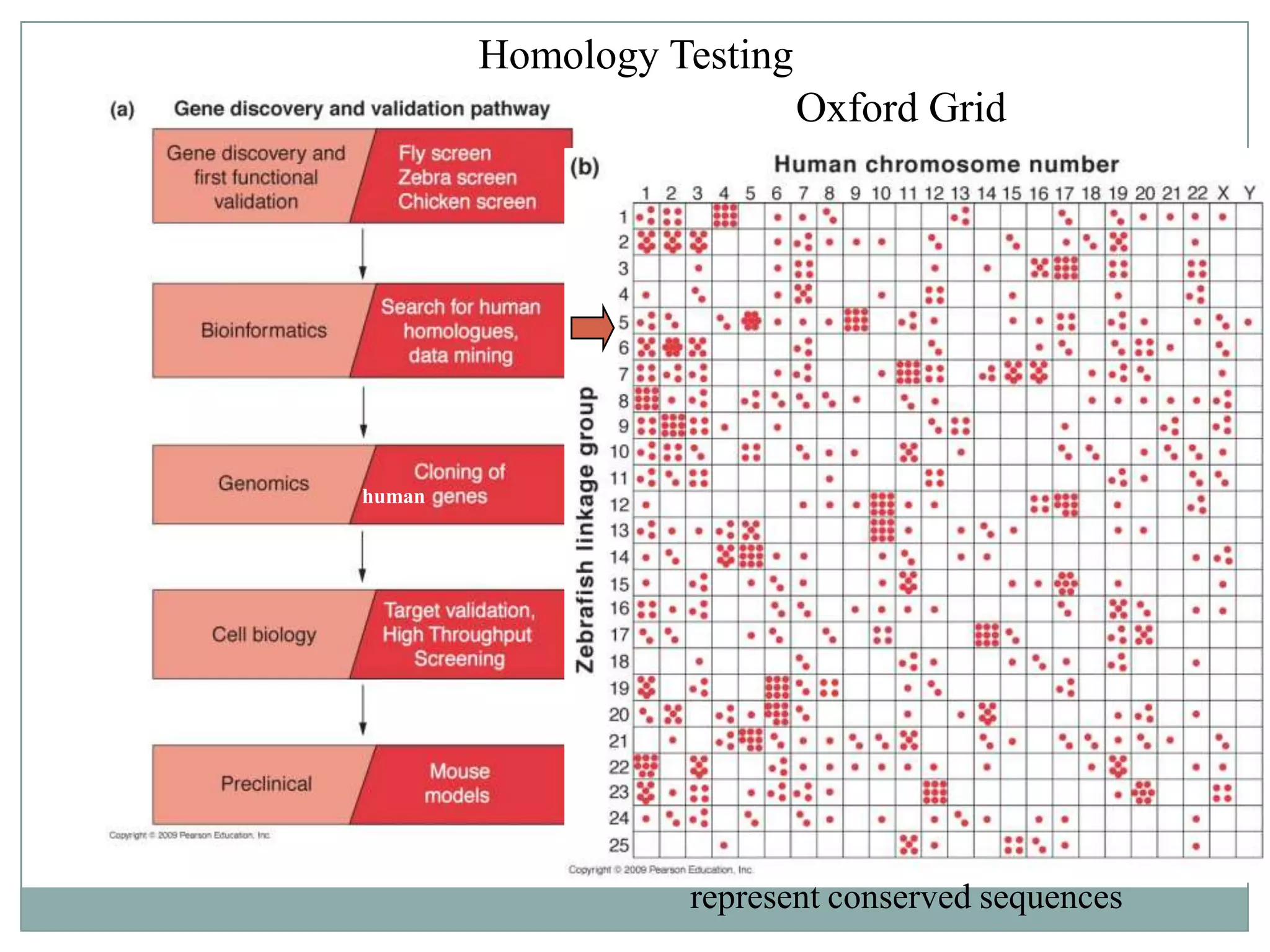
Homology Testing

Oxford Grid

human

Dots represent similar genes
Boxes with more than one dot
represent conserved sequences
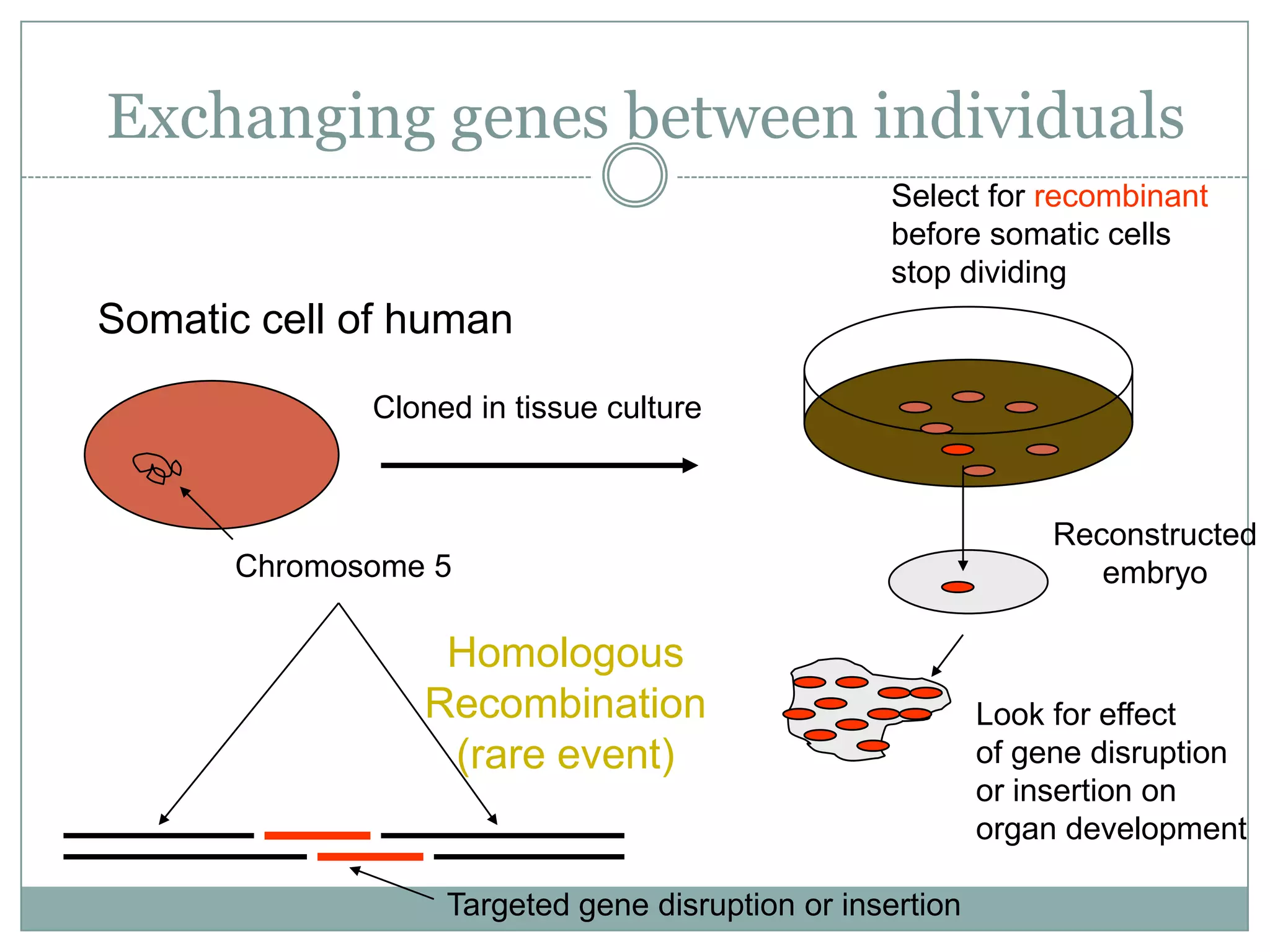
Exchanging genes between individuals
Select for recombinant
before somatic cells
stop dividing

Somatic cell of human
Cloned in tissue culture

Chromosome 5

Homologous
Recombination
(rare event)

Targeted gene disruption or insertion

Reconstructed
embryo

Look for effect
of gene disruption
or insertion on
organ development
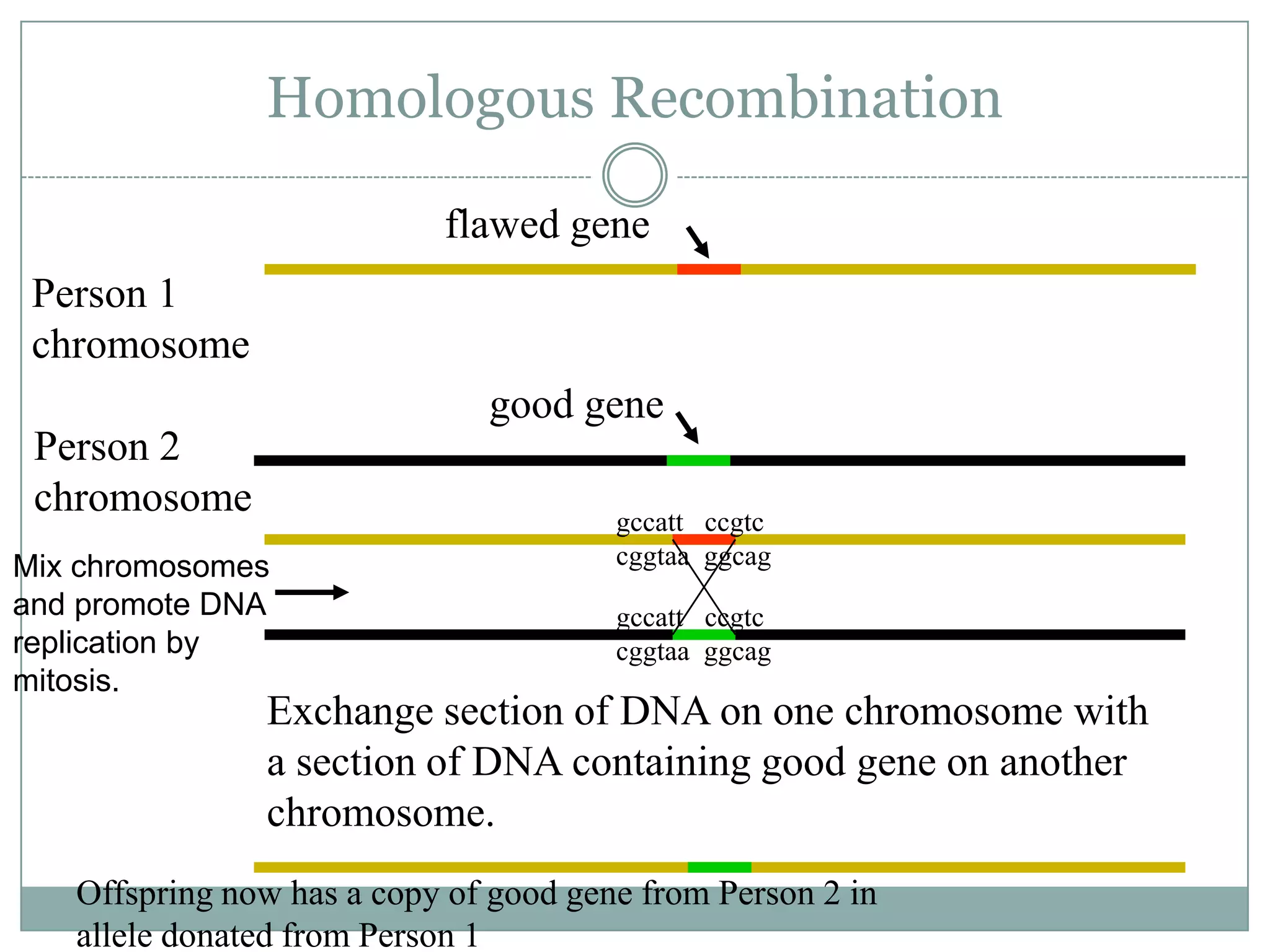
Homologous Recombination
flawed gene
Person 1
chromosome
good gene
Person 2
chromosome
Mix chromosomes
and promote DNA
replication by
mitosis.

gccatt ccgtc
cggtaa ggcag
gccatt ccgtc
cggtaa ggcag

Exchange section of DNA on one chromosome with
a section of DNA containing good gene on another
chromosome.

Offspring now has a copy of good gene from Person 2 in
allele donated from Person 1
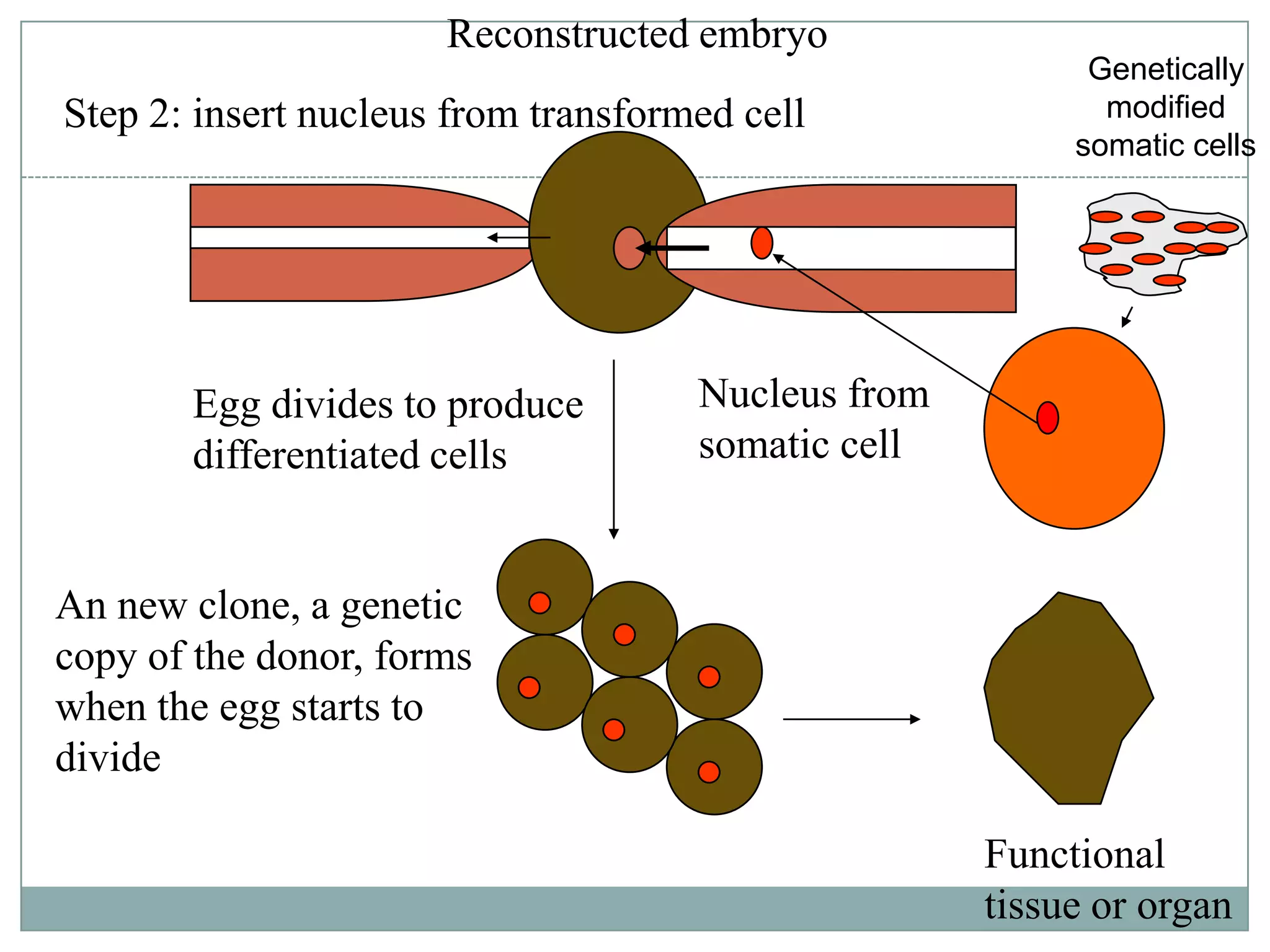
Reconstructed embryo
Step 2: insert nucleus from transformed cell

Egg divides to produce
differentiated cells

Genetically
modified
somatic cells

Nucleus from
somatic cell

An new clone, a genetic
copy of the donor, forms
when the egg starts to
divide
Functional
tissue or organ
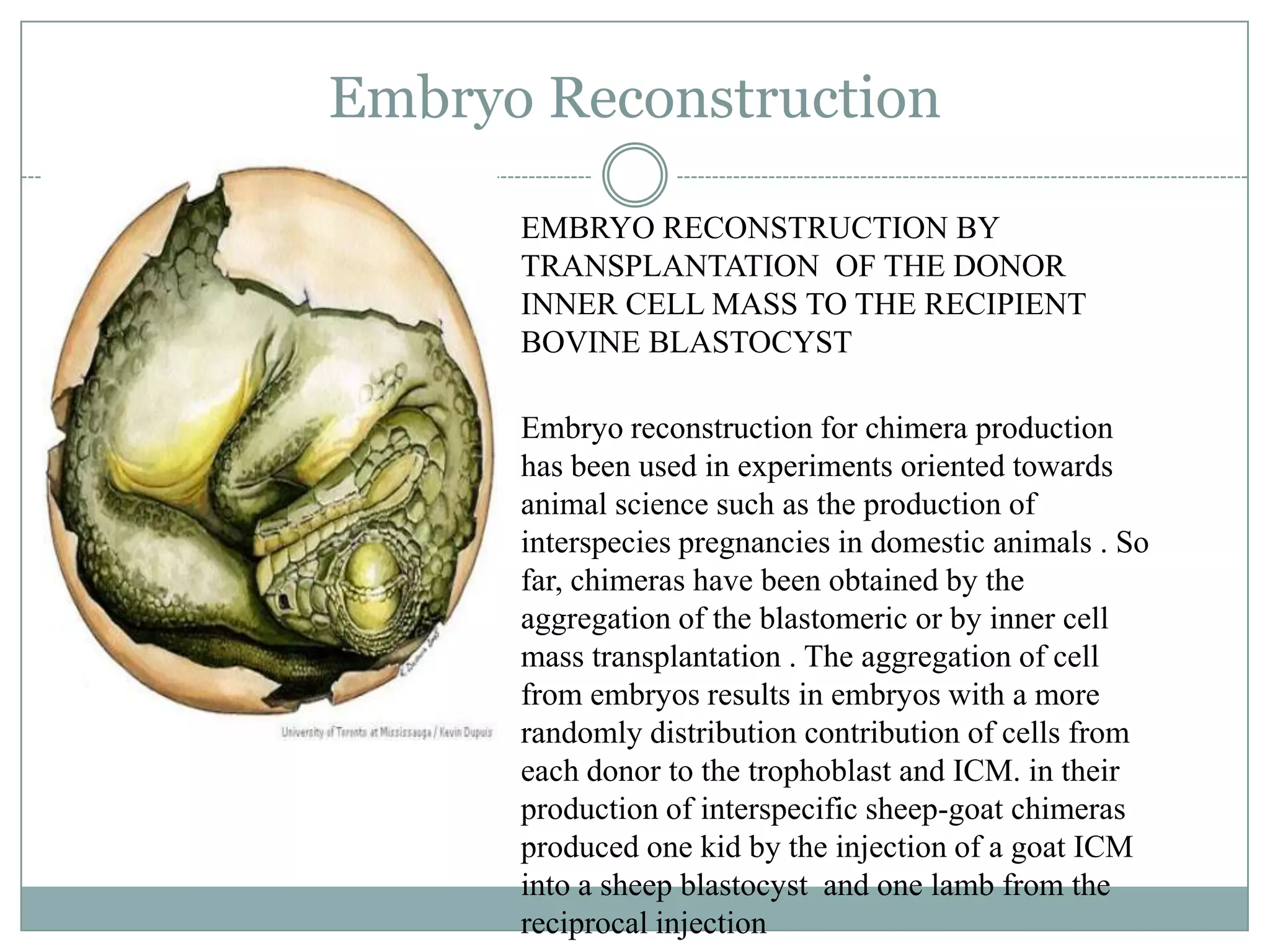
Embryo Reconstruction
EMBRYO RECONSTRUCTION BY
TRANSPLANTATION OF THE DONOR
INNER CELL MASS TO THE RECIPIENT
BOVINE BLASTOCYST
Embryo reconstruction for chimera production
has been used in experiments oriented towards
animal science such as the production of
interspecies pregnancies in domestic animals . So
far, chimeras have been obtained by the
aggregation of the blastomeric or by inner cell
mass transplantation . The aggregation of cell
from embryos results in embryos with a more
randomly distribution contribution of cells from
each donor to the trophoblast and ICM. in their
production of interspecific sheep-goat chimeras
produced one kid by the injection of a goat ICM
into a sheep blastocyst and one lamb from the
reciprocal injection
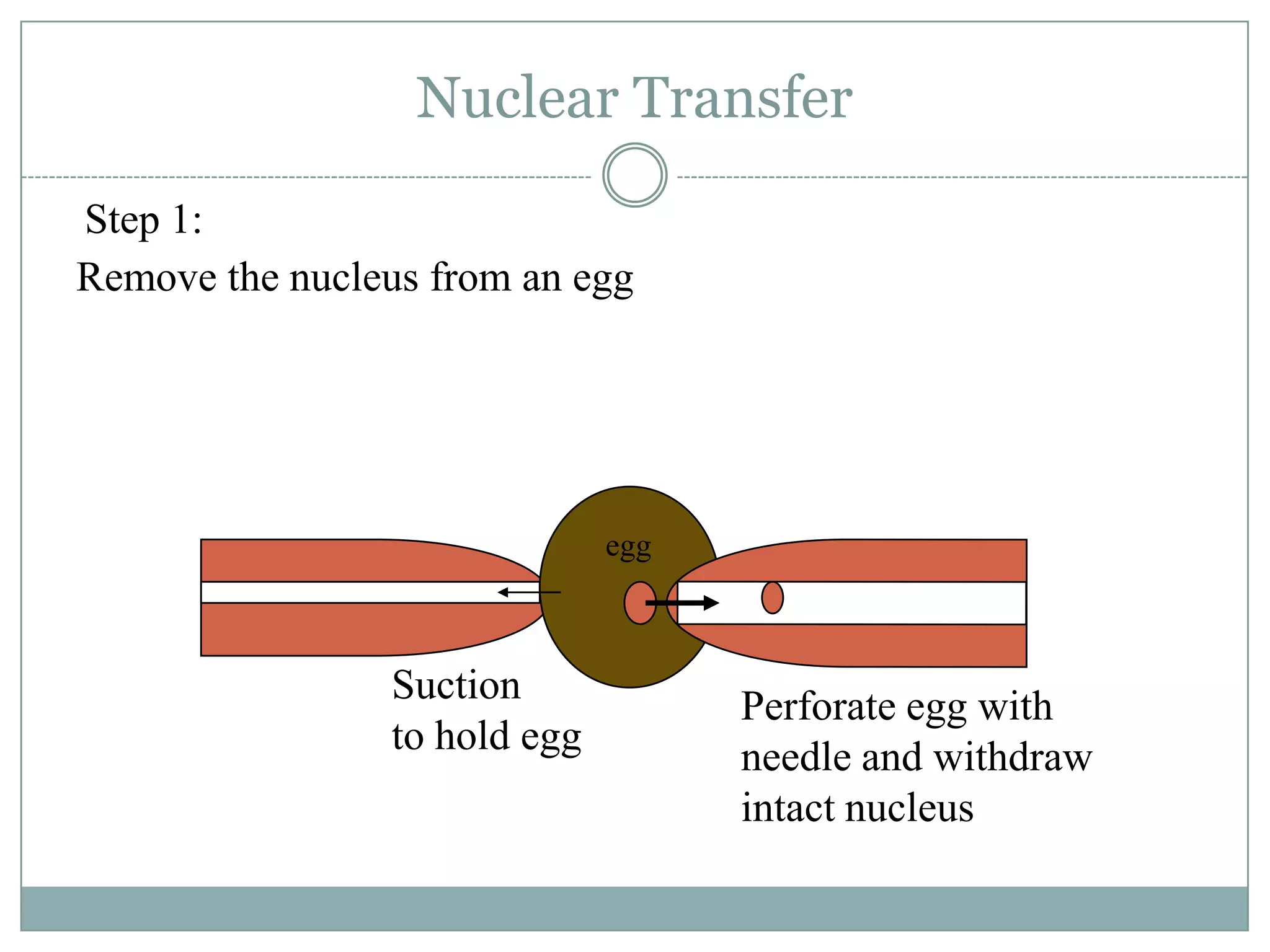
Nuclear Transfer
Step 1:
Remove the nucleus from an egg

egg

Suction
to hold egg

Perforate egg with
needle and withdraw
intact nucleus
Cloning
CREATING DOLLY: A BREAKTHROUGH IN
CLONING
 Embryo twinning (conventional approach)



splitting embryos in half to produce artificially created twins
commonly practiced in cattle industry today
 limitation is that organisms being copied is unknown


 you

may or may not end up with an animal that has
the desired characteristics and you have to wait until
the animals is full-grown to find out.

 Dolly was created from an adult cell-not an embryo
 Dolly was an exact copy of an adult with known
characteristics.
 How is this done?
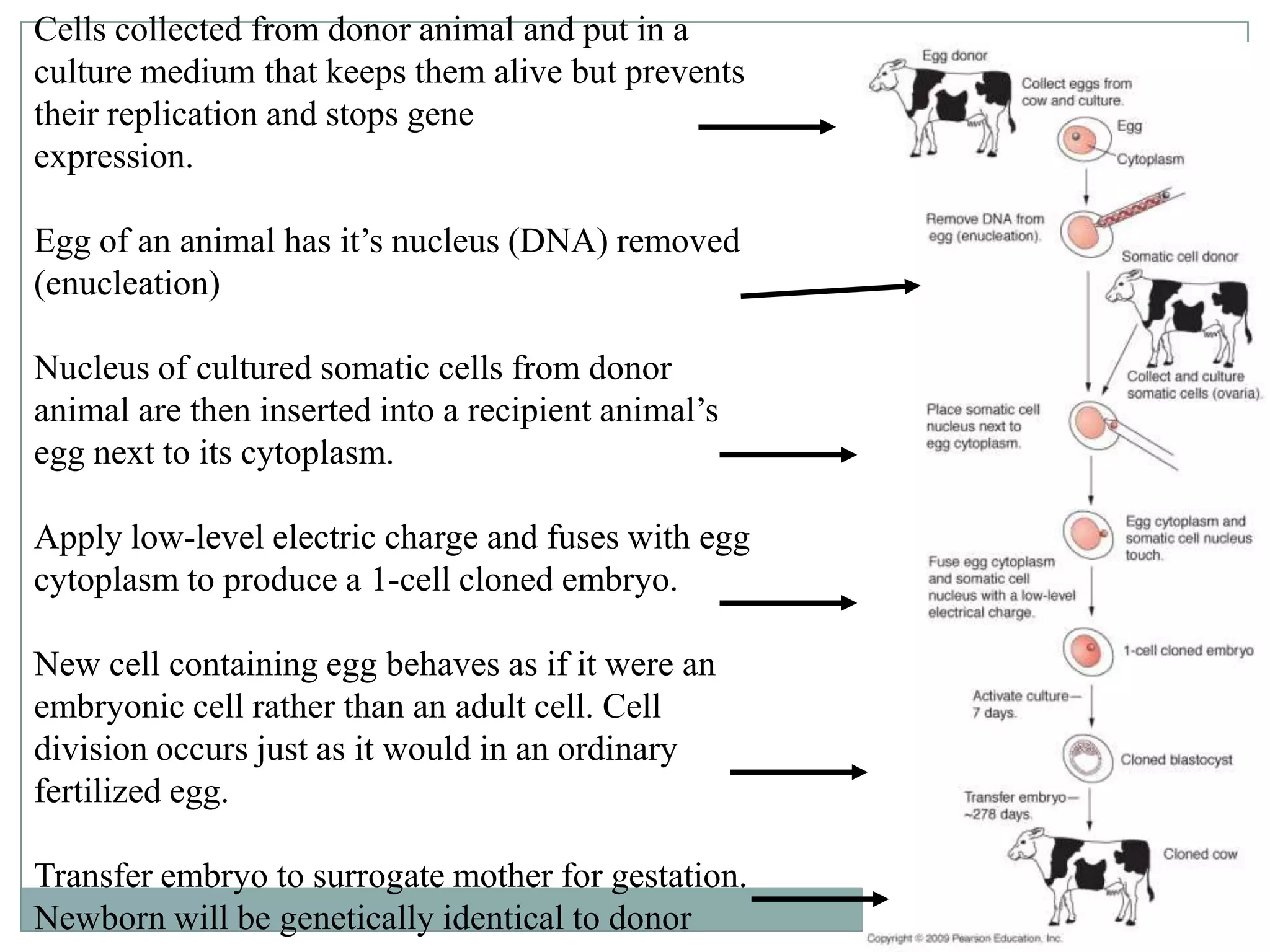
Cells collected from donor animal and put in a
culture medium that keeps them alive but prevents
their replication and stops gene
expression.
Egg of an animal has it’s nucleus (DNA) removed
(enucleation)
Nucleus of cultured somatic cells from donor
animal are then inserted into a recipient animal’s
egg next to its cytoplasm.

Apply low-level electric charge and fuses with egg
cytoplasm to produce a 1-cell cloned embryo.
New cell containing egg behaves as if it were an
embryonic cell rather than an adult cell. Cell
division occurs just as it would in an ordinary
fertilized egg.
Transfer embryo to surrogate mother for gestation.
Newborn will be genetically identical to donor
Successfully cloned species
 Sheep
 goat
 pig
 cow
 endangered cow (gaur)
 house cat
gaur
Limits of cloning
 Viable cell is required
 Success rate is still low
 Dolly was successful only after 277 failed attempts




only 29 implanted embryos lived longer than 6 days

Many clones are born with defects
kidney problems
 diabetes
 crippling disabilities
 old before their time-telomere length
 Dolly was diagnosed with arthritis -premature aging?

Cloning as a means of producing
replacement body parts?
 Idea is to reduce chance of cloned tissue from

being rejected by original “parent”.
 It would take years for clone to produce the organs
to be used for transplant
Benefits of Cloning
 Reduce variability of responses of a population

being used to test new drugs, etc.


avoids confounding factor of different genetic
predispositions

 Preservation of endangered species
 cloning pandas using common black bear as surrogate host.
 Reduce time to produce new breeds of farm

animals
from 6-9 years

3 years
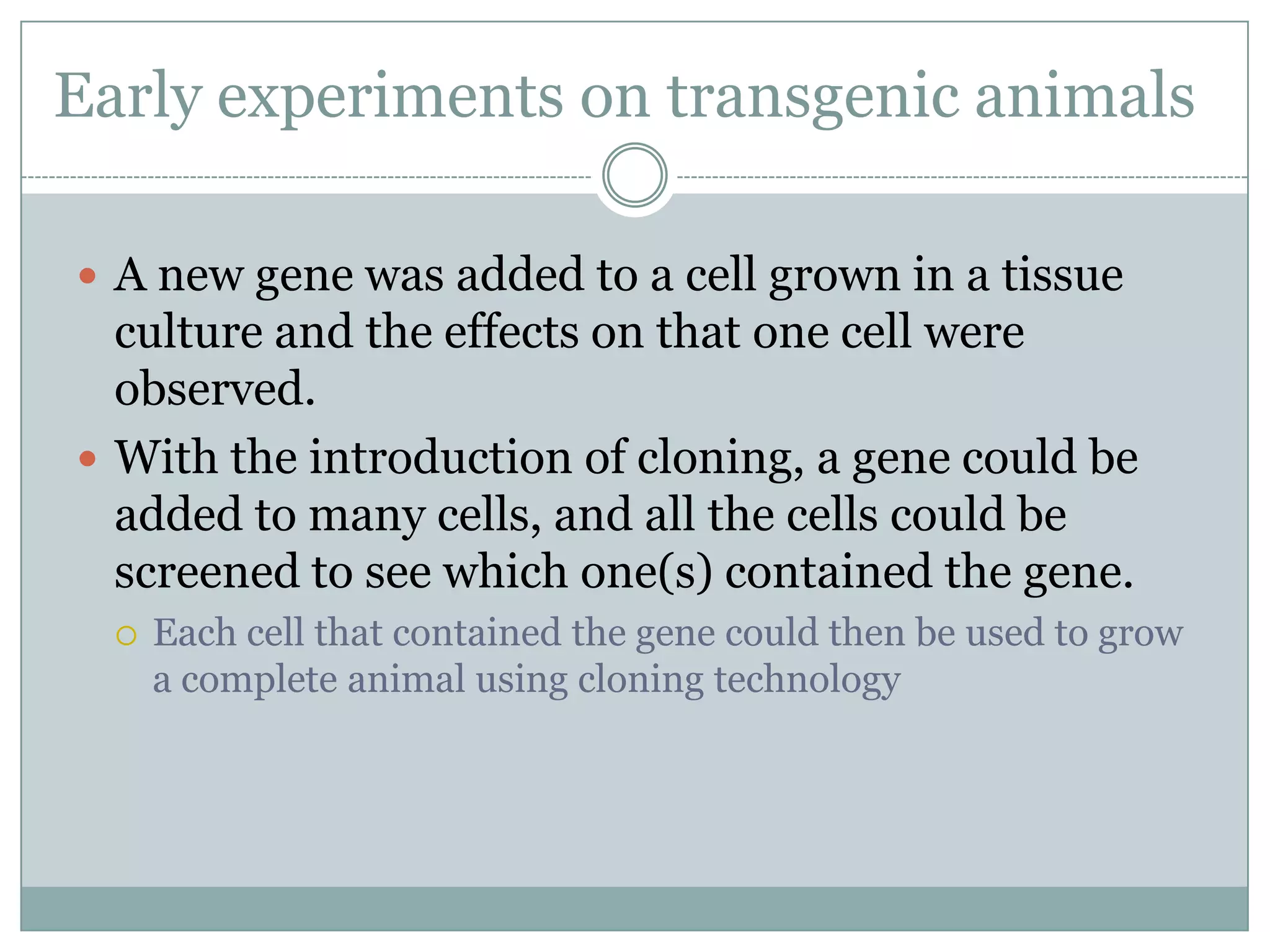
Early experiments on transgenic animals
 A new gene was added to a cell grown in a tissue

culture and the effects on that one cell were
observed.
 With the introduction of cloning, a gene could be
added to many cells, and all the cells could be
screened to see which one(s) contained the gene.


Each cell that contained the gene could then be used to grow
a complete animal using cloning technology
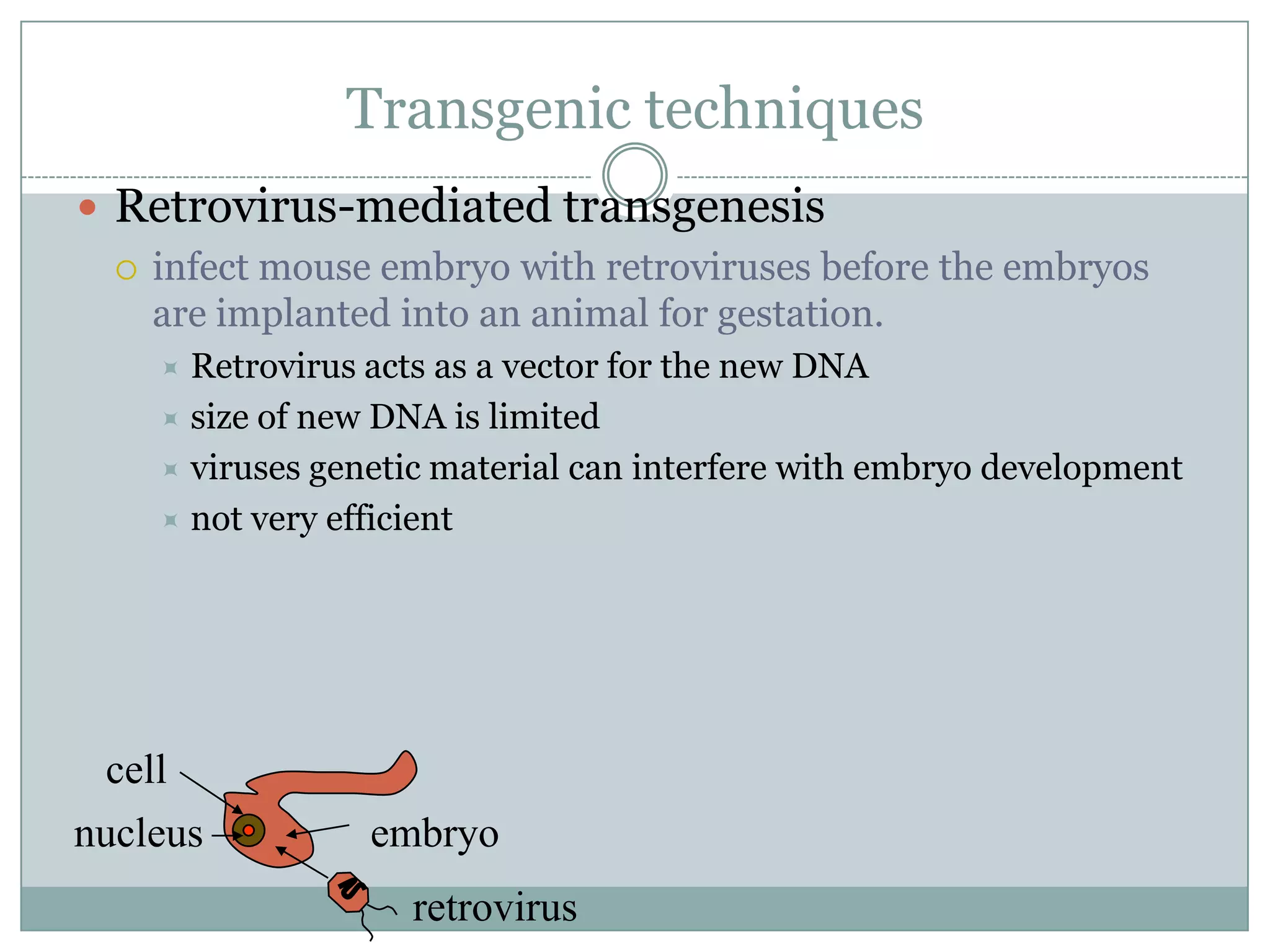
Transgenic techniques
 Retrovirus-mediated transgenesis
 infect mouse embryo with retroviruses before the embryos
are implanted into an animal for gestation.
Retrovirus acts as a vector for the new DNA
 size of new DNA is limited
 viruses genetic material can interfere with embryo development
 not very efficient


cell
nucleus

embryo
retrovirus
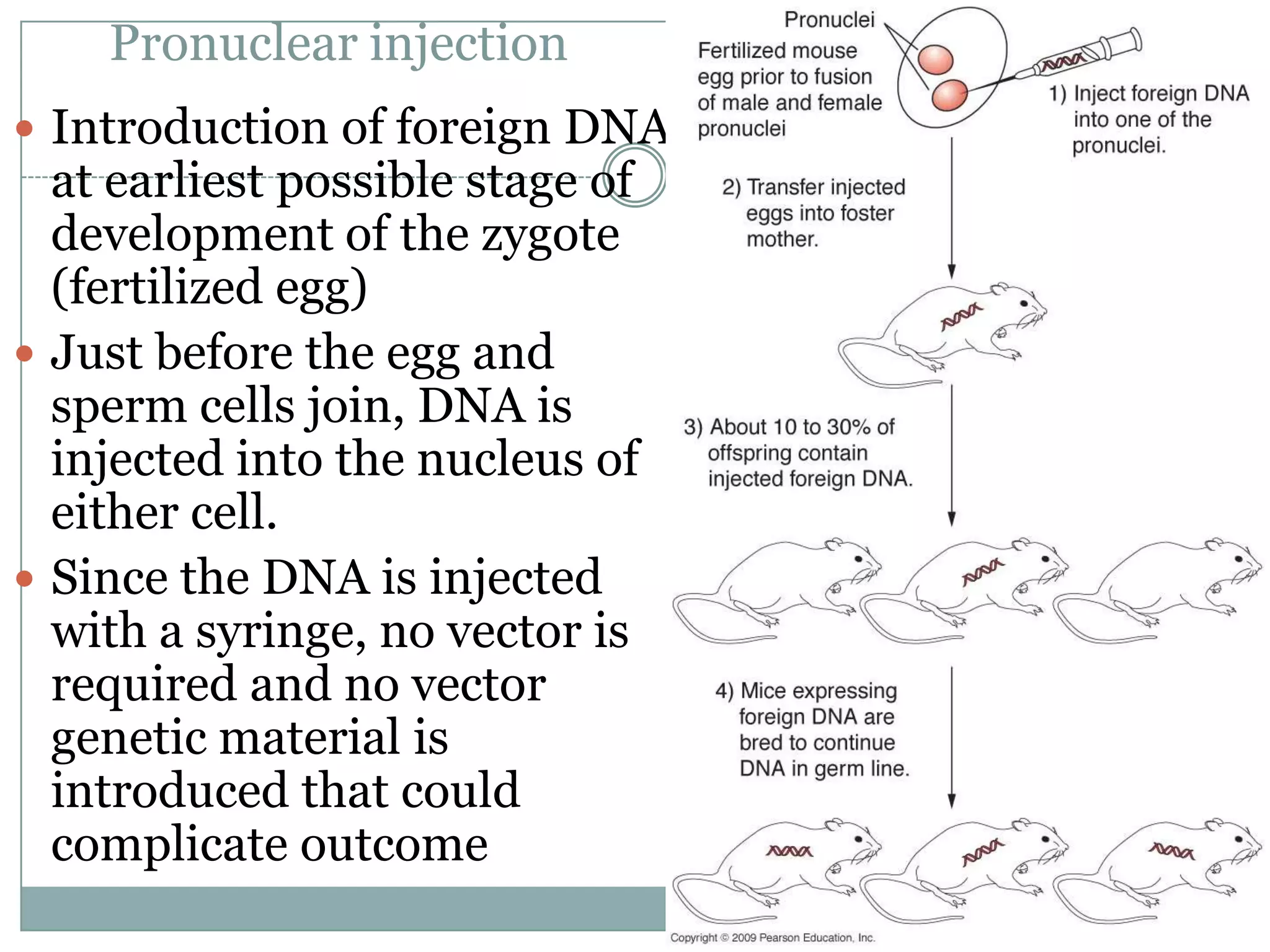
Pronuclear injection
 Introduction of foreign DNA

at earliest possible stage of
development of the zygote
(fertilized egg)
 Just before the egg and
sperm cells join, DNA is
injected into the nucleus of
either cell.
 Since the DNA is injected
with a syringe, no vector is
required and no vector
genetic material is
introduced that could
complicate outcome
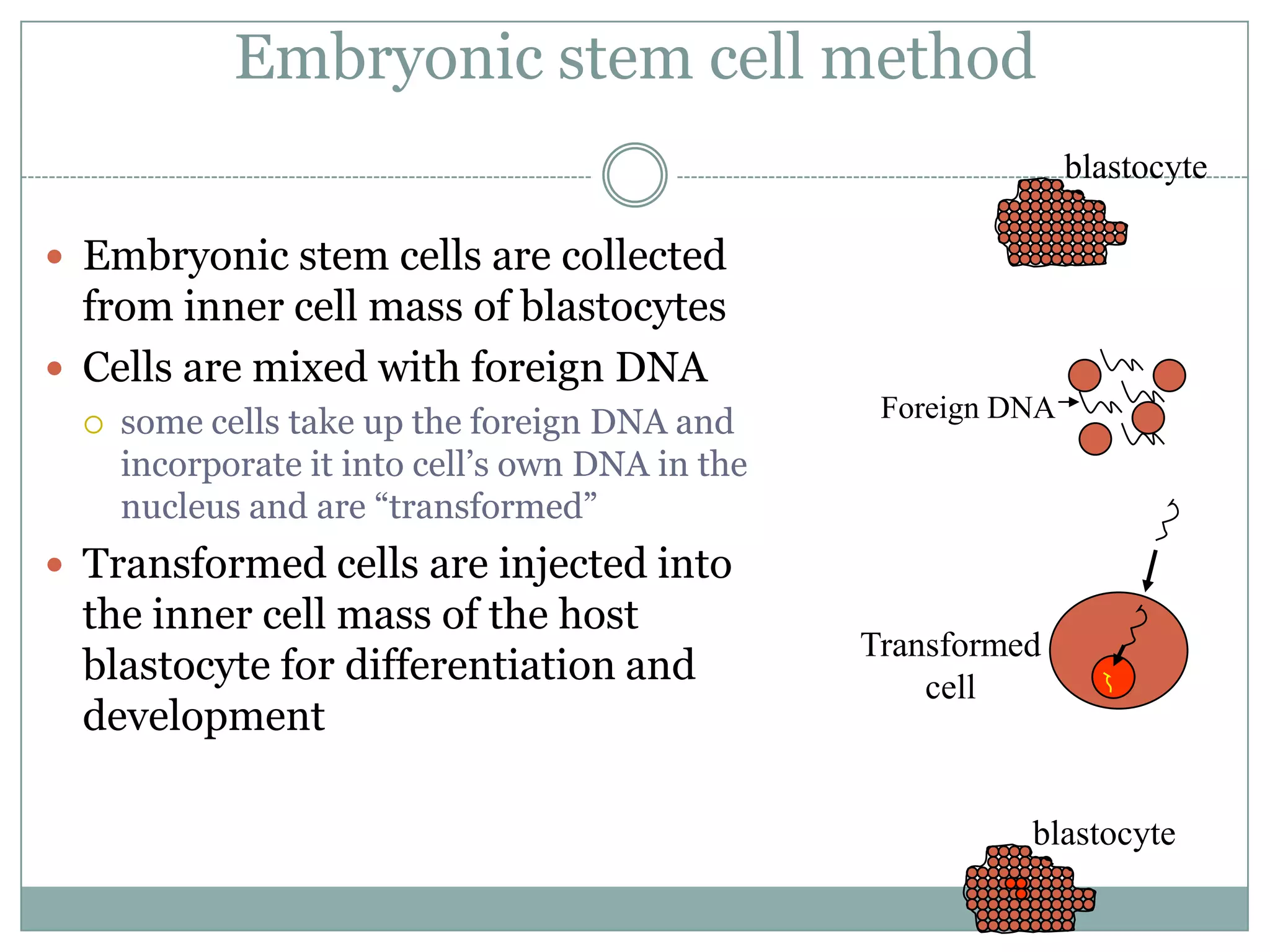
Embryonic stem cell method
blastocyte

 Embryonic stem cells are collected

from inner cell mass of blastocytes
 Cells are mixed with foreign DNA


some cells take up the foreign DNA and
incorporate it into cell’s own DNA in the
nucleus and are “transformed”

Foreign DNA

 Transformed cells are injected into

the inner cell mass of the host
blastocyte for differentiation and
development

Transformed
cell

blastocyte
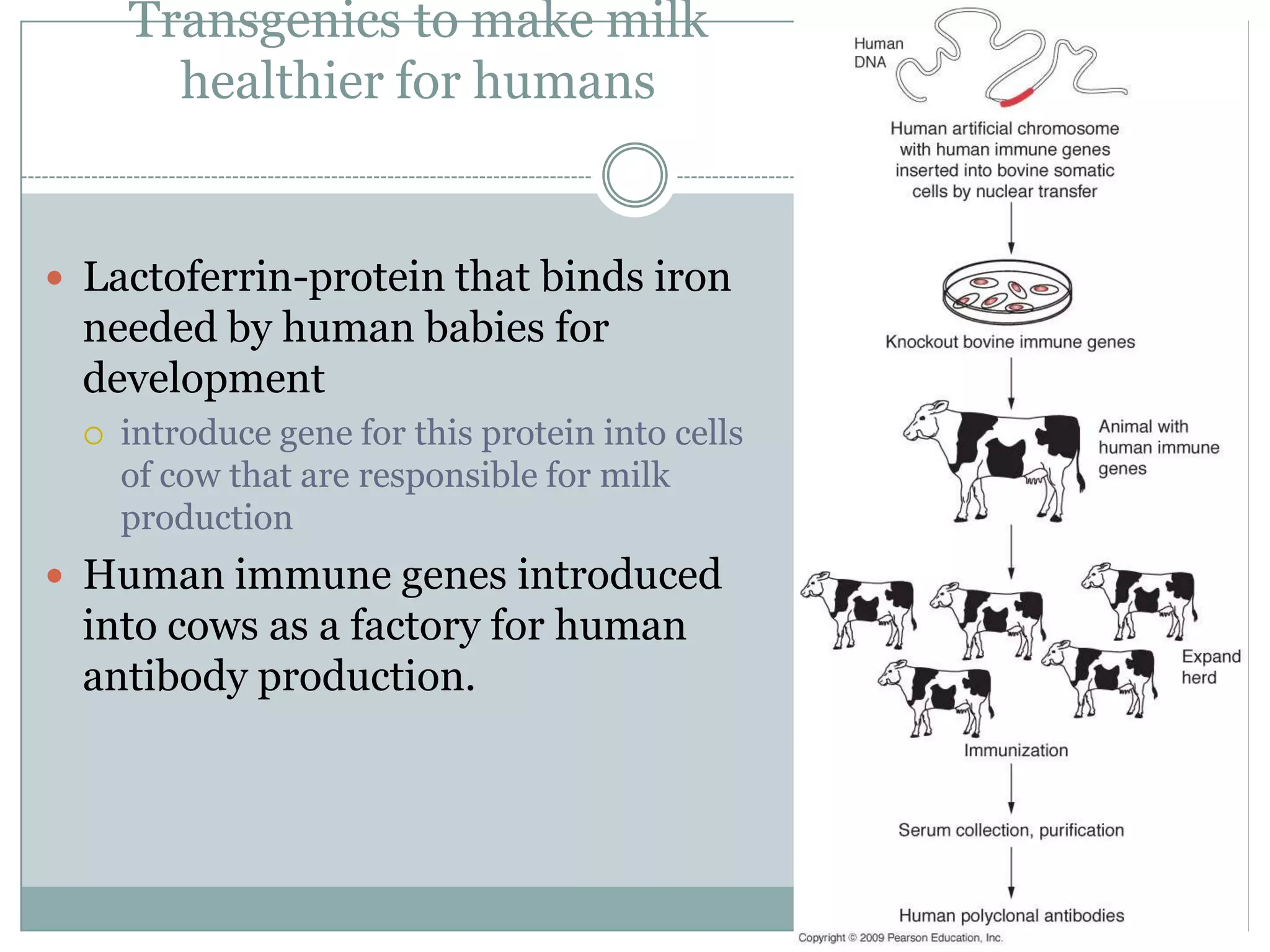
Transgenics to make milk
healthier for humans

 Lactoferrin-protein that binds iron

needed by human babies for
development


introduce gene for this protein into cells
of cow that are responsible for milk
production

 Human immune genes introduced

into cows as a factory for human
antibody production.
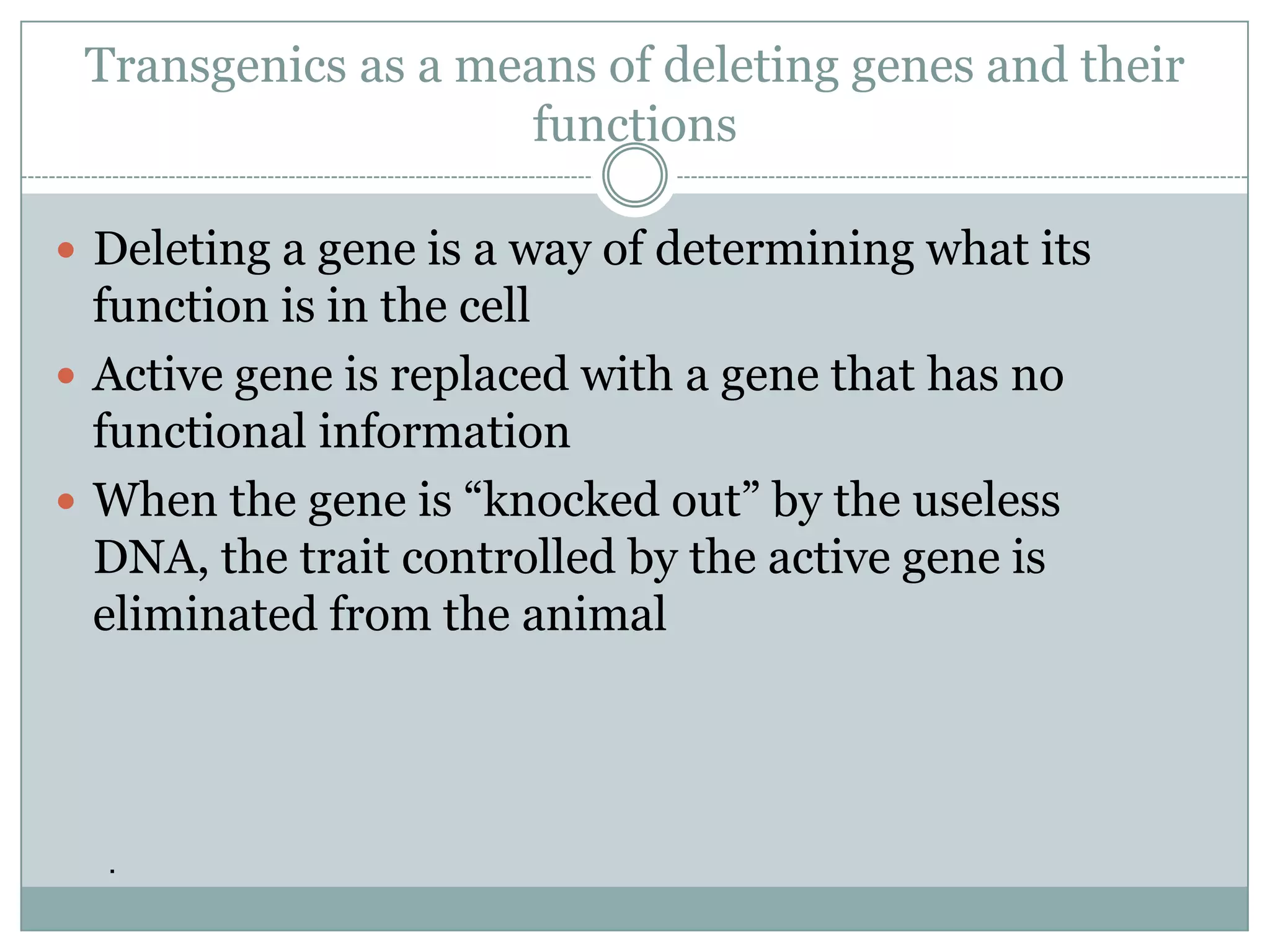
Transgenics as a means of deleting genes and their
functions
 Deleting a gene is a way of determining what its

function is in the cell
 Active gene is replaced with a gene that has no
functional information
 When the gene is “knocked out” by the useless
DNA, the trait controlled by the active gene is
eliminated from the animal

.
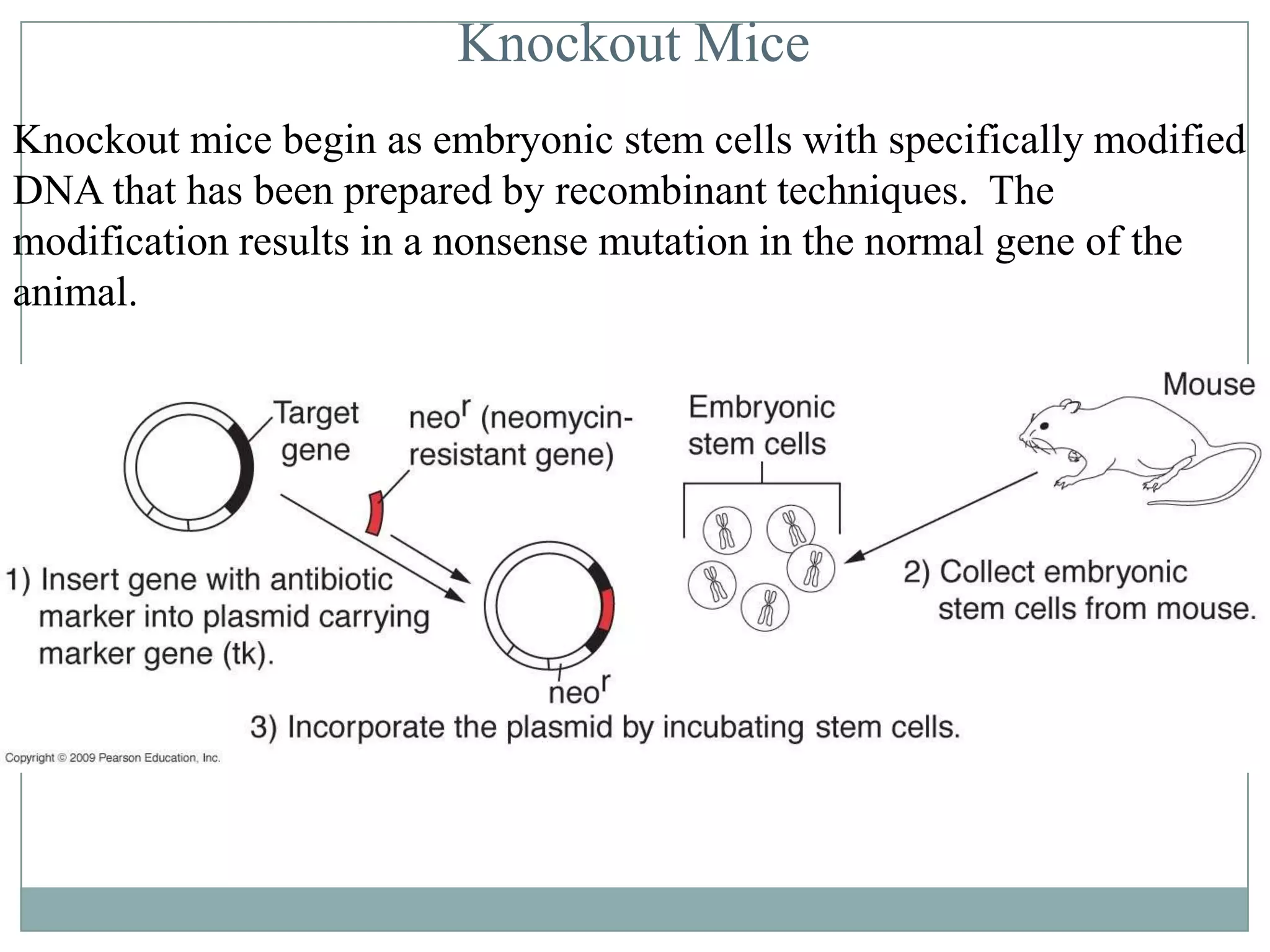
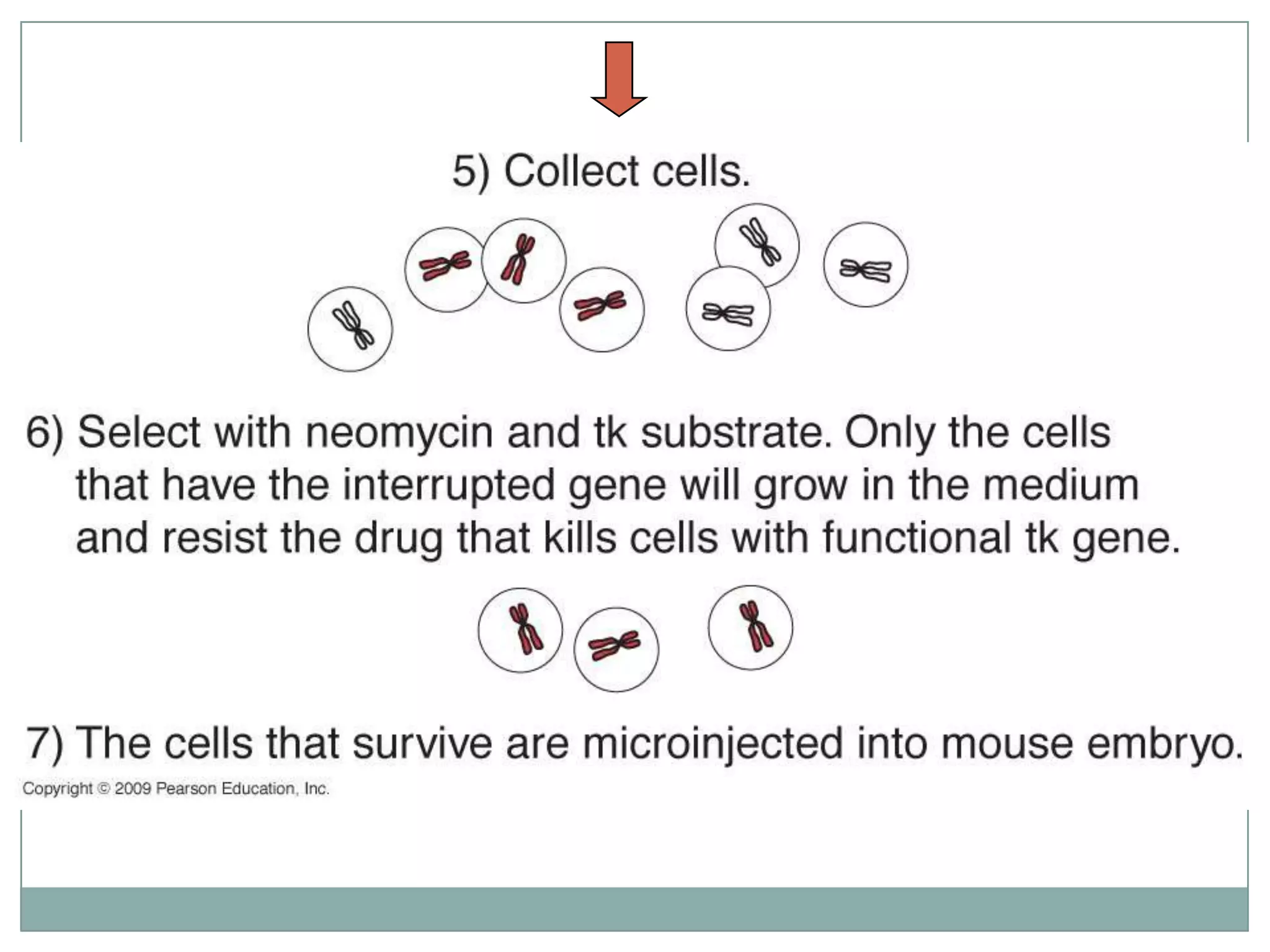
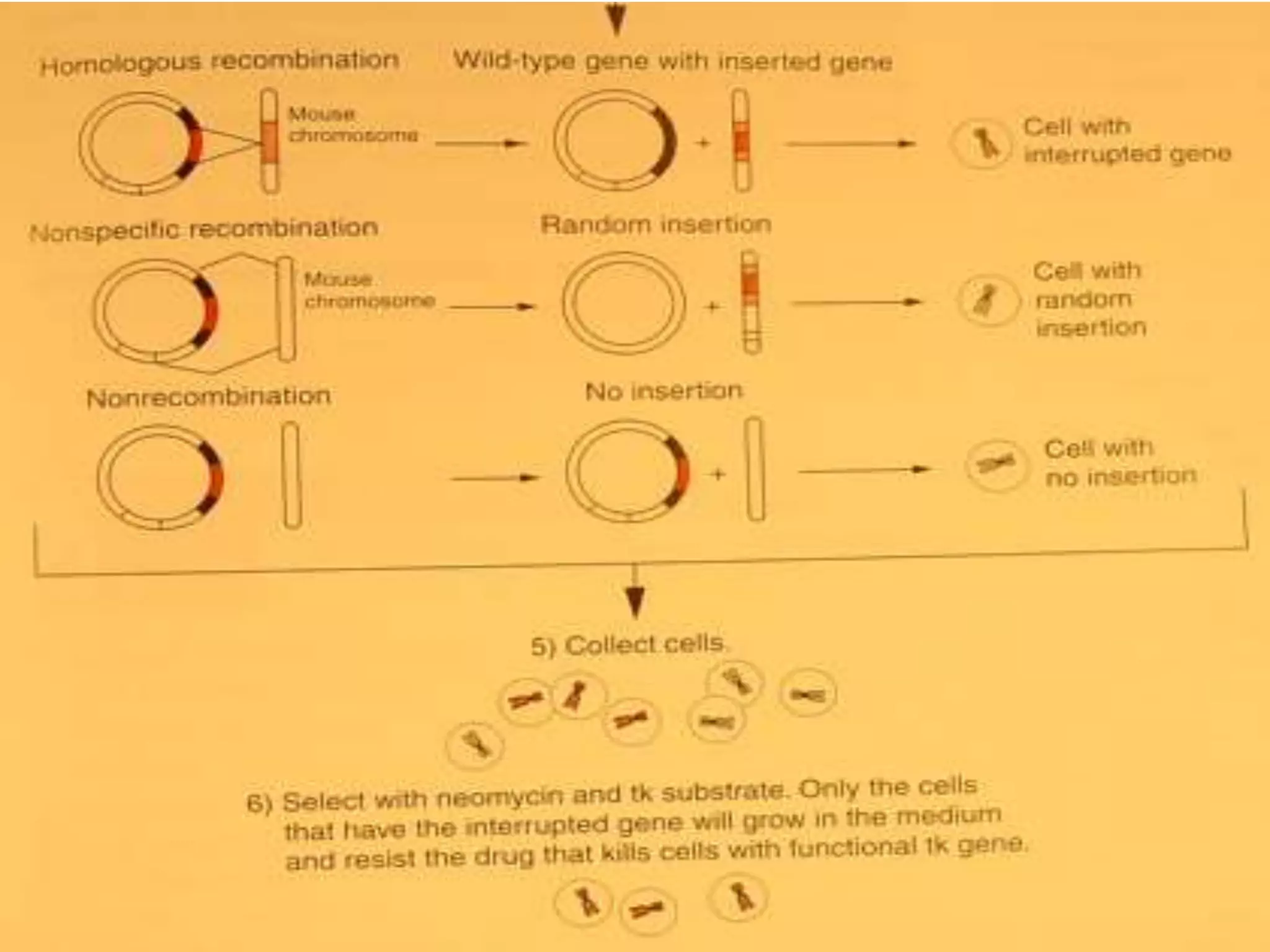
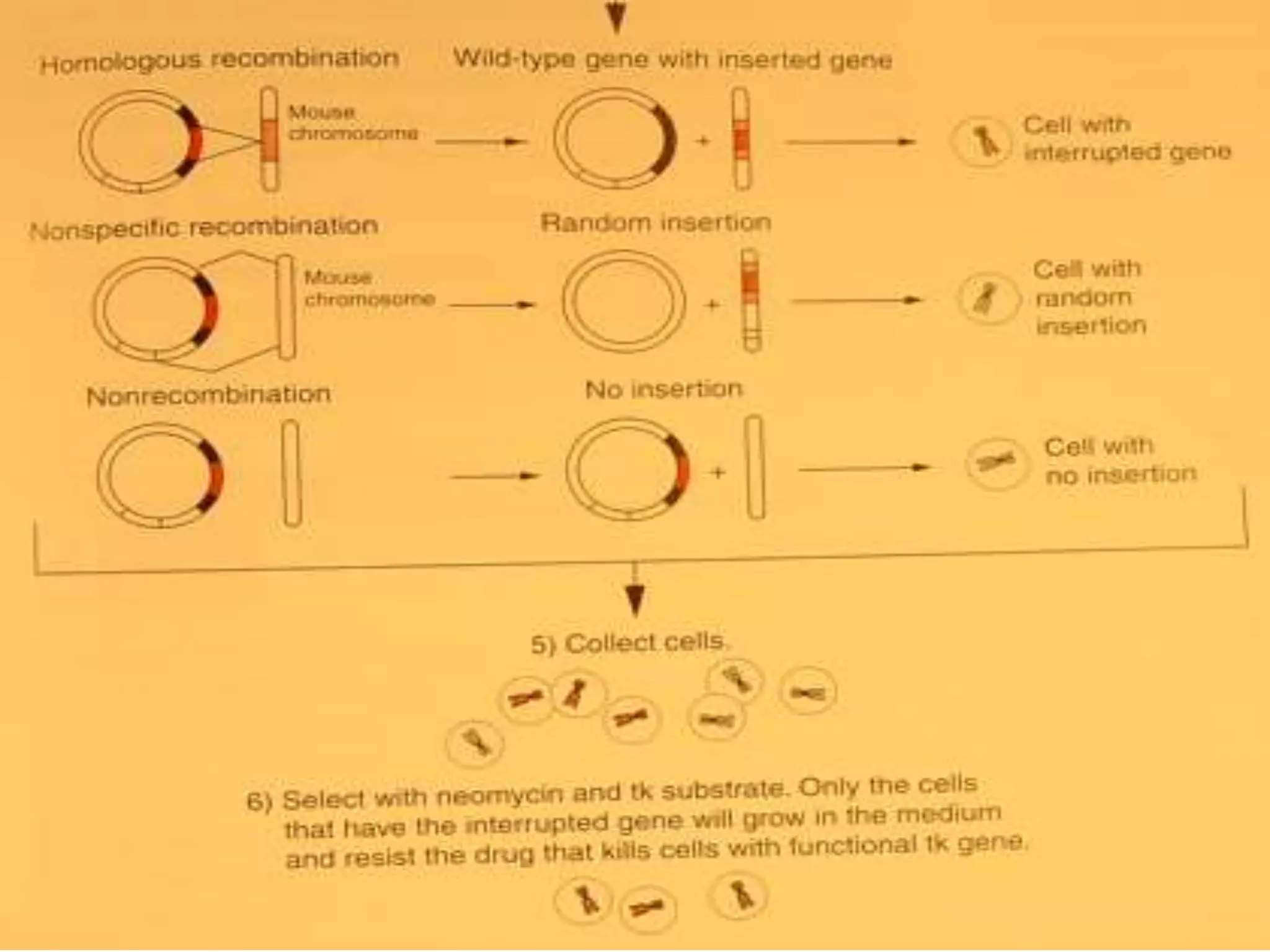
Knockout Mice
Knockout mice begin as embryonic stem cells with specifically modified
DNA that has been prepared by recombinant techniques. The
modification results in a nonsense mutation in the normal gene of the
animal.
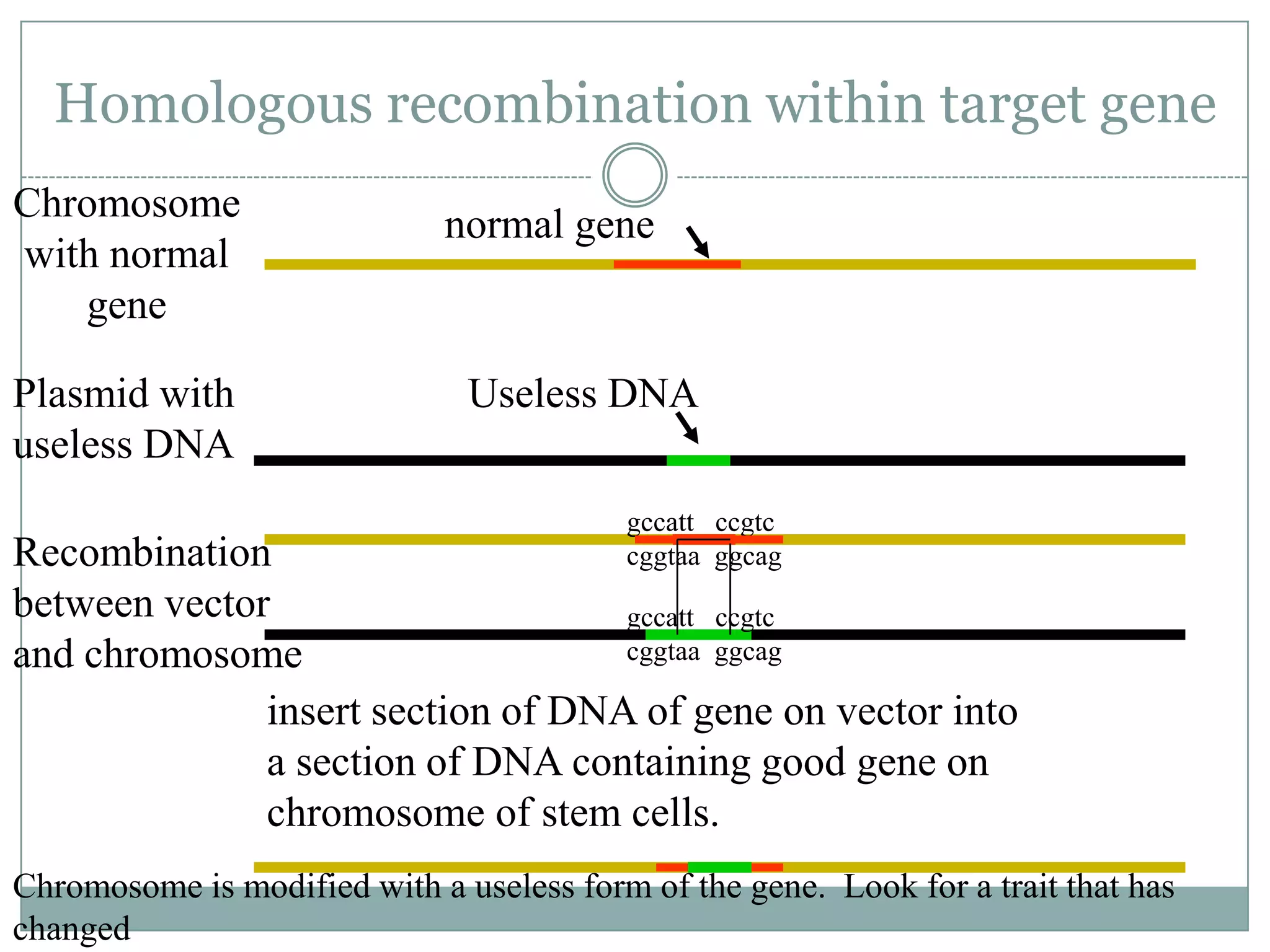
Homologous recombination within target gene
Chromosome
with normal
gene
Plasmid with
useless DNA

normal gene

Useless DNA
gccatt ccgtc
cggtaa ggcag

Recombination
between vector
gccatt ccgtc
cggtaa ggcag
and chromosome
insert section of DNA of gene on vector into
a section of DNA containing good gene on
chromosome of stem cells.
Chromosome is modified with a useless form of the gene. Look for a trait that has
changed
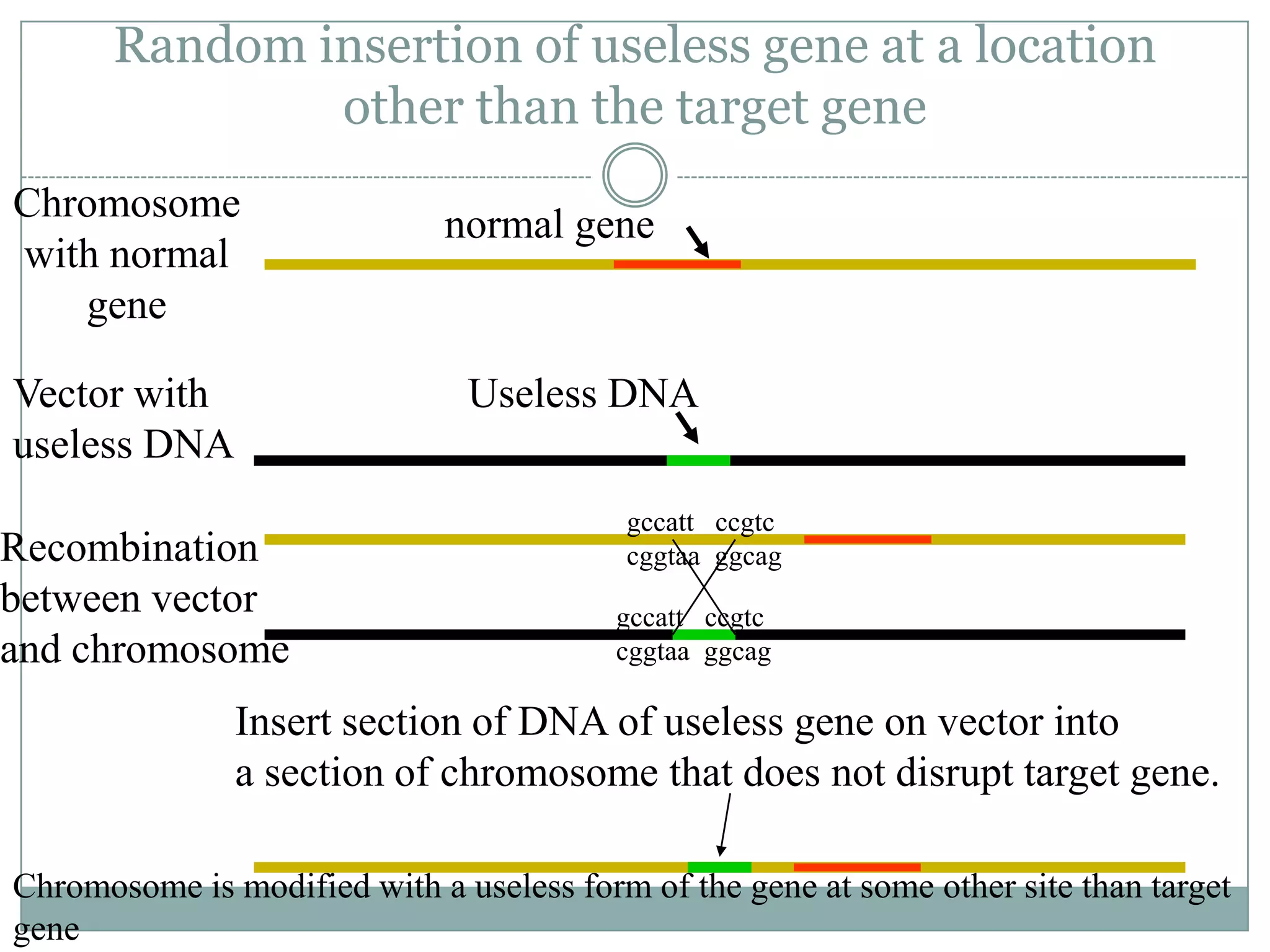
Random insertion of useless gene at a location
other than the target gene
Chromosome
with normal
gene
Vector with
useless DNA

normal gene

Useless DNA

Recombination
between vector
and chromosome

gccatt ccgtc
cggtaa ggcag
gccatt ccgtc
cggtaa ggcag

Insert section of DNA of useless gene on vector into
a section of chromosome that does not disrupt target gene.
Chromosome is modified with a useless form of the gene at some other site than target
gene
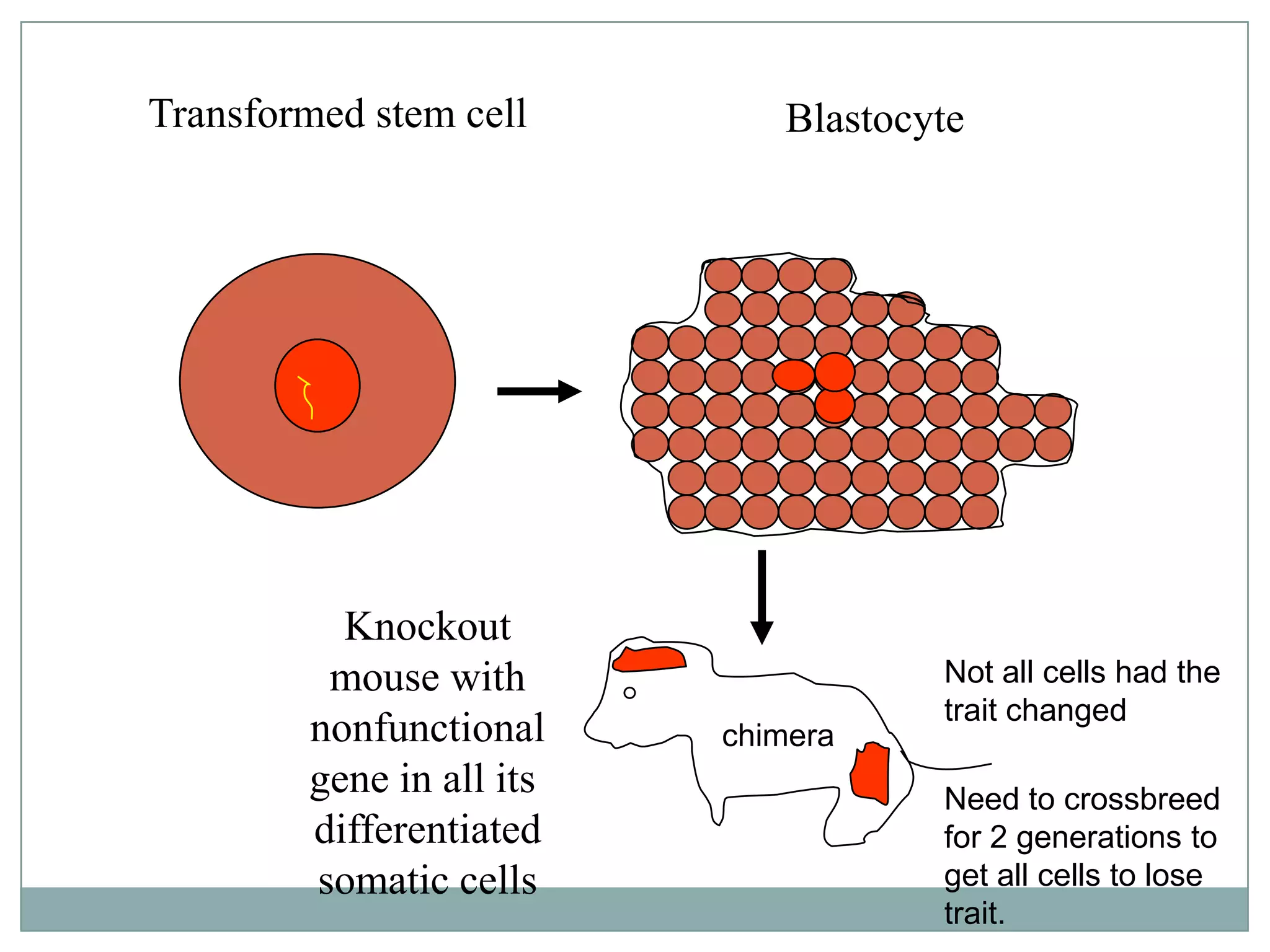
Transformed stem cell

Knockout
mouse with
nonfunctional
gene in all its
differentiated
somatic cells

Blastocyte

chimera

Not all cells had the
trait changed
Need to crossbreed
for 2 generations to
get all cells to lose
trait.
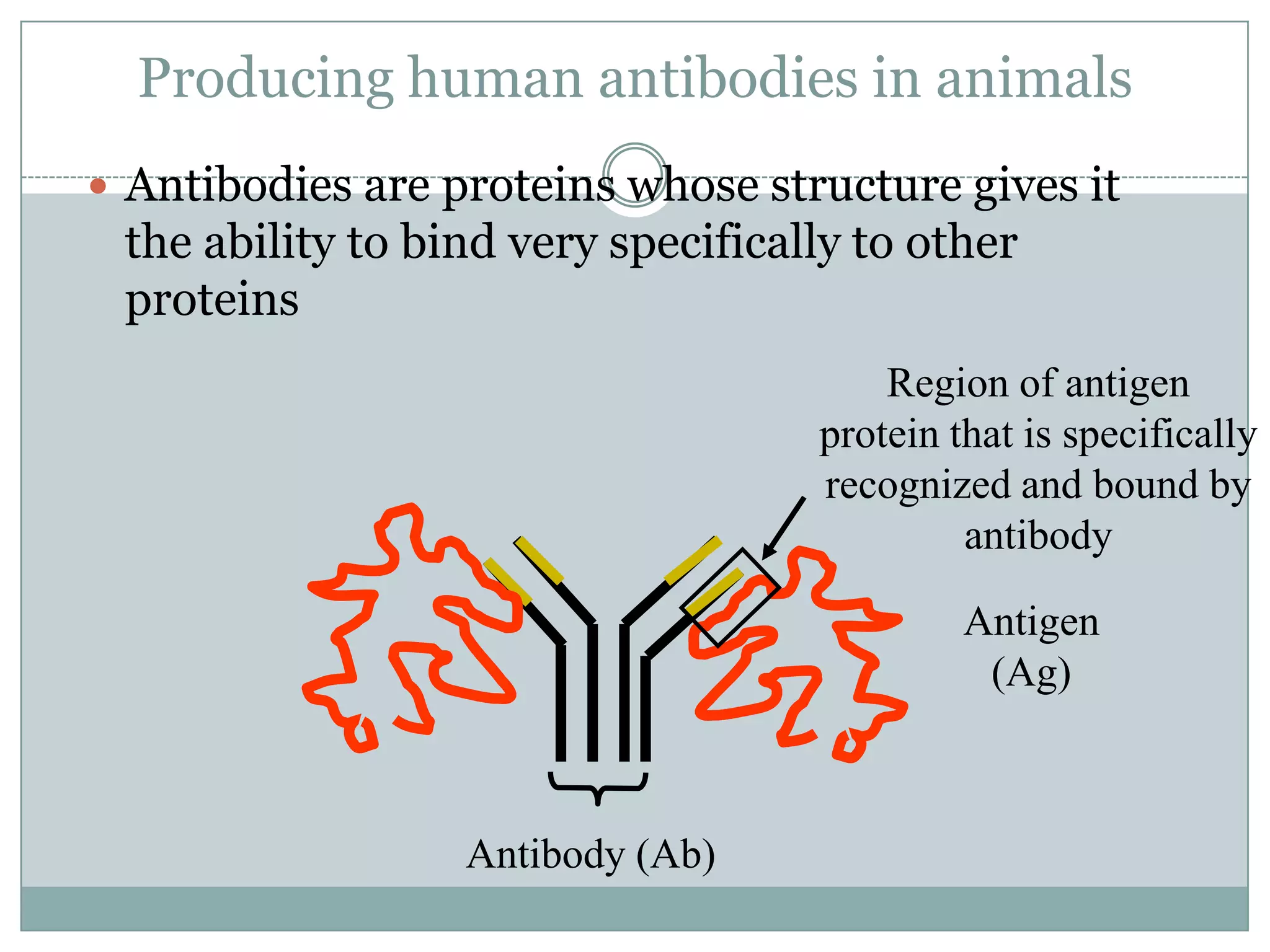
Producing human antibodies in animals
 Antibodies are proteins whose structure gives it

the ability to bind very specifically to other
proteins
Region of antigen
protein that is specifically
recognized and bound by
antibody
Antigen
(Ag)

Antibody (Ab)
 Antibodies could be designed that target and

inactivate cancer cells in our bodies.
 Myelomas: antibody-secreting tumors
 Monoclonal Abs (mAb) are produced from
myeloma cells that produce an Ab that reacts with
only one region of an antigenic protein
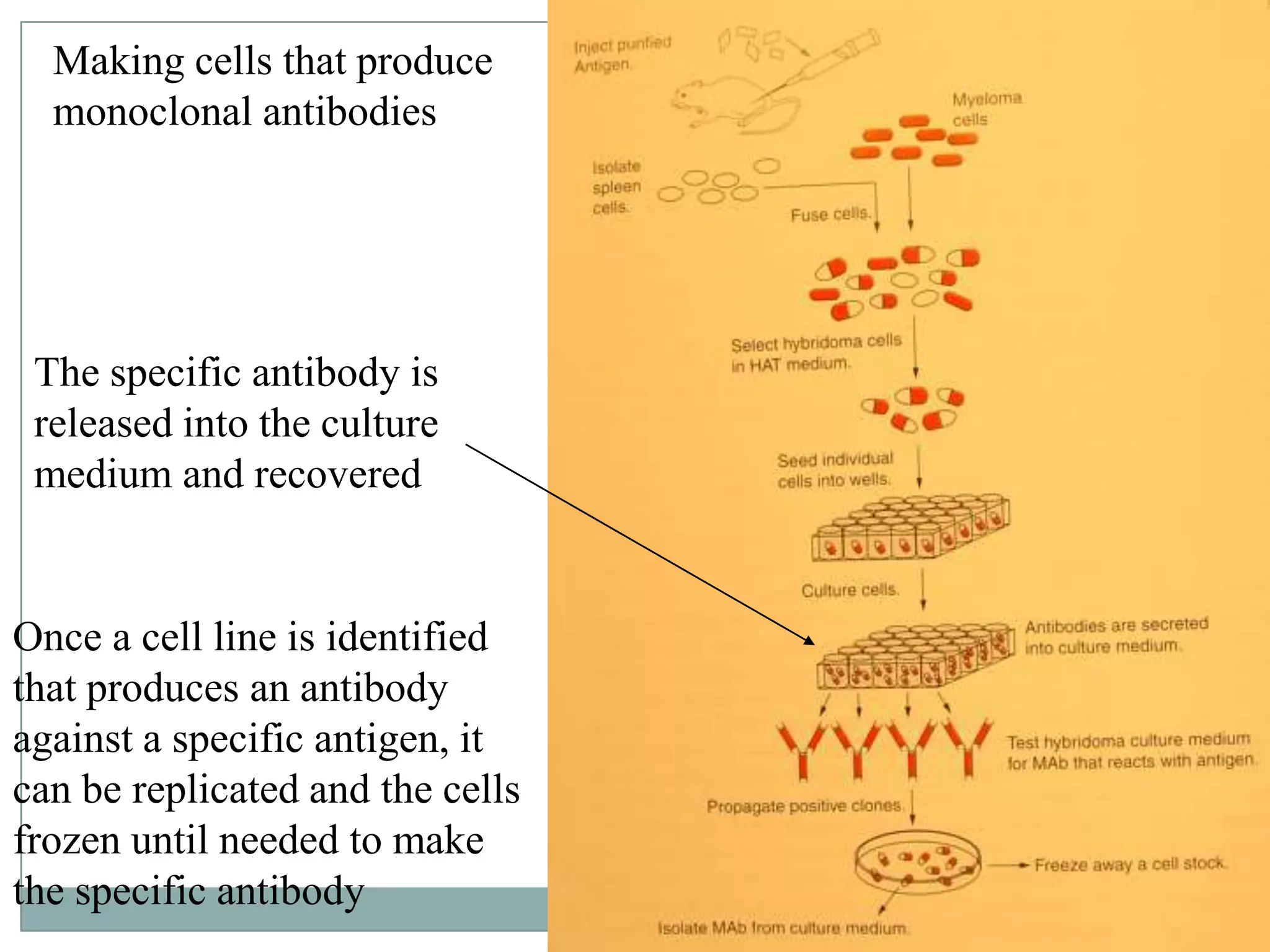
Making cells that produce
monoclonal antibodies

The specific antibody is
released into the culture
medium and recovered

Once a cell line is identified
that produces an antibody
against a specific antigen, it
can be replicated and the cells
frozen until needed to make
the specific antibody
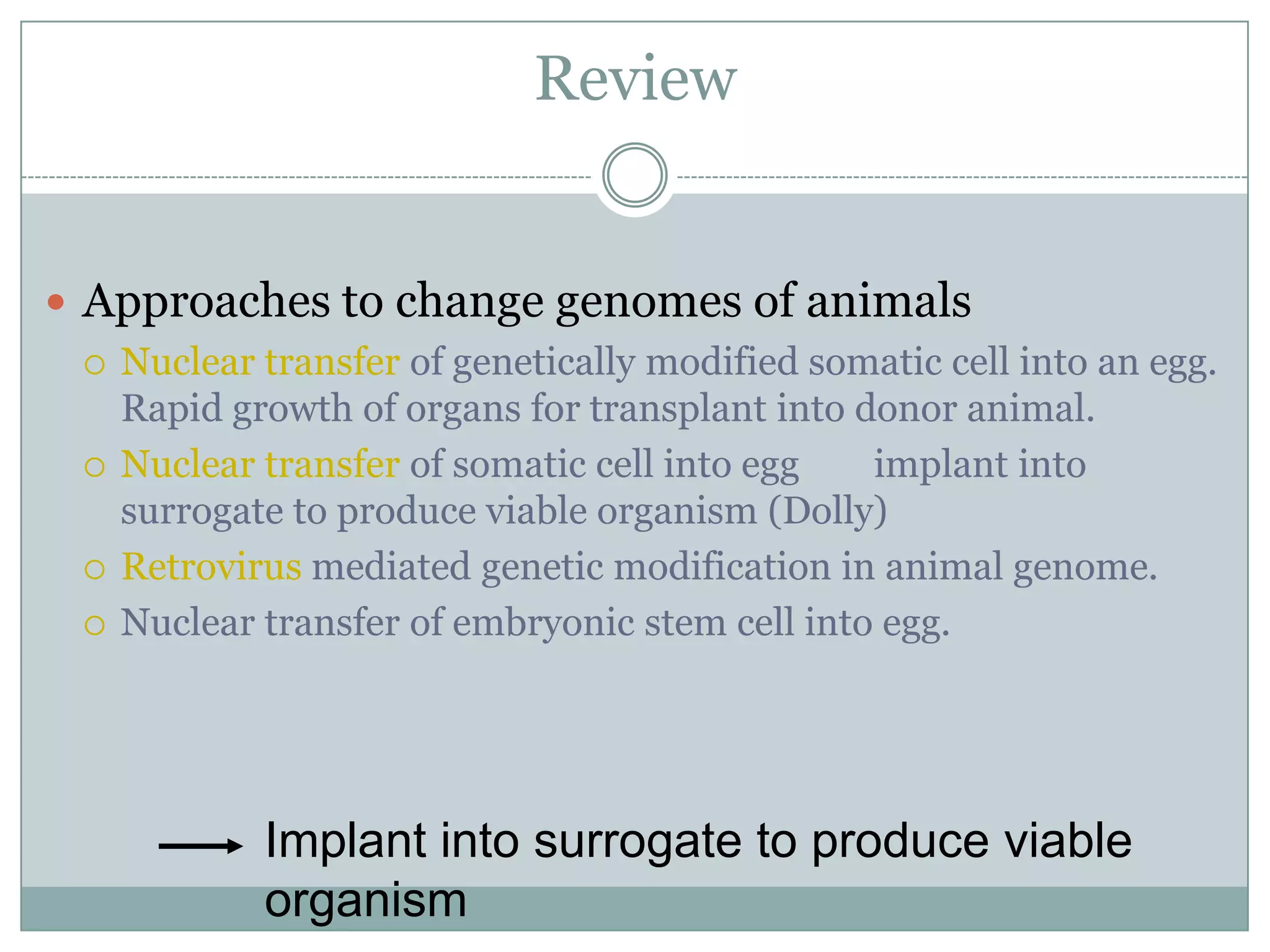
Review

 Approaches to change genomes of animals
 Nuclear transfer of genetically modified somatic cell into an egg.
Rapid growth of organs for transplant into donor animal.
 Nuclear transfer of somatic cell into egg
implant into
surrogate to produce viable organism (Dolly)
 Retrovirus mediated genetic modification in animal genome.
 Nuclear transfer of embryonic stem cell into egg.

Implant into surrogate to produce viable
organism
Chromosome manipulations

Chromosome manipulations

  • 1.
  • 2.
    Benefits of GeneticallyEngineered Animals  Used to develop new medical treatments  Improve our food supply  Enhance our understanding of biology of all animals, including humans
  • 3.
    Animal Models  Animalsystems are a model for the human system  Polio vaccine was developed using animals as test systems  Cataract surgical procedures were developed with animals  Dialysis was tested first in animals before being applied to human conditions
  • 4.
    Regulation of animalresearch  Animal Welfare Act  Sets specific regulations regarding, housing, feeding, cleanliness and medical care of animals  Researchers must first develop a plan describing Appropriateness of species to be used  Minimum number of animals needed for test    Oversight committee reviews and approves plan Government agencies monitor welfare of the test animals
  • 5.
    Phase Testing  Testinga new product for safety in humans involves vigorously following scientific methodology developed for animal systems  Involves collecting data from a statistically significant number of trials (experiments) in lab cell tissue cultures, in live animals and in human subjects.  3-stages of testing Human trials Animal model Tissue culture if successful if successful
  • 6.
    Testing  If testresults using cell cultures indicates toxicity of product, then product will never be tested on live animals.  Testing on live animals requires evaluation of more than one species, since different species may respond differently.
  • 7.
    Phase Testing  Animalmodels can provide the following information on a new product Absorption of chemical by body  Body metabolism of chemical  Time require for chemical or product to be excreted   If significant problems are encountered with product in live animals, then product is never tested in humans.
  • 8.
    Side-effects of newdrugs discovered in animal models  Example  Propecia Used to encourage hair growth Animal studies indicated that serious birth defects occurred in male offspring when pregnant animals were given large doses of drug As a result of animal tests, warnings were put on containers of Propecia to avoid birth defects in humans using drug.
  • 9.
    How do youselect appropriate animal as a model for the human system?  Look for genetic homology between animal and human systems.  In addition, identify animal that    Has short time between generations Can produce lots of offspring in each generation Can be easily maintained and manipulated in the laboratory
  • 10.
    Matching animal systemsas models for the human system System  Lung and cardiovascular Best animal model for human  Dog  Immune system  HIV and AIDS research  Mice  Monkey and chimpanzee
  • 11.
    A model organismis a non-human species that is extensively studied to understand particular biological phenomena
  • 12.
    Enviro Pig TM 12     Transgenicpigs express phytase in their salivary glands Phytic acid in the pig meal is degraded releasing phosphorus The phosphorus is absorbed by the pig. Normally the phytic acid/phosphorus complex passes through the pig and is excreted as waste  Pig waste is a major pollutant & can cause eutrophication of lakes & streams. YANAMALA VIJAY RAJ 1/20/2014
  • 13.
  • 14.
  • 15.
  • 16.
    Laboratory rat A laboratoryrat is a rat of the species Rattus norvegicus (brown rat) which is bred and kept for scientific research. Laboratory rats have served as an important animal model for research in psychology,medicine, and other fields. 16 YANAMALA VIJAY RAJ 1/20/2014
  • 17.
  • 18.
  • 19.
  • 20.
  • 21.
    Zebrafish  Lots ofgenetic similarity to humans  Egg lends itself to genetic transfer  no need to implant an egg inside a donor mother for gestation.  Embryos are transparent, making it possible to study cell division under microscope from first hour of creation.  transplant gene into embryo  Because the genetics of zebrafish and humans are similar, they are ideal animal systems for determining whether a new drug induces genetic mutations
  • 22.
    Easy to follow drugeffect on embryo development under microscope, sinc e egg can mature outside female.
  • 23.
    Homology Testing Oxford Grid human Dotsrepresent similar genes Boxes with more than one dot represent conserved sequences
  • 24.
    Exchanging genes betweenindividuals Select for recombinant before somatic cells stop dividing Somatic cell of human Cloned in tissue culture Chromosome 5 Homologous Recombination (rare event) Targeted gene disruption or insertion Reconstructed embryo Look for effect of gene disruption or insertion on organ development
  • 25.
    Homologous Recombination flawed gene Person1 chromosome good gene Person 2 chromosome Mix chromosomes and promote DNA replication by mitosis. gccatt ccgtc cggtaa ggcag gccatt ccgtc cggtaa ggcag Exchange section of DNA on one chromosome with a section of DNA containing good gene on another chromosome. Offspring now has a copy of good gene from Person 2 in allele donated from Person 1
  • 26.
    Reconstructed embryo Step 2:insert nucleus from transformed cell Egg divides to produce differentiated cells Genetically modified somatic cells Nucleus from somatic cell An new clone, a genetic copy of the donor, forms when the egg starts to divide Functional tissue or organ
  • 27.
    Embryo Reconstruction EMBRYO RECONSTRUCTIONBY TRANSPLANTATION OF THE DONOR INNER CELL MASS TO THE RECIPIENT BOVINE BLASTOCYST Embryo reconstruction for chimera production has been used in experiments oriented towards animal science such as the production of interspecies pregnancies in domestic animals . So far, chimeras have been obtained by the aggregation of the blastomeric or by inner cell mass transplantation . The aggregation of cell from embryos results in embryos with a more randomly distribution contribution of cells from each donor to the trophoblast and ICM. in their production of interspecific sheep-goat chimeras produced one kid by the injection of a goat ICM into a sheep blastocyst and one lamb from the reciprocal injection
  • 28.
    Nuclear Transfer Step 1: Removethe nucleus from an egg egg Suction to hold egg Perforate egg with needle and withdraw intact nucleus
  • 29.
    Cloning CREATING DOLLY: ABREAKTHROUGH IN CLONING
  • 30.
     Embryo twinning(conventional approach)  splitting embryos in half to produce artificially created twins commonly practiced in cattle industry today  limitation is that organisms being copied is unknown   you may or may not end up with an animal that has the desired characteristics and you have to wait until the animals is full-grown to find out.  Dolly was created from an adult cell-not an embryo  Dolly was an exact copy of an adult with known characteristics.  How is this done?
  • 31.
    Cells collected fromdonor animal and put in a culture medium that keeps them alive but prevents their replication and stops gene expression. Egg of an animal has it’s nucleus (DNA) removed (enucleation) Nucleus of cultured somatic cells from donor animal are then inserted into a recipient animal’s egg next to its cytoplasm. Apply low-level electric charge and fuses with egg cytoplasm to produce a 1-cell cloned embryo. New cell containing egg behaves as if it were an embryonic cell rather than an adult cell. Cell division occurs just as it would in an ordinary fertilized egg. Transfer embryo to surrogate mother for gestation. Newborn will be genetically identical to donor
  • 32.
    Successfully cloned species Sheep  goat  pig  cow  endangered cow (gaur)  house cat
  • 33.
  • 34.
    Limits of cloning Viable cell is required  Success rate is still low  Dolly was successful only after 277 failed attempts   only 29 implanted embryos lived longer than 6 days Many clones are born with defects kidney problems  diabetes  crippling disabilities  old before their time-telomere length  Dolly was diagnosed with arthritis -premature aging? 
  • 35.
    Cloning as ameans of producing replacement body parts?  Idea is to reduce chance of cloned tissue from being rejected by original “parent”.  It would take years for clone to produce the organs to be used for transplant
  • 36.
    Benefits of Cloning Reduce variability of responses of a population being used to test new drugs, etc.  avoids confounding factor of different genetic predispositions  Preservation of endangered species  cloning pandas using common black bear as surrogate host.  Reduce time to produce new breeds of farm animals from 6-9 years 3 years
  • 37.
    Early experiments ontransgenic animals  A new gene was added to a cell grown in a tissue culture and the effects on that one cell were observed.  With the introduction of cloning, a gene could be added to many cells, and all the cells could be screened to see which one(s) contained the gene.  Each cell that contained the gene could then be used to grow a complete animal using cloning technology
  • 38.
    Transgenic techniques  Retrovirus-mediatedtransgenesis  infect mouse embryo with retroviruses before the embryos are implanted into an animal for gestation. Retrovirus acts as a vector for the new DNA  size of new DNA is limited  viruses genetic material can interfere with embryo development  not very efficient  cell nucleus embryo retrovirus
  • 39.
    Pronuclear injection  Introductionof foreign DNA at earliest possible stage of development of the zygote (fertilized egg)  Just before the egg and sperm cells join, DNA is injected into the nucleus of either cell.  Since the DNA is injected with a syringe, no vector is required and no vector genetic material is introduced that could complicate outcome
  • 40.
    Embryonic stem cellmethod blastocyte  Embryonic stem cells are collected from inner cell mass of blastocytes  Cells are mixed with foreign DNA  some cells take up the foreign DNA and incorporate it into cell’s own DNA in the nucleus and are “transformed” Foreign DNA  Transformed cells are injected into the inner cell mass of the host blastocyte for differentiation and development Transformed cell blastocyte
  • 41.
    Transgenics to makemilk healthier for humans  Lactoferrin-protein that binds iron needed by human babies for development  introduce gene for this protein into cells of cow that are responsible for milk production  Human immune genes introduced into cows as a factory for human antibody production.
  • 42.
    Transgenics as ameans of deleting genes and their functions  Deleting a gene is a way of determining what its function is in the cell  Active gene is replaced with a gene that has no functional information  When the gene is “knocked out” by the useless DNA, the trait controlled by the active gene is eliminated from the animal .
  • 43.
    Knockout Mice Knockout micebegin as embryonic stem cells with specifically modified DNA that has been prepared by recombinant techniques. The modification results in a nonsense mutation in the normal gene of the animal.
  • 46.
    Homologous recombination withintarget gene Chromosome with normal gene Plasmid with useless DNA normal gene Useless DNA gccatt ccgtc cggtaa ggcag Recombination between vector gccatt ccgtc cggtaa ggcag and chromosome insert section of DNA of gene on vector into a section of DNA containing good gene on chromosome of stem cells. Chromosome is modified with a useless form of the gene. Look for a trait that has changed
  • 48.
    Random insertion ofuseless gene at a location other than the target gene Chromosome with normal gene Vector with useless DNA normal gene Useless DNA Recombination between vector and chromosome gccatt ccgtc cggtaa ggcag gccatt ccgtc cggtaa ggcag Insert section of DNA of useless gene on vector into a section of chromosome that does not disrupt target gene. Chromosome is modified with a useless form of the gene at some other site than target gene
  • 50.
    Transformed stem cell Knockout mousewith nonfunctional gene in all its differentiated somatic cells Blastocyte chimera Not all cells had the trait changed Need to crossbreed for 2 generations to get all cells to lose trait.
  • 51.
    Producing human antibodiesin animals  Antibodies are proteins whose structure gives it the ability to bind very specifically to other proteins Region of antigen protein that is specifically recognized and bound by antibody Antigen (Ag) Antibody (Ab)
  • 52.
     Antibodies couldbe designed that target and inactivate cancer cells in our bodies.  Myelomas: antibody-secreting tumors  Monoclonal Abs (mAb) are produced from myeloma cells that produce an Ab that reacts with only one region of an antigenic protein
  • 53.
    Making cells thatproduce monoclonal antibodies The specific antibody is released into the culture medium and recovered Once a cell line is identified that produces an antibody against a specific antigen, it can be replicated and the cells frozen until needed to make the specific antibody
  • 54.
    Review  Approaches tochange genomes of animals  Nuclear transfer of genetically modified somatic cell into an egg. Rapid growth of organs for transplant into donor animal.  Nuclear transfer of somatic cell into egg implant into surrogate to produce viable organism (Dolly)  Retrovirus mediated genetic modification in animal genome.  Nuclear transfer of embryonic stem cell into egg. Implant into surrogate to produce viable organism