Y13PH1224
Introduction to
Genetically
Modified
Organisms
(GMOS)
Introduction:
 A genetically modified organism (GMO) is an organism or microorganism whose
genetic material has been altered to contain a segment of DNA from another
organism.
 Modern recombinant DNA technology enables the “stitching together” of pieces
of DNA, regardless of the source of the pieces. Since the 1980s, this technology
has been used extensively in the lab by researchers for countless purposes: to
make copies of genes or proteins, to determine gene function, to study gene
expression patterns, and to create models for human disease.
 One application has been to generate food crops that are modified in a way that
is advantageous to either the producer or the consumer. Currently the GM crops
on the market have bacterial genes introduced into their genomes that encode
for pest or herbicide resistance.
 In theory, this should cut down on the amount of chemicals a farmer needs to
spray, but in practice that goal has not been realized as pests and weeds become
resistant to the chemicals being used.
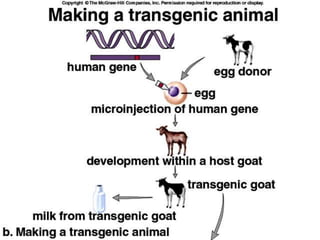
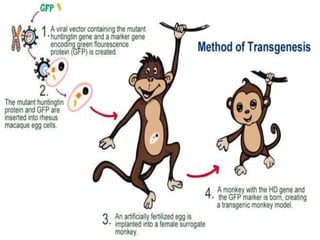
Transgenic Animals
A transgenic animal is one that carries
a foreign gene that has been
deliberately inserted into its genome.
The foreign gene is constructed
using recombinant DNA
methodology
How are transgenic
animals produced?
 Since the discovery of the molecular structure of DNA by Watson and Crick
in 1953, molecular biology research has gained momentum.
 Scientists can now produce transgenic animals because, since Watson and
Crick's discovery, there have been breakthroughs in:
 1. Recombinant DNA (artificially-produced DNA)
 2. Genetic cloning
 3. Analysis of gene expression (the process by which a gene gives rise to
a Protein)
 4. Genomic mapping
Three basic methods of
producing transgenic animals
1. DNA microinjection
2. Retrovirus-mediated gene transfer
3. Embryonic stem cell-mediated gene
transfer
1(a). DNA
Microinjection
1(a). Microinjection:
Using fine tipped (0.5 - 1.0
micrometer diameter) glass needle
or micropipette.
This method of gene transfer is used
to introduce DNA into large cells
such as oocytes, eggs, and the cells
of early embryo.
 The mouse was the first animal to undergo successful
gene transfer using DNA microinjection.6 This method
involves:
 transfer of a desired gene construct (of a single gene or a
combination of genes that are recombined and then
cloned) from another member of the same species or
from a different species into the pronucleus of a
reproductive cell .
 The manipulated cell, which first must be cultured in vitro
(in a lab, not in a live animal) to develop to a specific
embryonic phase, is then transferred to the recipient
female.
 The Desired gene construct is injected in the pronucleus
of a reproductive cell using a glass needle around 0.5 to
5 micrometers in diameter. The manipulated cell is
cultured in vitro to develop to a specific embryonic
phase, is then transferred to a recipient female.
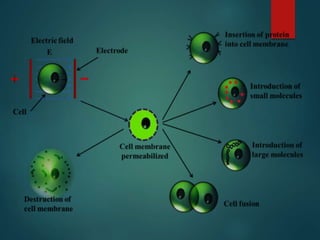
1(b). Electroporation
1(b).Electroporation:
The cells are placed in a solution
containing DNA and subjected to
electrical shocks to cause holes in
the membranes. The foreign DNA
fragments enter through the holes
into the cytoplasm and then to
nucleus.
Electroporation is a physical
transfection method that uses an
electrical pulse to create temporary
pores in cell membranes through
which substances like nucleic acids can
pass into cells.
It is a highly efficient strategy for the
introduction of foreign nucleic acids into
many cell types, including bacteria and
mammalian cells.
2. Retrovirus-
Mediated Gene
Transfer
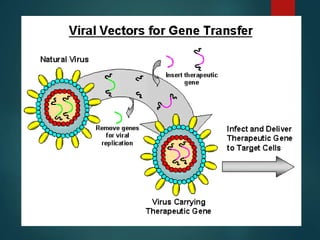
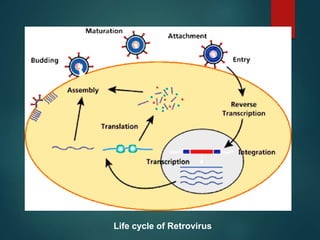
 A retrovirus is a virus that carries its genetic material in
the form of RNA rather than DNA.
 This method involves:
 Retroviruses used as vectors to transfer genetic material
into the host cell, resulting in a chimera, an organism
consisting of tissues or parts of diverse genetic
constitution
 Chimeras are inbred for as many as 20 generations until
homozygous (carrying the desired transgene in every cell)
transgenic offspring are born
Life cycle of Retrovirus
Four classes of viral
vector
 Retrovirus- commonly used
( Offspring’s derived from this method are
chimeric; not all cell carry the retrovirus
i.e diverse genetic constitution)
 Adenovirus
 Herpesvirus
 Adenoassociated Virus(AAV) Vectors
3. Embryonic Stem
Cell-Mediated Gene
Transfer
 Isolation of totipotent stem cells (stem cells that
can develop into any type of specialized cell) from
embryos.
 The desired gene is inserted into these cells.
 Cells containing the desired DNA are incorporated
into the host’s embryo, resulting in a chimeric
animal.
 Unlike the other two methods, which require live
transgenic offspring to test for the presence of the
desired transgene, this method allows testing for
transgenes at the cell stage.
Embryonic stem cells
Formation of gametocytes
Injection into blastocysts
Injection into foster mother
Formation of new individual
Applications
The benefits of these animals to human welfare can be grouped into areas:
 Agriculture
 Medicine
 Industry
 Medicine:-
We can say that medicine is one field which has took benefit of transgenic
animals most. Every year people die of kidney failure, heart failure and due to
other organs failure. But now scientists have succeeded in producing
transgenic animals like pigs which carry the organs needed for humans. Pig is
responsible for providing the organs to the humans and these organs can be
inserted into the human body through transplantation.

Transgenic animals have already helped in developing certain growth
hormones. For this purpose, special genes are inserted in the milk of the cow,
which increase the production of the milk. Similarly various genetic and
hereditary diseases like cystic fibrosis and phenylketonuria can be treated by
manufacturing milk which is developed with trans genesis.

Human gene therapy has provided opportunities for medicine that in a certain
genetic or acquired disease, damaged genes can be replaced with the healthy
genes and their function is secured.
 Agriculture:-
Agriculture is another field which has taken advantage of transgenic
animals. In livestock, when transgenic animals are bred with the normal
animals, the generation produced contains healthy organs, meat and milk.
Transgenic techniques have made quick production of animals while
traditional methods of animals breeding are time taking. Quality of the
animals also increases and they are the source of providing good quality
food to humans in the form of milk and meat.
Industry:-
Two scientists of Canada succeeded in inserting spider genes in the goats
who gave milk. The goats produced silk with the milk in large amounts. It
was a good source of economy for the industrialists. Polymer strands of the
silk were extracted from the milk and light threads were made. This thread
could be used in the making uniforms of soldiers and also the tennis
rockets.
Conclusion:-
 Transgenic animal techniques have developed rapidly and
provided more and improved platforms for the preparation of
transgenic animals since their emergence.
 All of these developments will provide new ideas and bring
forth important changes in fields like medicine, health and
livestock improvement.
 In particular, the economic and social benefits from the
production of bioreactors, drug production, and organ culture
for human transplantation will be great.
Genetically Modified Organisms 01

Genetically Modified Organisms 01

  • 1.
  • 2.
  • 3.
    Introduction:  A geneticallymodified organism (GMO) is an organism or microorganism whose genetic material has been altered to contain a segment of DNA from another organism.  Modern recombinant DNA technology enables the “stitching together” of pieces of DNA, regardless of the source of the pieces. Since the 1980s, this technology has been used extensively in the lab by researchers for countless purposes: to make copies of genes or proteins, to determine gene function, to study gene expression patterns, and to create models for human disease.  One application has been to generate food crops that are modified in a way that is advantageous to either the producer or the consumer. Currently the GM crops on the market have bacterial genes introduced into their genomes that encode for pest or herbicide resistance.  In theory, this should cut down on the amount of chemicals a farmer needs to spray, but in practice that goal has not been realized as pests and weeds become resistant to the chemicals being used.
  • 4.
    Transgenic Animals A transgenicanimal is one that carries a foreign gene that has been deliberately inserted into its genome. The foreign gene is constructed using recombinant DNA methodology
  • 7.
  • 8.
     Since thediscovery of the molecular structure of DNA by Watson and Crick in 1953, molecular biology research has gained momentum.  Scientists can now produce transgenic animals because, since Watson and Crick's discovery, there have been breakthroughs in:  1. Recombinant DNA (artificially-produced DNA)  2. Genetic cloning  3. Analysis of gene expression (the process by which a gene gives rise to a Protein)  4. Genomic mapping
  • 10.
    Three basic methodsof producing transgenic animals 1. DNA microinjection 2. Retrovirus-mediated gene transfer 3. Embryonic stem cell-mediated gene transfer
  • 11.
  • 12.
    1(a). Microinjection: Using finetipped (0.5 - 1.0 micrometer diameter) glass needle or micropipette. This method of gene transfer is used to introduce DNA into large cells such as oocytes, eggs, and the cells of early embryo.
  • 13.
     The mousewas the first animal to undergo successful gene transfer using DNA microinjection.6 This method involves:  transfer of a desired gene construct (of a single gene or a combination of genes that are recombined and then cloned) from another member of the same species or from a different species into the pronucleus of a reproductive cell .  The manipulated cell, which first must be cultured in vitro (in a lab, not in a live animal) to develop to a specific embryonic phase, is then transferred to the recipient female.
  • 14.
     The Desiredgene construct is injected in the pronucleus of a reproductive cell using a glass needle around 0.5 to 5 micrometers in diameter. The manipulated cell is cultured in vitro to develop to a specific embryonic phase, is then transferred to a recipient female.
  • 17.
  • 18.
    1(b).Electroporation: The cells areplaced in a solution containing DNA and subjected to electrical shocks to cause holes in the membranes. The foreign DNA fragments enter through the holes into the cytoplasm and then to nucleus.
  • 19.
    Electroporation is aphysical transfection method that uses an electrical pulse to create temporary pores in cell membranes through which substances like nucleic acids can pass into cells. It is a highly efficient strategy for the introduction of foreign nucleic acids into many cell types, including bacteria and mammalian cells.
  • 23.
  • 24.
     A retrovirusis a virus that carries its genetic material in the form of RNA rather than DNA.  This method involves:  Retroviruses used as vectors to transfer genetic material into the host cell, resulting in a chimera, an organism consisting of tissues or parts of diverse genetic constitution  Chimeras are inbred for as many as 20 generations until homozygous (carrying the desired transgene in every cell) transgenic offspring are born
  • 26.
    Life cycle ofRetrovirus
  • 27.
    Four classes ofviral vector  Retrovirus- commonly used ( Offspring’s derived from this method are chimeric; not all cell carry the retrovirus i.e diverse genetic constitution)  Adenovirus  Herpesvirus  Adenoassociated Virus(AAV) Vectors
  • 28.
  • 29.
     Isolation oftotipotent stem cells (stem cells that can develop into any type of specialized cell) from embryos.  The desired gene is inserted into these cells.  Cells containing the desired DNA are incorporated into the host’s embryo, resulting in a chimeric animal.  Unlike the other two methods, which require live transgenic offspring to test for the presence of the desired transgene, this method allows testing for transgenes at the cell stage.
  • 30.
    Embryonic stem cells Formationof gametocytes Injection into blastocysts Injection into foster mother Formation of new individual
  • 31.
    Applications The benefits ofthese animals to human welfare can be grouped into areas:  Agriculture  Medicine  Industry
  • 32.
     Medicine:- We cansay that medicine is one field which has took benefit of transgenic animals most. Every year people die of kidney failure, heart failure and due to other organs failure. But now scientists have succeeded in producing transgenic animals like pigs which carry the organs needed for humans. Pig is responsible for providing the organs to the humans and these organs can be inserted into the human body through transplantation.  Transgenic animals have already helped in developing certain growth hormones. For this purpose, special genes are inserted in the milk of the cow, which increase the production of the milk. Similarly various genetic and hereditary diseases like cystic fibrosis and phenylketonuria can be treated by manufacturing milk which is developed with trans genesis.  Human gene therapy has provided opportunities for medicine that in a certain genetic or acquired disease, damaged genes can be replaced with the healthy genes and their function is secured.
  • 33.
     Agriculture:- Agriculture isanother field which has taken advantage of transgenic animals. In livestock, when transgenic animals are bred with the normal animals, the generation produced contains healthy organs, meat and milk. Transgenic techniques have made quick production of animals while traditional methods of animals breeding are time taking. Quality of the animals also increases and they are the source of providing good quality food to humans in the form of milk and meat. Industry:- Two scientists of Canada succeeded in inserting spider genes in the goats who gave milk. The goats produced silk with the milk in large amounts. It was a good source of economy for the industrialists. Polymer strands of the silk were extracted from the milk and light threads were made. This thread could be used in the making uniforms of soldiers and also the tennis rockets.
  • 34.
    Conclusion:-  Transgenic animaltechniques have developed rapidly and provided more and improved platforms for the preparation of transgenic animals since their emergence.  All of these developments will provide new ideas and bring forth important changes in fields like medicine, health and livestock improvement.  In particular, the economic and social benefits from the production of bioreactors, drug production, and organ culture for human transplantation will be great.

Editor's Notes

  • #11 Gene transfer by microinjection is the predominant method used to produce transgenic farm animals. Since the insertion of DNA results in a random process, transgenic animals are mated to ensure that their offspring acquire the desired transgene.