NABH
YANAMALA VIJAY RAJ
BT14M004
MTECH IN CLINICAL ENG
IIT MADRAS & CMC VELLORE & SCTIMST
1
WHAT IS QUALITY
 The standard of something as measured against other things of a similar kind; the
degree of excellence of something.
 Meeting the needs and exceeding the expectations of the patients
 Delivering all and only the care that the patient and family needs
 A doctor may say: “The kind of care that may relive the pain and suffering and restore
health to the best possible level”
 A patient may say, “The best possible treatment that is timely, safe and affordable,
and can restore his health to his earning capacity at the earliest”
5/9/2016SCTIMST
2
Quality
 Quality in Hospitals is all about meeting expectations of:
 Patients
 Statutory / Legal bodies
 Internal Customers
 Owners / Trust
 Others
 Third parties (NABH)
5/9/2016SCTIMST
3
Quality in Hospitals
 In India, Heath System currently operates within an environment of rapid social, economical and
technical changes. Such changes raise the concern for the quality of health care.
 Hospital is an integral part of health care system.
 Accreditation would be the single most important approach for improving the quality of hospitals.
 Accreditation is an incentive to improve capacity of national hospitals to provide quality of care
5/9/2016SCTIMST
4
What is NABH?
 National Accreditation Board for Hospitals & Healthcare Providers (NABH) is a constituent board of
Quality Council of India (QCI), set up to establish and operate accreditation programme for
healthcare organizations.
 The board while being supported by all stakeholders including industry, consumers, government,
have full functional autonomy in its operation.
5/9/2016SCTIMST
5
ISQua (International Society for Quality in
HealthCare )
 ISQua is an international body which grants approval to Accreditation Bodies in the area of
healthcare as mark of equivalence of accreditation program of member countries.
 NABH is a member of ISQua Accreditation Council.
 NABH is an Institutional Member as well as a member of the Accreditation Council of the
International Society for Quality in HealthCare (ISQua).
 NABH is the founder member of proposed Asian Society for Quality in Healthcare (ASQua) being
registered in Malaysia.
 NABH is a member of International Steering Committee of WHO Collaborating Centre for Patient
Safety as a nominee of ISQua Accreditation Council
5/9/2016SCTIMST
6
BENEFITS OF ACCREDITATION
 Benefits for Patients
 Biggest beneficiary
 High quality of care and patient safety
 Rights of patients
 Patients satisfaction
 Commitment to quality care
 Community confidence
 Benchmarking
 Benefits for Hospital Staff
 Staff satisfaction
 Improves overall professional development
 Benefits to paying and regulatory bodies
 Benefits for Hospitals
 CQI
5/9/2016SCTIMST
7
What are the programs being offered by
NABH?
 Currently, NABH is offering accreditation programs for Hospitals, Small Health Care
Organizations/Nursing Homes, Blood Banks and Transfusion Services, Oral Substitution Therapy
(OST) Centres and Primary and Secondary Health Centres.
 A couple of more programs such as Medical Imaging services, Dental Hospitals/Centres, AYUSH
Hospitals are being developed.
5/9/2016SCTIMST
8
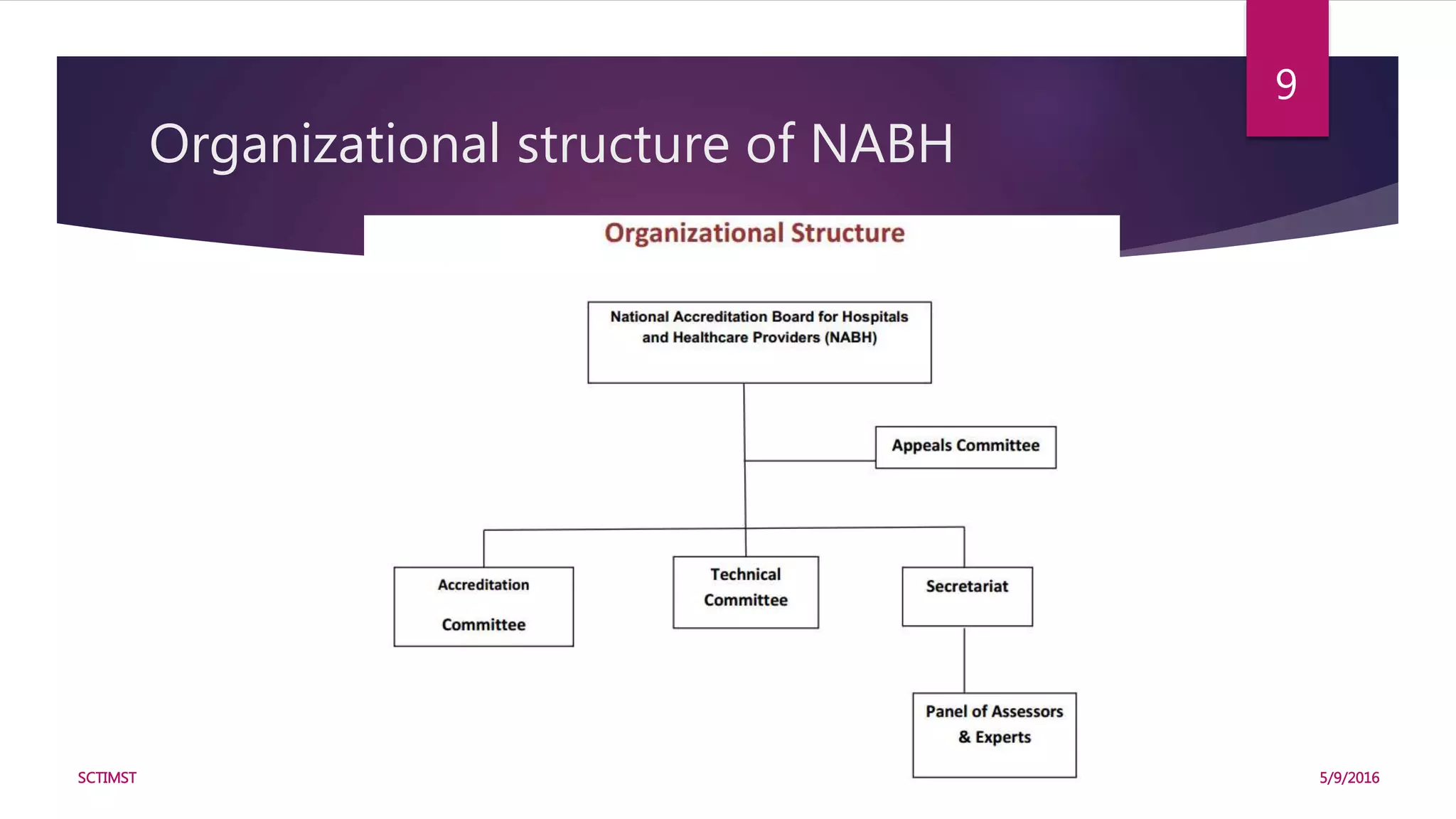
Organizational structure of NABH
5/9/2016SCTIMST
9
Organizational structure of NABH
The main functions of Accreditation Committee are as follows:
 Recommending to board about grant of accreditation or otherwise based on evaluation of
assessment reports & other relevant information.
 Approval of the major changes in the Scope of Accreditation include enhancement and reduction,
in respect of accredited hospitals.
 Recommending to the board on launching of new initiatives
5/9/2016SCTIMST
10
Accreditation Committee
Organizational structure of NABH
The main functions of Technical Committee are as follows:
 Drafting of accreditation standards and guidance documents
 Periodic review of standards
5/9/2016SCTIMST
11
Technical Committee
Organizational structure of NABH
5/9/2016SCTIMST
12
Appeals Committee
The Appeal Committee addresses appeals made by the hospitals against
any adverse decision regarding accreditation taken by the NABH. The adverse decisions may relate to
the following:
 refusal to accept an application,
 refusal to proceed with an assessment,
 corrective action requests,
 changes in accreditation scope,
 decisions to deny, suspend or withdraw accreditation, and
 any other action that impedes the attainment of accreditation
Organizational structure of NABH
 The Secretariat coordinates the entire activities related to NABH Accreditation to hospitals and
healthcare organizations.
5/9/2016SCTIMST
13
NABH Secretariat
Organizational structure of NABH
Panel of Assessors and Experts NABH has a panel of trained and qualified
assessors for assessment of hospitals.
 Principal Assessor
The Principal Assessor is overall responsible for conducting the pre assessments and final assessments
of the hospitals.
 Assessors
NABH has empanelled experts for assessment of hospitals. They are trained by NABH on hospital
accreditation and various assessment techniques. The assessors are responsible for evaluating the
hospital’s compliance with NABH Standards
5/9/2016SCTIMST
14
NABH Standards
 NABH Standards for hospitals prepared by technical committee contains complete set of standards
for evaluation of hospitals for grant of accreditation.
 The standards provide framework for quality of care for patients and quality improvement for
hospitals.
 The standards help to build a quality culture at all level and across all the function of hospital.
 NABH Standards has ten chapters incorporating 102 standards and 636 objective
elements.
5/9/2016SCTIMST
15
Outline of NABH Standards
NABH has 10 Chapters, 102 Standards, 636 Objectives Elements
5/9/2016SCTIMST
16
Patient Centered Standards
• Access, Assessment and Continuity of Care
(AAC)
• Care of Patient (COP)
• Management of Medication (MOM)
• Patient Right and Education (PRE)
• Hospital Infection Control (HIC)
Organization Centered Standards
• Continuous Quality Improvement (CQI)
• Responsibility of Management (ROM)
• Facility Management and Safety (FMS)
• Human Resource Management (HRM)
• Information Management System(IMS)
NABH Standards
Patient Centered Standards
Chapters
Std
1. Access, Assessment and
Continuity of Care (AAC)
14
2. Care of Patient (COP) 20
3. Management of Medication
(MOM)
13
4. Patient Right and Education
(PRE)
07
5. Hospital Infection Control (HIC) 09
Organization Centered
Standards Chapters
St
d
6. Continuous Quality
Improvement (CQI)
08
7. Responsibility of Management
(ROM)
06
8. Facility Management and
Safety (FMS)
08
9. Human Resource Management
(HRM)
10
10. Information Management
System(IMS)
07
5/9/2016SCTIMST
17
Assessment Criteria
 A hospital willing to be accredited by NABH must ensure the implementation of NABH standards
in its organization.
 The assessment team will check the implementation of NABH Standards in organization.
 The Hospital shall be able to demonstrate to NABH assessment team that all NABH standards, as
applicable, are followed
5/9/2016SCTIMST
18
Preparing for NABH Accreditation
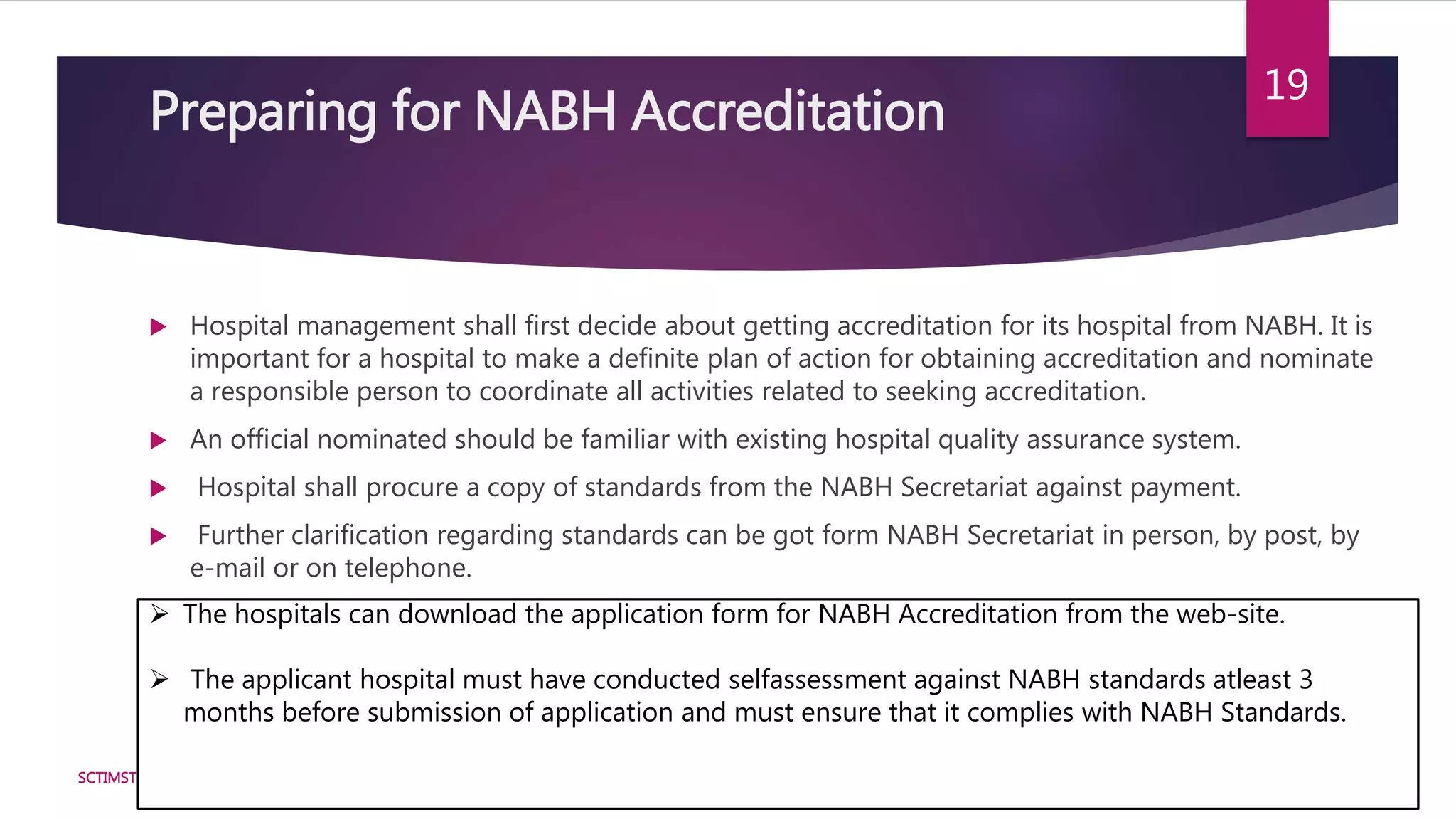
 Hospital management shall first decide about getting accreditation for its hospital from NABH. It is
important for a hospital to make a definite plan of action for obtaining accreditation and nominate
a responsible person to coordinate all activities related to seeking accreditation.
 An official nominated should be familiar with existing hospital quality assurance system.
 Hospital shall procure a copy of standards from the NABH Secretariat against payment.
 Further clarification regarding standards can be got form NABH Secretariat in person, by post, by
e-mail or on telephone.
 The hospital looking for accreditation shall understand the NABH assessment procedure.
 The hospitals shall ensure that the standards are implemented in the organization.
5/9/2016SCTIMST
19
 The hospitals can download the application form for NABH Accreditation from the web-site.
 The applicant hospital must have conducted selfassessment against NABH standards atleast 3
months before submission of application and must ensure that it complies with NABH Standards.
Preparing for NABH Accreditation
5/9/2016SCTIMST
20
5/9/2016SCTIMST
21
NABH Accreditation Procedure
Self-Assessment
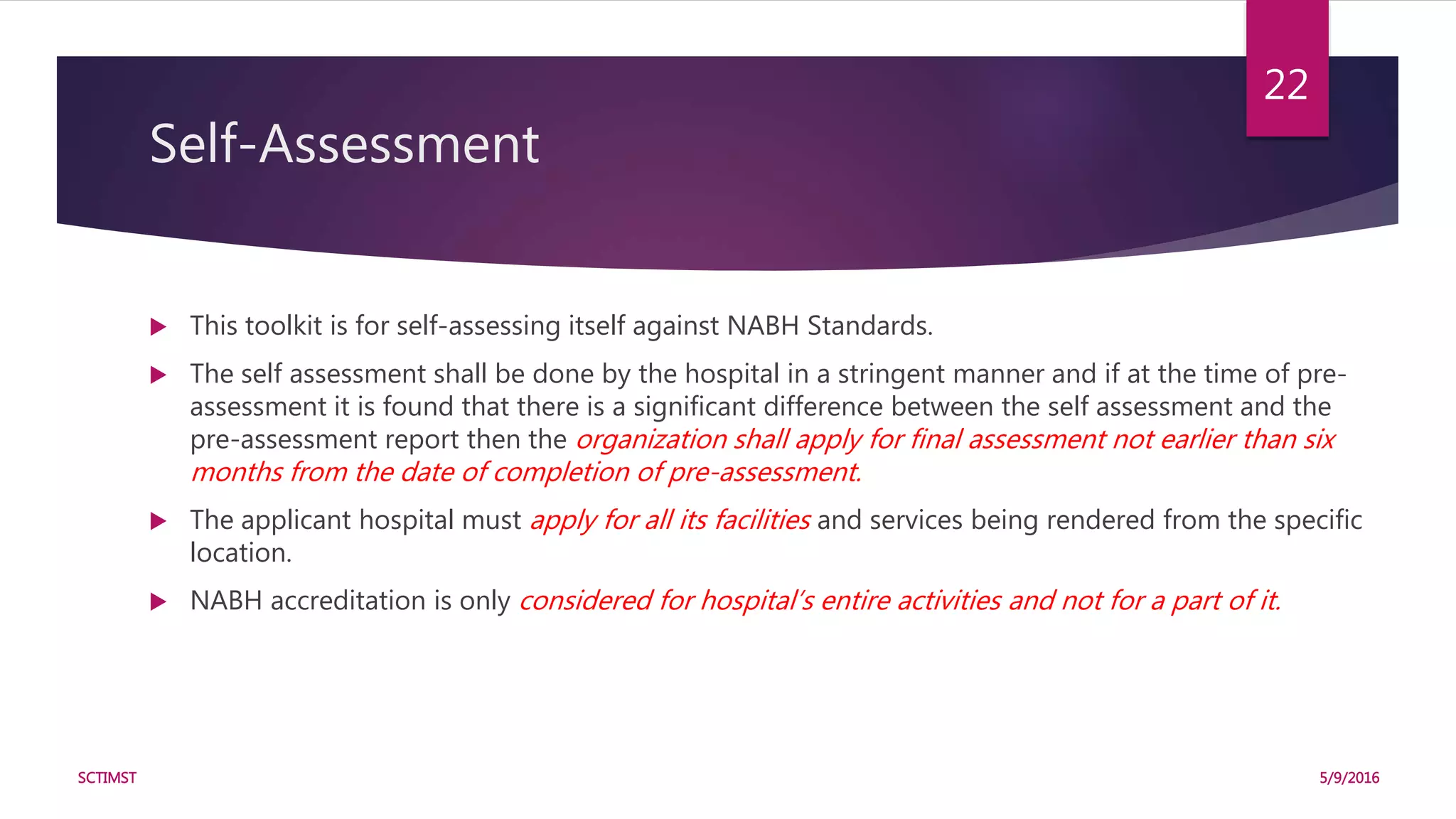
 This toolkit is for self-assessing itself against NABH Standards.
 The self assessment shall be done by the hospital in a stringent manner and if at the time of pre-
assessment it is found that there is a significant difference between the self assessment and the
pre-assessment report then the organization shall apply for final assessment not earlier than six
months from the date of completion of pre-assessment.
 The applicant hospital must apply for all its facilities and services being rendered from the specific
location.
 NABH accreditation is only considered for hospital’s entire activities and not for a part of it.
5/9/2016SCTIMST
22
Pre-Assessment:
NABH appoints a Principal Assessor/ Assessment Team who is responsible for pre assessment of
healthcare organization.
Objective of Pre-assessment:
 Check the preparedness of the hospital for final assessment
 Review the scope of accreditation and ascertain the requirement of the number of assessors
and the duration of the accreditation
 Review of the documentation system of the hospital
 Explain the methodology to be adopted for assessment.
5/9/2016SCTIMST
23
Final Assessment:
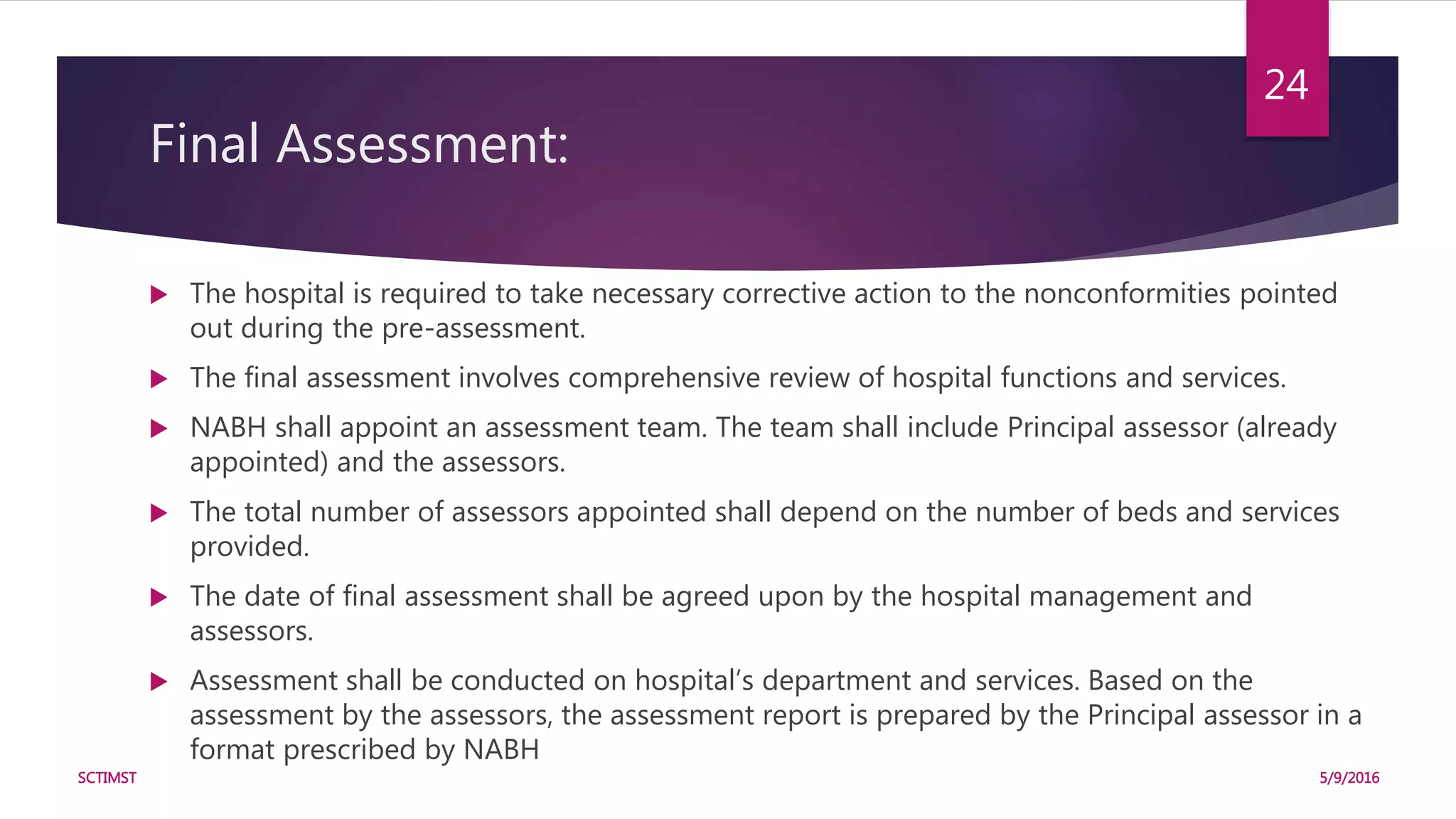
 The hospital is required to take necessary corrective action to the nonconformities pointed
out during the pre-assessment.
 The final assessment involves comprehensive review of hospital functions and services.
 NABH shall appoint an assessment team. The team shall include Principal assessor (already
appointed) and the assessors.
 The total number of assessors appointed shall depend on the number of beds and services
provided.
 The date of final assessment shall be agreed upon by the hospital management and
assessors.
 Assessment shall be conducted on hospital’s department and services. Based on the
assessment by the assessors, the assessment report is prepared by the Principal assessor in a
format prescribed by NABH
5/9/2016SCTIMST
24
GUIDELINES FOR USE OF NABH ACCREDITATION
MARK
 The use of this Mark by the Hospitals/ SHCO/ Blood Banks/ Primary Health Centre (PHC)/
Community Health Centre (CHC) will be under the control of NABH. Compliance with the guidelines
is required when using the NABH accreditation Mark.
5/9/2016SCTIMST
25
POLICIES AND PROCEDURES FOR DEALING WITH ADVERSE AN
OTHER DECISIONS AGAINST HCOs
Various categories of decisions are as follows:
A. Adverse decisions against applicant HCO
A.1 Inactive and Closed
B. Adverse decisions against accredited HCO
B.1 Shifting of Renewal Date
B.2 Expiry of Accreditation
B.3 Abeyance
B.4 Suspension
B.5 Forced Withdrawal
5/9/2016SCTIMST
26
C. Other decisions against accredited HCO
C.1 Voluntary Withdrawal
C.2 Extension of Validity of Accreditation Certificate
Inactive and Closed
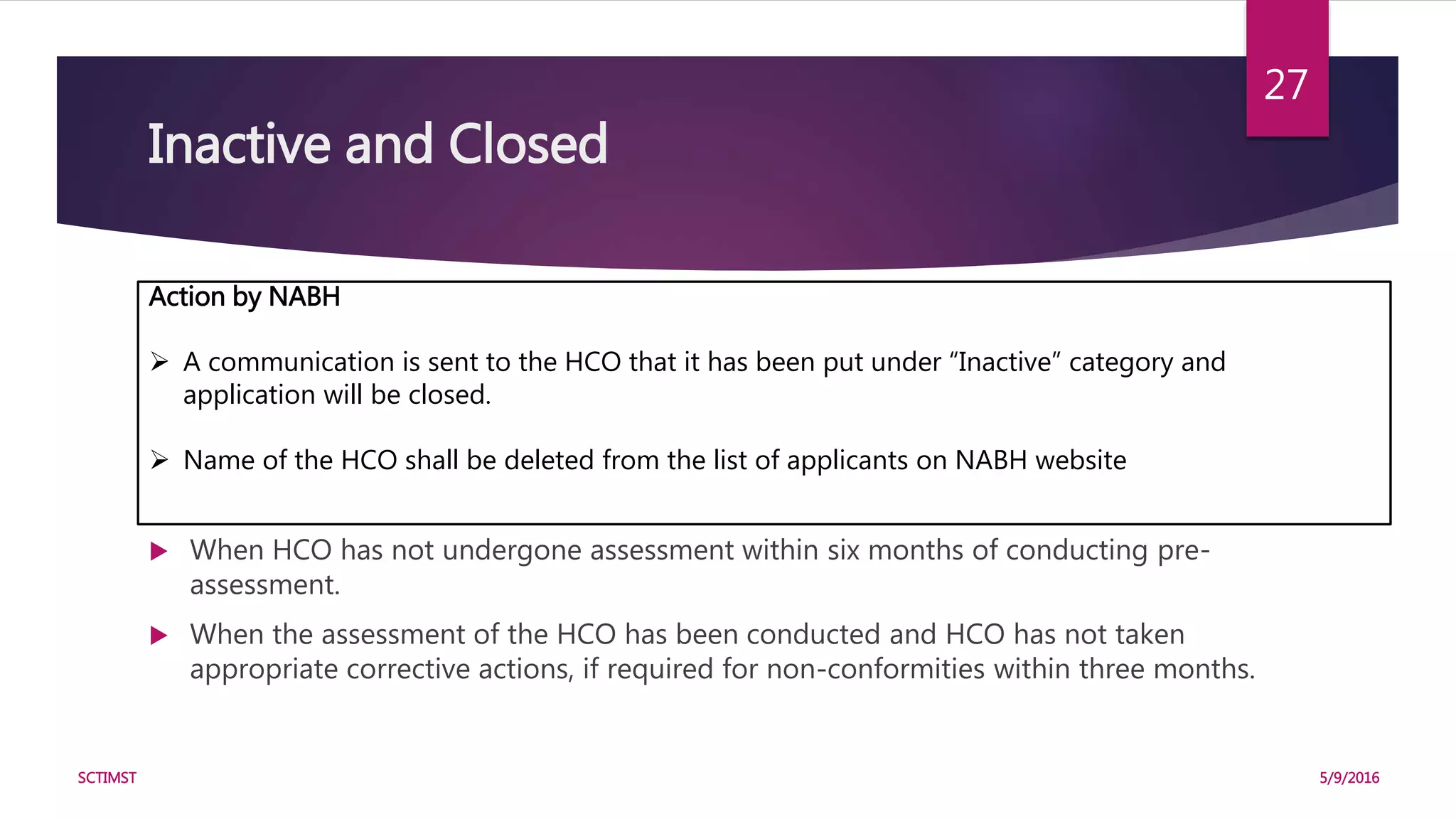
Conditions:
 When a HCO has submitted incomplete application and has not submitted
required information, application fee etc. within three months even after a reminder
is sent.
 When HCO has not undergone pre-assessment within three months of submitting
application.
 When HCO has not undergone assessment within six months of conducting pre-
assessment.
 When the assessment of the HCO has been conducted and HCO has not taken
appropriate corrective actions, if required for non-conformities within three months.
5/9/2016SCTIMST
27
Action by NABH
 A communication is sent to the HCO that it has been put under “Inactive” category and
application will be closed.
 Name of the HCO shall be deleted from the list of applicants on NABH website
Shifting of Renewal Date
Condition
 If a HCO has not applied 6 months prior to the expiry of accreditation and is unable to complete
formalities for re-accreditation before the expiry of accreditation.
Action by NABH
 The HCO will not remain in accredited category and cannot use NABH
Accreditation Mark.
 No extension will be granted after the expiry of accreditation.
 Accreditation status will be granted when the HCO undergoes the re-assessment; is able to
complete the corrective actions on the non-conformances after Reassessment and the
Accreditation Committee recommends renewal of accreditation.
5/9/2016SCTIMST
28
5.2 Expiry of Accreditation
Condition
 When the HCO has not submitted the application for renewal before expiry of accreditation.
Action by NABH
 NABH Officer shall inform the HCO at least one month before expiry of accreditation that it shall
not claim accreditation status and shall not use NABH.
 Accreditation Mark in letterheads, publicity matters etc. After the expiry of accreditation, NABH
website will be updated to show the expired status
5/9/2016SCTIMST
29
Abeyance
Condition
 When a HCO had undergone a Surveillance or Re-assessment visit and has not taken any
corrective action within 3 months of Surveillance/ Re-assessment visit.
 When a HCO has not paid the Accreditation fees and the accreditation expenses, beyond three
months’ liability.
 When a HCO does not appropriately respond to the queries as requested by NABH, even after two
reminders.
 When a total system failure or gross negligence in technical aspects is identified at the time of
Surveillance or Re-assessment visit.
5/9/2016SCTIMST
30
Action by NABH:
• The abeyance status is given to a HCO for no longer than three months.
• The HCO in abeyance status is not published, however if inquires are made the HCO is referred to as under
abeyance and working towards re-accreditation.
• To regain accreditation status, the HCO in abeyance status must notify to NABH of its desire and agree to
undergo full assessment, paying the re-assessment charges and other outstanding payments.
• Abeyance status will continue till reassessment is completed and a decision is taken.
If the HCO does not proceed further or respond or notify NABH about its inability of being reassessed within
3 months of the abeyance status, action shall be initiated to suspend the accreditation of the HCO.
• The HCO during the period of abeyance cannot use accreditation mark and claim accreditation.
Suspension
Condition
 When a HCO continues to be in ‘Abeyance’ status for three months,
 When a HCO violates the conditions of maintaining accreditation such as:
1) non co-operation with NABH
2) refusal to allow examination of documents & records
3) denial of access to NABH & its assessor to its services and patient care areas
4) wrong representation of scope of accreditation
5) misuse of accreditation mark
6) misleading reporting of facts
7) brings NABH into disrepute in any manner etc.
8) result of complaint analysis or any other information, which indicates that the HCO no longer
complies with requirements of NABH.
5/9/2016SCTIMST
31
Action by NABH
1. The HCO is notified in writing.
2. After 30 days, if issues are not resolved, a suspension letter is issued.
3. The suspension status of HCO is published.
4. A HCO can remain in suspension status for a maximum period of three months.
5. If the HCO does not respond to the actual suspension letter or refuses to meet the
conditions to lift the suspension, ‘Withdrawal’ action is initiated. If, even after
suspension, the HCO continues to violate the conditions of accreditation, an action
on withdrawal of accreditation shall be initiated by NABH.
Forced Withdrawal
 Condition
1. When a HCO remains in ‘Suspended status’ for three months and have not met the condition for lifting
the suspension even after three months.
 Action by NABH
1. The HCO is notified in writing.
2. The withdrawal status is published.
3. In case the HCO has been withdrawn from the accreditation programme it is debarred to participate in
the accreditation programme for at least 1 year. The HCO can be re-enrolled in the programme by giving
valid justification of earlier withdrawal by applying as a new HCO and paying full fees and assessment
charges, applicable at time.
4. After the HCO accreditation status is withdrawn, the HCO shall not use accreditation mark or claim
accreditation.
5/9/2016SCTIMST
32

NABH Extended

  • 1.
    NABH YANAMALA VIJAY RAJ BT14M004 MTECHIN CLINICAL ENG IIT MADRAS & CMC VELLORE & SCTIMST 1
  • 2.
    WHAT IS QUALITY The standard of something as measured against other things of a similar kind; the degree of excellence of something.  Meeting the needs and exceeding the expectations of the patients  Delivering all and only the care that the patient and family needs  A doctor may say: “The kind of care that may relive the pain and suffering and restore health to the best possible level”  A patient may say, “The best possible treatment that is timely, safe and affordable, and can restore his health to his earning capacity at the earliest” 5/9/2016SCTIMST 2
  • 3.
    Quality  Quality inHospitals is all about meeting expectations of:  Patients  Statutory / Legal bodies  Internal Customers  Owners / Trust  Others  Third parties (NABH) 5/9/2016SCTIMST 3
  • 4.
    Quality in Hospitals In India, Heath System currently operates within an environment of rapid social, economical and technical changes. Such changes raise the concern for the quality of health care.  Hospital is an integral part of health care system.  Accreditation would be the single most important approach for improving the quality of hospitals.  Accreditation is an incentive to improve capacity of national hospitals to provide quality of care 5/9/2016SCTIMST 4
  • 5.
    What is NABH? National Accreditation Board for Hospitals & Healthcare Providers (NABH) is a constituent board of Quality Council of India (QCI), set up to establish and operate accreditation programme for healthcare organizations.  The board while being supported by all stakeholders including industry, consumers, government, have full functional autonomy in its operation. 5/9/2016SCTIMST 5
  • 6.
    ISQua (International Societyfor Quality in HealthCare )  ISQua is an international body which grants approval to Accreditation Bodies in the area of healthcare as mark of equivalence of accreditation program of member countries.  NABH is a member of ISQua Accreditation Council.  NABH is an Institutional Member as well as a member of the Accreditation Council of the International Society for Quality in HealthCare (ISQua).  NABH is the founder member of proposed Asian Society for Quality in Healthcare (ASQua) being registered in Malaysia.  NABH is a member of International Steering Committee of WHO Collaborating Centre for Patient Safety as a nominee of ISQua Accreditation Council 5/9/2016SCTIMST 6
  • 7.
    BENEFITS OF ACCREDITATION Benefits for Patients  Biggest beneficiary  High quality of care and patient safety  Rights of patients  Patients satisfaction  Commitment to quality care  Community confidence  Benchmarking  Benefits for Hospital Staff  Staff satisfaction  Improves overall professional development  Benefits to paying and regulatory bodies  Benefits for Hospitals  CQI 5/9/2016SCTIMST 7
  • 8.
    What are theprograms being offered by NABH?  Currently, NABH is offering accreditation programs for Hospitals, Small Health Care Organizations/Nursing Homes, Blood Banks and Transfusion Services, Oral Substitution Therapy (OST) Centres and Primary and Secondary Health Centres.  A couple of more programs such as Medical Imaging services, Dental Hospitals/Centres, AYUSH Hospitals are being developed. 5/9/2016SCTIMST 8
  • 9.
    Organizational structure ofNABH 5/9/2016SCTIMST 9
  • 10.
    Organizational structure ofNABH The main functions of Accreditation Committee are as follows:  Recommending to board about grant of accreditation or otherwise based on evaluation of assessment reports & other relevant information.  Approval of the major changes in the Scope of Accreditation include enhancement and reduction, in respect of accredited hospitals.  Recommending to the board on launching of new initiatives 5/9/2016SCTIMST 10 Accreditation Committee
  • 11.
    Organizational structure ofNABH The main functions of Technical Committee are as follows:  Drafting of accreditation standards and guidance documents  Periodic review of standards 5/9/2016SCTIMST 11 Technical Committee
  • 12.
    Organizational structure ofNABH 5/9/2016SCTIMST 12 Appeals Committee The Appeal Committee addresses appeals made by the hospitals against any adverse decision regarding accreditation taken by the NABH. The adverse decisions may relate to the following:  refusal to accept an application,  refusal to proceed with an assessment,  corrective action requests,  changes in accreditation scope,  decisions to deny, suspend or withdraw accreditation, and  any other action that impedes the attainment of accreditation
  • 13.
    Organizational structure ofNABH  The Secretariat coordinates the entire activities related to NABH Accreditation to hospitals and healthcare organizations. 5/9/2016SCTIMST 13 NABH Secretariat
  • 14.
    Organizational structure ofNABH Panel of Assessors and Experts NABH has a panel of trained and qualified assessors for assessment of hospitals.  Principal Assessor The Principal Assessor is overall responsible for conducting the pre assessments and final assessments of the hospitals.  Assessors NABH has empanelled experts for assessment of hospitals. They are trained by NABH on hospital accreditation and various assessment techniques. The assessors are responsible for evaluating the hospital’s compliance with NABH Standards 5/9/2016SCTIMST 14
  • 15.
    NABH Standards  NABHStandards for hospitals prepared by technical committee contains complete set of standards for evaluation of hospitals for grant of accreditation.  The standards provide framework for quality of care for patients and quality improvement for hospitals.  The standards help to build a quality culture at all level and across all the function of hospital.  NABH Standards has ten chapters incorporating 102 standards and 636 objective elements. 5/9/2016SCTIMST 15
  • 16.
    Outline of NABHStandards NABH has 10 Chapters, 102 Standards, 636 Objectives Elements 5/9/2016SCTIMST 16 Patient Centered Standards • Access, Assessment and Continuity of Care (AAC) • Care of Patient (COP) • Management of Medication (MOM) • Patient Right and Education (PRE) • Hospital Infection Control (HIC) Organization Centered Standards • Continuous Quality Improvement (CQI) • Responsibility of Management (ROM) • Facility Management and Safety (FMS) • Human Resource Management (HRM) • Information Management System(IMS)
  • 17.
    NABH Standards Patient CenteredStandards Chapters Std 1. Access, Assessment and Continuity of Care (AAC) 14 2. Care of Patient (COP) 20 3. Management of Medication (MOM) 13 4. Patient Right and Education (PRE) 07 5. Hospital Infection Control (HIC) 09 Organization Centered Standards Chapters St d 6. Continuous Quality Improvement (CQI) 08 7. Responsibility of Management (ROM) 06 8. Facility Management and Safety (FMS) 08 9. Human Resource Management (HRM) 10 10. Information Management System(IMS) 07 5/9/2016SCTIMST 17
  • 18.
    Assessment Criteria  Ahospital willing to be accredited by NABH must ensure the implementation of NABH standards in its organization.  The assessment team will check the implementation of NABH Standards in organization.  The Hospital shall be able to demonstrate to NABH assessment team that all NABH standards, as applicable, are followed 5/9/2016SCTIMST 18
  • 19.
    Preparing for NABHAccreditation  Hospital management shall first decide about getting accreditation for its hospital from NABH. It is important for a hospital to make a definite plan of action for obtaining accreditation and nominate a responsible person to coordinate all activities related to seeking accreditation.  An official nominated should be familiar with existing hospital quality assurance system.  Hospital shall procure a copy of standards from the NABH Secretariat against payment.  Further clarification regarding standards can be got form NABH Secretariat in person, by post, by e-mail or on telephone.  The hospital looking for accreditation shall understand the NABH assessment procedure.  The hospitals shall ensure that the standards are implemented in the organization. 5/9/2016SCTIMST 19  The hospitals can download the application form for NABH Accreditation from the web-site.  The applicant hospital must have conducted selfassessment against NABH standards atleast 3 months before submission of application and must ensure that it complies with NABH Standards.
  • 20.
    Preparing for NABHAccreditation 5/9/2016SCTIMST 20
  • 21.
  • 22.
    Self-Assessment  This toolkitis for self-assessing itself against NABH Standards.  The self assessment shall be done by the hospital in a stringent manner and if at the time of pre- assessment it is found that there is a significant difference between the self assessment and the pre-assessment report then the organization shall apply for final assessment not earlier than six months from the date of completion of pre-assessment.  The applicant hospital must apply for all its facilities and services being rendered from the specific location.  NABH accreditation is only considered for hospital’s entire activities and not for a part of it. 5/9/2016SCTIMST 22
  • 23.
    Pre-Assessment: NABH appoints aPrincipal Assessor/ Assessment Team who is responsible for pre assessment of healthcare organization. Objective of Pre-assessment:  Check the preparedness of the hospital for final assessment  Review the scope of accreditation and ascertain the requirement of the number of assessors and the duration of the accreditation  Review of the documentation system of the hospital  Explain the methodology to be adopted for assessment. 5/9/2016SCTIMST 23
  • 24.
    Final Assessment:  Thehospital is required to take necessary corrective action to the nonconformities pointed out during the pre-assessment.  The final assessment involves comprehensive review of hospital functions and services.  NABH shall appoint an assessment team. The team shall include Principal assessor (already appointed) and the assessors.  The total number of assessors appointed shall depend on the number of beds and services provided.  The date of final assessment shall be agreed upon by the hospital management and assessors.  Assessment shall be conducted on hospital’s department and services. Based on the assessment by the assessors, the assessment report is prepared by the Principal assessor in a format prescribed by NABH 5/9/2016SCTIMST 24
  • 25.
    GUIDELINES FOR USEOF NABH ACCREDITATION MARK  The use of this Mark by the Hospitals/ SHCO/ Blood Banks/ Primary Health Centre (PHC)/ Community Health Centre (CHC) will be under the control of NABH. Compliance with the guidelines is required when using the NABH accreditation Mark. 5/9/2016SCTIMST 25
  • 26.
    POLICIES AND PROCEDURESFOR DEALING WITH ADVERSE AN OTHER DECISIONS AGAINST HCOs Various categories of decisions are as follows: A. Adverse decisions against applicant HCO A.1 Inactive and Closed B. Adverse decisions against accredited HCO B.1 Shifting of Renewal Date B.2 Expiry of Accreditation B.3 Abeyance B.4 Suspension B.5 Forced Withdrawal 5/9/2016SCTIMST 26 C. Other decisions against accredited HCO C.1 Voluntary Withdrawal C.2 Extension of Validity of Accreditation Certificate
  • 27.
    Inactive and Closed Conditions: When a HCO has submitted incomplete application and has not submitted required information, application fee etc. within three months even after a reminder is sent.  When HCO has not undergone pre-assessment within three months of submitting application.  When HCO has not undergone assessment within six months of conducting pre- assessment.  When the assessment of the HCO has been conducted and HCO has not taken appropriate corrective actions, if required for non-conformities within three months. 5/9/2016SCTIMST 27 Action by NABH  A communication is sent to the HCO that it has been put under “Inactive” category and application will be closed.  Name of the HCO shall be deleted from the list of applicants on NABH website
  • 28.
    Shifting of RenewalDate Condition  If a HCO has not applied 6 months prior to the expiry of accreditation and is unable to complete formalities for re-accreditation before the expiry of accreditation. Action by NABH  The HCO will not remain in accredited category and cannot use NABH Accreditation Mark.  No extension will be granted after the expiry of accreditation.  Accreditation status will be granted when the HCO undergoes the re-assessment; is able to complete the corrective actions on the non-conformances after Reassessment and the Accreditation Committee recommends renewal of accreditation. 5/9/2016SCTIMST 28
  • 29.
    5.2 Expiry ofAccreditation Condition  When the HCO has not submitted the application for renewal before expiry of accreditation. Action by NABH  NABH Officer shall inform the HCO at least one month before expiry of accreditation that it shall not claim accreditation status and shall not use NABH.  Accreditation Mark in letterheads, publicity matters etc. After the expiry of accreditation, NABH website will be updated to show the expired status 5/9/2016SCTIMST 29
  • 30.
    Abeyance Condition  When aHCO had undergone a Surveillance or Re-assessment visit and has not taken any corrective action within 3 months of Surveillance/ Re-assessment visit.  When a HCO has not paid the Accreditation fees and the accreditation expenses, beyond three months’ liability.  When a HCO does not appropriately respond to the queries as requested by NABH, even after two reminders.  When a total system failure or gross negligence in technical aspects is identified at the time of Surveillance or Re-assessment visit. 5/9/2016SCTIMST 30 Action by NABH: • The abeyance status is given to a HCO for no longer than three months. • The HCO in abeyance status is not published, however if inquires are made the HCO is referred to as under abeyance and working towards re-accreditation. • To regain accreditation status, the HCO in abeyance status must notify to NABH of its desire and agree to undergo full assessment, paying the re-assessment charges and other outstanding payments. • Abeyance status will continue till reassessment is completed and a decision is taken. If the HCO does not proceed further or respond or notify NABH about its inability of being reassessed within 3 months of the abeyance status, action shall be initiated to suspend the accreditation of the HCO. • The HCO during the period of abeyance cannot use accreditation mark and claim accreditation.
  • 31.
    Suspension Condition  When aHCO continues to be in ‘Abeyance’ status for three months,  When a HCO violates the conditions of maintaining accreditation such as: 1) non co-operation with NABH 2) refusal to allow examination of documents & records 3) denial of access to NABH & its assessor to its services and patient care areas 4) wrong representation of scope of accreditation 5) misuse of accreditation mark 6) misleading reporting of facts 7) brings NABH into disrepute in any manner etc. 8) result of complaint analysis or any other information, which indicates that the HCO no longer complies with requirements of NABH. 5/9/2016SCTIMST 31 Action by NABH 1. The HCO is notified in writing. 2. After 30 days, if issues are not resolved, a suspension letter is issued. 3. The suspension status of HCO is published. 4. A HCO can remain in suspension status for a maximum period of three months. 5. If the HCO does not respond to the actual suspension letter or refuses to meet the conditions to lift the suspension, ‘Withdrawal’ action is initiated. If, even after suspension, the HCO continues to violate the conditions of accreditation, an action on withdrawal of accreditation shall be initiated by NABH.
  • 32.
    Forced Withdrawal  Condition 1.When a HCO remains in ‘Suspended status’ for three months and have not met the condition for lifting the suspension even after three months.  Action by NABH 1. The HCO is notified in writing. 2. The withdrawal status is published. 3. In case the HCO has been withdrawn from the accreditation programme it is debarred to participate in the accreditation programme for at least 1 year. The HCO can be re-enrolled in the programme by giving valid justification of earlier withdrawal by applying as a new HCO and paying full fees and assessment charges, applicable at time. 4. After the HCO accreditation status is withdrawn, the HCO shall not use accreditation mark or claim accreditation. 5/9/2016SCTIMST 32