Priyanka Sanas
Master of Pharmacy: Pharmacology
1st Year
Guide: Dr B. B. Jain
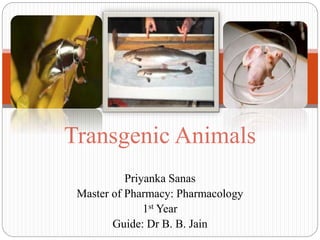
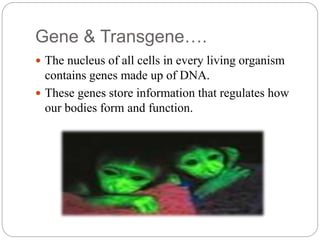
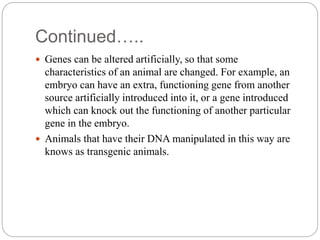
Transgenic Animals
Contents…
 Gene & Transgene
 Concept of Transgenic animals
 Methods of Production
 Examples
 Advantage
 Disadvantage
 Benefits & Applications
 References
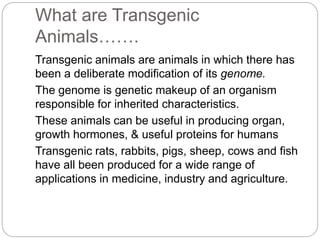
Gene & Transgene….
 The nucleus of all cells in every living organism
contains genes made up of DNA.
 These genes store information that regulates how
our bodies form and function.
Continued…..
 Genes can be altered artificially, so that some
characteristics of an animal are changed. For example, an
embryo can have an extra, functioning gene from another
source artificially introduced into it, or a gene introduced
which can knock out the functioning of another particular
gene in the embryo.
 Animals that have their DNA manipulated in this way are
knows as transgenic animals.
What are Transgenic
Animals…….
Transgenic animals are animals in which there has
been a deliberate modification of its genome.
The genome is genetic makeup of an organism
responsible for inherited characteristics.
These animals can be useful in producing organ,
growth hormones, & useful proteins for humans
Transgenic rats, rabbits, pigs, sheep, cows and fish
have all been produced for a wide range of
applications in medicine, industry and agriculture.
Production of Transgenic animals
To date, following are the basic methods of
producing transgenic animals:
 DNA microinjection
 Retrovirus-mediated gene transfer
 Embryonic stem cell-mediated gene transfer
 Sperm-Mediated Gene Transfer
 Somatic-Cell Nuclear Transfer
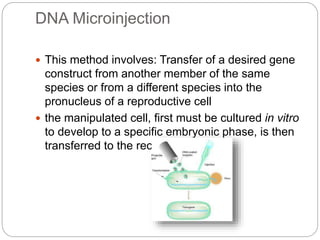
DNA Microinjection
 This method involves: Transfer of a desired gene
construct from another member of the same
species or from a different species into the
pronucleus of a reproductive cell
 the manipulated cell, first must be cultured in vitro
to develop to a specific embryonic phase, is then
transferred to the recipient female
Retrovirus-Mediated Gene
Transfer
 A retrovirus is a virus that carries its genetic
material in the form of RNA rather than DNA.
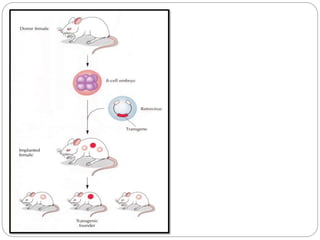
 This method involves: retroviruses used as
vectors to transfer genetic material into the host
cell, resulting in a chimera, an organism
consisting of tissues or parts of diverse genetic
constitution
 chimeras are inbred for as many as 20
generations until homozygous (carrying the
desired transgene in every cell) transgenic
offspring are born.
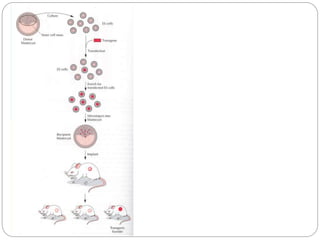
Embryonic Stem Cell-Mediated Gene
Transfer
 The presence of transgenes can be tested at the
embryonic state in this third method.
 This method involves: Isolation of totipotent stem cells
(stem cells that can develop into any type of
specialized cell) from embryos
 Then desired gene is inserted into these cells
 cells containing the desired DNA are incorporated into
the host’s embryo, resulting in a chimeric animal
 Unlike the other two methods, which require live
transgenic offspring to test for the presence of the
desired transgene, this method allows testing for
transgenes at the cell stage.
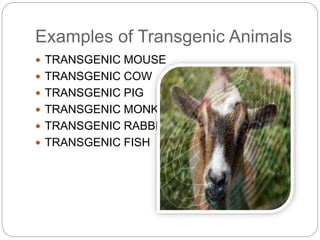
Examples of Transgenic Animals
 TRANSGENIC MOUSE
 TRANSGENIC COW
 TRANSGENIC PIG
 TRANSGENIC MONKEY
 TRANSGENIC RABBIT
 TRANSGENIC FISH
Advantages
• Increased growth rate
• Improved disease resistance.
• Improved food conversion rate.
• Increased muscle mass.
• Improved nutritional value.
• Improved wool quality
Disadvantage
• Inserted gene has multiple functions.
• Breeding problems.
• Sometimes leads to mutagenesis and functional
disorder.
• Low survival rate of transgenic animals.
Benefits of Animals
The benefits of these animals to human welfare can
be grouped into areas:
 Agriculture
 Medicine
 Industry
Applications
 Medical importance
 Disease model
 Bioreactors for pharmaceuticals
 Xenotransplantation
 Agricultural importance
 Disease resistant animals
 For improving quality and quantity of milk, meat, eggs
and wool production
 Industrial importance
 Toxicity sensitive transgenic animals to test chemicals.
 Spider silk in milk of goat
Human gene therapy
Human gene therapy involves adding a normal
copy of a gene (transgene) to the genome of a
person carrying defective copies of the gene. The
potential for treatments for the 5,000 named
genetic diseases is huge and transgenic animals
could play a role.
Disease model
Animals have been modified to exhibit the
symptoms and progression of a particular
disease, so that treatments for that disease can
be tested on them (e.g oncomouse, AIDS mouse
etc)
Nutritional supplements and
pharmaceuticals
Products such as insulin, growth hormone, and
blood anti-clotting factors can be obtained from
the milk of transgenic cows, sheep, or goats.
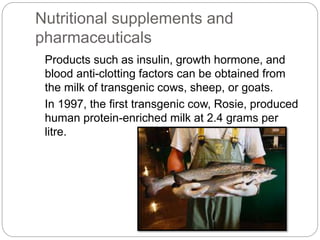
In 1997, the first transgenic cow, Rosie, produced
human protein-enriched milk at 2.4 grams per
litre.
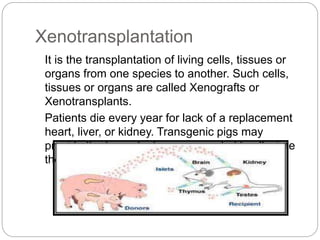
Xenotransplantation
It is the transplantation of living cells, tissues or
organs from one species to another. Such cells,
tissues or organs are called Xenografts or
Xenotransplants.
Patients die every year for lack of a replacement
heart, liver, or kidney. Transgenic pigs may
provide the transplant organs needed to alleviate
the shortfall.
References…
 Satyanarayana U, Biotechnology (2010), 1st
edition, Books and allied (P) Ltd, Kolkata.
 http://dsc.discovery.com/technology/tech-
10/genetic-engineering/10-transgenic-animals-
03.html
 Methods to Generate Transgenic Animals. By
Louis-Marie Houdebine.
http://www.springer.com/978-3-540-85842-3 Pg.:
31-48
 Endang Tri Margawati (January 2003).
“Transgenic Animals: Their Benefits To Human
Welfare” . Action bioscience .
http://www.actionbioscience.org/biotechnology/m
argawati.html
….

Transgenic animals

  • 1.
    Priyanka Sanas Master ofPharmacy: Pharmacology 1st Year Guide: Dr B. B. Jain Transgenic Animals
  • 2.
    Contents…  Gene &Transgene  Concept of Transgenic animals  Methods of Production  Examples  Advantage  Disadvantage  Benefits & Applications  References
  • 3.
    Gene & Transgene…. The nucleus of all cells in every living organism contains genes made up of DNA.  These genes store information that regulates how our bodies form and function.
  • 4.
    Continued…..  Genes canbe altered artificially, so that some characteristics of an animal are changed. For example, an embryo can have an extra, functioning gene from another source artificially introduced into it, or a gene introduced which can knock out the functioning of another particular gene in the embryo.  Animals that have their DNA manipulated in this way are knows as transgenic animals.
  • 5.
    What are Transgenic Animals……. Transgenicanimals are animals in which there has been a deliberate modification of its genome. The genome is genetic makeup of an organism responsible for inherited characteristics. These animals can be useful in producing organ, growth hormones, & useful proteins for humans Transgenic rats, rabbits, pigs, sheep, cows and fish have all been produced for a wide range of applications in medicine, industry and agriculture.
  • 6.
    Production of Transgenicanimals To date, following are the basic methods of producing transgenic animals:  DNA microinjection  Retrovirus-mediated gene transfer  Embryonic stem cell-mediated gene transfer  Sperm-Mediated Gene Transfer  Somatic-Cell Nuclear Transfer
  • 7.
    DNA Microinjection  Thismethod involves: Transfer of a desired gene construct from another member of the same species or from a different species into the pronucleus of a reproductive cell  the manipulated cell, first must be cultured in vitro to develop to a specific embryonic phase, is then transferred to the recipient female
  • 9.
    Retrovirus-Mediated Gene Transfer  Aretrovirus is a virus that carries its genetic material in the form of RNA rather than DNA.  This method involves: retroviruses used as vectors to transfer genetic material into the host cell, resulting in a chimera, an organism consisting of tissues or parts of diverse genetic constitution  chimeras are inbred for as many as 20 generations until homozygous (carrying the desired transgene in every cell) transgenic offspring are born.
  • 11.
    Embryonic Stem Cell-MediatedGene Transfer  The presence of transgenes can be tested at the embryonic state in this third method.  This method involves: Isolation of totipotent stem cells (stem cells that can develop into any type of specialized cell) from embryos  Then desired gene is inserted into these cells  cells containing the desired DNA are incorporated into the host’s embryo, resulting in a chimeric animal  Unlike the other two methods, which require live transgenic offspring to test for the presence of the desired transgene, this method allows testing for transgenes at the cell stage.
  • 13.
    Examples of TransgenicAnimals  TRANSGENIC MOUSE  TRANSGENIC COW  TRANSGENIC PIG  TRANSGENIC MONKEY  TRANSGENIC RABBIT  TRANSGENIC FISH
  • 14.
    Advantages • Increased growthrate • Improved disease resistance. • Improved food conversion rate. • Increased muscle mass. • Improved nutritional value. • Improved wool quality
  • 15.
    Disadvantage • Inserted genehas multiple functions. • Breeding problems. • Sometimes leads to mutagenesis and functional disorder. • Low survival rate of transgenic animals.
  • 16.
    Benefits of Animals Thebenefits of these animals to human welfare can be grouped into areas:  Agriculture  Medicine  Industry
  • 17.
    Applications  Medical importance Disease model  Bioreactors for pharmaceuticals  Xenotransplantation  Agricultural importance  Disease resistant animals  For improving quality and quantity of milk, meat, eggs and wool production  Industrial importance  Toxicity sensitive transgenic animals to test chemicals.  Spider silk in milk of goat
  • 18.
    Human gene therapy Humangene therapy involves adding a normal copy of a gene (transgene) to the genome of a person carrying defective copies of the gene. The potential for treatments for the 5,000 named genetic diseases is huge and transgenic animals could play a role.
  • 19.
    Disease model Animals havebeen modified to exhibit the symptoms and progression of a particular disease, so that treatments for that disease can be tested on them (e.g oncomouse, AIDS mouse etc)
  • 20.
    Nutritional supplements and pharmaceuticals Productssuch as insulin, growth hormone, and blood anti-clotting factors can be obtained from the milk of transgenic cows, sheep, or goats. In 1997, the first transgenic cow, Rosie, produced human protein-enriched milk at 2.4 grams per litre.
  • 21.
    Xenotransplantation It is thetransplantation of living cells, tissues or organs from one species to another. Such cells, tissues or organs are called Xenografts or Xenotransplants. Patients die every year for lack of a replacement heart, liver, or kidney. Transgenic pigs may provide the transplant organs needed to alleviate the shortfall.
  • 22.
    References…  Satyanarayana U,Biotechnology (2010), 1st edition, Books and allied (P) Ltd, Kolkata.  http://dsc.discovery.com/technology/tech- 10/genetic-engineering/10-transgenic-animals- 03.html  Methods to Generate Transgenic Animals. By Louis-Marie Houdebine. http://www.springer.com/978-3-540-85842-3 Pg.: 31-48  Endang Tri Margawati (January 2003). “Transgenic Animals: Their Benefits To Human Welfare” . Action bioscience . http://www.actionbioscience.org/biotechnology/m argawati.html
  • 23.