ELECTRO-SURGERY SAFET Y
AND MANAGEMENT
Y A N A M A L A V I J A Y R A J
M T E C H I N C L I N I C A L E N G
I I T M A D R A S & C M C V E L L O R E & S C T I M S T
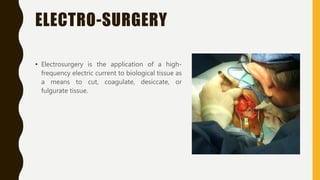
ELECTRO-SURGERY
• Electrosurgery is the application of a high-
frequency electric current to biological tissue as
a means to cut, coagulate, desiccate, or
fulgurate tissue.
PRINCIPLE
• Having an understanding of the principles of electricity is a strong foundation for best
practices in electro surgical patient care.
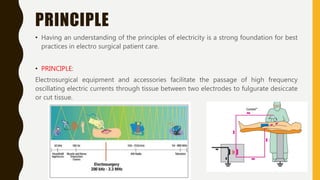
• PRINCIPLE:
Electrosurgical equipment and accessories facilitate the passage of high frequency
oscillating electric currents through tissue between two electrodes to fulgurate desiccate
or cut tissue.
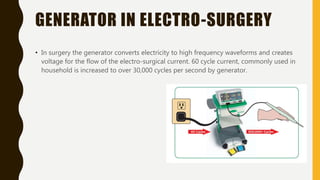
GENERATOR IN ELECTRO-SURGERY
• In surgery the generator converts electricity to high frequency waveforms and creates
voltage for the flow of the electro-surgical current. 60 cycle current, commonly used in
household is increased to over 30,000 cycles per second by generator.
PURPOSE OF GENERATOR
• Pulsating electrical current e.g. d.c. pulses or low-frequency currents (including mains
supply
frequencies) have a stimulating effect on nerve and muscle cells.
• With high frequency alternating currents (> 200 kHz), the physiological system can no
longer follow the stimulation impulse. An insensitivity to stimulus develops.
As a result, HF electrosurgical instruments are operated at a base frequency of > 300
kHz.
REGULATING THE THERMAL EFFECT
Regulating the thermal effect through:
1. Current and output power
2. Modulation level
3. Shape of electrode
4. Condition of active electrode
5. Cutting speed and duration of action
6. Tissue properties
MODULATION LEVEL
• This is understood to mean the wave form of the high frequency current produced by
a particular generator design and instrument setting.
• There is a number of different designs on the market resulting from the difference in
the specific data gathered by the various companies.
• The modulation level can for example be a parameter for the aggressiveness of an
electrical
incision, but it can also be for the depth of penetration in a coagulation procedure.
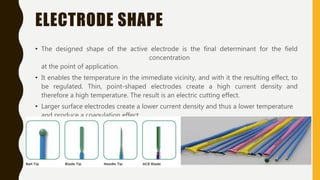
ELECTRODE SHAPE
• The designed shape of the active electrode is the final determinant for the field
concentration
at the point of application.
• It enables the temperature in the immediate vicinity, and with it the resulting effect, to
be regulated. Thin, point-shaped electrodes create a high current density and
therefore a high temperature. The result is an electric cutting effect.
• Larger surface electrodes create a lower current density and thus a lower temperature
and produce a coagulation effect.
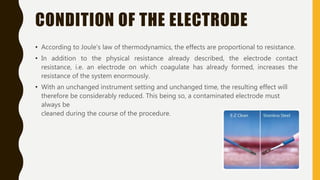
CONDITION OF THE ELECTRODE
• According to Joule's law of thermodynamics, the effects are proportional to resistance.
• In addition to the physical resistance already described, the electrode contact
resistance, i.e. an electrode on which coagulate has already formed, increases the
resistance of the system enormously.
• With an unchanged instrument setting and unchanged time, the resulting effect will
therefore be considerably reduced. This being so, a contaminated electrode must
always be
cleaned during the course of the procedure.
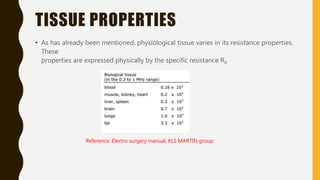
TISSUE PROPERTIES
• As has already been mentioned, physiological tissue varies in its resistance properties.
These
properties are expressed physically by the specific resistance R0
Reference: Electro surgery manual, KLS MARTIN group
EFFECTS OF CURRENT
• Temperatures above 45°C cause a breakdown in the structure of living tissue and
disruption of
the function of protein molecules. The process is referred to as denaturation. The origin is
a
thermal effect.
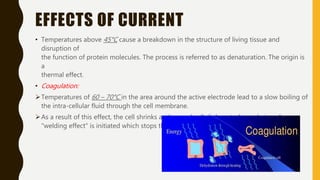
• Coagulation:
Temperatures of 60 – 70°C in the area around the active electrode lead to a slow boiling of
the intra-cellular fluid through the cell membrane.
As a result of this effect, the cell shrinks and several cells link up to form chains. A
"welding effect" is initiated which stops the bleeding.
EFFECTS OF CURRENT
• Electrotomy:
Temperatures of above 100°C in the region around the active electrode lead to the
rapid
evaporation of the fluid within the cell membrane.
As a result, the cell membrane ruptures forming vapor around the electrode which in
turn involves other cells lying in the path of the electrode as it moves.
Electrotomy thus cannot be compared to a mechanical cutting process.
• Mixed currents
The basic effects of coagulation and electrotomy can now be combined into so-called
mixed
currents, that have different characteristics.
The instrument thus provides such facilities as reduced haemorrhage incision, or
cutting with intense scab formation.
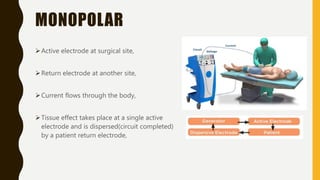
MONOPOLAR
Active electrode at surgical site,
Return electrode at another site,
Current flows through the body,
Tissue effect takes place at a single active
electrode and is dispersed(circuit completed)
by a patient return electrode,
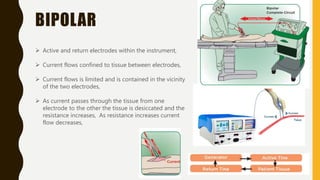
BIPOLAR
 Active and return electrodes within the instrument,
 Current flows confined to tissue between electrodes,
 Current flows is limited and is contained in the vicinity
of the two electrodes,
 As current passes through the tissue from one
electrode to the other the tissue is desiccated and the
resistance increases, As resistance increases current
flow decreases,
ELECTROSURGICAL GENERATORS
•Ground referenced generators (typically older outdated units)
• Isolated generators (today’s state of art technology)
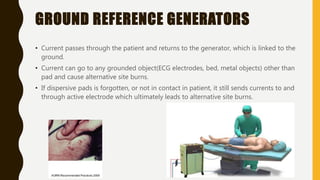
GROUND REFERENCE GENERATORS
• Current passes through the patient and returns to the generator, which is linked to the
ground.
• Current can go to any grounded object(ECG electrodes, bed, metal objects) other than
pad and cause alternative site burns.
• If dispersive pads is forgotten, or not in contact in patient, it still sends currents to and
through active electrode which ultimately leads to alternative site burns.
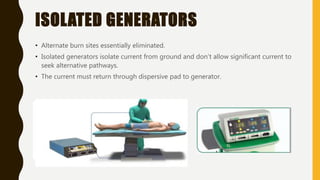
ISOLATED GENERATORS
• Alternate burn sites essentially eliminated.
• Isolated generators isolate current from ground and don’t allow significant current to
seek alternative pathways.
• The current must return through dispersive pad to generator.
ISOLATED GENERATORS LIMITATIONS
• If only a small portion of patient sticky return pad is in contact, or if conductivity of pad
is hampered, pad site burn can occur.
• This limitation lead to development and incorporation of RECQM system for sticky
pads and Megasoft technology.
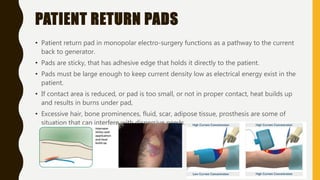
PATIENT RETURN PADS
• Patient return pad in monopolar electro-surgery functions as a pathway to the current
back to generator.
• Pads are sticky, that has adhesive edge that holds it directly to the patient.
• Pads must be large enough to keep current density low as electrical energy exist in the
patient.
• If contact area is reduced, or pad is too small, or not in proper contact, heat builds up
and results in burns under pad,
• Excessive hair, bone prominences, fluid, scar, adipose tissue, prosthesis are some of
situation that can interfere with dispersive needs.
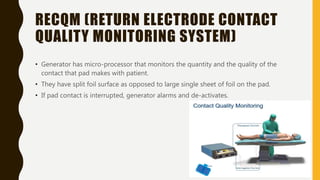
RECQM (RETURN ELECTRODE CONTACT
QUALITY MONITORING SYSTEM)
• Generator has micro-processor that monitors the quantity and the quality of the
contact that pad makes with patient.
• They have split foil surface as opposed to large single sheet of foil on the pad.
• If pad contact is interrupted, generator alarms and de-activates.
RISKS ASSOCIATED WITH ELECTR0-
SURGERY
Technical deficiency
Unwanted high frequency burning
Incorrect operation
Defective accessories
Ignition of flammable fluids and gases
Risks from improper combination with other equipment
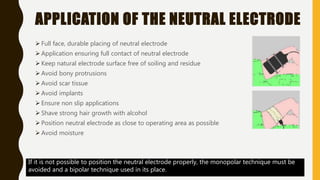
APPLICATION OF THE NEUTRAL ELECTRODE
 Full face, durable placing of neutral electrode
 Application ensuring full contact of neutral electrode
 Keep natural electrode surface free of soiling and residue
 Avoid bony protrusions
 Avoid scar tissue
 Avoid implants
 Ensure non slip applications
 Shave strong hair growth with alcohol
 Position neutral electrode as close to operating area as possible
 Avoid moisture
If it is not possible to position the neutral electrode properly, the monopolar technique must be
avoided and a bipolar technique used in its place.
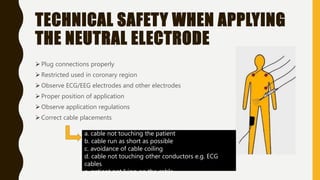
TECHNICAL SAFETY WHEN APPLYING
THE NEUTRAL ELECTRODE
 Plug connections properly
 Restricted used in coronary region
 Observe ECG/EEG electrodes and other electrodes
 Proper position of application
 Observe application regulations
 Correct cable placements
a. cable not touching the patient
b. cable run as short as possible
c. avoidance of cable coiling
d. cable not touching other conductors e.g. ECG
cables
e. patient not lying on the cable
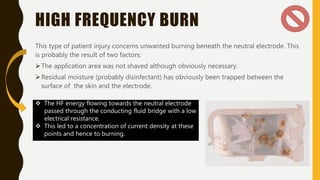
HIGH FREQUENCY BURN
This type of patient injury concerns unwanted burning beneath the neutral electrode. This
is probably the result of two factors:
The application area was not shaved although obviously necessary.
Residual moisture (probably disinfectant) has obviously been trapped between the
surface of the skin and the electrode.
 The HF energy flowing towards the neutral electrode
passed through the conducting fluid bridge with a low
electrical resistance.
 This led to a concentration of current density at these
points and hence to burning.
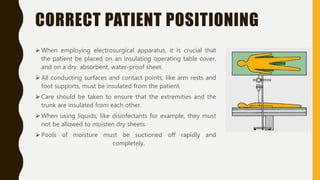
CORRECT PATIENT POSITIONING
 When employing electrosurgical apparatus, it is crucial that
the patient be placed on an insulating operating table cover,
and on a dry, absorbent, water-proof sheet.
 All conducting surfaces and contact points, like arm rests and
foot supports, must be insulated from the patient.
 Care should be taken to ensure that the extremities and the
trunk are insulated from each other.
 When using liquids, like disinfectants for example, they must
not be allowed to moisten dry sheets.
 Pools of moisture must be suctioned off rapidly and
completely.
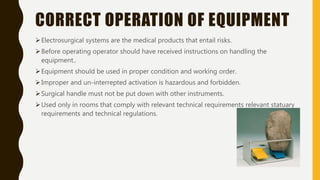
CORRECT OPERATION OF EQUIPMENT
Electrosurgical systems are the medical products that entail risks.
Before operating operator should have received instructions on handling the
equipment..
Equipment should be used in proper condition and working order.
Improper and un-interrepted activation is hazardous and forbidden.
Surgical handle must not be put down with other instruments.
Used only in rooms that comply with relevant technical requirements relevant statuary
requirements and technical regulations.
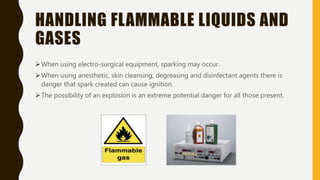
HANDLING FLAMMABLE LIQUIDS AND
GASES
When using electro-surgical equipment, sparking may occur.
When using anesthetic, skin cleansing, degreasing and disinfectant agents there is
danger that spark created can cause ignition.
The possibility of an explosion is an extreme potential danger for all those present.
UNINTENDED BURNS BY ACTIVE
ELECTRODE
Unintended burns are the least understood and most dangerous
hazards in
surgery.
A patient may be burned in three ways:
Insulation failure
Unintended burns at the active electrode site (direct coupling),
Unintended burns at an alternate site (capacitive coupling).
DIRECT COUPLING
• It occurs when active electrode touches another metal.
• Electric current flows active electrode to another metal and leads to un-intended burns
in tissues.
• Best way to avoid this risk is to refrain from activating active electrode until the
intended tissue is in field of vision and the electrode is in direct contact with tissue and
not in contact with any other metal object.
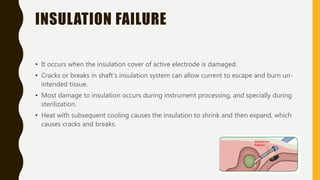
INSULATION FAILURE
• It occurs when the insulation cover of active electrode is damaged.
• Cracks or breaks in shaft’s insulation system can allow current to escape and burn un-
intended tissue.
• Most damage to insulation occurs during instrument processing, and specially during
sterilization.
• Heat with subsequent cooling causes the insulation to shrink and then expand, which
causes cracks and breaks.
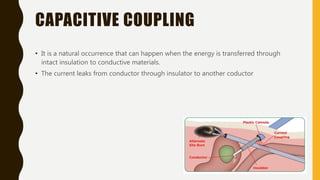
CAPACITIVE COUPLING
• It is a natural occurrence that can happen when the energy is transferred through
intact insulation to conductive materials.
• The current leaks from conductor through insulator to another coductor
STANDARDS OF PRACTICE FOR USE
OF ELECTROSURGERY
• AST
• IEC 60601-2-2
• AORN

Electrosurgery

  • 1.
    ELECTRO-SURGERY SAFET Y ANDMANAGEMENT Y A N A M A L A V I J A Y R A J M T E C H I N C L I N I C A L E N G I I T M A D R A S & C M C V E L L O R E & S C T I M S T
  • 2.
    ELECTRO-SURGERY • Electrosurgery isthe application of a high- frequency electric current to biological tissue as a means to cut, coagulate, desiccate, or fulgurate tissue.
  • 3.
    PRINCIPLE • Having anunderstanding of the principles of electricity is a strong foundation for best practices in electro surgical patient care. • PRINCIPLE: Electrosurgical equipment and accessories facilitate the passage of high frequency oscillating electric currents through tissue between two electrodes to fulgurate desiccate or cut tissue.
  • 4.
    GENERATOR IN ELECTRO-SURGERY •In surgery the generator converts electricity to high frequency waveforms and creates voltage for the flow of the electro-surgical current. 60 cycle current, commonly used in household is increased to over 30,000 cycles per second by generator.
  • 5.
    PURPOSE OF GENERATOR •Pulsating electrical current e.g. d.c. pulses or low-frequency currents (including mains supply frequencies) have a stimulating effect on nerve and muscle cells. • With high frequency alternating currents (> 200 kHz), the physiological system can no longer follow the stimulation impulse. An insensitivity to stimulus develops. As a result, HF electrosurgical instruments are operated at a base frequency of > 300 kHz.
  • 6.
    REGULATING THE THERMALEFFECT Regulating the thermal effect through: 1. Current and output power 2. Modulation level 3. Shape of electrode 4. Condition of active electrode 5. Cutting speed and duration of action 6. Tissue properties
  • 7.
    MODULATION LEVEL • Thisis understood to mean the wave form of the high frequency current produced by a particular generator design and instrument setting. • There is a number of different designs on the market resulting from the difference in the specific data gathered by the various companies. • The modulation level can for example be a parameter for the aggressiveness of an electrical incision, but it can also be for the depth of penetration in a coagulation procedure.
  • 8.
    ELECTRODE SHAPE • Thedesigned shape of the active electrode is the final determinant for the field concentration at the point of application. • It enables the temperature in the immediate vicinity, and with it the resulting effect, to be regulated. Thin, point-shaped electrodes create a high current density and therefore a high temperature. The result is an electric cutting effect. • Larger surface electrodes create a lower current density and thus a lower temperature and produce a coagulation effect.
  • 9.
    CONDITION OF THEELECTRODE • According to Joule's law of thermodynamics, the effects are proportional to resistance. • In addition to the physical resistance already described, the electrode contact resistance, i.e. an electrode on which coagulate has already formed, increases the resistance of the system enormously. • With an unchanged instrument setting and unchanged time, the resulting effect will therefore be considerably reduced. This being so, a contaminated electrode must always be cleaned during the course of the procedure.
  • 10.
    TISSUE PROPERTIES • Ashas already been mentioned, physiological tissue varies in its resistance properties. These properties are expressed physically by the specific resistance R0 Reference: Electro surgery manual, KLS MARTIN group
  • 11.
    EFFECTS OF CURRENT •Temperatures above 45°C cause a breakdown in the structure of living tissue and disruption of the function of protein molecules. The process is referred to as denaturation. The origin is a thermal effect. • Coagulation: Temperatures of 60 – 70°C in the area around the active electrode lead to a slow boiling of the intra-cellular fluid through the cell membrane. As a result of this effect, the cell shrinks and several cells link up to form chains. A "welding effect" is initiated which stops the bleeding.
  • 12.
    EFFECTS OF CURRENT •Electrotomy: Temperatures of above 100°C in the region around the active electrode lead to the rapid evaporation of the fluid within the cell membrane. As a result, the cell membrane ruptures forming vapor around the electrode which in turn involves other cells lying in the path of the electrode as it moves. Electrotomy thus cannot be compared to a mechanical cutting process.
  • 13.
    • Mixed currents Thebasic effects of coagulation and electrotomy can now be combined into so-called mixed currents, that have different characteristics. The instrument thus provides such facilities as reduced haemorrhage incision, or cutting with intense scab formation.
  • 14.
    MONOPOLAR Active electrode atsurgical site, Return electrode at another site, Current flows through the body, Tissue effect takes place at a single active electrode and is dispersed(circuit completed) by a patient return electrode,
  • 15.
    BIPOLAR  Active andreturn electrodes within the instrument,  Current flows confined to tissue between electrodes,  Current flows is limited and is contained in the vicinity of the two electrodes,  As current passes through the tissue from one electrode to the other the tissue is desiccated and the resistance increases, As resistance increases current flow decreases,
  • 16.
    ELECTROSURGICAL GENERATORS •Ground referencedgenerators (typically older outdated units) • Isolated generators (today’s state of art technology)
  • 17.
    GROUND REFERENCE GENERATORS •Current passes through the patient and returns to the generator, which is linked to the ground. • Current can go to any grounded object(ECG electrodes, bed, metal objects) other than pad and cause alternative site burns. • If dispersive pads is forgotten, or not in contact in patient, it still sends currents to and through active electrode which ultimately leads to alternative site burns.
  • 18.
    ISOLATED GENERATORS • Alternateburn sites essentially eliminated. • Isolated generators isolate current from ground and don’t allow significant current to seek alternative pathways. • The current must return through dispersive pad to generator.
  • 19.
    ISOLATED GENERATORS LIMITATIONS •If only a small portion of patient sticky return pad is in contact, or if conductivity of pad is hampered, pad site burn can occur. • This limitation lead to development and incorporation of RECQM system for sticky pads and Megasoft technology.
  • 20.
    PATIENT RETURN PADS •Patient return pad in monopolar electro-surgery functions as a pathway to the current back to generator. • Pads are sticky, that has adhesive edge that holds it directly to the patient. • Pads must be large enough to keep current density low as electrical energy exist in the patient. • If contact area is reduced, or pad is too small, or not in proper contact, heat builds up and results in burns under pad, • Excessive hair, bone prominences, fluid, scar, adipose tissue, prosthesis are some of situation that can interfere with dispersive needs.
  • 21.
    RECQM (RETURN ELECTRODECONTACT QUALITY MONITORING SYSTEM) • Generator has micro-processor that monitors the quantity and the quality of the contact that pad makes with patient. • They have split foil surface as opposed to large single sheet of foil on the pad. • If pad contact is interrupted, generator alarms and de-activates.
  • 22.
    RISKS ASSOCIATED WITHELECTR0- SURGERY Technical deficiency Unwanted high frequency burning Incorrect operation Defective accessories Ignition of flammable fluids and gases Risks from improper combination with other equipment
  • 23.
    APPLICATION OF THENEUTRAL ELECTRODE  Full face, durable placing of neutral electrode  Application ensuring full contact of neutral electrode  Keep natural electrode surface free of soiling and residue  Avoid bony protrusions  Avoid scar tissue  Avoid implants  Ensure non slip applications  Shave strong hair growth with alcohol  Position neutral electrode as close to operating area as possible  Avoid moisture If it is not possible to position the neutral electrode properly, the monopolar technique must be avoided and a bipolar technique used in its place.
  • 24.
    TECHNICAL SAFETY WHENAPPLYING THE NEUTRAL ELECTRODE  Plug connections properly  Restricted used in coronary region  Observe ECG/EEG electrodes and other electrodes  Proper position of application  Observe application regulations  Correct cable placements a. cable not touching the patient b. cable run as short as possible c. avoidance of cable coiling d. cable not touching other conductors e.g. ECG cables e. patient not lying on the cable
  • 25.
    HIGH FREQUENCY BURN Thistype of patient injury concerns unwanted burning beneath the neutral electrode. This is probably the result of two factors: The application area was not shaved although obviously necessary. Residual moisture (probably disinfectant) has obviously been trapped between the surface of the skin and the electrode.  The HF energy flowing towards the neutral electrode passed through the conducting fluid bridge with a low electrical resistance.  This led to a concentration of current density at these points and hence to burning.
  • 26.
    CORRECT PATIENT POSITIONING When employing electrosurgical apparatus, it is crucial that the patient be placed on an insulating operating table cover, and on a dry, absorbent, water-proof sheet.  All conducting surfaces and contact points, like arm rests and foot supports, must be insulated from the patient.  Care should be taken to ensure that the extremities and the trunk are insulated from each other.  When using liquids, like disinfectants for example, they must not be allowed to moisten dry sheets.  Pools of moisture must be suctioned off rapidly and completely.
  • 27.
    CORRECT OPERATION OFEQUIPMENT Electrosurgical systems are the medical products that entail risks. Before operating operator should have received instructions on handling the equipment.. Equipment should be used in proper condition and working order. Improper and un-interrepted activation is hazardous and forbidden. Surgical handle must not be put down with other instruments. Used only in rooms that comply with relevant technical requirements relevant statuary requirements and technical regulations.
  • 28.
    HANDLING FLAMMABLE LIQUIDSAND GASES When using electro-surgical equipment, sparking may occur. When using anesthetic, skin cleansing, degreasing and disinfectant agents there is danger that spark created can cause ignition. The possibility of an explosion is an extreme potential danger for all those present.
  • 29.
    UNINTENDED BURNS BYACTIVE ELECTRODE Unintended burns are the least understood and most dangerous hazards in surgery. A patient may be burned in three ways: Insulation failure Unintended burns at the active electrode site (direct coupling), Unintended burns at an alternate site (capacitive coupling).
  • 30.
    DIRECT COUPLING • Itoccurs when active electrode touches another metal. • Electric current flows active electrode to another metal and leads to un-intended burns in tissues. • Best way to avoid this risk is to refrain from activating active electrode until the intended tissue is in field of vision and the electrode is in direct contact with tissue and not in contact with any other metal object.
  • 31.
    INSULATION FAILURE • Itoccurs when the insulation cover of active electrode is damaged. • Cracks or breaks in shaft’s insulation system can allow current to escape and burn un- intended tissue. • Most damage to insulation occurs during instrument processing, and specially during sterilization. • Heat with subsequent cooling causes the insulation to shrink and then expand, which causes cracks and breaks.
  • 32.
    CAPACITIVE COUPLING • Itis a natural occurrence that can happen when the energy is transferred through intact insulation to conductive materials. • The current leaks from conductor through insulator to another coductor
  • 33.
    STANDARDS OF PRACTICEFOR USE OF ELECTROSURGERY • AST • IEC 60601-2-2 • AORN