GENE REPLACEMENT & TRANSGENIC ANIMALS
WELLCOME TO MY PRESENTATION
Presented By:
Arif Uddin
ID:22215008
Department of Pharmacy
Comilla University
2
CLONING
OUTLINE
• DEFINITION
• TYPES OF CLONING
• HUMAN CLONING
• ANIMAL CLONING
• ADVANTAGES AND
DISADVANTAGES
• RISKS
• APPLICATIONS
GENE KNOCKOUT ANIMAL MODELS
OUTLINE
• DEFINITION
• MODEL ORGANISIMS
• KNOCKOUT MICE
• USES
• TRANSGENIC VS.
KNOCKOUTTRANSGENIC VS.
KNOCKOUT
• PRODUCTION OF KNOCKOUT
MICE
• SOME EXPERIMENT RESULTS..
• APPLICATIONS
• LIMITATIONS
Cloning
4
DEFINITION
“It is the process of making a clone , a genetically
identical copy of an organism by replacing the nucleus
of an unfertilized ovum with the nucleus of a body cell
from the organism”.
5
HOW CLONING DIFFERS FROM NATURAL
PRODUCTION
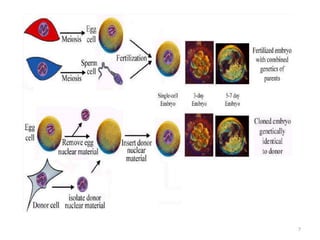
• Humans and most organisms result from
sexual production. The female egg is fertilized
by the male sperm and an embryo is formed.
• The embryo’s genetic structure is located in
the chromosomes found in the nucleus of
every embryonic cell.
• The new organism obtains one half of its
genes from the mother’s egg and the other
half from the father’s sperm.
6
BUT IN CLONIG……….
• The egg nucleus is removed through a
microscopic laboratory procedure and
replaced with a donor’s nucleus, containing
the unique genes of that individual.
• The egg which grows into an embryo , contains
only the donor’s genes. The cloned organism is
a near genetic copy of its “sole” parent rather
than a random genetic combination of two
parents.

7
8
TYPES OF CLONING
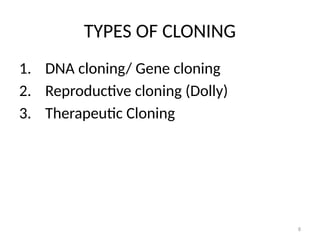
1. DNA cloning/ Gene cloning
2. Reproductive cloning (Dolly)
3. Therapeutic Cloning
9
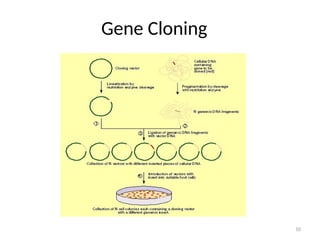
DNA/GENE CLONING
• Practiced since 1970
• A term used to describe a collection of DNA
fragments derived from the genome of an organism
and cloned randomly into suitable cloning vectors
(plasmids, phages).
• The term genomic DNA clone or chromosomal DNA
clone then refers to an individual cell carrying a
cloning vector with one of the cellular DNA
fragments or to a phage isolate with a specific DNA
insert.
10
Gene Cloning
11
Reproductive cloning
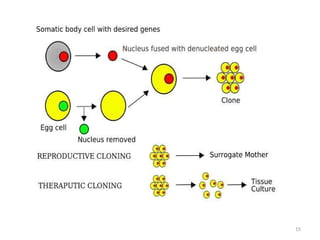
• Reproductive cloning is the production of a genetic
duplicate of an existing organism. A human clone would be
a genetic copy of an existing person.
• Some oppose reproductive cloning because of safety
considerations. Animal cloning is seldom successful, and
many scientists believe that reproductive cloning can never
be made safe. Human reproductive cloning would also
threaten the psychological well-being of cloned children,
open the door to more powerful genetic manipulation
technologies, and raise other social and ethical concerns.
12
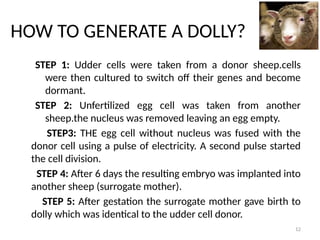
HOW TO GENERATE A DOLLY?
STEP 1: Udder cells were taken from a donor sheep.cells
were then cultured to switch off their genes and become
dormant.
STEP 2: Unfertilized egg cell was taken from another
sheep.the nucleus was removed leaving an egg empty.
STEP3: THE egg cell without nucleus was fused with the
donor cell using a pulse of electricity. A second pulse started
the cell division.
STEP 4: After 6 days the resulting embryo was implanted into
another sheep (surrogate mother).
STEP 5: After gestation the surrogate mother gave birth to
dolly which was identical to the udder cell donor.
13
Reproductive cloning
Benefits
• Maintain good DNA in
animal reproduction.
• Cloning geneticallya
modified animals: -
Xenotransplantation (avoid
tissue rejection) - Insulin
producers
Risk
• Highly inefficient: - Die
mysteriously - High costs
• Morally wrong to
experiment with animals.
• Could lead to the cloning of
humans
14
Therapeutic Cloning
Benefits
• Produce whole organs from
cloned stem cells.
• Produce healthy cells for
transplantation.
• Reduce need for organ
donors
• Test drugs, understand
diseases
Risk
• Killing embryos
in the process
Which creates embryonic Stem Cells. Researchers hope to use
theses cells to grow healthy tissue to replace injured or diseased
tissues in the human body.
15
16
Human Cloning
• The concept of human cloning welcomes the
prospect of making this world a place where
the disorders of a human like the diseases or
the genetic disorders diseases can be
removed.
17
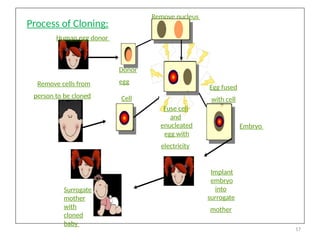
Process of Cloning:
Donor
egg
Remove nucleus
Remove cells from
person to be cloned
Human egg donor
Surrogate
mother
with
cloned
baby
Implant
embryo
into
surrogate
mother
Embryo
Cell
Egg fused
with cell
Fuse cell
and
enucleated
egg with
electricity
18
Animal Cloning
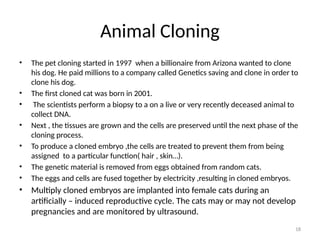
• The pet cloning started in 1997 when a billionaire from Arizona wanted to clone
his dog. He paid millions to a company called Genetics saving and clone in order to
clone his dog.
• The first cloned cat was born in 2001.
• The scientists perform a biopsy to a on a live or very recently deceased animal to
collect DNA.
• Next , the tissues are grown and the cells are preserved until the next phase of the
cloning process.
• To produce a cloned embryo ,the cells are treated to prevent them from being
assigned to a particular function( hair , skin…).
• The genetic material is removed from eggs obtained from random cats.
• The eggs and cells are fused together by electricity ,resulting in cloned embryos.
• Multiply cloned embryos are implanted into female cats during an
artificially – induced reproductive cycle. The cats may or may not develop
pregnancies and are monitored by ultrasound.
19
Advantages vs Disadvantages
Advantages
 There will be an endless
supply of animals to clone,
and we will never run out of
food from animals, because
we have been able to clone
based on previous efforts, the
most famous of these was the
first ever cloning of an animal,
Dolly the lamb which was a
successful cloning where Dolly
was a healthy lamb.
Disadvantages
 Many believe cloning is
quite inhumane, especially
that of religious and some
governmental parties which
don’t want to move forward
with this research. They
think life is just too precious
to take away, even if it is a
clone in which we are
testing.
20
What are the risks of cloning?
• Expensive and highly inefficient.
• More than 90% of cloning attempts fail to produce a viable offspring.
• In addition to low success rates, cloned animals tend to have more
compromised immune function and higher rates of infection, tumour
growth, and other disorders.
• Many cloned animals have not lived long enough to generate good data
about how clones age.
• Appearing healthy at a young age unfortunately is not a good indicator of
long term survival.
• Clones have been known to die mysteriously. For example, Australia's first
cloned sheep appeared healthy and energetic on the day she died, and
the results of her autopsy failed to determine a cause of death.
21
APPLICATION
Biomedical research
• Animals as drug producers
• Animal models
• Breeding androgenic body tissue
• Xenotransplantation
Livestock breeding and agriculture
• Transgenic clones
• Changes to agricultural structures
According to FDA Meat and milk from cow, pig, and goat clones, and the
offspring of any clones, are as safe as food we eat every day.
The main use of clones is to produce breeding stock, not food.
Gene Knockout animal models
23
Gene Knockout
• A gene knockout is a genetically engineered organism that
carries one or more genes in its chromosomes that have been
made inoperative.
• They are used in learning about a gene that has been
sequenced, but which has an unknown or incompletely known
function.
• The gene knock out technology allowed researchers to study
loss-of-function mutations wherein one can infer a gene's
function by observing what happens when the gene is absent or
when mutant copy of the gene is expressed instead of the
normal one.
24
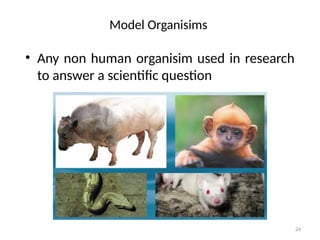
Model Organisims
• Any non human organisim used in research
to answer a scientific question
25
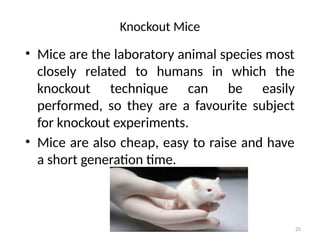
Knockout Mice
• Mice are the laboratory animal species most
closely related to humans in which the
knockout technique can be easily
performed, so they are a favourite subject
for knockout experiments.
• Mice are also cheap, easy to raise and have
a short generation time.
26
Uses
• Knocking out the activity of a gene provides valuable
information about what that gene normally does.
• Humans share many genes with mice. Consequently, observing
the characteristics of knockout mice gives researchers
information that can be used to better understand how a
similar gene may cause or contribute to disease in humans.
• Examples of research in which knockout mice have been useful
include studying and modelling different kinds of cancer,
obesity, heart disease, diabetes, arthritis, substance abuse,
anxiety, aging and Parkinson disease.
27
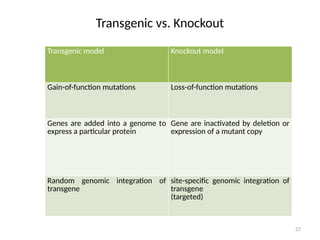
Transgenic vs. Knockout
Transgenic model Knockout model
Gain-of-function mutations Loss-of-function mutations
Genes are added into a genome to
express a particular protein
Gene are inactivated by deletion or
expression of a mutant copy
Random genomic integration of
transgene
site-specific genomic integration of
transgene
(targeted)
28
Production of knockout mice
Depending upon method of insertion of
artificial DNA into the chromosome of ES cells,
there are 2 methods to produce knockout
mouse in vitro:
o Gene Targeting (Homologous Recombination)
o Gene Trapping
29
Production of knockout mice (by Gene Targeting)
1. Harvesting of Embryonic stem cells from a mouse blastocyst.
2. Introducing the artificial DNA into the ES cells in the culture.
3. Screen ES cells and select those whose DNA includes the new gene.
Positive selection
It involves the isolation of a target cell population by using an antibody that specifically binds that
population.
Positive selection markers are used to enrich for recombination events
Eg. Encoding Antibiotic resistance gene Neomycin
Negative selection
It involves the depletion of all cell types except your cell type of interest.
Negative selection markers used to enrich for homologous recombination events over random insertions
Eg. Use of Herpes Simplex Virus (HSV) Thymidine Kinase (TK) gene
coupled with gancyclovir treatment.
4. Implant selected cells into normal mouse
5.embryos, making "chimeras“
Implant chimeric embryos in pseudopregnant females.
6. Females give birth to chimeric offspring, which are subsequently bred
to verify transmission of the new gene, producing a mutant mouse line.
30
Some experiment results..
 Knocking out p53 gene
• p53, a tumour suppressor gene is deleted or mutated in half
of human cancers.
• p53 knockout mice developed normally but developed a
variety of cancers including lymphomas when they grew old.
• Thus, the knock out model provided the ultimate proof that
p53 is indeed a tumour suppressor.
31
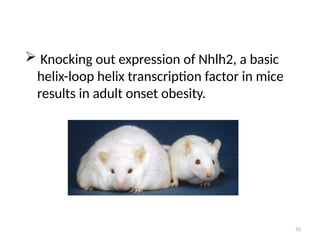
 Knocking out expression of Nhlh2, a basic
helix-loop helix transcription factor in mice
results in adult onset obesity.
32
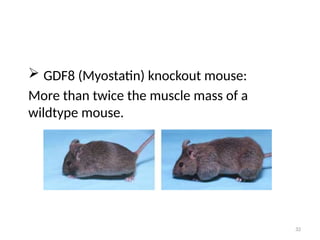
 GDF8 (Myostatin) knockout mouse:
More than twice the muscle mass of a
wildtype mouse.
33
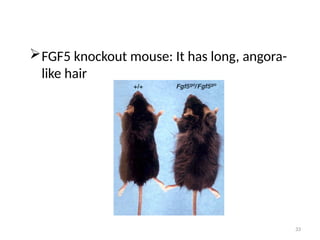
FGF5 knockout mouse: It has long, angora-
like hair
34
• The gene knockout models revealed that cells need more than
one mutant gene to become cancerous.
• For example when you knock out p53, it takes many months
for cancer to arise.
• Similarly, mice engineered to express a mutant Rb gene
indeed developed tumors, but not the ones researchers were
expecting.
• Thus, cells need more genetic alterations than just one.
35
Applications
• To determine the function of gene products.
• To create mouse model of human genetic diseases.
• To characterize genetic regulatory regions.
• To establish link between mutant phenotypes &
particular transcriptional units.
36
Limitations
• About 15 percent of gene knockouts are developmentally
lethal, which means that the genetically altered embryos
cannot grow into adult mice.
• In some instances, the gene may serve a different
function in adults than in developing embryos.
• Knocking out a gene also may fail to produce an
observable change in a mouse or may even produce
different characteristics from those observed in humans
in which the same gene is inactivated
37
References
• www.fda.org
• www.biotecnika.org
• www.genome.gov
• www.library.thinkquest.org
• www.metrolic.com
• www.bioethics.georgetown.org
• www.nms.com
Gene replacement, gene knockingout and its appl9cation

Gene replacement, gene knockingout and its appl9cation

  • 1.
    GENE REPLACEMENT &TRANSGENIC ANIMALS WELLCOME TO MY PRESENTATION Presented By: Arif Uddin ID:22215008 Department of Pharmacy Comilla University
  • 2.
    2 CLONING OUTLINE • DEFINITION • TYPESOF CLONING • HUMAN CLONING • ANIMAL CLONING • ADVANTAGES AND DISADVANTAGES • RISKS • APPLICATIONS GENE KNOCKOUT ANIMAL MODELS OUTLINE • DEFINITION • MODEL ORGANISIMS • KNOCKOUT MICE • USES • TRANSGENIC VS. KNOCKOUTTRANSGENIC VS. KNOCKOUT • PRODUCTION OF KNOCKOUT MICE • SOME EXPERIMENT RESULTS.. • APPLICATIONS • LIMITATIONS
  • 3.
  • 4.
    4 DEFINITION “It is theprocess of making a clone , a genetically identical copy of an organism by replacing the nucleus of an unfertilized ovum with the nucleus of a body cell from the organism”.
  • 5.
    5 HOW CLONING DIFFERSFROM NATURAL PRODUCTION • Humans and most organisms result from sexual production. The female egg is fertilized by the male sperm and an embryo is formed. • The embryo’s genetic structure is located in the chromosomes found in the nucleus of every embryonic cell. • The new organism obtains one half of its genes from the mother’s egg and the other half from the father’s sperm.
  • 6.
    6 BUT IN CLONIG………. •The egg nucleus is removed through a microscopic laboratory procedure and replaced with a donor’s nucleus, containing the unique genes of that individual. • The egg which grows into an embryo , contains only the donor’s genes. The cloned organism is a near genetic copy of its “sole” parent rather than a random genetic combination of two parents.
  • 7.
  • 8.
    8 TYPES OF CLONING 1.DNA cloning/ Gene cloning 2. Reproductive cloning (Dolly) 3. Therapeutic Cloning
  • 9.
    9 DNA/GENE CLONING • Practicedsince 1970 • A term used to describe a collection of DNA fragments derived from the genome of an organism and cloned randomly into suitable cloning vectors (plasmids, phages). • The term genomic DNA clone or chromosomal DNA clone then refers to an individual cell carrying a cloning vector with one of the cellular DNA fragments or to a phage isolate with a specific DNA insert.
  • 10.
  • 11.
    11 Reproductive cloning • Reproductivecloning is the production of a genetic duplicate of an existing organism. A human clone would be a genetic copy of an existing person. • Some oppose reproductive cloning because of safety considerations. Animal cloning is seldom successful, and many scientists believe that reproductive cloning can never be made safe. Human reproductive cloning would also threaten the psychological well-being of cloned children, open the door to more powerful genetic manipulation technologies, and raise other social and ethical concerns.
  • 12.
    12 HOW TO GENERATEA DOLLY? STEP 1: Udder cells were taken from a donor sheep.cells were then cultured to switch off their genes and become dormant. STEP 2: Unfertilized egg cell was taken from another sheep.the nucleus was removed leaving an egg empty. STEP3: THE egg cell without nucleus was fused with the donor cell using a pulse of electricity. A second pulse started the cell division. STEP 4: After 6 days the resulting embryo was implanted into another sheep (surrogate mother). STEP 5: After gestation the surrogate mother gave birth to dolly which was identical to the udder cell donor.
  • 13.
    13 Reproductive cloning Benefits • Maintaingood DNA in animal reproduction. • Cloning geneticallya modified animals: - Xenotransplantation (avoid tissue rejection) - Insulin producers Risk • Highly inefficient: - Die mysteriously - High costs • Morally wrong to experiment with animals. • Could lead to the cloning of humans
  • 14.
    14 Therapeutic Cloning Benefits • Producewhole organs from cloned stem cells. • Produce healthy cells for transplantation. • Reduce need for organ donors • Test drugs, understand diseases Risk • Killing embryos in the process Which creates embryonic Stem Cells. Researchers hope to use theses cells to grow healthy tissue to replace injured or diseased tissues in the human body.
  • 15.
  • 16.
    16 Human Cloning • Theconcept of human cloning welcomes the prospect of making this world a place where the disorders of a human like the diseases or the genetic disorders diseases can be removed.
  • 17.
    17 Process of Cloning: Donor egg Removenucleus Remove cells from person to be cloned Human egg donor Surrogate mother with cloned baby Implant embryo into surrogate mother Embryo Cell Egg fused with cell Fuse cell and enucleated egg with electricity
  • 18.
    18 Animal Cloning • Thepet cloning started in 1997 when a billionaire from Arizona wanted to clone his dog. He paid millions to a company called Genetics saving and clone in order to clone his dog. • The first cloned cat was born in 2001. • The scientists perform a biopsy to a on a live or very recently deceased animal to collect DNA. • Next , the tissues are grown and the cells are preserved until the next phase of the cloning process. • To produce a cloned embryo ,the cells are treated to prevent them from being assigned to a particular function( hair , skin…). • The genetic material is removed from eggs obtained from random cats. • The eggs and cells are fused together by electricity ,resulting in cloned embryos. • Multiply cloned embryos are implanted into female cats during an artificially – induced reproductive cycle. The cats may or may not develop pregnancies and are monitored by ultrasound.
  • 19.
    19 Advantages vs Disadvantages Advantages There will be an endless supply of animals to clone, and we will never run out of food from animals, because we have been able to clone based on previous efforts, the most famous of these was the first ever cloning of an animal, Dolly the lamb which was a successful cloning where Dolly was a healthy lamb. Disadvantages  Many believe cloning is quite inhumane, especially that of religious and some governmental parties which don’t want to move forward with this research. They think life is just too precious to take away, even if it is a clone in which we are testing.
  • 20.
    20 What are therisks of cloning? • Expensive and highly inefficient. • More than 90% of cloning attempts fail to produce a viable offspring. • In addition to low success rates, cloned animals tend to have more compromised immune function and higher rates of infection, tumour growth, and other disorders. • Many cloned animals have not lived long enough to generate good data about how clones age. • Appearing healthy at a young age unfortunately is not a good indicator of long term survival. • Clones have been known to die mysteriously. For example, Australia's first cloned sheep appeared healthy and energetic on the day she died, and the results of her autopsy failed to determine a cause of death.
  • 21.
    21 APPLICATION Biomedical research • Animalsas drug producers • Animal models • Breeding androgenic body tissue • Xenotransplantation Livestock breeding and agriculture • Transgenic clones • Changes to agricultural structures According to FDA Meat and milk from cow, pig, and goat clones, and the offspring of any clones, are as safe as food we eat every day. The main use of clones is to produce breeding stock, not food.
  • 22.
  • 23.
    23 Gene Knockout • Agene knockout is a genetically engineered organism that carries one or more genes in its chromosomes that have been made inoperative. • They are used in learning about a gene that has been sequenced, but which has an unknown or incompletely known function. • The gene knock out technology allowed researchers to study loss-of-function mutations wherein one can infer a gene's function by observing what happens when the gene is absent or when mutant copy of the gene is expressed instead of the normal one.
  • 24.
    24 Model Organisims • Anynon human organisim used in research to answer a scientific question
  • 25.
    25 Knockout Mice • Miceare the laboratory animal species most closely related to humans in which the knockout technique can be easily performed, so they are a favourite subject for knockout experiments. • Mice are also cheap, easy to raise and have a short generation time.
  • 26.
    26 Uses • Knocking outthe activity of a gene provides valuable information about what that gene normally does. • Humans share many genes with mice. Consequently, observing the characteristics of knockout mice gives researchers information that can be used to better understand how a similar gene may cause or contribute to disease in humans. • Examples of research in which knockout mice have been useful include studying and modelling different kinds of cancer, obesity, heart disease, diabetes, arthritis, substance abuse, anxiety, aging and Parkinson disease.
  • 27.
    27 Transgenic vs. Knockout Transgenicmodel Knockout model Gain-of-function mutations Loss-of-function mutations Genes are added into a genome to express a particular protein Gene are inactivated by deletion or expression of a mutant copy Random genomic integration of transgene site-specific genomic integration of transgene (targeted)
  • 28.
    28 Production of knockoutmice Depending upon method of insertion of artificial DNA into the chromosome of ES cells, there are 2 methods to produce knockout mouse in vitro: o Gene Targeting (Homologous Recombination) o Gene Trapping
  • 29.
    29 Production of knockoutmice (by Gene Targeting) 1. Harvesting of Embryonic stem cells from a mouse blastocyst. 2. Introducing the artificial DNA into the ES cells in the culture. 3. Screen ES cells and select those whose DNA includes the new gene. Positive selection It involves the isolation of a target cell population by using an antibody that specifically binds that population. Positive selection markers are used to enrich for recombination events Eg. Encoding Antibiotic resistance gene Neomycin Negative selection It involves the depletion of all cell types except your cell type of interest. Negative selection markers used to enrich for homologous recombination events over random insertions Eg. Use of Herpes Simplex Virus (HSV) Thymidine Kinase (TK) gene coupled with gancyclovir treatment. 4. Implant selected cells into normal mouse 5.embryos, making "chimeras“ Implant chimeric embryos in pseudopregnant females. 6. Females give birth to chimeric offspring, which are subsequently bred to verify transmission of the new gene, producing a mutant mouse line.
  • 30.
    30 Some experiment results.. Knocking out p53 gene • p53, a tumour suppressor gene is deleted or mutated in half of human cancers. • p53 knockout mice developed normally but developed a variety of cancers including lymphomas when they grew old. • Thus, the knock out model provided the ultimate proof that p53 is indeed a tumour suppressor.
  • 31.
    31  Knocking outexpression of Nhlh2, a basic helix-loop helix transcription factor in mice results in adult onset obesity.
  • 32.
    32  GDF8 (Myostatin)knockout mouse: More than twice the muscle mass of a wildtype mouse.
  • 33.
    33 FGF5 knockout mouse:It has long, angora- like hair
  • 34.
    34 • The geneknockout models revealed that cells need more than one mutant gene to become cancerous. • For example when you knock out p53, it takes many months for cancer to arise. • Similarly, mice engineered to express a mutant Rb gene indeed developed tumors, but not the ones researchers were expecting. • Thus, cells need more genetic alterations than just one.
  • 35.
    35 Applications • To determinethe function of gene products. • To create mouse model of human genetic diseases. • To characterize genetic regulatory regions. • To establish link between mutant phenotypes & particular transcriptional units.
  • 36.
    36 Limitations • About 15percent of gene knockouts are developmentally lethal, which means that the genetically altered embryos cannot grow into adult mice. • In some instances, the gene may serve a different function in adults than in developing embryos. • Knocking out a gene also may fail to produce an observable change in a mouse or may even produce different characteristics from those observed in humans in which the same gene is inactivated
  • 37.
    37 References • www.fda.org • www.biotecnika.org •www.genome.gov • www.library.thinkquest.org • www.metrolic.com • www.bioethics.georgetown.org • www.nms.com

Editor's Notes

  • #34 Instead of eye tumors, the animals suffered from pituitary and thyroid gland cancers. It was later found that found that a second gene protected the eye cells from cancer, and both mutations were required for tumors to form.