Chromosomal MutationsChromosomal Mutations
Changes in ChromosomeChanges in Chromosome
Number or StructureNumber or Structure
PRESENTED BYPRESENTED BY
NAVEED UL MUSHTAQNAVEED UL MUSHTAQ
Chromosome MutationsChromosome Mutations
• A chromosome mutation is a change in theA chromosome mutation is a change in the
structure or arrangement of thestructure or arrangement of the
chromosomeschromosomes
• Mutations are caused byMutations are caused by
• Physical agentsPhysical agents e.g. X-rays and ultraviolete.g. X-rays and ultraviolet
lightlight
• Chemical mutagensChemical mutagens such as nitrous acid orsuch as nitrous acid or
• By spontaneousBy spontaneous way by unequal crossingway by unequal crossing
over.over.
Alterations in ChromosomeAlterations in Chromosome
Structural changesStructural changes
•DELETIONDELETION
•DUPLICATIONDUPLICATION
•TRANSLOCATIONTRANSLOCATION
•INVERSIONSINVERSIONS
NUMERICAL CHANGESNUMERICAL CHANGES
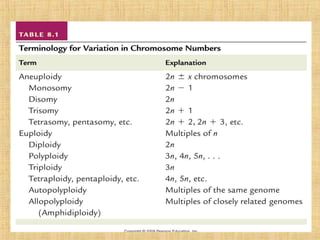
•Aneuploidy
Excess or Deficiency in a single chromosome
•EUPLOIDY.
Excess or Deficiency complete one or more
sets of chromosomes
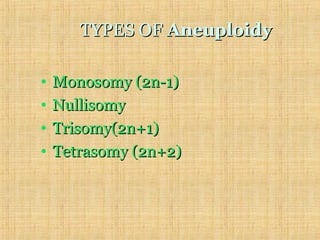
TYPES OFTYPES OF AneuploidyAneuploidy
• Monosomy (2n-1)Monosomy (2n-1)
• NullisomyNullisomy
• Trisomy(2n+1)Trisomy(2n+1)
• Tetrasomy (2n+2)Tetrasomy (2n+2)
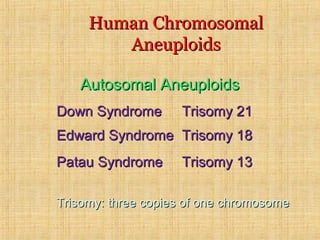
Human ChromosomalHuman Chromosomal
AneuploidsAneuploids
Down SyndromeDown Syndrome Trisomy 21Trisomy 21
Edward SyndromeEdward Syndrome Trisomy 18Trisomy 18
Patau SyndromePatau Syndrome Trisomy 13Trisomy 13
Autosomal AneuploidsAutosomal Aneuploids
Trisomy: three copies of one chromosomeTrisomy: three copies of one chromosome
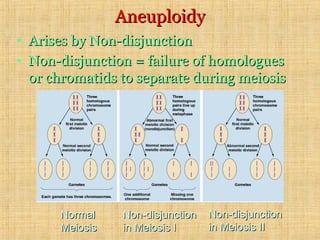
AneuploidyAneuploidy
• Arises by Non-disjunctionArises by Non-disjunction
• Non-disjunction = failure of homologuesNon-disjunction = failure of homologues
or chromatids to separate during meiosisor chromatids to separate during meiosis
NormalNormal
MeiosisMeiosis
Non-disjunctionNon-disjunction
in Meiosis Iin Meiosis I
Non-disjunctionNon-disjunction
in Meiosis IIin Meiosis II
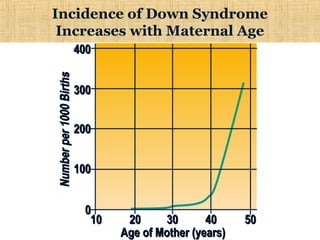
Incidence of Down Syndrome
Increases with Maternal Age
1010 2020 3030 4040 5050
00
100100
200200
300300
400400
Age of Mother (years)Age of Mother (years)
Numberper1000BirthsNumberper1000Births
Human ChromosomalHuman Chromosomal
AneuploidsAneuploids
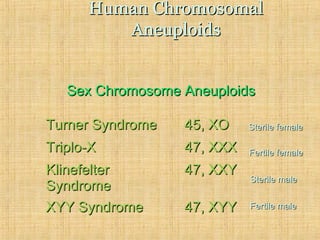
Sex Chromosome AneuploidsSex Chromosome Aneuploids
Turner SyndromeTurner Syndrome 45, XO45, XO
Triplo-XTriplo-X 47, XXX47, XXX
KlinefelterKlinefelter
SyndromeSyndrome
47, XXY47, XXY
XYY SyndromeXYY Syndrome 47, XYY47, XYY
Sterile femaleSterile female
Fertile femaleFertile female
Sterile maleSterile male
Fertile maleFertile male
Applying KnowledgeApplying Knowledge
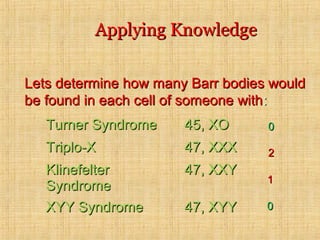
Lets determine how many Barr bodies wouldLets determine how many Barr bodies would
be found in each cell of someone withbe found in each cell of someone with::
Turner SyndromeTurner Syndrome 45, XO45, XO
Triplo-XTriplo-X 47, XXX47, XXX
KlinefelterKlinefelter
SyndromeSyndrome
47, XXY47, XXY
XYY SyndromeXYY Syndrome 47, XYY47, XYY
00
22
11
00
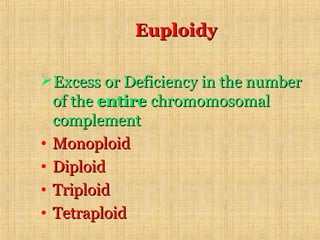
EuploidyEuploidy
Excess or Deficiency in the numberExcess or Deficiency in the number
of theof the entireentire chromomosomalchromomosomal
complementcomplement
• MonoploidMonoploid
• DiploidDiploid
• TriploidTriploid
• TetraploidTetraploid
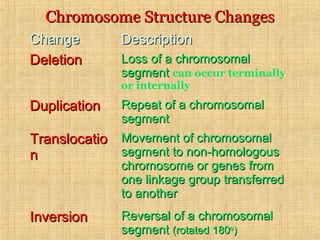
Chromosome Structure ChangesChromosome Structure Changes
ChangeChange DescriptionDescription
DeletionDeletion Loss of a chromosomalLoss of a chromosomal
segmentsegment can occur terminally
or internally
DuplicationDuplication Repeat of a chromosomalRepeat of a chromosomal
segmentsegment
TranslocatioTranslocatio
nn
Movement of chromosomalMovement of chromosomal
segment to non-homologoussegment to non-homologous
chromosome or genes fromchromosome or genes from
one linkage group transferredone linkage group transferred
to anotherto another
InversionInversion Reversal of a chromosomalReversal of a chromosomal
segmentsegment (rotated 180(rotated 180oo
))
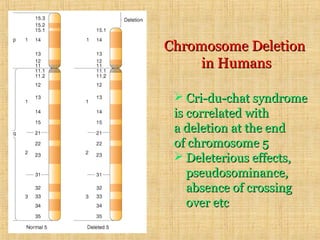
Chromosome DeletionChromosome Deletion
in Humansin Humans
 Cri-du-chat syndromeCri-du-chat syndrome
is correlated withis correlated with
a deletion at the enda deletion at the end
of chromosome 5of chromosome 5
 Deleterious effects,Deleterious effects,
pseudosominance,pseudosominance,
absence of crossingabsence of crossing
over etcover etc
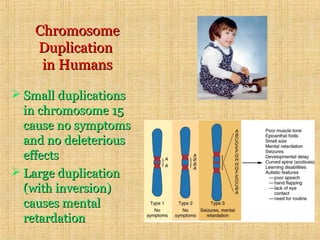
ChromosomeChromosome
DuplicationDuplication
in Humansin Humans
 Small duplicationsSmall duplications
in chromosome 15in chromosome 15
cause no symptomscause no symptoms
and no deleteriousand no deleterious
effectseffects
 Large duplicationLarge duplication
(with inversion)(with inversion)
causes mentalcauses mental
retardationretardation
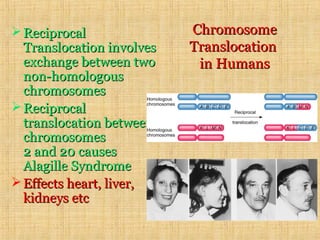
ChromosomeChromosome
TranslocationTranslocation
in Humansin Humans
 ReciprocalReciprocal
Translocation involvesTranslocation involves
exchange between twoexchange between two
non-homologousnon-homologous
chromosomeschromosomes
 ReciprocalReciprocal
translocation betweentranslocation between
chromosomeschromosomes
2 and 20 causes2 and 20 causes
Alagille SyndromeAlagille Syndrome
 Effects heart, liver,Effects heart, liver,
kidneys etckidneys etc
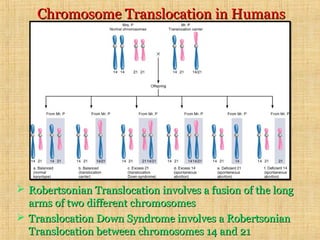
Chromosome Translocation in HumansChromosome Translocation in Humans
 Robertsonian Translocation involves a fusion of the longRobertsonian Translocation involves a fusion of the long
arms of two different chromosomesarms of two different chromosomes
 Translocation Down Syndrome involves a RobertsonianTranslocation Down Syndrome involves a Robertsonian
Translocation between chromosomes 14 and 21Translocation between chromosomes 14 and 21
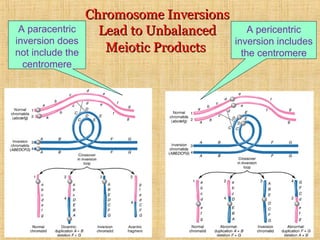
Chromosome InversionsChromosome Inversions
Lead to UnbalancedLead to Unbalanced
Meiotic ProductsMeiotic Products
A paracentric
inversion does
not include the
centromere
A pericentric
inversion includes
the centromere
SIGNIFICANCE OF INVERSIONSIGNIFICANCE OF INVERSION
• ORIGIN OF NEW SPECIESORIGIN OF NEW SPECIES
• PROOF FOR THE OCCURANCEPROOF FOR THE OCCURANCE
OF CROSSING OVEROF CROSSING OVER
• INVERSION IS CONSIDERED ASINVERSION IS CONSIDERED AS
CROSSING OVER REPRESSORSCROSSING OVER REPRESSORS
THANK YOUTHANK YOU
End of slide showEnd of slide show

chromosomal mutation

  • 1.
    Chromosomal MutationsChromosomal Mutations Changesin ChromosomeChanges in Chromosome Number or StructureNumber or Structure PRESENTED BYPRESENTED BY NAVEED UL MUSHTAQNAVEED UL MUSHTAQ
  • 2.
    Chromosome MutationsChromosome Mutations •A chromosome mutation is a change in theA chromosome mutation is a change in the structure or arrangement of thestructure or arrangement of the chromosomeschromosomes • Mutations are caused byMutations are caused by • Physical agentsPhysical agents e.g. X-rays and ultraviolete.g. X-rays and ultraviolet lightlight • Chemical mutagensChemical mutagens such as nitrous acid orsuch as nitrous acid or • By spontaneousBy spontaneous way by unequal crossingway by unequal crossing over.over.
  • 3.
    Alterations in ChromosomeAlterationsin Chromosome Structural changesStructural changes •DELETIONDELETION •DUPLICATIONDUPLICATION •TRANSLOCATIONTRANSLOCATION •INVERSIONSINVERSIONS NUMERICAL CHANGESNUMERICAL CHANGES •Aneuploidy Excess or Deficiency in a single chromosome •EUPLOIDY. Excess or Deficiency complete one or more sets of chromosomes
  • 4.
    TYPES OFTYPES OFAneuploidyAneuploidy • Monosomy (2n-1)Monosomy (2n-1) • NullisomyNullisomy • Trisomy(2n+1)Trisomy(2n+1) • Tetrasomy (2n+2)Tetrasomy (2n+2)
  • 5.
    Human ChromosomalHuman Chromosomal AneuploidsAneuploids DownSyndromeDown Syndrome Trisomy 21Trisomy 21 Edward SyndromeEdward Syndrome Trisomy 18Trisomy 18 Patau SyndromePatau Syndrome Trisomy 13Trisomy 13 Autosomal AneuploidsAutosomal Aneuploids Trisomy: three copies of one chromosomeTrisomy: three copies of one chromosome
  • 7.
    AneuploidyAneuploidy • Arises byNon-disjunctionArises by Non-disjunction • Non-disjunction = failure of homologuesNon-disjunction = failure of homologues or chromatids to separate during meiosisor chromatids to separate during meiosis NormalNormal MeiosisMeiosis Non-disjunctionNon-disjunction in Meiosis Iin Meiosis I Non-disjunctionNon-disjunction in Meiosis IIin Meiosis II
  • 8.
    Incidence of DownSyndrome Increases with Maternal Age 1010 2020 3030 4040 5050 00 100100 200200 300300 400400 Age of Mother (years)Age of Mother (years) Numberper1000BirthsNumberper1000Births
  • 9.
    Human ChromosomalHuman Chromosomal AneuploidsAneuploids SexChromosome AneuploidsSex Chromosome Aneuploids Turner SyndromeTurner Syndrome 45, XO45, XO Triplo-XTriplo-X 47, XXX47, XXX KlinefelterKlinefelter SyndromeSyndrome 47, XXY47, XXY XYY SyndromeXYY Syndrome 47, XYY47, XYY Sterile femaleSterile female Fertile femaleFertile female Sterile maleSterile male Fertile maleFertile male
  • 10.
    Applying KnowledgeApplying Knowledge Letsdetermine how many Barr bodies wouldLets determine how many Barr bodies would be found in each cell of someone withbe found in each cell of someone with:: Turner SyndromeTurner Syndrome 45, XO45, XO Triplo-XTriplo-X 47, XXX47, XXX KlinefelterKlinefelter SyndromeSyndrome 47, XXY47, XXY XYY SyndromeXYY Syndrome 47, XYY47, XYY 00 22 11 00
  • 11.
    EuploidyEuploidy Excess or Deficiencyin the numberExcess or Deficiency in the number of theof the entireentire chromomosomalchromomosomal complementcomplement • MonoploidMonoploid • DiploidDiploid • TriploidTriploid • TetraploidTetraploid
  • 12.
    Chromosome Structure ChangesChromosomeStructure Changes ChangeChange DescriptionDescription DeletionDeletion Loss of a chromosomalLoss of a chromosomal segmentsegment can occur terminally or internally DuplicationDuplication Repeat of a chromosomalRepeat of a chromosomal segmentsegment TranslocatioTranslocatio nn Movement of chromosomalMovement of chromosomal segment to non-homologoussegment to non-homologous chromosome or genes fromchromosome or genes from one linkage group transferredone linkage group transferred to anotherto another InversionInversion Reversal of a chromosomalReversal of a chromosomal segmentsegment (rotated 180(rotated 180oo ))
  • 13.
    Chromosome DeletionChromosome Deletion inHumansin Humans  Cri-du-chat syndromeCri-du-chat syndrome is correlated withis correlated with a deletion at the enda deletion at the end of chromosome 5of chromosome 5  Deleterious effects,Deleterious effects, pseudosominance,pseudosominance, absence of crossingabsence of crossing over etcover etc
  • 14.
    ChromosomeChromosome DuplicationDuplication in Humansin Humans Small duplicationsSmall duplications in chromosome 15in chromosome 15 cause no symptomscause no symptoms and no deleteriousand no deleterious effectseffects  Large duplicationLarge duplication (with inversion)(with inversion) causes mentalcauses mental retardationretardation
  • 15.
    ChromosomeChromosome TranslocationTranslocation in Humansin Humans ReciprocalReciprocal Translocation involvesTranslocation involves exchange between twoexchange between two non-homologousnon-homologous chromosomeschromosomes  ReciprocalReciprocal translocation betweentranslocation between chromosomeschromosomes 2 and 20 causes2 and 20 causes Alagille SyndromeAlagille Syndrome  Effects heart, liver,Effects heart, liver, kidneys etckidneys etc
  • 16.
    Chromosome Translocation inHumansChromosome Translocation in Humans  Robertsonian Translocation involves a fusion of the longRobertsonian Translocation involves a fusion of the long arms of two different chromosomesarms of two different chromosomes  Translocation Down Syndrome involves a RobertsonianTranslocation Down Syndrome involves a Robertsonian Translocation between chromosomes 14 and 21Translocation between chromosomes 14 and 21
  • 17.
    Chromosome InversionsChromosome Inversions Leadto UnbalancedLead to Unbalanced Meiotic ProductsMeiotic Products A paracentric inversion does not include the centromere A pericentric inversion includes the centromere
  • 18.
    SIGNIFICANCE OF INVERSIONSIGNIFICANCEOF INVERSION • ORIGIN OF NEW SPECIESORIGIN OF NEW SPECIES • PROOF FOR THE OCCURANCEPROOF FOR THE OCCURANCE OF CROSSING OVEROF CROSSING OVER • INVERSION IS CONSIDERED ASINVERSION IS CONSIDERED AS CROSSING OVER REPRESSORSCROSSING OVER REPRESSORS
  • 19.
    THANK YOUTHANK YOU Endof slide showEnd of slide show

Editor's Notes

  • #9 Figure: FIGURE 12.20 Title: Down syndrome frequency increases with maternal age Caption: The increase in frequency of Down syndrome after maternal age 35 is quite dramatic.