Welcome
Chromosomal and genetic
abnormalities
O A chromosome anomaly, abnormality or
aberration is a missing, extra, or irregular
portion of chromosomal DNA.
O It can be from an atypical number of
chromosomes or a structural abnormality
in one or more chromosome.
O Chromosome anomalies usually occur
when there is an error in cell division
following meiosis or mitosis..
Types of chromosomal
anomalies
There are many types of chromosome
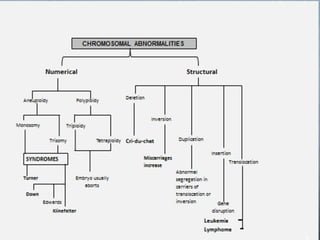
anomalies. They can be organized into two
basic groups:
 numerical
 structural
Numerical disorder
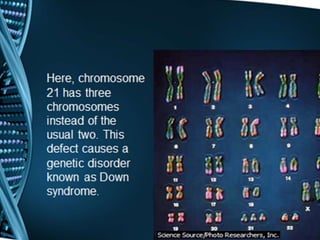
O This is called aneuploidy (an abnormal
number of chromosomes), and occurs
when an individual is missing either a
chromosome from a pair (monosomy) or
has more than two chromosomes of a pair
(trisomy, tetrasomy, etc.).
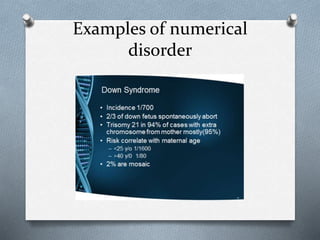
Examples of numerical
disorder
Symptoms of Down Syndrome
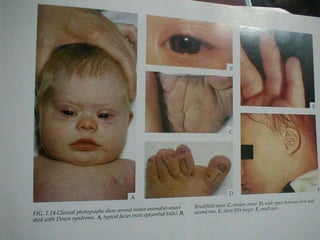
O Upward slant to eyes.
O Small ears that fold over at the top.
O Small, flattened nose.
O Small mouth, making tongue appear
large.
O Short neck.
O Small hands with short fingers
O Low muscle tone.
O Single deep crease across center of palm.
O Looseness of joints.
O Small skin folds at the inner corners of the
eyes.
O Excessive space between first and second
toe.
O In addition, down syndrome always
involves some degree of mental
retardation, from mild to severe. In most
cases, the mental retardation is mild to
moderate.
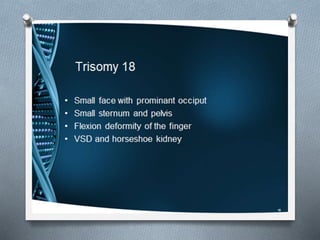
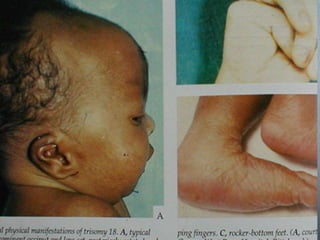
Trisomy-18
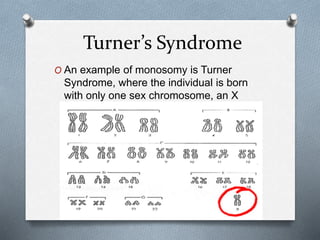
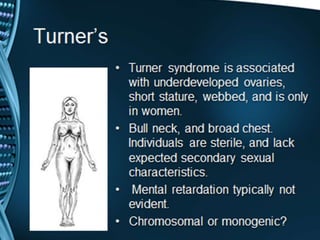
Turner’s Syndrome
O An example of monosomy is Turner
Syndrome, where the individual is born
with only one sex chromosome, an X
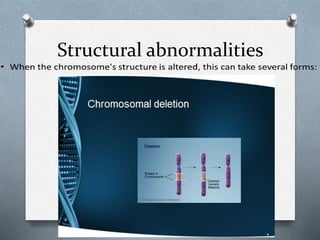
Structural abnormalities
O Deletions: A portion of the chromosome is
missing or deleted. Known disorders in
humans include Wolf-Hirschhorn
syndrome, which is caused by partial
deletion of the short arm of chromosome
4; and Jacobsen syndrome, also called
the terminal 11q deletion disorder.
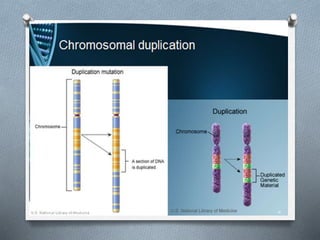
Duplications
O A portion of the chromosome is
duplicated, resulting in extra genetic
material. Known human disorders include
Charcot-Marie-Tooth disease type 1A
which may be caused by duplication of the
gene encoding peripheral myelin protein
22 (PMP22) on chromosome 17.
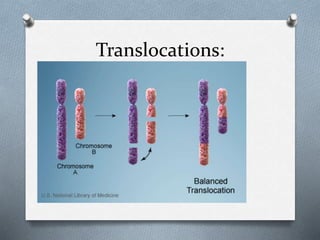
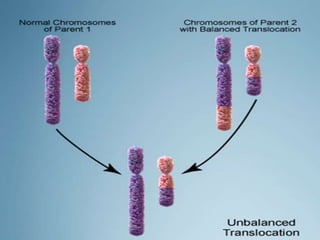
Translocations:
O A portion of one chromosome is
transferred to another chromosome.
There are two main types of
translocations:
O Reciprocal translocation: Segments
from two different chromosomes have
been exchanged.
O Robertsonian translocation: An entire
chromosome has attached to another at
the centromere - in humans these only
occur with chromosomes 13, 14, 15, 21
and 22.
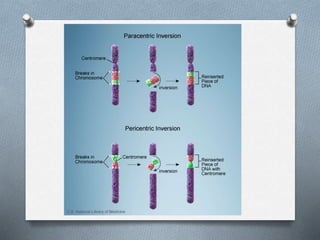
Inversions
O Inversions: A portion of the chromosome has
broken off, turned upside down and
reattached, therefore the genetic material is
inverted.
O Insertions: A portion of one chromosome has
been deleted from its normal place and
inserted into another chromosome.
O Rings: A portion of a chromosome has broken
off and formed a circle or ring. This can
happen with or without loss of genetic
material.
O Isochromosome: Formed by the mirror image
copy of a chromosome segment including the
centromere.
O Chromosome instability syndromes are a
group of disorders characterized by
chromosomal instability and breakage.
They often lead to an increased tendency
to develop certain types of malignancies.
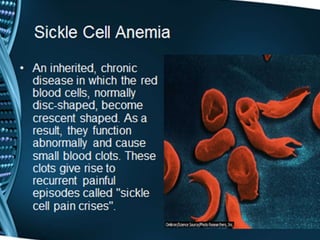
O Sickle cell disease is most commonly
found in African American
populations. This disease was discovered
over 80 years ago, but has not been given
the attention it deserves.
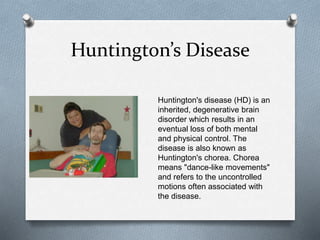
Huntington’s Disease
Huntington's disease (HD) is an
inherited, degenerative brain
disorder which results in an
eventual loss of both mental
and physical control. The
disease is also known as
Huntington's chorea. Chorea
means "dance-like movements"
and refers to the uncontrolled
motions often associated with
the disease.
Phenylketonuria or PKU
O People with PKU cannot consume any
product that contains aspartame.
O PKU is a metabolic disorder that results
when the PKU gene is inherited from both
parents .
O Caused by a deficiency of an enzyme
which is necessary for proper metabolism
of an amino acid called phenylalanine.
O Phenylalanine is an essential amino acid and
is found in nearly all foods which contain
protein, dairy products, nuts, beans, tofu…
etc.
O A low protein diet must be followed.
O Brain damage can result if the diet is not
followed causing mental retardation…and
mousy body odor (phenylacetic acid is in
sweat).
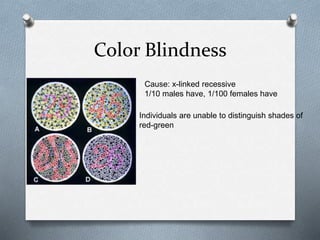
Color Blindness
Cause: x-linked recessive
1/10 males have, 1/100 females have
Individuals are unable to distinguish shades of
red-green
Inheritance
O Most chromosome abnormalities occur as
an accident in the egg or sperm, and
therefore the anomaly is present in every
cell of the body. Some anomalies,
however, can happen after conception,
resulting in Mosaicism (where some cells
have the anomaly and some do not).
O Chromosome anomalies can be inherited
from a parent or it maybe a mutation. This
is why chromosome studies are often
performed on parents when a child is
found to have an anomaly. If the parents
do not possess the abnormality it was not
initially inherited; however it may be
transmitted to subsequent generations.
How do chromosome
abnormalities happen?
O Chromosome abnormalities usually occur when there is an error in cell
division. There are two kinds of cell division.
O Mitosis results in two cells that are duplicates of the original cell. In
other words, one cell with 46 chromosomes becomes two cells with 46
chromosomes each. This kind of cell division occurs throughout the
body, except in the reproductive organs. This is how most of the cells
that make up our body are made and replaced.
O Meiosis results in cells with half the number of chromosomes, 23
instead of the normal 46. These are the eggs and sperm.
O
O In both processes, the correct number of chromosomes is
O supposed to end up in the resulting cells. However, errors in cell
division can result in cells with too few or too many copies of a
chromosome. Errors can also occur when the chromosomes are being
duplicated.
O Other factors that can increase the risk of
chromosome abnormalities are:
O Maternal Age: Women are born with all the
eggs they will ever have. Therefore, when a
woman is 30 years old, so are her eggs.
Some researchers believe that errors can
crop up in the eggs' genetic material as they
age over time. Therefore, older women are
more at risk of giving birth to babies with
chromosome abnormalities than younger
women. Since men produce new sperm
throughout their life, paternal age does not
increase risk of chromosome abnormalities.
O Environment: Although there is no
conclusive evidence that specific
environmental factors cause chromosome
abnormalities, it is still a possibility that
the environment may play a role in the
occurrence of genetic errors.
Thank
you

Chromosomal and Genetic abnormalities

  • 1.
  • 2.
    Chromosomal and genetic abnormalities OA chromosome anomaly, abnormality or aberration is a missing, extra, or irregular portion of chromosomal DNA. O It can be from an atypical number of chromosomes or a structural abnormality in one or more chromosome. O Chromosome anomalies usually occur when there is an error in cell division following meiosis or mitosis..
  • 3.
    Types of chromosomal anomalies Thereare many types of chromosome anomalies. They can be organized into two basic groups:  numerical  structural
  • 4.
    Numerical disorder O Thisis called aneuploidy (an abnormal number of chromosomes), and occurs when an individual is missing either a chromosome from a pair (monosomy) or has more than two chromosomes of a pair (trisomy, tetrasomy, etc.).
  • 5.
  • 7.
    Symptoms of DownSyndrome O Upward slant to eyes. O Small ears that fold over at the top. O Small, flattened nose. O Small mouth, making tongue appear large. O Short neck. O Small hands with short fingers
  • 8.
    O Low muscletone. O Single deep crease across center of palm. O Looseness of joints. O Small skin folds at the inner corners of the eyes. O Excessive space between first and second toe. O In addition, down syndrome always involves some degree of mental retardation, from mild to severe. In most cases, the mental retardation is mild to moderate.
  • 10.
  • 12.
    Turner’s Syndrome O Anexample of monosomy is Turner Syndrome, where the individual is born with only one sex chromosome, an X
  • 14.
  • 15.
    O Deletions: Aportion of the chromosome is missing or deleted. Known disorders in humans include Wolf-Hirschhorn syndrome, which is caused by partial deletion of the short arm of chromosome 4; and Jacobsen syndrome, also called the terminal 11q deletion disorder.
  • 16.
  • 17.
    O A portionof the chromosome is duplicated, resulting in extra genetic material. Known human disorders include Charcot-Marie-Tooth disease type 1A which may be caused by duplication of the gene encoding peripheral myelin protein 22 (PMP22) on chromosome 17.
  • 18.
  • 20.
    O A portionof one chromosome is transferred to another chromosome. There are two main types of translocations: O Reciprocal translocation: Segments from two different chromosomes have been exchanged. O Robertsonian translocation: An entire chromosome has attached to another at the centromere - in humans these only occur with chromosomes 13, 14, 15, 21 and 22.
  • 21.
  • 22.
    O Inversions: Aportion of the chromosome has broken off, turned upside down and reattached, therefore the genetic material is inverted. O Insertions: A portion of one chromosome has been deleted from its normal place and inserted into another chromosome. O Rings: A portion of a chromosome has broken off and formed a circle or ring. This can happen with or without loss of genetic material. O Isochromosome: Formed by the mirror image copy of a chromosome segment including the centromere.
  • 23.
    O Chromosome instabilitysyndromes are a group of disorders characterized by chromosomal instability and breakage. They often lead to an increased tendency to develop certain types of malignancies.
  • 25.
    O Sickle celldisease is most commonly found in African American populations. This disease was discovered over 80 years ago, but has not been given the attention it deserves.
  • 31.
    Huntington’s Disease Huntington's disease(HD) is an inherited, degenerative brain disorder which results in an eventual loss of both mental and physical control. The disease is also known as Huntington's chorea. Chorea means "dance-like movements" and refers to the uncontrolled motions often associated with the disease.
  • 34.
    Phenylketonuria or PKU OPeople with PKU cannot consume any product that contains aspartame. O PKU is a metabolic disorder that results when the PKU gene is inherited from both parents . O Caused by a deficiency of an enzyme which is necessary for proper metabolism of an amino acid called phenylalanine.
  • 35.
    O Phenylalanine isan essential amino acid and is found in nearly all foods which contain protein, dairy products, nuts, beans, tofu… etc. O A low protein diet must be followed. O Brain damage can result if the diet is not followed causing mental retardation…and mousy body odor (phenylacetic acid is in sweat).
  • 36.
    Color Blindness Cause: x-linkedrecessive 1/10 males have, 1/100 females have Individuals are unable to distinguish shades of red-green
  • 42.
    Inheritance O Most chromosomeabnormalities occur as an accident in the egg or sperm, and therefore the anomaly is present in every cell of the body. Some anomalies, however, can happen after conception, resulting in Mosaicism (where some cells have the anomaly and some do not).
  • 43.
    O Chromosome anomaliescan be inherited from a parent or it maybe a mutation. This is why chromosome studies are often performed on parents when a child is found to have an anomaly. If the parents do not possess the abnormality it was not initially inherited; however it may be transmitted to subsequent generations.
  • 44.
    How do chromosome abnormalitieshappen? O Chromosome abnormalities usually occur when there is an error in cell division. There are two kinds of cell division. O Mitosis results in two cells that are duplicates of the original cell. In other words, one cell with 46 chromosomes becomes two cells with 46 chromosomes each. This kind of cell division occurs throughout the body, except in the reproductive organs. This is how most of the cells that make up our body are made and replaced. O Meiosis results in cells with half the number of chromosomes, 23 instead of the normal 46. These are the eggs and sperm. O O In both processes, the correct number of chromosomes is O supposed to end up in the resulting cells. However, errors in cell division can result in cells with too few or too many copies of a chromosome. Errors can also occur when the chromosomes are being duplicated.
  • 45.
    O Other factorsthat can increase the risk of chromosome abnormalities are: O Maternal Age: Women are born with all the eggs they will ever have. Therefore, when a woman is 30 years old, so are her eggs. Some researchers believe that errors can crop up in the eggs' genetic material as they age over time. Therefore, older women are more at risk of giving birth to babies with chromosome abnormalities than younger women. Since men produce new sperm throughout their life, paternal age does not increase risk of chromosome abnormalities.
  • 46.
    O Environment: Althoughthere is no conclusive evidence that specific environmental factors cause chromosome abnormalities, it is still a possibility that the environment may play a role in the occurrence of genetic errors.
  • 47.