POOJA SINGH
POLYTENE CHROMOSOMES
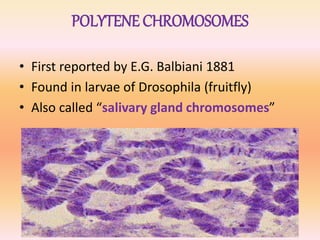
• First reported by E.G. Balbiani 1881
• Found in larvae of Drosophila (fruitfly)
• Also called “salivary gland chromosomes”
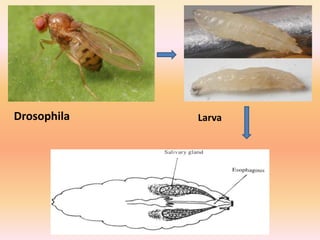
Drosophila Larva
Development of Polytene chromosomes
• Polytene chromosomes are developed from
standard chromosomes
• Some Specialized cells undergo repeated
DNA replication without cell division
process is known as ENDOMITOSIS
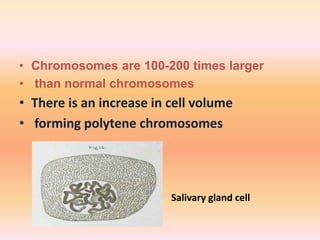
• Chromosomes are 100-200 times larger
• than normal chromosomes
• There is an increase in cell volume
• forming polytene chromosomes
Salivary gland cell
STRUCTURE OF
POLYTENE CHROMOSOMES
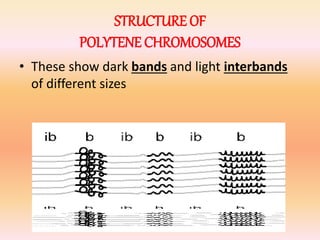
• These show dark bands and light interbands
of different sizes
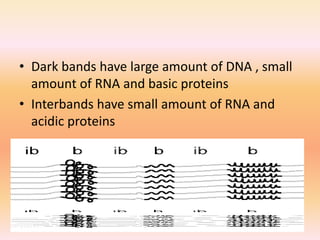
• Dark bands have large amount of DNA , small
amount of RNA and basic proteins
• Interbands have small amount of RNA and
acidic proteins
FORMATION OF PUFF
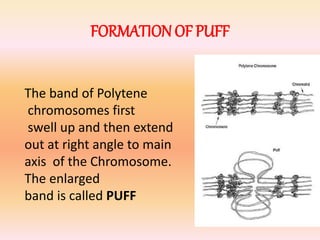
The band of Polytene
chromosomes first
swell up and then extend
out at right angle to main
axis of the Chromosome.
The enlarged
band is called PUFF
Puffs are the active site of mRNA, rRNA
and tRNA synthesis
Puffs seems to have concentration of
fibres, granules, RNA molecules
and proteins
BALBIANI RING
Chromonemata (Chromosomes material) of
polytene chromosomes give out a number of
loops at certain places.
Such loops are called BALBIANI RING. These
are rich in m RNA
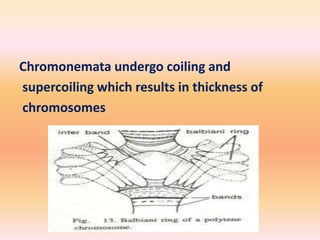
Chromonemata undergo coiling and
supercoiling which results in thickness of
chromosomes
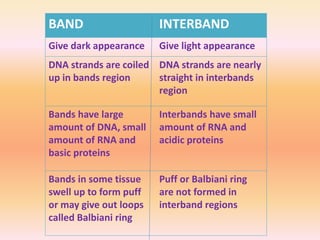
BAND INTERBAND
Give dark appearance Give light appearance
DNA strands are coiled
up in bands region
DNA strands are nearly
straight in interbands
region
Bands have large
amount of DNA, small
amount of RNA and
basic proteins
Interbands have small
amount of RNA and
acidic proteins
Bands in some tissue
swell up to form puff
or may give out loops
called Balbiani ring
Puff or Balbiani ring
are not formed in
interband regions
IMPORTANCE OF POLYTENE CHROMOSOMES
• Polyteny arises in tissues, organs and at
developmental stages when there is need for the
rapid development of an organ.
• Organs containing cells with polytene
chromosomes are involved in intense secretory
functions for rapid growth
• Polytinization helps the organism to conserve the
energy during the development where the cells
only increases the DNA content and cell division
phase is eliminated, there by conserving the
energy and time
Polytene chromosomes

Polytene chromosomes

  • 1.
  • 2.
    POLYTENE CHROMOSOMES • Firstreported by E.G. Balbiani 1881 • Found in larvae of Drosophila (fruitfly) • Also called “salivary gland chromosomes”
  • 3.
  • 4.
    Development of Polytenechromosomes • Polytene chromosomes are developed from standard chromosomes • Some Specialized cells undergo repeated DNA replication without cell division process is known as ENDOMITOSIS
  • 5.
    • Chromosomes are100-200 times larger • than normal chromosomes • There is an increase in cell volume • forming polytene chromosomes Salivary gland cell
  • 6.
    STRUCTURE OF POLYTENE CHROMOSOMES •These show dark bands and light interbands of different sizes
  • 7.
    • Dark bandshave large amount of DNA , small amount of RNA and basic proteins • Interbands have small amount of RNA and acidic proteins
  • 8.
    FORMATION OF PUFF Theband of Polytene chromosomes first swell up and then extend out at right angle to main axis of the Chromosome. The enlarged band is called PUFF
  • 9.
    Puffs are theactive site of mRNA, rRNA and tRNA synthesis Puffs seems to have concentration of fibres, granules, RNA molecules and proteins
  • 10.
    BALBIANI RING Chromonemata (Chromosomesmaterial) of polytene chromosomes give out a number of loops at certain places. Such loops are called BALBIANI RING. These are rich in m RNA
  • 11.
    Chromonemata undergo coilingand supercoiling which results in thickness of chromosomes
  • 12.
    BAND INTERBAND Give darkappearance Give light appearance DNA strands are coiled up in bands region DNA strands are nearly straight in interbands region Bands have large amount of DNA, small amount of RNA and basic proteins Interbands have small amount of RNA and acidic proteins Bands in some tissue swell up to form puff or may give out loops called Balbiani ring Puff or Balbiani ring are not formed in interband regions
  • 13.
    IMPORTANCE OF POLYTENECHROMOSOMES • Polyteny arises in tissues, organs and at developmental stages when there is need for the rapid development of an organ. • Organs containing cells with polytene chromosomes are involved in intense secretory functions for rapid growth • Polytinization helps the organism to conserve the energy during the development where the cells only increases the DNA content and cell division phase is eliminated, there by conserving the energy and time