PRESENTED BY
GOVIND GURU TRIBLE
UNIVERSITY,BANSWARA
SUBMITTEDTO:DR.JAYANA UPADHYAY
SUBMITTED BY: HEMANT DARJI
M.SC.(BOTANY)
2nd SAMASTER
TOPIC=MUTATION
 The term “MUTATION” was first coined by scientist
Hugo DeVries in 1901.
 A mutation is a change in the genetic material.This
means changes to the DNA or to the chromosomes
which carry the DNA.These changes are heritable (can
be passed on to the next generation) unless they have
lethal effects.
ROLE OF MUTATION
Ultimate source of all genetic variation and it provides
the raw material for Evolution
Some mutations lead to newer versions of proteins and
help the organisms to adapt to changes in the
environment. As the first step of evolution, the mutation
is important as it creates a new DNA sequence for a
specific gene which creates a new allele.
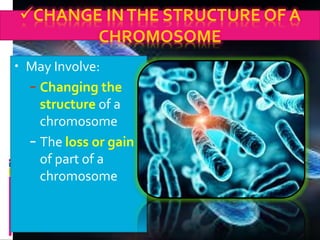
CHANGE INTHE STRUCTURE OF A
CHROMOSOME
• May Involve:
– Changing the
structure of a
chromosome
– The loss or gain
of part of a
chromosome
Chromosome Mutations
• Four types exist:
– Deletion
– Inversion
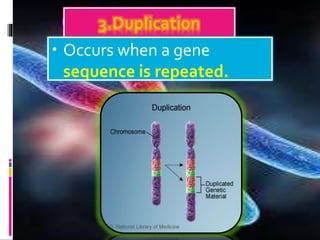
– Duplication
– Translocation
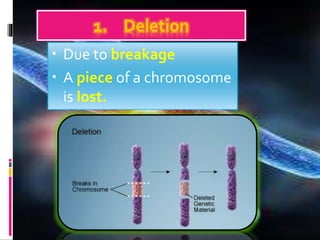
1. Deletion
• Due to breakage
• A piece of a chromosome
is lost.
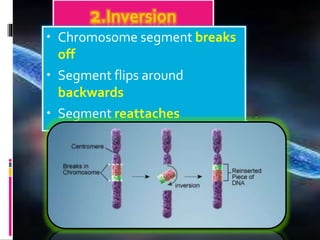
2.Inversion
• Chromosome segment breaks
off
• Segment flips around
backwards
• Segment reattaches
3.Duplication
• Occurs when a gene
sequence is repeated.
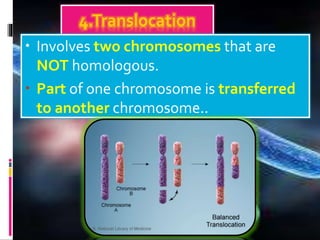
4.Translocation
• Involves two chromosomes that are
NOT homologous.
• Part of one chromosome is transferred
to another chromosome..
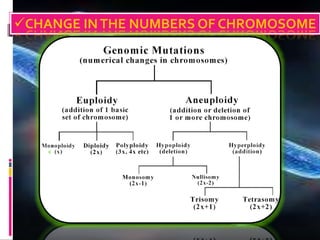
CHANGE INTHE NUMBERS OF CHROMOSOME
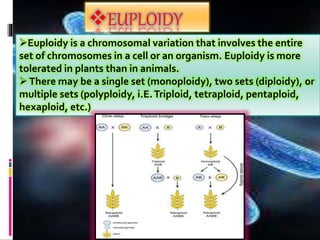
EUPLOIDY
Euploidy is a chromosomal variation that involves the entire
set of chromosomes in a cell or an organism. Euploidy is more
tolerated in plants than in animals.
There may be a single set (monoploidy), two sets (diploidy), or
multiple sets (polyploidy, i.E.Triploid, tetraploid, pentaploid,
hexaploid, etc.)
1.MONOPLOIDY
Monoploids have a single basic set of
chromosomes.
E.G.-Barleyand 10in corn.
Monoploidy is common in plant and raer in
animal.
Monoploids can be produced by artificial mean by the
following methods:-
1. X-rays treatment
2. Delayed pollination
3. Temperature shock (cold treatment)
4. Colchicine treatment
5. Distinct hybridization
2.POLYPLOIDY
Polyploidy occurs in cells and organisms when there are
more than two homologous sets of chromosomes.
Very common in plants – associated with origin of new
species – may positively correlate to size of individual.
There are two classes of polyploids based on the number
of chromosome sets: • . Even-number polyploids are more
likely to be at least partially fertile, because the potential
exists for equal segregation of homologs during meiosis. .
Odd-number polyploids will always have unpaired
chromosomes. Balanced gametes are rare and these
organisms are usually sterile or have increased zygote
death.
Triploids, pentaploids (all with odd number of
chromosome sets) are often sterile due to pairing problems
during meiosis.
Types of polyploidy in plants..
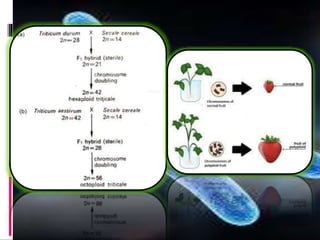
1.Autopolyploidy-Autopolyploids results when all sets of
chromosomes are from the same species, usually due to
meiotic error.
Examples include: – (1) “Seedless” fruits like bananas (3n =
33), grapes and watermelons. – (2) Grasses, garden flowers,
crop plants and forest trees
2.Allopolyploidy– hybrid of two or more closely related
species – partially homologous chromosomes
(homeologous) Allopolyploidy is caused by the presence of
several genomes of different species in a cell, a tissue or a
whole organism.
ANUEPLOIDy
This is a condition where the chromosome number is
not an exact multiple of the normal diploid number,
with either fewer or more than the normal number of
chromosome in the cell.
A condition of aneuploidy may occur due to loss of
one or more chromosomes during mitosis or meiosis.
In diploid organisms aneuploid variations take
four main forms that can be classified under
two main groups:
1. Hypoploidy: loss of one or more
chromosomes from basic set.(called
monosomy).(2n-1) or due to the lose of
one pair of chromosome called nullysomy
(2n-2).
2. Hyperploidy: presence of one or more
chromosomes in the basic set.(called
trisomy).(2n+1).or a pair of chromosomes
called tetrasomy(2n+2)
• Change in the nucleotide sequence
of a gene
• May only involve a single nucleotide
• May be due to copying errors,
• chemicals, viruses, etc.
Point mutations are the most common type of
gene mutation.
Also known as base pair substitution.
Change in a single nucleotide base pair.
 Point mutation can be categorized into three
types:
1) SILENT MUTATION
2) MISSENSE MUTATION
3) NONSENSE MUTATION
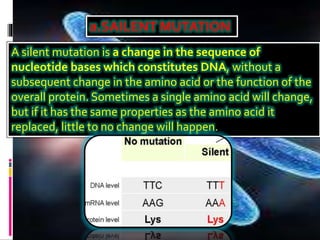
a.SAILENT MUTATION
A silent mutation is a change in the sequence of
nucleotide bases which constitutes DNA, without a
subsequent change in the amino acid or the function of the
overall protein. Sometimes a single amino acid will change,
but if it has the same properties as the amino acid it
replaced, little to no change will happen.
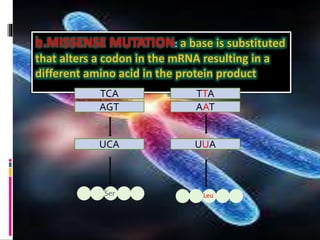
b.MISSENSE MUTATION: a base is substituted
that alters a codon in the mRNA resulting in a
different amino acid in the protein product
TCA
AGT
UCA
TTA
AAT
UUA
Ser Leu
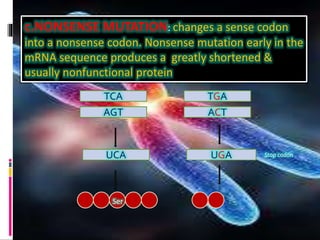
c.NONSENSE MUTATION: changes a sense codon
into a nonsense codon. Nonsense mutation early in the
mRNA sequence produces a greatly shortened &
usually nonfunctional protein
TCA
AGT
UCA
TGA
ACT
UGA
Ser
Stop codon
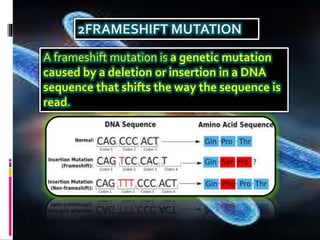
A frameshift mutation is a genetic mutation
caused by a deletion or insertion in a DNA
sequence that shifts the way the sequence is
read.
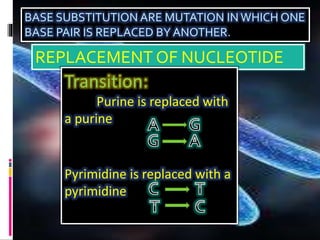
REPLACEMENT OF NUCLEOTIDE
Transition:
Purine is replaced with
a purine
Pyrimidine is replaced with a
pyrimidine
BASE SUBSTITUTION ARE MUTATION IN WHICH ONE
BASE PAIR IS REPLACED BY ANOTHER.
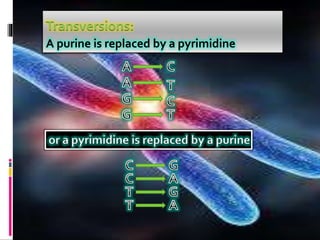
Transversions:
A purine is replaced by a pyrimidine
or a pyrimidine is replaced by a purine
According to the survival (effects),
mutations are classified into
following four types:
Lethal: A mutation which kills the individual that
carries it.
Sub-lethal: When mortality is more than 50% of
individuals that carry mutation
Sub-vital: When morality is less than 50% of individuals
that carry mutation
Vital: When all the mutant individual survives
According to the mode of origin
mutation may be…
A. SPONTANEOUS MUTATION: The
mutation that occurs spontaneously is termed as
spontaneous mutation. Most of the mutation that
originally studied occurs spontaneously.
B. INDUCED MUTATIONS: When mutations occur
by treating an organism with mutagenizing agent
is termed as induced mutation.
A mutagen is any substance or agent
that can cause a mutation, or change in
the sequence or structure of DNA.
MUTAGEN
Physical mutagens • Ionizing radiations such
as X-rays, gamma rays causes DNA breakage
and other damages. • Ultraviolet radiations with
wavelength above 260 nm are absorbed strongly
by bases, producing pyrimidine dimers, which
can cause error in replication .
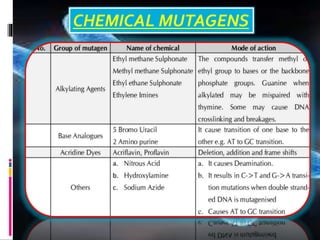
CHEMICAL MUTAGENS
MUTATION,CHROMOSOMAL MUTATION &GENE MUTATION

MUTATION,CHROMOSOMAL MUTATION &GENE MUTATION

  • 1.
  • 2.
    GOVIND GURU TRIBLE UNIVERSITY,BANSWARA SUBMITTEDTO:DR.JAYANAUPADHYAY SUBMITTED BY: HEMANT DARJI M.SC.(BOTANY) 2nd SAMASTER TOPIC=MUTATION
  • 3.
     The term“MUTATION” was first coined by scientist Hugo DeVries in 1901.  A mutation is a change in the genetic material.This means changes to the DNA or to the chromosomes which carry the DNA.These changes are heritable (can be passed on to the next generation) unless they have lethal effects.
  • 4.
    ROLE OF MUTATION Ultimatesource of all genetic variation and it provides the raw material for Evolution Some mutations lead to newer versions of proteins and help the organisms to adapt to changes in the environment. As the first step of evolution, the mutation is important as it creates a new DNA sequence for a specific gene which creates a new allele.
  • 5.
    CHANGE INTHE STRUCTUREOF A CHROMOSOME • May Involve: – Changing the structure of a chromosome – The loss or gain of part of a chromosome
  • 6.
    Chromosome Mutations • Fourtypes exist: – Deletion – Inversion – Duplication – Translocation
  • 7.
    1. Deletion • Dueto breakage • A piece of a chromosome is lost.
  • 8.
    2.Inversion • Chromosome segmentbreaks off • Segment flips around backwards • Segment reattaches
  • 9.
    3.Duplication • Occurs whena gene sequence is repeated.
  • 10.
    4.Translocation • Involves twochromosomes that are NOT homologous. • Part of one chromosome is transferred to another chromosome..
  • 11.
  • 12.
    EUPLOIDY Euploidy is achromosomal variation that involves the entire set of chromosomes in a cell or an organism. Euploidy is more tolerated in plants than in animals. There may be a single set (monoploidy), two sets (diploidy), or multiple sets (polyploidy, i.E.Triploid, tetraploid, pentaploid, hexaploid, etc.)
  • 13.
    1.MONOPLOIDY Monoploids have asingle basic set of chromosomes. E.G.-Barleyand 10in corn. Monoploidy is common in plant and raer in animal. Monoploids can be produced by artificial mean by the following methods:- 1. X-rays treatment 2. Delayed pollination 3. Temperature shock (cold treatment) 4. Colchicine treatment 5. Distinct hybridization
  • 14.
    2.POLYPLOIDY Polyploidy occurs incells and organisms when there are more than two homologous sets of chromosomes. Very common in plants – associated with origin of new species – may positively correlate to size of individual. There are two classes of polyploids based on the number of chromosome sets: • . Even-number polyploids are more likely to be at least partially fertile, because the potential exists for equal segregation of homologs during meiosis. . Odd-number polyploids will always have unpaired chromosomes. Balanced gametes are rare and these organisms are usually sterile or have increased zygote death. Triploids, pentaploids (all with odd number of chromosome sets) are often sterile due to pairing problems during meiosis.
  • 15.
    Types of polyploidyin plants.. 1.Autopolyploidy-Autopolyploids results when all sets of chromosomes are from the same species, usually due to meiotic error. Examples include: – (1) “Seedless” fruits like bananas (3n = 33), grapes and watermelons. – (2) Grasses, garden flowers, crop plants and forest trees 2.Allopolyploidy– hybrid of two or more closely related species – partially homologous chromosomes (homeologous) Allopolyploidy is caused by the presence of several genomes of different species in a cell, a tissue or a whole organism.
  • 17.
    ANUEPLOIDy This is acondition where the chromosome number is not an exact multiple of the normal diploid number, with either fewer or more than the normal number of chromosome in the cell. A condition of aneuploidy may occur due to loss of one or more chromosomes during mitosis or meiosis.
  • 18.
    In diploid organismsaneuploid variations take four main forms that can be classified under two main groups: 1. Hypoploidy: loss of one or more chromosomes from basic set.(called monosomy).(2n-1) or due to the lose of one pair of chromosome called nullysomy (2n-2). 2. Hyperploidy: presence of one or more chromosomes in the basic set.(called trisomy).(2n+1).or a pair of chromosomes called tetrasomy(2n+2)
  • 19.
    • Change inthe nucleotide sequence of a gene • May only involve a single nucleotide • May be due to copying errors, • chemicals, viruses, etc.
  • 20.
    Point mutations arethe most common type of gene mutation. Also known as base pair substitution. Change in a single nucleotide base pair.  Point mutation can be categorized into three types: 1) SILENT MUTATION 2) MISSENSE MUTATION 3) NONSENSE MUTATION
  • 21.
    a.SAILENT MUTATION A silentmutation is a change in the sequence of nucleotide bases which constitutes DNA, without a subsequent change in the amino acid or the function of the overall protein. Sometimes a single amino acid will change, but if it has the same properties as the amino acid it replaced, little to no change will happen.
  • 22.
    b.MISSENSE MUTATION: abase is substituted that alters a codon in the mRNA resulting in a different amino acid in the protein product TCA AGT UCA TTA AAT UUA Ser Leu
  • 23.
    c.NONSENSE MUTATION: changesa sense codon into a nonsense codon. Nonsense mutation early in the mRNA sequence produces a greatly shortened & usually nonfunctional protein TCA AGT UCA TGA ACT UGA Ser Stop codon
  • 24.
    A frameshift mutationis a genetic mutation caused by a deletion or insertion in a DNA sequence that shifts the way the sequence is read.
  • 25.
    REPLACEMENT OF NUCLEOTIDE Transition: Purineis replaced with a purine Pyrimidine is replaced with a pyrimidine BASE SUBSTITUTION ARE MUTATION IN WHICH ONE BASE PAIR IS REPLACED BY ANOTHER.
  • 26.
    Transversions: A purine isreplaced by a pyrimidine or a pyrimidine is replaced by a purine
  • 27.
    According to thesurvival (effects), mutations are classified into following four types: Lethal: A mutation which kills the individual that carries it. Sub-lethal: When mortality is more than 50% of individuals that carry mutation Sub-vital: When morality is less than 50% of individuals that carry mutation Vital: When all the mutant individual survives
  • 28.
    According to themode of origin mutation may be… A. SPONTANEOUS MUTATION: The mutation that occurs spontaneously is termed as spontaneous mutation. Most of the mutation that originally studied occurs spontaneously. B. INDUCED MUTATIONS: When mutations occur by treating an organism with mutagenizing agent is termed as induced mutation.
  • 29.
    A mutagen isany substance or agent that can cause a mutation, or change in the sequence or structure of DNA. MUTAGEN Physical mutagens • Ionizing radiations such as X-rays, gamma rays causes DNA breakage and other damages. • Ultraviolet radiations with wavelength above 260 nm are absorbed strongly by bases, producing pyrimidine dimers, which can cause error in replication .
  • 30.