Interchromosomal Alterations-
types, effects and detection.
Dr. Lakhvinder Singh
Department of Botany
G.G.M. Science College, Jammu
TRANSLOCATION
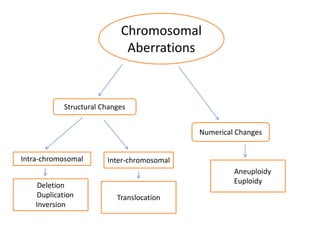
Chromosomal
Aberrations
Structural Changes
Numerical Changes
Intra-chromosomal Inter-chromosomal
Deletion
Duplication
Inversion
Translocation
Aneuploidy
Euploidy
Translocation
• It includes all types of unilateral or
bilateral transfer of chromosome
segments from one chromosome to
another non-homologous
chromosome.
• The genetic significance of
translocation is that genes from one
chromosome are transferred to the
another chromosome.
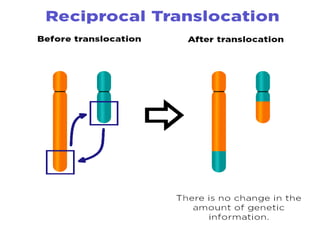
Reciprocal Translocation
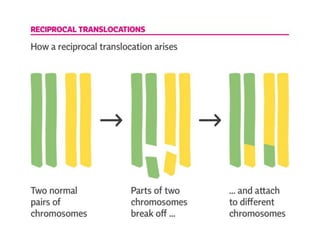
•When pieces of two non-
homologous chromosomes
are interchanged without any
net loss of genetic material,
the event is referred to as a
reciprocal translocation.
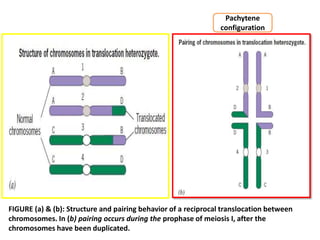
FIGURE (a) & (b): Structure and pairing behavior of a reciprocal translocation between
chromosomes. In (b) pairing occurs during the prophase of meiosis I, after the
chromosomes have been duplicated.
Pachytene
configuration
• Figure (a) in last slide shows a reciprocal translocation between
two large autosomes.
• These chromosomes have interchanged pieces of their right
arms.
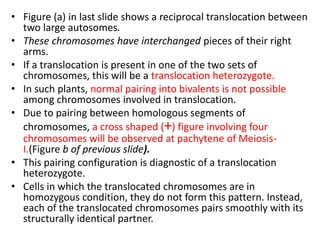
• If a translocation is present in one of the two sets of
chromosomes, this will be a translocation heterozygote.
• In such plants, normal pairing into bivalents is not possible
among chromosomes involved in translocation.
• Due to pairing between homologous segments of
chromosomes, a cross shaped (+) figure involving four
chromosomes will be observed at pachytene of Meiosis-
I.(Figure b of previous slide).
• This pairing configuration is diagnostic of a translocation
heterozygote.
• Cells in which the translocated chromosomes are in
homozygous condition, they do not form this pattern. Instead,
each of the translocated chromosomes pairs smoothly with its
structurally identical partner.
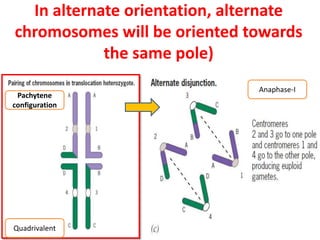
This ring quadrivalent (+) of 4
chromosomes at Pachytene of
meiosis-I can have one of
following three orientations at
Metaphase-I
1.Alternate
2.Adjacent-I
3.Adjacent-II
In alternate orientation, alternate
chromosomes will be oriented towards
the same pole)
Anaphase-I
Pachytene
configuration
Quadrivalent
In adjacent-I orientation, adjacent chromosomes having
non-homologous centromeres will move towards the same
pole.
In adjacent-II orientation, adjacent
chromosomes having homologous centromeres
will move towards the same pole.
• Alternate disjunction will give functional gametes.
• Adjacent I and adjacent-II disjunctions will form
gametes which would carry duplications and
deficiencies (aneuploid gametes).
• These aneuploid gametes will be non-functional.
• Therefore, in a plant having translocation in
Heterozygous condition, there will be
considerable pollen sterility.
• The production of aneuploid gametes by adjacent
disjunctions explains why translocation
heterozygotes have reduced fertility.
• Translocation heterozygotes are therefore
characterized by low fertility.
References
• Snustard, D.P. and Simmons, M.J. (2012).
Principles of Genetics (6th ed.). John Wiley &
Sons, Inc.
• Klug, W.S.; Cummings, M.R.; Spencer, C.A. and
Palladino, M.A. (2012). Concepts of Genetics
(10th ed). Pearson Education, Inc.
• Karp, G. (2010). Cell and Molecular Biology-
concepts and experiments (6th ed.). John
Wiley & Sons, Inc.
Thank You

Translocation

  • 1.
    Interchromosomal Alterations- types, effectsand detection. Dr. Lakhvinder Singh Department of Botany G.G.M. Science College, Jammu TRANSLOCATION
  • 2.
    Chromosomal Aberrations Structural Changes Numerical Changes Intra-chromosomalInter-chromosomal Deletion Duplication Inversion Translocation Aneuploidy Euploidy
  • 3.
    Translocation • It includesall types of unilateral or bilateral transfer of chromosome segments from one chromosome to another non-homologous chromosome. • The genetic significance of translocation is that genes from one chromosome are transferred to the another chromosome.
  • 4.
    Reciprocal Translocation •When piecesof two non- homologous chromosomes are interchanged without any net loss of genetic material, the event is referred to as a reciprocal translocation.
  • 8.
    FIGURE (a) &(b): Structure and pairing behavior of a reciprocal translocation between chromosomes. In (b) pairing occurs during the prophase of meiosis I, after the chromosomes have been duplicated. Pachytene configuration
  • 9.
    • Figure (a)in last slide shows a reciprocal translocation between two large autosomes. • These chromosomes have interchanged pieces of their right arms. • If a translocation is present in one of the two sets of chromosomes, this will be a translocation heterozygote. • In such plants, normal pairing into bivalents is not possible among chromosomes involved in translocation. • Due to pairing between homologous segments of chromosomes, a cross shaped (+) figure involving four chromosomes will be observed at pachytene of Meiosis- I.(Figure b of previous slide). • This pairing configuration is diagnostic of a translocation heterozygote. • Cells in which the translocated chromosomes are in homozygous condition, they do not form this pattern. Instead, each of the translocated chromosomes pairs smoothly with its structurally identical partner.
  • 10.
    This ring quadrivalent(+) of 4 chromosomes at Pachytene of meiosis-I can have one of following three orientations at Metaphase-I 1.Alternate 2.Adjacent-I 3.Adjacent-II
  • 11.
    In alternate orientation,alternate chromosomes will be oriented towards the same pole) Anaphase-I Pachytene configuration Quadrivalent
  • 12.
    In adjacent-I orientation,adjacent chromosomes having non-homologous centromeres will move towards the same pole.
  • 13.
    In adjacent-II orientation,adjacent chromosomes having homologous centromeres will move towards the same pole.
  • 14.
    • Alternate disjunctionwill give functional gametes. • Adjacent I and adjacent-II disjunctions will form gametes which would carry duplications and deficiencies (aneuploid gametes). • These aneuploid gametes will be non-functional. • Therefore, in a plant having translocation in Heterozygous condition, there will be considerable pollen sterility. • The production of aneuploid gametes by adjacent disjunctions explains why translocation heterozygotes have reduced fertility. • Translocation heterozygotes are therefore characterized by low fertility.
  • 15.
    References • Snustard, D.P.and Simmons, M.J. (2012). Principles of Genetics (6th ed.). John Wiley & Sons, Inc. • Klug, W.S.; Cummings, M.R.; Spencer, C.A. and Palladino, M.A. (2012). Concepts of Genetics (10th ed). Pearson Education, Inc. • Karp, G. (2010). Cell and Molecular Biology- concepts and experiments (6th ed.). John Wiley & Sons, Inc.
  • 16.