BY
K RAKESH GUPTA
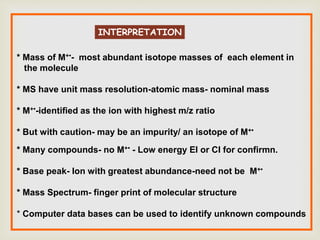
INTERPRETATION
* Mass of M+•- most abundant isotope masses of each element in
the molecule
* MS have unit mass resolution-atomic mass- nominal mass
* M+•-identified as the ion with highest m/z ratio
* But with caution- may be an impurity/ an isotope of M+•
* Many compounds- no M+• - Low energy EI or CI for confirmn.
* Base peak- Ion with greatest abundance-need not be M+•
* Mass Spectrum- finger print of molecular structure
* Computer data bases can be used to identify unknown compounds
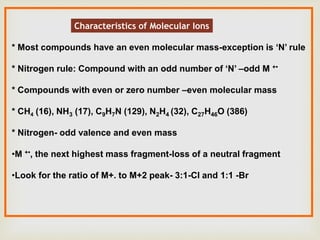
Characteristics of Molecular Ions
* Most compounds have an even molecular mass-exception is ‘N’ rule
* Nitrogen rule: Compound with an odd number of ‘N’ –odd M +•
* Compounds with even or zero number –even molecular mass
* CH4 (16), NH3 (17), C9H7N (129), N2H4 (32), C27H46O (386)
* Nitrogen- odd valence and even mass
•M +•, the next highest mass fragment-loss of a neutral fragment
•Look for the ratio of M+. to M+2 peak- 3:1-Cl and 1:1 -Br
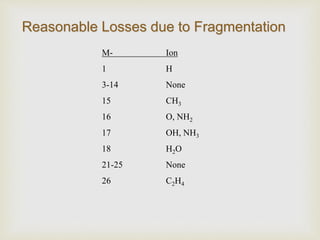
M- Ion
1 H
3-14 None
15 CH3
16 O, NH2
17 OH, NH3
18 H2O
21-25 None
26 C2H4
Reasonable Losses due to Fragmentation
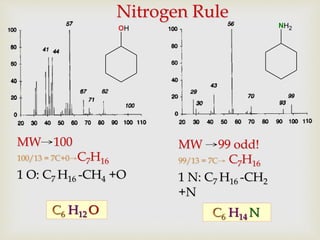
OH NH2
C6 H12 O C6 H14 N
MW→100
100/13 = 7C+0→C7H16
1 O: C7 H16 -CH4 +O
MW →99 odd!
99/13 = 7C→ C7H16
1 N: C7 H16 -CH2
+N
Nitrogen Rule
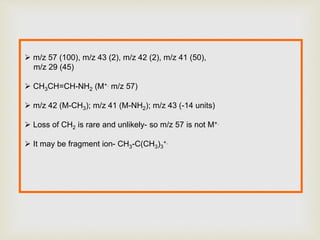
 m/z 57 (100), m/z 43 (2), m/z 42 (2), m/z 41 (50),
m/z 29 (45)
 CH3CH=CH-NH2 (M+. m/z 57)
 m/z 42 (M-CH3); m/z 41 (M-NH2); m/z 43 (-14 units)
 Loss of CH2 is rare and unlikely- so m/z 57 is not M+.
 It may be fragment ion- CH3-C(CH3)3
+.
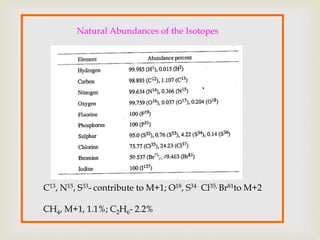
Natural Abundances of the Isotopes
C13, N15, S33- contribute to M+1; O18, S34 Cl35, Br81to M+2
CH4, M+1, 1.1%; C2H6- 2.2%
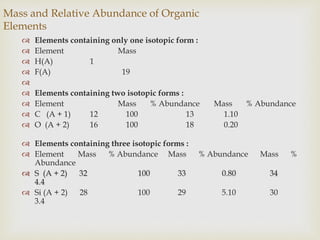
Mass and Relative Abundance of Organic
Elements
 Elements containing only one isotopic form :
 Element Mass
 H(A) 1
 F(A) 19

 Elements containing two isotopic forms :
 Element Mass % Abundance Mass % Abundance
 C (A + 1) 12 100 13 1.10
 O (A + 2) 16 100 18 0.20
 Elements containing three isotopic forms :
 Element Mass % Abundance Mass % Abundance Mass %
Abundance
 S (A + 2) 32 100 33 0.80 34
4.4
 Si (A + 2) 28 100 29 5.10 30
3.4

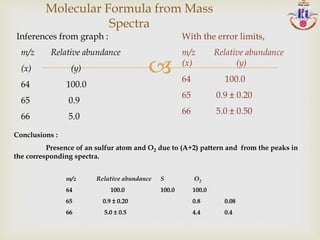
Molecular Formula from Mass
Spectra
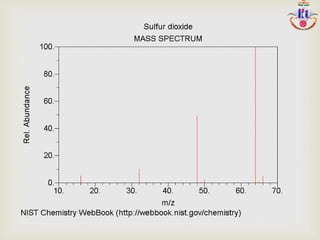
Inferences from graph :
m/z Relative abundance
(x) (y)
64 100.0
65 0.9
66 5.0
With the error limits,
m/z Relative abundance
(x) (y)
64 100.0
65 0.9 ± 0.20
66 5.0 ± 0.50
m/z Relative abundance S O2
64 100.0 100.0 100.0
65 0.9 ± 0.20 0.8 0.08
66 5.0 ± 0.5 4.4 0.4
Conclusions :
Presence of an sulfur atom and O2 due to (A+2) pattern and from the peaks in
the corresponding spectra.
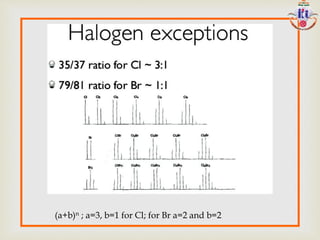
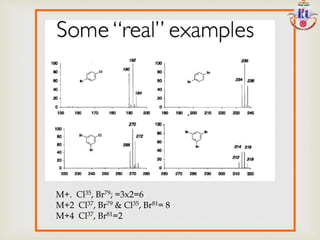
(a+b)n ; a=3, b=1 for Cl; for Br a=2 and b=2
M+. Cl35, Br79; =3x2=6
M+2 Cl37, Br79 & Cl35, Br81= 8
M+4 Cl37, Br81=2
Mass spectral reactions:
Unimolecular, competitive and consecutive
Ions with wide range of internal energy
ABCD + e-  ABCD +• + 2e
ABCD + e-  A +• + BCD•
 AB+ + CD•  A+ + B
 AB• + CD+ C+ + D (I)
 AD+ + BC• (II)
ABCD +• + ABCD  [ ABCD ABCD ]+  ABCDA+(III)
“Cool ions” appear as M +•
(I) Simple cleavages
(II) Rearrangements
(III) ion-molecule reactions
MS FRAGMENTATION OF HYPOTHETICAL MOLECULE
Abundance of ions depends on:
 Stability of the +ve charge in the cation or +.
 ion stabilization- e- sharing –hetero atoms nonbonding
orbital CH3-C + =O  CH3-CO +
 Resonance stabilization:CH2=CH-CH2
+  +CH2-CH=CH2
 Stability of radical or neutral species
 Steric arrangements of atoms or groups of atoms-
favoring Rearrangements
 Stevenson Rule: ABCD+.  A + + BCD• or A . + BCD+
Radical of high IE, Ion of low IE
 Loss of largest alkyl group-most abundance ion-exception
C2H5CH(CH3)-C4H9
+  [C2H5CH(CH3)+] >[CH(CH3)-C4H9
+ ]
> [C2H5CH-C4H9
+] > [C2H5C(CH3)-C4H9
+ ]

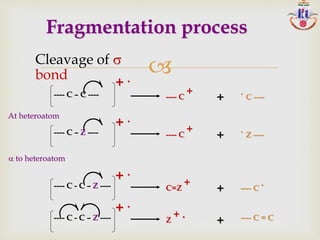
---- C – C ---- ---- C
+ . C ----+
---- C – Z ---- ---- C
+ . Z ----+
At heteroatom
+ .
+ .
a to heteroatom
---- C - C – Z ---- C=Z
+ ---- C
.
+
+ .
---- C - C – Z ---- Z
+ . ---- C = C
+
+ .
Fragmentation process
Cleavage of s
bond

+
.
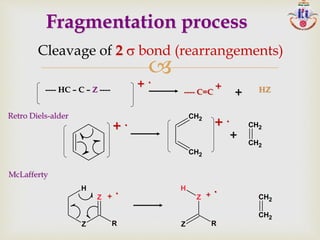
---- HC – C – Z ---- ---- C=C
+ HZ
+
Retro Diels-alder
+ .
CH2
CH2
CH2
CH2
+
+ . + .
McLafferty
Z
H
Z R
CH2
CH2
Z
H
Z R
+
.
Fragmentation process
Cleavage of 2 s bond (rearrangements)

R
R
CH+ < C+
R
R
R
R
R”
CH
R’
Loss of Largest Subst. Is most favored
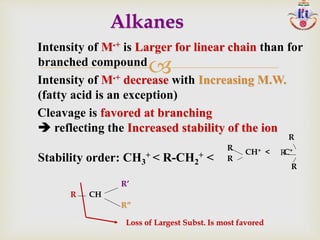
Alkanes
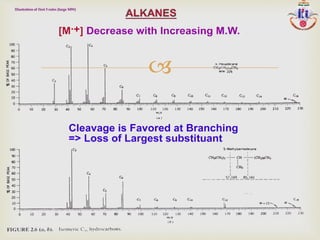
Intensity of M.+ is Larger for linear chain than for
branched compound
Intensity of M.+ decrease with Increasing M.W.
(fatty acid is an exception)
Cleavage is favored at branching
 reflecting the Increased stability of the ion
Stability order: CH3
+ < R-CH2
+ <
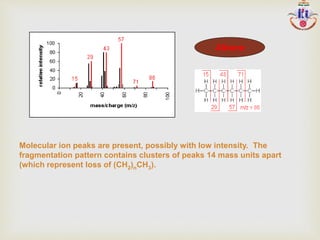
Molecular ion peaks are present, possibly with low intensity. The
fragmentation pattern contains clusters of peaks 14 mass units apart
(which represent loss of (CH2)nCH3).
Alkane

Illustration of first 3 rules (large MW)
CH3
CH3
CH3
CH3
CH3
CH3
CH3
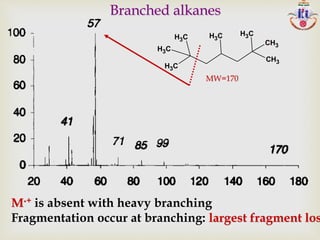
MW=170
M.+ is absent with heavy branching
Fragmentation occur at branching: largest fragment los
Branched alkanes
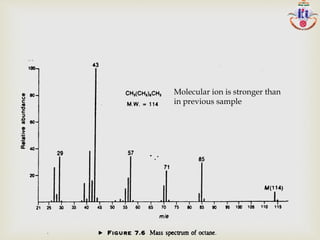
Molecular ion is stronger than
in previous sample
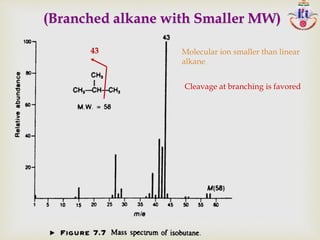
Molecular ion smaller than linear
alkane
Cleavage at branching is favored
43
(Branched alkane with Smaller MW)

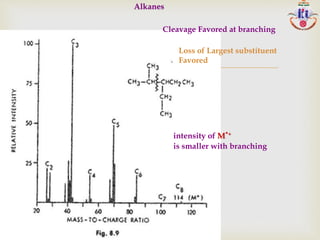
Alkanes
Cleavage Favored at branching
Loss of Largest substituent
Favored
intensity of M
.+
is smaller with branching

CH2
+
CH CH2 R
- R
.
CH2
+
CH CH2
CH2 CH CH2
+
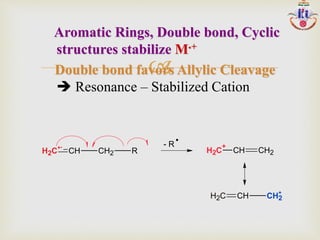
Aromatic Rings, Double bond, Cyclic
structures stabilize M.+
Double bond favors Allylic Cleavage
 Resonance – Stabilized Cation

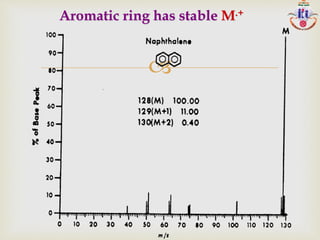
Aromatic ring has stable M.+

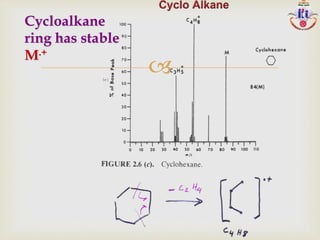
Cycloalkane
ring has stable
M.+
R
+ .
+
-R
.
CH2
CH2
CH2
CH2
+
+ . + .
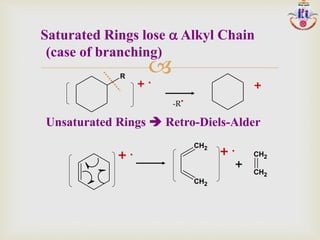
Saturated Rings lose a Alkyl Chain
(case of branching)
Unsaturated Rings  Retro-Diels-Alder

+ . + .
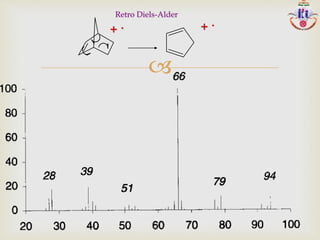
Retro Diels-Alder
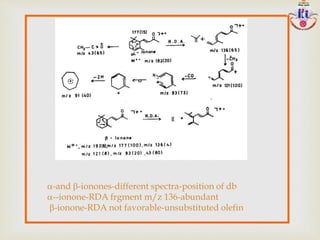
a-and -ionones-different spectra-position of db
a--ionone-RDA frgment m/z 136-abundant
-ionone-RDA not favorable-unsubstituted olefin

C
CH
+
R
-R
.
CH
+
CH2 CH2
+
+
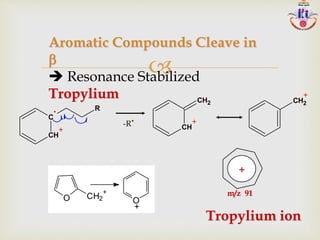
m/z 91
O CH2
+
O
+
Aromatic Compounds Cleave in

 Resonance Stabilized
Tropylium
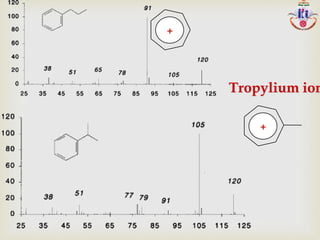
Tropylium ion
+
+
Tropylium ion

R CH2 CH2 Y R
x
CH2 Y R
+
CH2
+
Y R
x
R2
C
R1
O
C
R1
O
+
C
+
R1
O
- [RCH2]
- [R2]
larger
C-C Next to Heteroatom cleave leaving
the charge on the Heteroatom
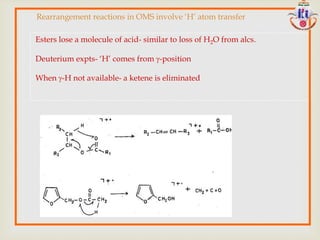
Esters lose a molecule of acid- similar to loss of H2O from alcs.
Deuterium expts- ‘H’ comes from -position
When -H not available- a ketene is eliminated
Rearrangement reactions in OMS involve ‘H’ atom transfer

x
CH2
CH2
H
CH2
O
C
Y
x
CH2
CH2
H
CH2
O
C
Y
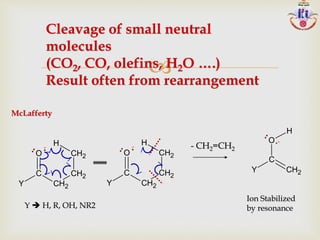
McLafferty
Y  H, R, OH, NR2
Ion Stabilized
by resonance
- CH2=CH2
x
CH2
O
C
Y
H
Cleavage of small neutral
molecules
(CO2, CO, olefins, H2O ….)
Result often from rearrangement
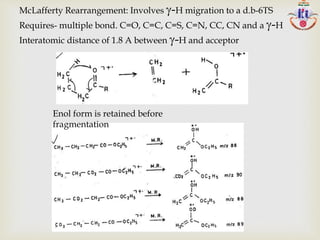
McLafferty Rearrangement: Involves -H migration to a d.b-6TS
Requires- multiple bond. C=O, C=C, C=S, C=N, CC, CN and a -H
Interatomic distance of 1.8 A between -H and acceptor
Enol form is retained before
fragmentation
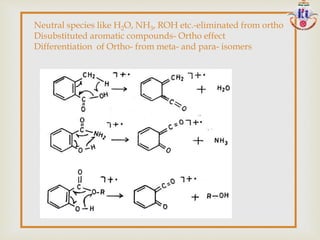
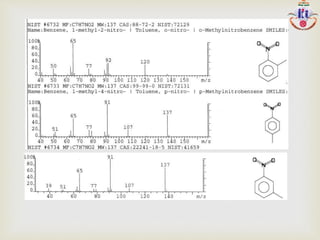
Neutral species like H2O, NH3, ROH etc.-eliminated from ortho
Disubstituted aromatic compounds- Ortho effect
Differentiation of Ortho- from meta- and para- isomers

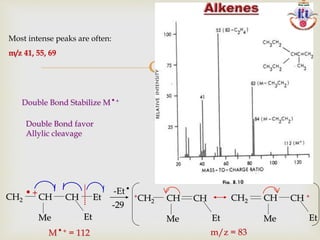
-Et
-29
Most intense peaks are often:
m/z 41, 55, 69
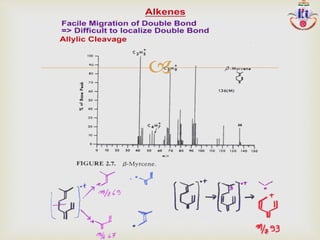
Double Bond Stabilize M+
Double Bond favor
Allylic cleavage
CH2 CH CH+ Et
EtMe
+CH2 CH CH
EtMe
CH2 CH CH +
EtMe
M+ = 112 m/z = 83

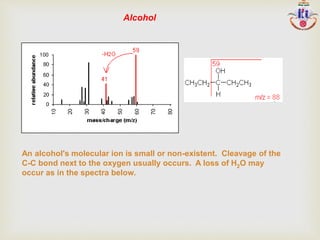
Alcohol
An alcohol's molecular ion is small or non-existent. Cleavage of the
C-C bond next to the oxygen usually occurs. A loss of H2O may
occur as in the spectra below.
16
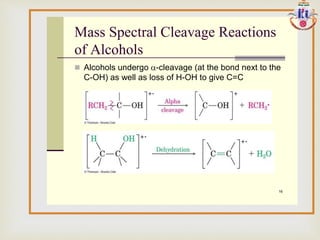
Mass Spectral Cleavage Reactions
of Alcohols
 Alcohols undergo a-cleavage (at the bond next to the
C-OH) as well as loss of H-OH to give C=C

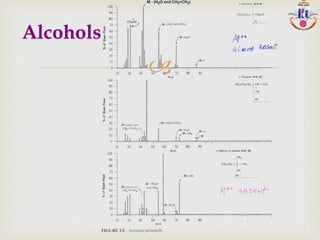
Alcohols

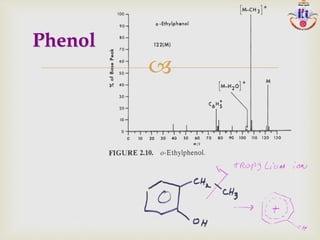
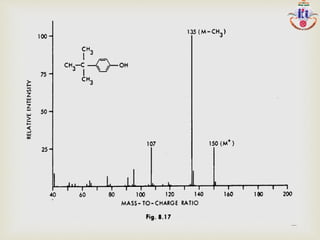
Phenol
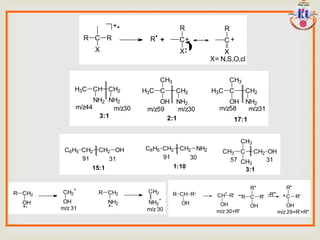
H3C CH
NH2
CH2
NH2
m/z30m/z44
3:1
H3C C
OH
CH2
NH2
CH3
m/z59 m/z30
2:1
H3C C
OH
CH2
NH2
CH3
m/z58 m/z31
17:1
C6H5 CH2 CH2 OH
91 31
15:1
C6H5 CH2 CH2 NH2
91 30
1:10
CH3 C CH2
CH3
CH3
OH
57 31
3:1
R CH2
OH
CH2
+
OH
+.
R CH2
NH2
CH2
NH2
+
+.
m/z 31 m/z 30
R CH R
OH
CH
+
R'
OH
m/z 30+R'
' "'R C R'
OH
R"
-R"' C R'
OH
R"
+
m/z 29+R'+R"
+.
C
R
X
+ C
R
X
+R C
X
R R
.
:
+
X= N,S,O,cl
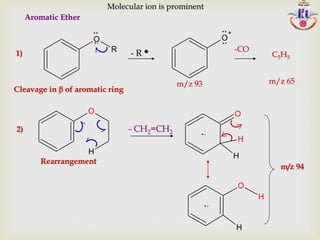
Molecular ion is prominent
1)
Cleavage in  of aromatic ring
Rearrangement
2)
x
O
R
O
+
C5H5
-CO
m/z 93 m/z 65
O
H
- CH2=CH2 x
O
H
H
x
O
H
H
m/z 94
- R
Aromatic Ether

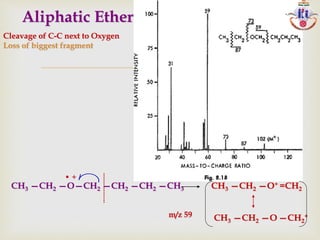
• +
B
CH3 —CH2 —O—CH2 —CH2 —CH2 —CH3 CH3 —CH2 —O+ =CH2
CH3 —CH2 —O —CH2
+
Cleavage of C-C next to Oxygen
Loss of biggest fragment
m/z 59
Aliphatic Ether
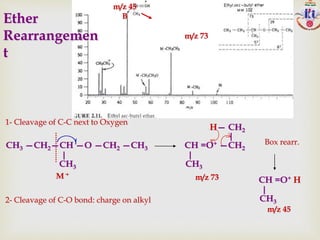
m/z 73
m/z 45
B
CH3 —CH2—CH —O —CH2 —CH3
CH3
CH =O+ —CH2
CH3
H— CH2
Box rearr.
CH =O+ H
CH3
1- Cleavage of C-C next to Oxygen
m/z 73
m/z 45
M·+
2- Cleavage of C-O bond: charge on alkyl
Ether
Rearrangemen
t
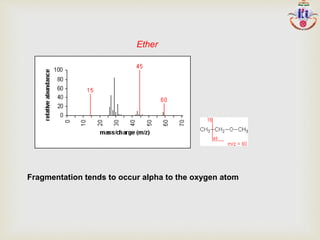
Ether
Fragmentation tends to occur alpha to the oxygen atom
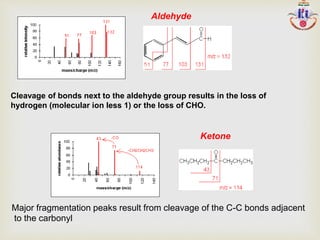
Aldehyde
Cleavage of bonds next to the aldehyde group results in the loss of
hydrogen (molecular ion less 1) or the loss of CHO.
Major fragmentation peaks result from cleavage of the C-C bonds adjacent
to the carbonyl
Ketone
Carboxylic Acid
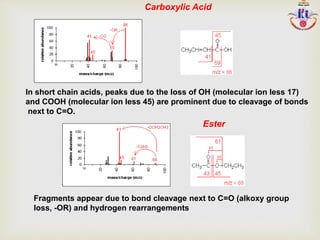
In short chain acids, peaks due to the loss of OH (molecular ion less 17)
and COOH (molecular ion less 45) are prominent due to cleavage of bonds
next to C=O.
Ester
Fragments appear due to bond cleavage next to C=O (alkoxy group
loss, -OR) and hydrogen rearrangements
Amide
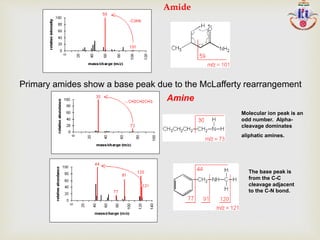
Primary amides show a base peak due to the McLafferty rearrangement
Amine
Molecular ion peak is an
odd number. Alpha-
cleavage dominates
aliphatic amines.
The base peak is
from the C-C
cleavage adjacent
to the C-N bond.
Halide
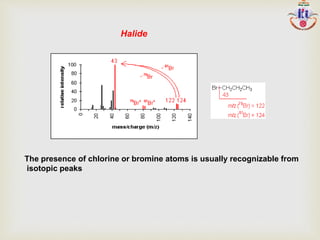
The presence of chlorine or bromine atoms is usually recognizable from
isotopic peaks

Ms interpretation

  • 1.
  • 2.
    INTERPRETATION * Mass ofM+•- most abundant isotope masses of each element in the molecule * MS have unit mass resolution-atomic mass- nominal mass * M+•-identified as the ion with highest m/z ratio * But with caution- may be an impurity/ an isotope of M+• * Many compounds- no M+• - Low energy EI or CI for confirmn. * Base peak- Ion with greatest abundance-need not be M+• * Mass Spectrum- finger print of molecular structure * Computer data bases can be used to identify unknown compounds
  • 3.
    Characteristics of MolecularIons * Most compounds have an even molecular mass-exception is ‘N’ rule * Nitrogen rule: Compound with an odd number of ‘N’ –odd M +• * Compounds with even or zero number –even molecular mass * CH4 (16), NH3 (17), C9H7N (129), N2H4 (32), C27H46O (386) * Nitrogen- odd valence and even mass •M +•, the next highest mass fragment-loss of a neutral fragment •Look for the ratio of M+. to M+2 peak- 3:1-Cl and 1:1 -Br
  • 4.
    M- Ion 1 H 3-14None 15 CH3 16 O, NH2 17 OH, NH3 18 H2O 21-25 None 26 C2H4 Reasonable Losses due to Fragmentation
  • 5.
    OH NH2 C6 H12O C6 H14 N MW→100 100/13 = 7C+0→C7H16 1 O: C7 H16 -CH4 +O MW →99 odd! 99/13 = 7C→ C7H16 1 N: C7 H16 -CH2 +N Nitrogen Rule
  • 6.
     m/z 57(100), m/z 43 (2), m/z 42 (2), m/z 41 (50), m/z 29 (45)  CH3CH=CH-NH2 (M+. m/z 57)  m/z 42 (M-CH3); m/z 41 (M-NH2); m/z 43 (-14 units)  Loss of CH2 is rare and unlikely- so m/z 57 is not M+.  It may be fragment ion- CH3-C(CH3)3 +.
  • 7.
    Natural Abundances ofthe Isotopes C13, N15, S33- contribute to M+1; O18, S34 Cl35, Br81to M+2 CH4, M+1, 1.1%; C2H6- 2.2%
  • 8.
    Mass and RelativeAbundance of Organic Elements  Elements containing only one isotopic form :  Element Mass  H(A) 1  F(A) 19   Elements containing two isotopic forms :  Element Mass % Abundance Mass % Abundance  C (A + 1) 12 100 13 1.10  O (A + 2) 16 100 18 0.20  Elements containing three isotopic forms :  Element Mass % Abundance Mass % Abundance Mass % Abundance  S (A + 2) 32 100 33 0.80 34 4.4  Si (A + 2) 28 100 29 5.10 30 3.4
  • 10.
     Molecular Formula fromMass Spectra Inferences from graph : m/z Relative abundance (x) (y) 64 100.0 65 0.9 66 5.0 With the error limits, m/z Relative abundance (x) (y) 64 100.0 65 0.9 ± 0.20 66 5.0 ± 0.50 m/z Relative abundance S O2 64 100.0 100.0 100.0 65 0.9 ± 0.20 0.8 0.08 66 5.0 ± 0.5 4.4 0.4 Conclusions : Presence of an sulfur atom and O2 due to (A+2) pattern and from the peaks in the corresponding spectra.
  • 11.
    (a+b)n ; a=3,b=1 for Cl; for Br a=2 and b=2
  • 12.
    M+. Cl35, Br79;=3x2=6 M+2 Cl37, Br79 & Cl35, Br81= 8 M+4 Cl37, Br81=2
  • 13.
    Mass spectral reactions: Unimolecular,competitive and consecutive Ions with wide range of internal energy ABCD + e-  ABCD +• + 2e ABCD + e-  A +• + BCD•  AB+ + CD•  A+ + B  AB• + CD+ C+ + D (I)  AD+ + BC• (II) ABCD +• + ABCD  [ ABCD ABCD ]+  ABCDA+(III) “Cool ions” appear as M +• (I) Simple cleavages (II) Rearrangements (III) ion-molecule reactions MS FRAGMENTATION OF HYPOTHETICAL MOLECULE
  • 14.
    Abundance of ionsdepends on:  Stability of the +ve charge in the cation or +.  ion stabilization- e- sharing –hetero atoms nonbonding orbital CH3-C + =O  CH3-CO +  Resonance stabilization:CH2=CH-CH2 +  +CH2-CH=CH2  Stability of radical or neutral species  Steric arrangements of atoms or groups of atoms- favoring Rearrangements  Stevenson Rule: ABCD+.  A + + BCD• or A . + BCD+ Radical of high IE, Ion of low IE  Loss of largest alkyl group-most abundance ion-exception C2H5CH(CH3)-C4H9 +  [C2H5CH(CH3)+] >[CH(CH3)-C4H9 + ] > [C2H5CH-C4H9 +] > [C2H5C(CH3)-C4H9 + ]
  • 15.
     ---- C –C ---- ---- C + . C ----+ ---- C – Z ---- ---- C + . Z ----+ At heteroatom + . + . a to heteroatom ---- C - C – Z ---- C=Z + ---- C . + + . ---- C - C – Z ---- Z + . ---- C = C + + . Fragmentation process Cleavage of s bond
  • 16.
     + . ---- HC –C – Z ---- ---- C=C + HZ + Retro Diels-alder + . CH2 CH2 CH2 CH2 + + . + . McLafferty Z H Z R CH2 CH2 Z H Z R + . Fragmentation process Cleavage of 2 s bond (rearrangements)
  • 17.
     R R CH+ < C+ R R R R R” CH R’ Lossof Largest Subst. Is most favored Alkanes Intensity of M.+ is Larger for linear chain than for branched compound Intensity of M.+ decrease with Increasing M.W. (fatty acid is an exception) Cleavage is favored at branching  reflecting the Increased stability of the ion Stability order: CH3 + < R-CH2 + <
  • 18.
    Molecular ion peaksare present, possibly with low intensity. The fragmentation pattern contains clusters of peaks 14 mass units apart (which represent loss of (CH2)nCH3). Alkane
  • 19.
     Illustration of first3 rules (large MW)
  • 20.
    CH3 CH3 CH3 CH3 CH3 CH3 CH3 MW=170 M.+ is absentwith heavy branching Fragmentation occur at branching: largest fragment los Branched alkanes
  • 21.
    Molecular ion isstronger than in previous sample
  • 22.
    Molecular ion smallerthan linear alkane Cleavage at branching is favored 43 (Branched alkane with Smaller MW)
  • 23.
     Alkanes Cleavage Favored atbranching Loss of Largest substituent Favored intensity of M .+ is smaller with branching
  • 24.
     CH2 + CH CH2 R -R . CH2 + CH CH2 CH2 CH CH2 + Aromatic Rings, Double bond, Cyclic structures stabilize M.+ Double bond favors Allylic Cleavage  Resonance – Stabilized Cation
  • 25.
  • 26.
  • 27.
    R + . + -R . CH2 CH2 CH2 CH2 + + .+ . Saturated Rings lose a Alkyl Chain (case of branching) Unsaturated Rings  Retro-Diels-Alder
  • 28.
     + . +. Retro Diels-Alder
  • 29.
    a-and -ionones-different spectra-positionof db a--ionone-RDA frgment m/z 136-abundant -ionone-RDA not favorable-unsubstituted olefin
  • 30.
     C CH + R -R . CH + CH2 CH2 + + m/z 91 OCH2 + O + Aromatic Compounds Cleave in   Resonance Stabilized Tropylium Tropylium ion
  • 31.
  • 32.
     R CH2 CH2Y R x CH2 Y R + CH2 + Y R x R2 C R1 O C R1 O + C + R1 O - [RCH2] - [R2] larger C-C Next to Heteroatom cleave leaving the charge on the Heteroatom
  • 33.
    Esters lose amolecule of acid- similar to loss of H2O from alcs. Deuterium expts- ‘H’ comes from -position When -H not available- a ketene is eliminated Rearrangement reactions in OMS involve ‘H’ atom transfer
  • 34.
     x CH2 CH2 H CH2 O C Y x CH2 CH2 H CH2 O C Y McLafferty Y  H,R, OH, NR2 Ion Stabilized by resonance - CH2=CH2 x CH2 O C Y H Cleavage of small neutral molecules (CO2, CO, olefins, H2O ….) Result often from rearrangement
  • 35.
    McLafferty Rearrangement: Involves-H migration to a d.b-6TS Requires- multiple bond. C=O, C=C, C=S, C=N, CC, CN and a -H Interatomic distance of 1.8 A between -H and acceptor Enol form is retained before fragmentation
  • 36.
    Neutral species likeH2O, NH3, ROH etc.-eliminated from ortho Disubstituted aromatic compounds- Ortho effect Differentiation of Ortho- from meta- and para- isomers
  • 38.
     -Et -29 Most intense peaksare often: m/z 41, 55, 69 Double Bond Stabilize M+ Double Bond favor Allylic cleavage CH2 CH CH+ Et EtMe +CH2 CH CH EtMe CH2 CH CH + EtMe M+ = 112 m/z = 83
  • 39.
  • 40.
    Alcohol An alcohol's molecularion is small or non-existent. Cleavage of the C-C bond next to the oxygen usually occurs. A loss of H2O may occur as in the spectra below.
  • 41.
    16 Mass Spectral CleavageReactions of Alcohols  Alcohols undergo a-cleavage (at the bond next to the C-OH) as well as loss of H-OH to give C=C
  • 42.
  • 43.
  • 45.
    H3C CH NH2 CH2 NH2 m/z30m/z44 3:1 H3C C OH CH2 NH2 CH3 m/z59m/z30 2:1 H3C C OH CH2 NH2 CH3 m/z58 m/z31 17:1 C6H5 CH2 CH2 OH 91 31 15:1 C6H5 CH2 CH2 NH2 91 30 1:10 CH3 C CH2 CH3 CH3 OH 57 31 3:1 R CH2 OH CH2 + OH +. R CH2 NH2 CH2 NH2 + +. m/z 31 m/z 30 R CH R OH CH + R' OH m/z 30+R' ' "'R C R' OH R" -R"' C R' OH R" + m/z 29+R'+R" +. C R X + C R X +R C X R R . : + X= N,S,O,cl
  • 46.
    Molecular ion isprominent 1) Cleavage in  of aromatic ring Rearrangement 2) x O R O + C5H5 -CO m/z 93 m/z 65 O H - CH2=CH2 x O H H x O H H m/z 94 - R Aromatic Ether
  • 47.
     • + B CH3 —CH2—O—CH2 —CH2 —CH2 —CH3 CH3 —CH2 —O+ =CH2 CH3 —CH2 —O —CH2 + Cleavage of C-C next to Oxygen Loss of biggest fragment m/z 59 Aliphatic Ether
  • 48.
    m/z 73 m/z 45 B CH3—CH2—CH —O —CH2 —CH3 CH3 CH =O+ —CH2 CH3 H— CH2 Box rearr. CH =O+ H CH3 1- Cleavage of C-C next to Oxygen m/z 73 m/z 45 M·+ 2- Cleavage of C-O bond: charge on alkyl Ether Rearrangemen t
  • 49.
    Ether Fragmentation tends tooccur alpha to the oxygen atom
  • 50.
    Aldehyde Cleavage of bondsnext to the aldehyde group results in the loss of hydrogen (molecular ion less 1) or the loss of CHO. Major fragmentation peaks result from cleavage of the C-C bonds adjacent to the carbonyl Ketone
  • 51.
    Carboxylic Acid In shortchain acids, peaks due to the loss of OH (molecular ion less 17) and COOH (molecular ion less 45) are prominent due to cleavage of bonds next to C=O. Ester Fragments appear due to bond cleavage next to C=O (alkoxy group loss, -OR) and hydrogen rearrangements
  • 52.
    Amide Primary amides showa base peak due to the McLafferty rearrangement Amine Molecular ion peak is an odd number. Alpha- cleavage dominates aliphatic amines. The base peak is from the C-C cleavage adjacent to the C-N bond.
  • 53.
    Halide The presence ofchlorine or bromine atoms is usually recognizable from isotopic peaks