WOODWARD FIESER RULES
AND APPLICATIONS
Pharmaceutical Analysis
DECLERATION
• A TEXT BOOK OF ORGANIC SPECTROSCOPY BY
P.S KALSI (PAGE # 40).
• A TEXT BOOK OF UV-VISIBLE AND INFRARED
SPECTROSCOPY BY RAJASHEKARAN (PAGE # 88-
100).
• INTRODUCTION TO SPECTROSCOPY BY PAVIA
(PAGE # 590).
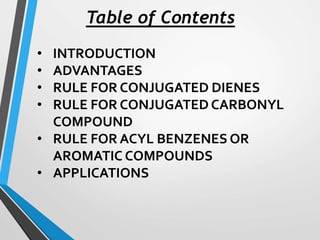
Table of Contents
• INTRODUCTION
• ADVANTAGES
• RULE FOR CONJUGATED DIENES
• RULE FOR CONJUGATED CARBONYL
COMPOUND
• RULE FOR ACYL BENZENES OR
AROMATIC COMPOUNDS
• APPLICATIONS
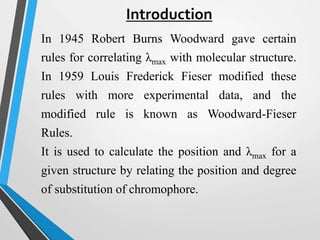
Introduction
In 1945 Robert Burns Woodward gave certain
rules for correlating λmax with molecular structure.
In 1959 Louis Frederick Fieser modified these
rules with more experimental data, and the
modified rule is known as Woodward-Fieser
Rules.
It is used to calculate the position and λmax for a
given structure by relating the position and degree
of substitution of chromophore.
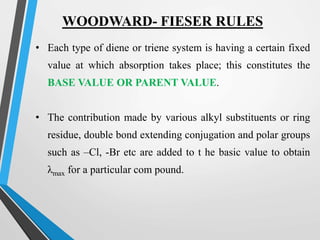
• Each type of diene or triene system is having a certain fixed
value at which absorption takes place; this constitutes the
BASE VALUE OR PARENT VALUE.
• The contribution made by various alkyl substituents or ring
residue, double bond extending conjugation and polar groups
such as –Cl, -Br etc are added to t he basic value to obtain
λmax for a particular com pound.
WOODWARD- FIESER RULES
• It is used to calculate the position and
maximum wave length for a given structure.
• By relating the position and degree of
substitution of chromophore
ADVANTAGES
RULE FOR CONJUGATED DIENES
 Conjugated dienes and polyenes are found in
most organic compounds.
 Longer the conjugated system, greater the
wavelength of absorption maximum.
 According to Woodward’s rules the λmax of the
molecule can be calculated using a formula:
λmax = Base value + Σ Substituent
Contributions + Σ Other Contributions.
BaseValue
 Each type of diene or triene system is having a
certain fixed value at which absorption takes
place; this constitutes the Base value or
Parent value.
 The first step in predicting the wavelength of
maximum UV absorption for conjugated dienes is to
determine whether it lies in an s-trans or s-cis
conformation.
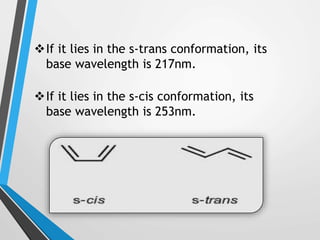
If it lies in the s-trans conformation, its
base wavelength is 217nm.
If it lies in the s-cis conformation, its
base wavelength is 253nm.
 the base value depends upon whether the
diene is a linear or hetero-annular or
transoid diene, or whether it is a cyclic or
homo-annular diene.
 The sum of all substituent contributions are
added to the base value to obtain the
wavelength of maximum absorption of the
molecule.
Woodward Fieser rule for
Conjugated Dienes and Polyenes
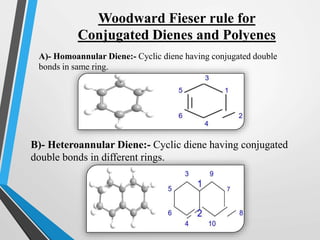
A)- Homoannular Diene:- Cyclic diene having conjugated double
bonds in same ring.
B)- Heteroannular Diene:- Cyclic diene having conjugated
double bonds in different rings.
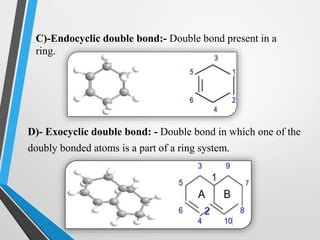
C)-Endocyclic double bond:- Double bond present in a
ring.
D)- Exocyclic double bond: - Double bond in which one of the
doubly bonded atoms is a part of a ring system.
E)- Double bond extending :- When more double bonds are
present other than conjugations.
Parent values and increments for
different Substituents or Groups
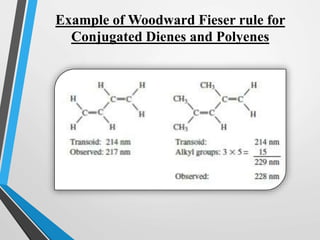
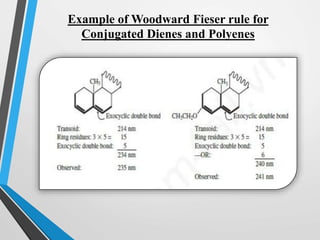
Example of Woodward Fieser rule for
Conjugated Dienes and Polyenes
Example of Woodward Fieser rule for
Conjugated Dienes and Polyenes
Woodward Fieser rule for α,β -
unsaturated Carbonyl compounds
Woodward-Fieser rules can be extended to calculate
the λmax of α,β-unsaturated carbonyl compounds. In
a similar manner to Woodward rules for dienes
discussed previously, there is base value to which the
substituent effects can be added and the λmax can be
calculated using the formula:
λMAX = BASE VALUE + Σ SUBSTITUENT
CONTRIBUTIONS + Σ OTHER CONTRIBUTIONS
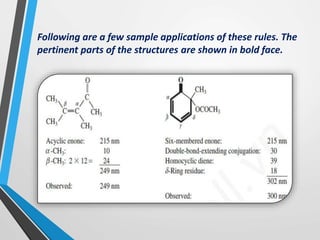
Following are a few sample applications of these rules. The
pertinent parts of the structures are shown in bold face.
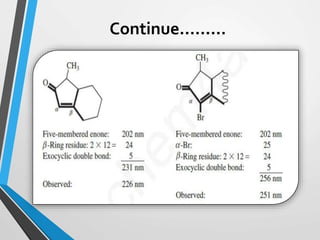
Continue………
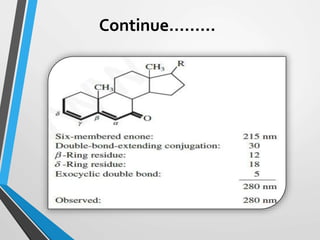
Continue………
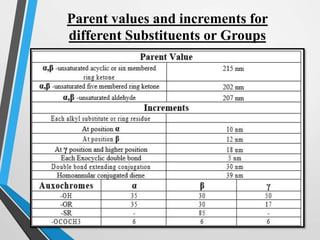
Parent values and increments for
different Substituents or Groups
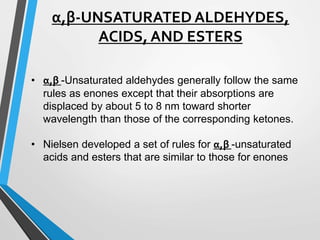
α,β-UNSATURATED ALDEHYDES,
ACIDS, AND ESTERS
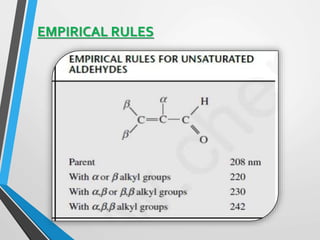
• α,β -Unsaturated aldehydes generally follow the same
rules as enones except that their absorptions are
displaced by about 5 to 8 nm toward shorter
wavelength than those of the corresponding ketones.
• Nielsen developed a set of rules for α,β -unsaturated
acids and esters that are similar to those for enones
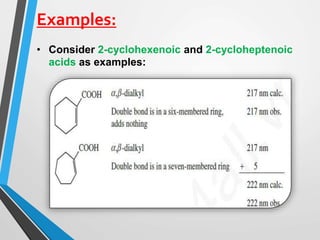
Examples:
• Consider 2-cyclohexenoic and 2-cycloheptenoic
acids as examples:
EMPIRICAL RULES
Woodward Fieser rule for Aromatic
compounds or Benzoyl derivatives.
The absorption that result from transitions within the
benzene chromophore can be quite complex. The
ultraviolet spectrum contains three absorption bands,
which sometimes contain a great deal of fine structure.
The electronic transitions are basically of the ∏ ∏*
type.
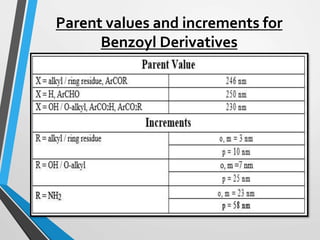
Parent values and increments for
Benzoyl Derivatives
Woodward Fieser Rules

Woodward Fieser Rules

  • 2.
    WOODWARD FIESER RULES ANDAPPLICATIONS Pharmaceutical Analysis
  • 3.
    DECLERATION • A TEXTBOOK OF ORGANIC SPECTROSCOPY BY P.S KALSI (PAGE # 40). • A TEXT BOOK OF UV-VISIBLE AND INFRARED SPECTROSCOPY BY RAJASHEKARAN (PAGE # 88- 100). • INTRODUCTION TO SPECTROSCOPY BY PAVIA (PAGE # 590).
  • 4.
    Table of Contents •INTRODUCTION • ADVANTAGES • RULE FOR CONJUGATED DIENES • RULE FOR CONJUGATED CARBONYL COMPOUND • RULE FOR ACYL BENZENES OR AROMATIC COMPOUNDS • APPLICATIONS
  • 5.
    Introduction In 1945 RobertBurns Woodward gave certain rules for correlating λmax with molecular structure. In 1959 Louis Frederick Fieser modified these rules with more experimental data, and the modified rule is known as Woodward-Fieser Rules. It is used to calculate the position and λmax for a given structure by relating the position and degree of substitution of chromophore.
  • 6.
    • Each typeof diene or triene system is having a certain fixed value at which absorption takes place; this constitutes the BASE VALUE OR PARENT VALUE. • The contribution made by various alkyl substituents or ring residue, double bond extending conjugation and polar groups such as –Cl, -Br etc are added to t he basic value to obtain λmax for a particular com pound. WOODWARD- FIESER RULES
  • 7.
    • It isused to calculate the position and maximum wave length for a given structure. • By relating the position and degree of substitution of chromophore ADVANTAGES
  • 8.
    RULE FOR CONJUGATEDDIENES  Conjugated dienes and polyenes are found in most organic compounds.  Longer the conjugated system, greater the wavelength of absorption maximum.  According to Woodward’s rules the λmax of the molecule can be calculated using a formula: λmax = Base value + Σ Substituent Contributions + Σ Other Contributions.
  • 9.
    BaseValue  Each typeof diene or triene system is having a certain fixed value at which absorption takes place; this constitutes the Base value or Parent value.  The first step in predicting the wavelength of maximum UV absorption for conjugated dienes is to determine whether it lies in an s-trans or s-cis conformation.
  • 10.
    If it liesin the s-trans conformation, its base wavelength is 217nm. If it lies in the s-cis conformation, its base wavelength is 253nm.
  • 11.
     the basevalue depends upon whether the diene is a linear or hetero-annular or transoid diene, or whether it is a cyclic or homo-annular diene.  The sum of all substituent contributions are added to the base value to obtain the wavelength of maximum absorption of the molecule.
  • 12.
    Woodward Fieser rulefor Conjugated Dienes and Polyenes A)- Homoannular Diene:- Cyclic diene having conjugated double bonds in same ring. B)- Heteroannular Diene:- Cyclic diene having conjugated double bonds in different rings.
  • 13.
    C)-Endocyclic double bond:-Double bond present in a ring. D)- Exocyclic double bond: - Double bond in which one of the doubly bonded atoms is a part of a ring system.
  • 14.
    E)- Double bondextending :- When more double bonds are present other than conjugations.
  • 15.
    Parent values andincrements for different Substituents or Groups
  • 16.
    Example of WoodwardFieser rule for Conjugated Dienes and Polyenes
  • 17.
    Example of WoodwardFieser rule for Conjugated Dienes and Polyenes
  • 18.
    Woodward Fieser rulefor α,β - unsaturated Carbonyl compounds Woodward-Fieser rules can be extended to calculate the λmax of α,β-unsaturated carbonyl compounds. In a similar manner to Woodward rules for dienes discussed previously, there is base value to which the substituent effects can be added and the λmax can be calculated using the formula: λMAX = BASE VALUE + Σ SUBSTITUENT CONTRIBUTIONS + Σ OTHER CONTRIBUTIONS
  • 19.
    Following are afew sample applications of these rules. The pertinent parts of the structures are shown in bold face.
  • 20.
  • 21.
  • 22.
    Parent values andincrements for different Substituents or Groups
  • 23.
    α,β-UNSATURATED ALDEHYDES, ACIDS, ANDESTERS • α,β -Unsaturated aldehydes generally follow the same rules as enones except that their absorptions are displaced by about 5 to 8 nm toward shorter wavelength than those of the corresponding ketones. • Nielsen developed a set of rules for α,β -unsaturated acids and esters that are similar to those for enones
  • 24.
    Examples: • Consider 2-cyclohexenoicand 2-cycloheptenoic acids as examples:
  • 25.
  • 26.
    Woodward Fieser rulefor Aromatic compounds or Benzoyl derivatives. The absorption that result from transitions within the benzene chromophore can be quite complex. The ultraviolet spectrum contains three absorption bands, which sometimes contain a great deal of fine structure. The electronic transitions are basically of the ∏ ∏* type.
  • 27.
    Parent values andincrements for Benzoyl Derivatives