Assistant Prof. Dr. Noor H. Naser
Aldabagh
CHROMOPHORE
 Chromophore is defined as the nucleus or any
isolated covalently bonded group responsible for
the absorption of light radiation. Any group
which exhibits absorption of electromagnetic
radiations in the visible or ultraviolet region. As
C=C , C=O ,NO2 etc.
 Some of the important chromophores are
carbonyls, acids, esters, nitrile, ethylene groups.
Assistant Prof. Dr. Noor Hatef 2
Absorption Characteristics of
Some Common
Chromophores
Assistant Prof. Dr. Noor Hatef 3
AUXOCHROM
E
 These are co-ordinatively saturated or
un-saturated groups which themselves do not
absorb radiation, but enhance
s
when present along with a
chromophore the absorbing properties
of chromophore.
 Also known as colour enhancing group.
 All auxochromes have one or more non-bonding
pair of electrons. Examples (-NH2 ,-OH ,-OR,-
COOH etc)
 Itextend the conjugation of a chromophore
by sharing the non-bonding electrons.
Assistant Prof. Dr. Noor Hatef 4
Assistant Prof. Dr. Noor Hatef 5
Effect of Solvent on
Absorption
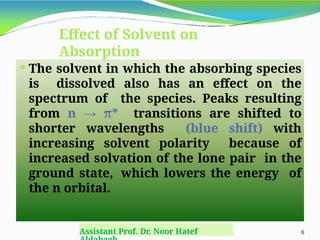
 The solvent in which the absorbing species
is dissolved also has an effect on the
spectrum of the species. Peaks resulting
from n → π* transitions are shifted to
shorter wavelengths (blue shift) with
increasing solvent polarity because of
increased solvation of the lone pair in the
ground state, which lowers the energy of
the n orbital.
Assistant Prof. Dr. Noor Hatef 6
Effect of Solvent on
Absorption
Assistant Prof. Dr. Noor Hatef 7
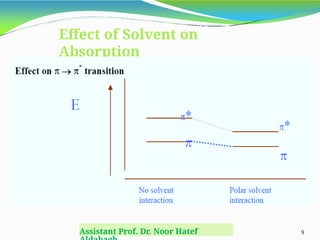
Effect of Solvent on
Absorption
 Often
the
reverse (red shift) is seen for π →
π*
transitions. This is caused by attractive
polarization forces between the solvent and the
absorbing molecule, which lower the energy
levels of both the excited and unexcited states.
The effect being greater for the excited state, the
energy difference between the excited and
unexcited states is slightly reduced, resulting in a
small red shift. This effect can also influence n →
π* transitions but cannot be observed due to the
dominant blue shift resulting from solvation of
lone pairs.
Assistant Prof. Dr. Noor Hatef 8
Effect of Solvent on
Absorption
Assistant Prof. Dr. Noor Hatef 9
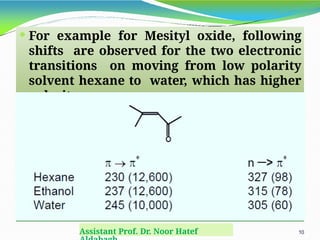
 For example for Mesityl oxide, following
shifts are observed for the two electronic
transitions on moving from low polarity
solvent hexane to water, which has higher
polarity.
Assistant Prof. Dr. Noor Hatef 10
TERMS USED IN
UV- VISIBLE
SPECTROSCOPY
Assistant Prof. Dr. Noor Hatef 11
Bathochromic shift(red
shift)
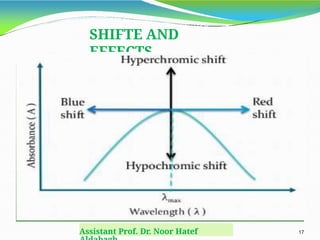
 When the absorption maxima(λmax)of a
compound shifts to longer wave length, it is
known as bathochromic shift or red shift.
 The effect is due to the presence of
auxochrome or by change of solvent.
 Eg: The n-π* transition for carbonyl
compounds experiences bathochromic
shift when the polarity of solvent is
decreased.
Assistant Prof. Dr. Noor Hatef 12
Hypsochromic shift(blue
shift)
 When the absorption maxima(λmax) of a
compound shifts to a shorter wave length,
it is known as hypsochromic shift or blue
shift.
 The effect is due to the presence of a group
causes removal of conjugation or by
change of solvent.
Assistant Prof. Dr. Noor Hatef 13
 Aniline shows blue shift in acidic medium science
it loses conjugation. (Aniline 280 nm, while
anilinium ion 203 nm)
Assistant Prof. Dr. Noor Hatef 14
Hyperchromic
effect
 When the absorption intensity (ε) of a
compound is increased, it is known as
hyperchromic shift.
 The introduction of auxochrome usually increase
the absorption intensity.
Assistant Prof. Dr. Noor Hatef 15
Hypochromic
effect
 When the absorption intensity (ε) of a
compound is decreased, it is known as
hypochromic shift.
 The introduction of a group that distorts the
geometry of molecule usually reduce the
absorption intensity.
Assistant Prof. Dr. Noor Hatef 16
SHIFTE AND
EFFECTS
Assistant Prof. Dr. Noor Hatef 17
Conjugated System and Unconjugated
System
 Unconjugated System
 Due to π → π* electronic transition unconjugated
alkenes absorb below 200 nm, e.g., ethene shows
an absorption at 171 nm. Alkyl substituents or the
ring residues attached to the olefinic carbon shift
the absorption band towards longer wavelength
as can be seen with absorption pattern of
compounds like 1-Octene and cyclohexene which
absorb at 177 nm and 182 nm, respectively.
Assistant Prof. Dr. Noor Hatef 18
Conjugated System and Unconjugated
System
 Conjugated System
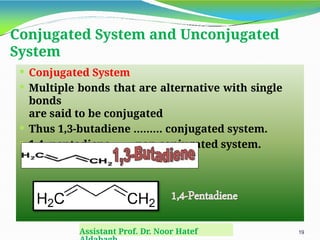
 Multiple bonds that are alternative with single
bonds
are said to be conjugated
 Thus 1,3-butadiene ……… conjugated system.
 1,4- pentadiene …… non conjugated system.
Assistant Prof. Dr. Noor Hatef 19
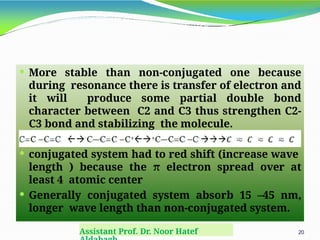
 More stable than non-conjugated one because
during resonance there is transfer of electron and
it will produce some partial double bond
character between C2 and C3 thus strengthen C2-
C3 bond and stabilizing the molecule.
 conjugated system had to red shift (increase wave
length ) because the π electron spread over at
least 4 atomic center
 Generally conjugated system absorb 15 –45 nm,
longer wave length than non-conjugated system.
Assistant Prof. Dr. Noor Hatef 20
 Many of the pigments responsible for the brilliant
color of fruit and flowers are said to be
conjugated polyene e.g: Lycopene.
 Compound containing series of conjugated
chromophore groups will appear colored to the
eye So, absorbed at equal or more than 400 nm
 If compounds appear colored contain not less than
4,usually 5 or more conjugated chromophoric and
auxochromic groups except azo,
diazocompounds.
 If two or more chromophoric group are present in
a molecule and they are conjugated the effects
are usually additives. 21
Assistant Prof. Dr. Noor Hatef
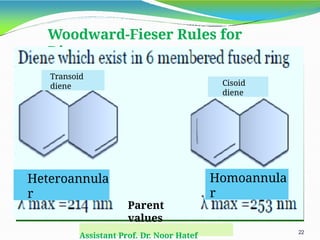
Woodward-Fieser Rules for
Dienes
Cisoid
diene
22
Assistant Prof. Dr. Noor Hatef
Transoid
diene
Parent
values
Homoannula
r
Heteroannula
r
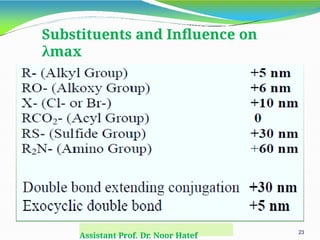
Substituents and Influence on
λmax
23
Assistant Prof. Dr. Noor Hatef
Examples for Wave length
Calculation
24
Assistant Prof. Dr. Noor Hatef
Examples for Wave length
Calculation
25
Assistant Prof. Dr. Noor Hatef
Examples for Wave length
Calculation
 Home Work ; calculate the wave length of
the following compounds.
26
Assistant Prof. Dr. Noor Hatef

Advanced Pharmaceutical Analysis-Lecture Two.pptx

  • 1.
    Assistant Prof. Dr.Noor H. Naser Aldabagh
  • 2.
    CHROMOPHORE  Chromophore isdefined as the nucleus or any isolated covalently bonded group responsible for the absorption of light radiation. Any group which exhibits absorption of electromagnetic radiations in the visible or ultraviolet region. As C=C , C=O ,NO2 etc.  Some of the important chromophores are carbonyls, acids, esters, nitrile, ethylene groups. Assistant Prof. Dr. Noor Hatef 2
  • 3.
    Absorption Characteristics of SomeCommon Chromophores Assistant Prof. Dr. Noor Hatef 3
  • 4.
    AUXOCHROM E  These areco-ordinatively saturated or un-saturated groups which themselves do not absorb radiation, but enhance s when present along with a chromophore the absorbing properties of chromophore.  Also known as colour enhancing group.  All auxochromes have one or more non-bonding pair of electrons. Examples (-NH2 ,-OH ,-OR,- COOH etc)  Itextend the conjugation of a chromophore by sharing the non-bonding electrons. Assistant Prof. Dr. Noor Hatef 4
  • 5.
    Assistant Prof. Dr.Noor Hatef 5
  • 6.
    Effect of Solventon Absorption  The solvent in which the absorbing species is dissolved also has an effect on the spectrum of the species. Peaks resulting from n → π* transitions are shifted to shorter wavelengths (blue shift) with increasing solvent polarity because of increased solvation of the lone pair in the ground state, which lowers the energy of the n orbital. Assistant Prof. Dr. Noor Hatef 6
  • 7.
    Effect of Solventon Absorption Assistant Prof. Dr. Noor Hatef 7
  • 8.
    Effect of Solventon Absorption  Often the reverse (red shift) is seen for π → π* transitions. This is caused by attractive polarization forces between the solvent and the absorbing molecule, which lower the energy levels of both the excited and unexcited states. The effect being greater for the excited state, the energy difference between the excited and unexcited states is slightly reduced, resulting in a small red shift. This effect can also influence n → π* transitions but cannot be observed due to the dominant blue shift resulting from solvation of lone pairs. Assistant Prof. Dr. Noor Hatef 8
  • 9.
    Effect of Solventon Absorption Assistant Prof. Dr. Noor Hatef 9
  • 10.
     For examplefor Mesityl oxide, following shifts are observed for the two electronic transitions on moving from low polarity solvent hexane to water, which has higher polarity. Assistant Prof. Dr. Noor Hatef 10
  • 11.
    TERMS USED IN UV-VISIBLE SPECTROSCOPY Assistant Prof. Dr. Noor Hatef 11
  • 12.
    Bathochromic shift(red shift)  Whenthe absorption maxima(λmax)of a compound shifts to longer wave length, it is known as bathochromic shift or red shift.  The effect is due to the presence of auxochrome or by change of solvent.  Eg: The n-π* transition for carbonyl compounds experiences bathochromic shift when the polarity of solvent is decreased. Assistant Prof. Dr. Noor Hatef 12
  • 13.
    Hypsochromic shift(blue shift)  Whenthe absorption maxima(λmax) of a compound shifts to a shorter wave length, it is known as hypsochromic shift or blue shift.  The effect is due to the presence of a group causes removal of conjugation or by change of solvent. Assistant Prof. Dr. Noor Hatef 13
  • 14.
     Aniline showsblue shift in acidic medium science it loses conjugation. (Aniline 280 nm, while anilinium ion 203 nm) Assistant Prof. Dr. Noor Hatef 14
  • 15.
    Hyperchromic effect  When theabsorption intensity (ε) of a compound is increased, it is known as hyperchromic shift.  The introduction of auxochrome usually increase the absorption intensity. Assistant Prof. Dr. Noor Hatef 15
  • 16.
    Hypochromic effect  When theabsorption intensity (ε) of a compound is decreased, it is known as hypochromic shift.  The introduction of a group that distorts the geometry of molecule usually reduce the absorption intensity. Assistant Prof. Dr. Noor Hatef 16
  • 17.
  • 18.
    Conjugated System andUnconjugated System  Unconjugated System  Due to π → π* electronic transition unconjugated alkenes absorb below 200 nm, e.g., ethene shows an absorption at 171 nm. Alkyl substituents or the ring residues attached to the olefinic carbon shift the absorption band towards longer wavelength as can be seen with absorption pattern of compounds like 1-Octene and cyclohexene which absorb at 177 nm and 182 nm, respectively. Assistant Prof. Dr. Noor Hatef 18
  • 19.
    Conjugated System andUnconjugated System  Conjugated System  Multiple bonds that are alternative with single bonds are said to be conjugated  Thus 1,3-butadiene ……… conjugated system.  1,4- pentadiene …… non conjugated system. Assistant Prof. Dr. Noor Hatef 19
  • 20.
     More stablethan non-conjugated one because during resonance there is transfer of electron and it will produce some partial double bond character between C2 and C3 thus strengthen C2- C3 bond and stabilizing the molecule.  conjugated system had to red shift (increase wave length ) because the π electron spread over at least 4 atomic center  Generally conjugated system absorb 15 –45 nm, longer wave length than non-conjugated system. Assistant Prof. Dr. Noor Hatef 20
  • 21.
     Many ofthe pigments responsible for the brilliant color of fruit and flowers are said to be conjugated polyene e.g: Lycopene.  Compound containing series of conjugated chromophore groups will appear colored to the eye So, absorbed at equal or more than 400 nm  If compounds appear colored contain not less than 4,usually 5 or more conjugated chromophoric and auxochromic groups except azo, diazocompounds.  If two or more chromophoric group are present in a molecule and they are conjugated the effects are usually additives. 21 Assistant Prof. Dr. Noor Hatef
  • 22.
    Woodward-Fieser Rules for Dienes Cisoid diene 22 AssistantProf. Dr. Noor Hatef Transoid diene Parent values Homoannula r Heteroannula r
  • 23.
    Substituents and Influenceon λmax 23 Assistant Prof. Dr. Noor Hatef
  • 24.
    Examples for Wavelength Calculation 24 Assistant Prof. Dr. Noor Hatef
  • 25.
    Examples for Wavelength Calculation 25 Assistant Prof. Dr. Noor Hatef
  • 26.
    Examples for Wavelength Calculation  Home Work ; calculate the wave length of the following compounds. 26 Assistant Prof. Dr. Noor Hatef