LECTURE 2:
Hassan Z. Harraz
hharraz2006@yahoo.com
2016- 2017
@ Hassan Harraz 2017
Outline of Lecture 2
We will explore all of the above in Lecture 2.
 Introduction
 Tectonic evolution of the CED
 Distribution of the ophiolite in Egypt
 Chromite Host Rocks
 Chemistry
 Ore Types
 Mineralogy
 Origin
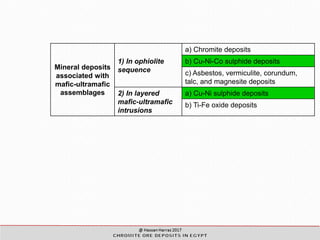
Mineral deposits
associated with
mafic-ultramafic
assemblages
1) In ophiolite
sequence
a) Chromite deposits
b) Cu-Ni-Co sulphide deposits
c) Asbestos, vermiculite, corundum,
talc, and magnesite deposits
2) In layered
mafic-ultramafic
intrusions
a) Cu-Ni sulphide deposits
b) Ti-Fe oxide deposits
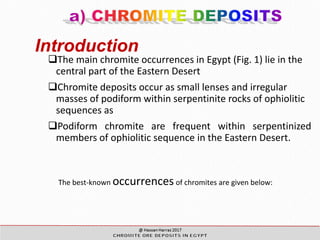
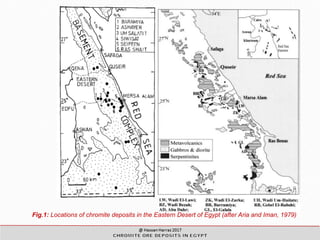
The main chromite occurrences in Egypt (Fig. 1) lie in the
central part of the Eastern Desert
Chromite deposits occur as small lenses and irregular
masses of podiform within serpentinite rocks of ophiolitic
sequences as
Podiform chromite are frequent within serpentinized
members of ophiolitic sequence in the Eastern Desert.
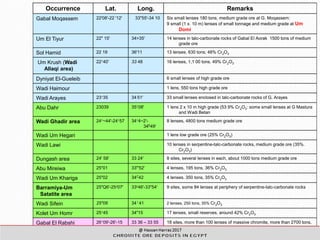
The best-known occurrences of chromites are given below:
Introduction
Fig.1: Locations of chromite deposits in the Eastern Desert of Egypt (after Aria and Iman, 1979)
Occurrence Lat. Long. Remarks
Gabal Moqassem 22'08'-22 '12' 33"55'-34 10 Six small lenses 180 tons, medium grade ore at G. Moqassem:
9 small (1 x. 10 m) lenses of small tonnage and medium grade at Um
Domi
Um El Tiyur 22" 15! 34>35' 14 lenses in talc-carbonate rocks of Gabal El Aorak 1500 tons of medium
grade ore
Sol Hamid 22 19 36'11 13 lenses. 630 tons; 48% Cr2O3
Um Krush (Wadi
Allaqi area)
22°40' 33 48 16 lenses, 1,1 00 tons. 49% Cr2O3
Dyniyat El-Gueleib 6 small lenses of high grade ore
Wadi Haimour 1 lens, 550 tons high grade ore
Wadi Arayes 23°35 34:51' 33 small lenses enclosed in talc-carbonate rocks of G. Arayes
Abu Dahr 23039 35°08' 1 lens 2 x 10 m high grade (53 9% Cr2O3: some small lenses at G Mastura
and Wadi Betan
Wadi Ghadir area 24°~44'-24°57 34°4~2'-
34549r
8 lenses, 4800 tons medium grade ore
Wadi Um Hegari 1 lens low grade ore (25% Cr2O3)
Wadi Lawi 10 lenses in serpentine-talc-carbonate rocks, medium grade ore (35%.
Cr2O3)
Dungash area 24' 58' 33 24' 8 sites, several lenses in each, about 1000 tons medium grade ore
Abu Mireiwa 25"01 33"'52' 4 lenses, 195 tons, 36% Cr2O3
Wadi Um Khariga 25"02 34C42 4 lenses. 350 tons, 35% Cr2O3
Barramiya-Um
Satatite area
25"Q6'-25J07' 33c46'-33"54' 9 sites, some 84 lenses at periphery of serpentine-talc-carbonate rocks
Wadi Sifein 25"06 34 ! 41 2 lenses, 250 tons, 35% Cr2O3
Kolet Um Homr 25°45 34"15 17 lenses, small reserves, around 42% Cr2O3
Gabal El Rabshi 26°09'-26'-15 33 36 – 33 55 18 sites, more than 100 lenses of massive chromite, more than 2700 tons,
averaging 44% Cr2O3
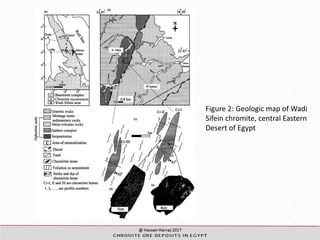
Figure 2: Geologic map of Wadi
Sifein chromite, central Eastern
Desert of Egypt
Egyptian Ore Deposits
Other, less important sites and many others of
negligible importance.
Production of chromite is very insignificant in Egypt,
only a few hundred tonnes annually.
It reached a climax of 998 tonnes in 1977, then
dropped to its present negligible level due to
exhaustion of the known lenses.
The majority of these ores are exhausted.
No large scale exploitation is reported in any of the
mentioned chromite occurrences.
It is well known that chromite ores can be
beneficiated by gravity separation and/or flotation
depending on the ore constituents and the economic
liberation size.
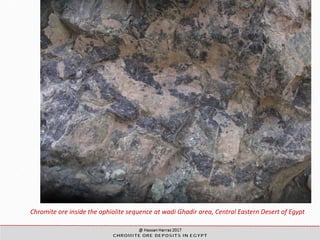
Chromite ore inside the ophiolite sequence at wadi Ghadir area, Central Eastern Desert of Egypt
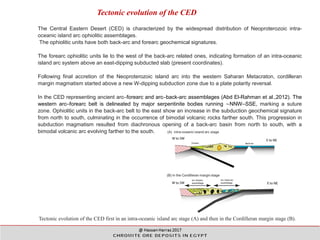
Tectonic evolution of the CED first in an intra-oceanic island arc stage (A) and then in the Cordilleran margin stage (B).
Tectonic evolution of the CED
The Central Eastern Desert (CED) is characterized by the widespread distribution of Neoproterozoic intra-
oceanic island arc ophiolitic assemblages.
The ophiolitic units have both back-arc and forearc geochemical signatures.
The forearc ophiolitic units lie to the west of the back-arc related ones, indicating formation of an intra-oceanic
island arc system above an east-dipping subducted slab (present coordinates).
Following final accretion of the Neoproterozoic island arc into the western Saharan Metacraton, cordilleran
margin magmatism started above a new W-dipping subduction zone due to a plate polarity reversal.
In the CED representing ancient arc–forearc and arc–back-arc assemblages (Abd El-Rahman et al.,2012). The
western arc–forearc belt is delineated by major serpentinite bodies running ∼NNW–SSE, marking a suture
zone. Ophiolitic units in the back-arc belt to the east show an increase in the subduction geochemical signature
from north to south, culminating in the occurrence of bimodal volcanic rocks farther south. This progression in
subduction magmatism resulted from diachronous opening of a back-arc basin from north to south, with a
bimodal volcanic arc evolving farther to the south.
Distribution of the ophiolite in Egypt
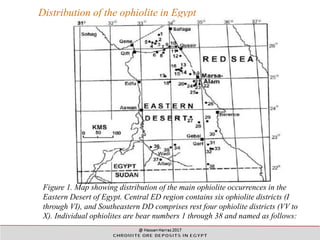
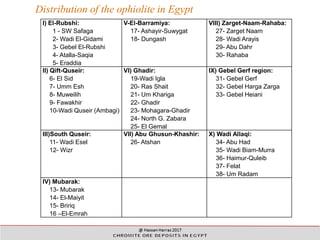
Figure 1. Map showing distribution of the main ophiolite occurrences in the
Eastern Desert of Egypt. Central ED region contains six ophiolite districts (I
through VI), and Southeastern DD comprises rest four ophiolite districts (VV to
X). Individual ophiolites are bear numbers 1 through 38 and named as follows:
Distribution of the ophiolite in Egypt
I) El-Rubshi:
1 - SW Safaga
2- Wadi El-Gidami
3- Gebel El-Rubshi
4- Atalla-Saqia
5- Eraddia
V-El-Barramiya:
17- Ashayir-Suwygat
18- Dungash
VIII) Zarget-Naam-Rahaba:
27- Zarget Naam
28- Wadi Arayis
29- Abu Dahr
30- Rahaba
II) Qift-Quseir:
6- El Sid
7- Umm Esh
8- Muweilih
9- Fawakhir
10-Wadi Quseir (Ambagi)
VI) Ghadir:
19-Wadi Igla
20- Ras Shait
21- Um Khariga
22- Ghadir
23- Mohagara-Ghadir
24- North G. Zabara
25- El Gemal
IX) Gebel Gerf region:
31- Gebel Gerf
32- Gebel Harga Zarga
33- Gebel Heiani
III)South Quseir:
11- Wadi Esel
12- Wizr
VII) Abu Ghusun-Khashir:
26- Atshan
X) Wadi Allaqi:
34- Abu Had
35- Wadi Biam-Murra
36- Haimur-Quleib
37- Felat
38- Um Radam
IV) Mubarak:
13- Mubarak
14- El-Maiyit
15- Bririq
16 –El-Emrah
Host Rocks
The chromites are enclosed in massive to schistose serpentinites as gently
folded tabular sheets and lenses, mullions, boudins and pods, up to 3 m
thick and up to 7 m long. Relics of the parental rocks of the serpentinites
are rare, but where present are harzburgite with subordinate dunite.
The sepentinites do not seem to be parts of one disrupted body but rather a
series of late Precambrian sheets or slices often associated with siltstones
or volcanic sequences (sometimes pillow lavas).
The serpentinites are moderately to intensely transformed into talc-
carbonates, particularly along faults and shear zones. Because the
chromite grains are "not of uniform composition and displayed varying
degrees of transformations, electron microprobe analysis of the grains was
performed to elucidate the petrogenetic significance of the chemical
variations and to study the secondary changes in chromite (El-Haddad and
Khudeir, 1989).
The country rocks enclosing chromite lenses are serpentinites or
serpentine-talc-carbonate rocks formed after harzburgite and dunite, at the
very base of the cumulate ultramafic rocks of the ophiolitic sequence in the
areas noted.
Host Rocks
 Several podiform chromitite pods of sub-economic value are frequently distributed
mainly in the central and southern parts of the Eastern Desert of Egypt. The
southern Eastern Desert (SED) chromitites, in most cases, are large in size
compared with the central Eastern Desert (CED) ones. The former Chromitite is
fresher than the latter, and has primary silicate minerals that survived alteration in
the Chromitite matrix and host peridotites (e.g., Ahmed et al., 2001).
 The podiform chromitites of Late Precambrian age are frequently found as
lensoidal pods mainly in the central and southern parts of the Eastern Desert,
Egypt (e.g., Khudeir et al., 1992; Ahmed et al., 2001). They are, in most cases,
hosted by fully Serpentinized peridotite which is a part of dismembered ophiolite
complexes of the Pan-African belt.
 The SED chromitite exhibits a very restricted compositional range of spinel with
high Cr contents (Cr#) (Cr/(Cr + Al) ~0.85, while the CED chromitite shows wide
compositional variations from high-Cr to high-Al varieties (Ahmed et al., 2001).
The chromian spinel is generally low in TiO2 content both in the SED and CED
chromitites recalling the ophiolitic chromitite.
 These chromites are of Alpine-podiform type, on the basis of the petrological
assemblage with which they occur, the shape and size of the individual pods, and
chemistry (i.e. High MgO/FeO and Cr/Fe ratios, and low Fe2O3 and Al2O3/Cr2O3
ratios
Fig.3: Variation of Cr2O3 versus Al2O3 of spinel in the Egyptian
Podiform chromitites. Compositional fields of Podiform and
Stratiform chromitites after Bonavia et al. (1993).
Fig.4: Cr-Al-Fe3+ plots of chrome spinel in the Egyptian Podiform chromitites (after
Ahmed et al., 2001). Average Cr# [=Cr/(Cr+Al) atomic ratio] are shown.
Fig.5: Cr# [=Cr/(Cr+Al) atomic ratio] versus
Mg#[=Mg/(Mg+Fe2+) atomic ratio] of chrome spinel in the
Egyptian Podiform chromitites and associated dunites and
harzburgites of Proterozoic ophiolite complex of Egypt(after
Ahmed et al., 2001). Note that all harzburgite spinels lie in the
field of abyssal peridotite (Dick and Bullen, 1984).
Fig.7: Cr-Al-Fe3+ plots of chrome spinel in the
dunite and hazburgite associated with
Podiform chromitites of the Proterozoic
ophiolite complex of Eastern Desert of Egypt.
Average Cr# [=Cr/(Cr+Al) atomic ratio] are
indicated. (after Ahmed et al., 2001)
Fig.6: Variation of Cr2O3 versus Al2O3 of
chrome spinel in the dunites and
hazburgites associated with Podiform
chromitites in the central Eastern Desert of
Egypt (after Ahmed et al., 2001).
Ore Types
Field and microscopic studies revealed the number of chromite
ore type namely:
i) Compact (Massive) ore type: composed of very dense massive
aggregates of chromite.
ii) Banded ore type: It shows parallel black bands of chromite
alternating with irregular discontinuous bands of
serpentinite and talc-carbonate rocks
iii) Disseminated ore type: A singe grains or small aggregates of
chromite crystals are embedded in a serpentine matrix. The
chromite grams are frequently idiomorphic (octahedral)
form.
iv) Nodular ore type: It occurs in the form of distinctly elliptical
to rounded chromite grains forming big nodules. These
nodules are bound together by a matrix of serpentine
v) Streaked and brecciated ore type: Densely packed layers of
raw of chromite grains are alternating with coarse to fine
streaks of chromites.
Mineralogy
Ore minerals mainly represented by
chromite (and its alteration products)
together with magnetite, hematite, goethite
(and limonite), chalcopyrite, pyrrhotite, and
sphalerite.
The percentage of chromite in whole
specimen varies from 90% (in the high-
grade ore) to -30% (in the low-grade ore).
Gangue minerals are talc, lizardite,
antigorite, pyroxene, clinochrysotite, and
quartz.
Origin
 It is believed that these chromites were formed
through early segregation, crystallization followed by
crystal settling from basic magma at spreading
centers during the formation of new oceanic crust.
 This crust, with its enclosed chromites, was
tectonically emplaced during accretion, prior to
cratonization. Therefore, infection of a late chromite-
rich residual liquid along pre-existing shear planes.
References
Ahmed, A.H. 2001. Platinum-group elements and Chromitite deposits in two ophiolite suites:
Proterozoic ophiolite, Eastern Desert, Egypt, and Phanerozoic ophiolite, northern Oman.
Unpublished PhD Thesis, Kanazawa University, Japan, 170 pp.
Ahmed, A.H., Arai, S., and Attia, A., 2001, Petrological characteristics of podiform chromitites and
associated peridotites of the Pan African Proterozoic ophiolite complexes of Egypt: Mineralium
Deposita, 36, 72–84
Amin, M. S. (1948) Origin and alteration of chromites from Egypt. Econ. Geol., 43, 133-53.
Aria, M. S., and Iman, I. (1979) Mineral map of Egypt, Scale 1:2000000, with explanatory notes and
lists. Geol. Surv. Egypt., 44P.
EI-Haddad, M. A. and Khudeir, A. A. (1989). Geologicaland geochemical studies on some chromite
deposits in the Central Eastern Desert, Egypt. Bull. Fac. Sci.,Assiut Univ., 13 (l-F), 141-58.
Abd El-Rahman, Y.; Polat, A.; Dilek, Y.; Kusky, T. M.; El-Sharkawi, M.A.; and Amir Said, A. (2012).
Cryogenian ophiolite tectonics and metallogeny of the Central Eastern Desert of Egypt.
International Geology Review iFirst,, 1–15.
Khudeir, A.A., El-Haddad, M.A. & Leake, B. 1992. Compositional variation in chromite from the
Eastern Desert, Egypt. Mineralogical Magazine 56, 567-574.
Follow me on Social Media
http://facebook.com/hzharraz
http://www.slideshare.net/hzharraz
https://www.linkedin.com/in/hassan-harraz-3172b235

CHROMITE ORE DEPOSITS IN EGYPT

  • 1.
    LECTURE 2: Hassan Z.Harraz hharraz2006@yahoo.com 2016- 2017 @ Hassan Harraz 2017
  • 2.
    Outline of Lecture2 We will explore all of the above in Lecture 2.  Introduction  Tectonic evolution of the CED  Distribution of the ophiolite in Egypt  Chromite Host Rocks  Chemistry  Ore Types  Mineralogy  Origin
  • 3.
    Mineral deposits associated with mafic-ultramafic assemblages 1)In ophiolite sequence a) Chromite deposits b) Cu-Ni-Co sulphide deposits c) Asbestos, vermiculite, corundum, talc, and magnesite deposits 2) In layered mafic-ultramafic intrusions a) Cu-Ni sulphide deposits b) Ti-Fe oxide deposits
  • 4.
    The main chromiteoccurrences in Egypt (Fig. 1) lie in the central part of the Eastern Desert Chromite deposits occur as small lenses and irregular masses of podiform within serpentinite rocks of ophiolitic sequences as Podiform chromite are frequent within serpentinized members of ophiolitic sequence in the Eastern Desert. The best-known occurrences of chromites are given below: Introduction
  • 5.
    Fig.1: Locations ofchromite deposits in the Eastern Desert of Egypt (after Aria and Iman, 1979)
  • 6.
    Occurrence Lat. Long.Remarks Gabal Moqassem 22'08'-22 '12' 33"55'-34 10 Six small lenses 180 tons, medium grade ore at G. Moqassem: 9 small (1 x. 10 m) lenses of small tonnage and medium grade at Um Domi Um El Tiyur 22" 15! 34>35' 14 lenses in talc-carbonate rocks of Gabal El Aorak 1500 tons of medium grade ore Sol Hamid 22 19 36'11 13 lenses. 630 tons; 48% Cr2O3 Um Krush (Wadi Allaqi area) 22°40' 33 48 16 lenses, 1,1 00 tons. 49% Cr2O3 Dyniyat El-Gueleib 6 small lenses of high grade ore Wadi Haimour 1 lens, 550 tons high grade ore Wadi Arayes 23°35 34:51' 33 small lenses enclosed in talc-carbonate rocks of G. Arayes Abu Dahr 23039 35°08' 1 lens 2 x 10 m high grade (53 9% Cr2O3: some small lenses at G Mastura and Wadi Betan Wadi Ghadir area 24°~44'-24°57 34°4~2'- 34549r 8 lenses, 4800 tons medium grade ore Wadi Um Hegari 1 lens low grade ore (25% Cr2O3) Wadi Lawi 10 lenses in serpentine-talc-carbonate rocks, medium grade ore (35%. Cr2O3) Dungash area 24' 58' 33 24' 8 sites, several lenses in each, about 1000 tons medium grade ore Abu Mireiwa 25"01 33"'52' 4 lenses, 195 tons, 36% Cr2O3 Wadi Um Khariga 25"02 34C42 4 lenses. 350 tons, 35% Cr2O3 Barramiya-Um Satatite area 25"Q6'-25J07' 33c46'-33"54' 9 sites, some 84 lenses at periphery of serpentine-talc-carbonate rocks Wadi Sifein 25"06 34 ! 41 2 lenses, 250 tons, 35% Cr2O3 Kolet Um Homr 25°45 34"15 17 lenses, small reserves, around 42% Cr2O3 Gabal El Rabshi 26°09'-26'-15 33 36 – 33 55 18 sites, more than 100 lenses of massive chromite, more than 2700 tons, averaging 44% Cr2O3
  • 7.
    Figure 2: Geologicmap of Wadi Sifein chromite, central Eastern Desert of Egypt
  • 8.
    Egyptian Ore Deposits Other,less important sites and many others of negligible importance. Production of chromite is very insignificant in Egypt, only a few hundred tonnes annually. It reached a climax of 998 tonnes in 1977, then dropped to its present negligible level due to exhaustion of the known lenses. The majority of these ores are exhausted. No large scale exploitation is reported in any of the mentioned chromite occurrences. It is well known that chromite ores can be beneficiated by gravity separation and/or flotation depending on the ore constituents and the economic liberation size.
  • 9.
    Chromite ore insidethe ophiolite sequence at wadi Ghadir area, Central Eastern Desert of Egypt
  • 10.
    Tectonic evolution ofthe CED first in an intra-oceanic island arc stage (A) and then in the Cordilleran margin stage (B). Tectonic evolution of the CED The Central Eastern Desert (CED) is characterized by the widespread distribution of Neoproterozoic intra- oceanic island arc ophiolitic assemblages. The ophiolitic units have both back-arc and forearc geochemical signatures. The forearc ophiolitic units lie to the west of the back-arc related ones, indicating formation of an intra-oceanic island arc system above an east-dipping subducted slab (present coordinates). Following final accretion of the Neoproterozoic island arc into the western Saharan Metacraton, cordilleran margin magmatism started above a new W-dipping subduction zone due to a plate polarity reversal. In the CED representing ancient arc–forearc and arc–back-arc assemblages (Abd El-Rahman et al.,2012). The western arc–forearc belt is delineated by major serpentinite bodies running ∼NNW–SSE, marking a suture zone. Ophiolitic units in the back-arc belt to the east show an increase in the subduction geochemical signature from north to south, culminating in the occurrence of bimodal volcanic rocks farther south. This progression in subduction magmatism resulted from diachronous opening of a back-arc basin from north to south, with a bimodal volcanic arc evolving farther to the south.
  • 11.
    Distribution of theophiolite in Egypt Figure 1. Map showing distribution of the main ophiolite occurrences in the Eastern Desert of Egypt. Central ED region contains six ophiolite districts (I through VI), and Southeastern DD comprises rest four ophiolite districts (VV to X). Individual ophiolites are bear numbers 1 through 38 and named as follows:
  • 12.
    Distribution of theophiolite in Egypt I) El-Rubshi: 1 - SW Safaga 2- Wadi El-Gidami 3- Gebel El-Rubshi 4- Atalla-Saqia 5- Eraddia V-El-Barramiya: 17- Ashayir-Suwygat 18- Dungash VIII) Zarget-Naam-Rahaba: 27- Zarget Naam 28- Wadi Arayis 29- Abu Dahr 30- Rahaba II) Qift-Quseir: 6- El Sid 7- Umm Esh 8- Muweilih 9- Fawakhir 10-Wadi Quseir (Ambagi) VI) Ghadir: 19-Wadi Igla 20- Ras Shait 21- Um Khariga 22- Ghadir 23- Mohagara-Ghadir 24- North G. Zabara 25- El Gemal IX) Gebel Gerf region: 31- Gebel Gerf 32- Gebel Harga Zarga 33- Gebel Heiani III)South Quseir: 11- Wadi Esel 12- Wizr VII) Abu Ghusun-Khashir: 26- Atshan X) Wadi Allaqi: 34- Abu Had 35- Wadi Biam-Murra 36- Haimur-Quleib 37- Felat 38- Um Radam IV) Mubarak: 13- Mubarak 14- El-Maiyit 15- Bririq 16 –El-Emrah
  • 13.
    Host Rocks The chromitesare enclosed in massive to schistose serpentinites as gently folded tabular sheets and lenses, mullions, boudins and pods, up to 3 m thick and up to 7 m long. Relics of the parental rocks of the serpentinites are rare, but where present are harzburgite with subordinate dunite. The sepentinites do not seem to be parts of one disrupted body but rather a series of late Precambrian sheets or slices often associated with siltstones or volcanic sequences (sometimes pillow lavas). The serpentinites are moderately to intensely transformed into talc- carbonates, particularly along faults and shear zones. Because the chromite grains are "not of uniform composition and displayed varying degrees of transformations, electron microprobe analysis of the grains was performed to elucidate the petrogenetic significance of the chemical variations and to study the secondary changes in chromite (El-Haddad and Khudeir, 1989). The country rocks enclosing chromite lenses are serpentinites or serpentine-talc-carbonate rocks formed after harzburgite and dunite, at the very base of the cumulate ultramafic rocks of the ophiolitic sequence in the areas noted.
  • 14.
    Host Rocks  Severalpodiform chromitite pods of sub-economic value are frequently distributed mainly in the central and southern parts of the Eastern Desert of Egypt. The southern Eastern Desert (SED) chromitites, in most cases, are large in size compared with the central Eastern Desert (CED) ones. The former Chromitite is fresher than the latter, and has primary silicate minerals that survived alteration in the Chromitite matrix and host peridotites (e.g., Ahmed et al., 2001).  The podiform chromitites of Late Precambrian age are frequently found as lensoidal pods mainly in the central and southern parts of the Eastern Desert, Egypt (e.g., Khudeir et al., 1992; Ahmed et al., 2001). They are, in most cases, hosted by fully Serpentinized peridotite which is a part of dismembered ophiolite complexes of the Pan-African belt.  The SED chromitite exhibits a very restricted compositional range of spinel with high Cr contents (Cr#) (Cr/(Cr + Al) ~0.85, while the CED chromitite shows wide compositional variations from high-Cr to high-Al varieties (Ahmed et al., 2001). The chromian spinel is generally low in TiO2 content both in the SED and CED chromitites recalling the ophiolitic chromitite.  These chromites are of Alpine-podiform type, on the basis of the petrological assemblage with which they occur, the shape and size of the individual pods, and chemistry (i.e. High MgO/FeO and Cr/Fe ratios, and low Fe2O3 and Al2O3/Cr2O3 ratios
  • 15.
    Fig.3: Variation ofCr2O3 versus Al2O3 of spinel in the Egyptian Podiform chromitites. Compositional fields of Podiform and Stratiform chromitites after Bonavia et al. (1993). Fig.4: Cr-Al-Fe3+ plots of chrome spinel in the Egyptian Podiform chromitites (after Ahmed et al., 2001). Average Cr# [=Cr/(Cr+Al) atomic ratio] are shown. Fig.5: Cr# [=Cr/(Cr+Al) atomic ratio] versus Mg#[=Mg/(Mg+Fe2+) atomic ratio] of chrome spinel in the Egyptian Podiform chromitites and associated dunites and harzburgites of Proterozoic ophiolite complex of Egypt(after Ahmed et al., 2001). Note that all harzburgite spinels lie in the field of abyssal peridotite (Dick and Bullen, 1984).
  • 16.
    Fig.7: Cr-Al-Fe3+ plotsof chrome spinel in the dunite and hazburgite associated with Podiform chromitites of the Proterozoic ophiolite complex of Eastern Desert of Egypt. Average Cr# [=Cr/(Cr+Al) atomic ratio] are indicated. (after Ahmed et al., 2001) Fig.6: Variation of Cr2O3 versus Al2O3 of chrome spinel in the dunites and hazburgites associated with Podiform chromitites in the central Eastern Desert of Egypt (after Ahmed et al., 2001).
  • 17.
    Ore Types Field andmicroscopic studies revealed the number of chromite ore type namely: i) Compact (Massive) ore type: composed of very dense massive aggregates of chromite. ii) Banded ore type: It shows parallel black bands of chromite alternating with irregular discontinuous bands of serpentinite and talc-carbonate rocks iii) Disseminated ore type: A singe grains or small aggregates of chromite crystals are embedded in a serpentine matrix. The chromite grams are frequently idiomorphic (octahedral) form. iv) Nodular ore type: It occurs in the form of distinctly elliptical to rounded chromite grains forming big nodules. These nodules are bound together by a matrix of serpentine v) Streaked and brecciated ore type: Densely packed layers of raw of chromite grains are alternating with coarse to fine streaks of chromites.
  • 18.
    Mineralogy Ore minerals mainlyrepresented by chromite (and its alteration products) together with magnetite, hematite, goethite (and limonite), chalcopyrite, pyrrhotite, and sphalerite. The percentage of chromite in whole specimen varies from 90% (in the high- grade ore) to -30% (in the low-grade ore). Gangue minerals are talc, lizardite, antigorite, pyroxene, clinochrysotite, and quartz.
  • 19.
    Origin  It isbelieved that these chromites were formed through early segregation, crystallization followed by crystal settling from basic magma at spreading centers during the formation of new oceanic crust.  This crust, with its enclosed chromites, was tectonically emplaced during accretion, prior to cratonization. Therefore, infection of a late chromite- rich residual liquid along pre-existing shear planes.
  • 20.
    References Ahmed, A.H. 2001.Platinum-group elements and Chromitite deposits in two ophiolite suites: Proterozoic ophiolite, Eastern Desert, Egypt, and Phanerozoic ophiolite, northern Oman. Unpublished PhD Thesis, Kanazawa University, Japan, 170 pp. Ahmed, A.H., Arai, S., and Attia, A., 2001, Petrological characteristics of podiform chromitites and associated peridotites of the Pan African Proterozoic ophiolite complexes of Egypt: Mineralium Deposita, 36, 72–84 Amin, M. S. (1948) Origin and alteration of chromites from Egypt. Econ. Geol., 43, 133-53. Aria, M. S., and Iman, I. (1979) Mineral map of Egypt, Scale 1:2000000, with explanatory notes and lists. Geol. Surv. Egypt., 44P. EI-Haddad, M. A. and Khudeir, A. A. (1989). Geologicaland geochemical studies on some chromite deposits in the Central Eastern Desert, Egypt. Bull. Fac. Sci.,Assiut Univ., 13 (l-F), 141-58. Abd El-Rahman, Y.; Polat, A.; Dilek, Y.; Kusky, T. M.; El-Sharkawi, M.A.; and Amir Said, A. (2012). Cryogenian ophiolite tectonics and metallogeny of the Central Eastern Desert of Egypt. International Geology Review iFirst,, 1–15. Khudeir, A.A., El-Haddad, M.A. & Leake, B. 1992. Compositional variation in chromite from the Eastern Desert, Egypt. Mineralogical Magazine 56, 567-574.
  • 21.
    Follow me onSocial Media http://facebook.com/hzharraz http://www.slideshare.net/hzharraz https://www.linkedin.com/in/hassan-harraz-3172b235