 Introduction
 Mineralization related to plate
tectonics
 Mineralization related to regional and
minor structures
 Examples
 Summery
 Mining geologists have for many decades
attempted to relate various types of mineralization
to large scale crustal structures.
 Nearly all hydrothermal deposits exhibit some
degree of structural control on mineralization.
 Structures (fractures, faults or folds) which form
prior to a mineralizing event are referred to as
“pre-mineral”.
 Geologists are keenly interested in pre-mineral
structures because these structures influence the
localization of ore by hydrothermal fluids utilizing
these pathways.
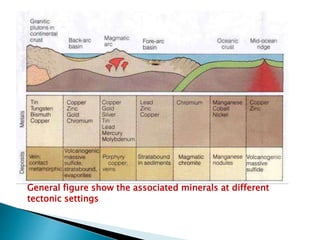
 Plate convergence and spreading centers
are among the important features which
control the global location of mineral
deposits.
 Other important features to which
mineralization appears to be related include
hotspots,(mantle plumes), rifting and other
extensional tectonics, and collision
tectonics.
 Intracratonic basins are accompanied by
mineralization e.g. the late Proterozoic Central
African Copper.
 Ocean basins and rises
 At some stage during this process an opening to
the sea may initiate marine conditions.
 Observations from theRed Sea region indicate that
evaporite series of great thickness may form at this
time. These evaporites contain halite as well as
gypsum and therefore have a double economic
importance.
 Hydrothermal mineralization with the development of copper,
zinc, silver and mercury has been reported from oceanic
ridges in the Atlantic and Indian Oceans.
 it was generated by sea water solutions circulating through
the oceanic crust that related to black smokers .
 black smokers have now been found on the Mid-Atlantic
Ridge indicating that the hydrothermal processes which
produce them probably operate along most active sea floor
spreading centers.
Black
smokers
Black smokers and associated
minerals .
 Subduction-related settings
Subdction zone and it’s
association minerals
General figure show the associated minerals at different
tectonic settings
 Structures (fractures, faults or folds) which form
prior to a mineralizing event are referred to as
“pre-mineral”.
 Structures which form after a mineralizing event,
and hence may be responsible for offset or removal
of mineralized zones, are referred to as “post-
mineral”.
 In some cases the formation of structures and
mineralization appear to be nearly synchronous.
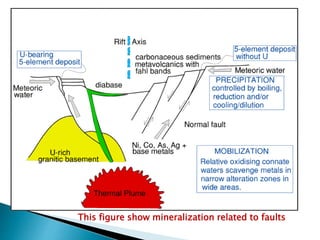
 Fractures and fault zones provide excellent pathways
for hydrothermal fluids to circulate through.
 Open-space filling has long been recognized as the
primary method of vein formation.
 The formation of breccia due to the grinding action of
the rocks adjacent to the fault plane increases the
‘structural porosity’, .
 Under certain conditions, breccia may itself provide the
host for mineralization.
 Intersections of structural features often are better
locations to prospect for mineralization
This figure show mineralization related to faults
 Within the geological record there is evidence of numerous
ore deposits precipitated in or near geological fold belts.
 This is due to the fact that folds can play different roles in
transporting aqueous minerals in a hydrothermal system.
 For a permeable fold, the focusing and mixing of different
reactive fluids can take place within the fold.
 Whereas for an impermeable fold, the existence of the fold
can change and even determine the channels of pore-fluid in
a hydrothermal system.
 Low-grade basement rocks of Neoproterozoic age
with well developed shear zones from Hawzien
area of northern Ethiopia.
 Geochemistry of surface and drill core samples
indicate enrichment of zinc in shear zones with low
concentrations of copper, lead, gold, arsenic and
silver.
 Zn-rich base metal mineralization with Pb-Cu-Fe
(±Ag-As-Au) is related to D2 deformation through
the shear zone.
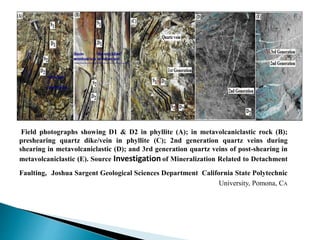
Field photographs showing D1 & D2 in phyllite (A); in metavolcaniclastic rock (B);
preshearing quartz dike/vein in phyllite (C); 2nd generation quartz veins during
shearing in metavolcaniclastic (D); and 3rd generation quartz veins of post-shearing in
metavolcaniclastic (E). Source Investigation of Mineralization Related to Detachment
Faulting, Joshua Sargent Geological Sciences Department California State Polytechnic
University, Pomona, CA
 One of the most common areas that enriched with
minerals in Egypt is Wadi Allaqi area, which most of
its mineralization related to major or large
structures.
 Wadi Allaqi located in the South Eastern desert of
Egypt.
 Geology of the Wadi Allaqi area
 The Wadi Allaqi area is underlain by
Neoproterozoic rocks, Cretaceous sandstones, and
Mesozoic to Cenozoic volcanic and sub-volcanic
rocks.
 These rocks include a mafic–ultramafic ophiolitic
assemblage, at least two volcano-sedimentary-
plutonic island arc assemblages, and late- to post-
tectonic granitic intrusions (Krṏoner et al., 1987;
Greiling et al., 1994; Shackleton, 1994; Abdelsalam
and Stern, 1996; Taylor et al., 1993; Berhe, 1990;
Shackleton, 1994).
 Structure geology of WadiAllaqi
 field and remote-sensing studies suggest thatthe
western part of the Allaqi suture developed through
four phases of Neoproterozoic deformation (D1 through
D4).
 D1 and D2 are associated with early collisional stages
between the Gerfterrane in the north with the Haya and
GabgabaTerranes to the south.
 whereas D3 and D4 represent deformation associated
with the later stages of collision (Abdelsalam and Stern,
1996), characterized by development of tight to
isoclinal, gently inclined folds, and reactivation of some
of the thrust faults in the E–W imbricate thrust zones.
Structural map of Wadi Allaqi
 Mineral deposits of WadiAllaqi
 Several mineral deposits are associated with
different rock units and structures in the study
area.
 Copper– nickel–platinum mineralization, podiform
chromite, and gold–quartz veins are associated
with ultramafic rocks.
 Marble, gold-bearing quartz veins and alteration
zones possibly associated with massive sulfides are
associated with metavolcanics, and zones of
radioactive mineralization are associated with
leucocratic granitic rocks.
 Landsat TM and SIR-C/X SAR images as well as
field studies indicate that these mineral deposits
are structurally controlled, as well as being
associated spatially with the late granites, as the
following:
1. Mineral deposits associated with D1, D2 (imbricate
thrust belt)
2. Mineral deposits associated with D3 (WadiUngate
shear zone)
3. Mineral deposits associated with D3, D4 (E–W
fractures and late granites)
The following table show the deformation events and
the mineraliztion that releated to them in Wadi
Allaqi
 Fractures and shear zones provide excellent pathways
for hydrothermal fluids to circulate through from their
sources to near surfaces.
 Folds can play different roles in transporting aqueous
minerals in a hydrothermal system.
 Also the shear zones consider one of the most
important areas lead to concentration and formation of
certain economic minerals.
 Besides the structural elements controlling much more
mineralization, some plate tectonic environments play
important roles to indicate mineralized zones.
‫هللا‬ ‫بفضل‬ ‫مت‬
Thank you

Mineralization controlled by Tectonics & structures.ppt

  • 2.
     Introduction  Mineralizationrelated to plate tectonics  Mineralization related to regional and minor structures  Examples  Summery
  • 3.
     Mining geologistshave for many decades attempted to relate various types of mineralization to large scale crustal structures.  Nearly all hydrothermal deposits exhibit some degree of structural control on mineralization.  Structures (fractures, faults or folds) which form prior to a mineralizing event are referred to as “pre-mineral”.  Geologists are keenly interested in pre-mineral structures because these structures influence the localization of ore by hydrothermal fluids utilizing these pathways.
  • 5.
     Plate convergenceand spreading centers are among the important features which control the global location of mineral deposits.  Other important features to which mineralization appears to be related include hotspots,(mantle plumes), rifting and other extensional tectonics, and collision tectonics.
  • 6.
     Intracratonic basinsare accompanied by mineralization e.g. the late Proterozoic Central African Copper.  Ocean basins and rises  At some stage during this process an opening to the sea may initiate marine conditions.  Observations from theRed Sea region indicate that evaporite series of great thickness may form at this time. These evaporites contain halite as well as gypsum and therefore have a double economic importance.
  • 7.
     Hydrothermal mineralizationwith the development of copper, zinc, silver and mercury has been reported from oceanic ridges in the Atlantic and Indian Oceans.  it was generated by sea water solutions circulating through the oceanic crust that related to black smokers .  black smokers have now been found on the Mid-Atlantic Ridge indicating that the hydrothermal processes which produce them probably operate along most active sea floor spreading centers.
  • 8.
    Black smokers Black smokers andassociated minerals .
  • 9.
     Subduction-related settings Subdctionzone and it’s association minerals
  • 10.
    General figure showthe associated minerals at different tectonic settings
  • 11.
     Structures (fractures,faults or folds) which form prior to a mineralizing event are referred to as “pre-mineral”.  Structures which form after a mineralizing event, and hence may be responsible for offset or removal of mineralized zones, are referred to as “post- mineral”.  In some cases the formation of structures and mineralization appear to be nearly synchronous.
  • 12.
     Fractures andfault zones provide excellent pathways for hydrothermal fluids to circulate through.  Open-space filling has long been recognized as the primary method of vein formation.  The formation of breccia due to the grinding action of the rocks adjacent to the fault plane increases the ‘structural porosity’, .  Under certain conditions, breccia may itself provide the host for mineralization.  Intersections of structural features often are better locations to prospect for mineralization
  • 13.
    This figure showmineralization related to faults
  • 14.
     Within thegeological record there is evidence of numerous ore deposits precipitated in or near geological fold belts.  This is due to the fact that folds can play different roles in transporting aqueous minerals in a hydrothermal system.  For a permeable fold, the focusing and mixing of different reactive fluids can take place within the fold.  Whereas for an impermeable fold, the existence of the fold can change and even determine the channels of pore-fluid in a hydrothermal system.
  • 15.
     Low-grade basementrocks of Neoproterozoic age with well developed shear zones from Hawzien area of northern Ethiopia.  Geochemistry of surface and drill core samples indicate enrichment of zinc in shear zones with low concentrations of copper, lead, gold, arsenic and silver.  Zn-rich base metal mineralization with Pb-Cu-Fe (±Ag-As-Au) is related to D2 deformation through the shear zone.
  • 16.
    Field photographs showingD1 & D2 in phyllite (A); in metavolcaniclastic rock (B); preshearing quartz dike/vein in phyllite (C); 2nd generation quartz veins during shearing in metavolcaniclastic (D); and 3rd generation quartz veins of post-shearing in metavolcaniclastic (E). Source Investigation of Mineralization Related to Detachment Faulting, Joshua Sargent Geological Sciences Department California State Polytechnic University, Pomona, CA
  • 17.
     One ofthe most common areas that enriched with minerals in Egypt is Wadi Allaqi area, which most of its mineralization related to major or large structures.  Wadi Allaqi located in the South Eastern desert of Egypt.
  • 18.
     Geology ofthe Wadi Allaqi area  The Wadi Allaqi area is underlain by Neoproterozoic rocks, Cretaceous sandstones, and Mesozoic to Cenozoic volcanic and sub-volcanic rocks.  These rocks include a mafic–ultramafic ophiolitic assemblage, at least two volcano-sedimentary- plutonic island arc assemblages, and late- to post- tectonic granitic intrusions (Krṏoner et al., 1987; Greiling et al., 1994; Shackleton, 1994; Abdelsalam and Stern, 1996; Taylor et al., 1993; Berhe, 1990; Shackleton, 1994).
  • 19.
     Structure geologyof WadiAllaqi  field and remote-sensing studies suggest thatthe western part of the Allaqi suture developed through four phases of Neoproterozoic deformation (D1 through D4).  D1 and D2 are associated with early collisional stages between the Gerfterrane in the north with the Haya and GabgabaTerranes to the south.  whereas D3 and D4 represent deformation associated with the later stages of collision (Abdelsalam and Stern, 1996), characterized by development of tight to isoclinal, gently inclined folds, and reactivation of some of the thrust faults in the E–W imbricate thrust zones.
  • 20.
    Structural map ofWadi Allaqi
  • 21.
     Mineral depositsof WadiAllaqi  Several mineral deposits are associated with different rock units and structures in the study area.  Copper– nickel–platinum mineralization, podiform chromite, and gold–quartz veins are associated with ultramafic rocks.  Marble, gold-bearing quartz veins and alteration zones possibly associated with massive sulfides are associated with metavolcanics, and zones of radioactive mineralization are associated with leucocratic granitic rocks.
  • 22.
     Landsat TMand SIR-C/X SAR images as well as field studies indicate that these mineral deposits are structurally controlled, as well as being associated spatially with the late granites, as the following: 1. Mineral deposits associated with D1, D2 (imbricate thrust belt) 2. Mineral deposits associated with D3 (WadiUngate shear zone) 3. Mineral deposits associated with D3, D4 (E–W fractures and late granites) The following table show the deformation events and the mineraliztion that releated to them in Wadi Allaqi
  • 24.
     Fractures andshear zones provide excellent pathways for hydrothermal fluids to circulate through from their sources to near surfaces.  Folds can play different roles in transporting aqueous minerals in a hydrothermal system.  Also the shear zones consider one of the most important areas lead to concentration and formation of certain economic minerals.  Besides the structural elements controlling much more mineralization, some plate tectonic environments play important roles to indicate mineralized zones.
  • 25.