Chromatography
⚫Chromatography (from Greek chroma "color
and graphein "towrite") is thecollectiveterm fora set
of laboratory techniques for the separation of
mixtures. The mixture is dissolved in a fluid called
the mobile phase, which carries it through a structure
holding another material called the stationary
phase. Thevariousconstituentsof the mixture travel at
different speeds, causing them to separate. The
separation is based on differential partitioning
between the mobileand stationary phases.
Chromatography, literally "colorwriting", was firstemployed
by Russian scientist Mikhail Tsvet in 1900. He continued to
work with chromatography in the first decade of the 20th
century, primarily for the separation of plantpigments such
as chlorophyll, carotenes, and xanthophylls. Since these
components have differentcolors (green, orange, and
yellow,respectively) theygave the technique its name.
APPLICATIONS OF CHROMATOGRAPHY
⚫The chromatographic technique is used for the
separationof aminoacids,proteins & carbohydrates.
⚫It is also used for theanalysis of
drugs,hormones,vitamins
⚫Helpful for thequalitative & quantitativeanalysis of
complex mixtures.
⚫The technique isalso useful for thedeterminationof
molecularweightof proteins.
PRINCIPLES
⚫Chromatographyusuallyconsistsof mobilephaseand
stationary phase.The mobile phase refers to the
mixture of substances to be separated dissolved in a
liquid oragas.The stationary phase is a porous solid
matrix through which the sample contained in the
mobile phase percolates.The interaction between the
mobile phase and the stationary phase results in the
separationof thecompound from the mixture.
⚫ These interactions include the physicochemical
principles such as adsorption, partition, ion-
exchange, molecular sieving and affinity.
Types of Chromatography
⚫There are following typesof Chromatography
Paper Chromatography
Thin Layer Chromatography(TLC)
Gel Chromatography
Column Chromatography
Ion Exchange Chromatography
Gel Filtration Chromatography
Gas Liquid Chromatography
Affinity Chromatography
Paper chromatography
⚫Paper chromatography is a technique that involves
placing a small dot or line of sample solution onto a
stripofchromatography paper. The paper is placed in a
jarcontaining a shallow layerof solventand sealed. As
the solventrises through the paper, it meets the
sample mixture, which starts to travel up the paper
with the solvent.
⚫ When the migration of the solvent is upwards, it
is referred to as ascending chromatography. In
descending chromatography, the solvent moves
downwards.
⚫
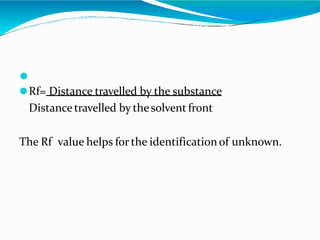
⚫Rf= Distance travelled by the substance
Distancetravelled by thesolvent front
The Rf value helps for the identificationof unknown.
Sometimes,it is rather difficult to separate a
complex mixture of substances bya single run with
one solvent system. In such a case, a second run is
carried out by a different solvent system, in a
direction perpendicular to the first run. This is
referred toas twodimensional chromatography.
Thin layer chromatography
⚫ Thin layerchromatography (TLC) is a widelyemployed
laboratory technique and is similar to paper
chromatography. However, instead of using a
stationary phase of paper, it involvesa stationary phase
of a thin layerof adsorbent like silicagel, alumina,
orcellulose . Compared to paper, it has theadvantage
of faster runs, better separations, and the choice
betweendifferent adsorbents.
In case of adsorption thin layer chromatography,
adsorbents such as activated silica gel, alumina,
kieselguhr are used.
THIN LAYER CHROMATOGRAPHY
GAS-LIQUID CHROMATOGRAPHY
⚫Gas chromatography (GC), also sometimes known as Gas-
Liquid chromatography, (GLC), is a separation technique in
which the mobile phase is a gas.It is the method of choice for
the separation of volatile substances or the volatile derivatives
of certain non-volatile substances.
⚫Stationary phase is an inert solid material impregnated with a
non-volatile liquid.
⚫In gas chromatography, a sample is rapidly heated and
vaporized at the injection port. The sample is transported
through the column by a mobile phase consisiting of an inert
gas. Sample components are separated based on their boiling
points and relativeaffinity for the stationary phase, which is
most often a viscous liquid (wax) within the column. The
higher a component's affinity for the stationary phase, the
slower it comes off the column. The components are then
detected and represented as peaks on a chromatogram.
⚫The mixtureof volatile material is injected into the
columnalong with the mobilephase.
⚫The separation of the volatile mixture is based on the
partition of the components between the mobile
phase(gas) and stationary phase (liq.), hence the name
GAS-LIQUID CHROMATOGRAPHY.
⚫It is well suited foruse in the petrochemical,
environmental monitoring and industrial
chemical fields.
⚫Sensitive, rapid and reliable.
ADSORPTION COLUMN CHROMATOGRAPHY
⚫Column chromatography is a separation technique in
which the stationary bed is within a tube.Adsorbents
are packed intoa column in a glass tube.Thisservesas
the stationary phase,leaving an open unrestricted path
for the mobile phase in the middleof the tube.
⚫Adsorbents such as silicagel, alumina, charcoal
powder & calcium hydroxyapatiteare used.
⚫The sample mixture in a solvent is loaded on this
column.The individual compoundsgetdifferentially
adsorbed on to theadsorbent.
⚫The elution is carried out by the buffersystem which is
the mobile phase.
⚫The individual compoundscomeoutof thecolumnat
different rates which may be collected separately &
identified.
COLUMN CHROMATOGRAPHY
ION EXCHANGE CHROMATOGRAPHY
⚫Ion exchange chromatography (usually referred to as
ion chromatography) uses an ion exchange
mechanism toseparate moleculeson the basisof their
electrical charges.Ion exchange chromatography usesa
charged stationary phase to separate charged
compounds including anions, cations, amino
acids, peptides, and proteins.
⚫Cationexchangers & anion exchangersare used as ion
exchange resins.
⚫ In conventional methods the stationary phase is
an ion exchange resin that carries charged functional
groups that interactwith oppositelycharged groupsof
thecompound toretain.
An anion exchanger (R+A–) exchanges its anion (A–)
with another anion (B–) in solution.
R+A– + B– R+B– + A–
Similarly, a cation exchanger (H+R–) exchanges its
cation (H+) with another cation (C+) in solution.
H+R– + C+ C+R– + H+
ION EXCHANGE CHROMATOGRAPHY
GEL FILTRATION CHROMATOGRAPHY
⚫Size-exclusion chromatography (SEC) is also known
as gel permeation chromatography (GPC) or gel
filtrationchromatography and separates molecules
according to theirsize, shape & molecularweight.
⚫It is also referred toas molecularsieving or molecular
exclusion chromatography.
⚫ Smaller molecules are able to enter the pores of the
media and, therefore, molecules are trapped and
removed from the flow of the mobile phase. However,
molecules that are larger than the average pore size of
the packing areexcluded and thussufferessentially no
retention; such species are the first to be eluted. This is
how the moleculesare separated.
⚫It is generally a low-resolution chromatography
technique and thus it is often reserved for the final,
"polishing" step of a purification. It is also useful for
determining the tertiary structureand quaternary
structureof purified proteins, especiallysince itcan be
carried out under native solutionconditions.
GEL FILTRATION CHROMATOGRAPHY
AFFINITY CHROMATOGRAPHY
⚫Affinity chromatography is based on selective non-
covalent interaction betweenan analyteand specific
molecules, referred toas ligands.
⚫The immobilized ligands actas molecular fish-hooks
& selectively pick up desired proteins while the
remaining protein pass through thecolumn.
AFFINITY CHROMATOGRAPHY
HIGH PERFORMANCE LIQUID
CHROMATOGRAPHY (HPLC )
⚫Liquid chromatography (LC) is a separation technique in
which the mobile phase is a liquid. Liquid chromatography
can be carried out either in a column or a plane. Present
day liquid chromatography that generally utilizes very
small packing particles and a relatively high pressure is
referred toas high performance liquid
chromatography (HPLC).
⚫Since the chromatographic techniques are slow & time
consuming,hence the separationcan begreatly improved
by using high pressure in the range of 5000-10000
psi(pounds per square inch),hence this technique is also
referred toas high pressure liquid chromatography.
⚫In HPLC the sample is forced by a liquid at high
pressure (the mobilephase) through a column that is
packed with a stationary phase composed of
irregularlyorsphericallyshaped particles.
⚫The interaction between the mobileand the stationary
phase leads to the separationof the mixture.
THANK YOU

chromatography.pptx

  • 2.
    Chromatography ⚫Chromatography (from Greekchroma "color and graphein "towrite") is thecollectiveterm fora set of laboratory techniques for the separation of mixtures. The mixture is dissolved in a fluid called the mobile phase, which carries it through a structure holding another material called the stationary phase. Thevariousconstituentsof the mixture travel at different speeds, causing them to separate. The separation is based on differential partitioning between the mobileand stationary phases.
  • 3.
    Chromatography, literally "colorwriting",was firstemployed by Russian scientist Mikhail Tsvet in 1900. He continued to work with chromatography in the first decade of the 20th century, primarily for the separation of plantpigments such as chlorophyll, carotenes, and xanthophylls. Since these components have differentcolors (green, orange, and yellow,respectively) theygave the technique its name.
  • 4.
    APPLICATIONS OF CHROMATOGRAPHY ⚫Thechromatographic technique is used for the separationof aminoacids,proteins & carbohydrates. ⚫It is also used for theanalysis of drugs,hormones,vitamins ⚫Helpful for thequalitative & quantitativeanalysis of complex mixtures. ⚫The technique isalso useful for thedeterminationof molecularweightof proteins.
  • 5.
    PRINCIPLES ⚫Chromatographyusuallyconsistsof mobilephaseand stationary phase.Themobile phase refers to the mixture of substances to be separated dissolved in a liquid oragas.The stationary phase is a porous solid matrix through which the sample contained in the mobile phase percolates.The interaction between the mobile phase and the stationary phase results in the separationof thecompound from the mixture. ⚫ These interactions include the physicochemical principles such as adsorption, partition, ion- exchange, molecular sieving and affinity.
  • 7.
    Types of Chromatography ⚫Thereare following typesof Chromatography Paper Chromatography Thin Layer Chromatography(TLC) Gel Chromatography Column Chromatography Ion Exchange Chromatography Gel Filtration Chromatography Gas Liquid Chromatography Affinity Chromatography
  • 8.
    Paper chromatography ⚫Paper chromatographyis a technique that involves placing a small dot or line of sample solution onto a stripofchromatography paper. The paper is placed in a jarcontaining a shallow layerof solventand sealed. As the solventrises through the paper, it meets the sample mixture, which starts to travel up the paper with the solvent. ⚫ When the migration of the solvent is upwards, it is referred to as ascending chromatography. In descending chromatography, the solvent moves downwards.
  • 11.
    ⚫ ⚫Rf= Distance travelledby the substance Distancetravelled by thesolvent front The Rf value helps for the identificationof unknown.
  • 12.
    Sometimes,it is ratherdifficult to separate a complex mixture of substances bya single run with one solvent system. In such a case, a second run is carried out by a different solvent system, in a direction perpendicular to the first run. This is referred toas twodimensional chromatography.
  • 14.
    Thin layer chromatography ⚫Thin layerchromatography (TLC) is a widelyemployed laboratory technique and is similar to paper chromatography. However, instead of using a stationary phase of paper, it involvesa stationary phase of a thin layerof adsorbent like silicagel, alumina, orcellulose . Compared to paper, it has theadvantage of faster runs, better separations, and the choice betweendifferent adsorbents. In case of adsorption thin layer chromatography, adsorbents such as activated silica gel, alumina, kieselguhr are used.
  • 15.
  • 16.
    GAS-LIQUID CHROMATOGRAPHY ⚫Gas chromatography(GC), also sometimes known as Gas- Liquid chromatography, (GLC), is a separation technique in which the mobile phase is a gas.It is the method of choice for the separation of volatile substances or the volatile derivatives of certain non-volatile substances. ⚫Stationary phase is an inert solid material impregnated with a non-volatile liquid. ⚫In gas chromatography, a sample is rapidly heated and vaporized at the injection port. The sample is transported through the column by a mobile phase consisiting of an inert gas. Sample components are separated based on their boiling points and relativeaffinity for the stationary phase, which is most often a viscous liquid (wax) within the column. The higher a component's affinity for the stationary phase, the slower it comes off the column. The components are then detected and represented as peaks on a chromatogram.
  • 17.
    ⚫The mixtureof volatilematerial is injected into the columnalong with the mobilephase. ⚫The separation of the volatile mixture is based on the partition of the components between the mobile phase(gas) and stationary phase (liq.), hence the name GAS-LIQUID CHROMATOGRAPHY.
  • 19.
    ⚫It is wellsuited foruse in the petrochemical, environmental monitoring and industrial chemical fields. ⚫Sensitive, rapid and reliable.
  • 20.
    ADSORPTION COLUMN CHROMATOGRAPHY ⚫Columnchromatography is a separation technique in which the stationary bed is within a tube.Adsorbents are packed intoa column in a glass tube.Thisservesas the stationary phase,leaving an open unrestricted path for the mobile phase in the middleof the tube. ⚫Adsorbents such as silicagel, alumina, charcoal powder & calcium hydroxyapatiteare used.
  • 21.
    ⚫The sample mixturein a solvent is loaded on this column.The individual compoundsgetdifferentially adsorbed on to theadsorbent. ⚫The elution is carried out by the buffersystem which is the mobile phase. ⚫The individual compoundscomeoutof thecolumnat different rates which may be collected separately & identified.
  • 22.
  • 23.
    ION EXCHANGE CHROMATOGRAPHY ⚫Ionexchange chromatography (usually referred to as ion chromatography) uses an ion exchange mechanism toseparate moleculeson the basisof their electrical charges.Ion exchange chromatography usesa charged stationary phase to separate charged compounds including anions, cations, amino acids, peptides, and proteins.
  • 24.
    ⚫Cationexchangers & anionexchangersare used as ion exchange resins. ⚫ In conventional methods the stationary phase is an ion exchange resin that carries charged functional groups that interactwith oppositelycharged groupsof thecompound toretain. An anion exchanger (R+A–) exchanges its anion (A–) with another anion (B–) in solution. R+A– + B– R+B– + A– Similarly, a cation exchanger (H+R–) exchanges its cation (H+) with another cation (C+) in solution. H+R– + C+ C+R– + H+
  • 25.
  • 26.
    GEL FILTRATION CHROMATOGRAPHY ⚫Size-exclusionchromatography (SEC) is also known as gel permeation chromatography (GPC) or gel filtrationchromatography and separates molecules according to theirsize, shape & molecularweight. ⚫It is also referred toas molecularsieving or molecular exclusion chromatography.
  • 27.
    ⚫ Smaller moleculesare able to enter the pores of the media and, therefore, molecules are trapped and removed from the flow of the mobile phase. However, molecules that are larger than the average pore size of the packing areexcluded and thussufferessentially no retention; such species are the first to be eluted. This is how the moleculesare separated.
  • 28.
    ⚫It is generallya low-resolution chromatography technique and thus it is often reserved for the final, "polishing" step of a purification. It is also useful for determining the tertiary structureand quaternary structureof purified proteins, especiallysince itcan be carried out under native solutionconditions.
  • 29.
  • 30.
    AFFINITY CHROMATOGRAPHY ⚫Affinity chromatographyis based on selective non- covalent interaction betweenan analyteand specific molecules, referred toas ligands. ⚫The immobilized ligands actas molecular fish-hooks & selectively pick up desired proteins while the remaining protein pass through thecolumn.
  • 31.
  • 32.
    HIGH PERFORMANCE LIQUID CHROMATOGRAPHY(HPLC ) ⚫Liquid chromatography (LC) is a separation technique in which the mobile phase is a liquid. Liquid chromatography can be carried out either in a column or a plane. Present day liquid chromatography that generally utilizes very small packing particles and a relatively high pressure is referred toas high performance liquid chromatography (HPLC). ⚫Since the chromatographic techniques are slow & time consuming,hence the separationcan begreatly improved by using high pressure in the range of 5000-10000 psi(pounds per square inch),hence this technique is also referred toas high pressure liquid chromatography.
  • 33.
    ⚫In HPLC thesample is forced by a liquid at high pressure (the mobilephase) through a column that is packed with a stationary phase composed of irregularlyorsphericallyshaped particles. ⚫The interaction between the mobileand the stationary phase leads to the separationof the mixture.
  • 35.