Chromatography
By...Kiransia
Chromatography
ļ‚— Chromatography (from Greek chroma "color
and graphein "to write") is the collective term for
a set of laboratory techniques for the
separation of mixtures. The mixture is dissolved
in a fluid called the mobile phase, which carries it
through a structure holding another material
called the stationary phase. The various
constituents of the mixture travel at different
speeds, causing them to separate. The separation
is based on differential partitioning between the
mobile and stationary phases.
History
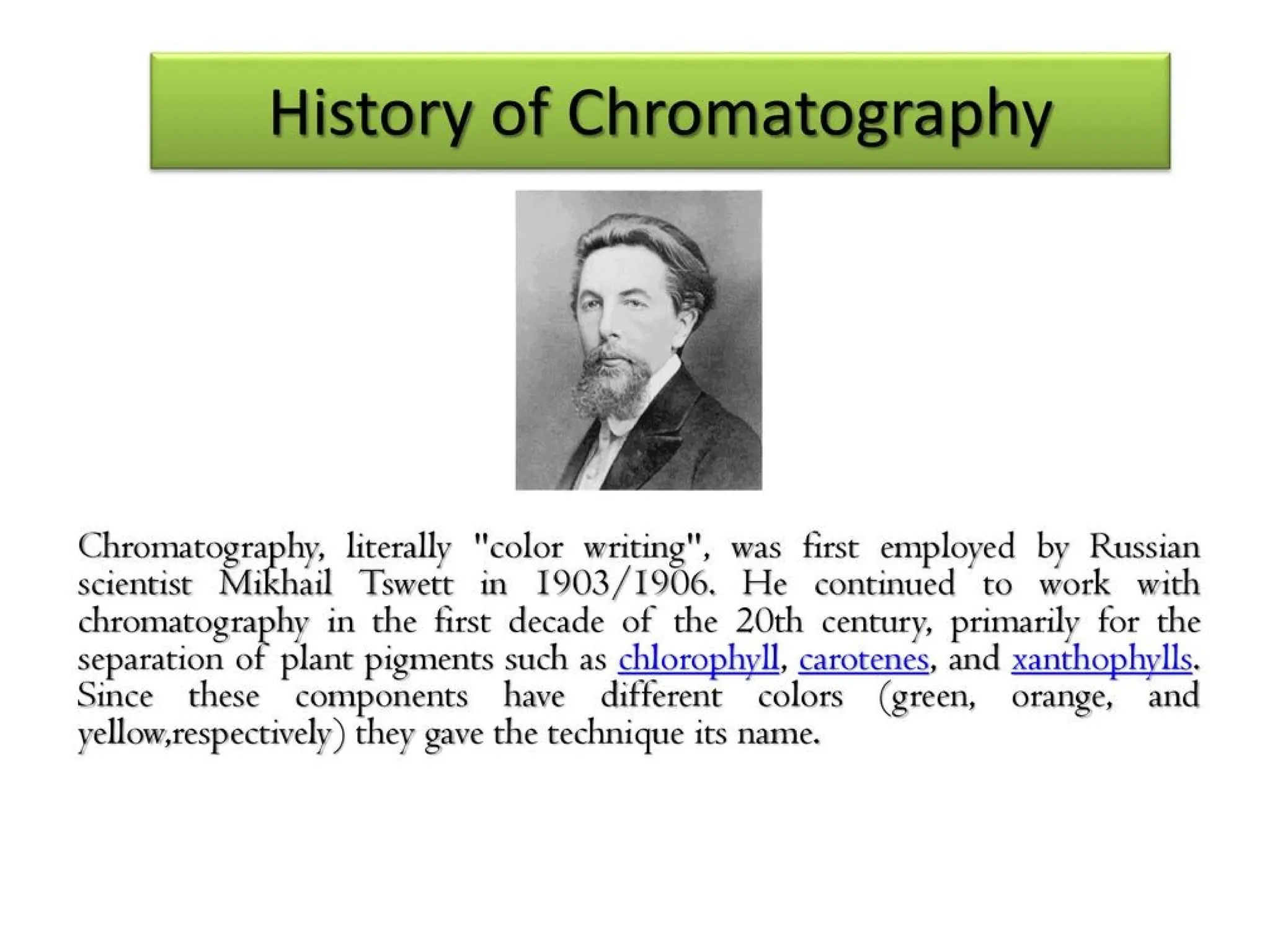
Chromatography, literally "color writing", was first employed by
Russian scientist Mikhail Tsvet in 1900. He continued to work
with chromatography in the first decade of the 20th century,
primarily for the separation of plant pigments such as
chlorophyll, carotenes, and xanthophylls. Since these components
have different colors (green, orange, and yellow,respectively) they
gave the technique its name.
PRINCIPLES
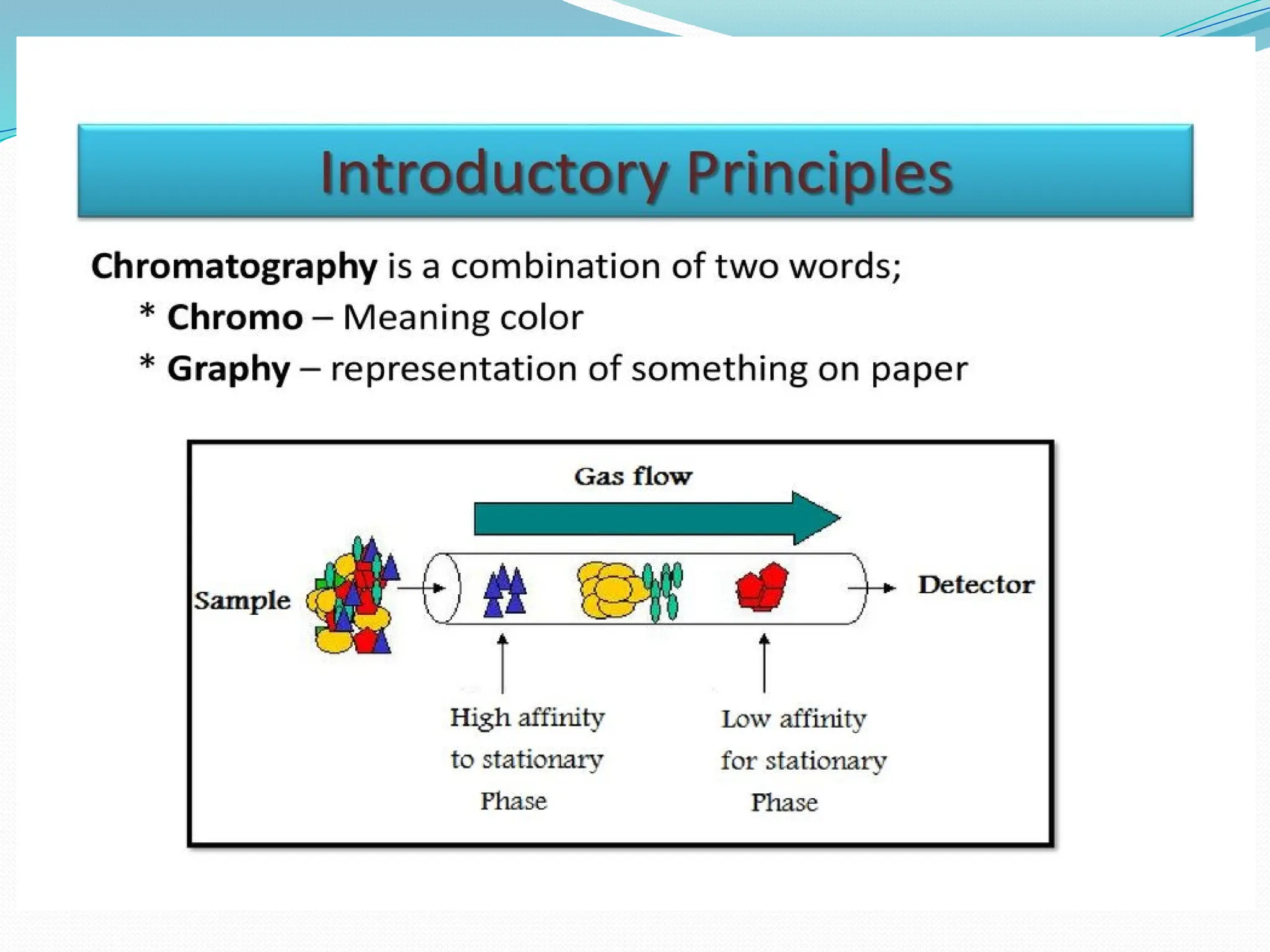
ļ‚— Chromatography usually consists of mobile
phase and stationary phase.The mobile phase
refers to the mixture of substances to be
separated dissolved in a liquid or a gas.The
stationary phase is a porous solid matrix
through which the sample contained in the
mobile phase percolates.The interaction between
the mobile phase and the stationary phase
results in the separation of the compound from
the mixture.
APPLICATIONS OF CHROMATOGRAPHY
ļ‚— The chromatographic technique is used for the
separation of amino acids,proteins &
carbohydrates.
ļ‚— It is also used for the analysis of
drugs,hormones,vitamins
ļ‚— Helpful for the qualitative & quantitative
analysis of complex mixtures.
ļ‚— The technique is also useful for the
determination of molecular weight of proteins.
Types of Chromatography
ļ‚— There are following types of Chromatography
Paper Chromatography
Thin Layer Chromatography(TLC)
Gel Chromatography
Column Chromatography
Ion Exchange Chromatography
Gel Filtration Chromatography
Gas Liquid Chromatography
Affinity Chromatography
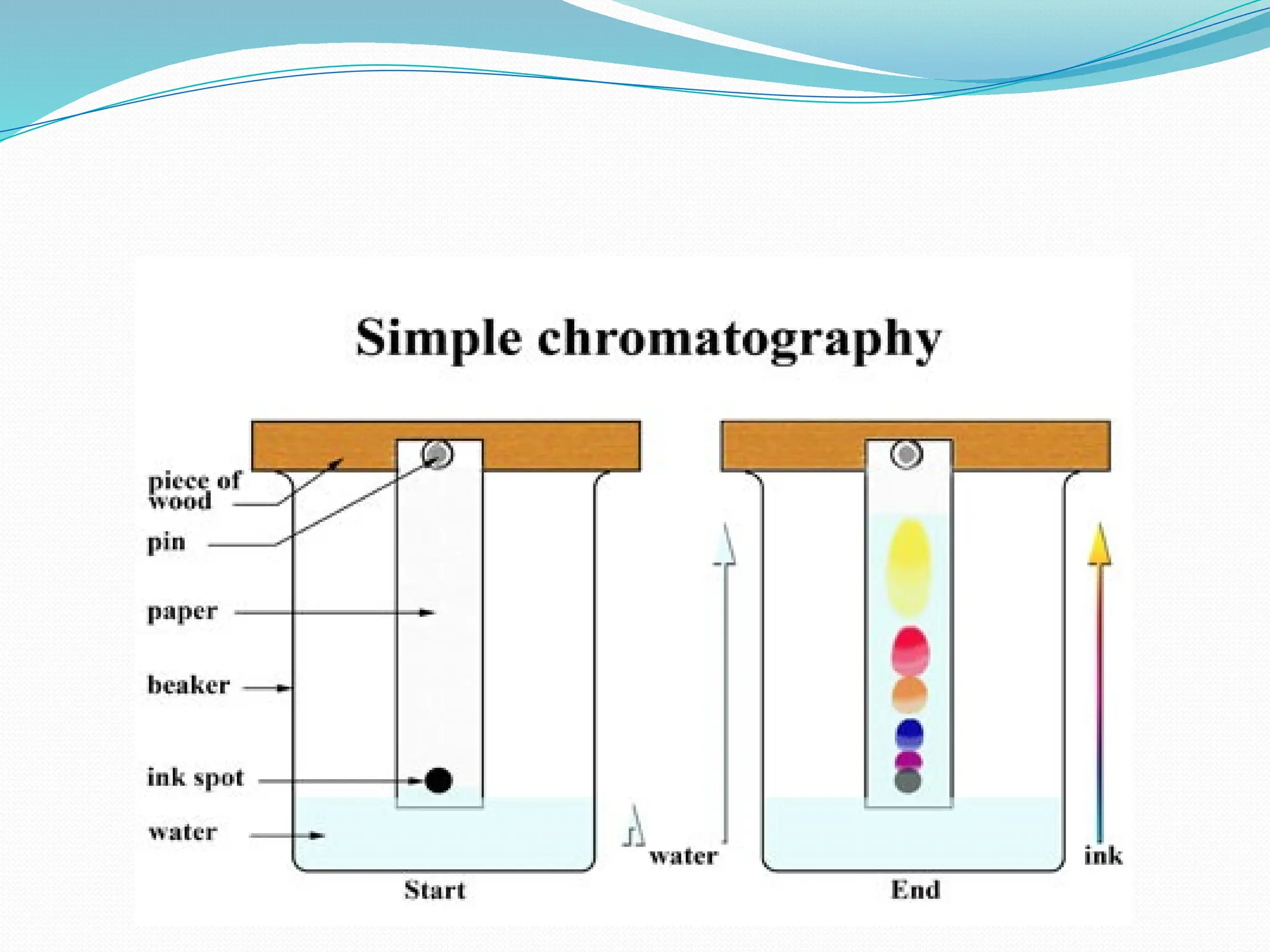
Paper chromatography
ļ‚— Paper chromatography is a technique that
involves placing a small dot or line of sample
solution onto a strip ofchromatography paper.
The paper is placed in a jar containing a shallow
layer of solvent and sealed. As the solvent rises
through the paper, it meets the sample mixture,
which starts to travel up the paper with the
solvent.
ļ‚—
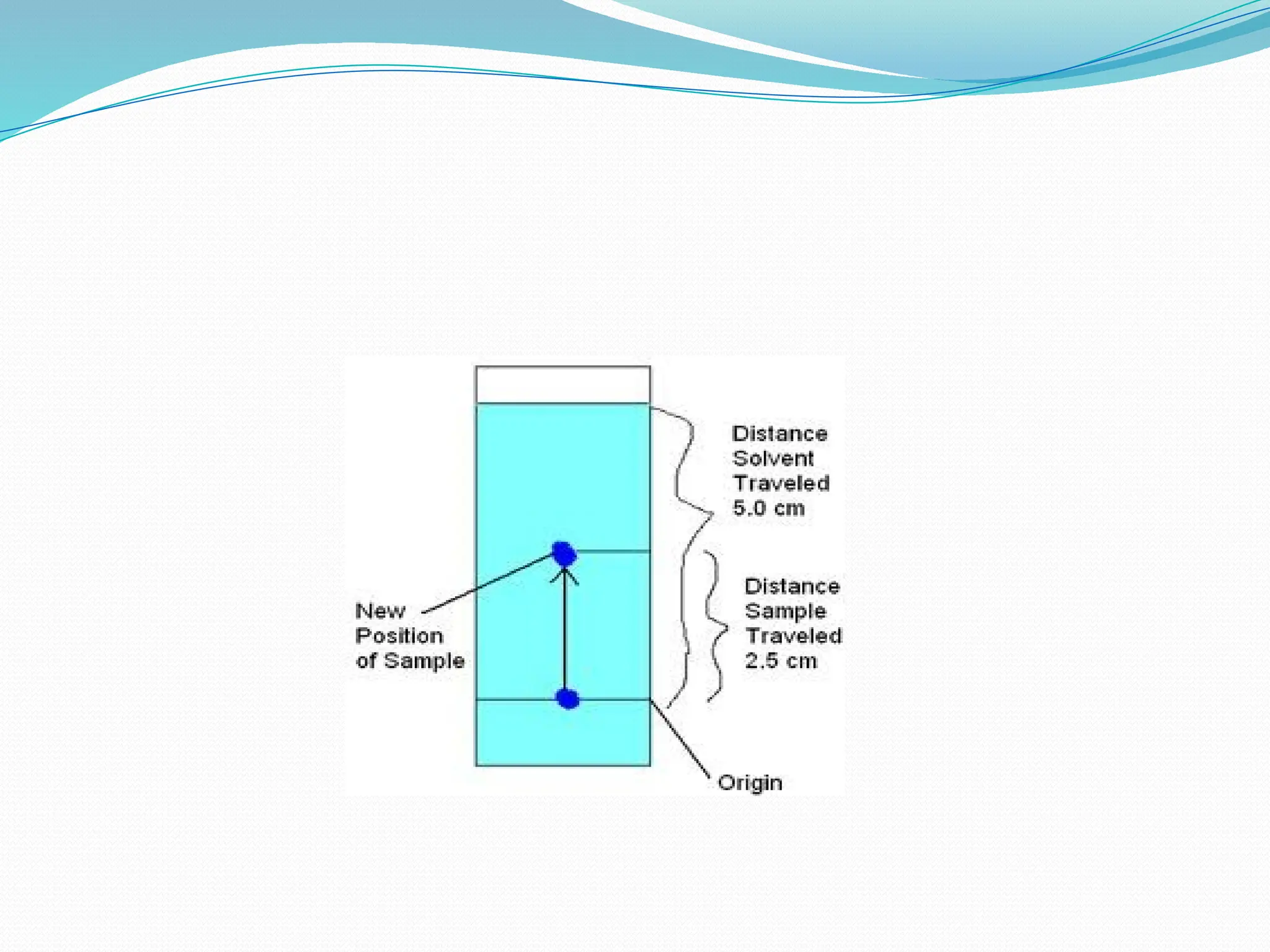
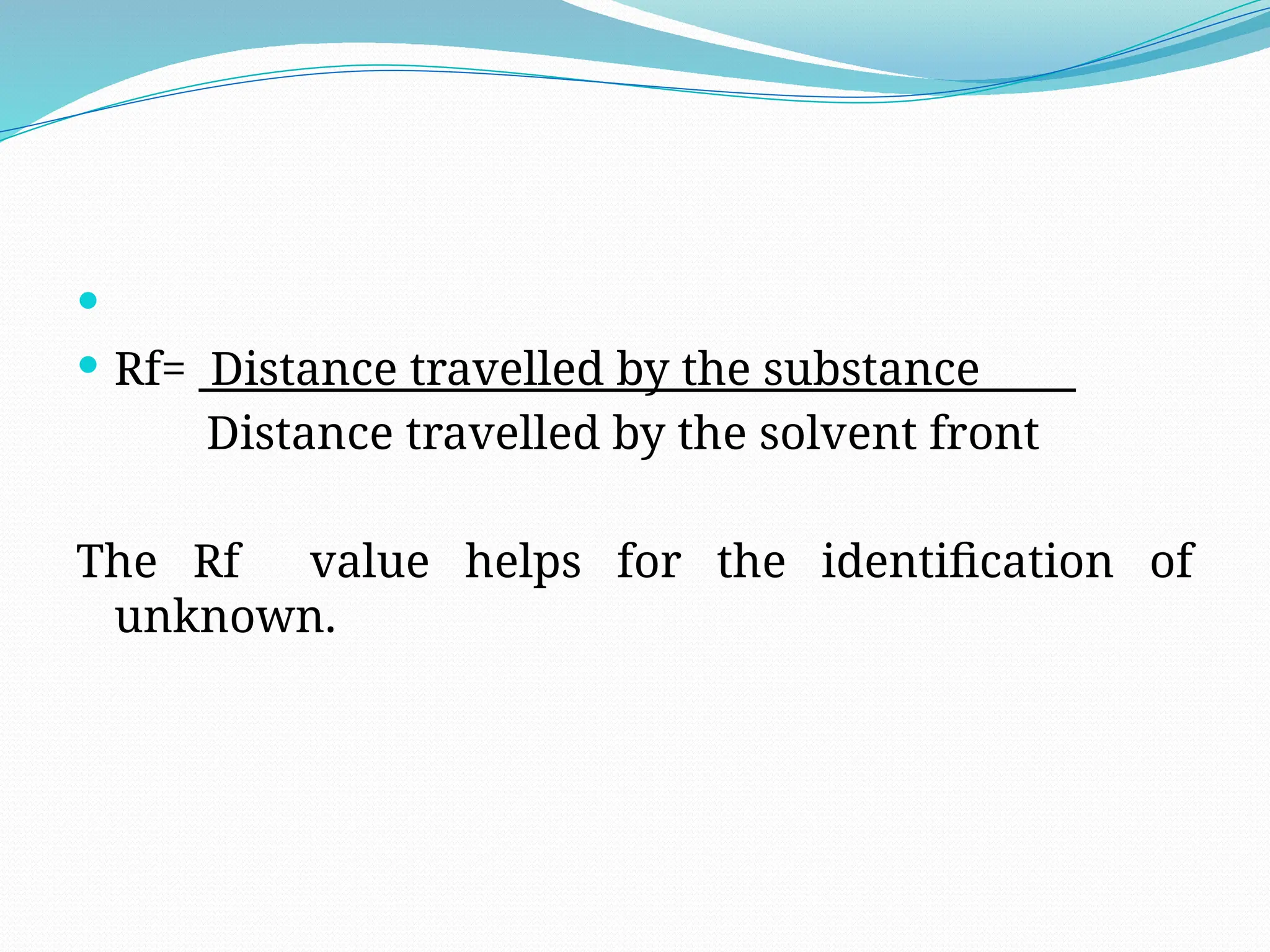
ļ‚— Rf= Distance travelled by the substance
Distance travelled by the solvent front
The Rf value helps for the identification of
unknown.
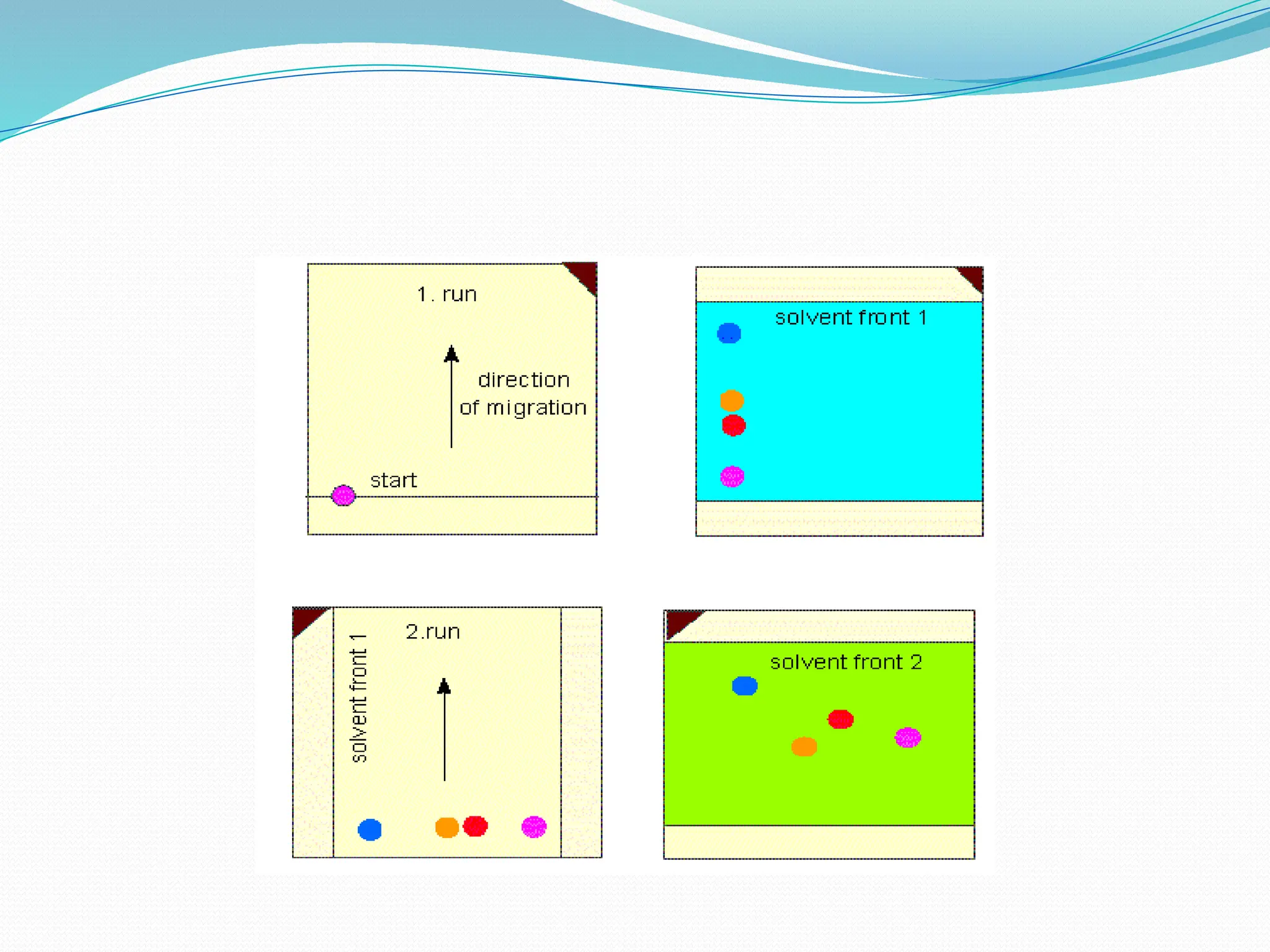
Sometimes,it is rather difficult to separate a
complex mixture of substances by a single
run with one solvent system. In such a case, a
second run is carried out by a different
solvent system, in a direction perpendicular
to the first run. This is referred to as two
dimensional chromatography.
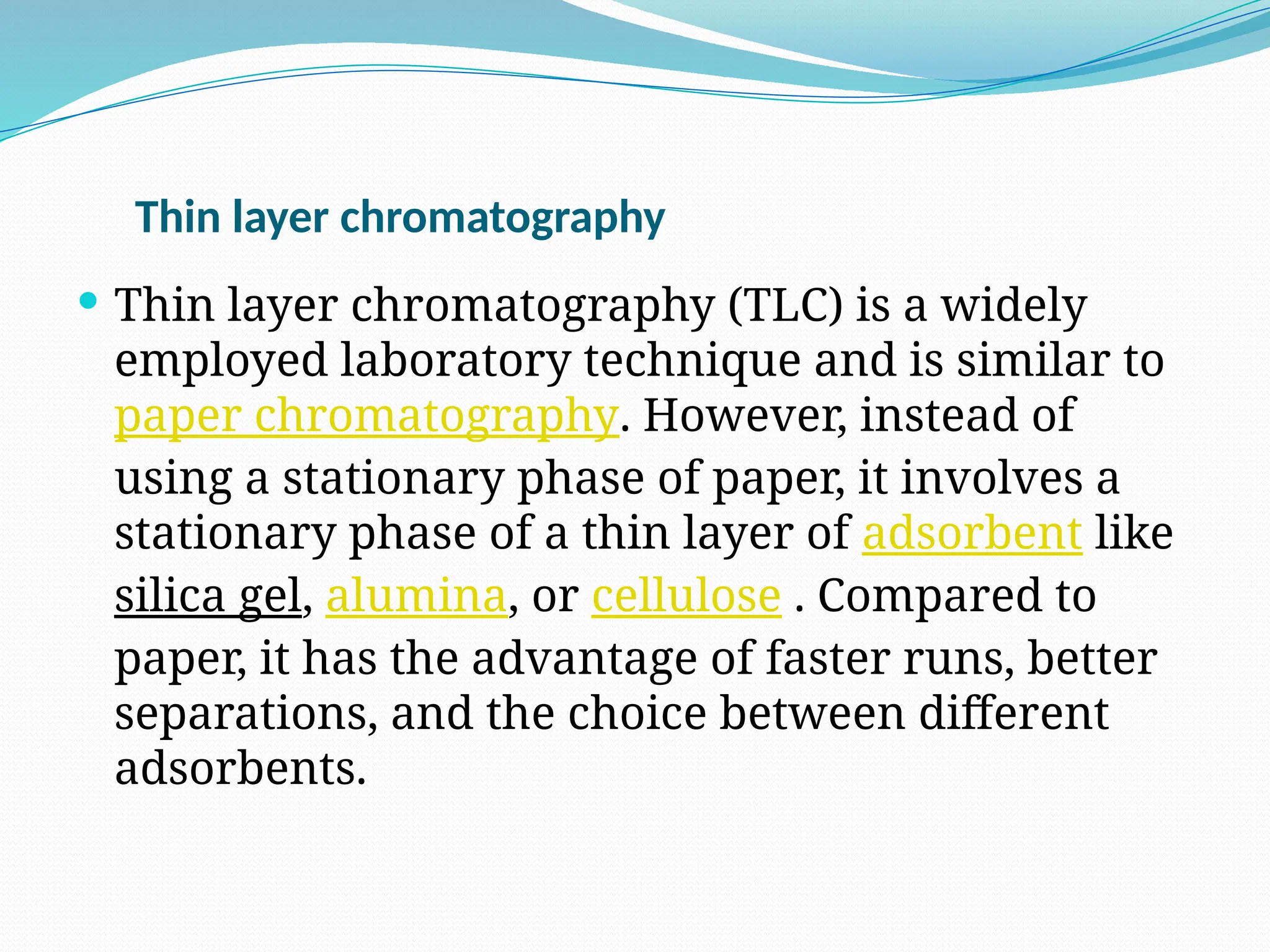
Thin layer chromatography
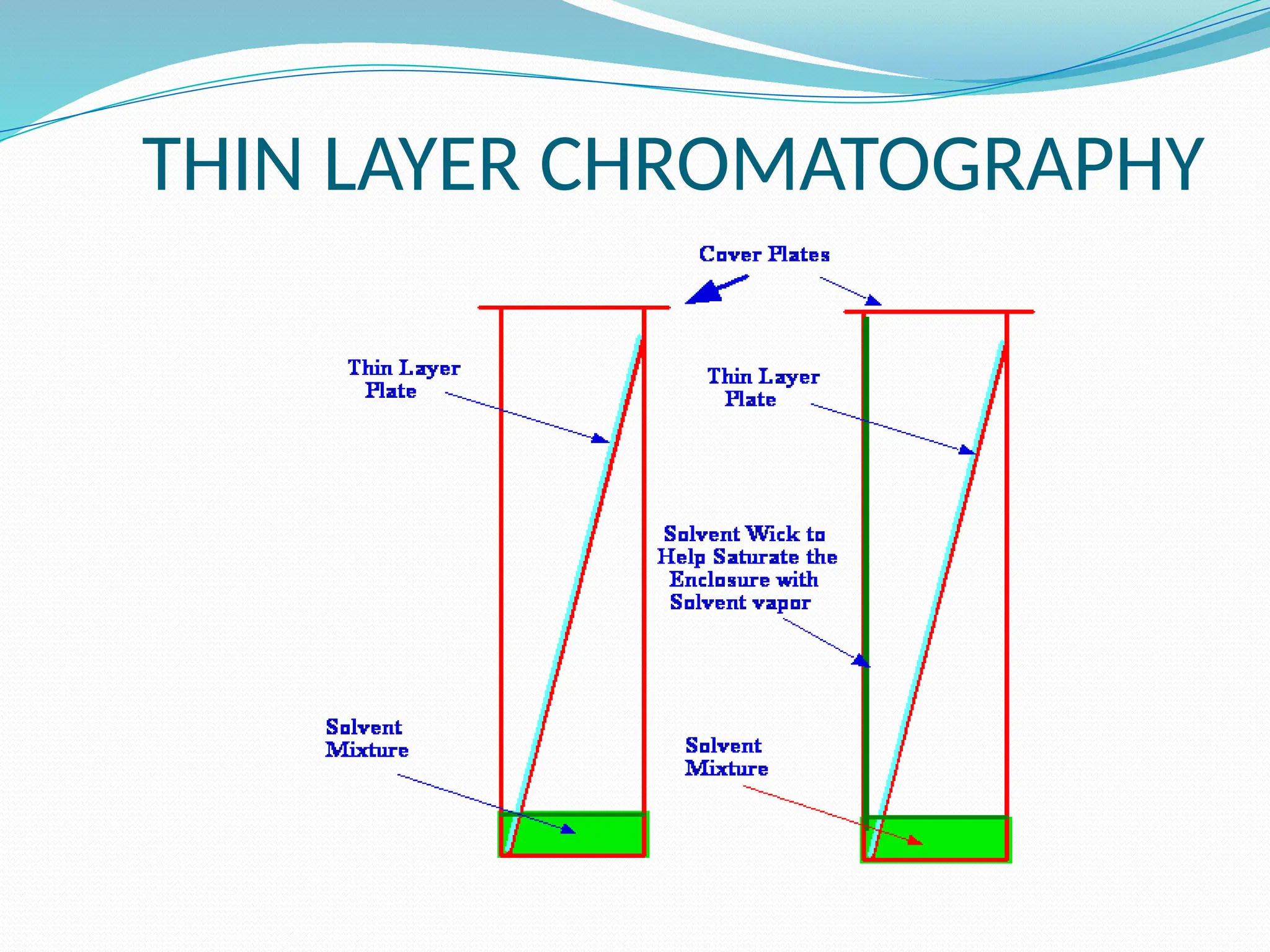
ļ‚— Thin layer chromatography (TLC) is a widely
employed laboratory technique and is similar to
paper chromatography. However, instead of
using a stationary phase of paper, it involves a
stationary phase of a thin layer of adsorbent like
silica gel, alumina, or cellulose . Compared to
paper, it has the advantage of faster runs, better
separations, and the choice between different
adsorbents.
THIN LAYER CHROMATOGRAPHY
GAS-LIQUID CHROMATOGRAPHY
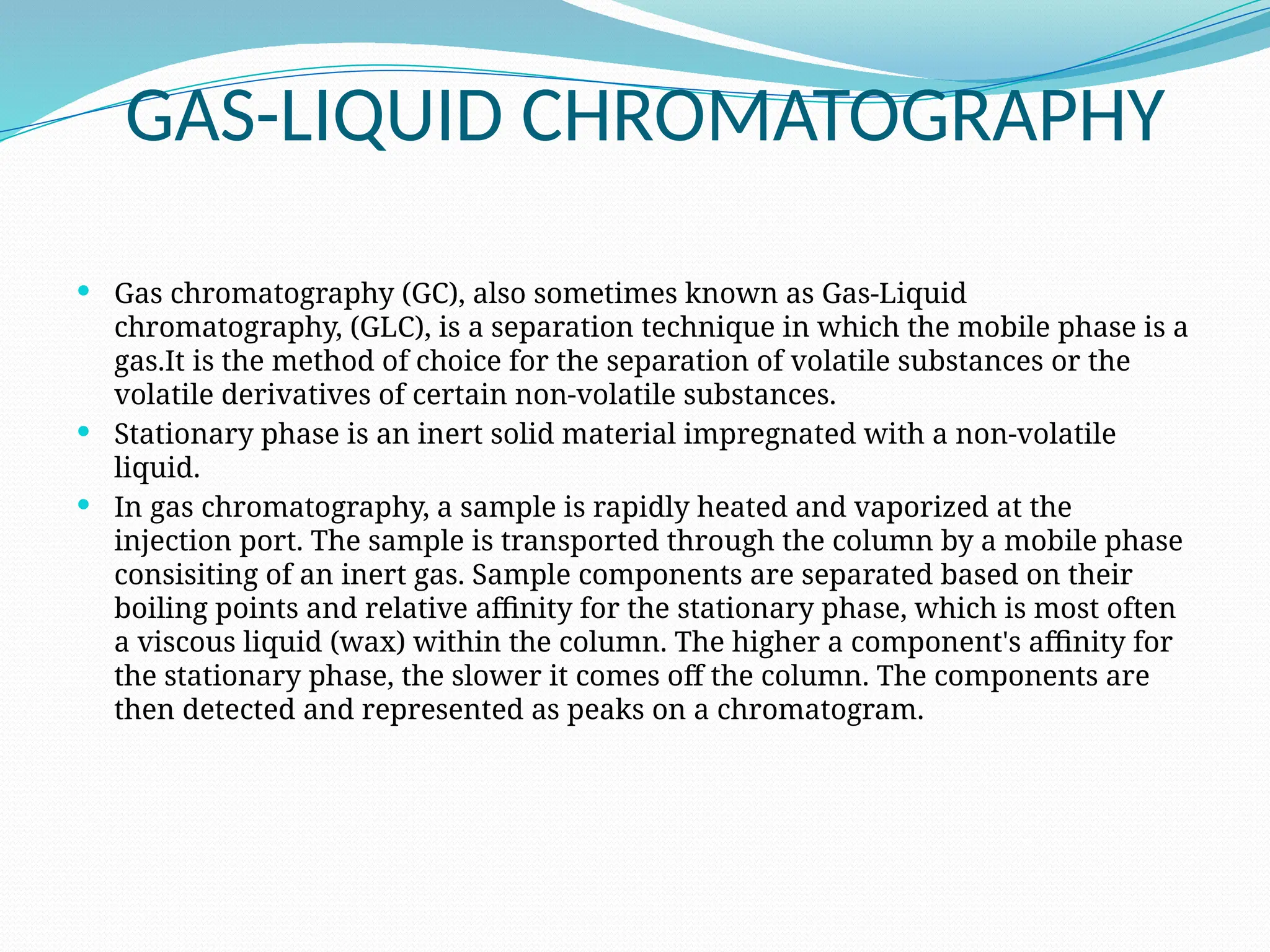
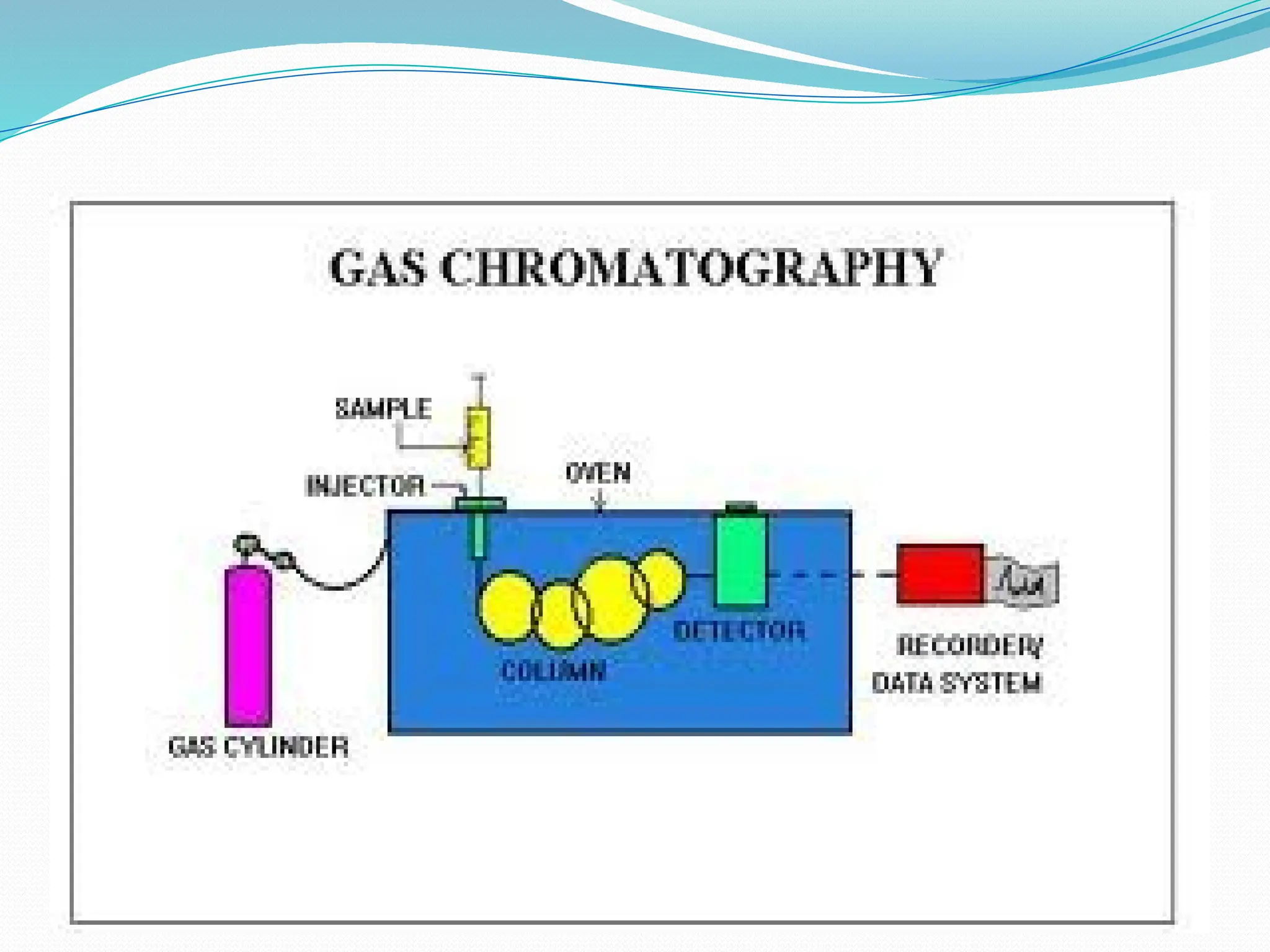
ļ‚— Gas chromatography (GC), also sometimes known as Gas-Liquid
chromatography, (GLC), is a separation technique in which the mobile phase is a
gas.It is the method of choice for the separation of volatile substances or the
volatile derivatives of certain non-volatile substances.
ļ‚— Stationary phase is an inert solid material impregnated with a non-volatile
liquid.
ļ‚— In gas chromatography, a sample is rapidly heated and vaporized at the
injection port. The sample is transported through the column by a mobile phase
consisiting of an inert gas. Sample components are separated based on their
boiling points and relative affinity for the stationary phase, which is most often
a viscous liquid (wax) within the column. The higher a component's affinity for
the stationary phase, the slower it comes off the column. The components are
then detected and represented as peaks on a chromatogram.
ļ‚— The mixture of volatile material is injected into
the column along with the mobile phase.
ļ‚— The separation of the volatile mixture is based
on the partition of the components between the
mobile phase(gas) and stationary phase (liq.),
hence the name GAS-LIQUID
CHROMATOGRAPHY.
ļ‚— It is well suited for use in the
petrochemical,environmental monitoring and
industrial chemical fields.
ļ‚— Sensitive, rapid and reliable.
ADSORPTION TLC
ļ‚— Adsorbents such as activated silica gel, alumina,
kieselguhr are used.
ADSORPTION COLUMN
CHROMATOGRAPHY
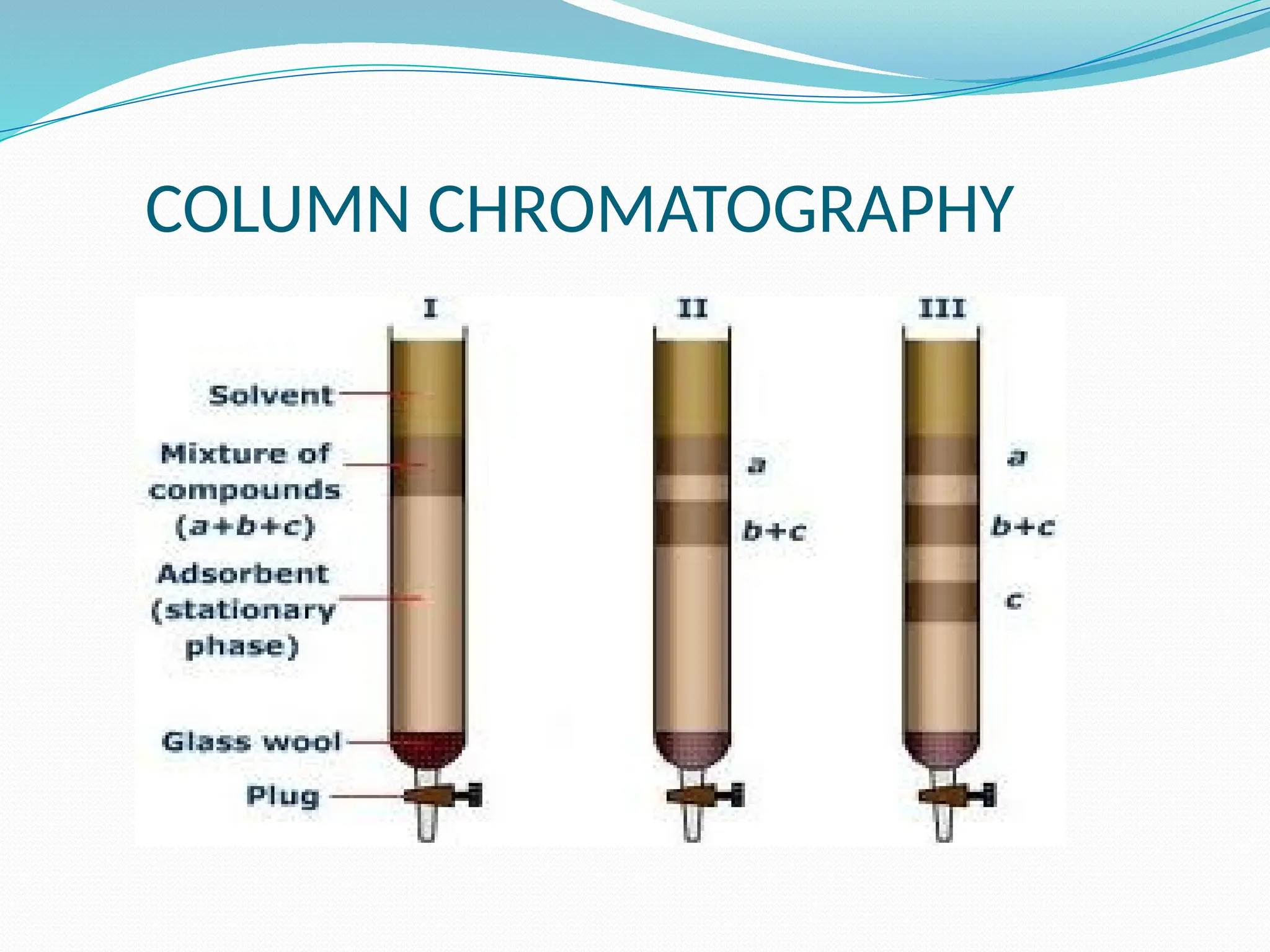
ļ‚— Column chromatography is a separation technique in
which the stationary bed is within a tube.Adsorbents
are packed into a column in a glass tube.This serves
as the stationary phase,leaving an open unrestricted
path for the mobile phase in the middle of the tube.
ļ‚— Adsorbents such as silica gel, alumina, charcoal
powder & calcium hydroxyapatite are used.
ļ‚— The sample mixture in a solvent is loaded on this
column.The individual compounds get
differentially adsorbed on to the adsorbent.
ļ‚— The elution is carried out by the buffer system
which is the mobile phase.
ļ‚— The individual compounds come out of the
column at different rates which may be collected
separately & identified.
COLUMN CHROMATOGRAPHY
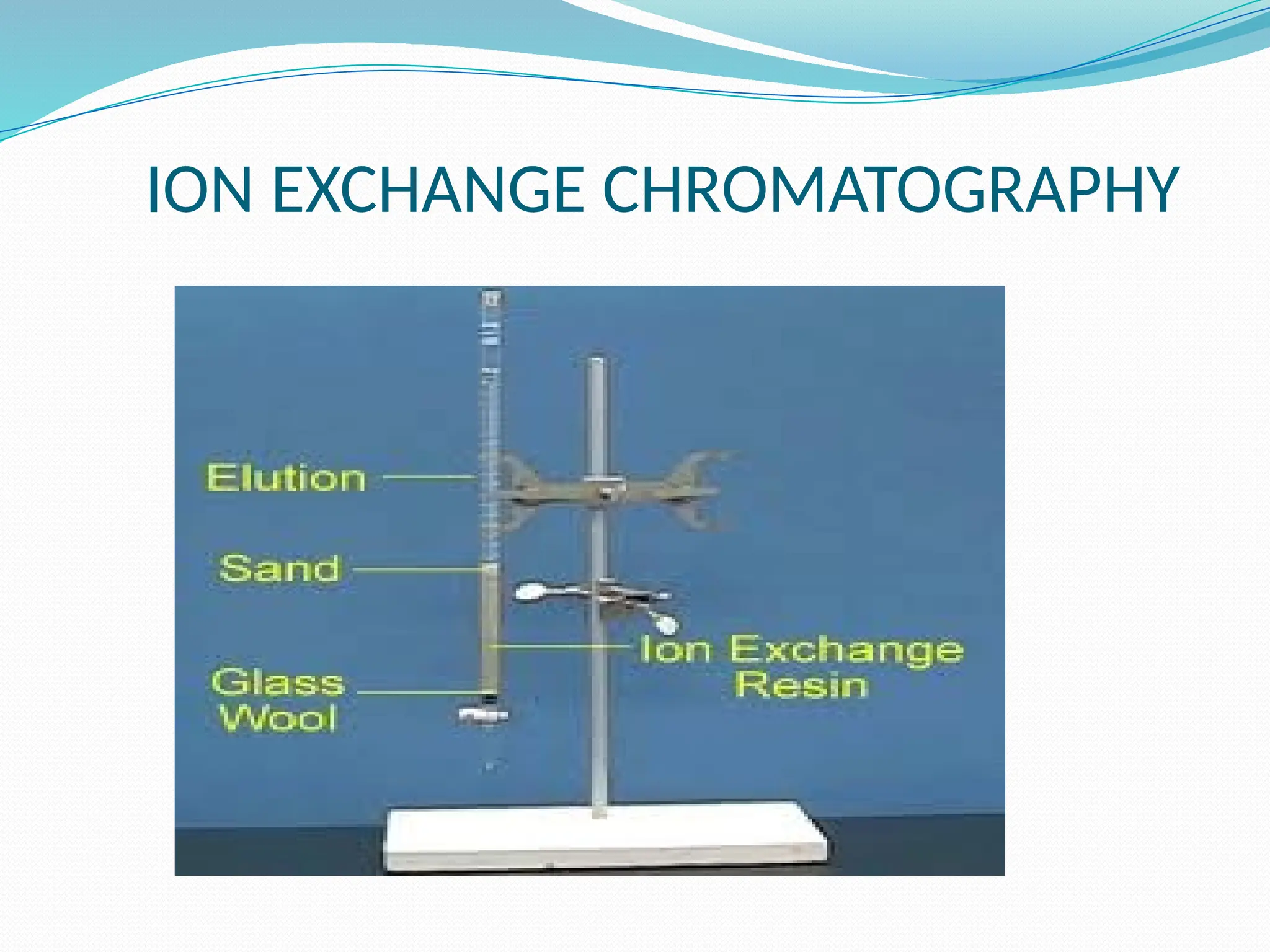
ION EXCHANGE CHROMATOGRAPHY
ļ‚— Ion exchange chromatography (usually referred
to as ion chromatography) uses an ion exchange
mechanism to separate molecules on the basis of
their electrical charges.Ion exchange
chromatography uses a charged stationary phase
to separate charged compounds including anions
, cations, amino acids, peptides, and proteins.
ļ‚— Cation exchangers & anion exchangers are used
as ion exchange resins.
ļ‚— In conventional methods the stationary phase is
an ion exchange resin that carries charged
functional groups that interact with oppositely
charged groups of the compound to retain.
ION EXCHANGE CHROMATOGRAPHY
GEL FILTRATION CHROMATOGRAPHY
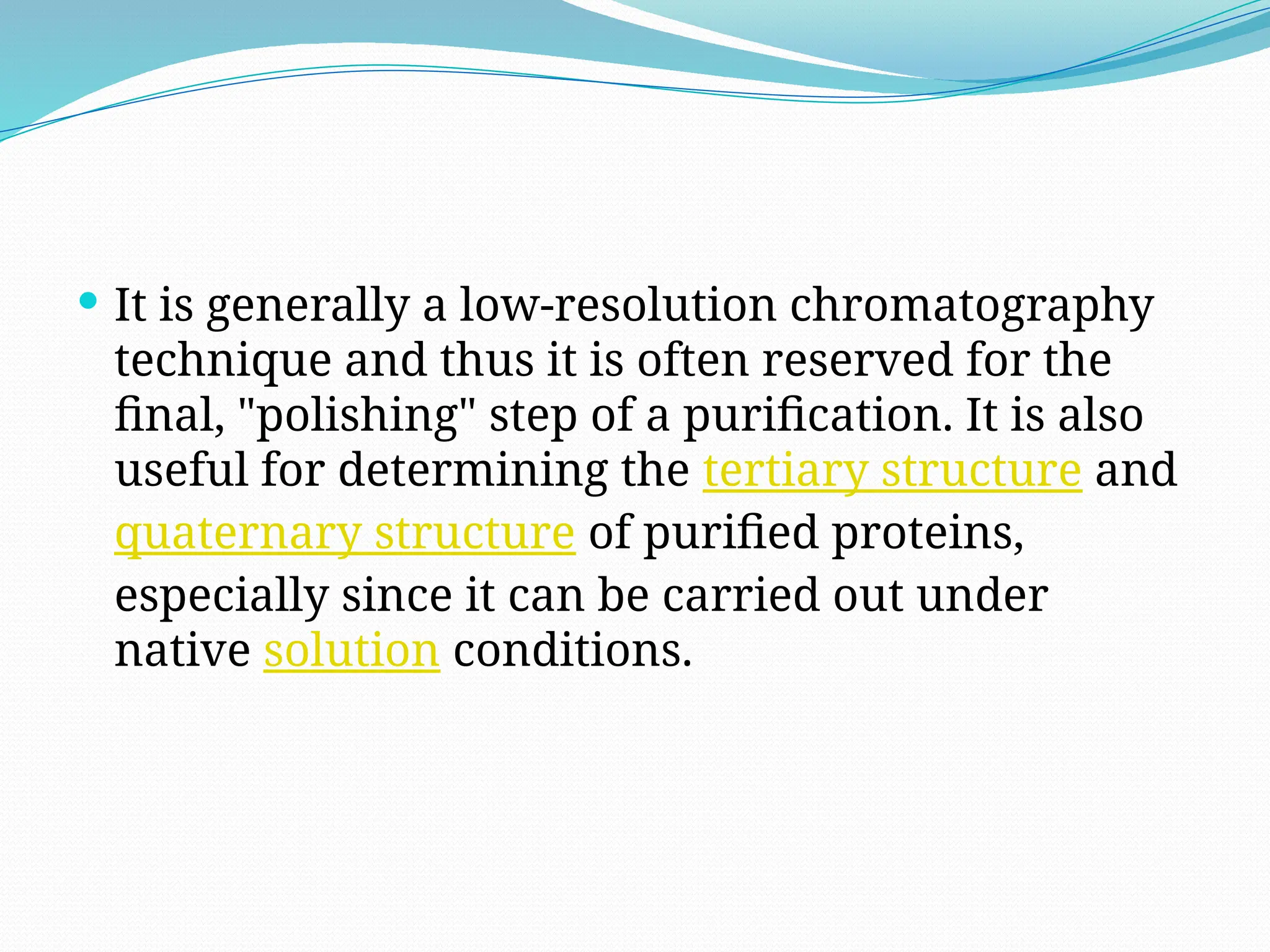
ļ‚— Size-exclusion chromatography (SEC) is also
known as gel permeation chromatography (GPC)
or gel filtration chromatography and separates
molecules according to their size, shape &
molecular weight.
ļ‚— It is also referred to as molecular sieving or
molecular exclusion chromatography.
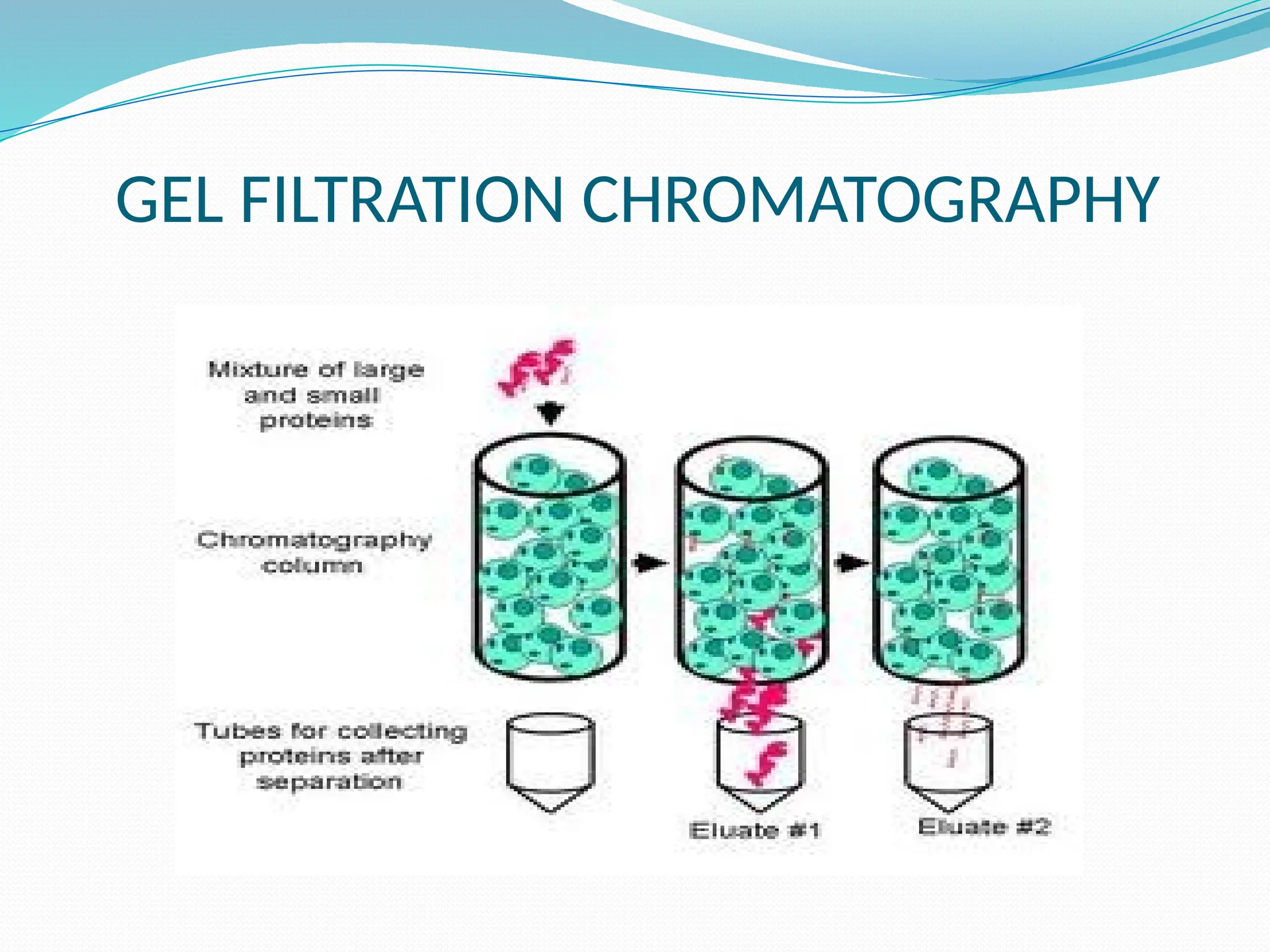
ļ‚— Smaller molecules are able to enter the pores of
the media and, therefore, molecules are trapped
and removed from the flow of the mobile phase.
However, molecules that are larger than the
average pore size of the packing are excluded
and thus suffer essentially no retention; such
species are the first to be eluted. This is how the
molecules are separated.
ļ‚— It is generally a low-resolution chromatography
technique and thus it is often reserved for the
final, "polishing" step of a purification. It is also
useful for determining the tertiary structure and
quaternary structure of purified proteins,
especially since it can be carried out under
native solution conditions.
GEL FILTRATION CHROMATOGRAPHY
AFFINITY CHROMATOGRAPHY
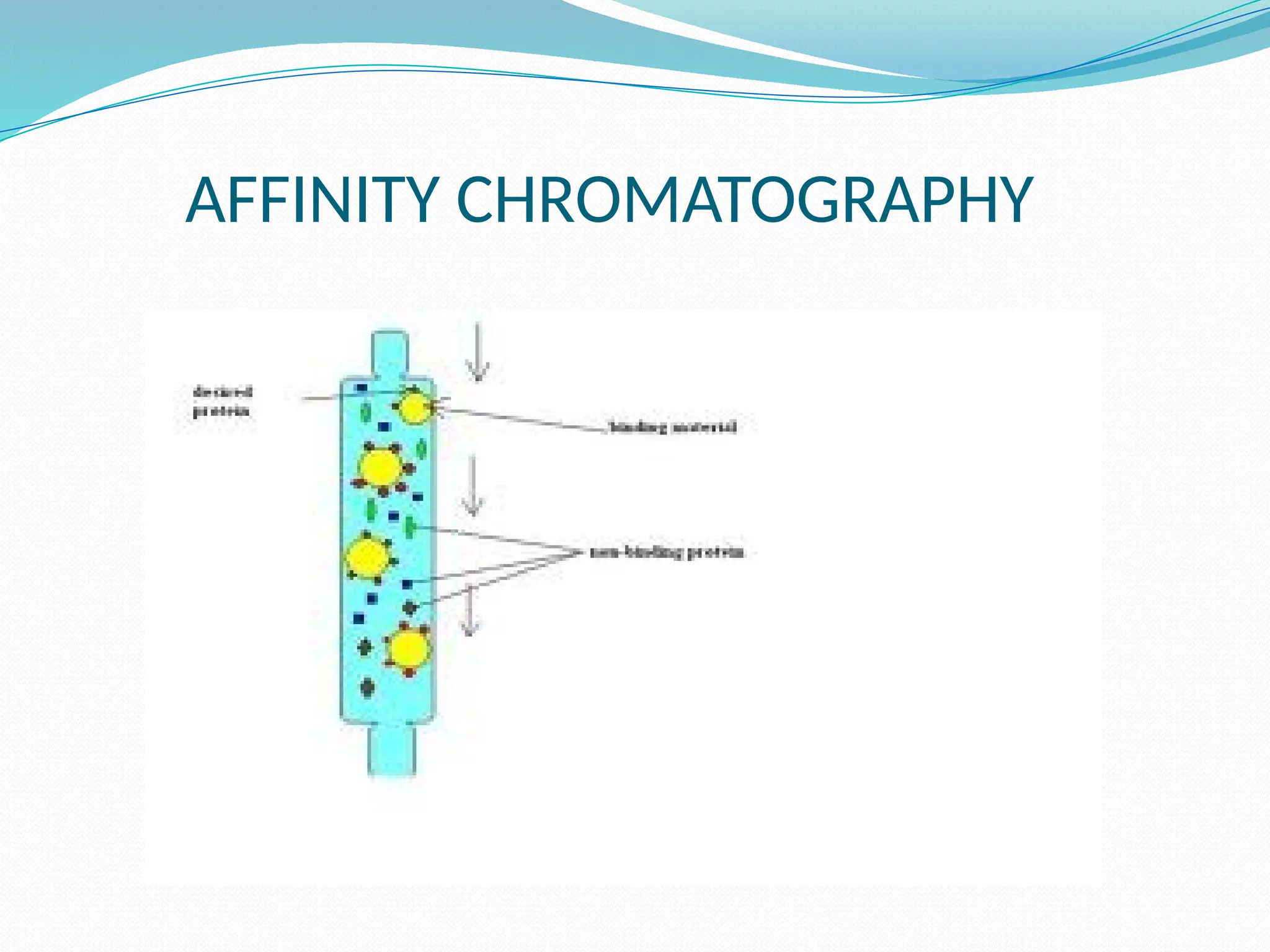
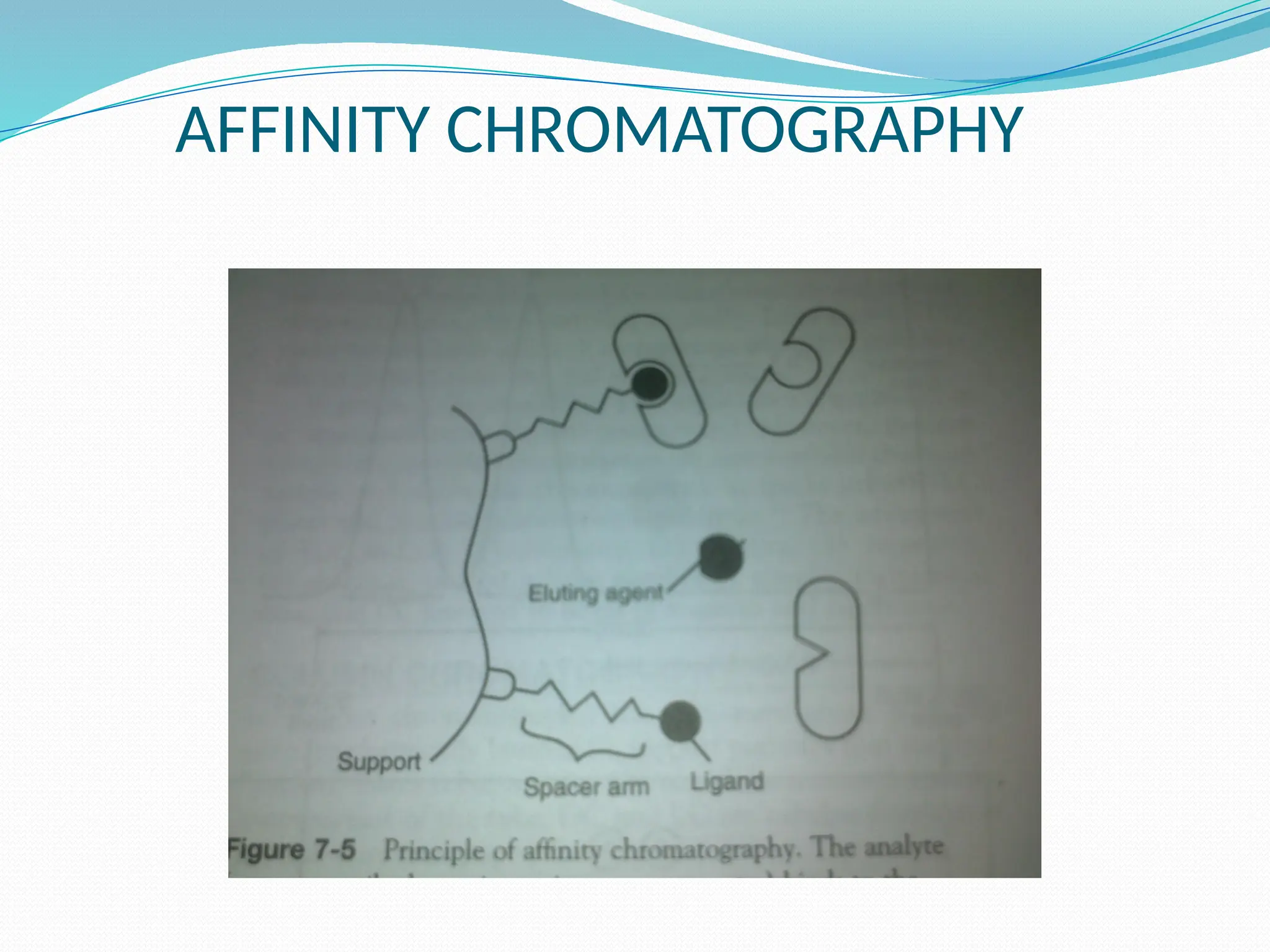
ļ‚— Affinity chromatography is based on selective
non-covalent interaction between an analyte and
specific molecules, referred to as ligands.
ļ‚— The immobilized ligands act as molecular fish-
hooks & selectively pick up desired proteins
while the remaining protein pass through the
column.
AFFINITY CHROMATOGRAPHY
HIGH PERFORMANCE LIQUID
CHROMATOGRAPHY (HPLC )
ļ‚— Liquid chromatography (LC) is a separation technique in
which the mobile phase is a liquid. Liquid
chromatography can be carried out either in a column or
a plane. Present day liquid chromatography that generally
utilizes very small packing particles and a relatively high
pressure is referred to as
high performance liquid chromatography (HPLC).
ļ‚— Since the chromatographic techniques are slow & time
consuming,hence the separation can be greatly improved
by using high pressure in the range of 5000-10000
psi(pounds per square inch),hence this technique is also
referred to as high pressure liquid chromatography.
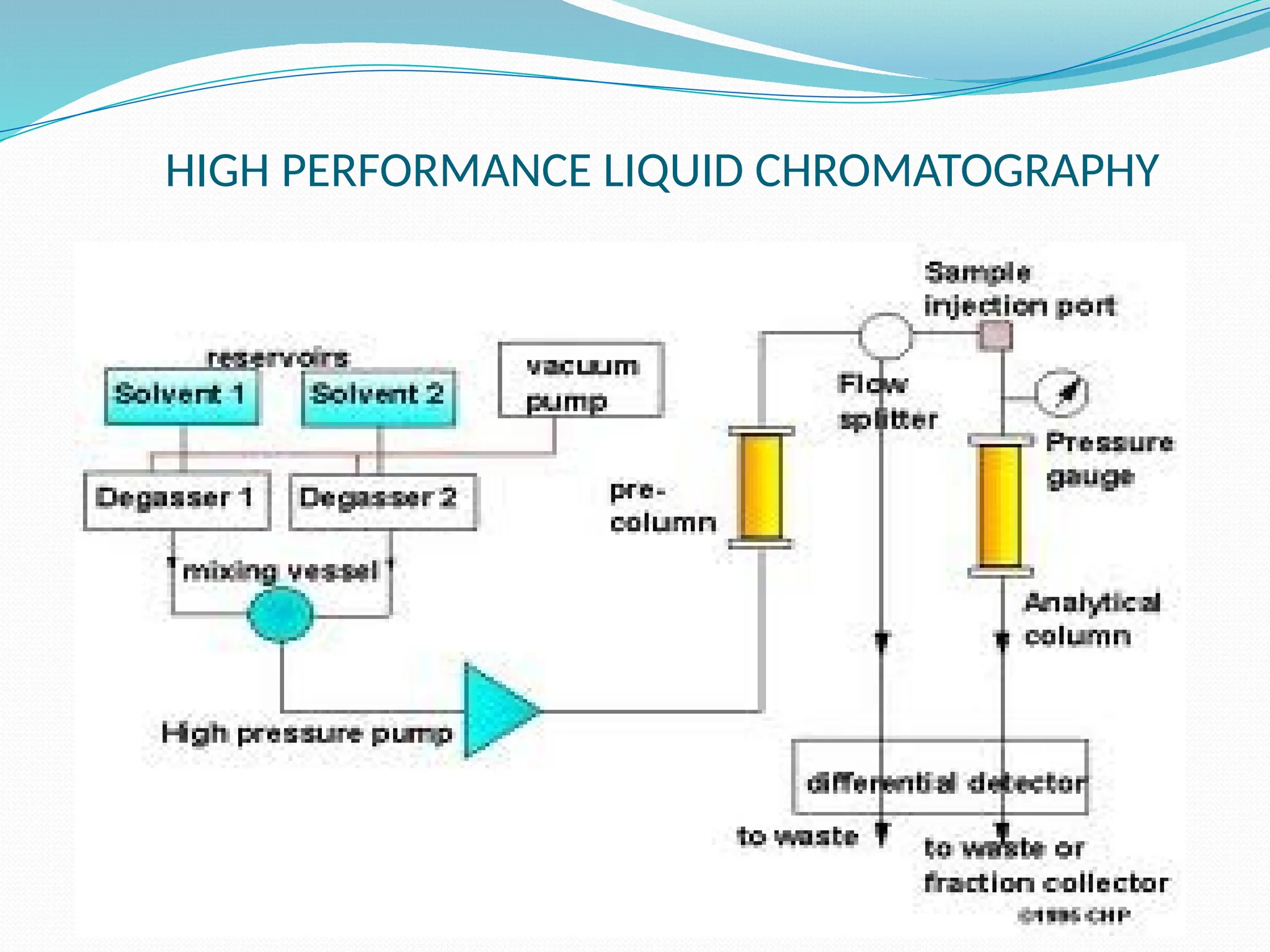
ļ‚— In HPLC the sample is forced by a liquid at high
pressure (the mobile phase) through a column
that is packed with a stationary phase composed
of irregularly or spherically shaped particles.
ļ‚— The interaction between the mobile and the
stationary phase leads to the separation of the
mixture.
HIGH PERFORMANCE LIQUID CHROMATOGRAPHY
THANKS

chromatography by sia).pptx by instrumen

  • 1.
  • 3.
    Chromatography ļ‚— Chromatography (fromGreek chroma "color and graphein "to write") is the collective term for a set of laboratory techniques for the separation of mixtures. The mixture is dissolved in a fluid called the mobile phase, which carries it through a structure holding another material called the stationary phase. The various constituents of the mixture travel at different speeds, causing them to separate. The separation is based on differential partitioning between the mobile and stationary phases.
  • 4.
    History Chromatography, literally "colorwriting", was first employed by Russian scientist Mikhail Tsvet in 1900. He continued to work with chromatography in the first decade of the 20th century, primarily for the separation of plant pigments such as chlorophyll, carotenes, and xanthophylls. Since these components have different colors (green, orange, and yellow,respectively) they gave the technique its name.
  • 5.
    PRINCIPLES ļ‚— Chromatography usuallyconsists of mobile phase and stationary phase.The mobile phase refers to the mixture of substances to be separated dissolved in a liquid or a gas.The stationary phase is a porous solid matrix through which the sample contained in the mobile phase percolates.The interaction between the mobile phase and the stationary phase results in the separation of the compound from the mixture.
  • 6.
    APPLICATIONS OF CHROMATOGRAPHY ļ‚—The chromatographic technique is used for the separation of amino acids,proteins & carbohydrates. ļ‚— It is also used for the analysis of drugs,hormones,vitamins ļ‚— Helpful for the qualitative & quantitative analysis of complex mixtures. ļ‚— The technique is also useful for the determination of molecular weight of proteins.
  • 7.
    Types of Chromatography ļ‚—There are following types of Chromatography Paper Chromatography Thin Layer Chromatography(TLC) Gel Chromatography Column Chromatography Ion Exchange Chromatography Gel Filtration Chromatography Gas Liquid Chromatography Affinity Chromatography
  • 8.
    Paper chromatography ļ‚— Paperchromatography is a technique that involves placing a small dot or line of sample solution onto a strip ofchromatography paper. The paper is placed in a jar containing a shallow layer of solvent and sealed. As the solvent rises through the paper, it meets the sample mixture, which starts to travel up the paper with the solvent.
  • 11.
    ļ‚— ļ‚— Rf= Distancetravelled by the substance Distance travelled by the solvent front The Rf value helps for the identification of unknown.
  • 12.
    Sometimes,it is ratherdifficult to separate a complex mixture of substances by a single run with one solvent system. In such a case, a second run is carried out by a different solvent system, in a direction perpendicular to the first run. This is referred to as two dimensional chromatography.
  • 14.
    Thin layer chromatography ļ‚—Thin layer chromatography (TLC) is a widely employed laboratory technique and is similar to paper chromatography. However, instead of using a stationary phase of paper, it involves a stationary phase of a thin layer of adsorbent like silica gel, alumina, or cellulose . Compared to paper, it has the advantage of faster runs, better separations, and the choice between different adsorbents.
  • 15.
  • 16.
    GAS-LIQUID CHROMATOGRAPHY ļ‚— Gaschromatography (GC), also sometimes known as Gas-Liquid chromatography, (GLC), is a separation technique in which the mobile phase is a gas.It is the method of choice for the separation of volatile substances or the volatile derivatives of certain non-volatile substances. ļ‚— Stationary phase is an inert solid material impregnated with a non-volatile liquid. ļ‚— In gas chromatography, a sample is rapidly heated and vaporized at the injection port. The sample is transported through the column by a mobile phase consisiting of an inert gas. Sample components are separated based on their boiling points and relative affinity for the stationary phase, which is most often a viscous liquid (wax) within the column. The higher a component's affinity for the stationary phase, the slower it comes off the column. The components are then detected and represented as peaks on a chromatogram.
  • 17.
    ļ‚— The mixtureof volatile material is injected into the column along with the mobile phase. ļ‚— The separation of the volatile mixture is based on the partition of the components between the mobile phase(gas) and stationary phase (liq.), hence the name GAS-LIQUID CHROMATOGRAPHY.
  • 19.
    ļ‚— It iswell suited for use in the petrochemical,environmental monitoring and industrial chemical fields. ļ‚— Sensitive, rapid and reliable.
  • 20.
    ADSORPTION TLC ļ‚— Adsorbentssuch as activated silica gel, alumina, kieselguhr are used.
  • 21.
    ADSORPTION COLUMN CHROMATOGRAPHY ļ‚— Columnchromatography is a separation technique in which the stationary bed is within a tube.Adsorbents are packed into a column in a glass tube.This serves as the stationary phase,leaving an open unrestricted path for the mobile phase in the middle of the tube. ļ‚— Adsorbents such as silica gel, alumina, charcoal powder & calcium hydroxyapatite are used.
  • 22.
    ļ‚— The samplemixture in a solvent is loaded on this column.The individual compounds get differentially adsorbed on to the adsorbent. ļ‚— The elution is carried out by the buffer system which is the mobile phase. ļ‚— The individual compounds come out of the column at different rates which may be collected separately & identified.
  • 23.
  • 24.
    ION EXCHANGE CHROMATOGRAPHY ļ‚—Ion exchange chromatography (usually referred to as ion chromatography) uses an ion exchange mechanism to separate molecules on the basis of their electrical charges.Ion exchange chromatography uses a charged stationary phase to separate charged compounds including anions , cations, amino acids, peptides, and proteins.
  • 25.
    ļ‚— Cation exchangers& anion exchangers are used as ion exchange resins. ļ‚— In conventional methods the stationary phase is an ion exchange resin that carries charged functional groups that interact with oppositely charged groups of the compound to retain.
  • 26.
  • 27.
    GEL FILTRATION CHROMATOGRAPHY ļ‚—Size-exclusion chromatography (SEC) is also known as gel permeation chromatography (GPC) or gel filtration chromatography and separates molecules according to their size, shape & molecular weight. ļ‚— It is also referred to as molecular sieving or molecular exclusion chromatography.
  • 28.
    ļ‚— Smaller moleculesare able to enter the pores of the media and, therefore, molecules are trapped and removed from the flow of the mobile phase. However, molecules that are larger than the average pore size of the packing are excluded and thus suffer essentially no retention; such species are the first to be eluted. This is how the molecules are separated.
  • 29.
    ļ‚— It isgenerally a low-resolution chromatography technique and thus it is often reserved for the final, "polishing" step of a purification. It is also useful for determining the tertiary structure and quaternary structure of purified proteins, especially since it can be carried out under native solution conditions.
  • 30.
  • 31.
    AFFINITY CHROMATOGRAPHY ļ‚— Affinitychromatography is based on selective non-covalent interaction between an analyte and specific molecules, referred to as ligands. ļ‚— The immobilized ligands act as molecular fish- hooks & selectively pick up desired proteins while the remaining protein pass through the column.

  • 32.
  • 33.
  • 34.
    HIGH PERFORMANCE LIQUID CHROMATOGRAPHY(HPLC ) ļ‚— Liquid chromatography (LC) is a separation technique in which the mobile phase is a liquid. Liquid chromatography can be carried out either in a column or a plane. Present day liquid chromatography that generally utilizes very small packing particles and a relatively high pressure is referred to as high performance liquid chromatography (HPLC). ļ‚— Since the chromatographic techniques are slow & time consuming,hence the separation can be greatly improved by using high pressure in the range of 5000-10000 psi(pounds per square inch),hence this technique is also referred to as high pressure liquid chromatography.
  • 35.
    ļ‚— In HPLCthe sample is forced by a liquid at high pressure (the mobile phase) through a column that is packed with a stationary phase composed of irregularly or spherically shaped particles. ļ‚— The interaction between the mobile and the stationary phase leads to the separation of the mixture.
  • 36.
  • 37.