Methods of extraction of drugs from the biological matrix
Presenting by
Dr Anumalagundam Srikanth,
Dept. of pharmaceutical analysis.
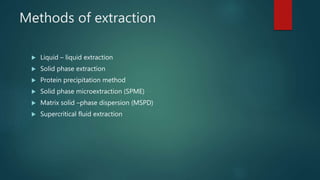
Methods of extraction
 Liquid – liquid extraction
 Solid phase extraction
 Protein precipitation method
 Solid phase microextraction (SPME)
 Matrix solid –phase dispersion (MSPD)
 Supercritical fluid extraction
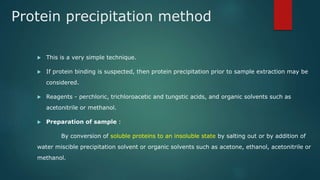
Protein precipitation method
 This is a very simple technique.
 If protein binding is suspected, then protein precipitation prior to sample extraction may be
considered.
 Reagents - perchloric, trichloroacetic and tungstic acids, and organic solvents such as
acetonitrile or methanol.
 Preparation of sample :
By conversion of soluble proteins to an insoluble state by salting out or by addition of
water miscible precipitation solvent or organic solvents such as acetone, ethanol, acetonitrile or
methanol.
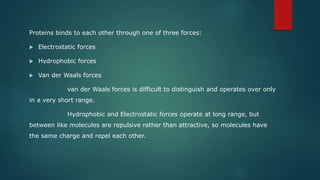
Proteins binds to each other through one of three forces:
 Electrostatic forces
 Hydrophobic forces
 Van der Waals forces
van der Waals forces is difficult to distinguish and operates over only
in a very short range.
Hydrophobic and Electrostatic forces operate at long range, but
between like molecules are repulsive rather than attractive, so molecules have
the same charge and repel each other.
How the proteins convert soluble state to an insoluble state?
 Proteins are made insoluble by altering their surface properties, charge characteristics.
 Changing the solvent characteristics
 The solubility of a protein increases with the addition of salt and reaches a maximum
after which there is a rapid linear decrease in solubility.
 There are several methods to reduce the solubility of proteins, which are ionic
precipitation ex. ammonium sulphate, sodium chloride; metal ions ex. Cu+2, Zn+2.
Types of Protein precipitation
1. SALTING OUT
2. SOLVENT PRECIPITATION
1. SALTING OUT:
 Ammonium sulphate is the salt usually used for salting out, because of its high solubility and high ionic
strength.
 solubility changes with temperature.
 It is cheap.
 The density of even a concentrated solution is less than that of protein.
so that protein can be centrifuged down from concentrated solutions.
 Solvent Precipitation:
When large amounts of a water-miscible solvent such as ethanol or
acetone are added to a protein solution, proteins precipitate out.
 The conventional wisdom is that this is due to decrease of the dielectric constant.
 Performed at low temperature.
 The condition for the protein is at 0°C and the solvent colder, -20°C in an ice-salt bath.
 Proteins tend to denature at higher temperatures.
 Achieve greater purification.
 Solvent precipitation can be done with polyethylene glycol at concentrations between
5 and 15%.
 the sample is centrifuged at high speed for sufficient time.
 the precipitated components of plasma will be settled at the bottom and clear
supernatant liquid will be separated out.
 The obtained supernatant liquid can be injected directly into the HPLC
 evaporated and reconstituted with the mobile phase and further clean up of the
sample can be carried out by using micro centrifuge at very high speed.
Advantages:
 Now protein precipitation plates are available, able to remove the unwanted plasma
proteins from plasma fluid samples prior to analysis
 Protein precipitation plates can be used in a wide range of aqueous and organic
sample preparation including total drug analysis
 Protein precipitation plates are compatible with small volume of solvent
 Protein precipitation plate contains hydrophobic PTFE membrane as a prefilter
removes the unwanted precipitated proteins
 Traditionally in this method plasma is mixed with protein precipitating agent and
diluting solvent then the whole mixture is vertex, mixed, centrifuge and filter
Disadvantages:
 May increase the back pressure of the HPLC system.
 Some components of plasma which are soluble in diluting solvent that bound to stationary
phase permanently that will affect the column performance.
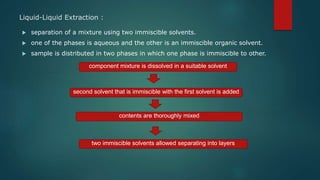
Liquid-Liquid Extraction :
 separation of a mixture using two immiscible solvents.
 one of the phases is aqueous and the other is an immiscible organic solvent.
 sample is distributed in two phases in which one phase is immiscible to other.
component mixture is dissolved in a suitable solvent
second solvent that is immiscible with the first solvent is added
contents are thoroughly mixed
two immiscible solvents allowed separating into layers
 The less dense solvent will be the upper layer, while the more dense
solvent will be the lower layer.
 layers are separated, transferred and the component in that solvent is
isolated.
 extraction hydrophilic compounds - polar aqueous phase
 hydrophobic compounds - organic solvents
 Analyte is extracted into the organic phase are easily recovered by
evaporation of the solvent,
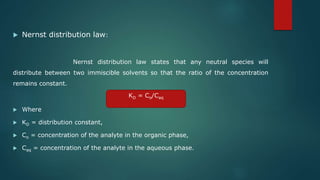
 Nernst distribution law:
Nernst distribution law states that any neutral species will
distribute between two immiscible solvents so that the ratio of the concentration
remains constant.
 Where
 KD = distribution constant,
 Co = concentration of the analyte in the organic phase,
 Caq = concentration of the analyte in the aqueous phase.
KD = Co/Caq
Selection of solvent :
 properties of an ideal solvent is that it should withdraw the active agent from a mixture
Selectivity
Capacity
Miscibility
Difference in density
Recovery
Corrosion
Viscosity
Low price
Chemical and thermal stability
Extraction under acidic and basic conditions :
 A change in the pH of the solvent (the addition of acid or base) can change the
solubility of an organic compound in a solvent considerably.
 Organic bases: Any organic amine can be extracted from an organic solvent with a strong
acid such as 1M hydrochloric acid
 Strong acids: Carboxylic acids can be extracted from an organic solvent with a weak base
such as 1M sodium bicarbonate
 Weak acids: Phenols can be extracted from an organic solvent with a strong base such as
1M sodium hydroxide
 Non-polar compounds stay in the organic layer
Disadvantages:
 Large solvent consumption.
 time consuming process.
 require an evaporation step -remove excess of organic solvent.
 not a suitable -several analytes.
 Emulsion formation may be possible
methods of extraction protein precipitation method.pptx

methods of extraction protein precipitation method.pptx

  • 1.
    Methods of extractionof drugs from the biological matrix Presenting by Dr Anumalagundam Srikanth, Dept. of pharmaceutical analysis.
  • 2.
    Methods of extraction Liquid – liquid extraction  Solid phase extraction  Protein precipitation method  Solid phase microextraction (SPME)  Matrix solid –phase dispersion (MSPD)  Supercritical fluid extraction
  • 3.
    Protein precipitation method This is a very simple technique.  If protein binding is suspected, then protein precipitation prior to sample extraction may be considered.  Reagents - perchloric, trichloroacetic and tungstic acids, and organic solvents such as acetonitrile or methanol.  Preparation of sample : By conversion of soluble proteins to an insoluble state by salting out or by addition of water miscible precipitation solvent or organic solvents such as acetone, ethanol, acetonitrile or methanol.
  • 4.
    Proteins binds toeach other through one of three forces:  Electrostatic forces  Hydrophobic forces  Van der Waals forces van der Waals forces is difficult to distinguish and operates over only in a very short range. Hydrophobic and Electrostatic forces operate at long range, but between like molecules are repulsive rather than attractive, so molecules have the same charge and repel each other.
  • 5.
    How the proteinsconvert soluble state to an insoluble state?  Proteins are made insoluble by altering their surface properties, charge characteristics.  Changing the solvent characteristics  The solubility of a protein increases with the addition of salt and reaches a maximum after which there is a rapid linear decrease in solubility.  There are several methods to reduce the solubility of proteins, which are ionic precipitation ex. ammonium sulphate, sodium chloride; metal ions ex. Cu+2, Zn+2.
  • 6.
    Types of Proteinprecipitation 1. SALTING OUT 2. SOLVENT PRECIPITATION 1. SALTING OUT:  Ammonium sulphate is the salt usually used for salting out, because of its high solubility and high ionic strength.  solubility changes with temperature.  It is cheap.  The density of even a concentrated solution is less than that of protein. so that protein can be centrifuged down from concentrated solutions.
  • 7.
     Solvent Precipitation: Whenlarge amounts of a water-miscible solvent such as ethanol or acetone are added to a protein solution, proteins precipitate out.  The conventional wisdom is that this is due to decrease of the dielectric constant.  Performed at low temperature.  The condition for the protein is at 0°C and the solvent colder, -20°C in an ice-salt bath.  Proteins tend to denature at higher temperatures.  Achieve greater purification.
  • 8.
     Solvent precipitationcan be done with polyethylene glycol at concentrations between 5 and 15%.  the sample is centrifuged at high speed for sufficient time.  the precipitated components of plasma will be settled at the bottom and clear supernatant liquid will be separated out.  The obtained supernatant liquid can be injected directly into the HPLC  evaporated and reconstituted with the mobile phase and further clean up of the sample can be carried out by using micro centrifuge at very high speed.
  • 9.
    Advantages:  Now proteinprecipitation plates are available, able to remove the unwanted plasma proteins from plasma fluid samples prior to analysis  Protein precipitation plates can be used in a wide range of aqueous and organic sample preparation including total drug analysis  Protein precipitation plates are compatible with small volume of solvent  Protein precipitation plate contains hydrophobic PTFE membrane as a prefilter removes the unwanted precipitated proteins  Traditionally in this method plasma is mixed with protein precipitating agent and diluting solvent then the whole mixture is vertex, mixed, centrifuge and filter
  • 10.
    Disadvantages:  May increasethe back pressure of the HPLC system.  Some components of plasma which are soluble in diluting solvent that bound to stationary phase permanently that will affect the column performance.
  • 11.
    Liquid-Liquid Extraction : separation of a mixture using two immiscible solvents.  one of the phases is aqueous and the other is an immiscible organic solvent.  sample is distributed in two phases in which one phase is immiscible to other. component mixture is dissolved in a suitable solvent second solvent that is immiscible with the first solvent is added contents are thoroughly mixed two immiscible solvents allowed separating into layers
  • 12.
     The lessdense solvent will be the upper layer, while the more dense solvent will be the lower layer.  layers are separated, transferred and the component in that solvent is isolated.  extraction hydrophilic compounds - polar aqueous phase  hydrophobic compounds - organic solvents  Analyte is extracted into the organic phase are easily recovered by evaporation of the solvent,
  • 13.
     Nernst distributionlaw: Nernst distribution law states that any neutral species will distribute between two immiscible solvents so that the ratio of the concentration remains constant.  Where  KD = distribution constant,  Co = concentration of the analyte in the organic phase,  Caq = concentration of the analyte in the aqueous phase. KD = Co/Caq
  • 14.
    Selection of solvent:  properties of an ideal solvent is that it should withdraw the active agent from a mixture Selectivity Capacity Miscibility Difference in density Recovery Corrosion Viscosity Low price Chemical and thermal stability
  • 15.
    Extraction under acidicand basic conditions :  A change in the pH of the solvent (the addition of acid or base) can change the solubility of an organic compound in a solvent considerably.  Organic bases: Any organic amine can be extracted from an organic solvent with a strong acid such as 1M hydrochloric acid  Strong acids: Carboxylic acids can be extracted from an organic solvent with a weak base such as 1M sodium bicarbonate  Weak acids: Phenols can be extracted from an organic solvent with a strong base such as 1M sodium hydroxide  Non-polar compounds stay in the organic layer
  • 16.
    Disadvantages:  Large solventconsumption.  time consuming process.  require an evaporation step -remove excess of organic solvent.  not a suitable -several analytes.  Emulsion formation may be possible